
Clean Label Mold Inhibitors Market Size and Share
Market Overview
| Study Period | 2021 - 2031 |
|---|---|
| Market Size (2026) | USD 1.60 Billion |
| Market Size (2031) | USD 2.31 Billion |
| Growth Rate (2026 - 2031) | 7.62 % |
| Fastest Growing Market | Asia-Pacific |
| Largest Market | North America |
| Market Concentration | Medium |
Major Players *Disclaimer: Major Players sorted in no particular order Image © Mordor Intelligence. Reuse requires attribution under CC BY 4.0. | |
Clean Label Mold Inhibitors Market Analysis by Mordor Intelligence
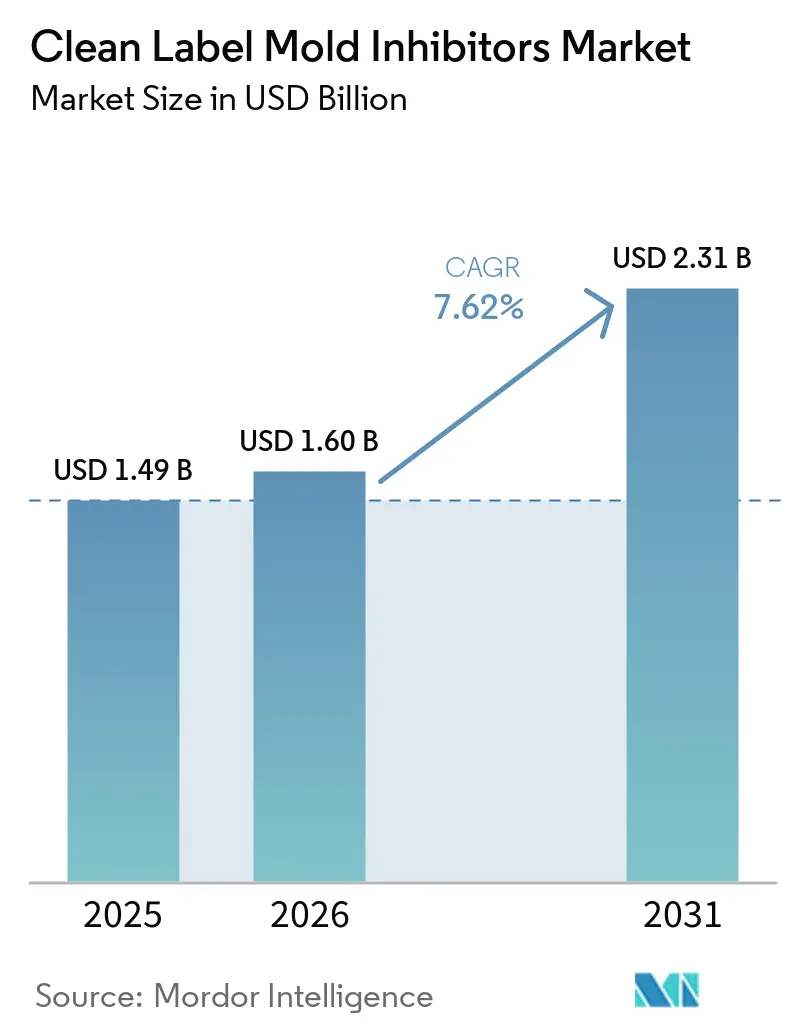
The clean label mold ingredients market size is projected to be USD 1.49 billion in 2025, USD 1.60 billion in 2026, and reach USD 2.31 billion by 2031, growing at a CAGR of 7.62% from 2026 to 2031. The clean label mold ingredients market is gaining momentum as food manufacturers increasingly replace conventional synthetic preservatives with consumer-friendly alternatives such as vinegar, fermented flour, and organic-acid-based systems. Retailer and private-label reformulation requirements are further accelerating adoption, often requiring suppliers across an entire program to align formulations within a defined timeframe. While bakery remains the core application segment, growing use in beverages and ready-to-eat foods is expanding demand for natural antimicrobial solutions. Suppliers are strengthening their offerings through fermentation technologies, predictive shelf-life testing, and technical application support to help manufacturers achieve effective mold control without conventional additives. However, higher ingredient costs and inconsistent performance in high-moisture or near-neutral-pH applications continue to create formulation challenges, reinforcing the importance of technical expertise and customized solutions.
Key Report Takeaways
- By ingredient type, vinegar-based products held 38.41% of sales in 2025, while fermented flour is forecast to grow at an 8.02% CAGR through 2031.
- By form, powder held 58.62% of sales in 2025, while liquid form is forecast to grow at an 8.44% CAGR through 2031.
- By application, bakery and confectionery accounted for 55.73% of the clean label mold ingredients market size in 2025, while beverages are forecast to grow at a 9.27% CAGR through 2031.
- By geography, North America held 36.20% of sales in 2025, while South America is forecast to grow at an 8.46% CAGR through 2031.
Note: Market size and forecast figures in this report are generated using Mordor Intelligence’s proprietary estimation framework, updated with the latest available data and insights as of January 2026.
Market Trends and Insights
Drivers Impact Analysis of Clean Label Mold Inhibitors Market*
| Driver | (~) % Impact on CAGR Forecast | Geographic Relevance | Impact Timeline |
|---|---|---|---|
| Rising demand for clean-label food ingredients | +2.2% | Global | Medium term (2-4 years) |
| Shift from synthetic to natural preservatives | +1.8% | North America and Europe | Medium term (2-4 years) |
| Increasing demand for extended shelf life | +1% | Global | Short term (≤ 2 years) |
| Growing packaged bakery product consumption | +1% | Asia-Pacific and South America | Medium term (2-4 years) |
| Expansion of fermentation-based preservation technologies | +0.7% | Global | Long term (≥ 4 years) |
| Rising focus on food waste reduction | +0.4% | North America and Europe | Medium term (2-4 years) |
| Source: Mordor Intelligence | |||
Rising Demand for Clean-Label Food Ingredients
Retailer-led clean label mandates are accelerating the adoption of mold control ingredients, particularly across private-label bakery programs. Reformulation requirements to eliminate synthetic preservatives create coordinated demand across suppliers, driving large-scale changes within defined procurement and contract cycles. In North America and Europe, ingredient transparency is increasingly becoming a core sourcing and product-development criterion for brand owners. As a result, clean label mold inhibitors are transitioning from a premium-value formulation option to a mainstream requirement across industrial bread, tortillas, and packaged snack applications. The trend is further supported by food-waste reduction initiatives, as effective natural mold control helps extend product shelf life and reduce losses across distribution and retail channels.
Shift from Synthetic to Natural Preservatives
The clean label mold ingredients market is supported by an evolving regulatory and labeling environment that increases the visibility and scrutiny of synthetic food additives. EU Regulation 1169/2011 requires food information to be presented clearly, while the European Food Safety Authority (EFSA) continues to review permitted food additives [1]. In August 2026, the U.S. Department of Health and Human Services (HHS) proposed mandatory notification requirements for substances used in food under self-affirmed Generally Recognized as Safe (GRAS) conclusions [2]. Within this environment, buffered vinegar and cultured wheat systems offer established documentation that can support manufacturers in assessing regulatory compliance and commercialization pathways. The proposed U.S. requirements could strengthen the competitive position of ingredients supported by comprehensive safety dossiers, while newer cultured extracts may require additional notification and regulatory validation before market entry. Consequently, regulatory readiness and compliance documentation are becoming increasingly important product-selection criteria, integrating regulatory considerations directly into formulation and procurement decisions.
Expansion of Fermentation-Based Preservation Technologies
Fermentation is expanding the technical capabilities of the clean label mold ingredients market by enabling cultured systems to deliver multiple naturally derived antifungal compounds. A 2025 review reported that lactic acid bacteria can produce organic acids, cyclic dipeptides, and phenylpropanoid compounds with activity against fungal spoilage organisms and mycotoxins in food systems. This multi-compound functionality supports broader application development across bread, fresh pasta, soft tortillas, and ready-to-eat foods. Fermentation-based platforms also enable suppliers to develop multi-strain fermentates designed to address spoilage risks associated with fungi such as Aspergillus, Penicillium, and Fusarium. BioVeritas applies fermentation to convert surplus food biomass into cultured extracts, linking preservative development with improved raw-material utilization. This approach can help specialist suppliers optimize feedstock costs, enhance formulation functionality, and differentiate their clean-label preservation portfolios.
Growing Packaged Bakery Product Consumption
Urbanization and the expansion of multi-city distribution networks across Asia-Pacific and South America are increasing demand for packaged bakery products with longer shelf stability. Products distributed across wider geographic markets may require an additional 3–5 days of shelf life before reaching consumers, making effective mold control an operational requirement rather than solely a clean label or product-positioning consideration. Kerry identified preservation and food protection as priority growth areas in its 2025 results, alongside continued expansion of its UpGrade fermentate and IsoAge vinegar portfolio. The broader shift toward biological solutions also supports this market opportunity. Together, these developments strengthen the commercial outlook for clean label mold ingredients, as food manufacturers increasingly require technically proven, natural preservation solutions capable of supporting extended shelf life across complex distribution networks.
Restraints Impact Analysis of Clean Label Mold Inhibitors Market*
| Restraint | (~) % Impact on CAGR Forecast | Geographic Relevance | Impact Timeline |
|---|---|---|---|
| Higher cost versus conventional preservatives | -1.5% | Asia-Pacific, South America, and Middle East and Africa | Medium term (2-4 years) |
| Variable efficacy across food applications | -0.8% | Global | Short term (≤ 2 years) |
| Potential sensory impacts at higher dosages | -0.6% | Global | Short term (≤ 2 years) |
| Complex formulation and regulatory requirements | -0.7% | Global, with early pressure in Europe and North America | Long term (≥ 4 years) |
| Source: Mordor Intelligence | |||
Higher Cost Versus Conventional Preservatives
Clean label mold inhibitors typically carry a 1.5–3.0x cost-in-use premium compared with conventional preservatives such as calcium propionate and potassium sorbate, creating a significant adoption barrier, particularly in price-sensitive markets. In addition, agricultural commodity volatility affecting inputs such as cultured wheat and cultured dextrose can increase procurement uncertainty relative to more standardized petrochemical-derived alternatives. To address this cost challenge, AB Mauri introduced BakeGard Ultra CL, a dried vinegar and cultured wheat flour blend positioned as a more cost-effective clean label preservation solution for bakeries. Such hybrid systems can improve market accessibility and support wider adoption, although competitive pricing may place additional pressure on supplier margins. Furthermore, sensory impact at higher inclusion levels remains a key formulation constraint, requiring manufacturers to optimize the balance between flavor, acidity, dosage levels, and mold inhibition performance.
Variable Efficacy Across Food Applications
Fermentation-based mold inhibitors generally demonstrate the most consistent performance under the pH and water activity conditions typical of industrial bread products. However, their efficacy can decline in high-moisture applications and formulations above pH 6.5, including cream fillings, dairy-adjacent bakery products, and certain ready-to-eat foods. As a result, applications such as dairy alternatives, neutral-pH beverages, pharmaceutical excipients, and multi-component meals may require natural mold inhibitors to be combined with additional preservation technologies, including acidulants and modified-atmosphere packaging. These multi-hurdle approaches increase formulation complexity, product validation requirements, development timelines, and overall operating costs. Consequently, the clean label mold ingredients market remains application-dependent, with natural preservation systems requiring customized formulation rather than serving as universal drop-in replacements for conventional preservatives.
*Our forecasts treat driver/restraint impacts as directional, not additive. The impact forecasts reflect baseline growth, mix effects, and variable interactions.
Clean Label Mold Inhibitors Market Segment Analysis
By Ingredient Type:
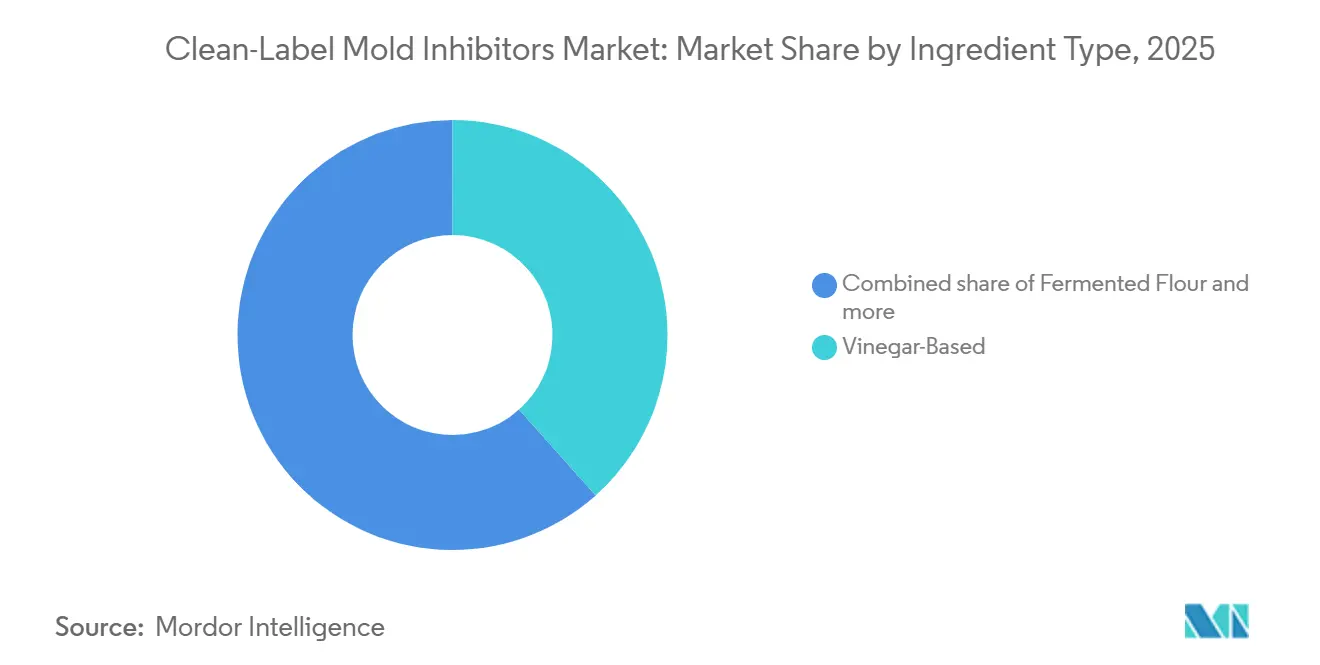
Vinegar-Based Products Lead, Fermented Flour ExpandsVinegar-based products accounted for 38.40% of the clean-label mold ingredients market in 2025, supported by regulatory familiarity and established use across industrial bread and tortilla production. Buffered vinegar systems can be integrated into high-speed mixing processes without significant modifications to existing bakery equipment, while availability in both dry and liquid formats provides flexibility across production lines. Fermented flour is projected to grow at an 8.02% CAGR through 2031, making it the fastest-growing ingredient type in the clean-label mold ingredients market. Research on sourdough-type fermentates found that selected cultures inhibited Aspergillus niger and Penicillium commune in bread for 10 days at a 0.5% inclusion rate. Corbion and Lallemand Baking offer cultured wheat solutions for commercial bakery applications, while Kemin markets SHIELD Pure as a concentrated fermentate for bread and tortilla producers. Starch-based systems provide an alternative for cakes, muffins, and tortillas, particularly where gluten-free positioning is required.
By Form:
Powder Remains the Standard, Liquid Broadens Use CasesPowder-based products accounted for 58.61% of the clean-label mold ingredients market in 2025, supported by their compatibility with established dry-ingredient handling systems in large-scale bakery operations. These formats enable controlled weighing and low-dose addition while offering ambient storage stability, reducing reliance on cold-chain infrastructure. This provides suppliers with greater flexibility to serve smaller bakeries and emerging markets where refrigerated storage may be limited. Dry vinegar and cultured flour blends also enable manufacturers to implement clean label preservation without investing in dedicated liquid dosing equipment, reinforcing powder as the preferred format for cost-sensitive industrial bakery applications.
Liquid products are projected to grow at an 8.44% CAGR through 2031, driven by increasing demand from beverage, dairy-adjacent, and ready-to-eat food manufacturers requiring consistent dispersion at low inclusion levels. A 2025 Scientific Reports study found that Lactobacillus plantarum-based fermentations could suppress Aspergillus species and AFB2 mycotoxin biosynthesis in a high-protein functional beverage [3]. This supports the applicability of liquid fermentation-based preservation systems in health-oriented beverage formulations. Consequently, liquid systems are expanding the clean label mold ingredients market beyond traditional dry bakery applications, particularly where rapid dissolution, uniform dispersion, and low-dose application are critical.
By Application:
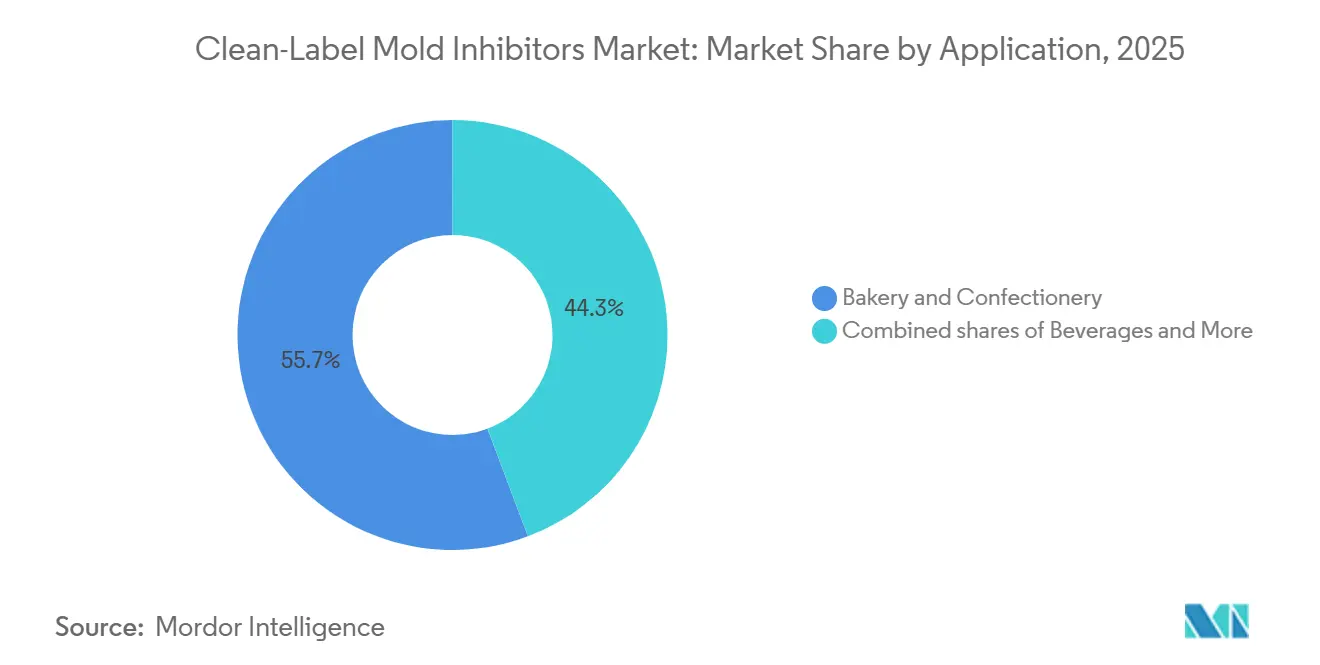
Bakery and Confectionery Provides the Base, Beverages Grows FastestBakery and confectionery accounted for 55.71% of the clean label mold ingredients market in 2025, reflecting the high mold exposure of products such as bread, tortillas, and sweet baked goods across extended retail distribution. These applications also benefit from established use of cultured wheat and vinegar-based preservation systems. Corbion strengthened its technical offering with the April 2025 launch of Verdad Essence WH100, supported by its Natural Mold Inhibition Model, which evaluates preservation solutions against 11 mold types and helps bakers estimate mold-free shelf life before full-scale. Such application-level validation is increasing the technical support expectations for commercial bakery ingredient suppliers.
Beverages are projected to grow at a 9.27% CAGR through 2031, making them the fastest-growing application segment in the clean label mold ingredients market. Functional beverages, kombucha, nonalcoholic fermented drinks, and lower-alcohol ready-to-drink products require effective control of mold and spoilage yeast, supporting demand for pH-flexible liquid systems and broad-spectrum fermentation-based solutions. Dairy and dairy alternatives, ready-to-cook foods, and ready-to-eat products provide additional growth opportunities, particularly where multiple preservation technologies are required. Animal feed, pharmaceuticals, and personal care represent smaller but emerging application areas for naturally derived preservation technologies.
Geography Analysis
North America Clean Label Mold Inhibitors Market
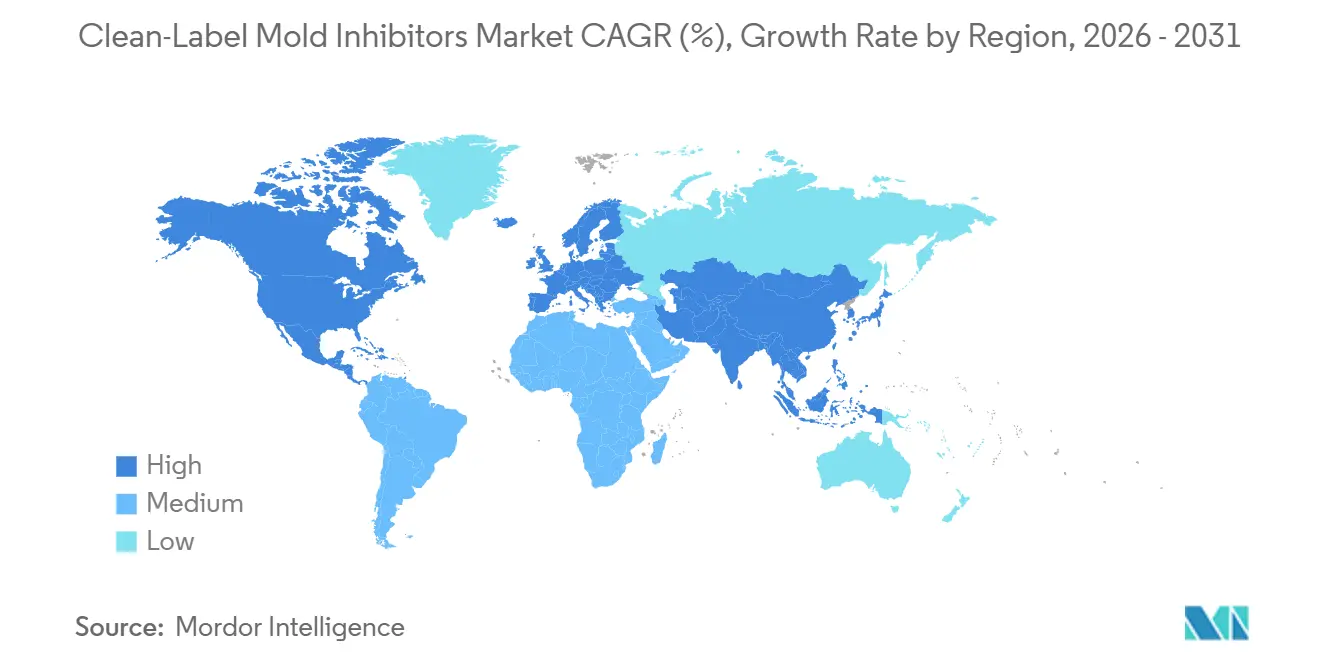
North America accounted for 36.20% of the clean-label mold ingredients market in 2025, making it the most established regional market for cultured wheat and vinegar-based mold inhibitors. Large-scale bread and tortilla manufacturers have incorporated these solutions into commercial production systems for several years. Established natural preservation systems may benefit from greater manufacturer familiarity with their food-use documentation and regulatory positioning. Retailer-driven ingredient standards further strengthen demand for recognizable preservation solutions, while Canada introduces additional compliance considerations through modernization of its Food and Drug Regulations.
Europe Clean Label Mold Inhibitors Market
Europe represents the second-largest regional market, supported by mature industrial bakery industries and continued emphasis on food additive transparency. Germany, the United Kingdom, and France remain key national markets, supported by established bakery reformulation programs. Suppliers operating across these markets must simultaneously address sensory performance, shelf-life requirements, and clean ingredient declarations, supporting demand for cultured flour, vinegar, and organic-acid-based preservation systems compatible with existing production processes.
South America, APAC and MEA Clean Label Mold Inhibitors Market
South America is projected to expand at an 8.46% CAGR through 2031, driven primarily by demand growth in Brazil and Argentina. Packaged bakery expansion, urbanization, and increasing consumer attention to ingredient labels are strengthening demand for reliable ambient shelf-life solutions across broader distribution networks. Brazil's biological inputs sector also recorded significant activity in 2025, supporting wider acceptance of biological and naturally derived solutions. Asia-Pacific presents a similar growth opportunity as urbanization and changing purchasing patterns increase demand for shelf-stable packaged bakery products. Middle East and Africa remains an emerging market, with future demand supported by expanding bakery chains, international retail formats, and adoption of halal-compatible, fermentation-derived preservation ingredients.
Competitive Landscape
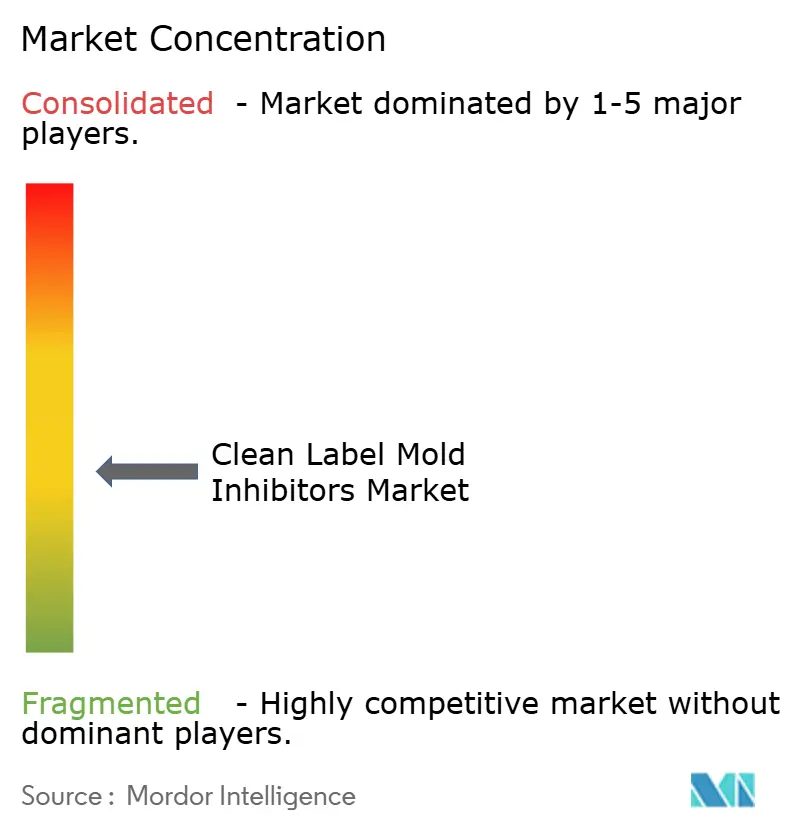
The clean label mold ingredients market has a moderately structured competitive landscape, with major players including Corbion, Kerry Group, Kemin Industries, DSM-Firmenich, and Lallemand. Competition is shifting beyond ingredient functionality toward fermentation capabilities, application expertise, technical service, and formulation optimization. Established suppliers benefit from broad customer relationships, manufacturing scale, and established bakery portfolios, while specialized companies compete through targeted solutions, faster innovation, and application-specific performance. The market remains differentiated by suppliers' ability to deliver consistent mold control, clean label positioning, regulatory support, and cost efficiency across diverse food matrices.
Competitive development is increasingly focused on expanding beyond traditional bakery applications into beverages, dairy alternatives, ready-to-eat foods, and other challenging formulations. Suppliers are investing in technologies that improve performance across varying pH, water activity, moisture levels, and shelf-life requirements, creating opportunities for solutions that can address applications where conventional clean label systems have limitations. This expansion is also increasing the importance of customized formulation support, validation testing, and technical collaboration between ingredient suppliers and food manufacturers.
The competitive landscape is also being shaped by portfolio expansion, strategic acquisitions, and biotechnology investments. Recent industry transactions and capacity additions indicate continued investment in specialized food ingredient platforms, fermentation technologies, and downstream application capabilities. These developments can strengthen suppliers' manufacturing scale, geographic coverage, innovation pipelines, and customer access. Overall, competitive intensity remains driven by the ability to combine ingredient performance with technical expertise, commercial scalability, regulatory readiness, and application breadth, rather than competing solely on product availability.
Clean Label Mold Inhibitors Industry Leaders
-
Kerry Group Plc
-
Corbion N.V.
-
International Flavors & Fragrances Inc.
-
Kemin Industries, Inc.
-
Puratos Group
- *Disclaimer: Major Players sorted in no particular order
Clean Label Mold Inhibitors Market Companies Covered in this Report
- Corbion N.V.
- Kemin Industries
- Kerry Group
- Puratos
- DSM-Firmenich
- Cain Food Industries
- Sunson Biotechnology
- BioVeritas
- Associated British Foods plc
- BDF Natural Ingredients
- Lallemand LLC
- International Flavors & Fragrance, Inc.
- Lesaffre Corporation
- Cargill, Incorporated
- Tate & Lyle PLC
- Galactic SA
- J&K Ingredients Inc.
- Ribus, Inc.
- Sacco System
- BASF SE
Recent Industry Developments in Clean Label Mold Inhibitors Market
- March 2026: Puratos entered into a definitive agreement to acquire Dawn Foods, combining Puratos' fermentation and R&D-led ingredient technology with Dawn Foods' bakery application expertise, manufacturing scale, and distribution network.
- September 2025: Corbion launched Verdad Essence WH100, a cultured wheat-based clean label mold inhibitor for bread, buns, tortillas, and flatbreads, designed to provide mold protection without compromising taste, texture, or shelf life.
- December 2024: Kemin Industries launched Shield V, a clean label mold inhibitor combining buffered vinegar with a botanical extract containing sorbic acid. The solution targets bread, tortillas, and cakes, offering a clean label alternative to potassium sorbate while also extending mold-free shelf life.
Global Clean Label Mold Inhibitors Market Report Scope
The clean label mold ingredients market comprises naturally derived and fermentation-based solutions that control mold growth, enhance shelf life, and enable manufacturers to maintain simple, recognizable ingredient labels. The market can be segmented by ingredient type into fermented flour, vinegar-based, starch-based, organic-acid-based, and other ingredients; by form into powder and liquid; by application into food and beverages, animal feed, pharmaceuticals, personal care and cosmetics; and by geography into North America, Europe, Asia-Pacific, South America, and the Middle East & Africa. The market size will be assessed in both value terms (USD) and volume terms (tons) across these segments.
Segmentation Overview
| Fermented Flour |
| Vinegar-Based |
| Starch-Based |
| Organic-Acid Based |
| Others |
| Powder |
| Liquid |
| Food and Beverages | Bakery and Confectionery |
| Dairy and Dairy Alternatives | |
| Beverages | |
| Ready-To-Cook/Ready-To-Eat Foods | |
| Others | |
| Animal Feed | |
| Pharmaceuticals | |
| Personal Care and Cosmetics |
| North America | United States |
| Canada | |
| Mexico | |
| Rest of North America | |
| Europe | Germany |
| United Kingdom | |
| France | |
| Spain | |
| Italy | |
| Netherlands | |
| Rest of Europe | |
| Asia-Pacific | China |
| India | |
| Japan | |
| Australia | |
| Rest of Asia-Pacific | |
| South America | Brazil |
| Argentina | |
| Rest of South America | |
| Middle East and Africa | United Arab Emirates |
| South Africa | |
| Saudi Arabia | |
| Rest of Middle East and Africa |
| By Ingredient Type | Fermented Flour | |
| Vinegar-Based | ||
| Starch-Based | ||
| Organic-Acid Based | ||
| Others | ||
| By Form | Powder | |
| Liquid | ||
| By Application | Food and Beverages | Bakery and Confectionery |
| Dairy and Dairy Alternatives | ||
| Beverages | ||
| Ready-To-Cook/Ready-To-Eat Foods | ||
| Others | ||
| Animal Feed | ||
| Pharmaceuticals | ||
| Personal Care and Cosmetics | ||
| By Geography | North America | United States |
| Canada | ||
| Mexico | ||
| Rest of North America | ||
| Europe | Germany | |
| United Kingdom | ||
| France | ||
| Spain | ||
| Italy | ||
| Netherlands | ||
| Rest of Europe | ||
| Asia-Pacific | China | |
| India | ||
| Japan | ||
| Australia | ||
| Rest of Asia-Pacific | ||
| South America | Brazil | |
| Argentina | ||
| Rest of South America | ||
| Middle East and Africa | United Arab Emirates | |
| South Africa | ||
| Saudi Arabia | ||
| Rest of Middle East and Africa | ||
Key Questions Answered in the Report
What is driving demand for clean label mold ingredients?
Retailer reformulation requirements, recognizable ingredient labels, and the need for longer shelf life in packaged foods are driving demand
Which ingredient type leads sales?
Vinegar-based products held 38.40% in 2025, supported by broad bakery use and established regulatory familiarity.
Which application has the largest share?
Bakery and confectionery held 55.71% in 2025 because bread, tortillas, and sweet baked goods need dependable mold control.
Which application is growing fastest?
Beverages is projected to expand at a 9.27% CAGR through 2031 as functional and fermented drink formats require clean label preservation.