
Clay Market Size and Share
Market Overview
| Study Period | 2021 - 2031 |
|---|---|
| Market Size (2026) | USD 18.25 Billion |
| Market Size (2031) | USD 24.33 Billion |
| Growth Rate (2026 - 2031) | 5.92 % |
| Fastest Growing Market | Asia-Pacific |
| Largest Market | Asia-Pacific |
| Market Concentration | Low |
Major Players *Disclaimer: Major Players sorted in no particular order Image © Mordor Intelligence. Reuse requires attribution under CC BY 4.0. | |
Clay Market Analysis by Mordor Intelligence
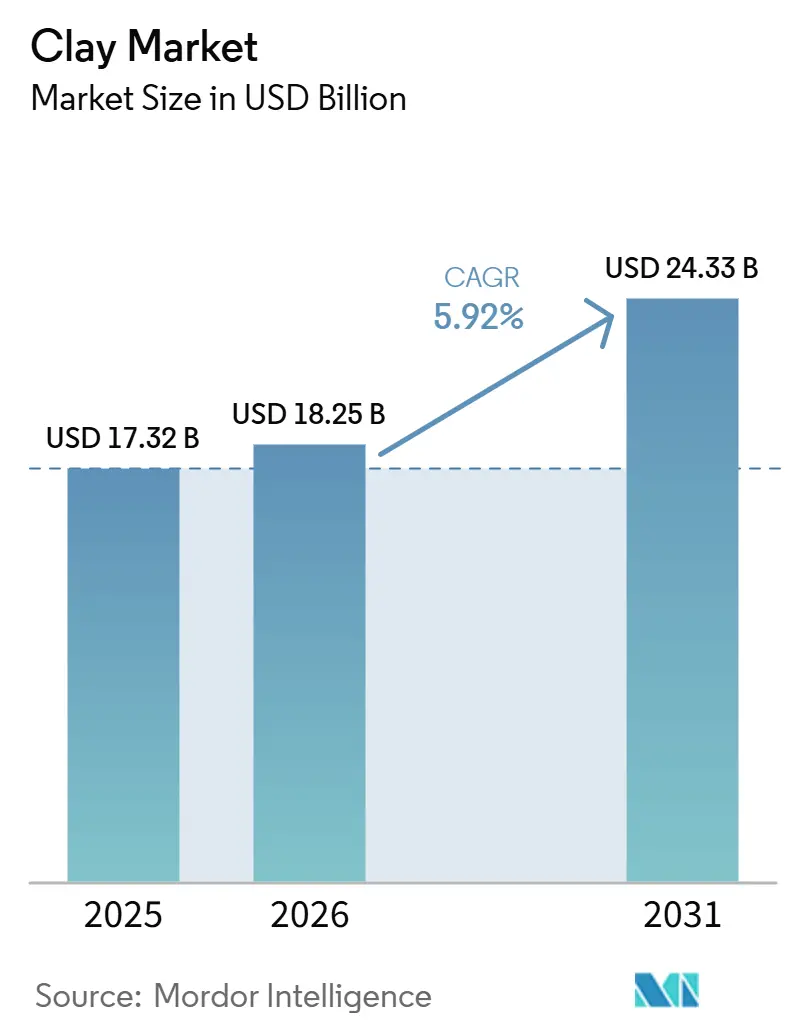
The clay market size was estimated at USD 17.32 billion in 2025 and is estimated to grow from USD 18.25 billion in 2026 to USD 24.33 billion by 2031, at a CAGR of 5.92% during the forecast period (2026-2031). The clay market serves construction, ceramics, industrial processing, and environmental remediation, generating demand across multiple end-use sectors. Urban construction in emerging economies, lower-carbon cement formulations, and oilfield services are supporting market growth during the forecast period. Producers are placing greater emphasis on beneficiated, calcined, and application-specific grades, as processing quality affects realized value. The average unit value of kaolin in the United States rose to USD 170 per metric ton in 2025, reflecting the importance of higher-value grades. The clay market also faces challenges from rehabilitation requirements, substitution by alternative fillers, and energy exposure in calcination-heavy product lines.
Key Report Takeaways
- By form, powder held 44.57% revenue share in 2025, while slurry is forecast to grow at a 6.18% CAGR through 2031.
- By clay type, kaolin held 31.81% revenue share in 2025, while bentonite is forecast to grow at a 6.92% CAGR through 2031.
- By application, construction materials held 28.96% revenue share in 2025, while water treatment and environmental applications are forecast to grow at a 7.66% CAGR through 2031.
- By geography, Asia-Pacific held 46.87% of the clay market share in 2025 and is forecast to grow at a 6.43% CAGR through 2031.
Note: Market size and forecast figures in this report are generated using Mordor Intelligence’s proprietary estimation framework, updated with the latest available data and insights as of January 2026.
Market Trends and Insights
Drivers Impact Analysis of Clay Market*
| Drivers | (~) % Impact on CAGR Forecast | Geographic Relevance | Impact Timeline |
|---|---|---|---|
| Ceramics, Sanitaryware, and Construction Demand | +1.5% | Global, with Asia-Pacific and the Middle-East as core markets | Medium term (2-4 years) |
| Paper Packaging, Coatings, and Functional Fillers | +0.9% | APAC, North America, and Europe | Medium term (2-4 years) |
| Bentonite in Drilling, Foundry, and Civil Engineering | +1.2% | North America, the Middle-East, and APAC | Short term (≤ 2 years) |
| AI-Enabled Process Control | +0.4% | Global, with early gains in North America and China | Long term (≥ 4 years) |
| Beneficiation and Mine Waste Recovery | +0.3% | North America, Europe, and Australia | Long term (≥ 4 years) |
| Source: Mordor Intelligence | |||
Expansion of Ceramic, Sanitaryware, and Construction Demand
Construction remains a major demand base for the clay market, as clay is used in bricks, tiles, sanitaryware, and related building materials across housing, commercial projects, and renovation work. Kaolin and ball clay provide the forming plasticity and post-firing whiteness required in sanitaryware, making housing completions and renovation spending in middle-income economies relevant to demand. Calcined clay represents a separate construction application, as it can be used in lower-carbon cement formulations rather than only in fired ceramic products. The Limestone Calcined Clay Cement (LC3) approach can reduce cement-related carbon dioxide emissions by up to 40% when 50% of clinker is replaced by calcined clay and limestone. LC3 is calcined at around 800°C, compared to around 1,450°C for clinker, and this lower temperature supports its relevance to cement decarbonization. The Global Cement and Concrete Association identifies calcined clays as an established route as the availability of fly ash and ground granulated blast-furnace slag declines. Molins had delivered more than 122,000 m³ of LC3 concrete and mortar in Spain by July 2025.
Increasing Use of Clay in Paper Packaging, Coatings, and Functional Fillers
Digitalization has reduced demand for graphical printing grades, but packaging demand has supported kaolin consumption in paper applications and retained an important role for the clay market. Coated packaging boards, labels, and specialty papers use kaolin because brightness, opacity, ink holdout, and surface appearance affect the finished product. E-commerce supports demand for coated packaging and partly offsets the decline in graphics-focused paper demand. Calcined kaolin commands greater value because processing improves its whiteness and rheological properties, while automotive plastics require surface-engineered fillers that meet tighter performance requirements. Imerys launched kaolin products for sustainable packaging and paper coatings in August 2025, reflecting the value placed on processed grades over undifferentiated filler material.
Rising Consumption of Bentonite in Drilling Fluids, Foundry Applications, and Civil Engineering
Bentonite serves drilling, foundry, and civil engineering applications, each with different investment cycles, giving the market a broad demand base rather than dependence on a single end use. Drilling fluids rely on the mineral for viscosity control, borehole stabilization, and filtration loss prevention. These functions make replacement difficult in many oil and gas well conditions, particularly where fluid performance affects drilling continuity. Foundries use bentonite as a sand binder where thermal stability and dimensional precision are required in metal casting. Civil engineering applications include diaphragm walls, slurry trench barriers, and cut-off walls, with global consumption in these uses reaching 1.2 million metric tons in 2024. Clariant introduced bentonite-based additives for slurry walls and groundwater barriers in September 2025, reflecting the role of specialized formulations in environmental and infrastructure applications.
Increasing Focus on Mineral Beneficiation and Mine Waste Recovery to Enhance Resource Utilization
Beneficiation is important when deposit quality varies and producers need a higher usable yield from feedstock, particularly for applications that require high mineral purity and consistent specifications. The clay market can obtain greater value from existing material by improving the quality of mineral fractions through separation and processing. A 2025 study described an acid-free short-flow process for high-quality separation of kaolinite from coal waste rock. This supports the recovery of secondary material streams and can reduce dependence on newly extracted material where suitable waste resources are available. The United States Department of the Interior launched an effort in 2025 to recover critical minerals from mine waste, underscoring the policy focus on recovery practices[1]. The commercial value of beneficiation and recovery remains dependent on deposit characteristics, processing costs, and the quality requirements of the final application.
Restraints Impact Analysis of Clay Market*
| Restraints | (~) % Impact on CAGR Forecast | Geographic Relevance | Impact Timeline |
|---|---|---|---|
| Mining, Rehabilitation, and Water Regulations | -0.5% | Global, with the European Union and Asia-Pacific as key jurisdictions | Medium term (2-4 years) |
| Alternative Fillers and Synthetic Materials | -0.6% | Global | Medium term (2-4 years) |
| High-Quality Deposit Availability and Specifications | -0.3% | Global | Long term (≥ 4 years) |
| Source: Mordor Intelligence | |||
Stringent Environmental Regulations Governing Mining, Land Rehabilitation, and Water Usage
Mine rehabilitation requirements raise the capital and technical demands of extraction, and these obligations can compress margins for producers that do not plan for closure costs early. In Australia, mining lease holders must begin rehabilitation as soon as reasonably practicable after disturbance and deliver the intended final land use for the mining area. In Florida, fuller's earth operators require notices of intent to mine, approved reclamation plans, and stormwater permits before and during operations. Compliance costs can pressure existing producers and delay new capacity, while ISO 14001 systems and national rehabilitation laws remain important operating considerations. Smaller regional producers face greater risk where they lack environmental management infrastructure, leaving the clay market to balance production continuity with land, water, and rehabilitation obligations.
Competition from Alternative Materials such as Calcium Carbonate, Talc, Silica, and Synthetic Functional Fillers
Ground calcium carbonate competes with kaolin in paper filling and coating because its lower processing cost is attractive when brightness and opacity requirements are less demanding. The United States Geological Survey (USGS) identifies calcium carbonate, diatomite, polymers, silica gel, and zeolites as substitutes for clay in filler, extender, and absorbent applications[2]. The risk is highest in cost-sensitive applications where customer specifications do not require clay-specific optical, rheological, or absorption performance. Synthetic fillers can provide engineered particle size distributions and surface chemistries that meet particular high-value application requirements without the same supply-geography constraints. Precipitated calcium carbonate has displaced some kaolin in cost-sensitive newsprint and standard offset grades, adding pressure in established paper uses. Producers can limit exposure by supplying specialty and calcined grades with clear application-specific performance and by providing technical support that helps customers maintain product quality.
*Our forecasts treat driver/restraint impacts as directional, not additive. The impact forecasts reflect baseline growth, mix effects, and variable interactions.
Clay Market Segment Analysis
By Form:
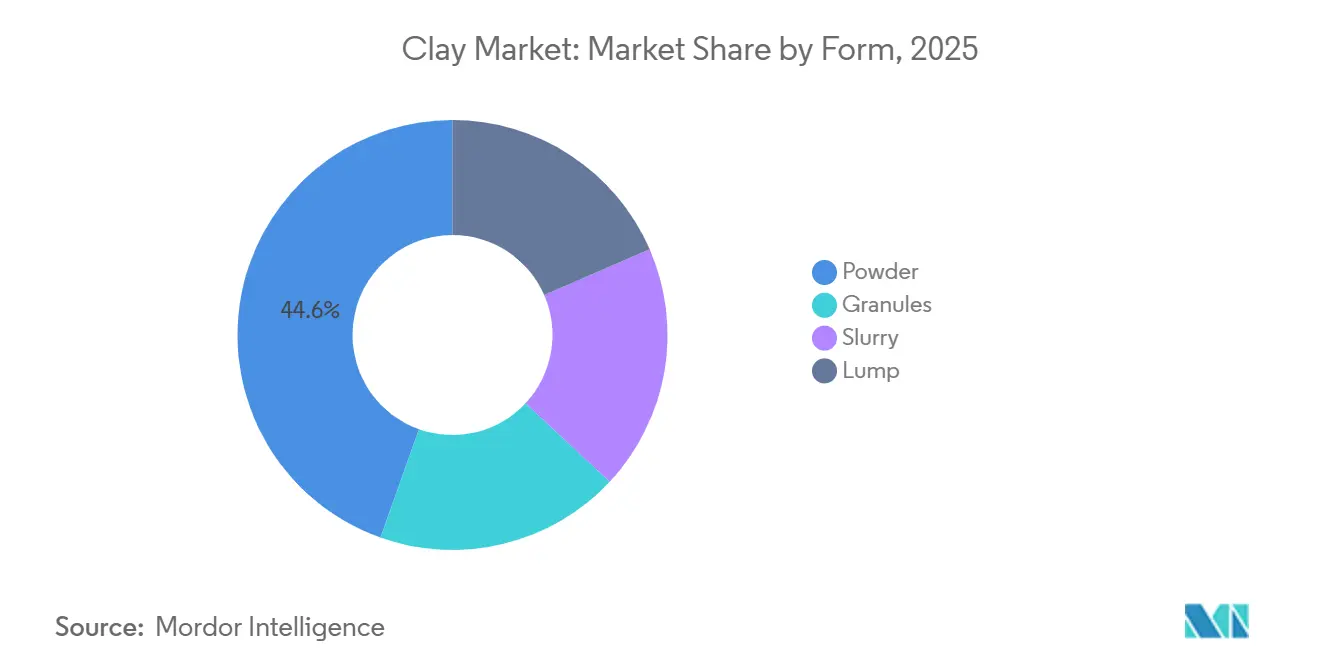
Powder Leadership Tested by Liquid Processing AdoptionPowder held 44.57% of the clay market share in 2025 and remained the leading form due to ease of handling across ceramics, paints, and construction materials. Dry mixing is standard in many ceramics-focused markets in Asia, supporting demand for powder in the preparation of tile and sanitaryware bodies. Granules held a smaller share but serve agriculture and controlled-release applications, where dust control and flow characteristics support their use.
Lump clay is the least processed form and is commonly used in lower-value applications, such as common brick and lightweight aggregate, where transportation costs and local availability often guide purchasing decisions. Slurry is projected to expand at a 6.18% CAGR through 2031, making it the fastest-growing form. Demand for slurry is supported by paper and coatings producers that prefer pre-dispersed, high-solids inputs. Slurry preparation helps control particle size distribution and surface chemistry before shipment. This format requires preparation and pumping infrastructure, which can favor integrated mineral processors.

By Clay Type:
Kaolin Leads While Bentonite Redefines Its RoleKaolin accounted for 31.81% of market revenue in 2025, driven by its use in paper coating, ceramics, paints, rubber, pharmaceutical excipients, and cosmetic fillers. The United States Geological Survey (USGS) reported world kaolin mine production of 50,000 metric tons in 2025, with China, Iran, and Uzbekistan among the leading producing countries. Ball clay, fire clay, and illite serve largely captive markets in ceramics and refractories, providing output stability but with limited growth opportunities.
Common clay has the greatest raw tonnage but carries the lowest unit value at USD 21 per ton in 2025, and its demand generally follows regional construction activity. Bentonite is projected to grow at a 6.92% CAGR through 2031, driven by drilling fluids and environmental sealing applications. United States fuller's earth production remained at 2,400 thousand metric tons in 2025, reflecting established demand in pet litter and industrial absorbents. A 2025 study found that sodium carbonate-modified Egyptian calcium bentonite removed lead, copper, and nickel from wastewater, supporting bentonite's role in compliance-driven water treatment applications.
By Application:
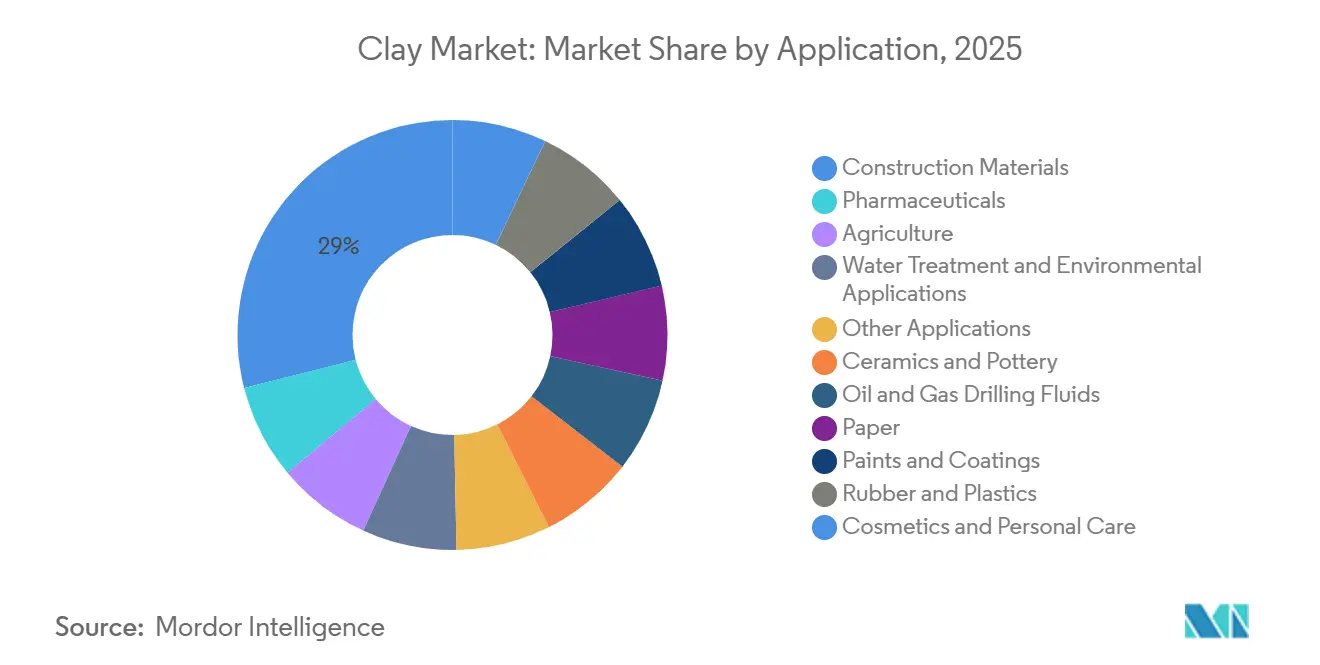
Construction Anchors Demand While Water Treatment Generates ReturnsConstruction materials accounted for 28.96% of market revenue in 2025, as clay is used in bricks, roofing tiles, sanitaryware, and calcined clay cement blends, providing output across several product categories. Research published in 2026 showed that cationic latex adsorption can increase metakaolin content in blended cements, improve workability, and reduce concrete carbon intensity. Ceramics and pottery were the second-largest application, with tile production in Vietnam, Indonesia, and India supporting demand, while mature European markets remained less dynamic.
Pharmaceuticals and agriculture are smaller, higher-value applications with strict requirements for particle size, purity, and safety. Water treatment and environmental applications are projected to grow at a 7.66% CAGR through 2031, supported by discharge regulations and the cost position of clay-based adsorbents. A 2026 review reported that functionalized and hybrid clay composites outperform unmodified clays in contaminant removal due to higher active-site density and multifunctional sorption. United States bentonite exports reached 640 thousand metric tons in 2025, indicating sustained international demand. Cosmetics and personal care offer higher revenue per ton, as purity and consistency requirements limit substitution.
Geography Analysis
APAC Clay Market
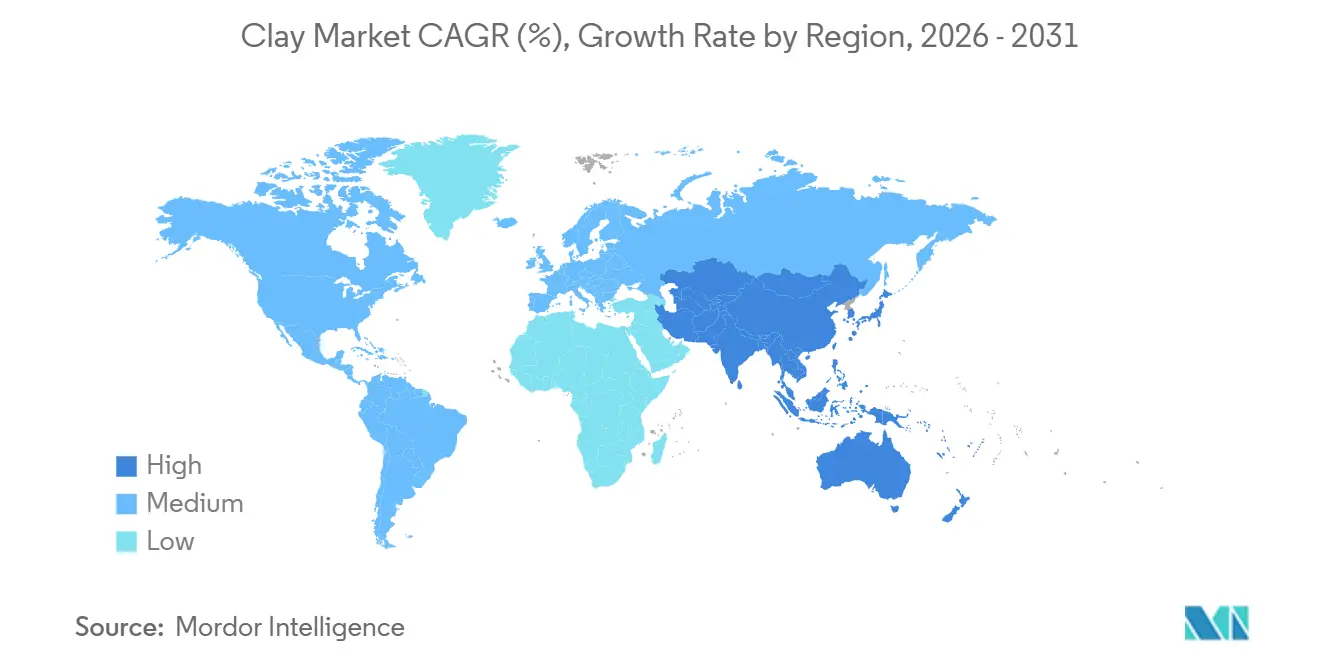
Asia-Pacific held 46.87% of market revenue in 2025 and is projected to grow at a 6.43% CAGR through 2031, making it both the largest and fastest-growing regional market. The region's clay market is supported by large-scale ceramics production, extensive construction activity, and a broad industrial customer base that consumes multiple clay grades. China remained the world's largest ceramics producer and a major paper market, driving demand for both construction-oriented and processed kaolin products. India represents an important growth center, with demand stemming from construction activity, bentonite exports to Gulf oilfield service providers, and pharmaceutical applications. Ashapura Minechem Limited reported India business revenue growth of more than 25% in H1 FY2026, reflecting the commercial significance of this expanding domestic and export base.
APAC and North America Clay Market
Japan and South Korea import high-purity kaolin from the United States and Australia for electronics, ceramics, and specialty coatings, where quality requirements rather than price drive procurement decisions. North America was the second-largest regional market, supported by demand from paper, environmental remediation, pet care, and oilfield services, each requiring different clay types and grades. United States clay production reached 26 million tons valued at USD 1.8 billion in 2025, with around 120 companies operating across 38 states. The United States exported 3.3 million metric tons of clay products in 2025, including 640 thousand metric tons of bentonite and 1.6 million metric tons of kaolin. Mexico is a secondary regional supplier, producing 2,100 thousand metric tons of kaolin annually and serving as a key destination for United States bentonite exports.
EMEA, South America and APAC Clay Market
Europe and the remaining regions are at different stages of development, with demand shaped by industrial policy, local mineral resources, construction programs, and oil and gas activity. The Czech Republic produced 2,400 thousand metric tons of kaolin in 2024, while European producers supply high-specification calcined clay for cement and coatings alongside lower-value common clay for brickmaking. European decarbonization policy supports the use of calcined clay cement blends. South America's market is centered on Brazil's kaolin reserves, while the Middle-East and Africa benefit from Saudi Arabian construction, ceramics, mining, and Gulf drilling activity. These regions also benefit from local construction demand, with Indian and Turkish exporters continuing to supply oilfield-related bentonite.
Competitive Landscape
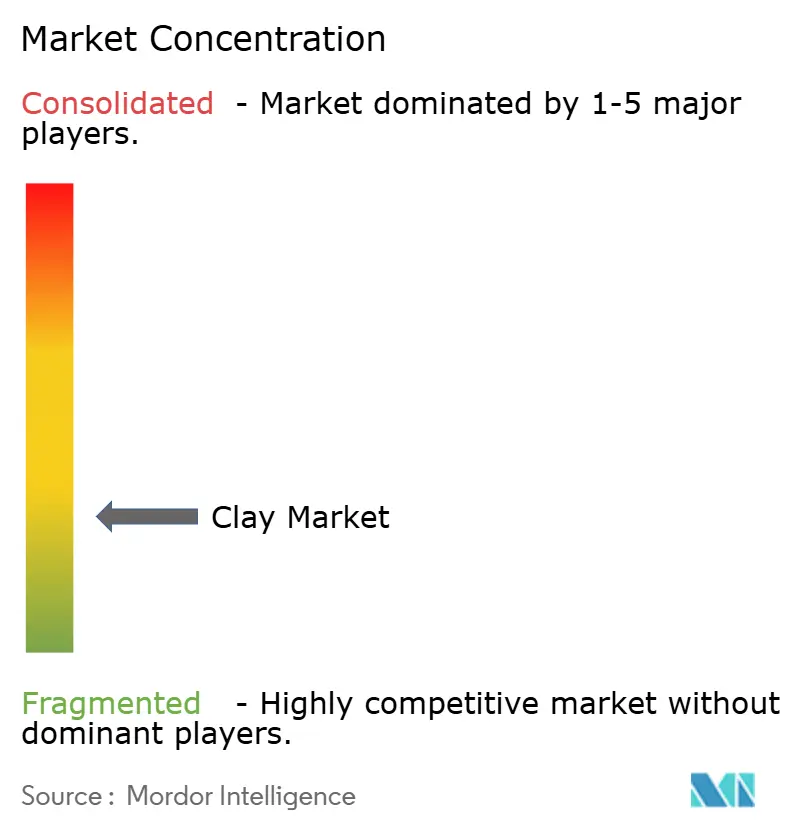
The clay market is fragmented. Imerys S.A. and Sibelco are geographically diversified suppliers with mining and processing assets across Europe, North America, and Asia-Pacific, which support long-term supply relationships with major ceramic and paper customers. Their integrated positions in the clay market give them greater capacity to supply processed grades and provide technical support to large industrial buyers. In February 2025, BASF SE and Sibelco announced a partnership focused on sustainable clay-based solutions for ceramics, filtration, and catalyst applications. Such arrangements combine technical capability and supply support, making it more difficult for competing suppliers to rely solely on price.
Specialty environmental grades remain an opportunity in modified bentonites for landfill liners, nuclear waste barriers, and wastewater composites, where large-scale suppliers and regional specialists do not hold a decisive position. In April 2026, Imerys entered a binding agreement to acquire Great Lakes Minerals, a Kentucky processor of refractory and abrasive minerals. The transaction is expected to generate USD 80 million in annual revenue after integration and support Imerys' industrial minerals position in North America. In March 2026, Burgess Pigment agreed to acquire Thiele Kaolin Company, a neighboring Georgia producer, reflecting continued interest in feedstock security and integration across adjacent mineral applications.
Indian integrated mineral groups and Australian kaolin developers are targeting premium ceramics export demand. Ashapura Minechem reported more than 25% year-on-year growth in India business revenue in H1 FY2026. AI-based process control can support real-time quality adjustments and reduce customer rejection risk, making it increasingly relevant to customer qualification and grade consistency. Mid-sized producers may lose ground when their beneficiation technology fails to meet application-specific requirements, even if their underlying mineral assets remain technically adequate. Patents and certifications for calcined clay, surface-modified bentonite, and pharmaceutical-grade kaolin can affect customer retention, as customers often require established performance and regulatory assurance. The clay market remains competitive because deposit quality, processing capability, application knowledge, and technical support all affect supplier selection.
Clay Industry Leaders
-
Imerys S.A.
-
Sibelco
-
Minerals Technologies Inc.
-
KaMin LLC
-
Ashapura Minechem Ltd.
- *Disclaimer: Major Players sorted in no particular order
Clay Market Companies Covered in this Report
- 20 Microns
- Ashapura Minechem Ltd.
- BASF
- Bentonite Performance Minerals LLC
- EICL
- Eurobent Sp. z o.o.
- Imerys S.A.
- KaMin LLC
- Kunimine Industries Co., Ltd.
- LKAB Minerals
- Minerals Technologies Inc.
- Sibelco
- Thiele Kaolin Company
- WA Kaolin Limited
- Wyo-Ben, Inc.
Recent Industry Developments in Clay Market
- April 2026: Imerys S.A. entered into a binding agreement to acquire Great Lakes Minerals, a US-based processor of refractory and abrasive clay minerals located in Kentucky. The deal is expected to generate USD 80 million in annual revenue from clay mineral processing post-integration and is expected to strengthen Imerys' position as a clay mineral supplier to industrial reshoring programs in North America.
- February 2025: BASF SE and Sibelco announced a strategic partnership to co-develop and supply industrial clay-based solutions across ceramics, filtration, and catalyst applications, aiming to enhance supply chain resilience and reduce the environmental impact of clay processing for joint customers.
Global Clay Market Report Scope
Clay is a natural, fine-grained earth material that is soft and malleable when wet and hardens when dried or heated. It is most commonly used to make pottery, bricks, and craft models.
The clay market is segmented by form, clay type, application, and geography. By form, the market is segmented into lump, powder, granules, and slurry. By clay type, the market is segmented into kaolin (china clay), bentonite, ball clay, fire clay, fuller's earth, common clay, illite, and other clay types. By application, the market is segmented into ceramics and pottery, construction materials, oil and gas drilling fluids, paper, paints and coatings, rubber and plastics, cosmetics and personal care, pharmaceuticals, agriculture, water treatment and environmental applications, and other applications. The report also covers market size and forecasts for clay across 16 countries in major regions. The market sizes and forecasts are provided in terms of value (USD).
Segmentation Overview
| Lump |
| Powder |
| Granules |
| Slurry |
| Kaolin (China Clay) |
| Bentonite |
| Ball Clay |
| Fire Clay |
| Fuller's Earth |
| Common Clay |
| Illite |
| Other Clay Types |
| Ceramics and Pottery |
| Construction Materials |
| Oil and Gas Drilling Fluids |
| Paper |
| Paints and Coatings |
| Rubber and Plastics |
| Cosmetics and Personal Care |
| Pharmaceuticals |
| Agriculture |
| Water Treatment and Environmental Applications |
| Other Applications |
| Asia-Pacific | China |
| India | |
| Japan | |
| South Korea | |
| Rest of Asia-Pacific | |
| North America | United States |
| Canada | |
| Mexico | |
| Europe | Germany |
| United Kingdom | |
| France | |
| Italy | |
| Russia | |
| Rest of Europe | |
| South America | Brazil |
| Argentina | |
| Rest of South America | |
| Middle-East and Africa | Saudi Arabia |
| South Africa | |
| Rest of Middle-East and Africa |
| By Form | Lump | |
| Powder | ||
| Granules | ||
| Slurry | ||
| By Clay Type | Kaolin (China Clay) | |
| Bentonite | ||
| Ball Clay | ||
| Fire Clay | ||
| Fuller's Earth | ||
| Common Clay | ||
| Illite | ||
| Other Clay Types | ||
| By Application | Ceramics and Pottery | |
| Construction Materials | ||
| Oil and Gas Drilling Fluids | ||
| Paper | ||
| Paints and Coatings | ||
| Rubber and Plastics | ||
| Cosmetics and Personal Care | ||
| Pharmaceuticals | ||
| Agriculture | ||
| Water Treatment and Environmental Applications | ||
| Other Applications | ||
| By Geography | Asia-Pacific | China |
| India | ||
| Japan | ||
| South Korea | ||
| Rest of Asia-Pacific | ||
| North America | United States | |
| Canada | ||
| Mexico | ||
| Europe | Germany | |
| United Kingdom | ||
| France | ||
| Italy | ||
| Russia | ||
| Rest of Europe | ||
| South America | Brazil | |
| Argentina | ||
| Rest of South America | ||
| Middle-East and Africa | Saudi Arabia | |
| South Africa | ||
| Rest of Middle-East and Africa | ||
Key Questions Answered in the Report
What is current market size of Clay Market?
The clay market size was estimated at USD 17.32 billion in 2025 and is estimated to grow from USD 18.25 billion in 2026 to USD 24.33 billion by 2031, at a CAGR of 5.92% during the forecast period (2026-2031).
Which clay form is expected to grow the fastest?
Slurry is forecast to grow at a 6.18% CAGR through 2031, as paper and coatings processors seek pre-dispersed, high-solids mineral inputs that simplify in-plant handling. Preparation before shipment also helps suppliers manage particle-size distribution and surface chemistry.
Why is bentonite demand increasing?
Bentonite is forecast to grow at a 6.92% CAGR through 2031. Drilling fluids, civil engineering barriers, foundry uses, and environmental sealing provide demand across several end-use areas with different capital-spending patterns.
What application will grow fastest through 2031?
Water treatment and environmental applications are forecast to grow at a 7.66% CAGR through 2031.