
Civic AI Platforms Market Size and Share
Market Overview
| Study Period | 2020 - 2031 |
|---|---|
| Market Size (2026) | USD 13.29 Billion |
| Market Size (2031) | USD 37.83 Billion |
| Growth Rate (2026 - 2031) | 23.27 % |
| Fastest Growing Market | Asia-Pacific |
| Largest Market | North America |
| Market Concentration | Medium |
Major Players *Disclaimer: Major Players sorted in no particular order Image © Mordor Intelligence. Reuse requires attribution under CC BY 4.0. | |
Civic AI Platforms Market Analysis by Mordor Intelligence
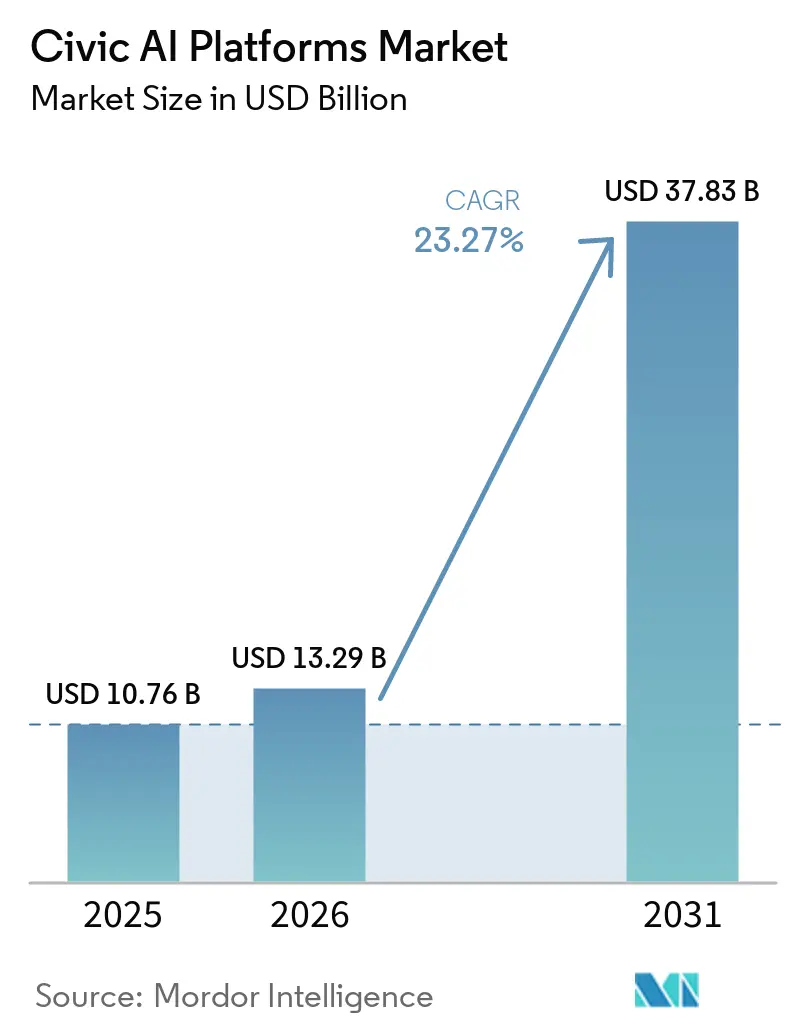
The civic AI platforms market size is projected to be USD 10.76 billion in 2025, USD 13.29 billion in 2026, and reach USD 37.83 billion by 2031, growing at a CAGR of 23.27% from 2026 to 2031. Growth reflects a move from stand-alone digital tools toward platforms that connect casework, service delivery, and data exchange across public agencies. Demand is also rising as citizens expect always-available services in several languages and agencies seek to reduce queues and the cost of handling routine cases. Sovereign cloud rules and data residency requirements are changing vendor selection and favoring deployments that can protect sensitive public data. Large federal agreements create opportunities for enterprise suppliers, while local agencies continue to favor providers with tailored permitting, 311, and citizen-service functions. Legacy technology and lengthy purchasing processes remain material limits on the civic AI platforms market because they delay integration and can slow a program’s move from pilot to broad use.
Key Report Takeaways
- By component, solutions held 62.31% of the civic AI platforms market share in 2025, while services are projected to expand at a 25.66% CAGR through 2031.
- By deployment mode, cloud accounted for 50.12% of the civic AI platforms market size in 2025, while hybrid deployment is expected to grow at a 26.11% CAGR through 2031.
- By application, administrative automation and case management held 22.43% share in 2025, while citizen services and engagement are projected to advance at a 25.98% CAGR through 2031.
- By end user, local and municipal government accounted for 31.29% share in 2025, while the federal and national government is expected to expand at a 24.87% CAGR through 2031 in the civic AI platforms market.
- By geography, North America held 31.29% share in 2025, while Asia-Pacific is projected to grow at a 24.99% CAGR through 2031 in the civic AI platforms market.
Note: Market size and forecast figures in this report are generated using Mordor Intelligence’s proprietary estimation framework, updated with the latest available data and insights as of January 2026.
Global Civic AI Platforms Market Trends and Insights
Drivers Impact Analysis*
| DRIVER | (~) % IMPACT ON CAGR FORECAST | GEOGRAPHIC RELEVANCE | IMPACT TIMELINE |
|---|---|---|---|
| Multi-Agency Workflow Orchestration Demand | +2.8% | Global | Medium term (2-4 years) |
| Citizen Expectations for 24/7 Multilingual Service Access | +2.5% | Global, the strongest pull in Asia-Pacific and Middle East, and Africa | Short term (≤ 2 years) |
| Public Sector Pressure to Reduce Backlogs and Cost per Case | +2.2% | North America and Europe | Short term (≤ 2 years) |
| Sovereign AI and Data Residency Programs | +1.9% | Europe, Canada, and core Asia-Pacific markets | Medium term (2-4 years) |
| Predictive Analytics for Public Safety and Asset Uptime | +1.6% | North America and Middle East, and Africa, with spillover to the Asia-Pacific | Medium term (2-4 years) |
| Generative AI for Public Communication and Case Triage | +1.4% | Global | Short term (≤ 2 years) |
| Source: Mordor Intelligence | |||
Multi-Agency Workflow Orchestration Demand
Public agencies are directing more platform spending toward work that crosses departmental boundaries. Separate systems can leave housing, welfare, and transit agencies with disconnected records for the same person. The civic AI platforms market benefits when agencies need a shared case view and coordinated routing. Japan’s Digital Agency deployed Government AI Gennai to 180,000 government employees during fiscal 2026, underscoring the scale of the government-wide deployment now underway.[1] The program also supports a more consistent approach to tools and governance across ministries. This demand favors platforms that can link existing applications without requiring each agency to replace its core systems at once.
Citizen Expectations for 24/7 Multilingual Service Access
Citizens increasingly expect public services to be easily accessible outside standard office hours. This expectation supports conversational interfaces that can answer routine questions, guide forms, and route more complex cases. The civic AI platforms market is therefore moving beyond limited chatbot trials toward services designed for large populations. South Korea launched its AI National Secretary pilot through KakaoTalk in March 2026, with voice and text support for civil administration services.[2] The government plans to extend the service to all 48 central agencies by 2027 and local governments by 2030. This kind of rollout makes multilingual design, accessible interfaces, and reliable links to agency records central requirements for suppliers.
Public Sector Pressure to Reduce Backlogs and Cost per Case
Budget pressure and service backlogs are making automation more important for public agencies. Administrative teams are focusing on permits, benefits, appointments, and records because these activities involve repetitive steps. The civic AI platforms market gains when agencies can show that a platform shortens processing times while preserving oversight. U.S.-obligated federal AI spending reached USD 7.2 billion in 2026, compared with USD 675 million in 2024. The increase indicates that large agencies are committing funds beyond early experimentation. It also gives vendors an incentive to package workflow tools with implementation and governance support.
Sovereign AI and Data Residency Programs
Data residency and sovereign computing requirements are becoming part of public procurement. These rules matter most when platforms process sensitive records or support high-impact public decisions. The civic AI platforms market is affected because compliance can narrow the field of eligible infrastructure and software providers. Canada launched its AI Sovereign Compute Infrastructure Program in May 2026 for data center proposals exceeding 100 MW, with conditions requiring Canadian data residency and supply-chain sovereignty.[3] The European Commission also proposed the Cloud and AI Development Act in June 2026 to support a common framework for cloud and AI development.[4] These measures increase the value of providers that can meet national certification, hosting, and audit requirements.
Restraints Impact Analysis*
| RESTRAINT | (~) % IMPACT ON CAGR FORECAST | GEOGRAPHIC RELEVANCE | IMPACT TIMELINE |
|---|---|---|---|
| Legacy System Interoperability Complexity | -2.1% | Global, most acute in North America and Europe | Long term (≥ 4 years) |
| Public Sector AI Procurement and Approval Cycles | -1.8% | North America and Europe | Long term (≥ 4 years) |
| Cybersecurity, Prompt Injection, and Model Governance Risk | -1.5% | Global | Medium term (2-4 years) |
| Bias, Explainability, and Records Retention Constraints | -1.2% | Europe and North America | Long term (≥ 4 years) |
| Source: Mordor Intelligence | |||
Legacy System Interoperability Complexity
Government technology often includes systems built for paper-led or narrowly defined administrative processes. These systems may not provide the real-time data access needed for case routing and agent-supported work. The civic AI platforms market can therefore face long project schedules even when an agency has a clear business case. The U.S. Government Accountability Office reported in February 2025 that agencies had completed 3 of 10 critical legacy IT modernization projects identified in 2019.[5] Two of the remaining projects did not have planned completion dates. Agencies may use middleware and application programming interfaces to connect old and new systems, but this adds testing, cost, and operational risk.
Public Sector AI Procurement and Approval Cycles
Public purchasing rules can move more slowly than changes in AI capability. Agencies must assess security, data use, records retention, fairness, and supplier viability before making a production award. The civic AI platforms market may lose momentum when a pilot ends before an agency completes its approval process. The U.S. Government Accountability Office found in 2026 that agencies should collect and apply lessons from AI acquisitions to improve future procurements. The GSA’s OneGov agreements address this issue by providing agencies with access to pre-negotiated offerings. Even so, program owners must align technical choices with legal, budget, and mission approvals.
*Our forecasts treat driver/restraint impacts as directional, not additive. The impact forecasts reflect baseline growth, mix effects, and variable interactions.
Segment Analysis
By Component: Solutions Form the Platform Core
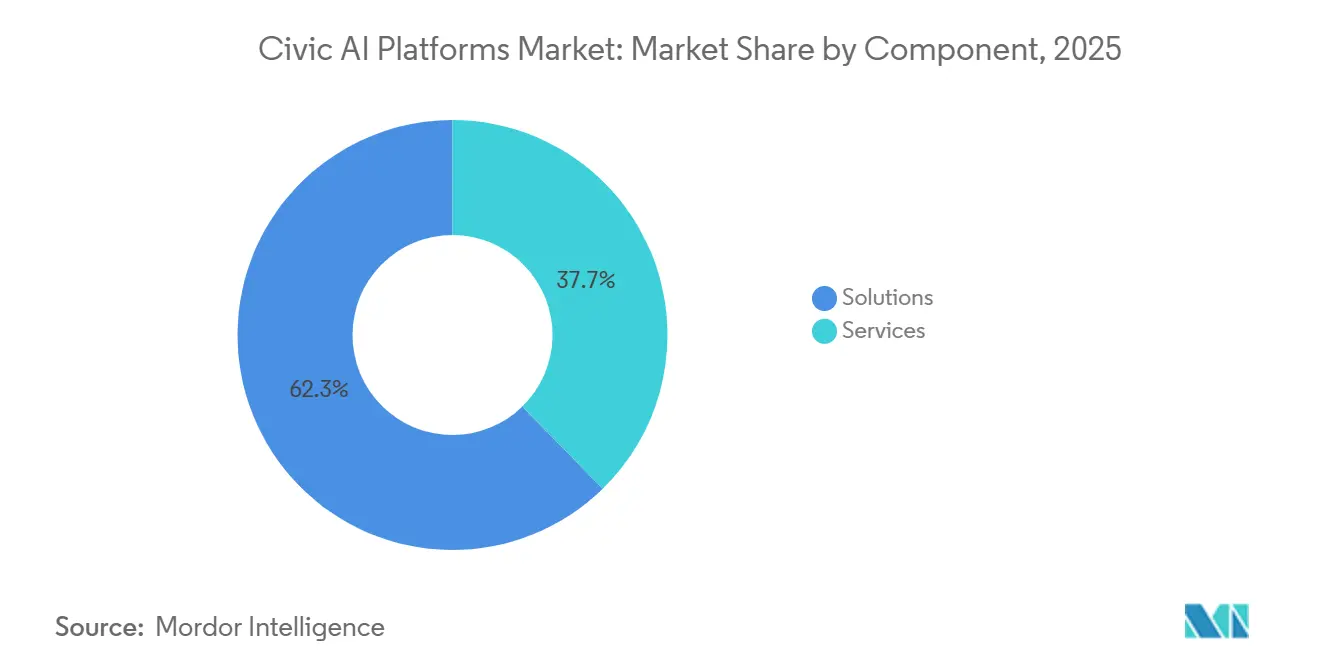
Solutions are projected to account for 62.31% of revenue in 2025, reflecting demand for software that supports orchestration, language processing, analytics, and case-management interfaces. The civic AI platforms market depends on these functions because agencies need systems that can manage workflows across multiple users and public programs. Platform licenses can provide a continuous operating environment rather than support a one-time project. They also give agencies a clearer way to standardize access controls and monitoring. This model suits departments that want to retain control over day-to-day service processes. However, agencies still need to connect these platforms with existing records and systems.
Services are projected to grow at a CAGR of 25.66% through 2031 as deployments require integration, change management, and continuous oversight. Providers are increasingly supporting model monitoring, bias review, retraining, and operational governance. These tasks remain necessary after an application goes live. Therefore, the civic AI platforms industry depends on service partners, even when solutions constitute the primary revenue stream. Japan is expected to release Government AI Gennai as open-source software in 2026, showing how governments with strong internal capabilities can build and manage part of the service layer themselves. Markets with lower internal capacity may continue to rely more heavily on external implementation support.
By Deployment Mode: Hybrid Use Expands Under Sovereignty Requirements
Cloud is projected to account for 50.12% of revenue in 2025 because it offers scalable computing and simpler access to enterprise applications. The GSA OneGov strategy lowered barriers to cloud-oriented procurement by consolidating agreements with major technology providers. The civic AI platforms market can use these agreements to bring approved tools to agencies without having to start each negotiation from scratch. Cloud models are particularly useful for high-volume citizen channels. They also allow agencies to expand capacity when demand rises. However, their use still depends on whether relevant records and workloads can be hosted in compliance with applicable rules.
Hybrid deployment is expected to record a CAGR of 26.11% through 2031, the highest rate among deployment modes. Agencies use hybrid designs to keep sensitive workloads in sovereign or controlled environments while using scalable services for public-facing tasks. This arrangement is relevant in defense, intelligence, and other high-risk settings. France’s government is expected to deploy an AI assistant on SecNumCloud-qualified infrastructure in June 2026, demonstrating the role of protected hosting in government adoption. The civic AI platforms market will likely see more contracts structured around these separate but connected environments. On-premises deployment remains important when air gaps or classification rules preclude use of the public cloud.
By Application: Administrative Automation Leads While Citizen Engagement Grows
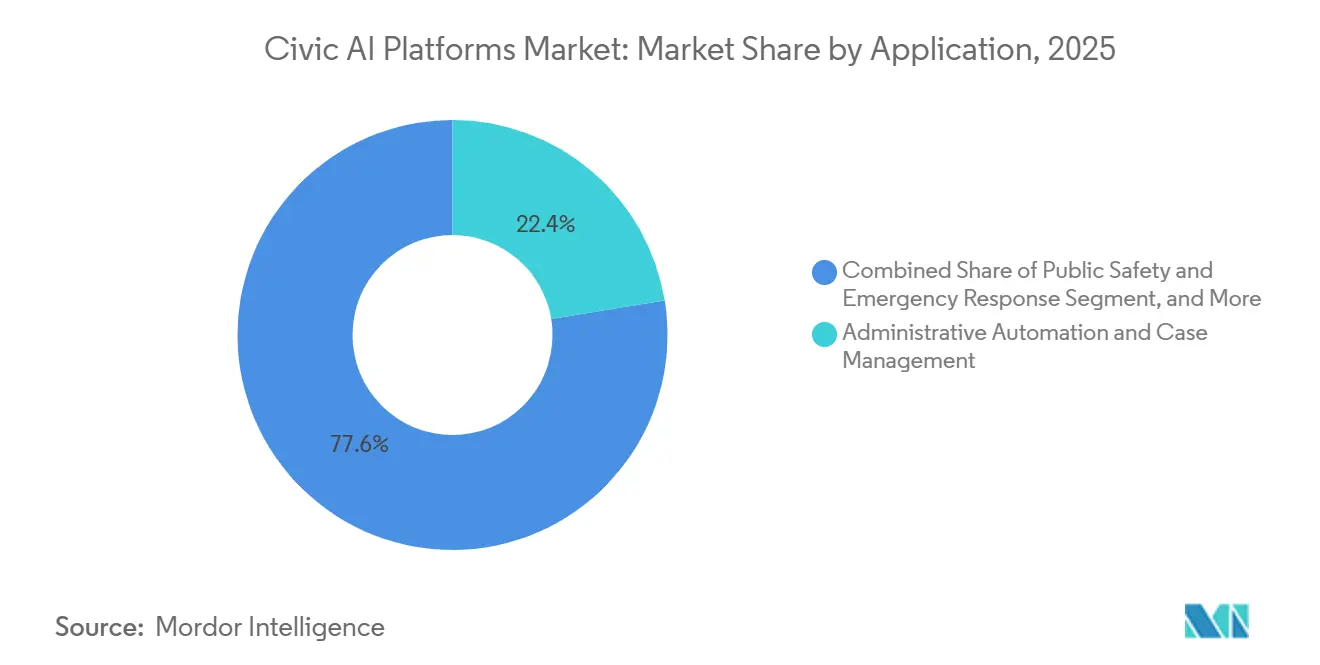
Administrative automation and case management are projected to account for 22.43% of revenue in the civic AI platforms market in 2025. Permits, benefit decisions, records reconciliation, and case routing offer practical targets because agencies can identify delays and repetitive handoffs. The civic AI platforms market supports these applications by giving teams a way to manage work across different programs. Finance and operations leaders can assess these applications through processing time and workload measures. This makes the value proposition more direct than for less-defined technology projects. It also increases the need for accurate records and clear rules for human review.
Citizen services and engagement are projected to expand at a CAGR of 25.98% through 2031. In the civic AI platforms market, public interfaces are moving from basic question-and-answer tools to platforms that support appointments, status checks, and document guidance. Portugal’s Gov.pt portal is expected to deploy a generative AI assistant in 2025, covering more than 2,300 government services across several languages. Public safety and emergency response also remain important because timely analysis can improve oversight. Brazil’s Alice system reduced the processing time for procurement audits from 400 days to 8 days. Healthcare, social services, and urban management create additional demand for coordination of data and service actions.

By End User: Local Governments Lead in Volume and Federal Agencies Increase Spending
Local and municipal government is projected to account for 31.29% of revenue in the civic AI platforms market in 2025. This share reflects the number of city and county agencies using tools for 311 services, permitting, enforcement, and public communication. The civic AI platforms market has broad demand at this level because each jurisdiction runs several citizen-facing services. Municipal buyers often require tools that align with local forms, policies, and workflows. This requirement gives specialized government technology providers an advantage in many competitive procurements. Local projects may be smaller than federal awards, but their combined volume supports a substantial revenue base.
The federal and national government is projected to grow at a CAGR of 24.87% through 2031. The civic AI platforms market benefits from the concentration of large agreements at the central government level. Potential US federal AI contract value is projected to reach USD 91.8 billion in 2026, with the Department of Defense accounting for 98.9% of that total. State and provincial governments form an important middle tier in countries where they run welfare, licensing, and education services. Public service organizations, such as transit authorities, utilities, and public healthcare bodies, also adopt similar architectures as their service obligations become more complex. These users extend demand beyond formal departments and ministries.
Geography Analysis
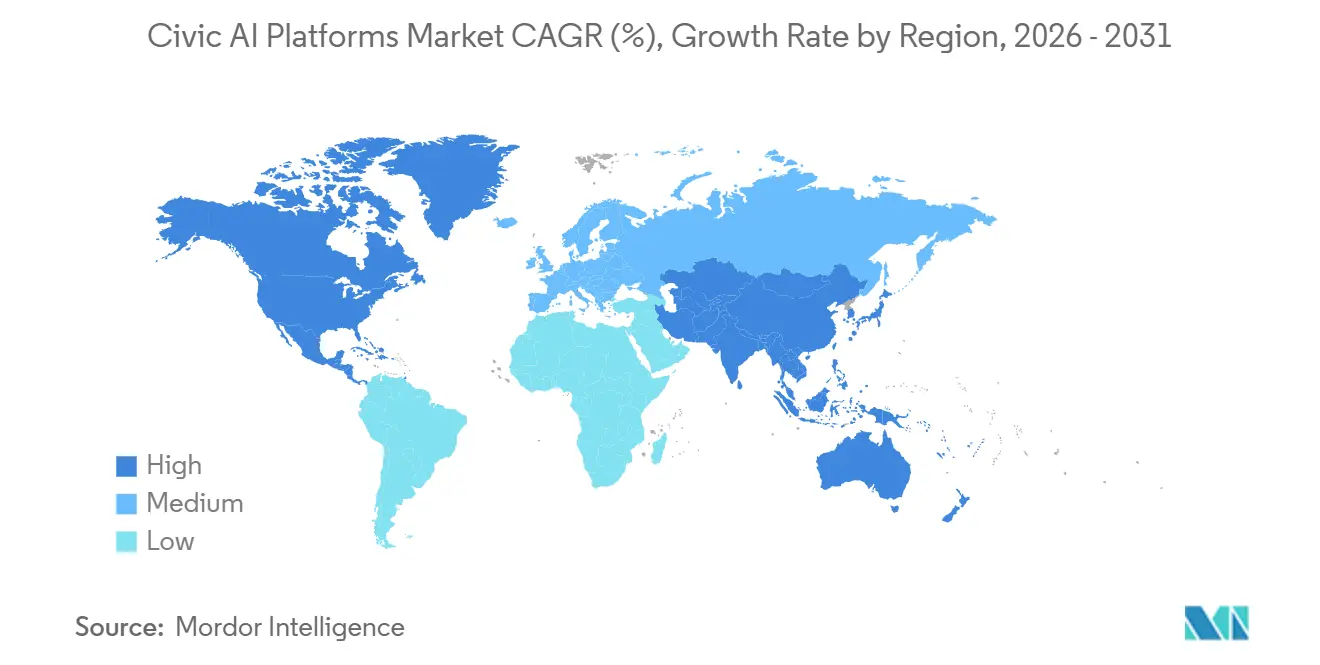
North America is expected to account for 31.29% of revenue in 2025, supported by U.S. federal investment and established government cloud procurement. U.S.-obligated federal AI spending is projected to reach USD 7.2 billion in 2026. The U.S. Army is expected to award Salesforce a USD 5.6 billion, 10-year contract in January 2026 for AI, data, and cloud technologies. The Department of Veterans Affairs is expected to award Salesforce a USD 1.6 billion, 3-year agreement in July 2026. Canada is adding momentum through its sovereign compute program and data residency requirements. Mexico and smaller South American countries remain at an earlier stage, with spending focused more on digital identity and e-government foundations.
South America presents an emerging opportunity, with Brazil demonstrating a clear government use case in procurement oversight. Brazil’s Alice system reduced audit processing time from 400 days to 8 days. Argentina and other South American governments remain in the early stages of procurement for chatbots and administrative automation. Europe is shaped by sovereign AI policy and the evolving compliance pathway under the EU AI Act. France is expected to deploy its government assistant to 1 million civil servants in June 2026. Portugal is expected to approve a National Sovereign Cloud Plan in 2026 that links sovereign cloud capability with public service modernization. The United Kingdom is expected to launch its Sovereign AI Fund in April 2026 to support domestic capability and public-sector applications.
Asia-Pacific is projected to advance at a 24.99% CAGR through 2031, the fastest regional growth rate. Japan is expected to deploy Government AI Gennai to 180,000 government employees during fiscal 2026 and issue Version 2.0 of its generative AI procurement guidance in June 2026. South Korea’s AI National Secretary pilot is expected to begin in March 2026 with voice and text civil service functions. India is expected to release AI Governance Guidelines in February 2026, establishing the AI Governance Group and the AI Safety Institute. The civic AI platforms market also has demand in Gulf Cooperation Council countries, where smart-city and digital service programs are expanding. Abu Dhabi’s TAMM platform deployed AI agents in October 2025 to connect life events with more than 1,000 services from more than 90 providers. Sub-Saharan Africa remains at an earlier stage of adoption, with activity centered on mobile notifications and pilot deployments.
Competitive Landscape
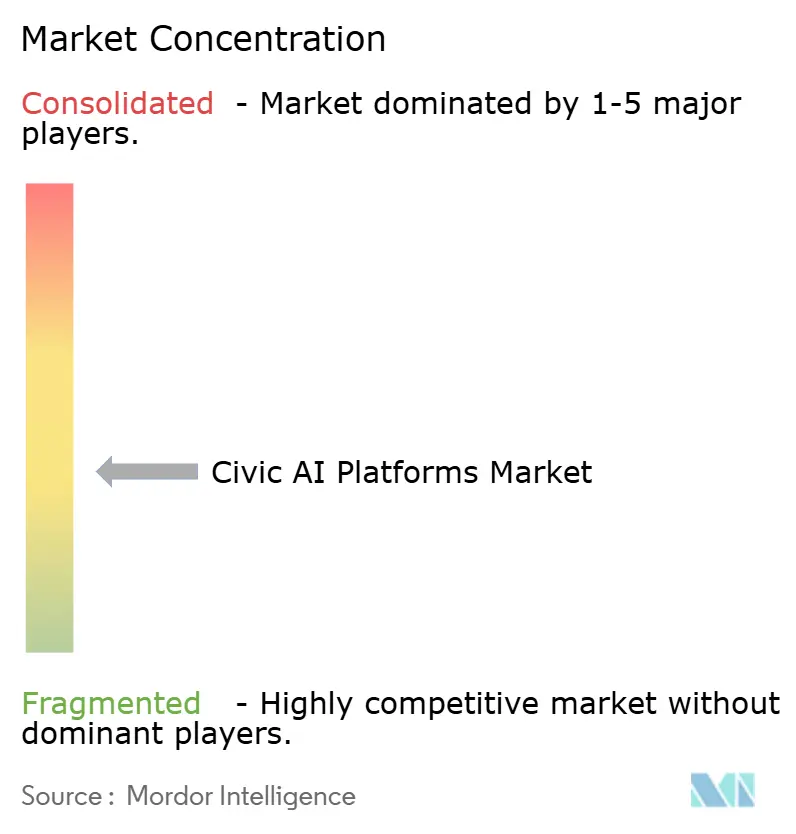
The civic AI platforms market is moderately fragmented across hyperscalers, enterprise workflow providers, and specialized government technology firms. Microsoft, Amazon Web Services, Google, IBM, and Oracle use existing government cloud relationships and authorized infrastructure to compete for large programs. Salesforce, ServiceNow, SAP, and Pegasystems compete through workflow integration and government-specific application capabilities. Salesforce is expected to report more than USD 7 billion in potential government contract value through Missionforce in 2026. ServiceNow stated that its government platform was active across nearly all 50 U.S. states in 2026. No combined top-player market share was provided; therefore, a concentration score cannot be derived without estimation.
Compliance remains a key competitive requirement because government buyers may require secure hosting, data controls, and alignment with national AI regulations. Providers with SecNumCloud qualification, FedRAMP High authorization, or comparable local credentials can access procurement categories that are difficult for uncertified competitors to enter. This requirement creates opportunities for regional integrators, domestic model providers, and specialized civic technology vendors. Tyler Technologies, Granicus, and CivicPlus maintain strong positions in municipal and county work through tools designed for permitting, 311 management, and citizen engagement. The civic AI platforms market also rewards suppliers that can adapt products to local forms, statutory requirements, and public records processes. General-purpose cloud tools may require these local capabilities to compete effectively in city and county bids.
Large suppliers are using agreements and acquisitions to embed AI functions within mission-critical workflows. Salesforce is expected to receive the U.S. Department of Veterans Affairs agreement in July 2026 to deploy Missionforce, Agentforce Public Sector, and Agentforce Health across the agency. Palantir and the U.S. Department of Agriculture entered into a USD 300 million agreement in April 2026 to modernize support for farmers and disaster-recovery workflows. Accela acquired Civira AI in July 2026 to add AI-assisted configuration and implementation to its government cloud offerings. These moves indicate that buyers are seeking products that can be embedded in established administrative processes. They also increase pressure on vendors that lack a clear path for agent-based functionality, governance, and integration.
Civic AI Platforms Industry Leaders
-
Microsoft Corporation
-
Amazon Web Services, Inc.
-
Google LLC
-
SAP SE
-
IBM Corporation
- *Disclaimer: Major Players sorted in no particular order
Recent Industry Developments
- July 2026: The US Department of Veterans Affairs awarded Salesforce a USD 1.6 billion, three-year Agentic Enterprise License Agreement to deploy Missionforce, Agentforce Public Sector, and Agentforce Health across the agency, targeting a reduction in veteran appointment scheduling from 28 days to minutes and representing the largest agentic AI platform contract in civilian government history.
- July 2026: Japan's Cabinet Office published the Second AI Basic Plan, formalizing a whole-of-government AI adoption framework and extending deployment of the Government AI Gennai platform to 180,000 officials across all central ministries, with fiscal 2027 as the target for full institutionalization of government-wide generative AI use.
- July 2026: Accela acquired the Civira AI platform, embedding AI agent technology purpose-built for civic technology into Accela's cloud solutions for state, county, and city governments, reducing configuration and implementation timelines and establishing an AI-native deployment architecture across Accela's installed base.
- May 2026: The Government of Canada launched the AI Sovereign Compute Infrastructure Program, soliciting proposals for data centers exceeding 100 MW with mandatory Canadian data residency and supply-chain sovereignty requirements, creating a structured procurement pathway for sovereign-compliant civic AI platform vendors.
Global Civic AI Platforms Market Report Scope
The Civic AI Platforms Market is Segmented by Component (Solutions, and Services), Deployment Mode (Cloud, On-Premises, and Hybrid), Application (Citizen Services and Engagement, Public Safety and Emergency Response, Administrative Automation And Case Management, Healthcare And Social Services, Smart Cities And Urban Management, and Other Application), End User (Federal And National Government, State And Provincial Government, Local And Municipal Government, Public Services Organizations, and Other End User), and Geography (North America, South America, Europe, Asia-Pacific, Middle East and Africa). The Market Forecasts are Provided in Terms of Value (USD).
| Solutions |
| Services |
| Cloud |
| On-Premises |
| Hybrid |
| Citizen Services and Engagement |
| Public Safety and Emergency Response |
| Administrative Automation And Case Management |
| Healthcare And Social Services |
| Smart Cities And Urban Management |
| Other Application |
| Federal And National Government |
| State And Provincial Government |
| Local And Municipal Government |
| Public Services Organizations |
| Other End User |
| North America | United States | |
| Canada | ||
| Mexico | ||
| South America | Brazil | |
| Argentina | ||
| Rest of South America | ||
| Europe | United Kingdom | |
| Germany | ||
| France | ||
| Italy | ||
| Rest of Europe | ||
| Asia-Pacific | China | |
| Japan | ||
| India | ||
| South Korea | ||
| Rest of Asia | ||
| Middle East and Africa | Middle East | Saudi Arabia |
| United Arab Emirates | ||
| Rest of Middle East | ||
| Africa | South Africa | |
| Egypt | ||
| Rest of Africa | ||
| By Component | Solutions | ||
| Services | |||
| By Deployment Mode | Cloud | ||
| On-Premises | |||
| Hybrid | |||
| By Application | Citizen Services and Engagement | ||
| Public Safety and Emergency Response | |||
| Administrative Automation And Case Management | |||
| Healthcare And Social Services | |||
| Smart Cities And Urban Management | |||
| Other Application | |||
| By End User | Federal And National Government | ||
| State And Provincial Government | |||
| Local And Municipal Government | |||
| Public Services Organizations | |||
| Other End User | |||
| By Geography | North America | United States | |
| Canada | |||
| Mexico | |||
| South America | Brazil | ||
| Argentina | |||
| Rest of South America | |||
| Europe | United Kingdom | ||
| Germany | |||
| France | |||
| Italy | |||
| Rest of Europe | |||
| Asia-Pacific | China | ||
| Japan | |||
| India | |||
| South Korea | |||
| Rest of Asia | |||
| Middle East and Africa | Middle East | Saudi Arabia | |
| United Arab Emirates | |||
| Rest of Middle East | |||
| Africa | South Africa | ||
| Egypt | |||
| Rest of Africa | |||
Key Questions Answered in the Report
What is the size of the civic AI platforms market?
The civic AI platforms market was valued at USD 10.76 billion in 2025, USD 13.29 billion in 2026, and is projected to reach USD 37.83 billion by 2031.
Which component leads to spending on civic AI platforms?
Solutions led with 62.31% of revenue in 2025, while services are projected to grow faster at a 25.66% CAGR.
Why are governments adopting hybrid AI deployment models?
Hybrid models allow agencies to retain sensitive data in controlled environments while using scalable services for citizen-facing workloads.
Which region is expanding fastest for civic AI platforms?
Asia-Pacific is projected to grow at a 24.99% CAGR through 2031, supported by government programs in Japan, South Korea, India, and China.
What are the main barriers to the adoption of civic AI platforms?
Legacy system integration, lengthy purchasing cycles, cybersecurity risks, and requirements for explainability and records retention can delay deployment.