
Citrus Oil Market Size and Share
Market Overview
| Study Period | 2022 - 2032 |
|---|---|
| Market Size (2027) | USD 6.99 Billion |
| Market Size (2032) | USD 9.65 Billion |
| Growth Rate (2027 - 2032) | 6.65 % |
| Fastest Growing Market | Asia-Pacific |
| Largest Market | Europe |
| Market Concentration | Medium |
Major Players *Disclaimer: Major Players sorted in no particular order Image © Mordor Intelligence. Reuse requires attribution under CC BY 4.0. | |
Citrus Oil Market Analysis by Mordor Intelligence
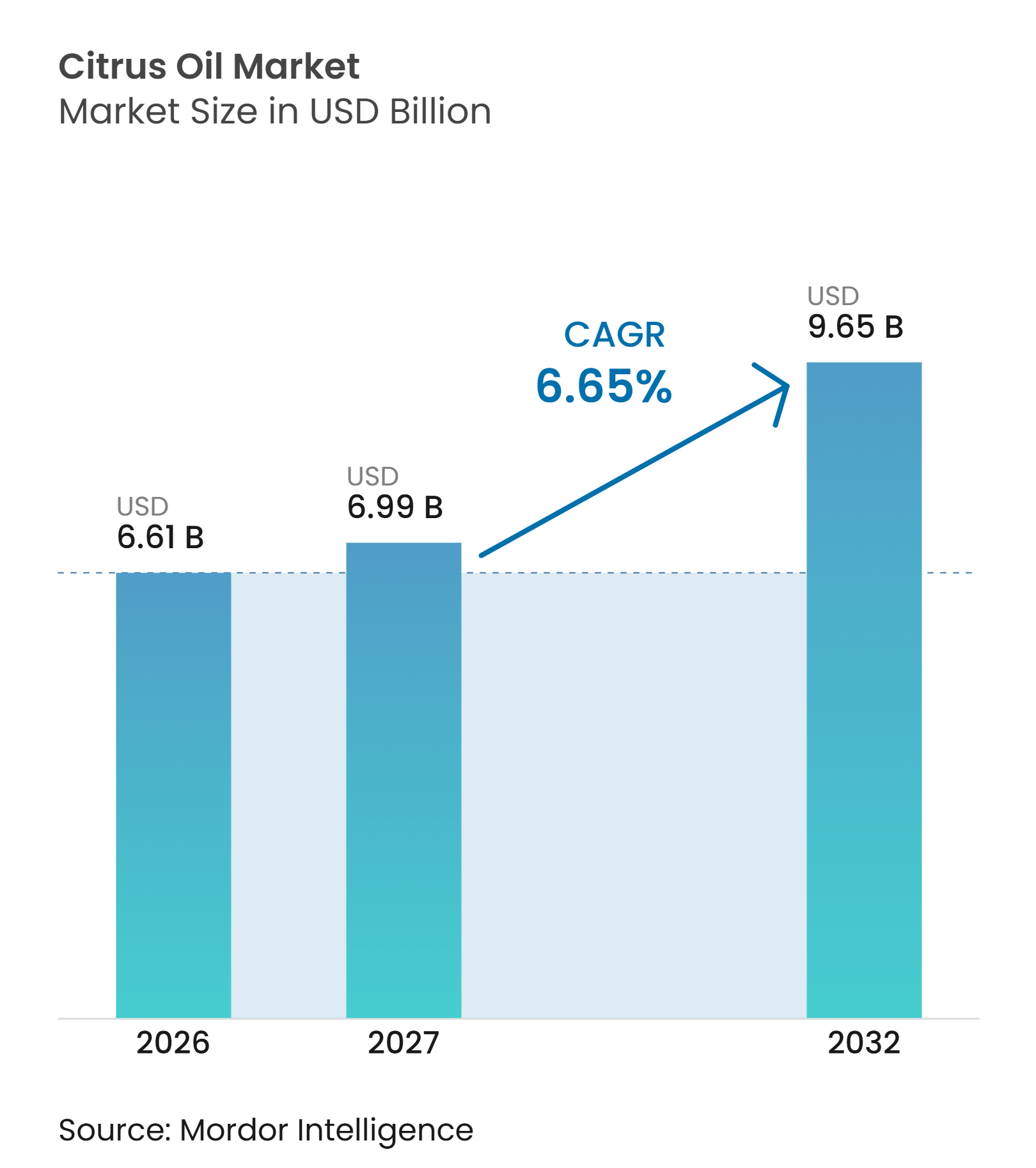
The citrus oil market size was valued at USD 6.61 billion in 2026 and is estimated to grow from USD 6.99 billion in 2027 to reach USD 9.65 billion by 2032, at a CAGR of 6.65% during the forecast period (2027-2032). Demand for citrus oils is supported by their use in food, personal care, fragrances, home care, and wellness products. Oils extracted from orange, lemon, bergamot, and grapefruit peels offer distinct sensory and functional properties. The citrus oil market is also influenced by demand for plant-derived ingredients, transparent label claims, and regulatory scrutiny of synthetic substances across major consumer markets. Suppliers that offer traceable sourcing, extraction capabilities, alternatives to constrained raw materials, and consistent technical documentation are better positioned to serve the citrus oil market.
Key Report Takeaways
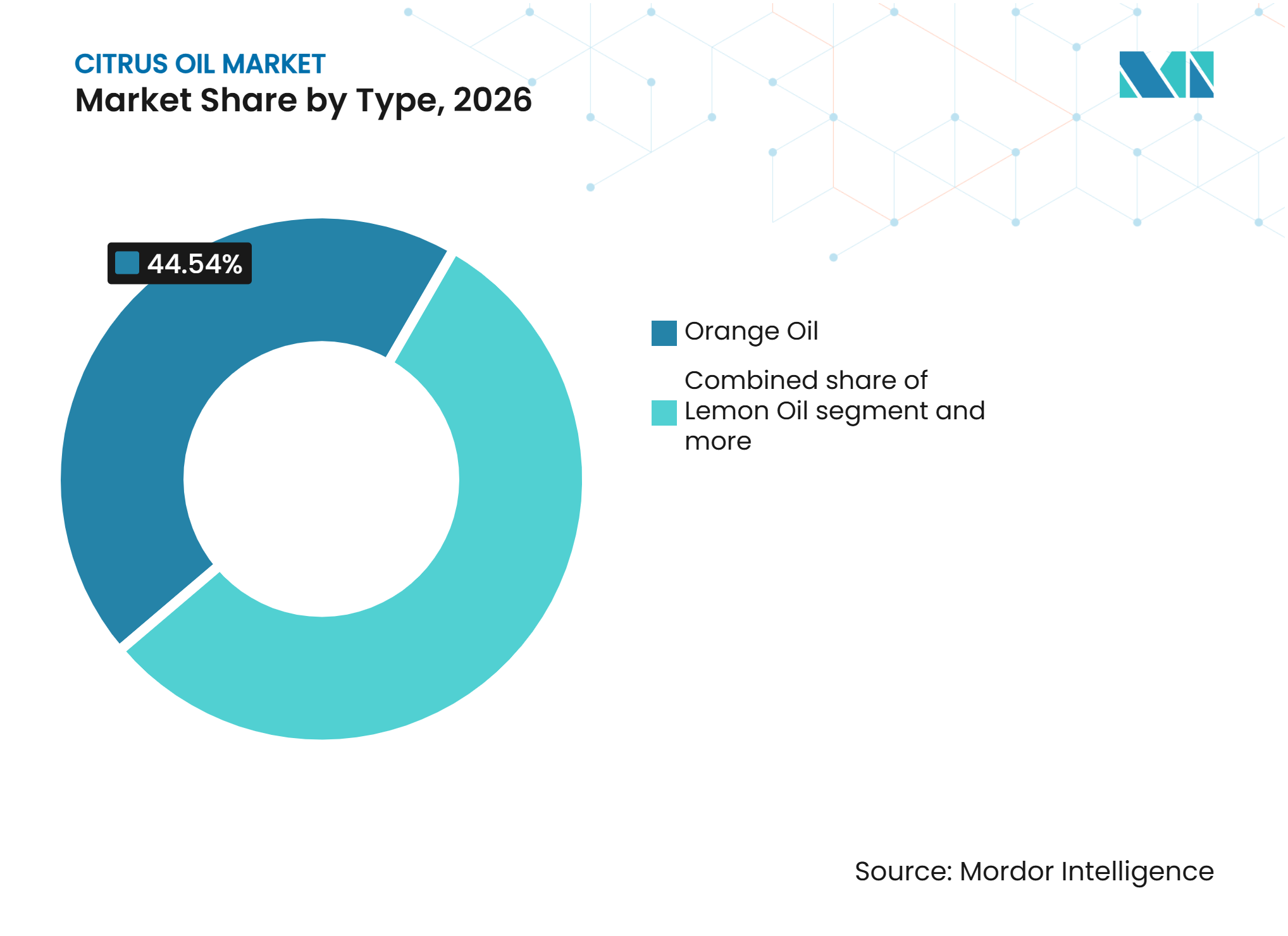
- By type, orange oil dominated the citrus oil market with a share of 44.54% in 2026, while lemon oil is anticipated to register the fastest CAGR of 9.12% during 2027-2032.
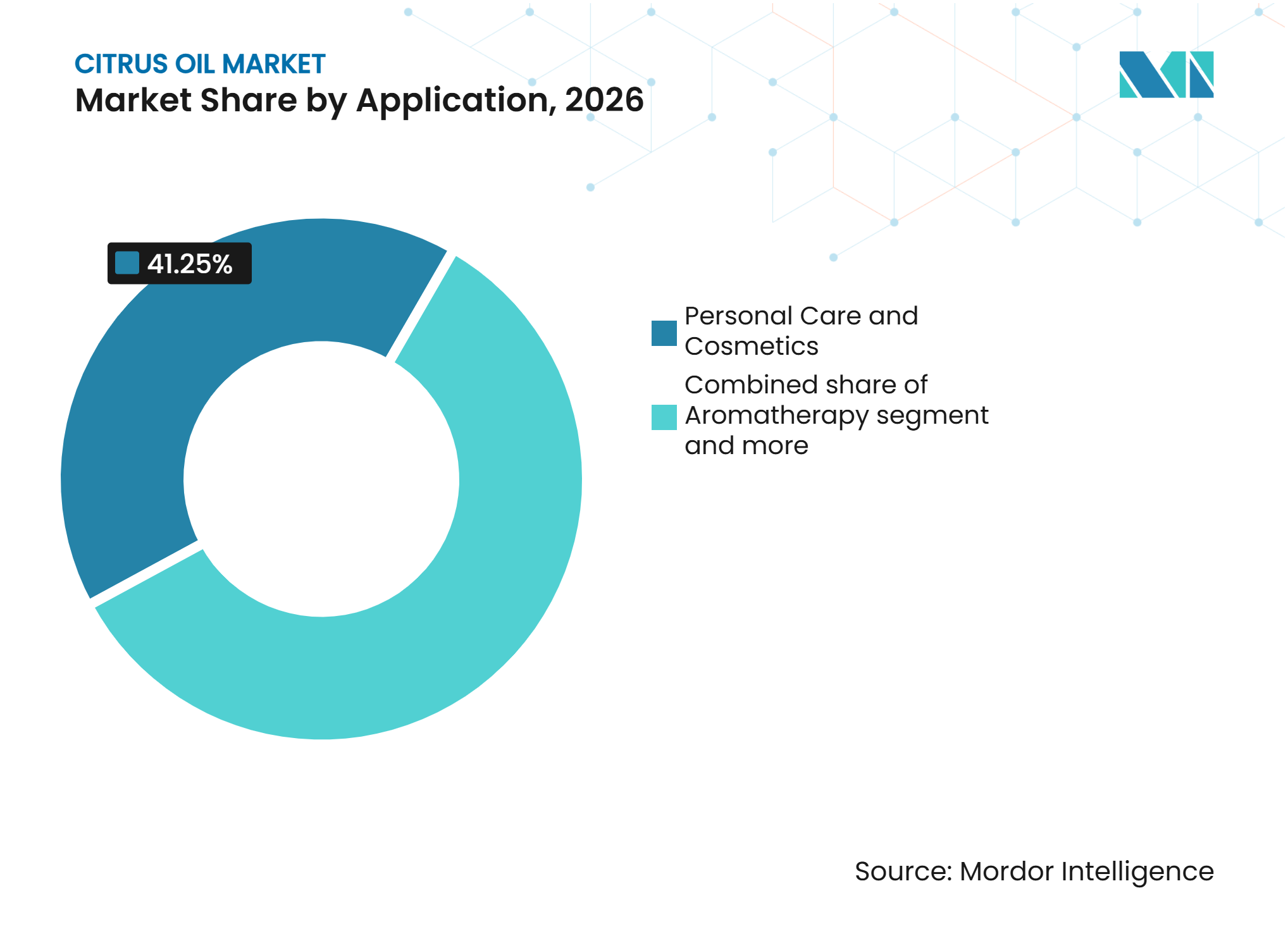
- By application, personal care and cosmetics led the market with a share of 41.25% in 2026, while aromatherapy is anticipated to register the fastest CAGR of 10.25% during 2027-2032.
- By geography, Europe dominated the citrus oil market with a share of 38.15% in 2026, while Asia-Pacific is projected to register the fastest CAGR of 8.54% during 2027-2032.
Note: Market numbers in this report are based on Mordor Intelligence's proprietary estimation framework, which combines nine months of actuals with Q4 projections for base year 2026.
Market Trends and Insights
Drivers Impact Analysis of Citrus Oil Market*
| Driver | (~) % Impact on CAGR Forecast | Geographic Relevance | Impact Timeline |
|---|---|---|---|
| Rising demand for natural flavoring ingredients | +1.2% | Global | Medium term (2-4 years) |
| Expanding applications across food and beverages | +1.5% | Global, with stronger gains in Asia-Pacific and North America | Medium term (2-4 years) |
| Growing preference for plant-based personal care | +1.3% | North America and Europe, with spillover to Asia-Pacific | Medium term (2-4 years) |
| Increasing adoption of aromatherapy and wellness | +1.1% | Asia-Pacific, with spillover to North America and Europe | Medium term (2-4 years) |
| Rising demand for natural fragrance formulations | +0.8% | Europe and North America | Long term (≥ 4 years) |
| Growing utilization of citrus processing by-products | +0.4% | South America and global markets | Long term (≥ 4 years) |
| Source: Mordor Intelligence | |||
Rising Demand for Natural Flavoring Ingredients
Growing consumer preference for natural, fruit-derived ingredients is encouraging food and beverage manufacturers to use citrus oils as alternatives to synthetic flavoring agents. Orange, lemon, lime, and grapefruit oils offer distinctive flavor profiles and aromatic properties, making them suitable for beverages, confectionery, bakery products, sauces, and processed foods. According to the United States Foreign Agricultural Service in March 2025, demand for natural, organic, and clean-label ingredients remains strong in the United Kingdom's food processing industry, reflecting manufacturers’ efforts to address evolving consumer preferences[1]. The report also identified natural flavors and additives as product categories with strong market potential in processed food and beverage manufacturing. These trends support the use of citrus oils in food formulations and create opportunities for manufacturers to expand their natural flavor ingredient portfolios.
Growing Preference for Plant-Based Personal Care
Citrus oils are expanding beyond fragrance applications in personal care products. Manufacturers increasingly use them in brightening, cleansing, sensory, and fresh-scented formulations that support natural product positioning. The requirements compel suppliers to provide comprehensive compositional information, reliable certificates of analysis, and consistent batch-level disclosures to brand customers. Brands can assess single-origin oils with verified allergen profiles more easily than undocumented blends, particularly when reviewing formulations for multiple markets. This trend creates a compliance-driven opportunity for the citrus oil market, as suppliers that meet documentation requirements while maintaining supply continuity can strengthen their market position.
Increasing Adoption of Aromatherapy and Wellness
The growing emphasis on mental well-being, relaxation, stress management, and holistic self-care is driving the adoption of aromatherapy products in residential and commercial settings. Citrus essential oils, particularly lemon, orange, and bergamot oils, are increasingly used in diffusers, massage oils, bath products, and personal care formulations because of their refreshing fragrances. In March 2025, according to the Australian Government Department of Health and Aged Care report, aromatherapy is among the most widely used natural therapies reported by consumers in Western countries[2]. The government’s evidence evaluation also identifies essential oils as the core components of aromatherapy, which consumers commonly use through inhalation and diluted topical applications. The growing use of aromatherapy in wellness centers, spas, massage facilities, and home-care routines is creating additional opportunities for citrus oil manufacturers. Consequently, the suitability of citrus-based essential oils for fragrance-focused relaxation and wellness products continues to support demand.
Growing Utilization of Citrus Processing By-Products
Citrus processors are increasingly seeking to derive greater value from peel streams that were previously treated primarily as residues from juice and fruit processing. Essential oil extraction converts these processing by-products into saleable ingredients for food, fragrance, home care, and other applications requiring citrus sensory characteristics. This approach improves resource efficiency and creates an additional revenue stream for integrated processors that control fruit handling and primary processing. It can also mitigate exposure to rising raw material costs by enabling processors to extract more value from fruit already handled in their facilities, rather than relying solely on additional fruit volumes. The citrus oil market can benefit businesses that combine conventional extraction methods with lower-waste product development and more stable raw material availability.
Restraints Impact Analysis of Citrus Oil Market*
| Restraint | (~) % Impact on CAGR Forecast | Geographic Relevance | Impact Timeline |
|---|---|---|---|
| Volatility in citrus fruit availability and prices | -1.0% | Global, with stronger exposure in North America and South America | Short term (≤ 2 years) |
| Climate variability and citrus crop diseases | -0.9% | North America, South America, and Europe | Short term (≤ 2 years) |
| Quality inconsistencies and product adulteration concerns | -0.5% | Asia-Pacific and Middle East and Africa | Medium term (2-4 years) |
| Stringent purity, safety, and regulatory requirements | -0.4% | North America and Europe | Medium term (2-4 years) |
| Source: Mordor Intelligence | |||
Volatility in Citrus Fruit Availability and Prices
Raw material volatility remains a direct concern for citrus processors and downstream formulators, as fruit cost and availability influence extraction economics and contracted ingredient pricing. The United States Department of Agriculture’s March 2025 outlook indicated very limited orange production in Florida, adding pressure to a supply chain that already depends on multiple growing regions and seasonal harvest conditions[3]. Rising fruit costs increase extraction expenses for essential oil producers and may require them to revise contract terms, production plans, or product specifications. Smaller buyers are particularly exposed because they have limited capacity to secure supply through long-term purchase agreements or diversify procurement across multiple origins. Consequently, procurement teams are likely to prioritize multi-origin sourcing, structured offtake arrangements, and regular quality assessments before committing to supply agreements.
Climate Variability and Citrus Crop Diseases
Citrus oil production depends heavily on the consistent availability and quality of citrus fruits, exposing manufacturers to climatic variability and crop diseases. Irregular rainfall, prolonged droughts, extreme temperatures, frost, and other severe weather events can damage citrus orchards, reduce fruit yields, and compromise the quality of raw materials used in essential oil extraction. In addition, diseases such as citrus greening and citrus canker can weaken trees, lower fruit production, and, in severe cases, require the removal of infected orchards. These factors disrupt the supply of oranges, lemons, limes, and other citrus fruits used for oil extraction. Fluctuations in raw material availability can increase procurement costs, create production uncertainties, and limit manufacturers’ ability to maintain consistent output. Therefore, climate variability and citrus crop diseases remain significant restraints on the citrus oil market’s stability and cost efficiency.
*Our forecasts treat driver/restraint impacts as directional, not additive. The impact forecasts reflect baseline growth, mix effects, and variable interactions.
Citrus Oil Market Segment Analysis
By Type:
Orange Oil Supports Broad Use, While Lemon Oil Expands FasterOrange oil accounted for 44.54% of the citrus oil market share in 2026, driven by its use in beverages, confectionery, household care, and industrial cleaning applications. Its d-limonene content supports degreasing applications, extending its role beyond flavor and fragrance. This broad application range enables orange oil to maintain substantial demand across consumer and commercial products. The orange oil segment of the citrus oil market benefits from its established use in beverage concentrates and cleaning formulations. Additionally, its compatibility with various fragrance and flavour formulations supports its adoption among food processors, cosmetic manufacturers, and household care product companies.
Lemon oil is forecast to grow at a CAGR of 9.12% through 2032, the highest growth rate among type segments. Its fresh sensory profile and use in functional beverages and clean beauty products support this growth. Bergamot oil remains concentrated in luxury fragrance and clinical aromatherapy applications. Furthermore, demand for lemon-based fragrances in personal care, home fragrance, and wellness formulations is creating additional opportunities for suppliers. This diversification across end-use industries strengthens the growth prospects of lemon oil within the citrus oil market.



By Application:
Personal Care Holds the Largest Position, While Aromatherapy AcceleratesPersonal care and cosmetics accounted for 41.25% of application revenue in 2026. Citrus oils provide fragrance, sensory appeal, and functional formulation benefits in skin care and hair care products. This demand supports suppliers that offer comprehensive testing, traceability, and certificates of analysis. As these requirements become more prevalent, personal care customers are likely to implement stricter supplier qualification standards across the citrus oil industry. Manufacturers are also prioritizing consistent fragrance profiles, ingredient purity, and compatibility with diverse cosmetic formulations. These trends create opportunities for suppliers that offer standardized citrus oil grades and customized ingredient solutions for premium personal care applications.
Aromatherapy is projected to expand at a CAGR of 10.25% through 2032. Food and beverage applications remain important, as orange oil supports natural flavoring claims. Pharmaceutical companies use citrus oils for flavor masking, excipients, and topical product applications, where product consistency is critical. The citrus oil industry can benefit from demand driven by clinical research, wellness positioning, and higher-value product formats. The growing adoption of essential oil diffusers, massage blends, and fragrance-based wellness products is creating additional opportunities for citrus oil applications. Suppliers that maintain consistent aroma profiles, purity standards, and reliable sourcing can strengthen their position across aromatherapy and wellness product categories.

Geography Analysis
Europe
Europe held a 38.15% share of the citrus oil market in 2026, supported by its well-established flavor, fragrance, food, and personal care manufacturing industries, whose customers require consistent ingredient performance. Germany, France, Italy, the Netherlands, and Spain represent key demand centers, while Italy and Spain also support regional citrus processing and handling activities. These requirements favor oils with reliable origin information, measured allergen content, and consistent documentation accompanying each batch. The European citrus oil market is responding to supply uncertainty through more efficient extraction processes, stricter supplier qualification, and closer monitoring of material availability.
Asia-Pacific
Asia-Pacific is projected to record the fastest growth in the citrus oil market, with a CAGR of 8.54% through 2032. Rising demand for premium personal care, functional food, and wellness products is driving consumption in China, India, Indonesia, and South Korea, where product differentiation is gaining importance. The region is shifting from volume-driven demand toward citrus oils with traceable origins, verified quality, and sensory profiles tailored to local product concepts. This shift may support products incorporating indigenous citrus varieties, stronger provenance claims, and differentiated citrus ingredients for domestic and export customers.
North America, South America, and Middle East and Africa
North America remains a key demand center for orange oil across food and beverage products, household products, and wellness-focused consumer goods. South America continues to serve as a major supply base, despite disease and climate-related pressures. In the Middle East and Africa, demand is growing through halal-focused food, personal care, and fragrance products. Europe maintains a strong market position due to the established use of citrus oils in premium fragrances, cosmetics, and natural flavor formulations. Meanwhile, Asia-Pacific presents additional growth opportunities, supported by expanding personal care manufacturing, increasing adoption of aromatherapy, and the growing use of natural ingredients in food and beverage products.

Competitive Landscape
Market Concentration

The citrus oil market is moderately concentrated. Givaudan and Symrise are key downstream formulators, while Citrosuco, Sucocítrico Cutrale, Citromax, and MCI Miritz Citrus operate closer to extraction and raw material processing. This structure gives large formulators significant influence over technical specifications and customer relationships, while regional processors remain critical to supply continuity and product origin. The market is becoming more concentrated in the midstream segment as companies acquire processing assets. Buyers without long-term supply arrangements may have fewer independent processors to choose from.
In April 2025, Tradebe Life Sciences acquired Florachem and CitraSource from International Flavors & Fragrances (IFF) in July. These transactions expanded Tradebe’s United States citrus ingredient platform and add processing capabilities across several citrus types. Tradin Organic’s 2025 partnership with Citromil also added organic citrus processing capabilities in Spain. These developments demonstrate that integrated sourcing, processing, and material quality have become strategic assets. They enable companies to broaden their product portfolios, strengthen supply chain control, and serve customers across multiple end-use industries more efficiently.
Symrise identifies selective enrichment technologies and sensory capabilities as important tools for delivering authentic flavor solutions amid raw material supply pressures. Suppliers must meet regulatory and customer requirements related to product safety, documentation, and responsible sourcing. Certified organic and single-origin oils can differentiate themselves when they provide verifiable traceability. Companies also differentiate through customized oil compositions, consistent aroma profiles, and application-specific technical support.
Citrus Oil Industry Leaders
-
Citrosuco S.A.
-
Symrise AG
-
Louis Dreyfus Company
-
Lebermuth, Inc.
-
Citrusvil S.A.
- *Disclaimer: Major Players sorted in no particular order
Citrus Oil Market Companies Covered in this Report
- Citrosuco S.A.
- Sucocítrico Cutrale Ltda.
- Louis Dreyfus Company
- Citromax Group
- Citrusvil S.A.
- Symrise AG
- Givaudan SA
- Lebermuth, Inc.
- Lionel Hitchen Limited
- MCI Miritz Citrus GmbH & Co. KG
- COTA Ltda.
- Prinova
- Citrus Oleo
- Sucorrico
- Citroflavor
- Prodalim
- Citrus and Allied Essences Ltd.
- Treatt plc
- Zuvamesa
- Procimart
Recent Industry Developments in Citrus Oil Market
- June 2026: Acomo N.V. acquired 100% of Citromil S.L., a Spain-based organic citrus producer, strengthening its organic ingredients business. The acquisition expanded Acomo’s citrus sourcing and processing capabilities for lemon, orange, mandarin, grapefruit, and lime, including essential oil production.
- July 2025: Tradebe Life Sciences acquired CitraSource from IFF, a processor of citrus oils derived from oranges, grapefruits, lemons, tangerines, and limes using traditional and molecular distillation. The acquisition complemented Tradebe’s April 2025 acquisition of Florachem, completing a vertically integrated North American citrus ingredients platform with distribution across more than 10 countries.
- March 2025: Symrise AG expanded its natural citrus ingredient portfolio for beverage and confectionery manufacturers by upgrading its extraction and flavor standardization capabilities. This expansion strengthens its SET Flavors™ platform for customers pursuing clean-label reformulation and enhances its competitive position in Europe and Asia-Pacific.
Global Citrus Oil Market Report Scope
Citrus oils are natural essential oils extracted from the peels of citrus fruits such as oranges, lemons, limes, and grapefruits.
The citrus oil market is segmented by type, application, and geography. By type, the market is segmented into orange oil, lemon oil, bergamot oil, grapefruit oil, and other types. By application, the market is segmented into food and beverage, pharmaceuticals, aromatherapy, personal care and cosmetics, home care products, and other applications. Based on geography, the market is classified into North America, Europe, South America, Asia-Pacific, and the Middle East and Africa. The market forecasts are provided in terms of value (USD).
Segmentation Overview
| Orange Oil |
| Lemon Oil |
| Bergamot Oil |
| Grapefruit Oil |
| Other Types |
| Food and Beverage |
| Pharmaceuticals |
| Aromatheraphy |
| Personal Care and Cosmetics |
| Home Care Products |
| Other Applications |
| North America | United States |
| Canada | |
| Mexico | |
| Rest of North America | |
| Europe | Germany |
| United Kingdom | |
| Italy | |
| France | |
| Spain | |
| Netherlands | |
| Poland | |
| Belgium | |
| Sweden | |
| Rest of Europe | |
| Asia-Pacific | China |
| India | |
| Japan | |
| Australia | |
| Indonesia | |
| South Korea | |
| Thailand | |
| Singapore | |
| Rest of Asia-Pacific | |
| South America | Brazil |
| Argentina | |
| Colombia | |
| Chile | |
| Peru | |
| Rest of South America | |
| Middle East and Africa | South Africa |
| Saudi Arabia | |
| United Arab Emirates | |
| Nigeria | |
| Egypt | |
| Morocco | |
| Turkey | |
| Rest of Middle East and Africa |
| By Type | Orange Oil | |
| Lemon Oil | ||
| Bergamot Oil | ||
| Grapefruit Oil | ||
| Other Types | ||
| By Application | Food and Beverage | |
| Pharmaceuticals | ||
| Aromatheraphy | ||
| Personal Care and Cosmetics | ||
| Home Care Products | ||
| Other Applications | ||
| By Geography | North America | United States |
| Canada | ||
| Mexico | ||
| Rest of North America | ||
| Europe | Germany | |
| United Kingdom | ||
| Italy | ||
| France | ||
| Spain | ||
| Netherlands | ||
| Poland | ||
| Belgium | ||
| Sweden | ||
| Rest of Europe | ||
| Asia-Pacific | China | |
| India | ||
| Japan | ||
| Australia | ||
| Indonesia | ||
| South Korea | ||
| Thailand | ||
| Singapore | ||
| Rest of Asia-Pacific | ||
| South America | Brazil | |
| Argentina | ||
| Colombia | ||
| Chile | ||
| Peru | ||
| Rest of South America | ||
| Middle East and Africa | South Africa | |
| Saudi Arabia | ||
| United Arab Emirates | ||
| Nigeria | ||
| Egypt | ||
| Morocco | ||
| Turkey | ||
| Rest of Middle East and Africa | ||
Key Questions Answered in the Report
What is the current size and future growth outlook of the citrus oil market?
The citrus oil market was valued at USD 6.61 billion in 2026 and is projected to grow from USD 6.99 billion in 2027 to USD 9.65 billion by 2032, registering a CAGR of 6.65% during 2027-2032.
Which type segment held the largest share of the citrus oil market in 2026?
Orange oil was the leading type segment in the citrus oil market, accounting for 44.54% of total market revenue in 2026.
Which application segment dominated the citrus oil market in 2026?
The personal care and cosmetics segment held the largest market share of 41.25% in 2026.
Which region accounted for the largest share of the citrus oil market in 2026?
Europe led the citrus oil market with 38.15% share in 2026.