
Citronella Oil Market Size and Share
Market Overview
| Study Period | 2021 - 2031 |
|---|---|
| Market Size (2026) | USD 90.24 Million |
| Market Size (2031) | USD 120.09 Million |
| Fastest Growing Market | Asia-Pacific |
| Largest Market | Asia-Pacific |
| Market Concentration | Low |
Major Players *Disclaimer: Major Players sorted in no particular order Image © Mordor Intelligence. Reuse requires attribution under CC BY 4.0. | |
Citronella Oil Market Analysis by Mordor Intelligence
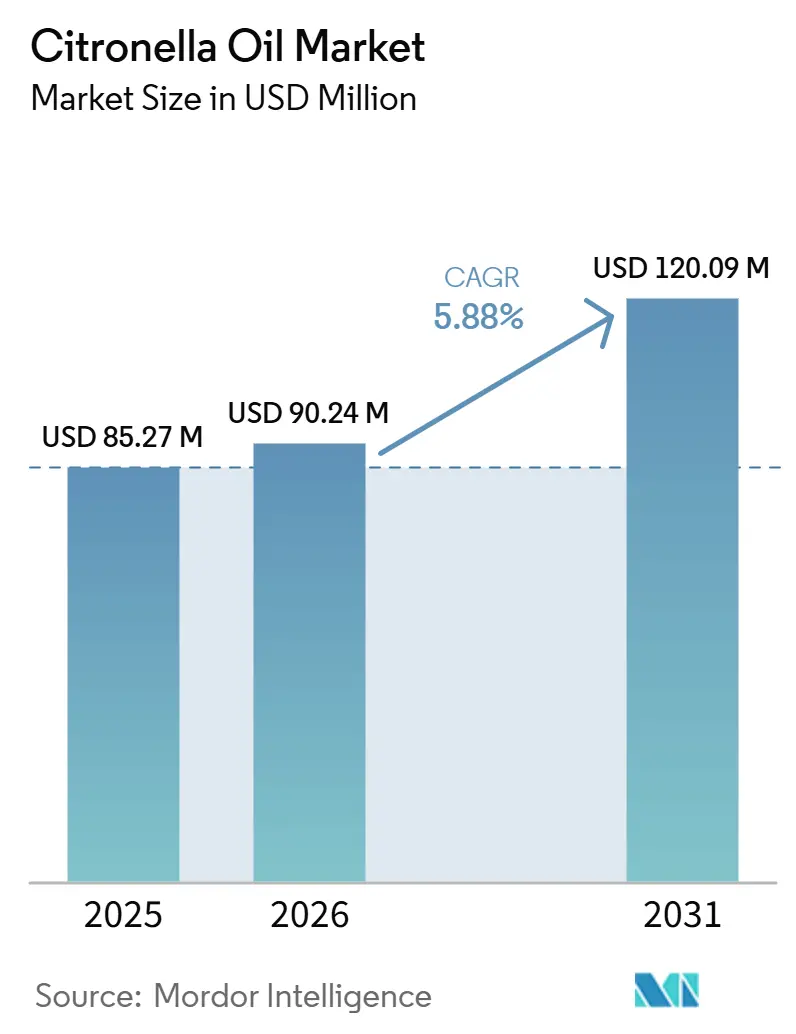
The citronella oil market size was valued at USD 85.27 million in 2025 and estimated to grow from USD 90.24 million in 2026 to reach USD 120.09 million by 2031, at a CAGR of 5.88% during the forecast period (2026-2031). Demand is moving beyond traditional mosquito-repellent uses into personal care, home fragrance, wellness, and specialty-ingredient applications, as buyers seek plant-based materials with familiar safety and labeling profiles. Citronella’s status as a biochemical pesticide under United States law helps eligible minimum-risk products reach the market without the full registration process required for many conventional pesticides. This supports new sprays, candles, lotions, and home-use products, although the citronella oil market still faces a practical limitation: conventional formulations tend to lose effectiveness more quickly than some synthetic repellents. Research on controlled-release systems is important because encapsulation can reduce volatility and extend the release of the active oil. The citronella oil market is therefore shaped by a balance between demand for natural ingredients, the need for reliable efficacy, and the availability of consistently documented supply.
Key Report Takeaways
- By type, Java citronella oil accounted for 57.73% of the market revenue in 2025, while Ceylon citronella oil is projected to grow at a CAGR of 6.46% through 2031.
- By category, conventional citronella oil accounted for 73.56% of the market revenue in 2025, while organic citronella oil is expected to grow at a CAGR of 7.45% through 2031.
- By application, household and home care accounted for 46.08% of the citronella oil market in 2025, while beauty and personal care is projected to register a CAGR of 6.59% through 2031.
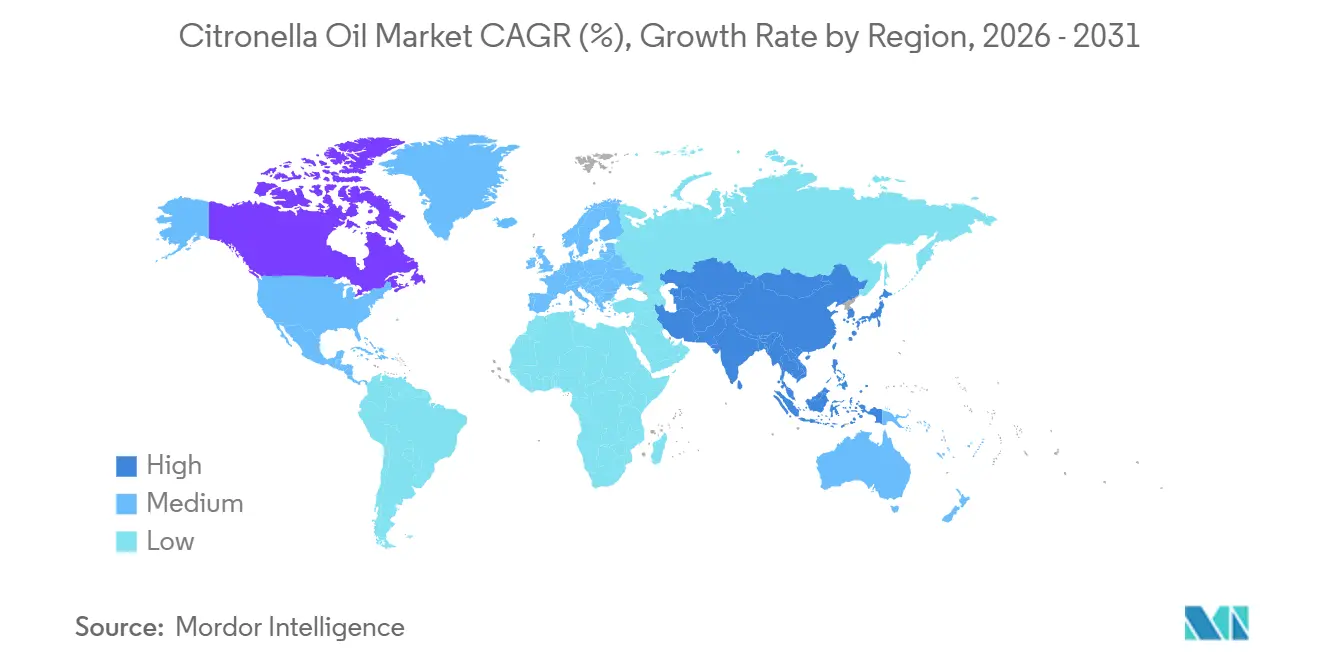
- By geography, Asia-Pacific accounted for 38.36% of the market revenue in 2025 and is projected to grow at a CAGR of 6.26% through 2031.
Note: Market size and forecast figures in this report are generated using Mordor Intelligence’s proprietary estimation framework, updated with the latest available data and insights as of January 2026.
Market Trends and Insights
Drivers Impact Analysis of Citronella Oil Market*
| Driver | (~) % Impact on CAGR Forecast | Geographic Relevance | Impact Timeline |
|---|---|---|---|
| Rising demand for natural mosquito repellents | +2.1% | Global, strongest in North America, Europe, and endemic areas of Asia-Pacific | Short term (≤ 2 years) |
| Expansion of aromatherapy and wellness products | +0.9% | North America and Europe, with growth in Asia-Pacific and the Middle East and Africa | Medium term (2-4 years) |
| Demand for botanical fragrance ingredients | +0.8% | Europe and North America | Medium term (2-4 years) |
| Vector-borne disease prevention spending | +0.7% | Global, especially South and Southeast Asia, Sub-Saharan Africa, and Latin America | Short term (≤ 2 years) |
| Clean-label personal care formulations | +0.6% | North America and Europe | Medium term (2-4 years) |
| Controlled-release citronella formulations | +0.4% | Global, especially premium segments in North America, Europe, and Asia-Pacific | Long term (≥ 4 years) |
| Source: Mordor Intelligence | |||
Rising Demand for Natural Mosquito Repellents
The citronella oil market benefits from consumer interest in alternatives to DEET and other synthetic repellent ingredients, particularly in products intended for frequent household use. The U.S. Environmental Protection Agency classifies citronella oil as a biochemical pesticide, and qualifying products may be exempt under 40 CFR 152.25(f)[1]Source: United States Environmental Protection Agency, “Minimum Risk Pesticides Exempted from FIFRA Registration,” EPA.gov.. This approach lowers a barrier for product developers who use citronella in candles, sprays, and lotions, while still requiring attention to labeling and product claims. Citronella is also familiar to consumers, making it easier for brands to explain the ingredient's role in personal and outdoor-use products. Scientific literature continues to show that essential-oil repellents have shorter protection periods than established synthetic alternatives, but their biodegradability and lower perceived toxicity remain relevant purchase factors. For the citronella oil market, this means that accessibility and perceived gentleness can support volume, even as higher-risk settings continue to require stronger, longer-lasting protection.
Expansion of Aromatherapy and Wellness Products
The citronella oil market draws demand from aromatherapy and home-wellness products because the oil can offer fragrance as well as functional repellency. Van Aroma identifies citronella Java oil for use in aromatherapy, fragrances, cosmetic applications, and functional ingredient systems, illustrating the range of end uses open to qualified suppliers. This breadth can give producers a steadier base of demand than a business tied only to mosquito seasons in temperate countries. Home diffusers, scented candles, room sprays, and topical wellness products allow the ingredient to reach multiple retail channels. Buyers in Europe and North America tend to seek documented quality and consistent composition for these uses, which gives certified material a stronger position than undifferentiated commodity oil. The citronella oil market can also benefit when wellness applications drive year-round purchasing, even as seasonal outdoor-repellent demand weakens.
Demand for Botanical Fragrance Ingredients
Citronella oil is a primary commercial source of citronellal, geraniol, and citronellol, the three monoterpene compounds that underpin a wide range of fine fragrance, soap, and detergent accords. ISO 3848:2016, the international quality standard for Java-type citronella oil, mandates citronellal content between 31.0-40.0% and geraniol between 20.0-25.0%, benchmarks that directly govern ingredient acceptance by the fragrance industry. IFRA's 51st Amendment, progressively implemented through 2025, introduced tighter restrictions on geraniol usage in deodorant and underarm products, compelling formulators to back-calculate citronella usage levels more rigorously, an indirect compliance discipline that benefits suppliers with traceable, GC-MS-documented batches over commodity brokers. Van Aroma's Citronellal Natural 85%+ product carries Credo Clean Standard, Halal, and IFRA-compliant certifications, demonstrating that suppliers with multi-framework documentation can access premium European and North American fragrance buyers at a meaningful price premium over non-certified alternatives. The fragrance-to-commodity price spread for certified citronella oil has created a bifurcated supplier landscape where documentation quality, not just production scale, determines access to high-value accounts.
Rising Vector-Borne Disease Prevention Spending
Public health expenditure on vector control is directly correlated with demand for citronella oil-based repellent products, particularly across endemic markets in South Asia, Southeast Asia, Sub-Saharan Africa, and Latin America. The CDC's Division of Vector-Borne Diseases requested USD 114.6 million for FY2025, and the organization's 2024 National Public Health Strategy formalized a multi-agency federal response framework for VBD prevention and control[2]Source: Centers for Disease Control and Prevention, “National Public Health Strategy to Prevent and Control Vector-Borne Diseases in People,” CDC.gov.. WHO's 2026-2027 program budget allocations specifically include vector control and environmental health as funding priorities, reflecting a sustained intergovernmental commitment to reducing the mosquito-borne disease burden, which indirectly supports the adoption of natural repellent tools at community and household levels. The second-order driver here is that government-funded public health communications about dengue, malaria, and chikungunya act as zero-cost marketing for natural repellent actives; each disease outbreak advisory effectively reinforces consumer demand for affordable, accessible protection. Brazil, India, and Indonesia all fall within high-endemicity zones where this dynamic is most pronounced, linking government health investment to retail citronella oil sales with measurable immediacy.
Restraints Impact Analysis of Citronella Oil Market*
| Restraint | (~) % Impact on CAGR Forecast | Geographic Relevance | Impact Timeline |
|---|---|---|---|
| Competition from longer-lasting repellents | -1.3% | Global, strongest in North America and high-endemicity markets in Asia-Pacific and Africa | Short term (≤ 2 years) |
| Climate-driven variability in yield and composition | -0.8% | Asia-Pacific, with effects on South American supply | Medium term (2-4 years) |
| Inconsistent citronellal content and adulteration | -0.6% | Global, highest in price-sensitive channels in Asia-Pacific and Latin America | Medium term (2-4 years) |
| Regulatory and certification cost burden | -0.5% | Europe, North America, and global fragrance supply chains | Long term (≥ 4 years) |
| Source: Mordor Intelligence | |||
Competition from Longer-Lasting Synthetic Repellents
The citronella oil market faces direct competition from picaridin, IR3535, DEET, and newer natural active ingredients that provide longer documented protection periods. A 2025 field study found substantial protection from sustained-release IR3535 and DEET products against mosquitoes under field conditions. In July 2025, NC State University reported the first EPA registration for Mimikai’s natural undecanone-based repellent, which offered 8-hour mosquito protection and 4-hour tick protection. This reduces the distinction between natural products and short-duration products that citronella had long occupied. Citronella remains useful in household and low-intensity outdoor settings, but buyers in high-exposure environments are more likely to prioritize duration. The citronella oil market, therefore, needs effective encapsulation, clear use guidance, and product formats that match the protection level expected by each end user.
Climate-Driven Variability in Oil Yield and Composition
Citronella grass cultivation is highly sensitive to rainfall distribution, temperature, and humidity, with oil yield in Java recorded at 1.2% during the dry season versus 0.5% in the wet season, a greater than 50% seasonal swing that directly impacts supply reliability and distillate quality. Unpredictable monsoon patterns and elevated atmospheric moisture in Indonesia's primary growing regions periodically suppress herbage yield and dilute citronellal concentration, the key quality marker that ISO 3848 governs. Research from IOP Conference Series (Earth and Environmental Science, 2025) conducted in Indonesia's Gayo Highlands documented significant variation in Cymbopogon nardus suitability across elevation zones, confirming that small shifts in growing-region microclimates can materially alter production economics[3]Source: M. Nasir and H. Basri, “Analysis of the Suitability of Citronella Grass in the Gayo Highlands,” IOP Conference Series Earth and Environmental Science, IOPscience.iop.org. . Indian production, concentrated in Assam and Karnataka, follows a distinct seasonal pattern with harvest windows between June and December, and any disruption, drought, excessive rain, or delayed monsoon, cascades into short-term price spikes and formulation planning disruptions for international buyers. Supply advisories published in early 2026 by ingredient trader Ultra International noted tight supply conditions and reduced farmer participation in select citronella-producing regions, consistent with ongoing agro-climatic variability risks.
*Our forecasts treat driver/restraint impacts as directional, not additive. The impact forecasts reflect baseline growth, mix effects, and variable interactions.
Citronella Oil Market Segment Analysis
By Type:
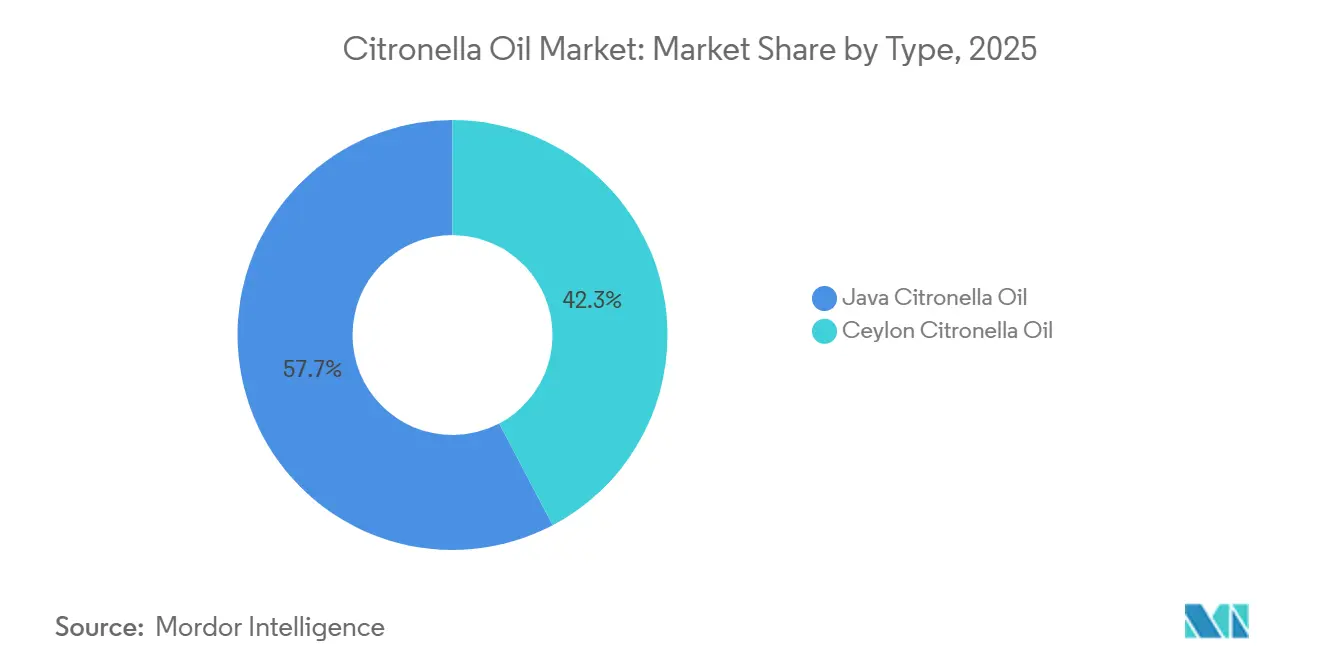
Java Citronella Oil Leads Supply and Formulation AccessJava citronella oil held 57.73% revenue share in 2025 because its composition and established supply base make it the preferred type for many fragrance and repellent formulations. It is derived from Cymbopogon winterianus and has a recognized quality framework under ISO 3848:2016, which defines expected ranges for citronellal and geraniol. The defined composition supports use by buyers who need repeatable fragrance and functional performance. Indonesia is a key source of Java-type material, while India also provides a significant supply to domestic processors and export customers. Van Aroma describes at-source Indonesian distillation and supplies certified Java oil to fragrance, cosmetic, and functional ingredient customers. The type’s production scale and established specifications give it a practical advantage for global buyers seeking consistent bulk availability.
Ceylon citronella oil is projected to grow at a 6.46% CAGR through 2031, making it the faster-growing type in the citronella oil market. It is derived from Cymbopogon nardus and is concentrated mainly in Sri Lanka, where it has a distinct composition that supports selected perfumery uses. ISO 3849:2003 for Sri Lankan-type citronella oil completed its systematic review and remained current in December 2025. EOAS Organics states that it produces Ceylon citronella oil in Sri Lanka and exports to customers across the Americas, Europe, the Middle East, and Asia-Pacific. The segment has less overall volume than Java type, but its differentiated profile can support premium positioning in specialized fragrance and pharmaceutical channels. This keeps Ceylon type commercially relevant even where Java type dominates mainstream procurement.


By Category:
Organic Grades Grow Faster Than Conventional SupplyConventional citronella oil accounted for 73.56% of the citronella oil market size in 2025, reflecting demand from household products, detergents, and mass-market fragrance manufacturers that prioritize price and dependable bulk supply. Indonesia, China, and India have broad networks of distillers that supply conventional grades. These grades remain important because large-volume users often cannot absorb the documentation and certification costs associated with organic sourcing. Conventional supply also supports basic candles, diffusers, sprays, soaps, and industrial fragrance applications. The category remains competitive because producers can offer similar material from several origins. Its continued role in the citronella oil market depends on whether suppliers can maintain acceptable quality without adding costs that make the product less competitive.
Organic citronella oil is forecast to grow at a 7.45% CAGR through 2031 as specialty retailers and premium personal care brands place greater weight on traceable botanical inputs. Organic certification can offer a clearer product story for shoppers and can help brands meet supplier-screening standards in North America and Europe. Nature’s Flavors lists certified organic citronella essential oil for food, fragrance, and personal care uses, showing the availability of this grade in specialty channels. Producers that maintain controlled cultivation and chain-of-custody records are better placed to serve this segment. The price premium can be attractive, although certification requires recurring audits and disciplined supply management. The citronella oil market is likely to retain a large conventional base while organic material takes a larger role in branded and higher-value applications.
By Application:
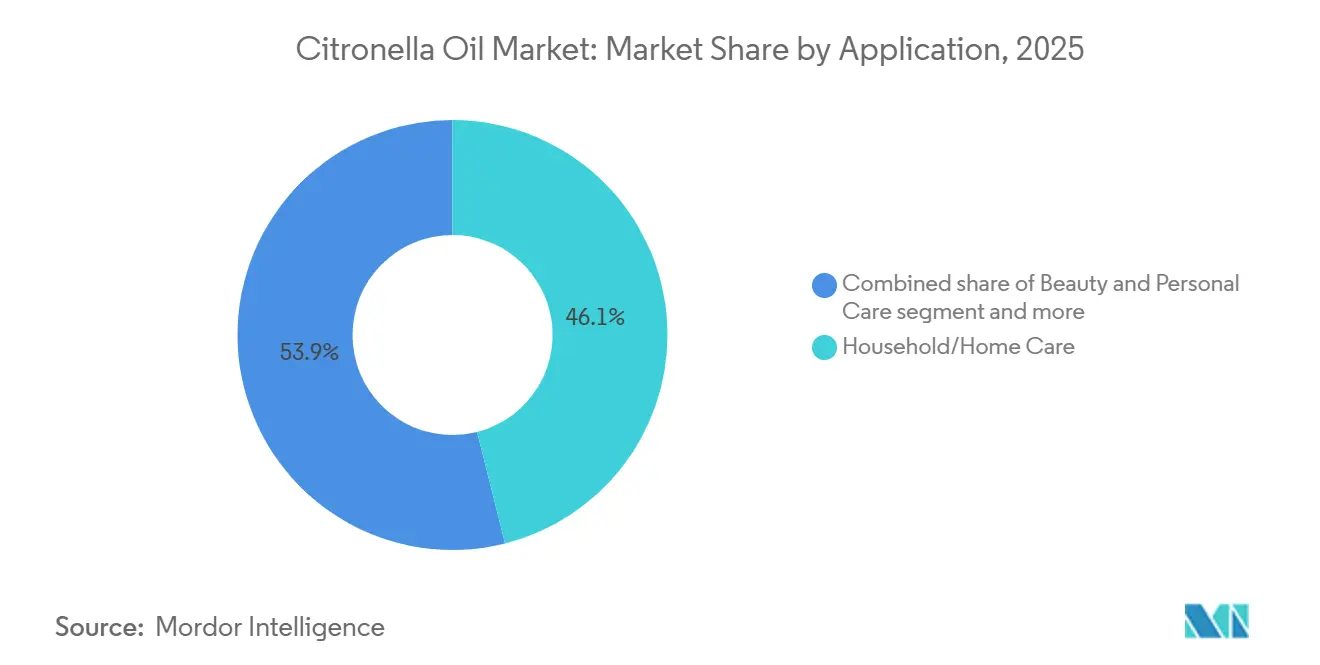
Home Care Remains the Volume Base While Beauty ExpandsHousehold and home care accounted for 46.08% of the citronella oil market size in 2025, supported by candles, diffusers, room sprays, and patio-use products. Citronella is familiar in these formats, and its association with outdoor comfort and mosquito avoidance supports repeat seasonal demand. In the United States, qualifying minimum-risk products can use the EPA pathway when they meet the conditions for ingredients, labeling, and claims. Maine’s Board of Pesticides Control issued a proposed policy in July 2026 covering a registration framework for citronella candles that make soft claims. Such guidance can give manufacturers clearer boundaries for household product development. Home care will remain important because it combines high-volume formats with established consumer awareness.
Beauty and personal care are expected to grow at a 6.59% CAGR through 2031, supported by natural deodorants, body washes, topical products, and fragrance-led formulations. The application gives suppliers access to products where composition, documentation, and sensory performance are more important than low cost alone. Food and beverage uses remain small but provide steady demand for flavor applications that leverage citronellal’s citrus-like profile. Pharmaceutical and antimicrobial uses are also being investigated, with a 2026 ACS Omega study reporting controlled citronella release from hydroxyapatite and sodium alginate matrices and antimicrobial activity against E. coli. These uses do not replace household demand, but they reduce dependence on any single product category. The citronella oil market can gain stability when suppliers serve several applications with different purchase cycles.

Geography Analysis
APAC Citronella Oil Market
Asia-Pacific held 38.36% of the citronella oil market share in 2025 and is projected to grow at a 6.26% CAGR through 2031. The region combines the main cultivation and distillation base with rising local consumption of personal care, wellness, and household products. Indonesia, Sri Lanka, India, China, and other producing countries have the tropical and subtropical conditions needed for citronella grass, as well as established essential-oil processing networks. Indonesia is particularly important for Java type material, while Sri Lanka remains closely tied to Ceylon type supply. India’s Assam and Karnataka regions also support cultivation and processing for domestic and export demand. Demand is rising in urban areas of India, China, and Southeast Asia as consumers purchase more formulated wellness, personal care, and home-fragrance products. High exposure to mosquito-borne disease in several countries adds a practical demand base for repellent formats. The CDC and WHO frameworks on vector-borne disease reinforce the broader importance of accessible personal protection and vector-control measures. Japan and China also provide higher-value customer bases where quality specifications can be strict. The citronella oil market in Asia-Pacific will depend on whether producers can pair agricultural scale with stronger testing, traceability, and consistent export documentation.
North America and Europe Citronella Oil Market
North America and Europe remain the main value-capture regions for certified, organic, and specification-led citronella oil purchases. Buyers in these regions often use the oil in premium personal care, fragrance, home-wellness, and outdoor household products. In North America, the EPA’s minimum-risk framework supports qualifying citronella products, although brands must carefully manage their ingredient selections and claims. Demand also reflects interest in alternatives to synthetic repellents, even though products with high-duration protection retain an important role. In Europe, fragrance and cosmetic buyers rely on standards and documentation that reward ISO-compliant material and supplier testing. Germany was the largest national market in Europe in 2025, supported by natural-product retail, fragrance processing, and distribution links. The United Kingdom, France, the Netherlands, and Spain add demand for specialty fragrance and personal care uses. These regions are less central to cultivation but more central to price realization for documented supply. The citronella oil market is likely to see continued separation between premium certified grades sold into these regions and lower-priced bulk grades sold through less formal channels.
South America and MEA Citronella Oil Market
South America and the Middle East and Africa add further demand, although each area follows a different pattern. Brazil is the leading South American outlet because recurring dengue and chikungunya concerns support household awareness of mosquito control, while its cosmetics sector provides a second route for botanical ingredients. Argentina and Mexico add demand through outdoor hospitality, tourism, and household uses such as candles and patio repellents. In the Middle East and Africa, the United Arab Emirates and South Africa operate as distribution points for imported essential oils and premium personal care ingredients. Sub-Saharan Africa has a greater need for accessible mosquito-protection products because malaria remains a major public health concern. The World Health Organization continues to place vector control within its program priorities, which supports the relevance of affordable protection tools. Currency pressure, transport gaps, and inconsistent retail access can limit near-term expansion in some countries. The citronella oil market can still grow in these areas when local distributors match product formats and price points to household purchasing conditions.

Competitive Landscape
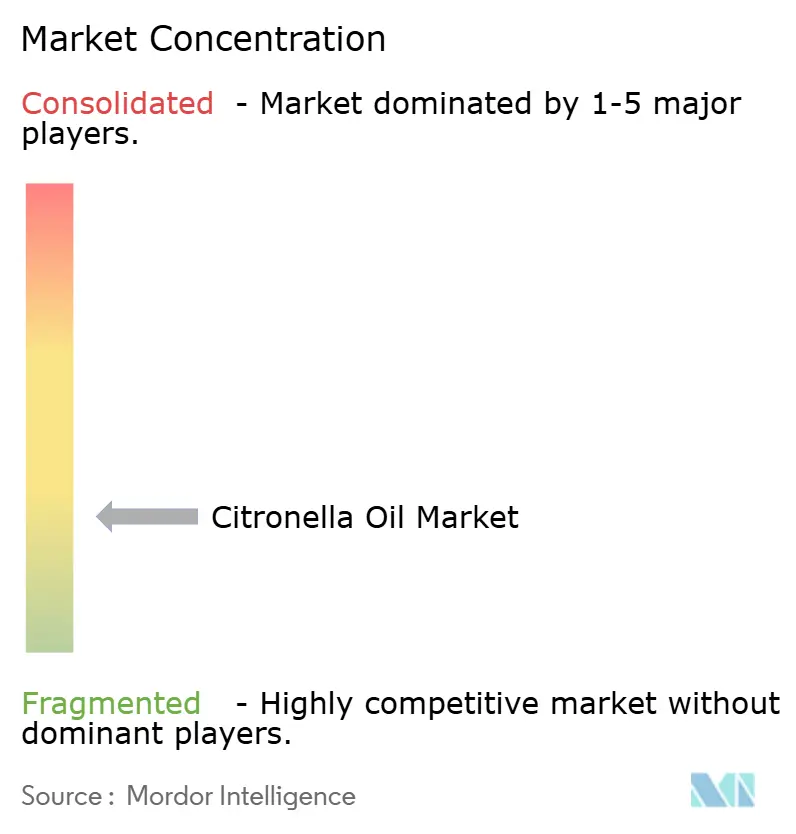
The citronella oil market is highly fragmented, leaving a large share of supply distributed among numerous small and mid-sized distillers. Van Aroma, Anhui Great Nation Essential Oils, EOAS Organics, Arora Aromatics, and Sivaroma Naturals are the leading named participants. No single producer has sufficient scale to set global prices or define quality requirements for the full market. Competition is therefore divided between suppliers with formal certification and traceable supply chains, and lower-cost brokers selling bulk material with less documentation. The first group can serve fragrance, personal care, and specialty customers that require batch testing and stable composition. The second group remains important for commodity household and industrial uses, where price is the central buying criterion. This structure keeps purchasing competitive but can lead to uneven quality outcomes across supply tiers. Companies that can verify composition and origin have more room to defend margins than companies that compete only on raw-material price. The citronella oil market is fragmented in production but increasingly selective in the premium accounts that determine access to higher-value demand.
Van Aroma’s strategy illustrates the importance of vertical integration in the citronella oil market. The company describes at-source Indonesian operations, processing capability, and a commercial presence that includes Indonesia, India, the United Arab Emirates, the United States, and the Netherlands. Its EFEO profile identifies FSSC 22000 certification and involvement in natural aroma ingredient supply. This structure can help the company manage raw-material sourcing, processing, quality control, and export relationships within one operating model. EOAS Organics has built a different position around Sri Lankan Ceylon-type material and international exports from its steam-distillation operations. Indian participants such as Arora Aromatics and Sivaroma Naturals can compete through essential-oil processing and higher-value derivatives such as citronellal, geraniol, and citronellol. Chinese producers retain volume advantages, but larger buyers are placing more weight on chain-of-custody and analytical documentation. The result is a competitive field where access to premium customers depends less on volume alone and more on whether the supplier can meet technical and compliance expectations.
The strongest opportunity for suppliers is in certified organic material and value-added derivatives, where the available supply is less developed than demand from premium personal care and fine fragrance customers. ISO standards for Java and Sri Lankan types provide a recognized route for suppliers to demonstrate product consistency. Fragrance buyers also benefit from suppliers that can provide constituent-level documentation aligned with IFRA requirements. Microencapsulation is another route to differentiation because it may help suppliers address citronella’s short conventional protection period. In July 2026, Van Aroma launched an Outdoor Living botanical suite featuring Citronella Java and Lemongrass Oil for personal care and home-fragrance customers. In March 2026, the company also presented sourcing and formulation capabilities at SIMPPAR 2026. These actions show that suppliers are competing not only through bulk oil, but also through product concepts, certification, technical service, and greater control over the route from farm to customer.
Citronella Oil Industry Leaders
Van Aroma
Anhui Great Nation Essential Oils Co., Ltd.
EOAS International
Arora Aromatics Pvt. Ltd.
Sivaroma Naturals Pvt. Ltd.
- *Disclaimer: Major Players sorted in no particular order
Citronella Oil Market Companies Covered in this Report
- Van Aroma
- Anhui Great Nation Essential Oils Co., Ltd.
- Jiangxi Hengcheng Natural Flavor Oil Co., Ltd.
- Nanchang Yang Pu Natural Essence & Spice Co., Ltd.
- EOAS Organics / EOAS International
- PT Karimun Kencana Aromatics
- Yunnan Aroma Source
- Yunnan Tian Lake Essential Oil Company Ltd.
- Manohar Botanical Extracts Pvt. Ltd.
- Reho Natural Ingredients
- Arora Aromatics Pvt. Ltd.
- Sivaroma Naturals Pvt. Ltd.
- Blue Hills & Company
- Mane KANCOR Ingredients Pvt. Ltd. / MANE Group
- AG Organica Pvt. Ltd.
- AOS Products Pvt. Ltd.
- Rakesh Sandal Industries
- VDH Organics Pvt. Ltd.
- Kunshan Odowell Co., Ltd.
- Shiv Shakti India

Recent Industry Developments in Citronella Oil Market
- July 2026: Van Aroma launched its "Outdoor Living" botanical suite featuring Citronella Java and Lemongrass Oil, positioning the paired ingredient offering for personal care and home fragrance brands seeking functional natural repellency credentials with a premium aromatic profile.
- June 2026: Maine's Board of Pesticides Control issued a proposed policy establishing a "soft claims" framework for citronella candle registration under FIFRA Section 25(b), creating a streamlined pathway for products with ≥3% citronella, making non-specific repellency suggestions.


Global Citronella Oil Market Report Scope
Citronella oil is an essential oil extracted from citronella grass, widely used for its fragrance, insect-repellent properties, and functional benefits in personal care, household, and industrial applications. The citronella oil market is segmented by type, category, application, and geography. By type, the market includes Java citronella oil and Ceylon citronella oil. Based on category, the market is divided into conventional and organic citronella oil. By application, the market covers food and beverage, beauty and personal care, pharmaceuticals, household/home care, and other applications. By geography, the report covers North America, Europe, Asia-Pacific, South America, and the Middle East and Africa, with market size and forecasts provided for each region. The market forecasts are provided in terms of value (USD) and volume(Liters).
| Java Citronella Oil |
| Ceylon Citronella Oil |
| Conventional |
| Organic |
| Food and Beverage |
| Beauty and Personal Care |
| Pharmaceuticals |
| Household/Home Care |
| Other Applications |
| North America | United States |
| Canada | |
| Mexico | |
| Rest of North America | |
| Europe | Germany |
| United Kingdom | |
| Italy | |
| France | |
| Spain | |
| Netherlands | |
| Rest of Europe | |
| Asia-Pacific | China |
| India | |
| Japan | |
| Australia | |
| South Korea | |
| Rest of Asia-Pacific | |
| South America | Brazil |
| Argentina | |
| Rest of South America | |
| Middle East and Africa | South Africa |
| United Arab Emirates | |
| Rest of Middle East and Africa |
| By Type | Java Citronella Oil | |
| Ceylon Citronella Oil | ||
| By Category | Conventional | |
| Organic | ||
| By Application | Food and Beverage | |
| Beauty and Personal Care | ||
| Pharmaceuticals | ||
| Household/Home Care | ||
| Other Applications | ||
| By Geography | North America | United States |
| Canada | ||
| Mexico | ||
| Rest of North America | ||
| Europe | Germany | |
| United Kingdom | ||
| Italy | ||
| France | ||
| Spain | ||
| Netherlands | ||
| Rest of Europe | ||
| Asia-Pacific | China | |
| India | ||
| Japan | ||
| Australia | ||
| South Korea | ||
| Rest of Asia-Pacific | ||
| South America | Brazil | |
| Argentina | ||
| Rest of South America | ||
| Middle East and Africa | South Africa | |
| United Arab Emirates | ||
| Rest of Middle East and Africa | ||


Key Questions Answered in the Report
What is the projected size of the citronella oil sector by 2031?
It is projected to reach USD 120.09 million by 2031, expanding at a 5.88% CAGR from 2026.
Which citronella oil type has the largest share?
Java citronella oil led with 57.73% of revenue in 2025, supported by its established supply base and ISO-defined composition.
Why is organic citronella oil growing faster?
Organic grades are projected to grow at 7.45% CAGR because premium personal care and specialty retail buyers seek traceable botanical ingredients.
What is the largest application for citronella oil?
Household and home care led with 46.08% of revenue in 2025 through candles, diffusers, room sprays, and outdoor products.
Page last updated on:





