
China Seed Processing Machinery Market Size and Share
Market Overview
| Study Period | 2021 - 2031 |
|---|---|
| Forecast Data Period | 2026 - 2031 |
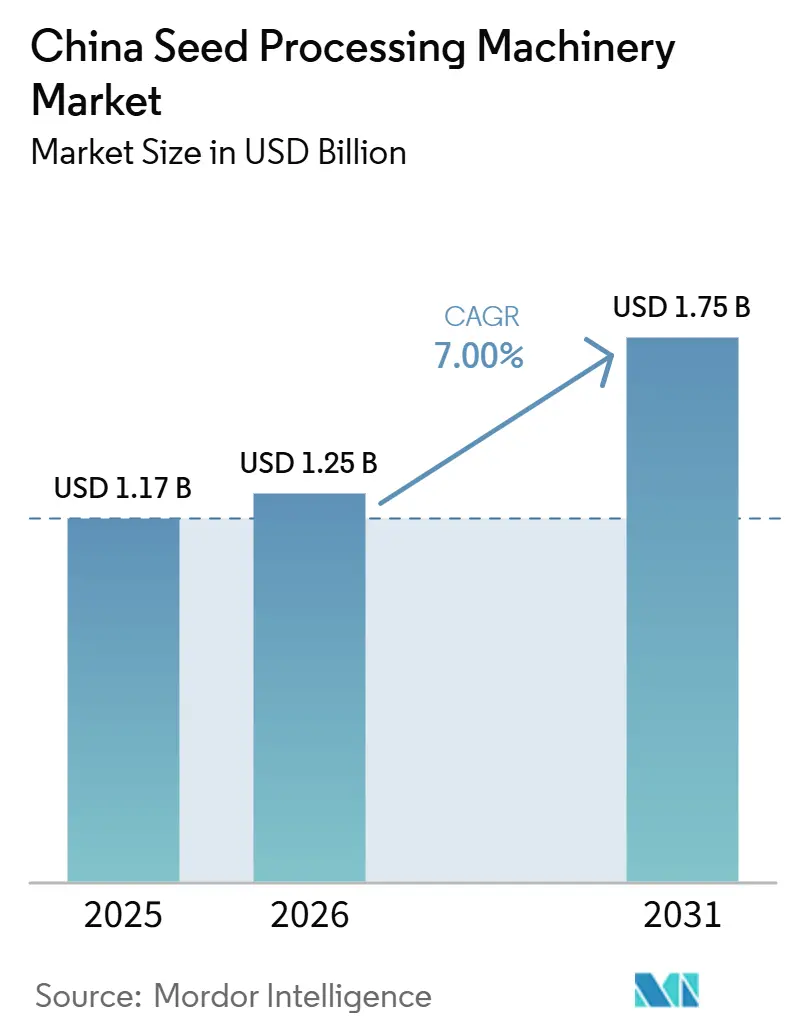
| Base Year Market Size (2025) | USD 1.17 Billion |
| Market Size (2026) | USD 1.25 Billion |
| Market Size (2031) | USD 1.75 Billion |
| Growth Rate (2026 - 2031) | 7.00 % |
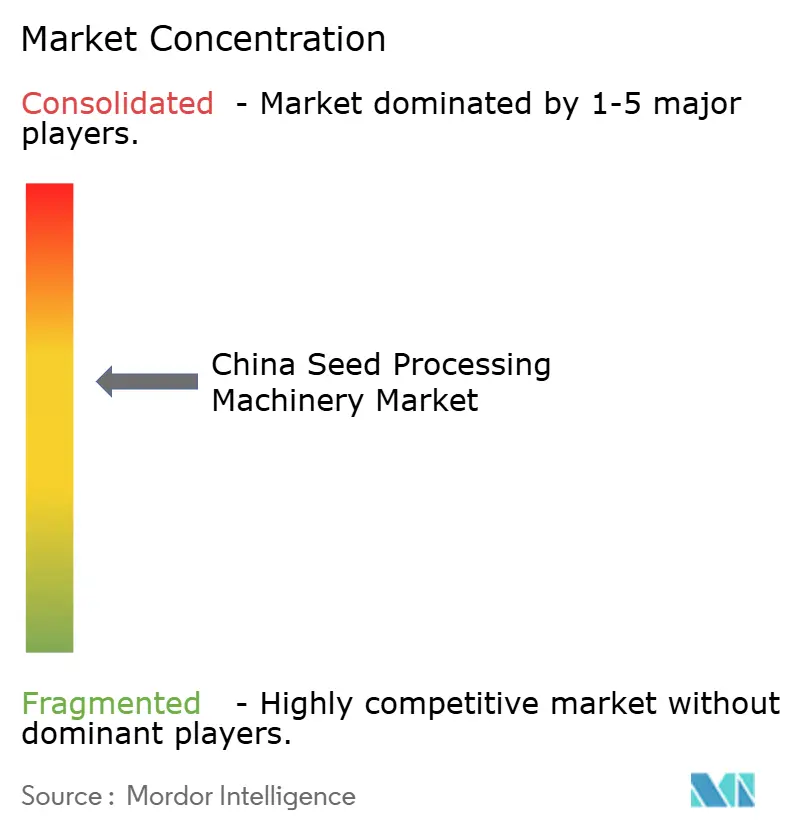
| Market Concentration | Medium |
Major Players *Disclaimer: Major Players sorted in no particular order Image © Mordor Intelligence. Reuse requires attribution under CC BY 4.0. | |
China Seed Processing Machinery Market Analysis by Mordor Intelligence
The China seed processing machinery market was valued at USD 1.17 billion in 2025 and is estimated to grow from USD 1.25 billion in 2026 to reach USD 1.75 billion by 2031, at a CAGR of 7% during the forecast period (2026-2031). This growth is driven by stricter seed certification regulations, machinery subsidies, and rising demand for consistent seed quality. Processing plants are shifting from basic air-screen cleaning to integrated lines that combine grading, destoning, optical sorting, treatment, and packaging. Certification and traceability requirements are also increasing the value of connected equipment, as processors need reliable records for each seed lot. Domestic suppliers benefit from lower equipment prices, while international suppliers maintain positions in advanced sorting and turnkey installations. Investment is anticipated to remain concentrated in commercial processing plants and faster-growing seed production regions.
Key Report Takeaways
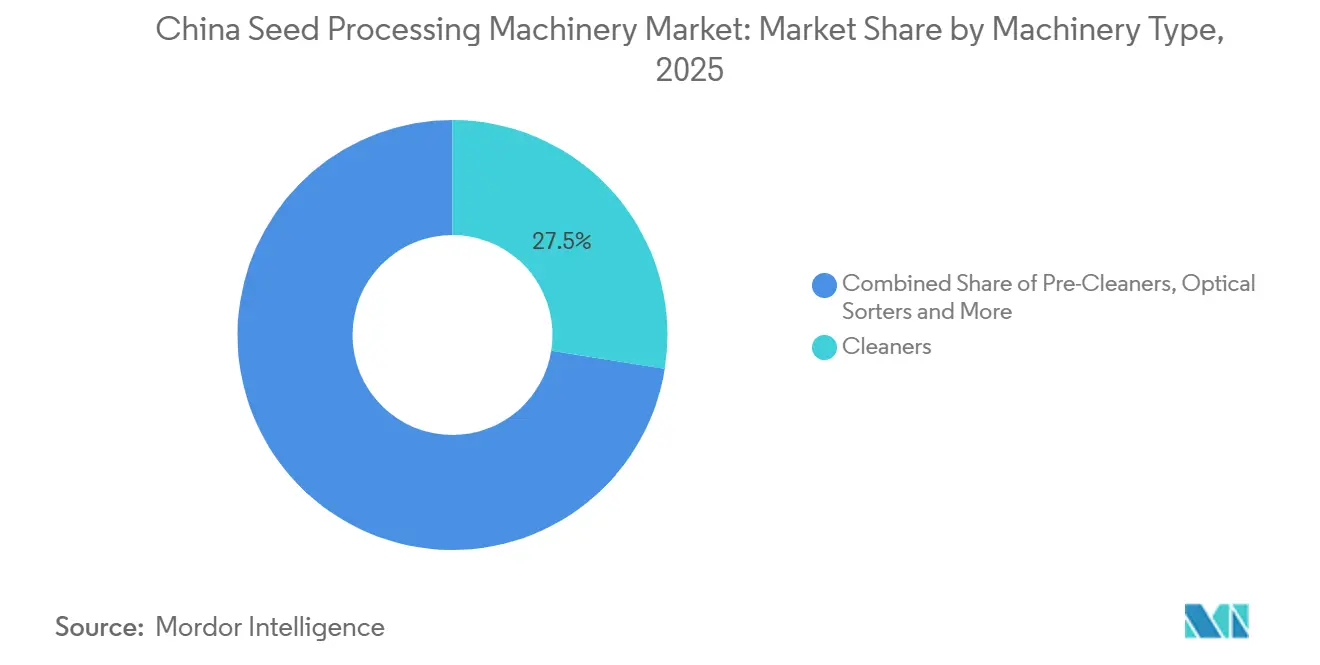
- By machinery type, cleaners led with 27.5% of the China seed processing machinery market share in 2025, while optical sorters is forecast to be the fastest growing at an 11.5% CAGR through 2031.
- By operation mode, automatic systems held 65% of the China seed processing machinery market share in 2025 and are the fastest with a projected CAGR at 8.5% through 2031.
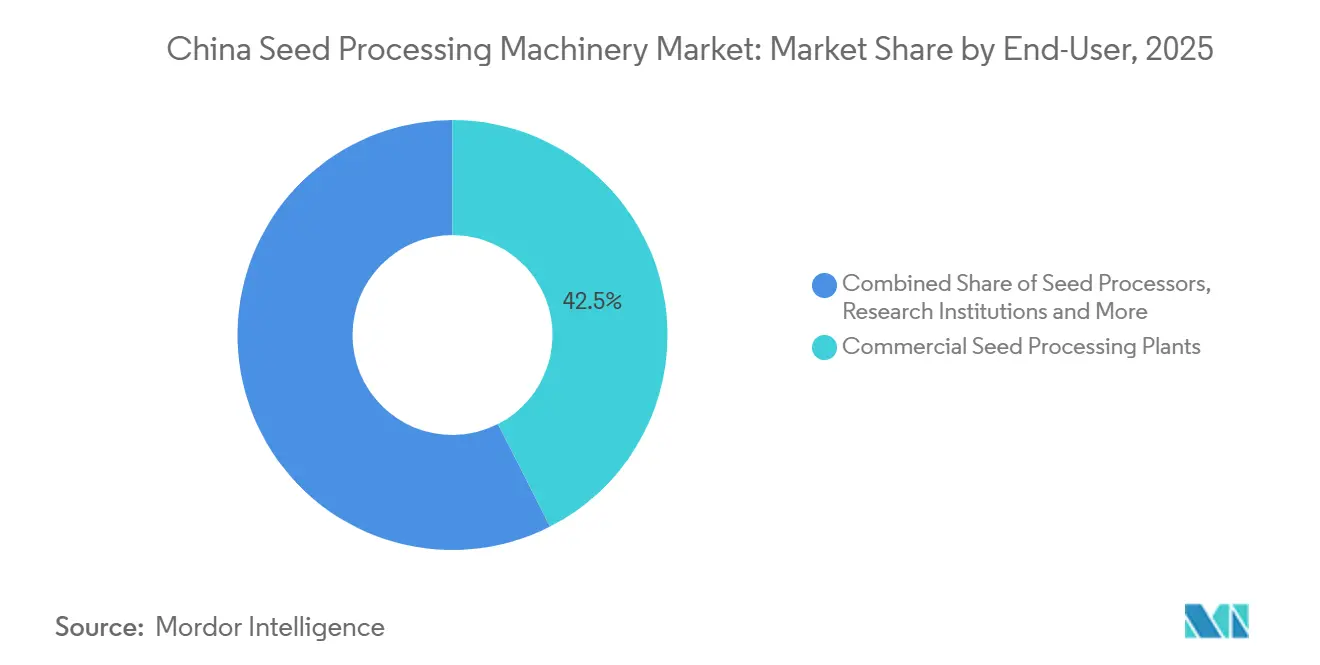
- By end user, commercial seed processing plants accounted for 42.5% of the China seed processing machinery market in 2025 and are advancing as the fastest-growing segment at an 8% CAGR through 2031.
Note: Market size and forecast figures in this report are generated using Mordor Intelligence’s proprietary estimation framework, updated with the latest available data and insights as of January 2026.
China Seed Processing Machinery Market Trends and Insights
Drivers Impact Analysis*
| Driver | (~) % Impact on CAGR Forecast | Geographic Relevance | Impact Timeline |
|---|---|---|---|
| Expansion of Certified Seed Production | +1.80% | China-wide, with the strongest impact across Northeast China, East China, and Northwest China | Medium term (2–4 years) |
| Government Subsidies for Seed Processing Equipment | +1.50% | China-wide, particularly across Gansu, Xinjiang, Heilongjiang, Shandong, Anhui, and Zhejiang | Short term (≤ 2 years) |
| Automation of Seed Quality Inspection | +1.30% | National, with faster adoption across processing hubs in East China and North China | Medium term (2–4 years) |
| Rising Demand for Export-Grade Seed Purity | +0.90% | East China, particularly Jiangsu, Zhejiang, and Shandong, with spillover demand in Northeast China | Medium term (2–4 years) |
| Growth of Contract Seed Processing | +0.60% | Central China and North China cooperative seed-processing networks, with increasing activity in Xinjiang | Medium term (2–4 years) |
| Digital Traceability Requirements in Seed Processing | +0.40% | National, with early implementation in Heilongjiang, Shandong, Hebei, and Xinjiang | Long term (≥ 4 years) |
| Source: Mordor Intelligence | |||
Expansion of Certified Seed Production
China's first certified seeds reached commercial markets in early 2025, following the accreditation of 2 certification bodies and the registration of the first certification inspectors in 2024. The new system imposes stricter requirements for physical purity and germination than the previous approach. As a result, processors require graders, destoners, coaters, and cleaners within the same production line, making a basic cleaner insufficient for certified production needs. MARA's 2025 action on crop variety homogenization further supports the use of traceable, high-purity varieties. This is directing more capital spending toward post-harvest seed handling. The impact is most pronounced in Northeast China, where soybean and corn seed certification is expanding. The China seed processing machinery market stands to benefit as certification converts quality control from a voluntary process into a production requirement.
Government Subsidies for Seed Processing Equipment
The central government's 2025 subsidy list includes seed initial-processing equipment within agricultural machinery purchase support. This support is in accordance with the 2024-2026 national machinery purchase and application subsidy guidelines. Provincial programs can supplement central support and improve the economics of larger projects. Gansu seed production counties have provided facility and equipment subsidies covering up to 40% of installation costs[1]Source: Ministry of Agriculture and Rural Affairs of the People’s Republic of China, “2025 Central Finance Agriculture Subsidy Policy List 2,” MARA, yk.gov.cn. The national framework prioritizes high-performance and intelligent equipment, including optical sorters and automated grading systems. This makes replacing older mechanical lines more feasible for processors. The policy also increases the appeal of complete, multi-stage systems over stand-alone machines. Demand in China's seed processing machinery market is supported across major growing provinces, as the eligible equipment category is clearly defined.
Automation of Seed Quality Inspection
Optical sorting and machine vision are replacing parts of manual seed inspection. In 2025, researchers from the Chinese Academy of Sciences and the Hefei Institutes of Physical Science developed a nondestructive prototype for detecting and sorting rice seed vitality. The Hunan Provincial Agricultural Society validated the project, which reported near-100% post-sorting germination rates. Domestic AI-enabled sorters were priced at USD 105,000 per channel, compared with USD 235,000 for imported systems. The lower price allows medium-sized processors to consider upgrades with a 3–4 year payback period. Buyers can add an optical sorting module to an existing mechanical line rather than replacing the entire line. This modular approach broadens the buyer base beyond national seed enterprises and creates opportunities for suppliers that can integrate new sorting equipment with legacy infrastructure.
Rising Demand for Export-Grade Seed Purity
Export-oriented seed processors face higher purity and documentation requirements from overseas buyers. The revised General Directive for Labeling of Agricultural Seeds was published in October 2024 and took effect in October 2025[2]Source: Organisation for Economic Co-operation and Development, “China, Agricultural Policy Monitoring and Evaluation 2025,” OECD, oecd.org. It requires QR codes that link packages to production, logistics, and processing data. This increases demand for packaging equipment with digital printing, batch coding, and database integration capabilities. In 2025, Jiangsu accounted for 22.5% of domestic machinery output, and Shandong accounted for 37.5%, reflecting the concentration of sophisticated processing capacity in East China. Connected packaging and in-line monitoring can help processors meet both product quality and documentation requirements. As equipment that was once optional becomes part of a compliance-oriented investment, demand in the China seed processing machinery market is estimated to grow.
Restraints Impact Analysis*
| Restraint | (~) % Impact on CAGR Forecast | Geographic Relevance | Impact Timeline |
|---|---|---|---|
| High Upfront Cost of Optical Sorting Systems | -1.50% | China-wide, with the greatest impact on processors across Central China, Southwest China, and Northwest China | Medium term (2–4 years) |
| Fragmented Demand Among Small and Medium Processors | -1.00% | Central China and North China, particularly county-level seed processing operations | Long term (≥ 4 years) |
| Shortage of Skilled Commissioning and Maintenance Technicians | -0.80% | National, with the largest workforce gap across Northwest China and Southwest China | Medium term (2–4 years) |
| Inconsistent Data and Compliance Requirements Across Provinces | -0.60% | National, with the highest regulatory complexity in Xinjiang, Inner Mongolia, and Yunnan | Medium term (2–4 years) |
| Source: Mordor Intelligence | |||
High Upfront Cost of Optical Sorting Systems
Domestic optical sorters cost USD 105,000 per channel, while imported systems cost USD 235,000 per channel. Both prices are significantly above the USD 11,500 entry price of a small domestic air-screen cleaner. Most of China's estimated 25,000 installed processing lines handle less than 500 tonnes of seed per season. These operators often cannot justify the cost of optical sorting equipment within a payback period of less than 5 years. Retrofitting an optical sorter into an older mechanical line can add a 22.5% integration cost premium, raising the financial hurdle even when buyers do not replace the entire line. Equipment leasing and service-based models could reduce the initial financial burden, but subsidy eligibility still favors equipment purchases. Until financing options expand or equipment prices decline, cost will remain a limiting factor for adoption in smaller processing operations.
Fragmented Demand among Small and Medium Processors
Small and medium processors typically purchase individual machines rather than integrated lines. County-level cooperatives and village-scale facilities usually replace failed components rather than upgrading entire systems, keeping average order values below USD 60,000 in the lower tier of the China seed processing machinery market. Large national seed enterprises, by contrast, can invest USD 1.2 million or more in turnkey systems, while small processors generally focus on stand-alone machines priced below USD 25,000. Online platform procurement accounted for 12% of seed market transactions in 2025, making price comparison easier for buyers and reducing suppliers' ability to differentiate on technical support and service. To serve buyers who build processing capacity in stages, suppliers need to offer modular product designs.
*Our forecasts treat driver/restraint impacts as directional, not additive. The impact forecasts reflect baseline growth, mix effects, and variable interactions.
Segment Analysis
By Machinery Type: Cleaning Equipment Leads Revenue While Optical Sorting Grows Fastest
Cleaners accounted for 27.5% of revenue in 2025, making it the largest machinery category. Optical sorters is forecast to grow at the fastest rate, with a 11.5% CAGR through 2031, the highest among machinery types. Optical sorters generated 7–9 times the revenue per unit of standard cleaners, reflecting their domestic price of USD 105,000 per channel. Commercial plants increasingly specify multi-channel installations, so sorting revenue can rise faster than machine volumes.
China's AI-powered seed sorting represents a structural shift rather than an incremental upgrade. Research published by the Chinese Academy of Sciences (CAS) has validated a nondestructive laser-spectroscopy seed vitality detection system, achieving near-100% post-sorting germination rates. This indicates that future generations of optical sorters in China will be capable of detecting internal seed defects, an area where current equipment is limited to surface-level assessment. This capability gap between current and next-generation sorting is driving a replacement cycle for optical equipment, which domestic suppliers, including Hefei Taihe and Anhui Zhongke, are positioning to capture before international competitors can reprice their products.



By Operation Mode: Automatic Systems Extend Their Lead
Automatic systems accounted for 65% of revenue in 2025 and are forecast to grow at an 8.5% CAGR through 2031. Automatic lines operating at 10-20 tonnes per hour require 2 operators, compared with 6-8 operators for semi-automatic equivalents. The MARA Smart Agriculture Action Plan 2024-2028 promotes AI, IoT, and automated machinery across the agricultural supply chain. The China seed processing machinery market is moving toward systems that provide steadier throughput with fewer operators.
Many mid-scale processors are adding automated controls to existing semi-automatic lines rather than replacing full systems. Upgrades can include HMI touchscreens, automated aspirators, and PLC-integrated conveying. This approach is relevant in Central and North China, where many installations from the 2010s are entering their second decade of operation. Cimbria completed a digitalized seed-cleaning line featuring HMI touchscreens, automated conveying, Delta cleaning equipment, and gravity tables. Retrofit kits generate upgrade revenue for suppliers and offer processors a lower-cost path to traceability compliance.
By End User: Commercial Plants Set Equipment Requirements
Commercial seed processing plants accounted for 42.5% of the China seed processing machinery market in 2025 and are forecast to grow at an 8% CAGR through 2031. Research institutions represent a smaller but strategically important segment in which advanced seed vitality testing and small-batch optical sorting are prioritized over throughput economics. The dominance of commercial seed processing plants reflects state policy, as certified seed production mandates and export-quality protocols are enforced at the commercial plant level rather than at the farm level, directing subsidy-supported capital investment to these sites.
Contract processing is changing machinery requirements at commercial plants. Plants handling third-party lots require multi-crop compatibility and rapid changeovers, rather than maximum single-crop throughput. Origin Agritech's Xinjiang facility integrates cleaning, drying, threshing, precision sorting, coating, and packaging. This configuration is becoming more relevant to domestic contract processors. Suppliers that design flexible lines from the outset can avoid costly retrofits later.
Geography Analysis
East China remains the largest market for seed processing equipment in 2025, supported by the dense concentration of commercial seed processing facilities in Jiangsu, Shandong, and Henan. Strong agricultural output, efficient logistics, and proximity to major domestic and export markets continue to sustain equipment demand. As most large plants completed major modernization between 2024 and 2025, investment is now shifting toward automation upgrades and equipment replacement. North and Northeast China are expanding more rapidly, driven by commercial seed production and government support for soybean seed-processing technologies.
Central China continues to benefit from the expansion of hybrid rice seed production and certification programs in Hubei and Hunan, increasing demand for precision grading, cleaning, and optical sorting equipment. South China records relatively moderate growth due to its focus on vegetable seeds, sugarcane, and other specialty crops, which require smaller, customized processing systems. Southwest China is emerging as a growing market, supported by crop improvement programs in Yunnan and Sichuan and rising demand for flexible processing solutions suited to diverse crop varieties.
Northwest China is projected to be the fastest-growing regional market during the forecast period as government initiatives accelerate the modernization of commercial seed production[3]Source: United States Department of Agriculture Foreign Agricultural Service, “Planting Seeds Annual 2025,” USDA FAS GAIN Report, apps.fas.usda.gov. Gansu is witnessing significant investments in automated corn seed processing facilities through subsidy programs, while Xinjiang is expanding processing capacity for corn, cotton, and sunflower seeds. Rising investments in integrated processing infrastructure and China's continued emphasis on domestic seed security are anticipated to make the region a key growth area for seed processing equipment suppliers.
Competitive Landscape
The China seed processing machinery market is moderately fragmented in 2025, with both international and domestic manufacturers competing across different equipment categories. The five major players operating in the market are Bühler AG, Satake Corporation, Hefei Taihe Intelligent Technology Group Co., Ltd, Anhui Zhongke Optic-electronic Color Sorter Machinery Co., Ltd., and AGI. Global companies maintain a strong presence in high-value technologies such as optical sorting and turnkey processing systems, while domestic manufacturers dominate mechanical cleaning, grading, separation, and packaging equipment through competitive pricing, localized manufacturing, and extensive after-sales support. No single supplier holds sufficient market concentration to significantly influence pricing, resulting in a highly competitive environment.
Technology innovation is increasingly shaping competition in the premium segment. In 2025, Bühler AG introduced the SORTEX AI700 optical sorter, which incorporates deep learning to improve contaminant detection and sorting efficiency. Similarly, Hefei Taihe (Hefei Meyer) expanded its AI-based sorting capabilities through a partnership with Kingfa Technology, reflecting the growing global competitiveness of Chinese equipment manufacturers. These developments indicate the industry's transition toward intelligent, AI-enabled seed processing solutions.
A significant opportunity exists in supplying modular, connected processing lines for county-level processors and cooperatives. International manufacturers often face higher localization and service costs, while many domestic suppliers continue to compete primarily on price with limited digital functionality. Growing adoption of machine vision, AI-powered inspection, and data connectivity is narrowing this gap, as demonstrated by Anhui Zhongke Optic-electronic Color Sorter Machinery Co., Ltd..'s launch of its LUX Series AI optical sorter in 2026. Suppliers that combine intelligent automation, modular equipment design, and strong regional service networks are anticipated to strengthen their competitive position over the forecast period.
China Seed Processing Machinery Industry Leaders
Bühler AG
Satake Corporation
Hefei Taihe Intelligent Technology Group Co., Ltd
Anhui Zhongke Optic-electronic Color Sorter Machinery Co., Ltd..
AGI
- *Disclaimer: Major Players sorted in no particular order

Recent Industry Developments
- May 2026: PETKUS Technologie GmbH launched its OS f X optical sorter at the International Seed Federation World Seed Congress in Lisbon. The product targets high-precision fine-seed sorting, where standard color sorters may not meet agronomic purity requirements.
- April 2026: Satake Corporation launched the SSW80A mid-capacity rice milling machine in Hiroshima. The 8 metric tons per hour model fills the capacity range between the company’s 6 metric tons per hour and 10 metric tons per hour machines.
- March 2026: Cimbria completed a fully modern and digitalized seed cleaning line for SPS in New Zealand. The line uses HMI touchscreens, automated conveying, Delta cleaning equipment, and gravity tables.


China Seed Processing Machinery Market Report Scope
Seed processing machinery encompasses equipment used in agriculture to clean, sort, grade, dry, treat, and package seeds, improving their quality and viability for planting. These machines play a critical role in removing impurities, ensuring uniformity, and safeguarding seeds from pests and diseases.
The China seed processing machinery market report is segmented by machinery type (pre-cleaners, cleaners, dryers, graders, coaters and treaters, separators and destoners, polishers, optical sorters, seed packagers, and other specialized equipment), by operation mode (automatic and semi-automatic), and by end-user (commercial seed processing plants, seed producers, research institutions, on-farm facilities, and grain handling facilities). The market forecasts are provided in terms of value (USD).
| Pre-Cleaners |
| Cleaners |
| Dryers |
| Graders |
| Coaters and Treaters |
| Separators and Destoners |
| Polishers |
| Optical Sorters |
| Seed Packagers |
| Other Specialized Equipment |
| Automatic |
| Semi-Automatic |
| Commercial Seed Processing Plants |
| Seed Producers |
| Research Institutions |
| On-Farm Facilities |
| Grain Handling Facilities |
| By Machinery Type | Pre-Cleaners |
| Cleaners | |
| Dryers | |
| Graders | |
| Coaters and Treaters | |
| Separators and Destoners | |
| Polishers | |
| Optical Sorters | |
| Seed Packagers | |
| Other Specialized Equipment | |
| By Operation Mode | Automatic |
| Semi-Automatic | |
| By End User | Commercial Seed Processing Plants |
| Seed Producers | |
| Research Institutions | |
| On-Farm Facilities | |
| Grain Handling Facilities |


Key Questions Answered in the Report
What is the projected value of the China seed processing machinery market by 2031?
The China seed processing machinery market is forecast to reach USD 1.75 billion by 2031, expanding at a 7% CAGR from 2026.
Which machinery category is growing the fastest in China?
Optical and electronic sorting is forecast to grow at an 11.5% CAGR through 2031, supported by certification requirements and replacement demand.
Why are automatic seed processing systems gaining adoption?
Automatic systems held 65% of revenue in 2025 and are forecast to grow at an 8.5% CAGR because they require fewer operators and support traceability needs.
Which end users are investing most in seed processing equipment?
Commercial seed processing plants accounted for 42.5% of revenue in 2025 and are forecast to grow at an 8% CAGR through 2031.
Page last updated on:





