
China Orange Juice Market Size and Share
Market Overview
| Study Period | 2021 - 2031 |
|---|---|
| Forecast Data Period | 2026 - 2031 |
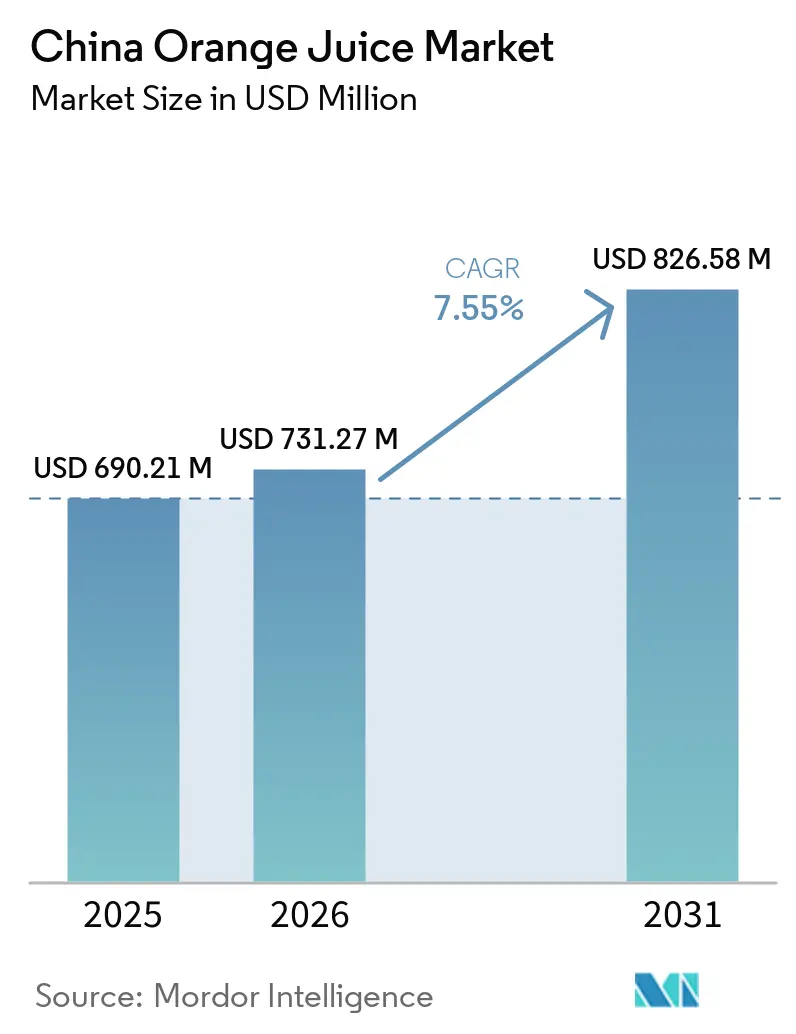
| Base Year Market Size (2025) | USD 0.69 Billion |
| Market Size (2026) | USD 0.73 Billion |
| Market Size (2031) | USD 1.05 Billion |
| Growth Rate (2026 - 2031) | 7.55 % |
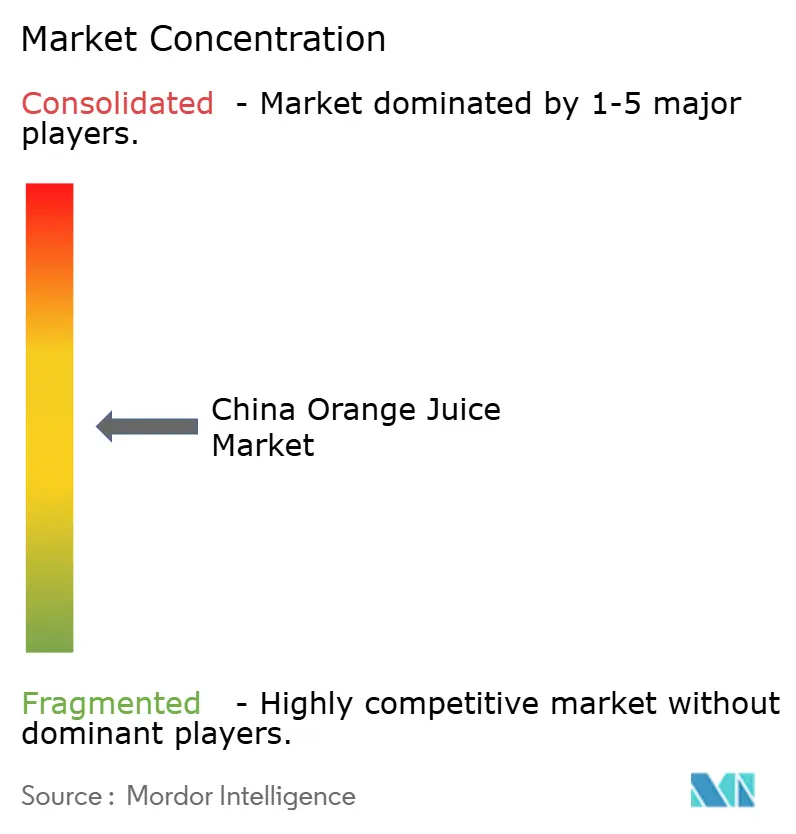
| Market Concentration | Medium |
Major Players *Disclaimer: Major Players sorted in no particular order Image © Mordor Intelligence. Reuse requires attribution under CC BY 4.0. | |
China Orange Juice Market Analysis by Mordor Intelligence
The China orange juice market size is projected to be USD 0.69 billion in 2025, USD 0.73 billion in 2026, and reach USD 1.05 billion by 2031, growing at a CAGR of 7.55% from 2026 to 2031. Demand is moving toward products with clear ingredient lists, recognizable fruit content, and stronger freshness cues. This change supports premium formats, while concentrate remains important for accessible prices and broad availability. Digital retail gives brands more room to explain differences between concentrated, NFC, and cold-pressed products before purchase. Producers are also investing in sourcing, processing, and traceability because imported concentrate exposure can affect cost and availability. Competition from ready-to-drink tea and functional beverages remains a constraint because these categories target many of the same urban consumers.
Key Report Takeaways
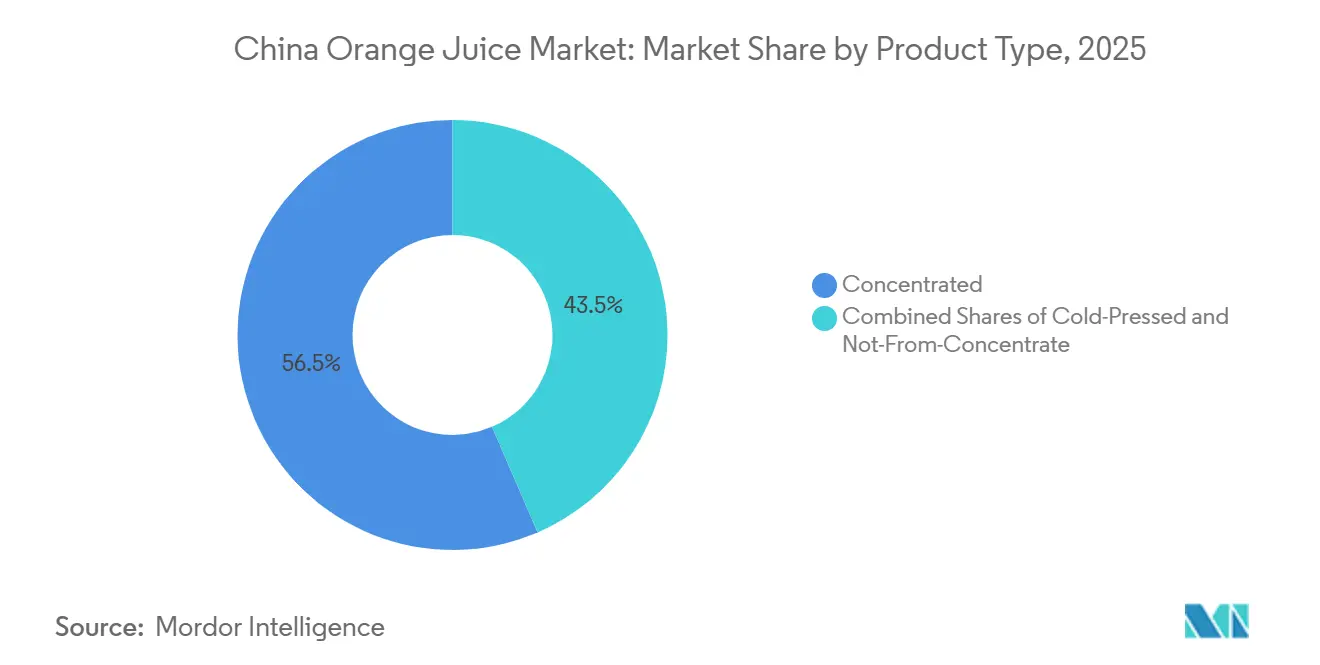
- By product type, concentrated orange juice held 56.48% of the China orange juice market share in 2025, while cold-pressed juice is forecast to grow at a 9.12% CAGR through 2031.
- By packaging type, bottles accounted for 45.38% of value in 2025, while cartons are forecast to grow at a 9.55% CAGR through 2031.
- By category, conventional orange juice held 68.32% of value in 2025, while organic orange juice is forecast to grow at an 8.67% CAGR through 2031.
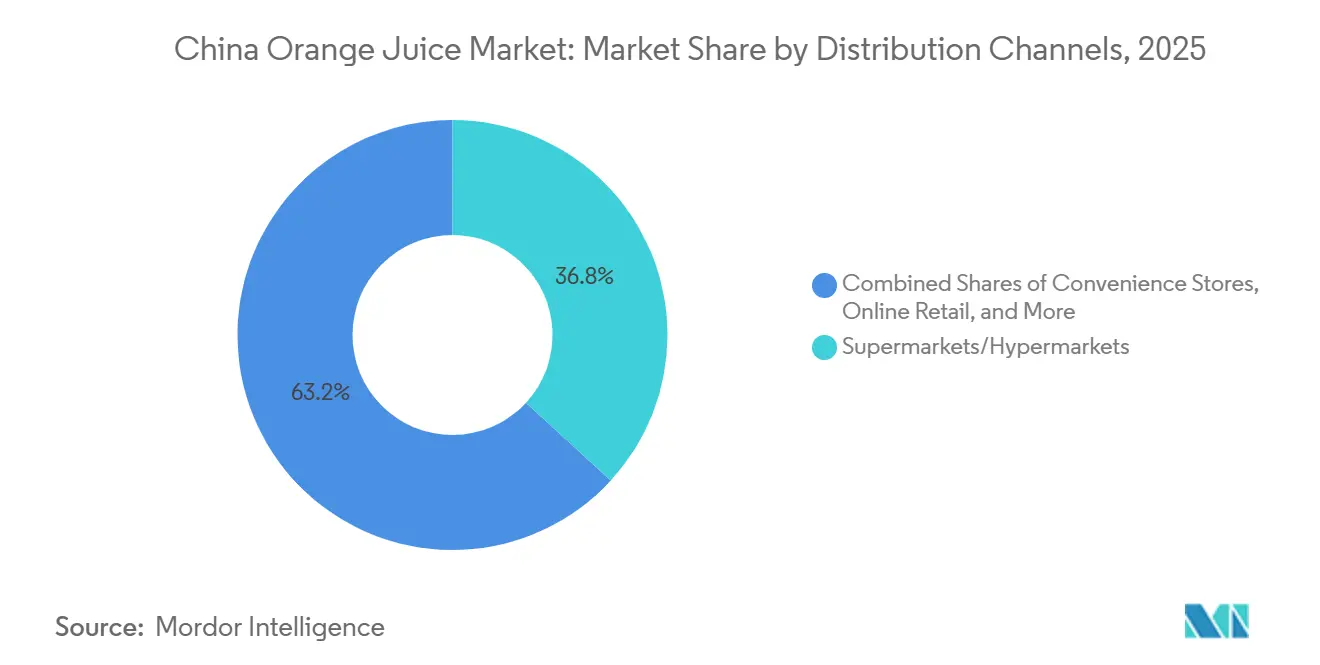
- By distribution channel, supermarkets and hypermarkets held 36.47% of value in 2025, while online retail is forecast to grow at an 8.34% CAGR through 2031.
Note: Market size and forecast figures in this report are generated using Mordor Intelligence’s proprietary estimation framework, updated with the latest available data and insights as of January 2026.
China Orange Juice Market Trends and Insights
Drivers Impact Analysis*
| Driver | (~) % Impact on CAGR Forecasts | Geographic Relevance | Impact Timeline |
|---|---|---|---|
| Rising Demand for 100% Natural Juice | +2.0% | National, concentrated in Tier 1 and Tier 2 cities | Medium term (2-4 years) |
| Growing Preference for Low-Sugar Beverages | +0.8% | National | Short term (≤ 2 years) |
| Orange Cultivation and Raw-Material Procurement | +0.7% | Jiangxi, Hunan, Hubei, Egypt, and Morocco sourcing hubs | Long term (≥ 4 years) |
| Expansion of E-Commerce and Digital Retail | +1.1% | National, strongest in Tier 3 to Tier 5 cities | Medium term (2-4 years) |
| Growth of Premium and NFC Juice Products | +1.4% | Eastern and southern coastal cities, extending into Central China | Medium term (2-4 years) |
| Rising Innovation in Juice Extraction and Processing | +0.6% | Shandong, Jiangxi, and Hubei production hubs | Long term (≥ 4 years) |
| Source: Mordor Intelligence | |||
Rising Demand for 100% Natural Juice and Low-Sugar Beverages
Chinese consumers increasingly distinguish 100% juice from diluted juice drinks, supporting demand for clear fruit-content labels. Younger buyers in leading cities seek freshly squeezed, 100% orange juice and NFC products because they associate them with vitamin C and freshness[1]. This preference pressures reconstituted products that rely on lower prices and less specific ingredient positioning. Lower-sugar choices encourage reformulation, while fiber-fortified juice and vitamin C products with zinc offer additional benefits. The China orange juice market favors brands that support functional claims with evidence and communicate their formulations simply. Café chains can introduce fresh orange juice through hybrid beverages, creating trial occasions that may later support retail purchases.
Expansion of E-Commerce and Digital Retail
Digital retail changes how premium orange juice reaches consumers and how brands explain product differences. Livestreaming and product content can show distinctions among FC, NFC, and HPP products before a buyer compares prices. Community group-buy platforms make premium formats more accessible in Tier 3 to Tier 5 locations. Nongfu Spring introduced its 17.5° 100% fresh cold-pressed orange juice in a 900mL bottle at Sam’s Club in January 2025, where it became a bestseller. The China orange juice market can gain from subscriptions and repeat ordering when delivery and cold-chain handling protect quality. Brands also need clear pricing because digital channels make competing beverage choices easier to compare.
Growth of Premium and NFC Juice Products
NFC products offer a premium position between mainstream concentrated juice and higher-priced cold-pressed HPP products. This range gives consumers a quality upgrade without the cost structure of the most specialized cold-chain formats. Nongfu Spring emphasized additive-free, pure juice positioning across its NFC and 17.5° lines and recorded CNY 5.18 billion in juice revenue during 2025. Its integrated supply chain included more than 4,000 contracted orange growers in Jiangxi and a 36-hour orchard-to-bottle process. The Chinese orange juice market may widen access to cold-pressed products as high-pressure processing and cold-chain systems develop. Premium products still need consistent quality during distribution because freshness claims must be supported by the consumer experience.
Orange Cultivation, Raw-Material Procurement, and Processing Innovation
China’s import exposure has made domestic orange processing and cultivation more important for the Chinese orange juice market. When Brazilian supply declined, local processors expanded fresh-fruit processing to address concentrate shortages. Domestic frozen concentrated orange juice production reached 31,000 metric tonnes in 2024/25, compared with 17,500 metric tonnes in 2023/24. Growers and processors in Jiangxi, Hunan, and Hubei are becoming more central to local supply, while Egypt and Morocco offer additional sourcing routes. In June 2025, a Zigui FCOJ facility began processing up to 100,000 tonnes of fresh oranges annually[2]. Domestic capacity can reduce import exposure but requires long-term investment before it can replace imported concentrate at scale.
Restraints Impact Analysis*
| Restraint | (~) % Impact on CAGR Forecasts | Geographic Relevance | Impact Timeline |
|---|---|---|---|
| Competition from Tea and Other Functional Beverages | -0.9% | National; Tier 1 cities, 20–35 cohort | Short term |
| Dependence on Imported Juice Concentrate | -0.7% | Shandong, Jiangxi, Xinjiang processors | Long term |
| Strict Food Safety and Labeling Requirements (new) | -0.5% | National; domestic + importers equally | Long term |
| Consumer Preference for Lower-Calorie Beverages (new) | -0.6% | National; Tier 1 & 2 cities, 20–40 cohort | Short term |
| Source: Mordor Intelligence | |||
Competition from Tea and Other Functional Beverages
Ready-to-drink tea competes directly for spending by younger urban consumers who also buy premium orange juice. Functional energy drinks and herbal infusions compete for morning use, refreshment, and sports-related occasions. Nongfu Spring’s tea products generated CNY 21.6 billion in revenue during 2025, compared with CNY 5.18 billion for its juice products. Tea revenue grew 29%, while juice revenue grew 26.7%, which reflects the category’s competitive pressure. Fruit-and-tea blends may attract consumers who seek flavor, portability, and lower perceived sweetness. The China orange juice market needs products that serve more drinking occasions while retaining the distinct qualities of juice.
Dependence on Imported Juice Concentrate
China relies on imported FCOJ, creating exposure that stronger retail demand alone cannot resolve. Brazil is a major supplier of concentrated orange juice to China, and Brazilian FCOJ imports declined 63% in 2024/25. Imports from Israel fell 23% during the same season, prompting Chinese processors to expand domestic fresh-orange processing. Imports are forecast to rise 30% to 64,100 metric tonnes in 2025/26 as Brazilian output recovers. Orchards and processing facilities in inland provinces need time to create a more resilient supply base. The China orange juice market, therefore, remains sensitive to supplier-country production conditions and related shifts in concentrate prices.
*Our forecasts treat driver/restraint impacts as directional, not additive. The impact forecasts reflect baseline growth, mix effects, and variable interactions.
Segment Analysis
By Product Type: Concentrate Maintains Broad Reach While Cold-Pressed Juice Grows Fastest
Cold-pressed juice is projected to record a 9.12% CAGR from 2026 to 2031, the fastest rate among product types. This pace is above the 7.55% rate forecast for the overall China orange juice market. High-pressure processing can extend shelf life while supporting a fresh product position. The technology remains more demanding than conventional processing because products need controlled cold-chain handling. Cold-pressed formats therefore serve consumers willing to pay for freshness, limited processing, and premium presentation.
Concentrated orange juice held 56.48% of the China orange juice market size in 2025. Its position reflects broad availability in retail and foodservice and its importance in products priced below CNY 10. This segment remains necessary for households that prioritize accessibility and familiar formats. NFC products sit between concentrate and cold-pressed products in both price and quality perception. In the China orange juice industry, this middle position helps established brands and regional entrants address premium demand without the full cost base of cold-pressed formats.

By Packaging Type: Bottles Lead Current Value While Cartons Gain Through Cold-Fill Use
Bottles held 45.38% of packaging value in 2025, giving them the leading position in the China orange juice market. PET bottles support portable, single-serve purchases, especially in convenience stores and urban commercial areas. Their shape and visibility also help brands use packaging to signal a higher-value product. Glass bottles are more common in HPP and artisanal NFC products that sell at prices above CNY 20 per unit. Cans retain a role in corporate catering, quick-service food outlets, and on-the-go consumption. Some brands are moving cans toward a mid-tier premium position rather than using them only for value products.
Cartons are forecast to expand at a 9.55% CAGR through 2031, faster than other packaging formats. Aseptic cold-fill systems support lightweight multilayer cartons for premium ambient and refrigerated NFC offerings. This changes the role of cartons, which were historically linked with concentrated juice in mass retail. Cartons can reduce logistics weight while allowing larger retail pack sizes. The China orange juice market can use this format to widen distribution for products that need consistent quality but do not require glass or specialist bottles. Packaging choice now affects product positioning, transport requirements, and the distribution channels available to each brand.
By Category: Conventional Juice Holds the Largest Base While Organic Gains Demand
Conventional orange juice held 68.32% of value in 2025, giving it the largest category position. It is supported by established consumer familiarity, wider distribution, and strong representation in accessible price ranges. Conventional products remain important in supermarkets, hypermarkets, and mainstream foodservice. Their broad reach also gives large brands a reliable platform for volume sales. The category must respond to consumer requests for simpler labels and better information about ingredients. This response can help conventional producers defend demand without limiting their business to the lowest price tier.
Organic orange juice is projected to expand at an 8.67% CAGR through 2031. The category is supported by urban consumers who seek certified production and greater visibility into cultivation practices. In 2026, organic certification rules require full supply-chain transparency and continuing oversight across production, processing, logistics, and sales. Organic juice often reaches consumers through e-commerce subscriptions and premium club-store formats rather than supermarket impulse purchases. This purchase pattern frames the product as a considered household choice. The China orange juice industry needs traceability systems and consistent compliance to serve this segment effectively.
By Distribution Channels: Supermarkets Retain Scale While Online Retail Builds Premium Demand
Supermarkets and hypermarkets accounted for 36.47% of the China orange juice market share in 2025. These stores remain important for concentrated products, where price comparison and regular shelf presence influence selection. They also offer brands an efficient way to reach mainstream households. However, premium shoppers are increasingly moving online for products that need more explanation before purchase. This movement weakens the ability of physical stores to serve as the only discovery channel. Retailers need clear assortments because premium formats can otherwise be difficult to compare beside value-focused products.
Online retail is projected to grow at an 8.34% CAGR through 2031. Livestreaming, direct-to-consumer ordering, and subscriptions help brands explain differences among concentrated, NFC, and HPP juice formats. Sam’s Club sales of Nongfu Spring’s 17.5° cold-pressed orange juice also show the importance of premium launch platforms. Convenience and grocery stores continue to serve single-occasion urban consumption. Other channels include specialty juice bars, foodservice, corporate catering, and fresh-squeezed vending equipment in offices and busy locations. Together, these channels can create new occasions without replacing the need for mainstream retail distribution.
Geography Analysis
Eastern and southern coastal provinces accounted for more than 60% of consumption value in 2025. The China orange juice market in these areas benefits from higher incomes, established cold-chain systems, and wider access to premium retail. Shanghai, Beijing, Guangzhou, and Shenzhen remain important consumption hubs. Premium club stores and modern retailers can introduce products that require careful handling and higher consumer spending. Nongfu Spring’s 900mL 17.5° cold-pressed orange juice became a bestseller at Sam’s Club after its January 2025 launch. This supports the role of coastal premium retail as a launch platform for NFC and cold-pressed products.
Local brands in Sichuan and Yunnan have a separate competitive advantage because they are closer to citrus-growing areas. Lower logistics costs can help these companies compete against national brands. Central and western China are projected to grow by more than 6.5% annually. Urbanization, rising incomes, and expanded cold-chain networks are supporting demand in Tier 3 to Tier 5 cities. The China orange juice market size in these regions can grow as domestic production and processing move closer to inland demand. In June 2025, the Zigui facility in Hubei brought automated FCOJ capacity to an important citrus-producing area.
Domestic orange juice production reached 31,500 metric tonnes in MY2025/26 on a 65° Brix basis. This was up from 17,500 metric tonnes in MY2023/24 after supply disruptions encouraged more local processing. China had 816,500 hectares of orange cultivation and forecast orange production of 7.68 million metric tonnes in MY2025/26. This provides a base for further domestic processing expansion. Processing capacity remains concentrated in a limited group of inland provinces. Weather events or regulatory disruptions in those areas could therefore affect the domestic supply base.
Competitive Landscape
The China orange juice market has a moderate concentration score because five large companies hold a significant share of retail value, while premium challengers and private labels continue to gain ground. Coca-Cola through Minute Maid, Huiyuan, Nongfu Spring, Kangshifu, and PepsiCo through Tropicana are the leading companies identified in the supplied research. Their position is based on brand recognition, broad distribution, and product portfolios that cover several price levels. Their combined position has weakened since 2020 as specialized premium brands and private labels expand. This creates competition at both the accessible and premium ends of the category. National players need more than distribution scale to defend their position.
Nongfu Spring has built its premium juice position through supply-chain control and product positioning. The company works with more than 4,000 contracted orange growers in Jiangxi and uses a 36-hour orchard-to-bottle process. It also launched the 17.5° cold-pressed orange juice at Sam’s Club in January 2025. COFCO Tunhe uses blockchain traceability across 120,000 mu of cultivation bases. This approach supports supply-chain visibility and can help meet regulatory and buyer requirements.
Huiyuan has also moved into adjacent premium fruit-and-tea products. In June 2026, Beijing Huiyuan launched the Huiyuan Tea Fruit series with jasmine grapefruit, green tea guava, and oolong kumquat variants. In February 2026, Huiyuan Group launched Zanjiaguoyuan as a repositioning initiative focused on natural and additive-free juice products[3]. The CNY 10 to CNY 20 tier remains important because it sits between commodity concentrate and ultra-premium HPP products. Brands without a clear cold-chain, sourcing, or functional proposition may face pressure from both private labels and premium NFC competitors. Food safety, labeling, and organic compliance can favor larger companies with established regulatory and research capabilities.
China Orange Juice Industry Leaders
-
The Coca-Cola Company
-
China Huiyuan Juice Group Limited
-
Wei Chuan U.S.A., Inc.
-
Nongfu Spring Co., Ltd.
-
PepsiCo, Inc.
- *Disclaimer: Major Players sorted in no particular order
Recent Industry Developments
- February 2026: Huiyuan Group launched new brand "Zanjiaguoyuan" (咱家果源). Backed by 35 years of full industrial-chain capabilities spanning 20+ production parks and nearly 200 advanced manufacturing lines, Huiyuan Group launched this brand as a strategic repositioning initiative focused on 100% natural, additive-free juice products. Dozens of distributors signed agreements in Henan and northeastern China within weeks of the launch, covering the full product range across the juice and fresh-fruit categories.
- June 2025: Zigui, Hubei commissioned a 10,000-tonne automated FCOJ production line. Hubei Qugu International Agriculture Group launched a fully automated FCOJ production line backed by an investment of over CNY 50 million. The facility features 12 cup-type juice extractors, processes 100,000 tonnes of fresh oranges annually, and produces more than 10,000 tonnes of concentrated orange juice.
China Orange Juice Market Report Scope
| Concentrated |
| Not-From-Concentrate |
| Cold-Pressed |
| Bottles |
| Cartons |
| Cans |
| Others |
| Conventional |
| Organic |
| Supermarkets/Hypermarkets |
| Convenience/Grocery Stores |
| Online Retail Stores |
| Other Distribution Channels |
| Product Type | Concentrated |
| Not-From-Concentrate | |
| Cold-Pressed | |
| Packaging Type | Bottles |
| Cartons | |
| Cans | |
| Others | |
| Category | Conventional |
| Organic | |
| Distribution Channels | Supermarkets/Hypermarkets |
| Convenience/Grocery Stores | |
| Online Retail Stores | |
| Other Distribution Channels |
Key Questions Answered in the Report
What is the forecast growth rate for China orange juice?
The China orange juice market is forecast to grow at a CAGR of 7.55% from 2026 to 2031, reaching USD 1.05 billion by 2031.
Which orange juice product type is growing fastest in China?
Cold-pressed juice is the fastest-growing product type, with a forecast CAGR of 9.12% through 2031.
Why are NFC orange juice products becoming more important in China?
NFC products offer a premium position between concentrated and cold-pressed juice, supported by demand for clear ingredients and freshness.
Which packaging format is expected to grow fastest for orange juice?
Cartons are forecast to grow at a 9.55% CAGR through 2031 as cold-fill systems support premium ambient and refrigerated products.