
China Microgreens Market Size and Share
Market Overview
| Study Period | 2021 - 2031 |
|---|---|
| Forecast Data Period | 2026 - 2031 |
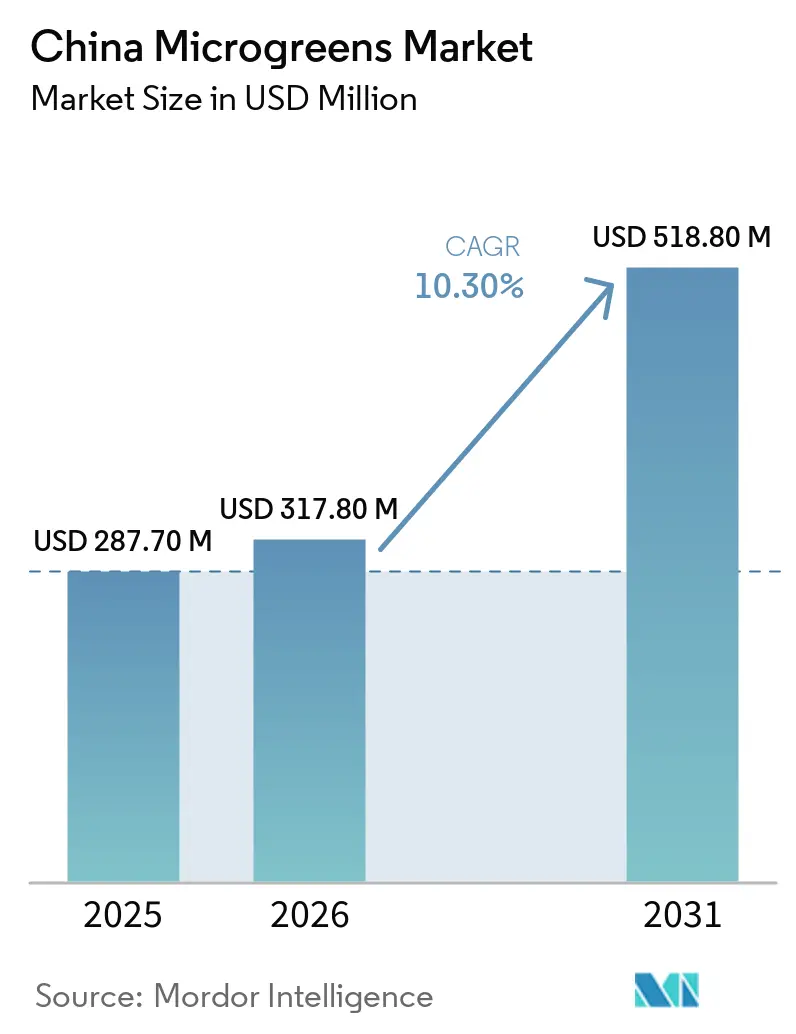
| Base Year Market Size (2025) | USD 287.70 Million |
| Market Size (2026) | USD 317.80 Million |
| Market Size (2031) | USD 518.80 Million |
| Growth Rate (2026 - 2031) | 10.30 % |
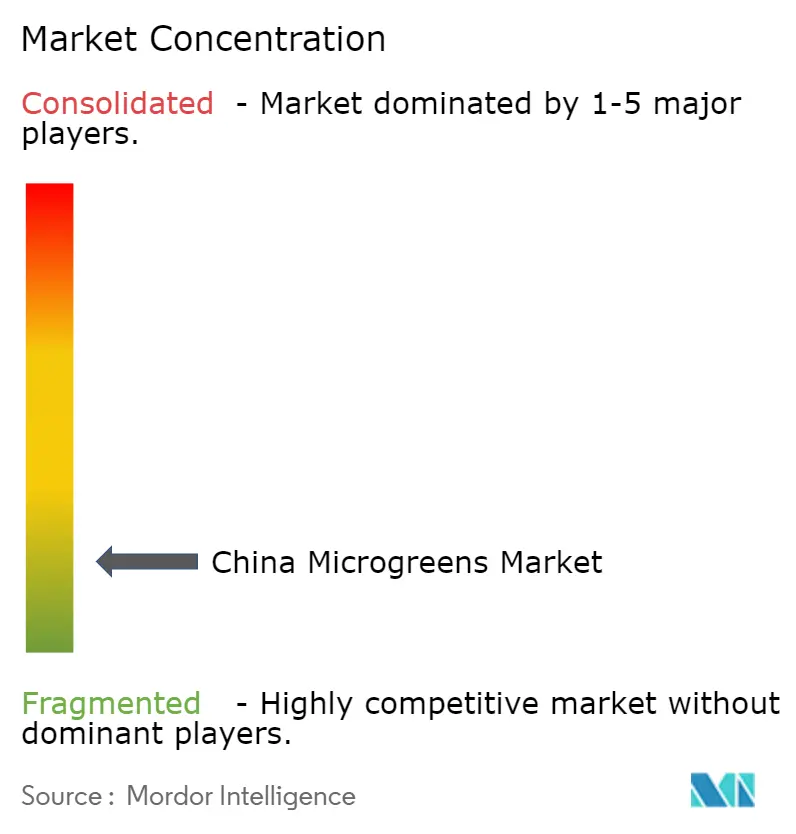
| Market Concentration | Low |
Major Players *Disclaimer: Major Players sorted in no particular order Image © Mordor Intelligence. Reuse requires attribution under CC BY 4.0. | |
China Microgreens Market Analysis by Mordor Intelligence
The China microgreens market was valued at USD 287.70 million in 2025 and is projected to grow from USD 317.80 million in 2026 to USD 518.80 million by 2031, at a CAGR of 10.30% from 2026 to 2031. The market is supported by changing food preferences in major cities and continued investment in controlled-environment agriculture. Demand comes from retail stores, premium restaurants, hotels, and direct-to-consumer services, providing suppliers with multiple routes to reach buyers. Producers that maintain product quality, traceability, and delivery reliability are better positioned to serve these channels. The market also faces pressure from short shelf life, uneven cold-chain coverage, and consumer confusion between microgreens and sprouts. Investment in packaging, farm automation, and consumer communication can help suppliers address these constraints before the category becomes more established.
Key Report Takeaways
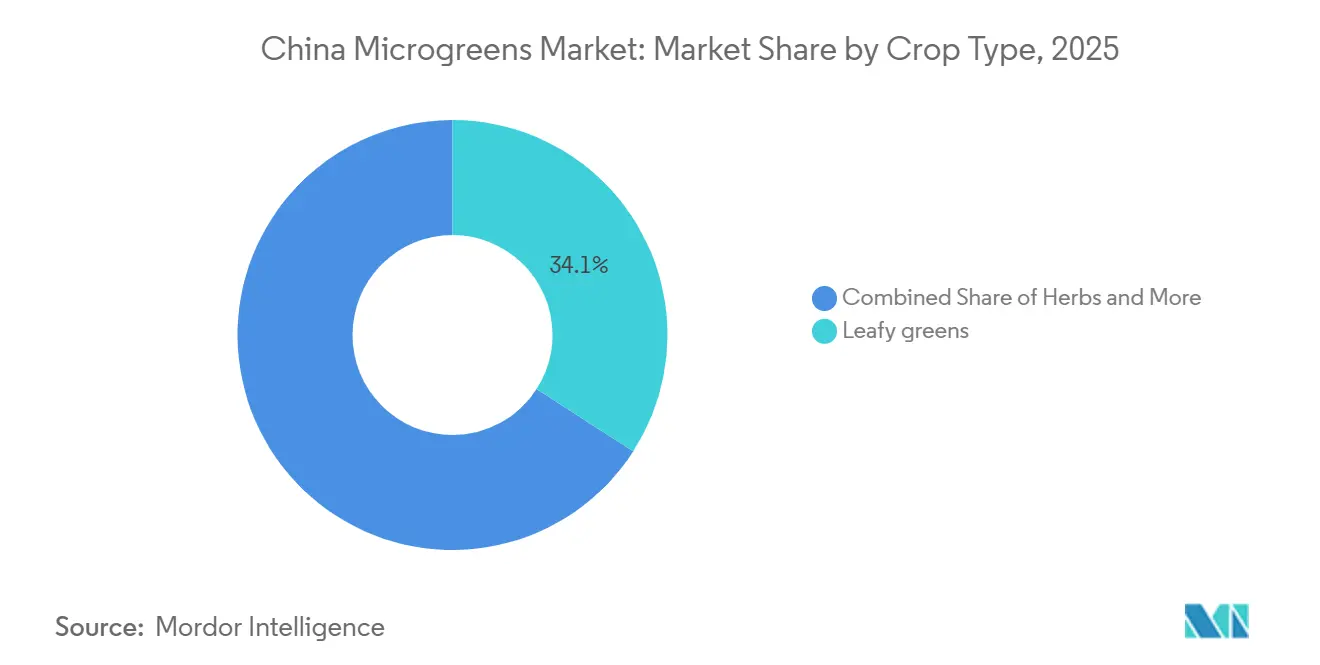
- By crop type, leafy greens accounted for the largest 34.1% of the China microgreens market share in 2025, while herbs are projected to grow at the fastest CAGR of 13.8% from 2026 to 2031.
- By farming method, indoor farming accounted for the largest share at 38.0% in 2025, while the China microgreens market size for vertical farming is projected to grow at the fastest CAGR of 16.5% from 2026 to 2031.
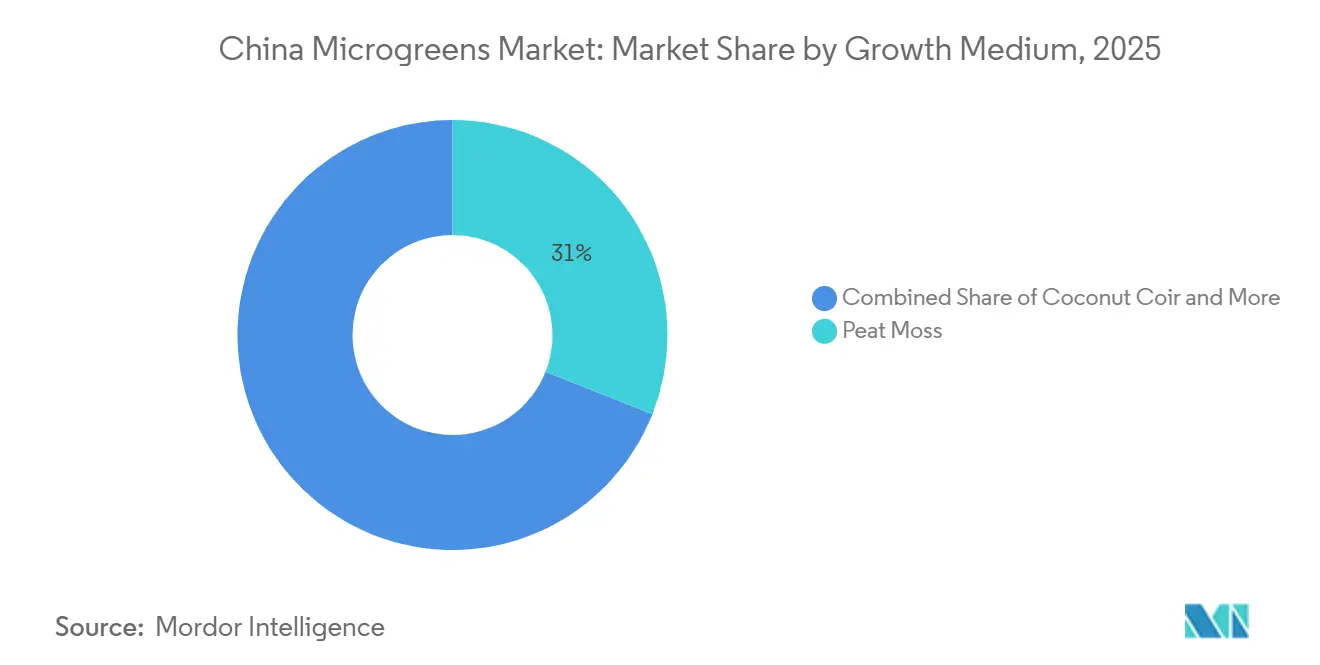
- By growth medium, peat moss accounted for the largest share at 31.0% in 2025, while coconut coir is projected to grow at the fastest CAGR of 15.9% from 2026 to 2031.
- By distribution channel, hypermarkets and supermarkets accounted for the largest share at 31.0% in 2025, while online retail and direct-to-consumer sales are projected to grow at the fastest CAGR of 13.2% from 2026 to 2031.
Note: Market size and forecast figures in this report are generated using Mordor Intelligence’s proprietary estimation framework, updated with the latest available data and insights as of January 2026.
Market Trends and Insights
Drivers Impact Analysis of China Microgreens Market*
| Driver | (~) % Impact on CAGR Forecast | Geographic Relevance | Impact Timeline | |
|---|---|---|---|---|
| Rising Demand for Nutrient-Dense and Functional Foods | 2.80% | National, with the highest penetration in Beijing, Shanghai, Guangzhou, and Chengdu | Short term (≤ 2 years) | |
| Expansion of Urban Indoor and Vertical Farming | 2.30% | East China, South China, and North China | Medium term (2-4 years) | |
| Premiumization of Restaurant and Hospitality Menus | 1.80% | Tier 1 cities and selected Tier 2 cities | Medium term (2-4 years) | |
| Retail Expansion of Premium Fresh-Produce Assortments | 1.50% | National, with early gains in coastal urban clusters | Short term (≤ 2 years) | |
| AI-Enabled Crop Recipes and Lower-Cost Farm Automation | 1.0% | East China and North China | Medium term (2-4 years) | |
| Living-Tray Sales and Near-Harvest Delivery Models | 0.70% | Tier 1 cities and densely populated suburban areas | Long term (≥ 4 years) | |
| Source: Mordor Intelligence | ||||
Rising Demand for Nutrient-Dense and Functional Foods
China's focus on healthier diets is supporting demand for fresh, nutrient-dense foods, creating favorable conditions for microgreens as a fresh functional ingredient. In 2025, the National Health Commission of the People's Republic of China (NHC) recommended that consumers eat at least 300 grams of fresh vegetables daily, underscoring the importance of vegetables in everyday diets[1]. This guidance may encourage consumers and foodservice operators to incorporate nutrient-rich microgreens into meals, salads, and prepared dishes. As awareness of balanced nutrition grows, this dietary emphasis may support broader adoption of fresh microgreens across China.
Expansion of Urban Indoor and Vertical Farming
China's policy support for modern facility agriculture is creating favorable conditions for indoor and vertical microgreens production. In 2025, the Ministry of Agriculture and Rural Affairs of the People's Republic of China (MARA) set a target for facility-grown vegetables to account for 40% of total vegetable production by 2030. This policy direction supports investment in plant factories, advanced greenhouses, and other controlled production systems that can provide year-round output near urban markets. As facility agriculture expands, microgreens producers can leverage controlled environments and efficient land use, supporting broader adoption and market growth.
AI-Enabled Crop Recipes and Lower-Cost Farm Automation
AI-enabled automation is improving the scalability and consistency of controlled-environment microgreen production in China by precisely managing growing conditions. In 2026, the Thirteenth Division of the Xinjiang Production and Construction Corps reported that Rocket Farm established a 1.5-acre smart greenhouse and planted more than 20,000 boxes of sprouts in 2025, using Internet of Things and artificial intelligence technologies to monitor and control temperature and humidity. This production model supports year-round cultivation and consistent quality, improving operational efficiency and encouraging wider adoption of automated microgreens production in China.
Living-Tray Sales and Near-Harvest Delivery Models
Living-tray and near-harvest delivery models can strengthen microgreens distribution by allowing growers to preserve freshness while establishing direct relationships with consumers. In 2026, the Ministry of Commerce of the People's Republic of China (MOFCOM) reported that online retail sales of agricultural products reached 783.31 billion yuan (USD 112.70 billion) in 2025, a year-over-year increase of 9.9%[2]. The growth in online agricultural product sales provides a stronger distribution channel for living microgreens and recurring home deliveries, enabling producers to reach consumers closer to harvest. This direct model can improve accessibility and support the growth of China's microgreens market.
Restraints Impact Analysis of China Microgreens Market*
| Restraint | (~) % Impact on CAGR Forecast | Geographic Relevance | Impact Timeline | |
|---|---|---|---|---|
| Short Post-Harvest Shelf Life and Cold-Chain Gaps | -1.70% | National, with greater pressure in Central and Western China | Short term (≤ 2 years) | |
| High Electricity and Controlled-Environment Operating Costs | -1.20% | Indoor farming hubs, with higher heating needs in Northern China | Medium term (2-4 years) | |
| Food-Safety Risk from Poor Sanitation and Traceability | -0.90% | National, particularly among smaller growers | Medium term (2-4 years) | |
| Inconsistent Consumer Understanding of Microgreens Versus Sprouts | -0.50% | Tier 3 cities, suburban areas, and rural distribution zones | Long term (≥ 4 years) | |
| Source: Mordor Intelligence | ||||
Short Post-Harvest Shelf Life and Cold-Chain Gaps
Microgreens have a short post-harvest life, which increases dependence on reliable cold-chain infrastructure and makes storage capacity constraints a direct limitation on market distribution. In 2025, the Chinese Academy of Agricultural Sciences (CAAS) reported that China required 124.588 million metric tons of cold storage capacity for agricultural products needing low-temperature storage, while existing capacity stood at only 75 million metric tons. This shortfall of 49.588 million metric tons limits microgreens suppliers' ability to maintain product quality during storage and transportation, particularly over longer distribution routes. As a result, cold-chain capacity constraints restrict the expansion of China's microgreens market.
High Electricity and Controlled-Environment Operating Costs
High electricity requirements can constrain the economics and scalability of controlled-environment microgreen production, particularly when artificial lighting operates continuously. In 2026, researchers publishing in Modern Agriculture estimated that a vertical plant factory model in China consumed 817,600 kWh annually to produce 86,400 kilograms of lettuce, illustrating the substantial electricity demand of controlled-environment production[3]. Such energy-intensive operations can increase operating expenses for producers using LED lighting and climate-control systems. As a result, high electricity costs can reduce production cost efficiency and limit investment in controlled-environment systems, constraining growth in China's microgreens market.
*Our forecasts treat driver/restraint impacts as directional, not additive. The impact forecasts reflect baseline growth, mix effects, and variable interactions.
China Microgreens Market Segment Analysis
By Crop Type:
Herbs Grow Faster While Leafy Greens Retain the Largest BaseLeafy greens accounted for the largest share of the China microgreens market at 34.1% in 2025, supported by their broad applicability across foodservice, retail, and institutional food preparation. Arugula, broccoli, lettuce, and chicory microgreens offer varied flavors, textures, and visual characteristics, allowing buyers to incorporate them into a variety of meal formats. Their established use in fresh-produce applications supports recurring procurement from restaurants and organized retailers. Pea and sunflower microgreens also broaden the crop mix by providing mild flavors and a distinctive appearance. This combination of factors supports the established position of leafy greens within overall demand.
Herbs are projected to grow at the fastest CAGR of 13.8% from 2026 to 2031, driven by growing culinary interest in fresh aromatic ingredients. Basil, fennel, and carrot microgreens provide concentrated flavors, distinctive aromas, and visual differentiation in prepared dishes. Their suitability for garnish and specialty culinary applications encourages restaurants and hospitality operators to incorporate them into evolving menus. Fresh herb microgreens also offer an alternative format for buyers seeking differentiated produce over conventional dried ingredients. These characteristics are driving expansion in applications among premium foodservice users and supporting faster growth in the herbs segment.

By Farming Method:
Vertical Farming Expands and Indoor Farming LeadsIndoor farming accounted for the largest share at 38.0% in 2025, reflecting the suitability of controlled environments for consistent microgreens production. Indoor systems allow growers to manage lighting, temperature, humidity, irrigation, and sanitation more precisely than less controlled production settings. These capabilities support predictable crop cycles and year-round availability, which are important for supplying restaurants, retailers, and direct-to-consumer channels. Indoor production also reduces exposure to external weather conditions and facilitates standardized growing protocols. As buyers increasingly seek reliable supplies of specialty fresh produce, controlled production environments support continued adoption of indoor farming systems.
Vertical farming is projected to grow at the fastest CAGR of 16.5% from 2026 to 2031, supported by its ability to use production space efficiently in urban environments. Multi-level growing systems can increase cultivation density while enabling controlled management of lighting, irrigation, temperature, and humidity. Integration with artificial intelligence and Internet of Things technologies can further support environmental monitoring and production scheduling. These characteristics make vertical systems relevant where access to agricultural land is constrained, and consumers are concentrated in cities. Greater adoption of automated controlled-environment systems can therefore support the faster expansion of vertical farming applications.
By Growth Medium:
Coconut Coir Gains Ground Against an Established Peat Moss BasePeat moss accounted for the largest share at 31.0% in 2025, supported by its established use as a cultivation substrate and its suitability for controlled microgreens production. Its physical characteristics provide growers with a familiar medium for seed germination and early plant development. Established sourcing and production practices also simplify adoption among commercial and smaller-scale growers. Soil remains relevant in systems that use conventional cultivation practices, while hydroponic nutrient solutions provide an alternative for those requiring precise nutrient management. The availability of multiple growing media allows producers to select substrates according to production requirements, operating systems, and customer preferences.
Coconut coir is projected to grow at the fastest CAGR of 15.9% from 2026 to 2031, supported by its drainage characteristics, stable physical structure, and compatibility with controlled cultivation systems. Its renewable origin appeals to growers and buyers seeking substrate options with documented environmental characteristics. Coconut coir can be used across different production configurations, including systems supplying premium fresh-produce channels and direct-to-consumer formats. Tissue paper remains relevant for living-tray applications where lightweight substrates complement near-harvest delivery. These characteristics encourage producers to diversify substrate selection and support faster adoption of coconut coir.
By Distribution Channel:
Online Retail and Direct-to-Consumer Grows Faster While Hypermarkets and Supermarkets Retain VolumeHypermarkets and supermarkets accounted for the largest share at 31.0% in 2025, supported by their broad consumer reach and established fresh-produce distribution infrastructure. These outlets provide microgreens with greater visibility among urban shoppers while allowing producers to introduce specialty greens alongside conventional fresh produce. Their organized procurement systems also facilitate recurring supply relationships for standardized products. Specialty grocery stores remain relevant for differentiated varieties and premium offerings, while restaurants and foodservice distributors provide opportunities for culinary applications. This combination of retail and foodservice access supports broader product discovery and strengthens the commercial reach of microgreens.
Online retail and direct-to-consumer sales are projected to grow at the fastest CAGR of 13.2% from 2026 to 2031, supported by expanding digital access to agricultural products and fresh food. Online channels allow producers to communicate product attributes directly, coordinate recurring deliveries, and introduce living-tray formats closer to harvest. Direct relationships also provide growers with customer feedback that helps refine crop selection, packaging, and delivery schedules. Restaurants and foodservice distributors introduce specialty varieties through professional kitchens, while farmers' markets and community agriculture provide product education. These channels collectively support wider consumer access and continued distribution development.
Geography Analysis
East China remains the leading regional base for microgreens, supported by Shanghai's concentration of urban consumers, organized food retail, hospitality activity, and advanced agricultural technology. Jiangsu and Zhejiang contribute additional production and technology capabilities that complement Shanghai's demand centers. The region's dense urban structure supports shorter delivery distances for highly perishable products, while established logistics networks connect farms, retailers, restaurants, and households. Shanghai is also expanding its smart-agriculture infrastructure, creating a supportive environment for controlled production. These characteristics make East China well-suited for commercial microgreens operations serving urban foodservice and retail customers.
South China, particularly Guangdong and the Pearl River Delta, offers a favorable environment for specialty fresh produce due to its large urban population, established foodservice sector, and proximity to Hong Kong. Restaurants and hospitality operators drive demand for visually distinctive ingredients used in contemporary and premium dishes. The region's commercial infrastructure also gives growers access to organized retailers, foodservice distributors, and direct-to-consumer channels. Guangdong's role in modern agricultural development further supports controlled production and the adoption of technology. These conditions enable producers to serve nearby urban consumers while reducing distribution distances for highly perishable microgreens.
Shanghai's policy framework provides a measurable indicator of the region's progress in controlled-environment agriculture. In 2025, the Shanghai Municipal Agriculture and Rural Affairs Commission (SMARAC) announced plans to build more than 10 intelligent greenhouses and plant factories by 2030. The initiative also promotes artificial intelligence, Internet of Things technologies, and intelligent environmental control. This policy direction is projected to strengthen production infrastructure for specialty fresh vegetables and support technology-enabled microgreen cultivation. As a result, Shanghai and the wider Yangtze River Delta are positioned to remain important locations for future controlled-environment production.
Competitive Landscape
The China microgreens market is fragmented in 2025, with Jin Douzi Agricultural Co., Ltd., Jiangsu New Hope Ecological Technology Co., Ltd., iMicrogreen, Urban Grow, and Aqua Green Limited among the key players. The competitive landscape includes specialty producers, technology-oriented farms, direct-to-consumer operators, and suppliers serving premium fresh produce applications. Companies differentiate through crop variety, production technology, freshness, traceability, sustainability practices, and customer relationships. Local producers benefit from proximity to urban buyers, given the short post-harvest windows of microgreens. Technology-enabled farms compete through controlled production and standardized quality, while smaller operators focus on customized varieties and direct customer relationships across foodservice, retail, institutional, and direct-to-consumer channels.
China and Hong Kong-based producers compete through localized production, fresh delivery, specialty crop selection, and technology adoption. Operators such as Full Nature Farms, Common Farms, Farmacy Group, Urban Grow, and Genius Greens represent specialized production businesses identified in the competitive material. Their positioning reflects different approaches to controlled cultivation, specialty produce, and direct customer access. Producers serving restaurants emphasize freshness and customized varieties, while retail-oriented operators focus on packaging, consistency, and distribution. The presence of both specialized farms and technology-enabled producers supports a competitive environment with multiple operating models and customer strategies.
Jiangsu New Hope Ecological Technology Co., Ltd. illustrates the growing integration of production scale and controlled-environment technology among young green producers in China. The company operates an integrated production base spanning cultivation, processing, storage, logistics, and sales, supported by vertically integrated growing facilities and intelligent environmental control systems. It has a daily production capacity of 260 metric tons, supported by intelligent LED lighting, heating, water-curtain, and monitoring technologies. This integrated operating model strengthens production efficiency, automation, and supply chain capabilities, positioning the company to compete in China's harvested microgreens and young greens market.
China Microgreens Industry Leaders
-
Jin Douzi Agricultural Co., Ltd.
-
Jiangsu New Hope Ecological Technology Co., Ltd.
-
iMicrogreen
-
Urban Grow
-
Aqua Green Limited
- *Disclaimer: Major Players sorted in no particular order
China Microgreens Market Companies Covered in this Report
- Full Nature Farms
- Common Farms Limited
- Farmacy Group Limited
- Urban Grow
- growsFresh
- Aqua Green Limited
- iMicrogreen
- Jin Douzi Agricultural Co., Ltd.
- Jiangsu New Hope Ecological Technology Co., Ltd.
Recent Industry Developments in China Microgreens Market
- June 2025: The Kunshan Municipal Government in Jiangsu introduced subsidies for facility greenhouses with intelligent environmental control and water-fertilizer integration systems. Eligible projects can receive support of up to 30% of the total investment, capped at CNY 3 million (USD 0.42 million) per project, for controlled-environment systems suitable for microgreen cultivation.
- June 2025: The Beijing Municipal Agriculture and Rural Affairs Bureau has included factory-produced young greens in its vegetable production subsidy program, covering plant factory and intelligent greenhouse production. This initiative supports microgreens cultivation by encouraging investment in controlled-environment systems and strengthening technology-enabled production capacity.
- April 2025: Farmacy Group Ltd. launched SEED by Farmacy in Cyberport, Hong Kong, combining an indoor smart hydroponic farm with seed-to-table dining. The facility grows fresh greens, herbs, and microgreens onsite, supplying fresh ingredients for restaurant dishes and expanding Farmacy's controlled-environment microgreens offering.
China Microgreens Market Report Scope
Microgreens are young, edible vegetable and herb seedlings harvested 7 to 21 days after germination. They are valued for their nutritional content, flavor, vibrant color, and applications in salads, garnishes, sandwiches, and specialty dishes.
The China microgreens market report is segmented by crop type (leafy greens, broccoli, radish, pea, sunflower, basil, arugula, lettuce and chicory, fennel, carrot, herbs, and other crop types), by farming method (indoor farming, vertical farming, commercial greenhouse farming, soil-based farming, and other farming methods), by growth medium (peat moss, soil, coconut coir, hydroponic nutrient solution, tissue paper, and other growth media), and by distribution channel (hypermarkets and supermarkets, specialty grocery stores, restaurants and foodservice distributors, online retail and direct-to-consumer, and farmers’ markets and community agriculture). The market forecasts are provided in terms of value (USD).
Segmentation Overview
| Leafy Greens |
| Broccoli |
| Radish |
| Pea |
| Sunflower |
| Basil |
| Arugula |
| Lettuce and Chicory |
| Fennel |
| Carrot |
| Herbs |
| Other Crop Types |
| Indoor Farming |
| Vertical Farming |
| Commercial Greenhouse Farming |
| Soil-Based Farming |
| Other Farming Methods |
| Peat Moss |
| Soil |
| Coconut Coir |
| Hydroponic Nutrient Solution |
| Tissue Paper |
| Other Growth Media |
| Hypermarkets and Supermarkets |
| Specialty Grocery Stores |
| Restaurants and Foodservice Distributors |
| Online Retail and Direct-to-Consumer |
| Farmers’ Markets and Community Agriculture |
| By Crop Type | Leafy Greens |
| Broccoli | |
| Radish | |
| Pea | |
| Sunflower | |
| Basil | |
| Arugula | |
| Lettuce and Chicory | |
| Fennel | |
| Carrot | |
| Herbs | |
| Other Crop Types | |
| By Farming Method | Indoor Farming |
| Vertical Farming | |
| Commercial Greenhouse Farming | |
| Soil-Based Farming | |
| Other Farming Methods | |
| By Growth Medium | Peat Moss |
| Soil | |
| Coconut Coir | |
| Hydroponic Nutrient Solution | |
| Tissue Paper | |
| Other Growth Media | |
| By Distribution Channel | Hypermarkets and Supermarkets |
| Specialty Grocery Stores | |
| Restaurants and Foodservice Distributors | |
| Online Retail and Direct-to-Consumer | |
| Farmers’ Markets and Community Agriculture |
Key Questions Answered in the Report
What is the projected growth rate and market size for China microgreens through 2031?
The China microgreens market is projected to grow at a CAGR of 10.3% from 2026 to 2031, reaching USD 518.80 million.
Which crop type is growing fastest in China?
Herbs are projected to grow at the fastest CAGR of 13.8% from 2026 to 2031, supported by demand from premium foodservice.
Which farming method is expanding most quickly?
Vertical farming is projected forecast to grow at the fastest CAGR of 16.5% from 2026 to 2031.
Which sales channel is projected to grow fastest?
Online retail and direct-to-consumer sales are projected to grow at the fastest CAGR of 13.2% from 2026 to 2031.