
China Health Insurance Market Size and Share
Market Overview
| Study Period | 2021 - 2032 |
|---|---|
| Forecast Data Period | 2027 - 2032 |
| Base Year Market Size (2026) | USD 152.70 Billion |
| Market Size (2027) | USD 162.20 Billion |
| Market Size (2032) | USD 225.30 Billion |
| Growth Rate (2027 - 2032) | 6.80 % |
| Market Concentration | Low |
Major Players *Disclaimer: Major Players sorted in no particular order Image © Mordor Intelligence. Reuse requires attribution under CC BY 4.0. | |
China Health Insurance Market Analysis by Mordor Intelligence
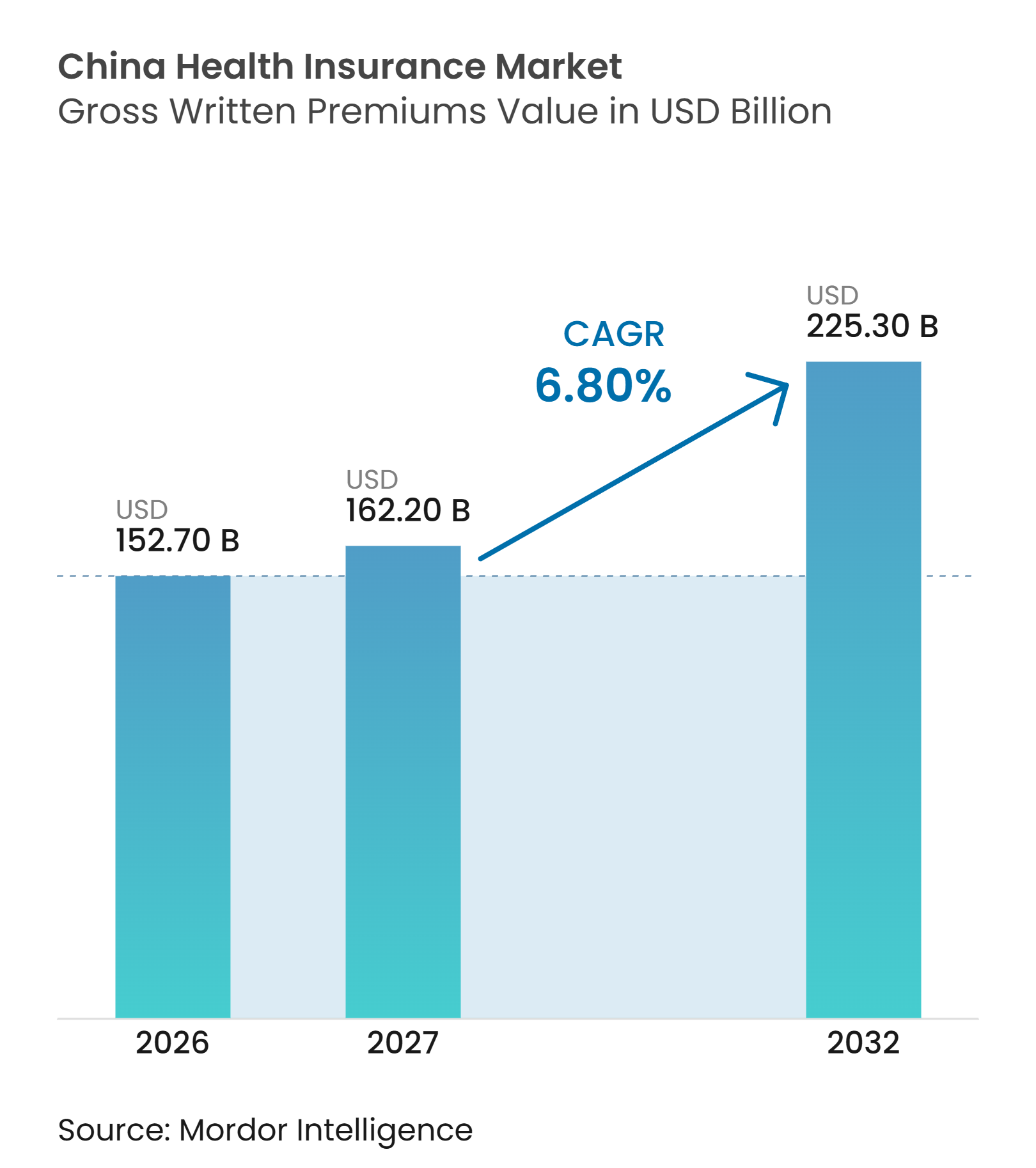
The China Health Insurance Market size in terms of gross written premiums value is expected to increase from USD 152.70 billion in 2026 to USD 162.20 billion in 2027 and reach USD 225.30 billion by 2032, growing at a CAGR of 6.80% over 2027-2032.
The China health insurance industry is moving from rapid expansion in critical illness policies toward more specialized coverage and closer links with healthcare delivery. The National Financial Regulatory Administration continues to call for more precise pricing, specialist insurers, and deeper coordination with healthcare systems, which supports a more durable growth path. Demand for protection beyond basic medical coverage continues to support medical expense policies, innovative drug coverage, and long-term care products. Digital platforms are changing customer acquisition and claims service, while established insurers retain broad agency and broker networks. Medical cost inflation, adverse selection, and fragmented health records remain material limits on underwriting performance and product design.
Key Report Takeaways
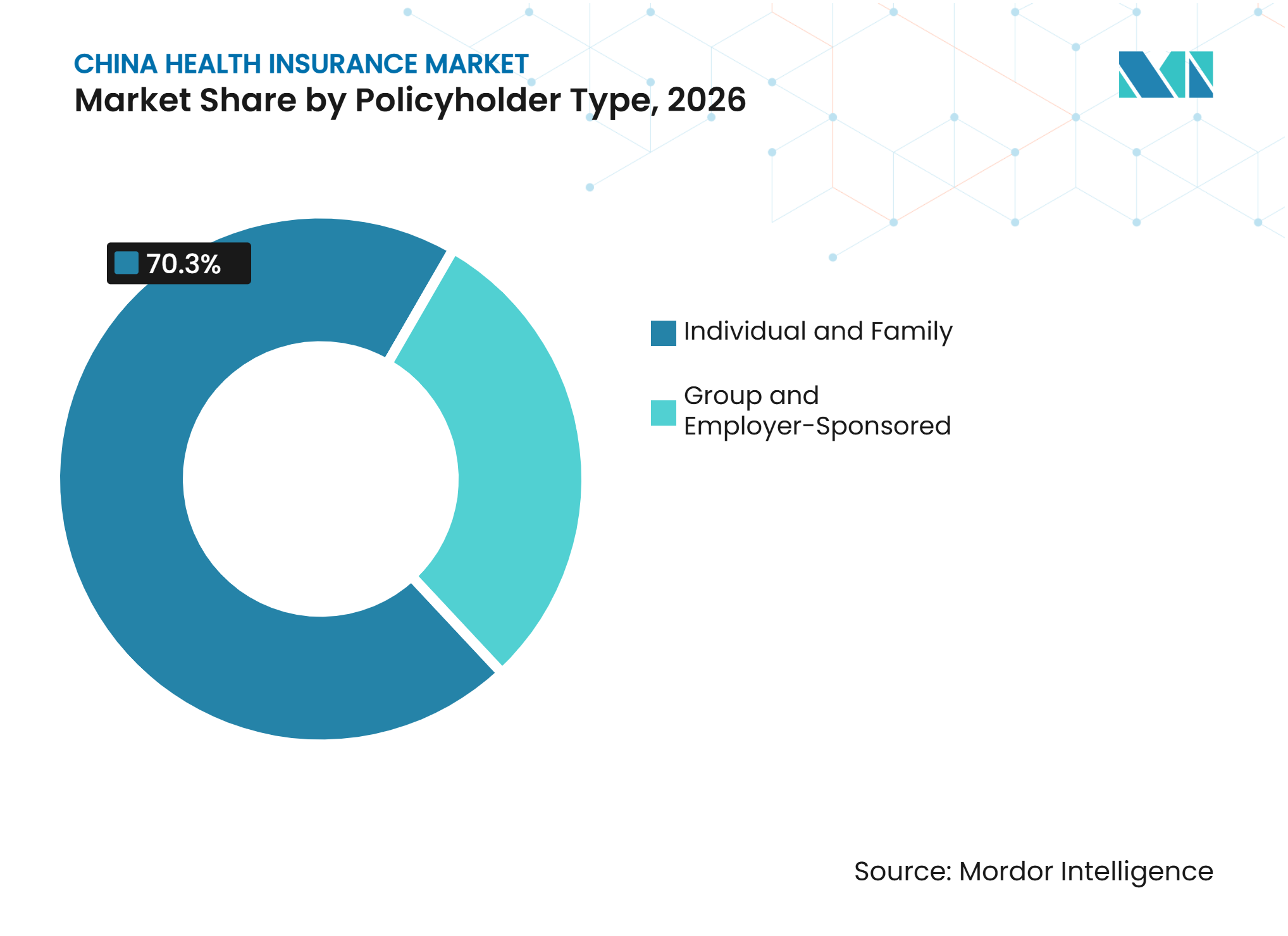
- By policyholder type, individual and family policies captured 70.3% of the China health insurance market share in 2026, while group and employer-sponsored insurance is projected to grow at a 7.8% CAGR through 2032.
- By product type, medical expense insurance captured 54.6% of the China health insurance market share in 2026, while long-term care insurance is projected to grow at a 9.6% CAGR through 2032.
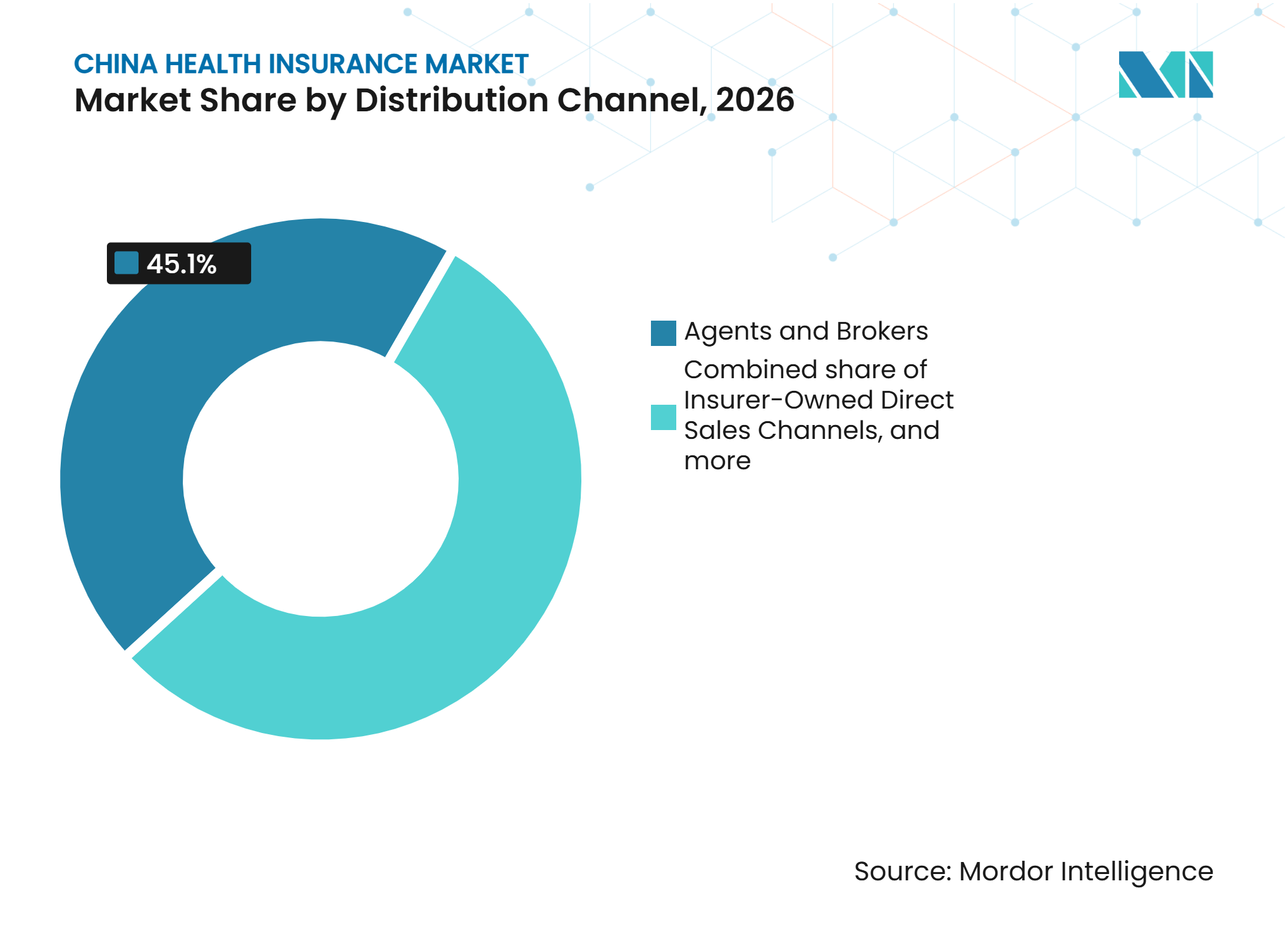
- By distribution channel, agents and brokers captured 45.1% of the China health insurance market share in 2026, while third-party digital platforms and aggregators are projected to grow at an 11.9% CAGR through 2032.
- By geography, East China captured 40.4% of the China health insurance market size in 2026, while West China is projected to grow at an 8.5% CAGR through 2032.
Note: Market numbers in this report are based on Mordor Intelligence's proprietary estimation framework, which combines nine months of actuals with Q4 projections for base year 2026.
Market Trends and Insights
Drivers Impact Analysis of China Health Insurance Market*
| Driver | (~) % Impact on CAGR Forecast | Geographic Relevance | Impact Timeline |
|---|---|---|---|
| Commercial Coverage Beyond Basic Medical Benefits | +1.8% | All regions, with highest intensity in East and Central China | Medium term (2-4 years) |
| Health Protection Demand From an Aging Population | +1.6% | National, with pronounced demand in Northeast and East China | Long term (≥ 4 years) |
| Innovative Drugs and Advanced Treatments in Commercial Coverage | +1.0% | East China, including Shanghai and Zhejiang, with spillover to core Asia-Pacific provinces | Medium term (2-4 years) |
| Employer-Sponsored Group Health Insurance | +0.8% | East and Central China and industrial city clusters in West China | Medium term (2-4 years) |
| Products for Chronic and Pre-existing Conditions | +0.6% | National, with early adoption in first-tier cities | Short term (≤ 2 years) |
| Digital Claims and Service Delivery | +0.8% | National, concentrated in digital-first markets in East and South China | Short term (≤ 2 years) |
| Source: Mordor Intelligence | |||
Expansion of Commercial Health Insurance Beyond Basic Medical Coverage
China’s basic medical insurance system covered 1.319 billion participants as of May 2026, but its mandate remained focused on protecting essential needs. The 15th Five-Year Health Security Plan directs commercial coverage toward services outside the basic medical insurance catalog, including innovative drugs, high-cost outpatient treatment, and specialist procedures. The Commercial Health Insurance Innovative Drug Catalogue created a defined route for insurers to cover 19 high-value medicines that sit outside basic reimbursement arrangements. Commercial health insurance reimbursements for innovative drugs reached CNY 14.7 billion (USD 2.0 billion) in 2025, following a 70% compound annual growth rate over four years[1]. The catalog includes CAR-T therapies and Alzheimer’s disease treatments, extending the range of high-cost care that commercial policies can address. This framework gives insurers a clearer role in covering costs that the basic system does not absorb.
Rising Demand for Health Protection Among an Aging Population
China had 310.31 million people aged 60 and above at the end of 2024, representing 22.0% of its population. This aging population is increasing the need for long-term care financing and services, creating potential opportunities for commercial health and long-term care insurance products. In March 2026, China introduced guidelines to establish a nationwide social long-term care insurance system by the end of 2028, with a benchmark contribution rate of around 0.3% and fund reimbursement of approximately 50% for eligible urban and rural residents and 70% for employees, subject to applicable rules. By September 2026, the program covered more than 320 million people, and over 4.6 million had received care services[2]. As the public system expands, commercial insurers may have opportunities to offer supplementary protection for care needs or expenses beyond the scope of public benefits, depending on product design and regulatory requirements.
Integration of Innovative Drugs and Advanced Treatments Into Commercial Insurance
China is expanding the role of commercial health insurance in financing innovative medicines and advanced treatments that are not covered by basic medical insurance. On December 7, 2025, the National Healthcare Security Administration released the first commercial health insurance innovative drug catalog, listing 19 medicines and creating a reference for insurers considering coverage of high-value therapies[3]. In August 2025, Shanghai introduced 18 measures to strengthen commercial health insurance, including support for group policies covering innovative drugs and devices, data sharing between medical and insurance stakeholders, and one-stop settlement services. According to the China Insurance Association, commercial health insurance payouts for innovative drugs and medical devices reached an estimated CNY 14.7 billion (USD 2.05 billion) in 2025, up from CNY 12.4 billion (USD 1.72 billion) in 2024. Policy initiatives are also encouraging insurers and pharmaceutical companies to explore negotiated pricing and alternative payment arrangements, including outcome-based and installment payments. These developments create opportunities for commercial health insurance products to complement basic medical coverage and improve access to costly innovative treatments, subject to insurers’ coverage decisions and policy terms.
Digitalization of Health Insurance Claims and Service Delivery
Digital claims management is raising service expectations across the China health insurance industry. ZhongAn reported that more than 45% of health insurance claims underwent automated review in 2025, with some settled in 15 seconds and 76% of customers receiving payment within one working day[4]. Ping An upgraded its AI Doctor service in June 2026, extending it to 90 million monthly active users across core group applications. The service connects health risk assessment with insurance product recommendations. The wider use of digital claims, policy servicing, and health management can reduce routine handling time. Data protection obligations under the Personal Information Protection Law and NFRA requirements make the secure use of health information a necessary competitive capability.
Restraints Impact Analysis of China Health Insurance Market*
| Restraint | (~) % Impact on CAGR Forecast | Geographic Relevance | Impact Timeline |
|---|---|---|---|
| Adverse Selection and Risk-Pricing Challenges in Inclusive Medical Plans | -0.6 % | National; most acute in non-employment urban resident and rural plans | Medium term (2–4 years) |
| Medical Cost Inflation and Rising Claims Exposure | -0.5 % | National, with higher exposure in tier-1 hospital-dense East China | Long term (≥ 4 years) |
| Limited Data Integration for Health Risk Assessment | -0.3 % | National; particularly relevant where insurer, hospital, and healthcare data systems remain fragmented | Medium to long term (2–4+ years) |
| Sustainability Challenges in City-Level Inclusive Medical Insurance | -0.4 % | National; varies by city according to enrolment, claims experience, and local programme design | Medium to long term (2–4+ years) |
| Source: Mordor Intelligence | |||
Adverse Selection and Risk-Pricing Challenges in Inclusive Medical Plans
Inclusive city-level medical products have enrolled many people at low premium levels, but their risk pools can become difficult to price. The National Financial Regulatory Administration’s July 2025 notice directed operators to apply risk-stratified pricing based on age, sex, and health status. The notice recognized that flat-rate designs could encourage enrollment among people with higher expected medical costs. A 2025 study found a positive relationship between hospitalization behavior and public health insurance uptake in China. Plans that cannot distinguish risk across policyholders may face high claims ratios and have less capacity to support product innovation. Regulatory requirements create a common framework, but their application remains uneven across provincial-level operators.
Medical Cost Inflation and Rising Claims Exposure
Medical cost inflation continues to pressure underwriting margins across health insurance products. PICC Property and Casualty reported a 99.5% combined ratio in health insurance during 2024, while its loss ratio rose 2.8 percentage points to 62.1%. Group health insurance combined ratios range from 100% to 120%, which limits profitability for many operators. The cost per admission at tertiary hospitals reached CNY 13,335 (USD 1,852) in 2025. DRG/DIP payment reform covered 91.8% of discharged hospital patients by the end of 2025. The reform can restrain provider billing growth, but fragmented records still limit commercial insurers’ ability to price risk and manage claims early.
*Our forecasts treat driver/restraint impacts as directional, not additive. The impact forecasts reflect baseline growth, mix effects, and variable interactions.
China Health Insurance Market Segment Analysis
By Policyholder Type:
Retail Policies Lead While Employer Coverage ExpandsIndividual and family policies held 70.3% of the China health insurance market size in 2026. Retail leadership reflects the long development of captive agency networks and internet platforms offering standardized medical products at accessible entry points. Commercial health insurance reached households earlier than it reached employers because social insurance historically met a larger share of workplace needs. Individual decisions therefore still shape most policy purchases. Agency relationships also remain important where customers need help understanding critical illness and care coverage.
Group and employer-sponsored insurance is forecast to grow at a 7.8% CAGR from 2027 to 2032. The segment benefits from policy support for commercial coverage as a workplace protection layer. Shanghai’s group products offer employers a mechanism to use employees’ personal medical account balances for supplementary benefits. Ping An Health Insurance uses 128 employee data dimensions to create risk maps and adjust group benefit configurations. This approach can reduce service costs and support retention where employers expect more tailored benefits.


By Product Type:
Medical Expense Insurance Leads and Long-Term Care Grows FastestMedical expense insurance accounted for a 54.6% share in 2026. Its position is supported by products that cover hospitalization, surgery, and an increasing range of innovative outpatient drugs. Mass-market million-yuan medical plans and inclusive city-level plans remain important forms of this coverage. Critical illness and disease coverage has matured among working-age adults, which has reduced the growth available from its earlier mass-market expansion.
Long-term care insurance is forecast to expand at a 9.6% CAGR from 2027 to 2032. The March 2026 long-term care policy supports this outlook through national coverage goals, a base premium rate of 0.3% of wages, and subsidies for rural and non-employed participants. The policy also positions commercial long-term care plans above the social minimum. Disability income protection remains at an earlier stage but can address gaps as flexible work expands. NFRA guidance on converting life policy liabilities into care benefits gives insurers another route to design integrated care products.
By Distribution Channel:
Agency Networks Remain Important as Digital Platforms AccelerateAgents and brokers held a 45.1% share in 2026. Their role remains strong where critical illness and long-term care products require detailed discussion and personal trust. Mobile-enabled servicing is also changing how agency channels manage group endorsements, claims, and renewals. PICC reported that its enterprise application reduced group policy endorsement processing from 3 to 5 business days to less than 30 minutes. Bancassurance remains important for retirement-linked health products sold through state bank networks.
Third-party digital platforms and aggregators are projected to grow at an 11.9% CAGR from 2027 to 2032. WeChat, Alipay, and ZhongAn use broad platform ecosystems to reach and serve customers at lower distribution costs. ZhongAn served 29.34 million insured people through its health ecosystem in 2025, with an average gross written premium of CNY 613 (USD 85) per customer. Tencent WeSure upgraded four health insurance products in May 2026 with Pacific Health Insurance and other insurers. The China health insurance industry must meet data security requirements as these ecosystems use more personal health information.

Geography Analysis
East China held a 40.4% share in 2026. Shanghai, Jiangsu, and Zhejiang combine higher household incomes, multinational employers, and mature digital insurance infrastructure. Shanghai’s Hu Hui Bao product has accumulated more than 33 million enrollments and paid more than CNY 3 billion (USD 416.7 million) in claims since its 2021 launch. Its 2026 edition added coverage for brain-computer interface surgery. The China health insurance market benefits in this region from policy experimentation and broad access to healthcare providers.
West China is forecast to grow at an 8.5% CAGR from 2027 to 2032. National policy focuses on expanding basic and supplementary coverage among rural residents, migrant workers, and non-employed urban residents. The national base system had 1.319 billion participants in 2026, providing a broad foundation for supplementary commercial coverage. The transition from urban resident to urban employee-type coverage can create benefit gaps during changes in formal employment. Digital channels can help insurers serve these populations across large geographic areas.
Central China and Northeast China also offer distinct demand patterns. Central China’s manufacturing corridors support the development of employer-sponsored health plans. Northeast China has an older workforce and a heavy industrial employer base, which supports demand for medical expense and long-term care coverage. Shanghai and Beijing have each issued 18 measures to encourage higher-quality commercial health insurance development. These measures can offer a policy model for other regions. The United Kingdom, United States, and Asia-Pacific markets are not used as benchmarks in this assessment because the market assessment focuses on China.
Competitive Landscape
Market Concentration
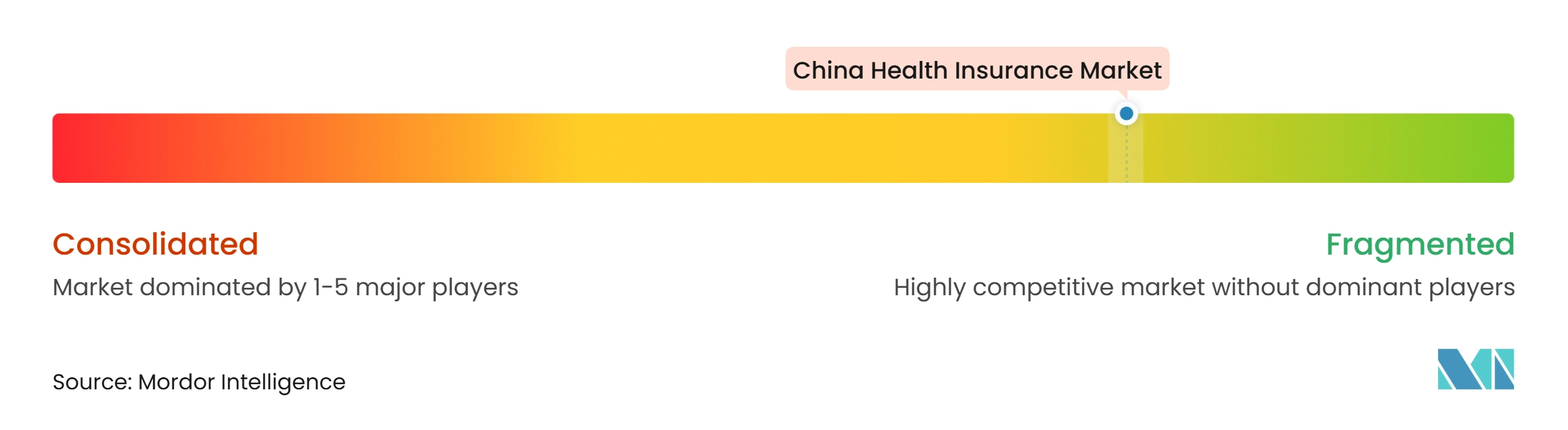
The China health insurance market is fragmented, with competition spanning specialist health insurers, diversified life and property insurers, digital-first providers, and technology-enabled distribution platforms. The market includes Ping An Health Insurance, PICC Health, Pacific Health Insurance, Fosun United Health Insurance, and Kunlun Health Insurance, alongside larger groups such as China Life, New China Life, and Taikang Life that distribute health products through agency and bancassurance networks. ZhongAn Online P&C Insurance adds a digital-first model focused on online distribution and platform-based servicing. This variety of providers and distribution channels gives customers access to different product structures and service models, rather than concentrating competition in a narrow group of specialist insurers. The China Banking and Insurance Regulatory Commission’s successor, the National Financial Regulatory Administration (NFRA), has also emphasized professional and specialized development in health insurance, supporting differentiated offerings across the market.
Product innovation and technology are important competitive differentiators. Ping An Health Insurance uses AI-based analysis across 128 employee data dimensions to tailor corporate benefits and health-management plans. PICC Health reported original premium income of CNY 56.27 billion (USD 7.84 billion) in 2025, up 15.5% year on year, while its internet health insurance business generated CNY 20.38 billion (USD 2.84 billion) in premiums, demonstrating the scale of digital distribution alongside traditional channels. ZhongAn’s health ecosystem, according to the company’s 2025 results cited in your source, generated CNY 12.68 billion (USD 1.77 billion) in gross written premiums, up 22.7% year on year. Pacific Health Insurance has also pursued technology-led partnerships, including an AI health-management offering with Ant Health.
Competition is also shaped by unmet needs in chronic-condition coverage, long-term care for older people with disabilities, and portable protection for migrant and flexible workers. NFRA requirements for product design, pricing, claims settlement, and consumer protection create compliance demands for insurers developing complex long-term care and innovative-drug products. Health-data integration, claims management, and secure handling of sensitive information are therefore central to sustainable differentiation. The China Insurance Association reported that health insurance premiums across property and life insurers grew by 15.2% year on year in the first half of 2026, indicating continued sector growth. Overall, the market is best characterized as fragmented, with competition driven by specialized products, digital capabilities, service quality, and distribution reach.
China Health Insurance Industry Leaders
-
China Life Insurance Company Limited
-
PICC Health Insurance Company Limited
-
Ping An Insurance (Group) Company of China, Ltd
-
New China Life Insurance Company Ltd
-
China Pacific Insurance (Group) Co., Ltd.
- *Disclaimer: Major Players sorted in no particular order
China Health Insurance Market Companies Covered in this Report
- Ping An Health Insurance Company of China, Ltd
- PICC Health Insurance Company Limited
- China Pacific Health Insurance Co., Ltd
- Fosun United Health Insurance Co., Ltd
- Kunlun Health Insurance Co., Ltd
- Hexie Health Insurance Co., Ltd
- Ruihua Health Assurance
- China Life Insurance Company Limited
- New China Life Insurance Company Ltd
- Taikang Life Insurance Co., Ltd
- Allianz China Life Insurance Company Limited
- AIA's mainland China underwriting entity
- China Pacific Property & Casualty Insurance Co., Ltd
- ZhongAn Online P&C Insurance Co., Ltd
- AXA Tianping Property & Casualty Insurance Company Limited
- Sunshine's relevant health-insurance underwriting subsidiary
- Taikang Pension & Insurance Co., Ltd
Recent Industry Developments in China Health Insurance Market
- October 2026: PICC Property and Casualty launched “AI Fu An Kang,” a million-yuan medical insurance product developed in partnership with Ant Health’s AI platform, integrating AI health management agents, real-time medical consultation, and personalized claims tracking directly within the Ant Jinglingfu app, establishing a new benchmark for “health insurance + AI intelligent agent + full-chain health services.”
- July 2026: Beijing’s Municipal Medical Security Bureau, NFRA Beijing Regional Bureau, and 6 co-issuing departments published 18 specific measures to support commercial health insurance high-quality development, including a mechanism to apply NHSA’s intelligent claims audit rules directly to commercial payer claims, functionally integrating state medical insurance audit capacity into the commercial sector’s fraud detection infrastructure.
- June 2026: Ping An Healthcare and Technology Company upgraded its “Ping An AI Doctor” service, embedding the platform across 4 core Ping An Group applications with 90 million monthly active users, powered by the Ping An Medical Master large model and delivering an “AI response in seconds plus full-process supervision by human doctors” model.
- June 2026: Pacific Health Insurance partnered with Ant Health to launch “Blue Medical Insurance,” providing guaranteed renewable long-term medical insurance to individuals aged 30 days to 75 years with no health examination required and coverage for common pre-existing conditions including hypertension, diabetes, and hepatitis B, a significant underwriting boundary expansion with the first-ever AI health manager integrated as a policy service component.
China Health Insurance Market Report Scope
Segmentation Overview
| Individual and Family |
| Group and Employer-Sponsored |
| Medical Expense Insurance |
| Critical Illness and Disease Insurance |
| Long-Term Care Insurance |
| Disability Income Protection Insurance |
| Agents and Brokers |
| Bancassurance |
| Insurer-Owned Direct Sales Channels |
| Third-Party Digital Platforms and Aggregators |
| East China |
| Central China |
| West China |
| Northeast China |
| By Policyholder Type | Individual and Family |
| Group and Employer-Sponsored | |
| By Product Type | Medical Expense Insurance |
| Critical Illness and Disease Insurance | |
| Long-Term Care Insurance | |
| Disability Income Protection Insurance | |
| By Distribution Channel | Agents and Brokers |
| Bancassurance | |
| Insurer-Owned Direct Sales Channels | |
| Third-Party Digital Platforms and Aggregators | |
| By Geography | East China |
| Central China | |
| West China | |
| Northeast China |
Key Questions Answered in the Report
What is the forecast growth rate for health insurance in China?
The sector is forecast to grow at a 6.8% CAGR from 2027 to 2032, increasing from USD 162.2 billion in 2027 to USD 225.3 billion by 2032.
Which product category has the largest share in China?
Medical expense insurance leads with a 54.6% share in 2026, supported by demand for supplementary inpatient, outpatient, surgery, and drug coverage.
Which health insurance product is growing fastest in China?
Long-term care insurance is forecast to grow at a 9.6% CAGR through 2032, supported by national care insurance policy and population aging.
Which distribution channel is expanding fastest?
Third-party digital platforms and aggregators are forecast to grow at an 11.9% CAGR through 2032, ahead of traditional distribution channels.
Which region leads health insurance demand in China?
East China leads with a 40.4% share in 2026, supported by higher incomes, employer concentration, and advanced healthcare infrastructure.
What are the main risks facing insurers in China?
Medical cost inflation, adverse selection, high claims exposure, and fragmented health records can weaken pricing accuracy and underwriting results.