
China Container Homes Market Size and Share
Market Overview
| Study Period | 2021 - 2032 |
|---|---|
| Forecast Data Period | 2027 - 2032 |
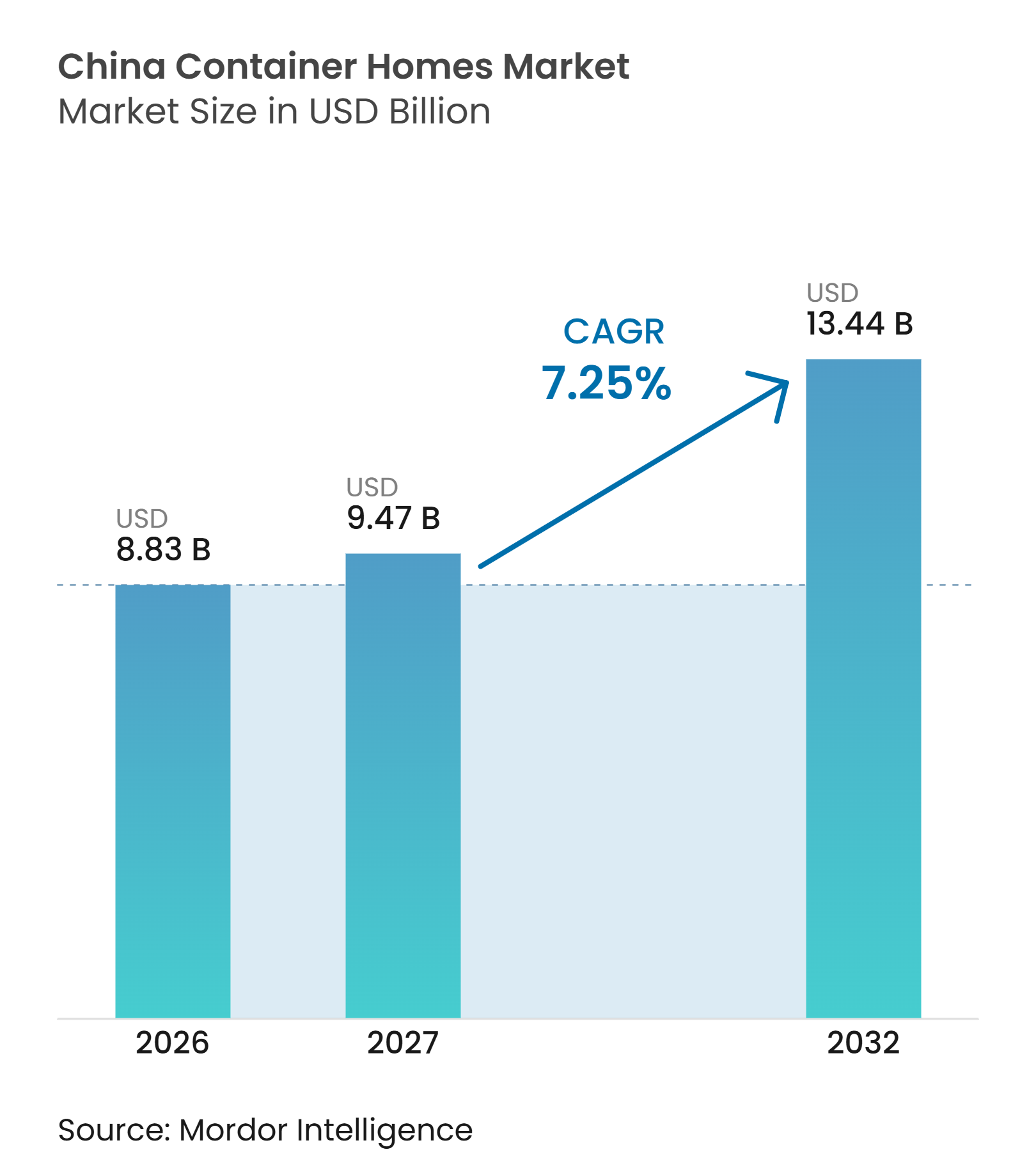
| Base Year Market Size (2026) | USD 8.83 Billion |
| Market Size (2027) | USD 9.47 Billion |
| Market Size (2032) | USD 13.44 Billion |
| Growth Rate (2027 - 2032) | 7.25 % |
| Market Concentration | Low |
Major Players *Disclaimer: Major Players sorted in no particular order Image © Mordor Intelligence. Reuse requires attribution under CC BY 4.0. | |
China Container Homes Market Analysis by Mordor Intelligence
The China Container Homes Market size was valued at USD 8.83 billion in 2026 and is forecast to grow to USD 9.47 billion in 2027 and USD 13.44 billion by 2032, expanding at a CAGR of 7.25% during 2027–2032.
China’s integrated container manufacturing base supports shorter delivery cycles and lower unit costs for domestic projects and export orders. The China container homes industry also benefits from urban renewal policy, which supports intelligent construction and prefabricated building systems in public infrastructure and housing-related projects. Demand is shifting beyond construction camps toward emergency facilities, institutional buildings, tourism sites, and digital infrastructure. This wider use base can reduce exposure to the property cycle, although price pressure and land-use limits continue to constrain permanent residential applications. Manufacturers with factory controls, technical documentation, and certified materials are better placed to compete for higher-specification projects under updated compliance requirements.
Key Report Takeaways
- By offering, on-site built units held 58.5% of the China container homes market size in 2026, giving the segment the leading China container homes industry share, while factory-built units are projected to grow at a 7.9% CAGR through 2032.
- By construction type, fixed units held 52% of the China container homes industry size in 2026, giving the segment the leading China container homes market share, while movable units are projected to grow at an 8.4% CAGR through 2032.
- By end use, residential homes accounted for 46.5% of the China container homes market size in 2026, giving the segment the leading China container homes industry share, while emergency homes are projected to grow at an 8.7% CAGR through 2032.
- By city, Shanghai accounted for 8.6% of the China container homes market share in 2026, while Shenzhen is projected to grow at an 8.05% CAGR through 2032.
Note: Market numbers in this report are based on Mordor Intelligence's proprietary estimation framework, which combines nine months of actuals with Q4 projections for base year 2026.
Market Trends and Insights
Drivers Impact Analysis of China Container Homes Market*
| Drivers | (~) % Impact on CAGR Forecast | Geographic Relevance | Impact Timeline |
|---|---|---|---|
| Container Manufacturing Scale and Low Unit Costs | +2.3% | Global, strongest in the Pearl River Delta manufacturing cluster | Short term (≤ 2 years) |
| Workforce Housing for Infrastructure and Industrial Projects | +1.8% | National, with intensity in Shenzhen, Guangzhou, and inland industrial corridors | Short term (≤ 2 years) |
| Standardized Post-Disaster and Emergency Deployment | +1.3% | National, with spillover to Belt and Road Initiative partner markets | Medium term (2-4 years) |
| Export Demand from Belt and Road Initiative and Emerging Markets | +1.0% | ASEAN, Middle East, Africa, and Eastern Europe | Medium term (2-4 years) |
| Tourism, Camping, and Rural Hospitality Units | +0.7% | National, with early gains in Yunnan, Sichuan, Zhejiang, and coastal destinations | Medium term (2-4 years) |
| Source: Mordor Intelligence | |||
Container Manufacturing Scale and Low Unit Costs
China’s container production system supports the China container homes market by bringing steel structures, insulated panels, electrical systems, plumbing components, and furnishing suppliers close to assembly facilities. Manufacturing clusters in Guangdong provide a concentrated supply base for complete modular building systems. The arrangement reduces transport between production stages and gives producers greater control over delivery schedules. It also supports product designs that can be packed efficiently for export and installed quickly at the destination. In August 2026, a Guangzhou intelligent production line reported a prefabrication integration rate of up to 80%, showing how process integration can shorten site work and improve production consistency. These operating conditions help suppliers respond to demand for standardized units without relying on extensive on-site labor.
Workforce Housing for Infrastructure and Industrial Projects
Infrastructure and industrial projects create concentrated, temporary housing needs that conventional housing stock cannot always meet near project sites. The China container homes market serves this demand through dormitories, site offices, sanitary facilities, and short-term management accommodation. Such units can be installed on project schedules that align with construction work, logistics development, and industrial expansion. China’s prefabricated building exports increased 45% year over year in the first quarter of 2026, with products reaching more than 150 countries and regions. This export activity indicates that manufacturers are meeting workforce accommodation needs beyond the domestic base. Data center construction may reinforce this use case because it often requires temporary workforces in areas with limited nearby accommodation.
Standardized Post-Disaster and Emergency Deployment
Emergency preparedness programs are creating recurring demand for standardized shelter and institutional units. The China container homes market can supply reusable facilities for medical care, isolation, welfare services, and temporary accommodation after emergency events. The national focus on intelligent construction and prefabricated systems supports the use of standardized building solutions in public projects. Shenzhen People’s Hospital Bao’an Branch used 101 independently removable modules in a hospital project, demonstrating a model for maintenance and flexible institutional deployment. Units that can be moved and reused offer municipal buyers an alternative to single-use emergency structures. Technical standards issued jointly by national ministries also increase the importance of documented material and safety performance.
Export Demand from Belt and Road Initiative and Emerging Markets
Export demand gives domestic manufacturers another outlet when local property activity is weaker. Huangpu Customs supervised exports of 23 batches of modular housing in the first 7 months of 2026, with ASEAN markets including Indonesia, Vietnam, Thailand, and Malaysia contributing to demand[1]. The China container homes market benefits when manufacturers can combine local production scale with export-ready product documentation. Guangzhou producers have also shipped completed building modules to international projects, including hospitality developments[2]. Export projects require producers to meet destination-country requirements for structure, fire protection, insulation, and logistics. This favors firms that can provide consistent specifications across repeat orders. It also gives producers a reason to develop products for tourism, health care, and workforce housing rather than relying on a single domestic end use.
Restraints Impact Analysis of China Container Homes Market*
| Restraints | (~) % Impact on CAGR Forecast | Geographic Relevance | Impact Timeline |
|---|---|---|---|
| Overcapacity and Low-Cost Price Competition | -1.7% | National, most acute in Hebei, Shandong, and Guangdong manufacturing clusters | Short term (≤ 2 years) |
| Restrictions on Permanent Residential Use and Land-Use Rules | -1.1% | National, with strictest enforcement in Tier-1 and Tier-2 cities | Medium term (2-4 years) |
| Weak Property Market and Limited Financing for Non-Conventional Homes | -0.8% | National, with spillover into Tier-3 and Tier-4 cities | Medium term (2-4 years) |
| Thermal and Climate-Performance Requirements | -0.5% | Northern China, eastern coastal cities, and export-destination markets | Long term (≥ 4 years) |
| Source: Mordor Intelligence | |||
Overcapacity and Low-Cost Price Competition
A large base of manufacturers puts sustained pressure on prices for standard flat-pack and expandable products. The China container homes market includes more than 1,000 active factories, creating wide differences in technical capability and commercial positioning. Producers serving basic site accommodation often compete mainly on delivered costs, limiting the funding available for product improvement. Price-based competition can also delay investment in testing, quality records, and design development. National requirements for insulation materials make performance documentation more important for suppliers seeking institutional work. The effect is a split between commodity suppliers and firms that can pursue projects where compliance and delivery assurance carry more weight than price alone.
Restrictions on Permanent Residential Use and Land-Use Rules
Planning and land-use rules limit the conversion of many container units into permanent residential properties. The China container homes market therefore has a narrower role in mainstream housing than in temporary, institutional, recreational, and emergency applications. In major cities, temporary-building permits can restrict long-term tenure, mortgage registration, and conventional leasing arrangements. Buyers may then favor uses where permanent residential status is not essential, such as workforce housing, tourism cabins, public facilities, and emergency shelters. This framework directs manufacturers toward customer groups that value fast installation and mobility more than permanent title. It also makes product certification and clear use-case design important when suppliers approach municipal or institutional buyers.
*Our forecasts treat driver/restraint impacts as directional, not additive. The impact forecasts reflect baseline growth, mix effects, and variable interactions.
China Container Homes Market Segment Analysis
By Offering:
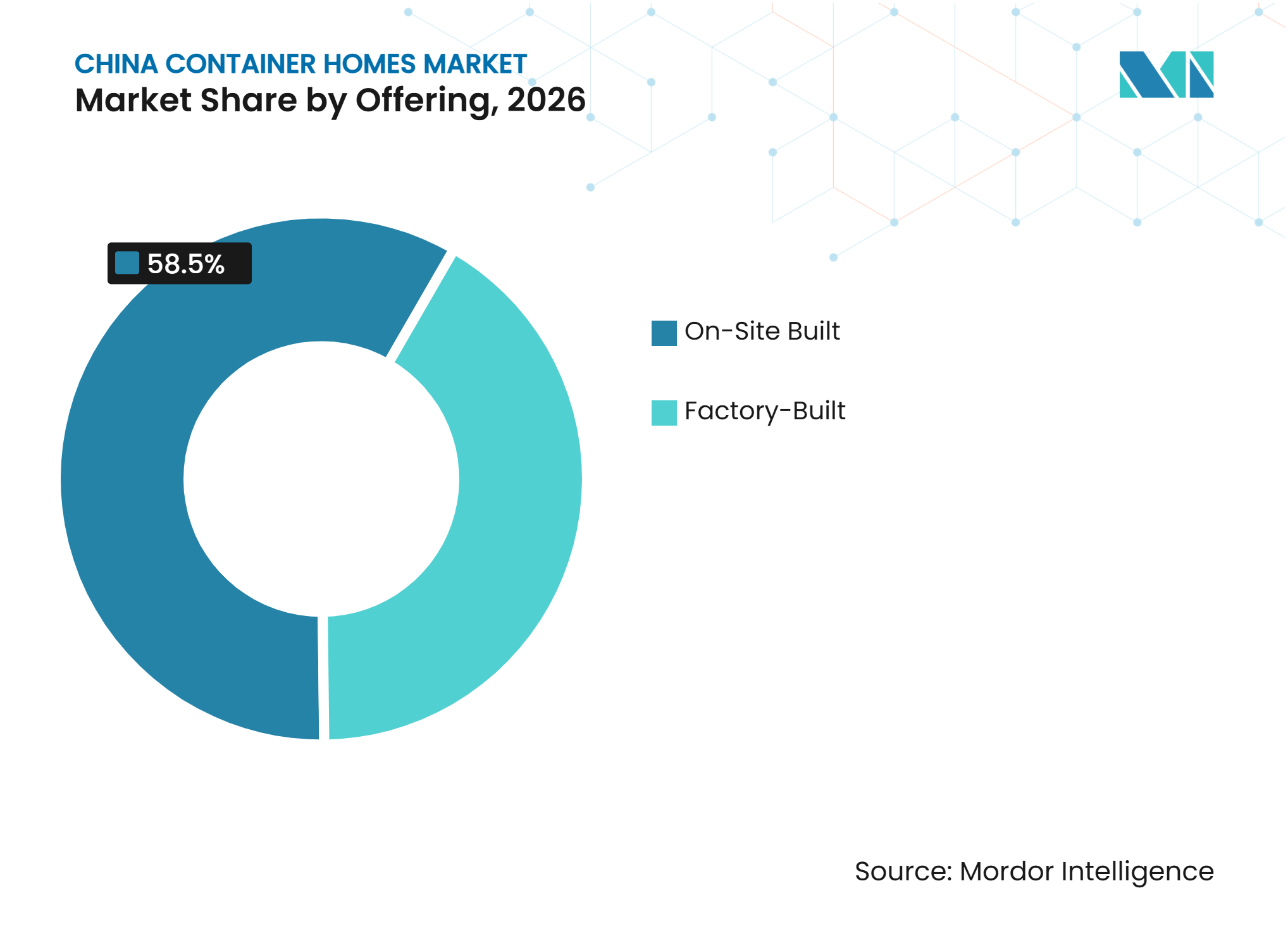
On-Site Built Units Retain a Broad Project BaseOn-site built units accounted for 58.5% of the China container homes market size in 2026, reflecting their wide use across construction sites, rural hospitality projects, and urban renewal areas. Project owners often use on-site assembly because their teams already manage cranes, staging areas, and local installation work. This option can also reduce the need to transport fully finished modules through congested urban locations. It remains suitable for projects that require flexible layouts or have changing space requirements during construction. On-site-built suppliers can adapt individual units to local conditions, including site access, utilities, and available foundations. The format remains central, with procurement focusing on practical deployment and short lead times.
Factory-built units are projected to expand at a 7.9% CAGR through 2032 as buyers seek more reliable production controls. Their growth is linked to applications in health care, education, export, and other projects where quality records are part of procurement requirements. Production in a controlled facility supports documented welds, tested finishes, and more consistent thermal and fire performance. Guangdong’s building export activity shows that manufacturers are moving from individual modules toward more complete modular building deliveries. The China container homes industry is therefore moving toward factory-made products where certification and repeatability matter most. Joint national requirements for insulation materials make controlled production processes more relevant for suppliers serving higher-specification clients.


By Construction Type:
Fixed Units Support Established Sites While Movable Formats ExpandFixed units held 52% of total demand in 2026, supported by projects that have stable foundations, utility connections, and longer operating periods. These installations are used for affordable housing programs, campus accommodation, and tourism projects where relocation is not planned. Fixed units can be integrated with roads, drainage, and local service networks once a site is ready. Their role is strongest where a project owner has clarity on the long-term use of the location. Municipal planning conditions also influence whether fixed units can remain in place for longer periods. These factors keep the fixed format relevant for established institutional and hospitality sites.
Movable structures are expected to grow at an 8.4% CAGR through 2032 because they meet needs that change by location or season. Construction camps, emergency stockpiles, offshore support uses, and seasonal resorts all require units that can be transported and reinstalled. Foldable and expandable configurations can improve freight efficiency by reducing the space needed during transport. Repeated movement requires stronger connections, reliable weather seals, and durable insulation. This technical requirement can create an advantage for manufacturers that have validated designs and production controls. The China container homes market is also finding opportunities for movable units during institutional renovation cycles, when temporary capacity is needed without interrupting ongoing services.
By End Use:
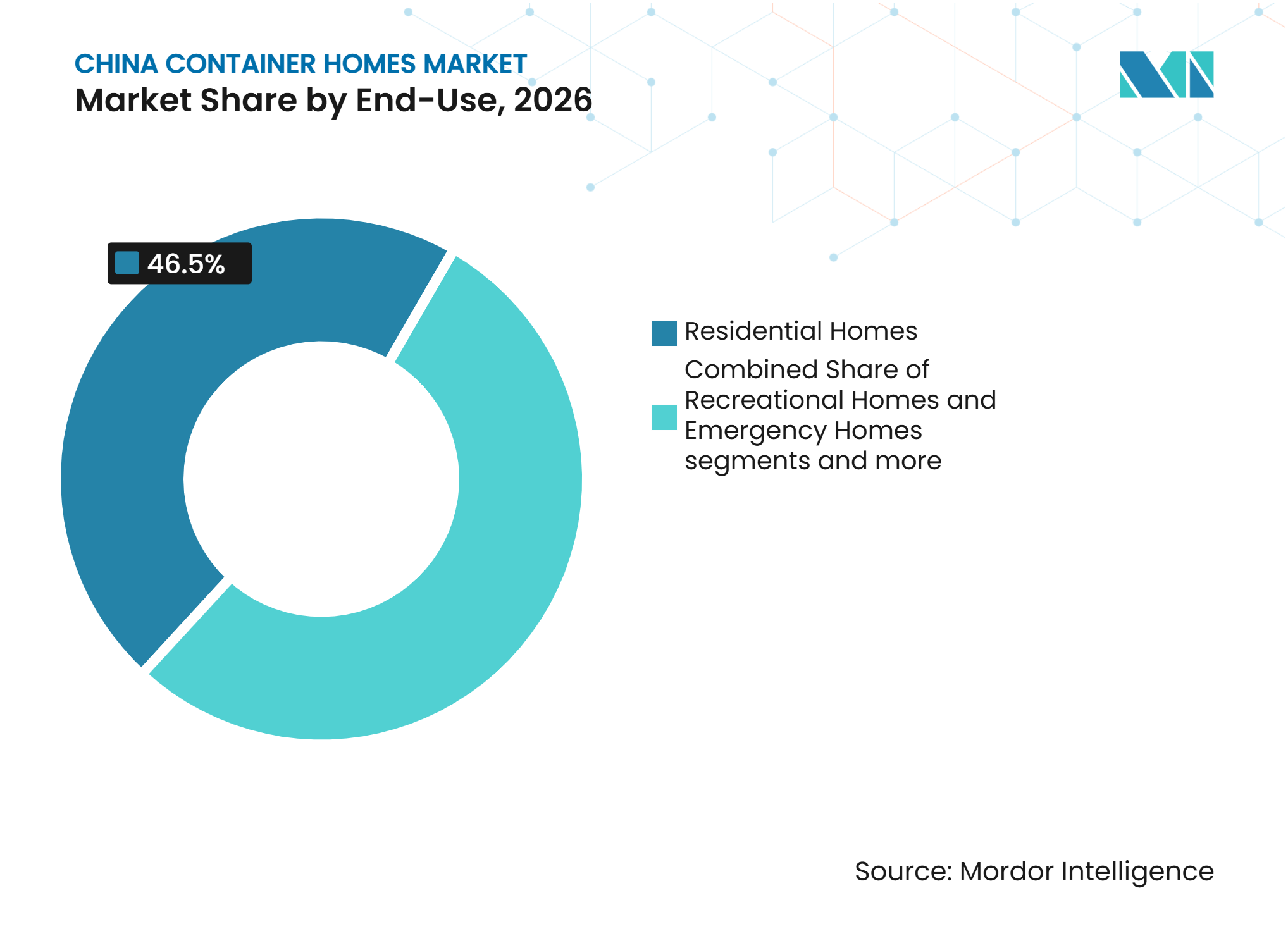
Residential Homes Remain the Largest Demand BaseResidential homes represented 46.5% of total demand in 2026, supported by rural construction demand and affordable housing needs. Their appeal rests on the ability to provide units more quickly than many conventional construction methods. Residential demand is still shaped by planning limits, financing conditions, and the ability to secure suitable land use approvals. Recreational homes serve campgrounds, agritourism venues, and boutique accommodation providers that value flexible layouts and shorter construction periods. Nursing homes are emerging as a further use case because providers need additional capacity during upgrades or expansion. These end uses help suppliers diversify even when conventional property development is weak.
Emergency homes are forecast to advance at an 8.7% CAGR through 2032, the fastest rate among end uses. Public-sector buyers can use modular units for shelter, health facilities, isolation capacity, and welfare services. The Shenzhen hospital project shows how removable modular components can support institutional flexibility and maintenance after completion[3]. China’s policy support for intelligent construction and prefabricated systems gives emergency-ready facilities a clearer public procurement role. Suppliers need to demonstrate safety, material, and production compliance for this work. The China container homes industry can consequently benefit from recurring procurement rather than relying only on event-specific demand.


Geography Analysis
Shanghai
Shanghai held 8.6% of the China container homes market share in 2026, making it the leading city segment. Urban renewal, infrastructure works, and industrial park development support recurring demand for site accommodation and temporary offices. The city’s dense project environment also supports orders for flat-pack dormitories and service facilities. National policy promotes intelligent construction and prefabricated building systems, providing a supportive direction for urban development projects. Procurement decisions are influenced by delivery speed, site safety, and local planning requirements. Suppliers that can provide standardized products with complete documentation are better suited to larger institutional projects. Shanghai’s broad demand base across construction, logistics, and industrial activity offers stability even when individual project categories change.
Shenzhen
Shenzhen is expected to expand at an 8.05% CAGR through 2032, supported by its position near Guangdong’s modular production network. The city combines demand for workforce accommodation with public-sector interest in emergency and institutional construction. The hospital project at Shenzhen People’s Hospital Bao’an Branch used removable modules and demonstrates how modular methods can be applied to high-specification facilities. Manufacturing proximity can reduce delivery times and help suppliers coordinate components for complex projects. The Greater Bay Area has also supported exports of complete building systems, strengthening the regional production base. Compliance with material requirements issued by national ministries remains relevant for producers that supply public projects. This combination of local demand, supply-chain access, and technical project references supports Shenzhen’s growth.
Beijing, Guangzhou, Hangzhou, and Other Key Cities
Beijing is using modular construction in affordable rental housing, including a project that delivered 241 rental units with 203 standardized modules. Guangzhou combines urban demand with production capacity, including an intelligent modular construction line that began operating in 2026. Hangzhou has potential for tourism and hospitality projects where low-footprint structures are compatible with resort and agritourism concepts. Chengdu and Wuhan are earlier-stage locations where emergency procurement and campus accommodation can provide initial demand. Customs data on modular housing exports through Guangdong also points to the importance of southern production hubs in serving foreign customers. These cities will not necessarily follow the same demand pattern as Shanghai or Shenzhen. Their development depends on local housing policy, infrastructure activity, tourism demand, and public-sector procurement. The China container homes market can expand across this mixed group as prefabricated construction methods gain acceptance in different local applications.
Competitive Landscape
Market Concentration
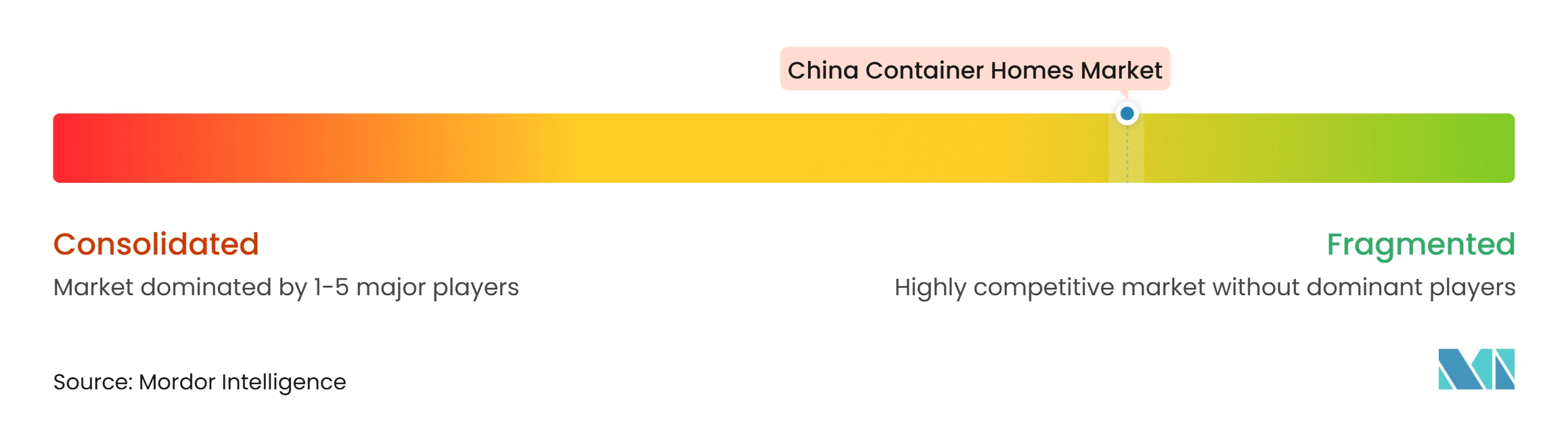
The China container homes market has a broad supplier base that ranges from commodity manufacturers to industrialized modular building specialists. Basic providers supply construction camps and standard site units where product specifications are relatively simple. Companies such as GS Housing (Beijing GS Housing Co., Ltd.), K-HOME (Henan K-Home Steel Structure Co., Ltd.), Lida Group, and Guangdong WELLCAMP Building Materials serve tourism, commercial, emergency, and export customers with broader product portfolios. At the higher end, CIMC Modular Building Systems and China Construction Science and Industry Corporation Ltd. compete through engineering capability, factory controls, and complex project delivery. The presence of many suppliers keeps price competition strong in standard products. It also creates an opening for firms that can prove performance through documented production and material compliance.
Technology and quality control are central to competition for institutional projects. Automated production, controlled factory work, and digital design systems can improve consistency in ways that manual on-site assembly may not achieve. CIMC Modular Building Systems shipped 104 completed modules for the Earth Hotels Riyadh project in July 2026, demonstrating an approach that combines factory completion with export delivery. China Construction Science and Industry Corporation Ltd. delivered the modular hospital project in Shenzhen using 101 removable modules, establishing a reference project for adaptable health infrastructure. These examples show why suppliers with proven delivery records can compete for projects where quality, timing, and operations matter together. Requirements for insulation materials further increase the value of validated supply systems.
The next stage of competition is likely to center on end uses that require more design and operational support. Elder care, emergency shelter systems, and prefabricated data center facilities provide opportunities for specialized products. Guangzhou Construction Group signed an order for 150 building modules for delivery to 6 Australian cities in August 2026, showing that producers are pursuing international demand beyond basic unit exports. Companies with international certification, clear technical files, and dependable logistics can use these projects to build repeat business. Smaller producers may remain focused on price-sensitive domestic or export orders. The competitive structure is therefore divided between volume-oriented suppliers and companies targeting complex, higher-value applications. This division is consistent with a market where scale is widespread but advanced technical delivery is concentrated among fewer firms.
China Container Homes Industry Leaders
-
CIMC Modular Building Systems
-
Guangdong C.BOX Co., Ltd
-
K-HOME (Henan K-Home Steel Structure Co., Ltd)
-
CGCH (China Green Container House)
-
GS Housing (Beijing GS Housing Co., Ltd)
- *Disclaimer: Major Players sorted in no particular order
China Container Homes Market Companies Covered in this Report
- CIMC Modular Building Systems
- Guangdong C.BOX Co., Ltd
- GS Housing (Beijing GS Housing Co., Ltd)
- K-HOME (Henan K-Home Steel Structure Co., Ltd)
- CGCH (China Green Container House)
- ZN House
- Konbuild
- Nanjing Tuopeng Construction Technology Co., Ltd
- WIDE HZ
- Guangdong WELLCAMP Building Materials Co., Ltd.
- Lida Group
- Foshan SOEASY Building Materials Co., Ltd.
- PTH House
- DXH Container
- JJC Houses
- Shandong Quality Integrated House Co., Ltd.
- China Construction Science and Industry Corporation Ltd.
- HiG Housing Tech Co., Ltd
- Heshi (Hebei) Integrated Housing Co., Ltd
- Max Prefab House Co., Ltd
Recent Industry Developments in China Container Homes Market
- October 2026: CIMC Modular Building Systems shipped 63 factory-integrated modular building units from Dongguan's Humen Port for an elderly-care apartment development in central England. The approximately 3,000 m² development is designed to provide nearly 80 age-friendly residential units and shared facilities, demonstrating the application of Chinese-manufactured modular buildings in overseas residential and social infrastructure projects.
- September 2026: CIMC Modular Building Systems shipped 104 factory-manufactured modules from its Jiangmen production base in China for the Earth Hotel Riyadh project in Saudi Arabia. The approximately 11,000 m² boutique hotel comprises 99 rooms and is scheduled to open in early 2027. The project marks CIMC's first modular hotel development in the Middle East and strengthens its international modular construction business.
- August 2026: Guangzhou Construction Group and its subsidiaries secured an order for 150 prefabricated building modules through a strategic cooperation agreement with an Australian partner signed on 11 August 2026. The modules, covering approximately 60,000 m² of building area, are intended for deployment across six Australian markets, including Sydney, Melbourne, Queensland, New South Wales, Western Australia, and South Australia.
China Container Homes Market Report Scope
Segmentation Overview
| Factory-Built |
| On-Site Built |
| Fixed |
| Movable |
| Residential Homes |
| Recreational Homes |
| Emergency Homes |
| Nursing Homes |
| Shenzhen |
| Beijing |
| Shanghai |
| Hangzhou |
| Guangzhou |
| Other Key Cities |
| By Offering | Factory-Built |
| On-Site Built | |
| By Construction Type | Fixed |
| Movable | |
| By End-Use | Residential Homes |
| Recreational Homes | |
| Emergency Homes | |
| Nursing Homes | |
| By City | Shenzhen |
| Beijing | |
| Shanghai | |
| Hangzhou | |
| Guangzhou | |
| Other Key Cities |
Key Questions Answered in the Report
What is the value of the China container homes market?
The sector is projected at USD 8.83 billion in 2026 and is forecast to reach USD 13.44 billion by 2032.
What is the forecast growth rate through 2032?
The market is forecast to grow at a 7.25% CAGR from 2027 to 2032.
Which offering leads demand in China?
On-site built units lead with 58.5% share in 2026 because they remain widely used at construction and urban renewal sites.
Which construction type is growing fastest?
Movable units are projected to grow at an 8.4% CAGR through 2032, supported by construction camps, emergency stockpiles, and seasonal projects.
Which end use is growing fastest?
Emergency homes are projected to grow at an 8.7% CAGR through 2032 as public buyers seek standardized shelters and institutional facilities.
Which city has the strongest growth outlook?
Shenzhen is projected to grow at an 8.05% CAGR through 2032 because it combines local demand with access to Guangdong’s modular production base.