
China Construction Project Management Services Market Size and Share
Market Overview
| Study Period | 2021 - 2032 |
|---|---|
| Forecast Data Period | 2027 - 2032 |
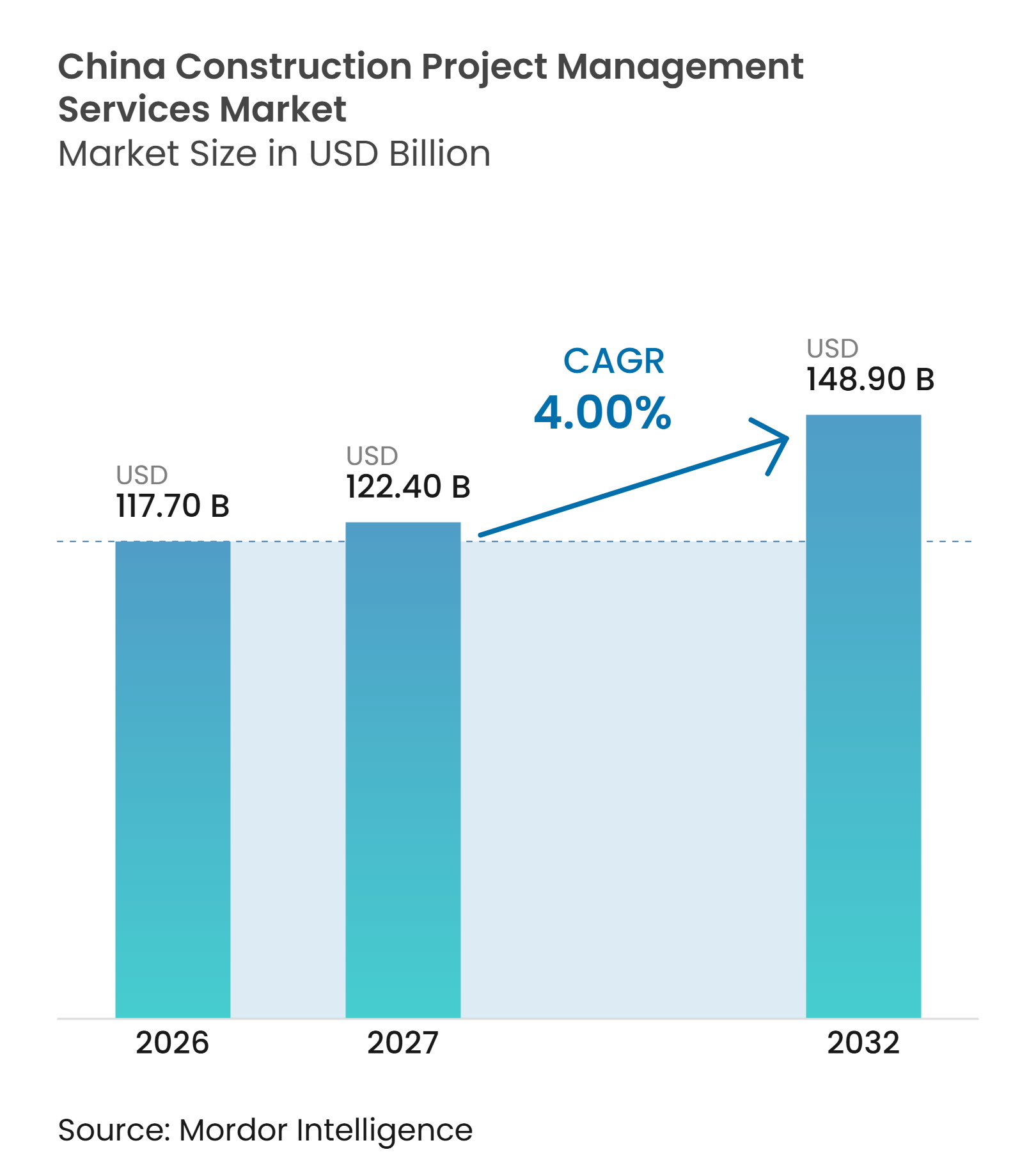
| Base Year Market Size (2026) | USD 117.70 Billion |
| Market Size (2027) | USD 122.40 Billion |
| Market Size (2032) | USD 148.90 Billion |
| Growth Rate (2027 - 2032) | 4.00 % |
| Market Concentration | Low |
Major Players *Disclaimer: Major Players sorted in no particular order Image © Mordor Intelligence. Reuse requires attribution under CC BY 4.0. | |
China Construction Project Management Services Market Analysis by Mordor Intelligence
The China Construction Project Management Services Market size was valued at USD 1.12 billion in 2026 and is projected to increase to USD 1.22 billion in 2027 and USD 1.94 billion by 2032, registering a CAGR of 9.72% during 2027–2032.
State-backed infrastructure programs are creating a broad pipeline of work that requires coordinated planning, procurement, supervision, and cost control. The 15th Five-Year Plan directs investment toward water systems, power grids, computing networks, communications, underground pipelines, and logistics networks. Central state-owned enterprises plan USD 299 billion of 2026 infrastructure investment, which supports near-term demand for specialist delivery services. Whole-Process Engineering Consulting (WPEC) is changing procurement by combining services that were previously bought under separate contracts. The residential downturn remains a material constraint, so firms that serve industrial, infrastructure, and urban renewal projects have a stronger position in the China construction project management services industry.
Key Report Takeaways
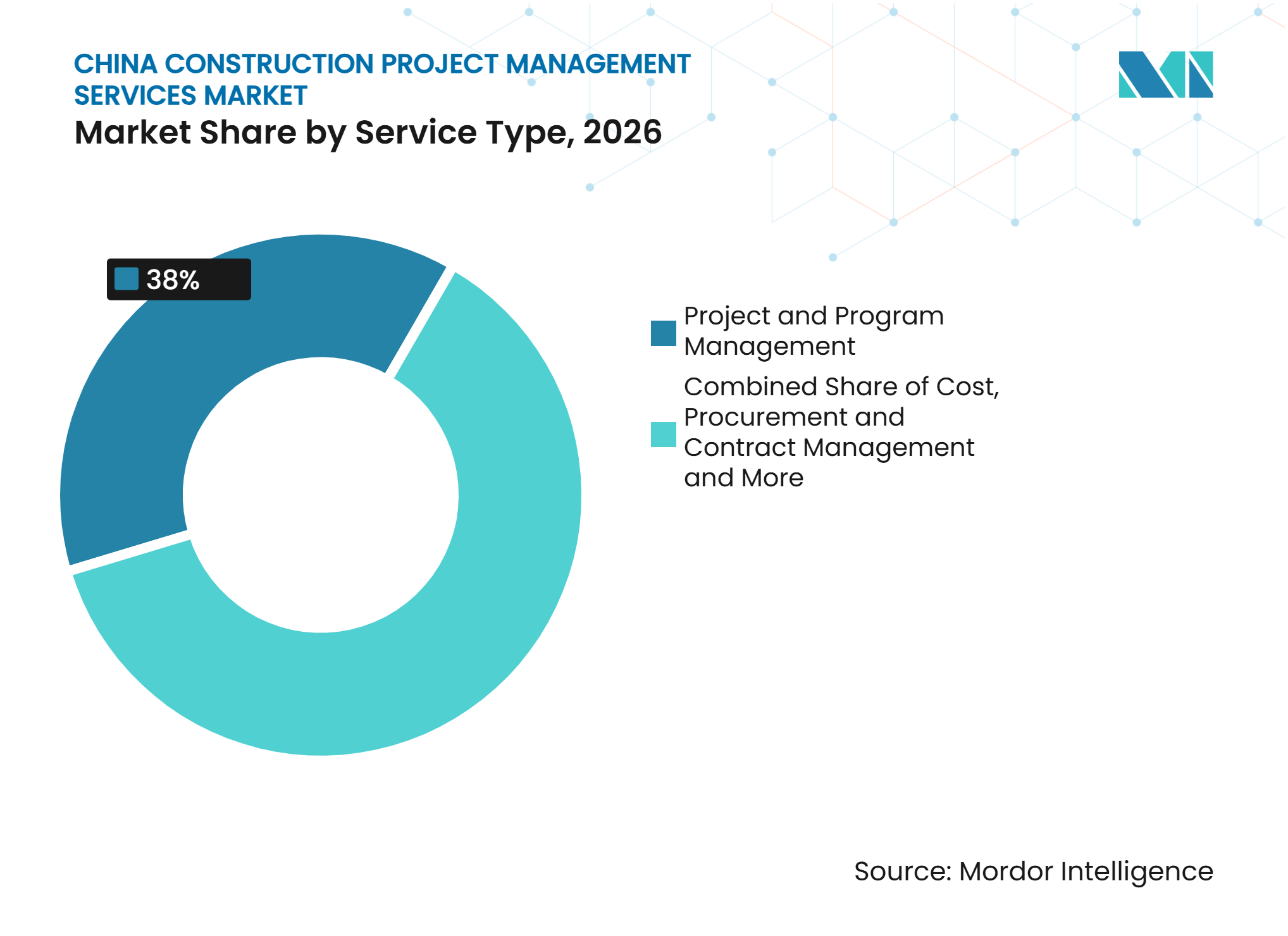
- By service type, project and program management held 38.0% of the China construction project management services market share in 2026 and is forecast to grow at a 10.60% CAGR through 2032.
- By project type, infrastructure construction held 46.0% of the China construction project management services market size in 2026, while industrial construction is forecast to grow at a 10.90% CAGR through 2032.
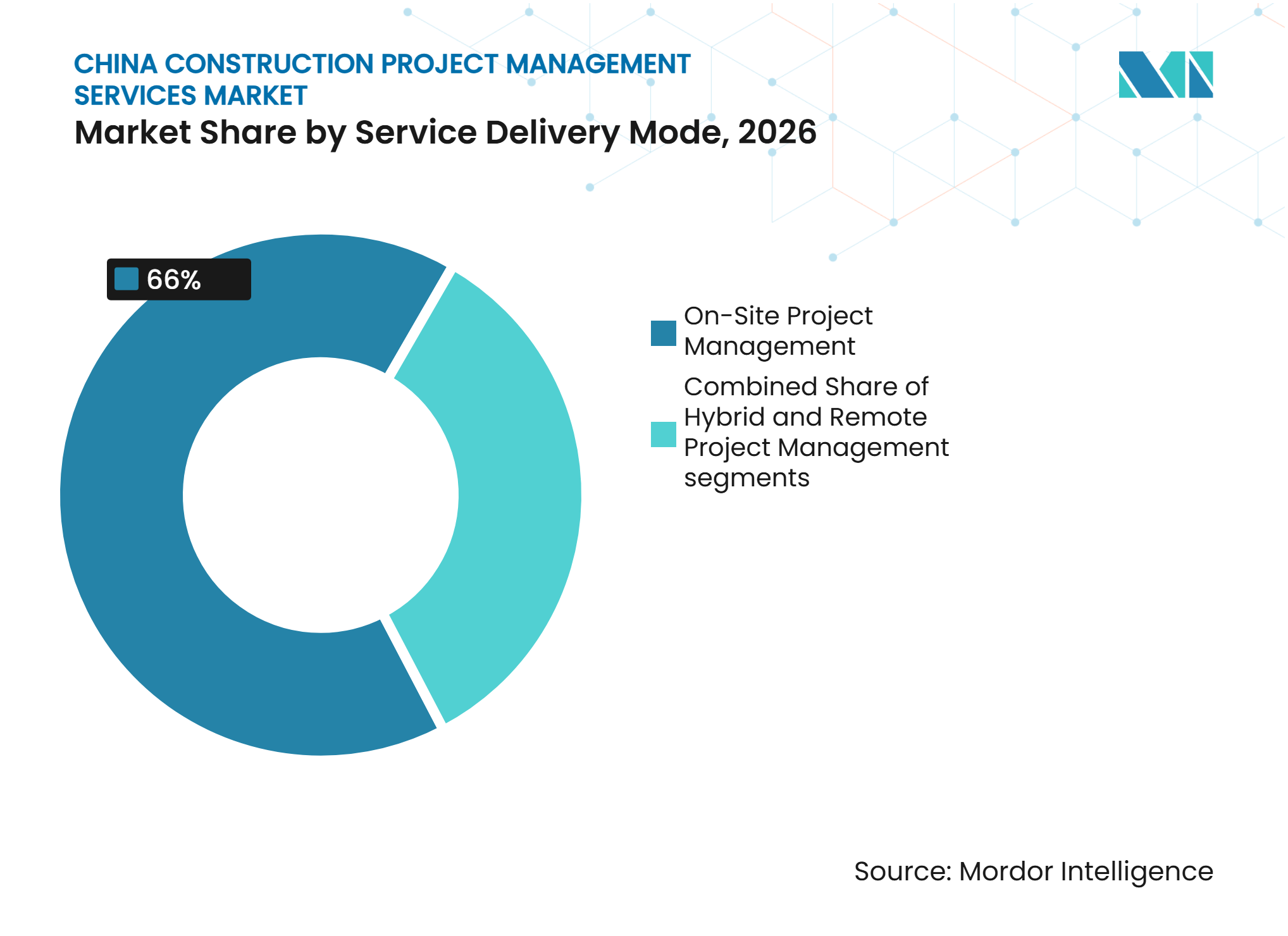
- By delivery mode, on-site project management held 66.0% of the China construction project management services market size in 2026, while remote project management is forecast to grow at a 12.80% CAGR through 2032.
- By city, Shanghai accounts for 17.5% of the China construction project management services market share in 2026, while Shenzhen is forecast to grow at an 11.20% CAGR through 2032.
Note: Market numbers in this report are based on Mordor Intelligence's proprietary estimation framework, which combines nine months of actuals with Q4 projections for base year 2026.
Market Trends and Insights
Drivers Impact Analysis of China Construction Project Management Services Market*
| Drivers | (~) % Impact on CAGR Forecast | Geographic Relevance | Impact Timeline |
|---|---|---|---|
| Government Push for Whole-Process Engineering Consulting | +3.0% | National, with strong regulatory influence in Shanghai, Shenzhen, Beijing, Guangzhou, and Hangzhou | Short term (≤ 2 years) |
| Urban Renewal and New-Type Urbanization Programs | +2.5% | National, concentrated in Tier 1 and Tier 2 cities, with spillover to smaller municipalities. | Medium term (2-4 years) |
| New Infrastructure Investment in Data Centers, 5G, and Smart Cities | +2.0% | National hubs include Shanghai, Shenzhen, Beijing, and Hangzhou, with western nodes in Inner Mongolia, Ningxia, and Gansu. | Short term (≤ 2 years) to Medium term (2-4 years) |
| Ultra-High-Voltage Transmission and Large-Scale Renewable Energy Bases | +1.5% | Western China, including Xizang, Inner Mongolia, and Ningxia, with transmission corridors to eastern coastal cities | Medium term (2-4 years) |
| Local-Government Special-Purpose Bond Financing for Infrastructure | +1.0% | National, with acceleration in Guangdong, Shandong, Hubei, and Jiangsu | Short term (≤ 2 years) |
| Building Information Modeling and Intelligent Construction Mandates on Public Projects | +0.8% | National, with notable compliance factors in Shanghai, Anhui, Ningxia, and Liaoning | Long-term (≥ 4 years) |
| Source: Mordor Intelligence | |||
Government Push for Whole-Process Engineering Consulting
Whole-process engineering consulting is changing how government-funded construction work is purchased in China. In September 2025, the National Development and Reform Commission issued Document No. 824, which called for integrated investment advisory, project management, procurement, supervision, and cost consulting services[1]. The policy replaces fragmented engagements with a unified mandate and raises the value of contracts that combine several management functions. It also requires traceable records for technical decisions, cost assumptions, and compliance reviews. Firms with Building Information Modeling, or BIM, data systems and broad consulting capabilities are better able to meet these requirements. The national T/GHLM001-2025 standard has provided a shared process for government-funded WPEC work since August 2025[2].
Urban Renewal and New-Type Urbanization Programs
Urban renewal is a supporting program for oversight and cost management work across established cities. China released its first national urban renewal plan for 2026 through 2030 in June 2026. The plan places more attention on older communities, aging commercial properties, underground pipelines, and underused industrial land. These projects need phased scheduling because tenants, local agencies, and contractors remain active during delivery. They also require management of heritage requirements, site logistics, and mixed funding arrangements. Shanghai’s 2026 through 2028 action plan includes the renewal of commercial buildings and the activation of underused industrial land. The work provides multi-year assignments for firms that can manage complex urban sites.
New Infrastructure Investment in Data Centers, 5G, and Smart Cities
New infrastructure investment is creating work that requires more specialized technical coordination. The Ministry of Industry and Information Technology has identified sustained information-infrastructure development as a national priority[3]. Data centers and artificial intelligence (AI) clusters need coordinated power systems, cooling equipment, structured cabling, and staged commissioning. These requirements differ from conventional commercial building oversight. The construction sequence is also sensitive because equipment installation depends on the readiness of electrical and mechanical systems. Specialists can use this capability to compete for higher-value assignments within the China construction project management services industry. The same requirements encourage owners to partner with delivery teams that have relevant industrial and digital infrastructure experience.
Ultra-High-Voltage Transmission and Large-Scale Renewable Energy Bases
Ultra-high-voltage (UHV) transmission projects are generating long-duration project management work. Construction began on the Xizang to Guangdong UHV transmission line in April 2026. The 2,681-kilometer project has an investment value of USD 7.76 billion and a transmission capacity of 10 million kilowatts. The route crosses areas with significant elevation changes and demanding logistics conditions. Managers must coordinate schedules, safety controls, supply deliveries, and regulatory requirements across multiple jurisdictions. A separate Inner Mongolia transmission corridor will integrate renewable power with major demand centers.
Restraints Impact Analysis of China Construction Project Management Services Market*
| Restraints | (~) % Impact on CAGR Forecast | Geographic Relevance | Impact Timeline |
|---|---|---|---|
| Prolonged Real Estate Sector Downturn | -1.8% | National, with acute pressure in Shanghai, Hangzhou, and Beijing | Short term (≤ 2 years) to Medium term (2-4 years) |
| Local-Government Debt Constraints Slowing Project Pipelines | -0.9% | National, with greater pressure in fiscally strained municipalities in Hunan, Liaoning, and Yunnan | Medium term (2-4 years) |
| In-House Project Management by State-Owned Contractors Limiting Outsourcing | -0.5% | National, concentrated in major projects managed by China State Construction Engineering Corporation, China Railway Construction Corporation, and China Communications Construction Company. | Medium term (2-4 years) |
| Low-Price Competition in Public Consulting Tenders | -0.4% | National, most prevalent in second-tier and third-tier cities with limited budget flexibility | Long term (≥ 4 years) |
| Source: Mordor Intelligence | |||
Prolonged Real Estate Sector Downturn
The residential construction downturn is reducing supervision and quantity-surveying work tied to new housing starts. Real estate development investment declined 20.6% from January through September 2026. Newly started building floor space also declined during the same period. The fall reduces a source of recurring work for firms that previously depended on large residential pipelines. Experienced supervisors and cost managers are therefore competing for urban renewal and infrastructure assignments. This movement can place pressure on fees even where public investment supports activity. Firms that reduce their exposure to new residential projects can focus resources on more resilient mandates.
Local-Government Debt Constraints Slowing Project Pipelines
Local-government debt can delay project approvals and postpone the start of construction programs. Debt obligations can limit the proportion of financing immediately available for new assets. The use of self-review and self-issuance processes may improve the use of bond quotas in some provinces. It also places repayment risk more clearly on local authorities. Project managers may face longer conversion periods between early planning work and active assignments. This constraint makes a diversified client portfolio more useful for providers in the China construction project management services market.
*Our forecasts treat driver/restraint impacts as directional, not additive. The impact forecasts reflect baseline growth, mix effects, and variable interactions.
China Construction Project Management Services Market Segment Analysis
By Service Type:
Project and Program Management Leads the Market and Records the Fastest GrowthProject and program management held 38.0% of the China construction project management services market in 2026. It is the leading service type because clients need a single team to coordinate scope, schedules, procurement, risk, and delivery reporting. It is also forecast to grow at a 10.60% CAGR through 2032, making it the fastest-growing service type. WPEC supports this position because the framework combines advisory and management functions under one integrated mandate. This structure increases the importance of providers that can coordinate decisions across the full project life cycle.
Cost, procurement, and contract management continue to support major programs where owners face material and delivery cost risks. Construction supervision and quality management also retain a stable role because public projects must meet national construction quality and safety requirements. Other project management services include BIM advisory and digital twin consulting. These services are gaining relevance as public authorities ask for digital project submissions and traceable records. The China construction project management industry is therefore moving toward broader mandates, while specialized services remain important within those mandates.



By Project Type:
Infrastructure Construction Leads While Industrial Construction Grows FastestInfrastructure construction accounted for 46.0% of the China construction project management services market size in 2026. It leads the project type mix because national programs cover water, power, computing, communications, underground pipelines, and logistics networks. Central state-owned enterprises have committed USD 299 billion to infrastructure investment for 2026. These programs require management support across feasibility planning, contractor coordination, safety, cost control, and completion. UHV corridors and urban renewal programs further support the segment’s large base of demand.
Industrial construction is forecast to grow at a 10.90% CAGR through 2032, making it the fastest-growing project type. AI hardware plants, semiconductor facilities, data centers, and energy-intensive campuses need specialized coordination during construction and commissioning. These facilities require close control of electrical capacity, cooling systems, equipment sequencing, and technical interfaces. Residential construction faces weaker conditions as new housing activity declines. Commercial construction is also selective, although life sciences campuses and data-center-related assets continue to produce assignments. ISO 9001, the international quality management standard, remains relevant across project types where clients require formal quality systems.
By Service Delivery Mode:
On-Site Project Management Remains Core While Remote Project Management ExpandsOn-site project management held 66.0% of the China construction project management services market in 2026. Physical presence remains important for safety-critical work on transmission sites, deep foundations, tunnels, and high-altitude renewable energy projects. Managers on these sites can respond to installation issues, coordinate contractors, and support regulator inspections. The delivery model also remains relevant when project owners need direct control over daily work. The continued size of on-site work shows that remote systems are not a full substitute for field-based engineering oversight.
Remote project management is forecast to grow at a 12.80% CAGR through 2032. It uses digital reporting, BIM models, cameras, dashboards, and structured document controls to extend oversight beyond the site. Shanghai’s BIM-assisted drawing review system accepts IFC models alongside conventional drawings. Hybrid Project Management combines periodic site visits with continuous platform-based monitoring. This model suits mid-sized commercial and industrial projects that need qualified oversight while controlling full-time staffing costs. The China construction project management industry is likely to use each delivery mode according to site risk, project complexity, and client governance needs.

Geography Analysis
Shanghai
Shanghai accounted for 17.5% of the China construction project management services market share in 2026. The city combines public infrastructure, life sciences campuses, urban renewal, and complex commercial assets. Its 2026 through 2028 urban renewal agenda covers commercial properties and underused industrial land. Shanghai’s 2025 BIM Application Guide sets a detailed local standard for digital project information and compliance review.
Shenzhen
Shenzhen is forecast to grow at an 11.20% CAGR from 2027 to 2032. The city benefits from AI-linked industrial activity, advanced manufacturing investment, and the Hetao Shenzhen-Hong Kong Innovation and Technology Co-operation Zone. Its WPEC requirement for a share of new government and state-funded projects adds a clear compliance factor. Providers that understand cleanroom construction, power systems, and intelligent manufacturing can compete for specialized assignments. Shenzhen’s mix of policy support and private industrial investment supports its faster growth profile.
Beijing, Hangzhou, Guangzhou, and Other Key Cities
Beijing supports government infrastructure, UHV substations, aerospace maintenance, repair, and overhaul (MRO), and advanced manufacturing work. Hangzhou benefits from its digital economy, while Guangzhou draws activity from Greater Bay Area logistics and industrial investment. China’s six strategic infrastructure networks widen demand beyond the largest coastal cities. Local financing capacity will still influence project start dates in many municipalities.
Competitive Landscape
Market Concentration
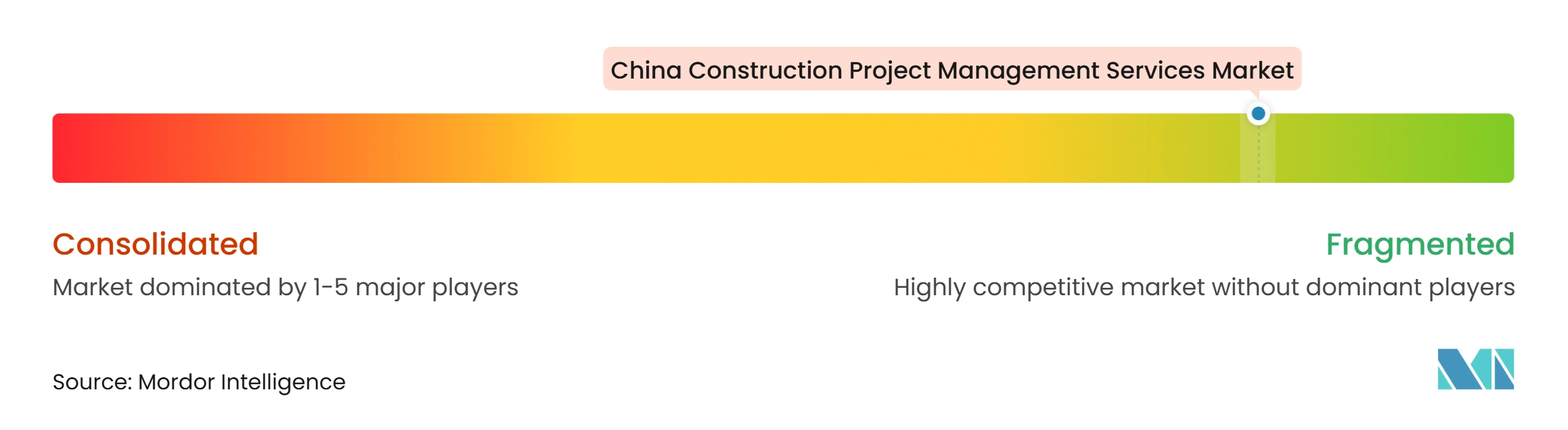
The China construction project management services market is fragmented in nature. China State Construction Engineering Corporation Limited (CSCEC), China Railway Construction Corporation Limited (CRCC), and China Communications Construction Company Limited (CCCC) have strong positions in public infrastructure because they combine construction, procurement, and delivery capabilities. Their size and established pipelines can limit independent outsourcing on large public projects. International professional services firms such as Turner & Townsend, AECOM, Arcadis, and Rider Levett Bucknall China compete more actively for premium private-sector and multinational-client work. This creates a division between domestic, large-scale public delivery and specialized private-sector advisory services.
Competitive strategies increasingly reflect the move toward integrated delivery and specialized sectors. China State Construction Engineering Corporation Limited (CSCEC) uses its broad construction platform to retain management functions within its projects. China Railway Construction Corporation Limited (CRCC) has also increased its overseas activity, which reduces reliance on weaker domestic construction activity. Turner & Townsend has highlighted capacity and pricing opportunities in advanced manufacturing and renewable energy projects as residential construction cools. WPEC favors firms that can combine project management, supervision, cost consulting, procurement support, and digital information controls. The National Development and Reform Commission’s policy direction makes this integrated capability more important in government-funded work.
Technology is another point of competition in the China construction project management services market. Leading state-owned firms are building intelligent-construction systems, while international firms emphasize sector expertise and global delivery methods. BIM platforms can improve recordkeeping, enable remote review, and support the audit trail expected under WPEC. The Ministry of Housing and Urban-Rural Development (MOHURD) also maintains policy support for BIM development in construction. Mid-sized consulting groups may have an opening if they hold strong engineering credentials and can offer both digital and compliance capabilities. Their opportunity is strongest where a project needs more independent oversight than an in-house contractor model can provide.
China Construction Project Management Services Industry Leaders
-
China State Construction Engineering Corporation Limited (CSCEC)
-
China Railway Group Limited
-
China Railway Construction Corporation Limited (CRCC)
-
China Communications Construction Company Limited (CCCC)
-
Power Construction Corporation of China (PowerChina)
- *Disclaimer: Major Players sorted in no particular order
China Construction Project Management Services Market Companies Covered in this Report
- China State Construction Engineering Corporation Limited (CSCEC)
- China Railway Group Limited
- China Railway Construction Corporation Limited (CRCC)
- China Communications Construction Company Limited (CCCC)
- Power Construction Corporation of China (PowerChina)
- China Energy Engineering Corporation Limited
- Metallurgical Corporation of China Ltd. (MCC)
- Shanghai Construction Group Co., Ltd.
- Beijing Urban Construction Group Co., Ltd.
- Shanghai Tunnel Engineering Co., Ltd.
- CITIC Construction Co., Ltd.
- Shanghai Investigation, Design & Research Institute Co., Ltd. (SIDRI)
- Shanghai Jianke Engineering Consulting Co., Ltd.
- AECOM China
- Arcadis China
- Jacobs China
- Turner & Townsend China
- Rider Levett Bucknall China
Recent Industry Developments in China Construction Project Management Services Market
- October 2026: State Grid Corporation of China received approval for 3 UHV projects with a combined investment of USD 8.9 billion. The portfolio includes 1 alternating-current line and 2 direct-current lines under the 15th Five-Year Plan power grid buildout, adding to the construction management pipeline in China’s energy infrastructure sector.
- March 2026: China State Construction Engineering Corporation Limited (CSCEC) completed the renovation of the Hanzhuangzi Sanli residential community in Beijing's Fengtai District. The project involved building upgrades, underground utility relocation, landscaping, and public-area refurbishment, benefiting more than 2,000 residents directly and serving 13 surrounding communities with a population exceeding 10,000. The project demonstrated CSCEC's capabilities in urban renewal and the management of occupied-site renovation works.
- February 2026: China Railway Construction Corporation Limited (CRCC) announced that it had secured major project bids totaling RMB 45.142 billion (approximately USD 6.32 billion). The contracts included railway construction works for the Bomi–Ranwu Railway, Guangzhou East Station renovation, Liu'an–Anqing Railway, and Chongqing–Qianjiang Railway, alongside other railway and mining infrastructure projects.
China Construction Project Management Services Market Report Scope
Segmentation Overview
| Project and Program Management |
| Cost, Procurement and Contract Management |
| Construction Supervision and Quality Management |
| Other Project Management Services |
| Residential Construction |
| Commercial Construction |
| Industrial Construction |
| Infrastructure Construction |
| On-Site Project Management |
| Remote Project Management |
| Hybrid Project Management |
| Shenzhen |
| Beijing |
| Shanghai |
| Hangzhou |
| Guangzhou |
| Other Key Cities |
| By Service Type | Project and Program Management |
| Cost, Procurement and Contract Management | |
| Construction Supervision and Quality Management | |
| Other Project Management Services | |
| By Project Type | Residential Construction |
| Commercial Construction | |
| Industrial Construction | |
| Infrastructure Construction | |
| By Service Delivery Mode | On-Site Project Management |
| Remote Project Management | |
| Hybrid Project Management | |
| By City | Shenzhen |
| Beijing | |
| Shanghai | |
| Hangzhou | |
| Guangzhou | |
| Other Key Cities |
Key Questions Answered in the Report
What is the projected value of China construction project management services by 2032?
The China Construction Project Management Services Market size was valued at USD 1.12 billion in 2026 and is projected to increase to USD 1.22 billion in 2027 and USD 1.94 billion by 2032, registering a CAGR of 9.72% during 2027–2032.
Which project type has the largest share in China?
Infrastructure construction leads project types with a 46.0% share in 2026.
Which project type is expected to grow the fastest?
Industrial construction is forecast to grow at a 10.90% CAGR through 2032, supported by AI hardware, semiconductor, data center, and energy-related projects.
Why is Whole-Process Engineering Consulting important?
WPEC combines advisory, management, procurement, supervision, and cost consulting in integrated mandates for government-funded projects.
What is driving remote project management adoption?
BIM-based review, digital reporting, and platform monitoring support remote oversight, while safety-critical work still requires on-site management.
Which city is expected to grow the fastest?
Shenzhen is forecast to expand at an 11.20% CAGR through 2032 because of AI-oriented industrial construction and technology-zone development.