
China Bonsai Market Size and Share
Market Overview
| Study Period | 2021 - 2031 |
|---|---|
| Forecast Data Period | 2026 - 2031 |
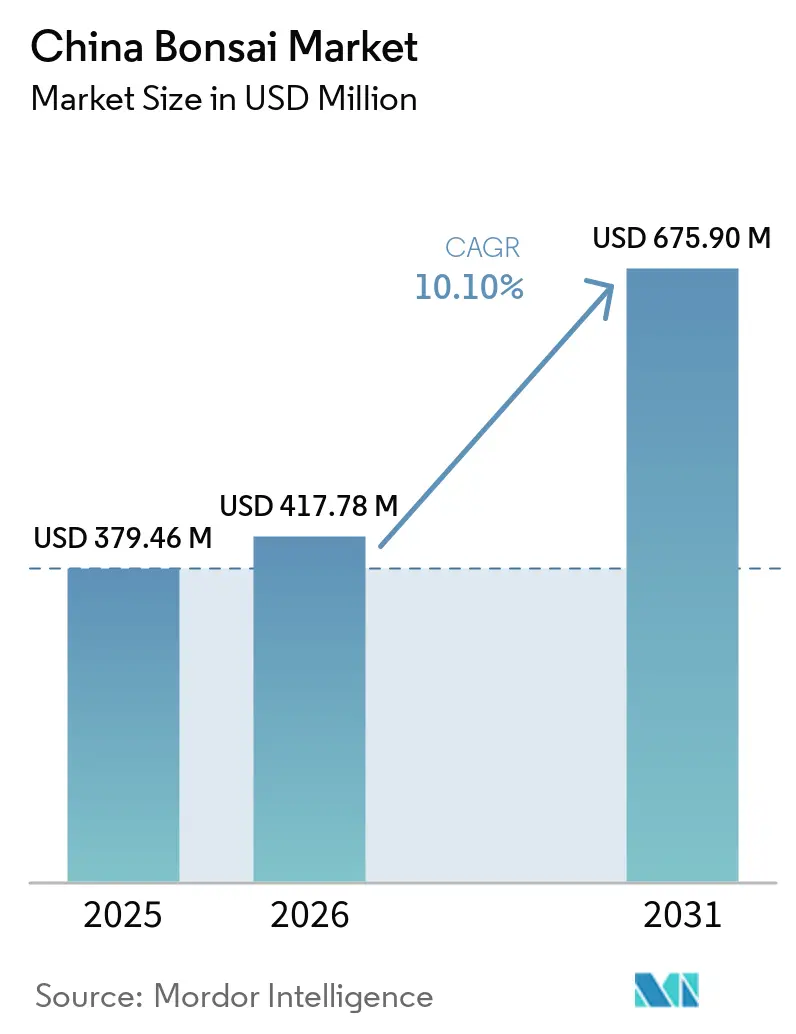
| Base Year Market Size (2025) | USD 379.46 Million |
| Market Size (2026) | USD 417.78 Million |
| Market Size (2031) | USD 675.90 Million |
| Growth Rate (2026 - 2031) | 10.10 % |
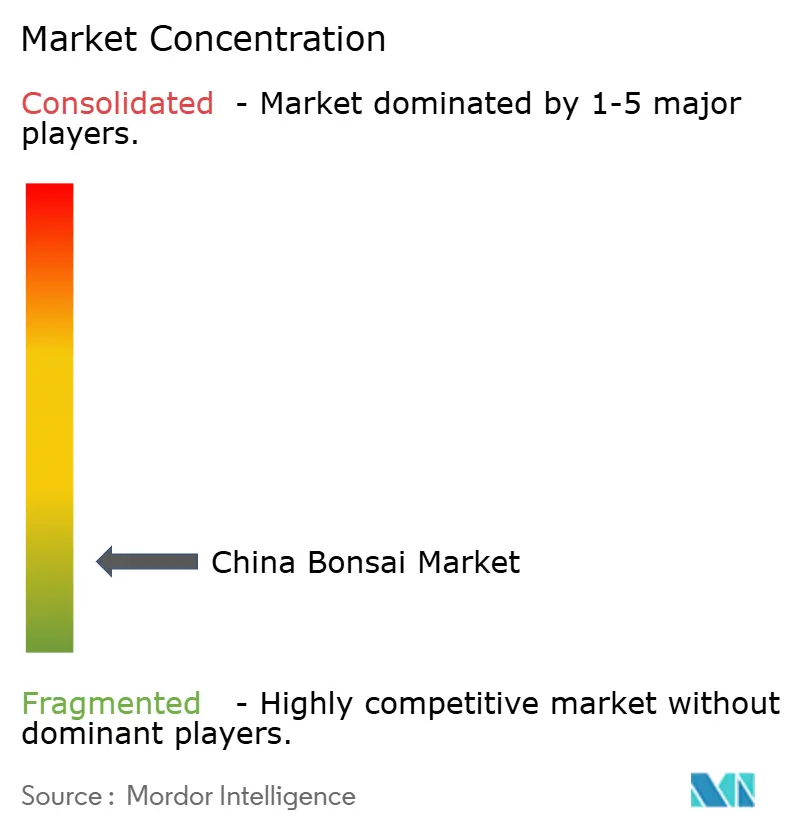
| Market Concentration | Low |
Major Players *Disclaimer: Major Players sorted in no particular order Image © Mordor Intelligence. Reuse requires attribution under CC BY 4.0. | |
China Bonsai Market Analysis by Mordor Intelligence
The China bonsai market size was valued at USD 379.46 million in 2025 and is projected to grow from USD 417.78 million in 2026 to USD 675.90 million by 2031, at a CAGR of 10.10% during the forecast period 2026 to 2031. Growth is driven by rising interest in ornamental plants, traditional Chinese horticultural art, and urban greenery. Limited living space is encouraging households to adopt compact bonsai plants, while increasing use of bonsai for interior decoration and landscape design is creating demand across residential and commercial spaces. Online retail and live-commerce platforms are expanding market access through product demonstrations and care guidance. Established coastal nursery clusters benefit from horticultural expertise and distribution networks, while inland producers leverage lower labor costs and growing online sales channels.
Key Report Takeaways
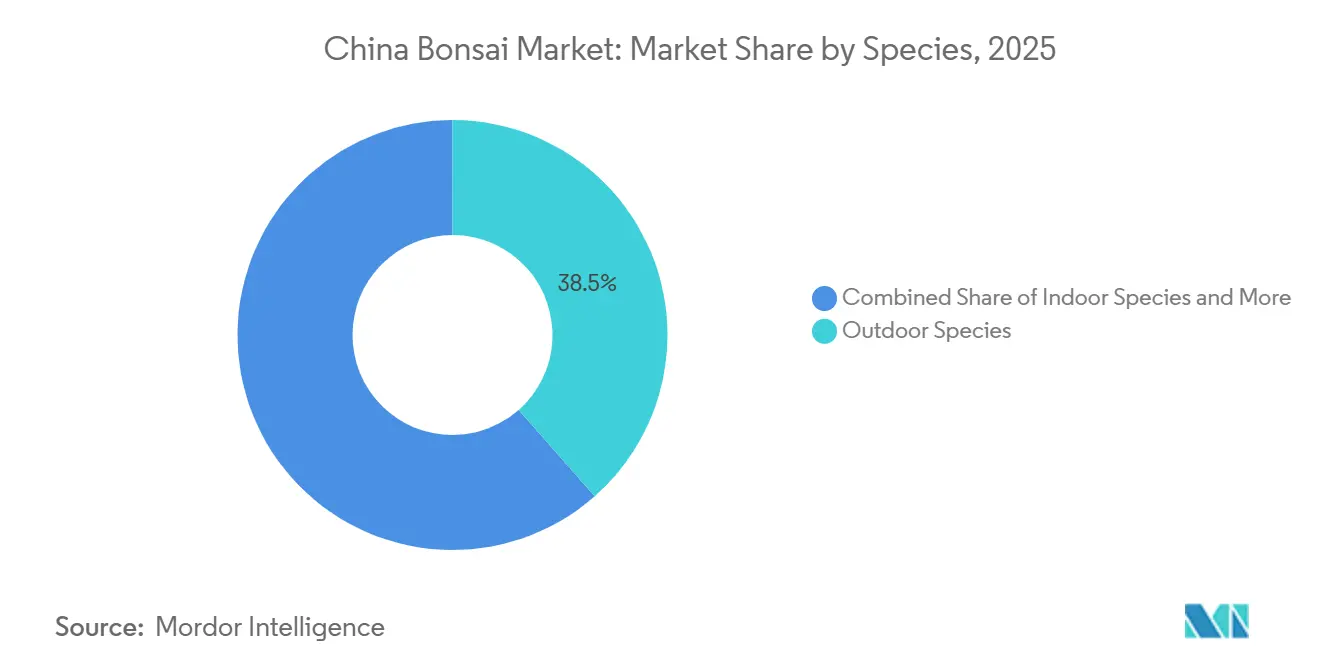
- By species, outdoor species were the largest segment and held 38.5% of the China bonsai market share in 2025, while indoor species are the fastest-growing segment and are forecast to expand at an 11.4% CAGR between 2026 and 2031.
- By distribution channel, offline channels were the largest segment and held 57.0% of the China bonsai market size in 2025, while online channels are forecast to grow at a CAGR of 15.2% from 2026 to 2031.
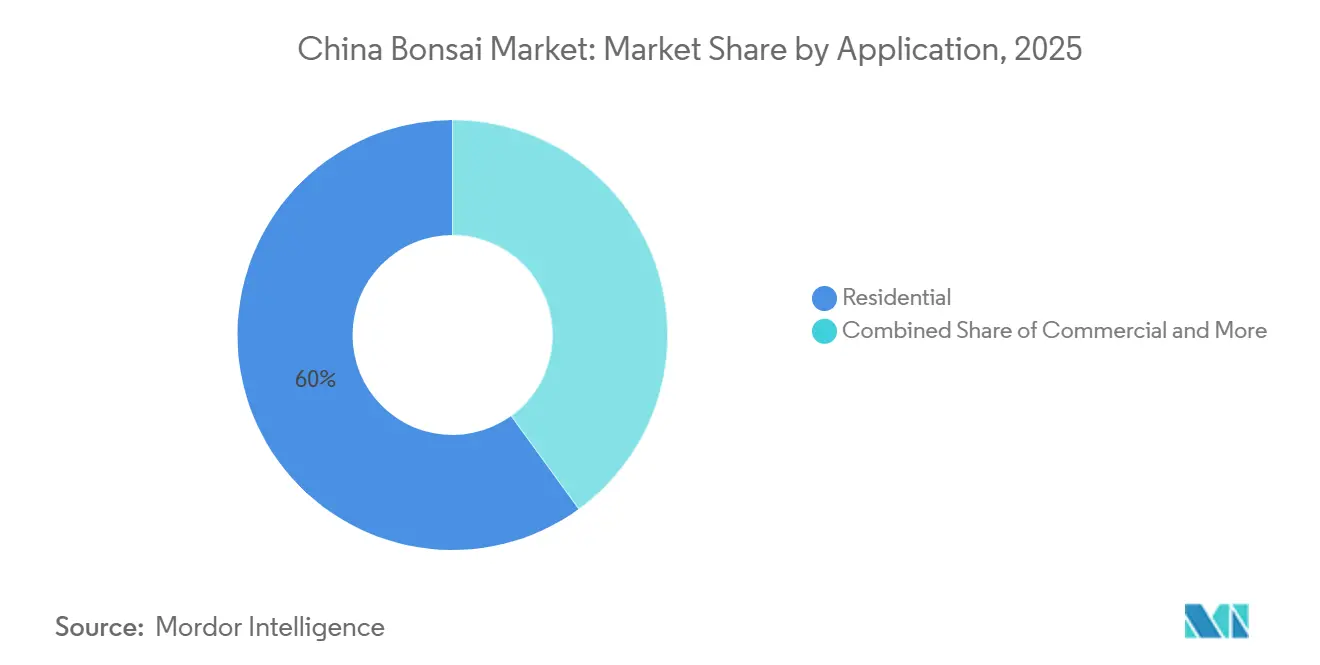
- By application, residential end use was the largest segment and held 60.0% of the market share in 2025, while commercial use is the fastest-growing segment and is anticipated to expand at a 12.0% CAGR between 2026 and 2031.
Note: Market size and forecast figures in this report are generated using Mordor Intelligence’s proprietary estimation framework, updated with the latest available data and insights as of January 2026.
Market Trends and Insights
Drivers Impact Analysis of China Bonsai Market*
| Driver | (~) % Impact on CAGR Forecast | Geographic Relevance | Impact Timeline |
|---|---|---|---|
| Cultural Significance and Penjing Heritage | +1.8% | China-wide, with highest intensity in Jiangsu, Zhejiang, Guangdong, and Fujian production and collection hubs | Long term (≥ 4 years) |
| Urban Densification and Demand for Compact Ornamentals | +1.6% | Tier 1 and tier 2 cities nationwide, with secondary spillover into county-level urban areas | Long term (≥ 4 years) |
| AI-Powered Plant Identification and Digital Care Support | +2% | National, with highest mobile-commerce penetration in eastern coastal provinces | Short term (≤ 2 years) |
| Premiumization of Hobby Crops and Collectible Specimens | +1.3% | Urban collector markets, strongest in the Yangtze River Delta and Greater Bay Area | Medium term (2-4 years) |
| Export-nursery Clusters in Guangdong, Fujian, and Zhejiang | +1.1% | Guangdong, Fujian, and Zhejiang, with spillover to emerging logistics corridors in Jiangsu and Hubei | Medium term (2-4 years) |
| Standardized Small-bonsai Production for Cross-border Commerce | +0.7% | Zhejiang and Guangdong export zones, with beneficiaries in Europe, North America, and Southeast Asia | Short term (≤ 2 years) |
| Source: Mordor Intelligence | |||
Cultural Significance and Penjing Heritage
The China bonsai market is deeply rooted in the country's penjing tradition, encompassing horticultural craftsmanship, artistic expression, cultural heritage, and a growing collector community. The 11th National Penjing Exhibition opened at Tiger Hill Scenic Area in Suzhou in October 2024, reinforcing interest in the category among officials and collectors. Shanghai Museum East also opened a roof garden in September 2024 featuring its Resonance of Wood and Stone exhibition, placing Shanghai-style penjing within a cultural institution. Such placements support the perception of penjing as an artistic object with cultural significance, rather than solely a decorative plant. They also draw attention to provenance, regional style, the training history of individual trees, and the skill required to maintain a mature specimen. As a result, the China bonsai market presents opportunities in heritage-class specimens that appeal to collectors, beyond the conventional gardening buyer segment.
Urban Densification and Demand for Compact Ornamentals
Rapid urbanization and the prevalence of apartment living in major Chinese cities are supporting demand for space-efficient ornamental plants in the China bonsai market. Bonsai offers an attractive solution for consumers seeking greenery that fits balconies, windowsills, and compact indoor or outdoor spaces without requiring large gardens. This trend is particularly evident among first-time buyers and younger urban households that value decorative plants with cultural and aesthetic appeal. Producers are responding by offering beginner-friendly bonsai, easy-care species, and compact specimens with clear maintenance guidance. As consumer interest develops, many buyers upgrade to older, more intricately trained bonsai with higher artistic and collectible value, supporting demand across multiple price segments.
AI-Powered Plant Identification and Digital Care Support
AI-powered plant identification tools and digital care services are helping reduce the knowledge barriers associated with bonsai ownership in China. People's Daily reported in June 2025 that applications such as Xingse and Flower Companion can identify more than 4,000 plant species[1]. The AI Flower WeChat mini-program from Huaaiwo also uses photographs to assess plant health and provide watering and fertilization reminders. These capabilities can help novice buyers understand plant requirements and manage routine care after purchasing bonsai online. Live-commerce platforms further support purchasing decisions through demonstrations of species characteristics, pruning techniques, and maintenance practices. Together, digital identification, accessible care guidance, and interactive product demonstrations can improve buyer confidence, support online bonsai sales, and broaden market access beyond experienced collectors.
Export-nursery Clusters in Guangdong, Fujian, and Zhejiang
Established nursery clusters in Guangdong, Fujian, and Zhejiang support the China bonsai market by providing specialized cultivation expertise, export infrastructure, and access to international buyers. According to China's National Forestry and Grassland Administration, Zhangzhou in Fujian is China's largest potted-flower export base, with flower and nursery plant exports exceeding USD 100 million in 2024 and shipments reaching more than 50 countries and regions[2]. These established production and distribution networks support bonsai market growth by facilitating the cultivation, handling, packaging, and international shipment of live ornamental plants. Access to export channels enables bonsai nurseries to reach overseas collectors and retailers, expanding potential customer bases beyond domestic markets. Such infrastructure strengthens the ability of established production clusters to supply international demand.
Restraints Impact Analysis of China Bonsai Market*
| Restraint | (~) % Impact on CAGR Forecast | Geographic Relevance | Impact Timeline |
|---|---|---|---|
| Labor-intensive Shaping and Maintenance Costs | -1.3% | China-wide, with the greatest effect in coastal production hubs facing wage inflation | Long term (≥ 4 years) |
| Limited Expert Care Capacity Outside Established Hubs | -0.9% | Inland cities and lower-density markets with limited reach of professional care networks | Medium term (2-4 years) |
| Phytosanitary and Soil-free Export Compliance | -1.5% | Export-facing nurseries, with greatest relevance for European Union and North American destination markets | Medium term (2-4 years) |
| Climate-related Pest and Mortality Risk | -1% | Subtropical production zones in Guangdong and Fujian | Long term (≥ 4 years) |
| Source: Mordor Intelligence | |||
Labor-intensive Shaping and Maintenance Costs
The China bonsai market relies on skilled labor for wiring, pruning, grafting, and repotting. These tasks require experienced practitioners and cannot be easily automated without reducing the value of carefully styled material. Wage pressure can narrow margins for mid-priced nurseries while benefiting sellers focused on premium trees. Care networks are also unevenly distributed, as collectors in Suzhou, Yangzhou, and Guangzhou have easier access to clubs, workshops, and specialist services than buyers in other regions. People's Daily reported in December 2025 that Gaojiayan Town in Hubei had more than 5,000 workers in bonsai cultivation and sales. Newer inland hubs may offer lower labor costs, but require time to develop comparable skills and service capacity.
Phytosanitary and Soil-free Export Compliance
Phytosanitary requirements and plant-health risks can constrain Chinese bonsai exports by increasing inspection, treatment, documentation, and handling costs. Exporters must comply with destination-market quarantine rules, including restrictions on growing media and regulated pests. In November 2025, the European and Mediterranean Plant Protection Organization (EPPO) reported that Dutch authorities detected four regulated invasive plant species among pseudo-bonsai plants imported from China during inspections at 20 Dutch importing companies[3]. These findings highlight the risk of shipment restrictions and additional compliance costs. Smaller nurseries may face greater challenges due to limited pest-monitoring resources, while transport delays and inadequate temperature or moisture control can further reduce plant quality.
*Our forecasts treat driver/restraint impacts as directional, not additive. The impact forecasts reflect baseline growth, mix effects, and variable interactions.
China Bonsai Market Segment Analysis
By Species:
Outdoor Species Lead Revenue While Indoor Formats Gain New BuyersOutdoor species held 38.5% of the China bonsai market share in 2025, making them the largest species category and an important revenue base for established nurseries. Needle trees, including juniper and pine, have long-standing associations with longevity, endurance, and scholarly culture in Chinese bonsai traditions. Their collector appeal can support higher values than standard starter plants, particularly when shaping and age are evident. Deciduous species such as trident maple and Chinese elm attract hobbyists interested in seasonal changes, visible growth cycles, and detailed horticultural work. This lower barrier to entry can help sellers introduce the category without requiring buyers to have immediate knowledge of specialist training methods.
Indoor species are forecast to expand at an 11.4% CAGR between 2026 and 2031, the highest rate in the species category. This growth opportunity is tied to apartment living, restricted outdoor access, and limited availability of private space for larger plants. Indoor buyers need trees that can tolerate controlled humidity, variable temperatures, and artificial lighting without losing their visual appeal. Flower Companion provides care guidance that helps owners manage plant needs in these conditions and identify basic signs of stress. National nursery quality standards give producers a reference point for standardizing indoor output for retail distribution. This combination of product suitability and practical guidance can make indoor bonsai a more accessible entry point for new urban buyers.

By Distribution Channel:
Offline Channels Remain Largest as Online Sales ExpandOffline channels accounted for 57.0% of the China bonsai market share in 2025, supported by buyers' preference for inspecting plants before purchase. Nurseries, garden centers, specialty stores, and wholesale distributors remain important for higher-value specimens, allowing customers to assess trunk form, root condition, branch structure, and plant health while receiving personalized care advice.
Online channels are forecast to grow at a CAGR of 15.2% from 2026 to 2031, driven by online marketplaces, brand websites, live commerce, and social commerce. These platforms expand supplier reach beyond established horticultural centers and enable sellers to demonstrate plant characteristics and explain maintenance requirements. China Daily reported in February 2026 that more than 300 families in Zhouquan Village used live streaming as their primary sales channel for penjing businesses. This approach can improve buyer confidence in remote purchases and broaden market access. The China bonsai market is therefore likely to retain a mixed distribution model, with online platforms supporting discovery and sales while offline outlets remain important for direct inspection and specialized purchases.
By Application:
Residential Purchases Set Demand While Commercial Use Builds ValueResidential end use held 60.0% of the China bonsai market size in 2025, making homes the primary source of demand. Buyers commonly place starter trees on balconies, windowsills, side tables, and in living rooms, where small displays can add greenery without requiring extensive space. AI-enabled care reminders are particularly relevant to this group, as they can address watering, light exposure, and leaf-health concerns. Easier access to guidance can reduce anxiety among new owners who lack experience with living ornamental plants. The segment also provides the broadest base for repeat purchases of smaller trees, soil, tools, and related accessories. Residential demand is therefore linked both to first-time adoption and to the ongoing care needs that follow an initial purchase.
Commercial use is forecast to expand at a 12.0% CAGR between 2026 and 2031, the fastest application growth rate. Property developers, hotels, and interior design firms use heritage penjing to give spaces a distinct cultural identity and a more considered interior aesthetic. This buyer group is more likely to seek medium or large specimens with records of origin, styling history, and professional training. Landscape projects and public spaces can generate volume demand, although purchasing decisions in this segment are often more price sensitive and subject to broader greening requirements. Institutional gifts, art fairs, and cultural venues remain smaller outlets, but heritage-class trees can carry substantial value when linked to exhibitions or formal occasions. These uses can also strengthen visibility for high-quality penjing beyond the traditional collector community.
Geography Analysis
Guangdong and Fujian are important export-oriented production locations in the China bonsai market, supported by established ornamental-plant nurseries, suitable growing conditions, and access to international shipping channels. Fujian’s Zhangzhou is particularly associated with ficus bonsai and live ornamental-plant exports. Superior Chinese Bonsai Nursery operates four farms across Guangdong and Fujian and reports exporting plants to more than 30 countries, illustrating the role of established coastal suppliers in international trade. Export-focused nurseries can integrate cultivation, plant selection, phytosanitary preparation, packing, and dispatch within established operating networks, giving them advantages in serving overseas wholesalers and retailers.
Jiangsu is an important center for traditional penjing culture, specialist cultivation, and domestic distribution. Suzhou and Yangzhou are associated with established bonsai styles and collector communities, while Shuyang county has a large ornamental-plant production base and increasingly uses livestreaming and e-commerce to reach buyers beyond local markets. In February 2026, China Daily reported that Shuyang’s ornamental-plant industry covered approximately 40,000 hectares, produced more than 10 million miniature landscape pots, and supported over 300,000 jobs. The combination of cultivation expertise, supplier networks, and digital retail channels supports Jiangsu’s role in serving domestic consumers and expanding the reach of penjing products.
Hubei is an emerging bonsai production and online-sales hub, with Gaojiayan Town in Changyang Tujia Autonomous County illustrating how inland communities are developing the sector beyond China’s established coastal clusters. Livestreaming has helped producers broaden their customer reach and strengthen the contribution of bonsai cultivation to the local economy. However, inland producers seeking to expand into international trade may need to develop stronger export documentation, plant-health compliance, and logistics capabilities. China’s GB 15569-2026, issued in March 2026 and scheduled to take effect in April 2027, will update domestic quarantine procedures for agricultural-plant movement, making compliance with plant-health requirements relevant to producers and distributors moving eligible plants between regions.
Competitive Landscape
The China bonsai market is fragmented, with Superior Chinese Bonsai Nursery Co.,Ltd., Weiguang Penjing (Bonsai) & Gardening Corp., HS Bonsai Nursery, Hangzhou Newtone Gardening Co., Ltd., and Zhangzhou Wisdom Industry & Trade Co., Ltd. representing the major players in 2025. Competition centers on species specialization, cultivation and styling expertise, nursery capacity, export readiness, phytosanitary compliance, and access to domestic and international buyers. Superior Chinese Bonsai Nursery competes through multi-farm production and international export reach, while Weiguang Penjing combines bonsai cultivation with display and exhibition facilities. HS Bonsai Nursery specializes in Ficus microcarpa bonsai and international plant sales, whereas Zhangzhou Wisdom Industry & Trade emphasizes nursery infrastructure and export-production requirements. Hangzhou Newtone Gardening adds specialist production capabilities, including bonsai intended for international markets.
Competitive differentiation is increasingly shaped by the ability to combine cultivation expertise with export infrastructure and effective distribution. Superior Chinese Bonsai Nursery reports operating four farms across Guangdong and Fujian and exporting to more than 30 countries, illustrating the importance of production capacity and established overseas buyer relationships. HS Bonsai Nursery differentiates itself through its focus on Ficus microcarpa and its export experience, while Zhangzhou Wisdom Industry & Trade highlights nursery facilities and management practices intended to support international plant trade. Hangzhou Newtone Gardening has also been identified in a European Food Safety Authority assessment concerning Chinese Pinus parviflora bonsai grafted onto Pinus thunbergii for export.
The market offers further opportunities for companies to differentiate through digital sales, traceability, specialist after-sales care, and stronger connections between growers and collectors. Online retail and livestreaming can help nurseries reach customers beyond their immediate regions, while documented plant provenance, cultivation history, and phytosanitary records could strengthen buyer confidence in higher-value specimens. Export-oriented producers may benefit from improving documentation and adapting growing, packing, and dispatch procedures to destination-market requirements. Meanwhile, specialist nurseries can build customer loyalty through styling expertise, species-specific cultivation guidance, and maintenance services. As domestic e-commerce and international trade develop, competitive advantage is likely to depend increasingly on the ability to combine reliable plant quality, distinctive bonsai craftsmanship, efficient distribution, and credible plant-health documentation rather than on production volume alone.
China Bonsai Industry Leaders
-
Superior Chinese Bonsai Nursery Co.,Ltd
-
Weiguang Penjing (Bonsai) & Gardening Corp.
-
Zhangzhou Wisdom Industry & Trade Co., Ltd.
-
Hangzhou Newtone Gardening Co., Ltd.
-
HS Bonsai Nursery
- *Disclaimer: Major Players sorted in no particular order
China Bonsai Market Companies Covered in this Report
- Shanghai Penjing Garden
- Superior Chinese Bonsai Nursery Co.,Ltd
- HS Bonsai Nursery
- Dongyi Artificial Plants Co., Limited
- Qingyi Yuan Penjing Garden
- Mistral Bonsai S.L
- Lodder Bonsai B.V.
- Herons Bonsai Limited
- Brussel's Bonsai Nursery, LLC
- Oriental Bonsai Art Co., Ltd.
- Weiguang Penjing (Bonsai) & Gardening Corp.
- Hangzhou Newtone Gardening Co., Ltd.
- Zhangzhou Wisdom Industry & Trade Co., Ltd.
Recent Industry Developments in China Bonsai Market
- September 2026: Shouheng International Flower City officially opened in Laishui, Hebei, establishing a major trading hub for flowers, nursery stock, and ornamental plants, including bonsai. The facility integrates trading, warehousing, logistics, and digital operations to improve distribution between production regions and northern Chinese markets, potentially expanding market access for bonsai suppliers.
- March 2026: China issued GB 15569-2026, a revised national standard governing the quarantine of agricultural plants during domestic transportation, effective April 2027. The standard updates procedures for plant inspection, quarantine treatment, and certification, potentially affecting nurseries and sellers transporting regulated plants across regional markets. Compliance requirements may influence distribution processes and operating costs for businesses handling bonsai plants.
- October 2025: China's first Bonsai 4S Service Center was inaugurated in Rugao, Jiangsu, alongside the 17th Jiangsu Bonsai Art Exhibition. The center integrates bonsai sales with professional maintenance, supporting materials, and related services to address post-purchase care challenges and fragmented distribution channels. This service-oriented model could improve ownership experiences, encourage participation among novice buyers, and support broader adoption of bonsai plants.
China Bonsai Market Report Scope
Bonsai is a living dwarf tree or shrub that is cultivated in a pot through careful pruning and training. The China bonsai market report is segmented by species (indoor species, outdoor species, needle tree species, and deciduous tree species), by distribution channel (online and offline), and by application (residential, commercial, and others). The market sizes and forecasts are provided in terms of value (USD) for all the above segments.
Segmentation Overview
| Indoor Species |
| Outdoor Species |
| Needle Tree Species |
| Deciduous Tree Species |
| Online |
| Offline |
| Residential |
| Commercial |
| Others (institutional gifts, art fairs) |
| By Species | Indoor Species |
| Outdoor Species | |
| Needle Tree Species | |
| Deciduous Tree Species | |
| By Distribution Channel | Online |
| Offline | |
| By Application | Residential |
| Commercial | |
| Others (institutional gifts, art fairs) |
Key Questions Answered in the Report
What is the projected value of the China bonsai market by 2031?
The China bonsai market is forecast to reach USD 675.90 million by 2031, rising from USD 417.78 million in 2026 as compact residential use, collector interest, and wider digital sales access support demand.
What is driving bonsai sales in China?
Compact urban living, live-commerce education, AI-supported plant care, cultural interest in penjing, and established nursery clusters support demand. These factors make it easier for newer buyers to select, receive, and maintain a living ornamental plant.
Which bonsai species segment is largest in China?
Outdoor species led with 38.5% share in 2025, while indoor species are anticipated to record the highest growth rate at 11.4% CAGR between 2026 and 2031.
What is the leading application for bonsai in China?
Residential use held 60.0% share in 2025, as buyers commonly use bonsai on balconies, windowsills, and in living rooms. Commercial offices and hospitality also provide a growing outlet for documented heritage specimens and culturally distinctive displays.