
China Autonomous Agricultural Tractor Market Size and Share
Market Overview
| Study Period | 2021 - 2031 |
|---|---|
| Forecast Data Period | 2026 - 2031 |
| Base Year Market Size (2025) | USD 0.65 Billion |
| Market Size (2026) | USD 0.79 Billion |
| Market Size (2031) | USD 2.17 Billion |
| Growth Rate (2026 - 2031) | 22.40 % |
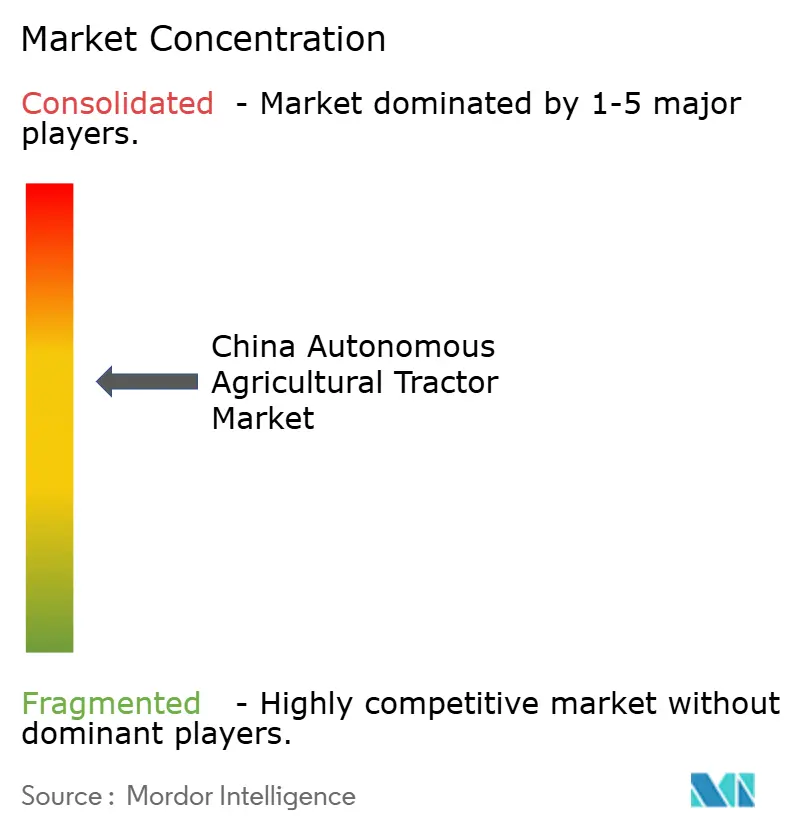
| Market Concentration | Medium |
Major Players
*Disclaimer: Major Players sorted in no particular order Image © Mordor Intelligence. Reuse requires attribution under CC BY 4.0. |
|
China Autonomous Agricultural Tractor Market Analysis by Mordor Intelligence
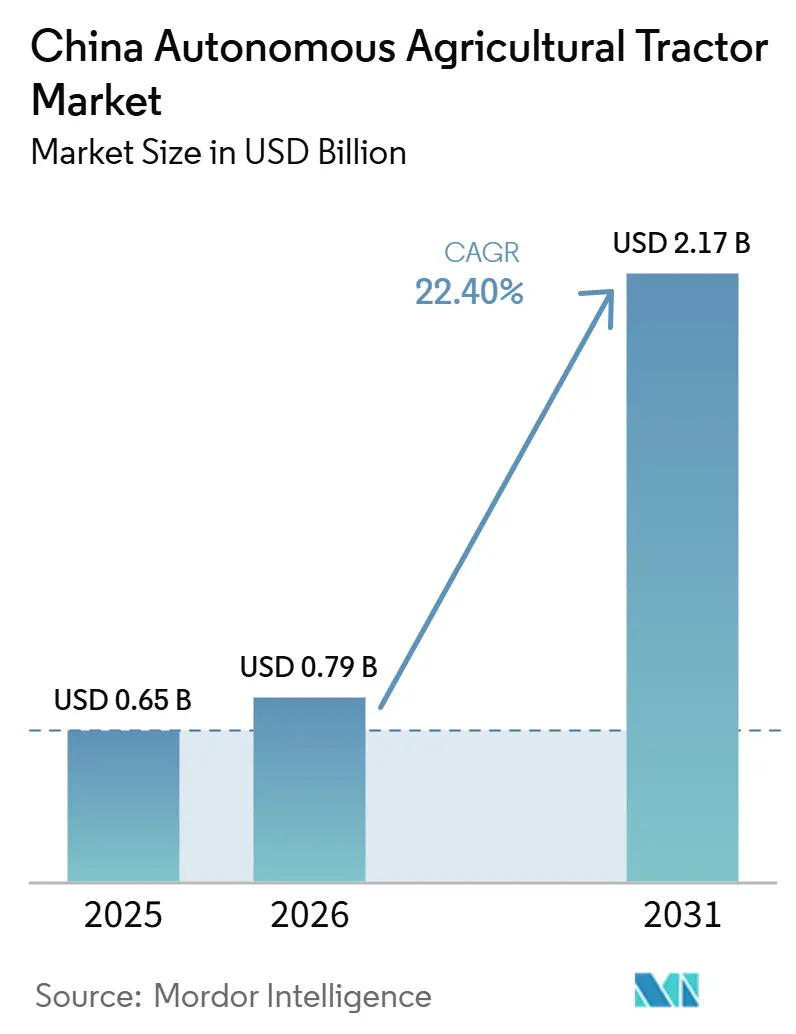
The China autonomous agricultural tractor market was valued at USD 0.65 billion in 2025 and is estimated to grow from USD 0.79 billion in 2026 and reach USD 2.17 billion by 2031, at a CAGR of 22.4% during the forecast period (2026-2031). The market is shaped by government support for smart farming, labor constraints, and a growing domestic equipment base. National initiatives promoting agricultural modernization continue to encourage the development and adoption of autonomous tractors, agricultural drones, and smart irrigation technologies. The Ministry of Agriculture and Rural Affairs (MARA) issued 2026 spring-plowing guidance that supports BeiDou-enabled equipment in major grain-producing areas. Domestic producers benefit from local navigation integration, subsidy access, and service networks, while foreign producers must adapt their products and data practices to local requirements. Demand is strongest where farm operators can spread equipment costs across larger acreages or shared fleets.
Key Report Takeaways
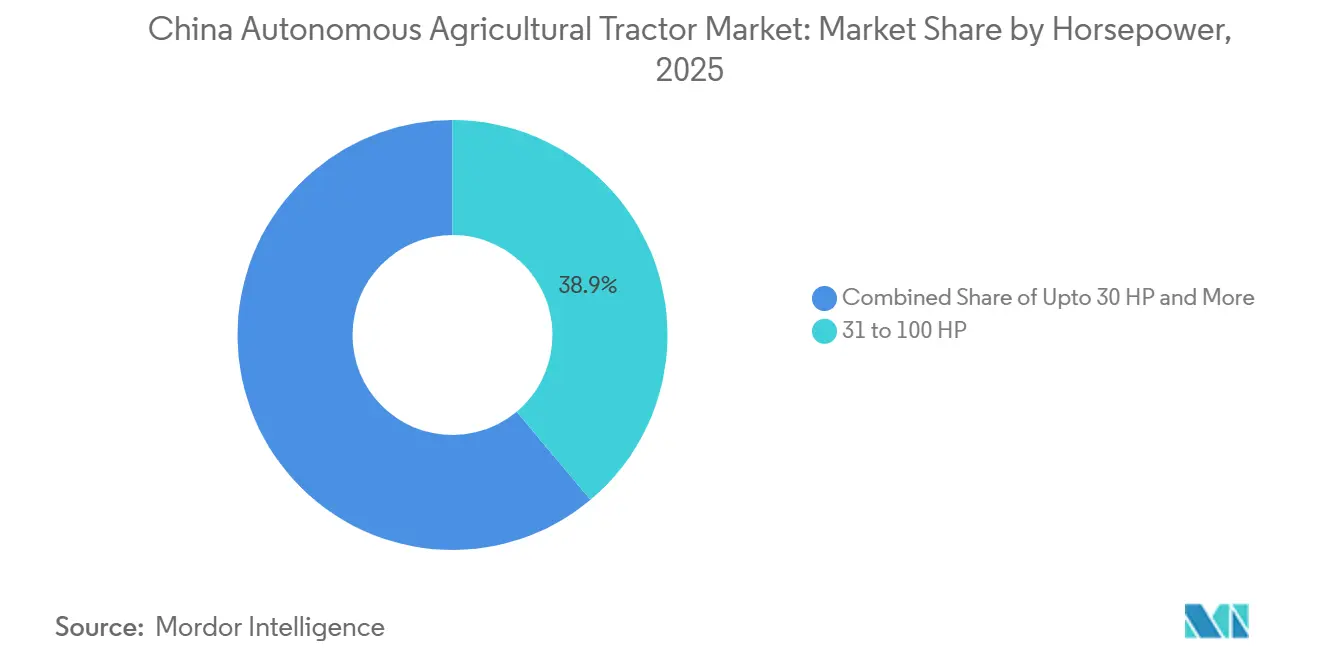
- By horsepower, 31-100 HP was the largest segment and held 38.9% of the China agricultural tractor market share in 2025, while above 100 HP is the fastest-growing segment and is forecasted to expand at a 23.4% CAGR between 2026 and 2031.
- By automation level, semi-automated was the largest segment and held 67.6% of the China agricultural tractor market size in 2025, while fully automated is the fastest-growing segment and forecasted to expand at a 22.5% CAGR between 2026 and 2031.
- By drive type, diesel was the largest segment and held 75.7% of the market share in 2025, while battery-electric is the fastest-growing segment and is forecasted to expand at a 28.2% CAGR between 2026 and 2031.
- By application, tillage was the largest segment and held 36.9% of the market share in 2025, while orchard and vineyard operations are the fastest-growing segment and are forecasted to expand at a 28.0% CAGR between 2026 and 2031.
- By component, GPS /GNSS systems was the largest segment and held 34.9% of the market share in 2025, while LiDAR and radar modules are the fastest-growing segment and are forecasted to expand at a 22.6% CAGR between 2026 and 2031.
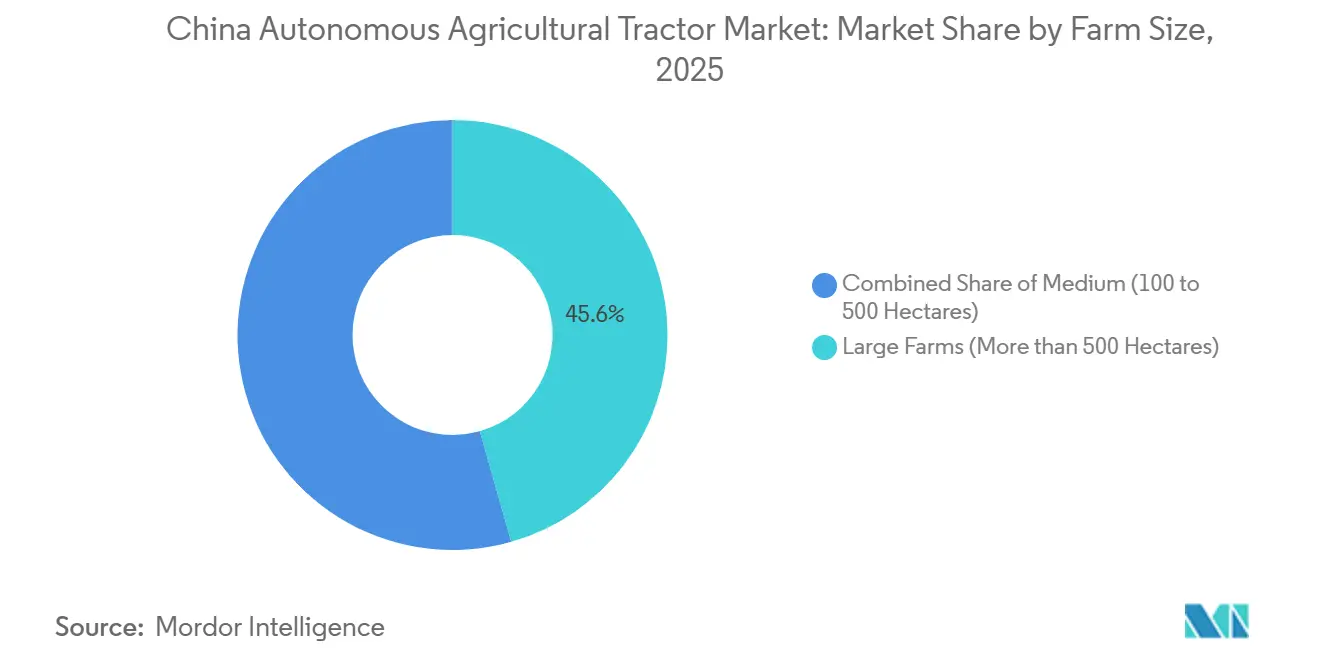
- By farm size, large farms (more than 500 hectares) was the largest segment and held 45.6% of the market share in 2025, while medium farms (100-500 hectares) are the fastest-growing segment and are forecasted to expand at a 23.9% CAGR between 2026 and 2031.
Note: Market size and forecast figures in this report are generated using Mordor Intelligence’s proprietary estimation framework, updated with the latest available data and insights as of January 2026.
China Autonomous Agricultural Tractor Market Trends and Insights
Drivers Impact Analysis*
| Driver | (~) % Impact on CAGR Forecast | Geographic Relevance | Impact Timeline |
|---|---|---|---|
| Government-led smart agriculture and BeiDou deployment | +4.2% | National, with concentration in Heilongjiang, Henan, Jiangsu, and Xinjiang grain belts | Short term (≤ 2 years) |
| Agricultural labor shortages and rising rural labor costs | +3.8% | National, with the strongest effect in Northeast and Central China | Medium term (2-4 years) |
| Precision farming and input optimization requirements | +3.2% | National, with early gains in Shandong, Jilin, and Anhui high-standard farmland zones | Medium term (2-4 years) |
| Expansion of large-scale farming and agricultural service cooperatives | +2.8% | National, with concentration in flatland grain regions and spillover to Sichuan and Hunan | Medium term (2-4 years) |
| Small-plot autonomy enabled by retrofit and shared-use models | +2.1% | National, especially the Yangtze River Basin and hilly provinces | Long term (≥ 4 years) |
| China-specific localization of autonomous agricultural machinery | +1.9% | National, with a deeper effect where foreign service networks are limited | Long term (≥ 4 years) |
| Source: Mordor Intelligence | |||
Government-Led Smart Agriculture and BeiDou Deployment
The China autonomous agricultural tractor market is closely linked to the country's smart agriculture agenda and the adoption of BeiDou navigation technology. Government support for BeiDou-enabled autonomous equipment, together with standards governing automatic driving systems for agricultural machinery, provides equipment buyers with a clearer framework for procurement, certification, and subsidy eligibility. These policies also favor systems designed around domestic navigation infrastructure over products developed solely for foreign satellite-navigation platforms. The Ministry of Agriculture and Rural Affairs (MARA) and the Ministry of Industry and Information Technology (MIIT) continue to shape subsidy policies and priorities for intelligent agricultural equipment modernization.
Agricultural Labor Shortages and Rising Rural Labor Costs
The China autonomous agricultural tractor market addresses the challenge of securing workers during spring plowing and autumn harvest seasons. Rising labor costs and seasonal labor shortages are increasing farmers' willingness to adopt labor-saving technologies, particularly where agricultural extension services support technology adoption. Cooperative managers can therefore evaluate autonomous equipment based on its ability to reduce peak-season staffing risks, rather than annual wage costs alone. This strengthens the value proposition for tractors that can maintain consistent field operations while enabling operators to oversee multiple tasks. The benefits are most pronounced on larger farms, where higher equipment utilization can justify the initial investment.
Precision Farming and Input Optimization Requirements
The China autonomous agricultural tractor market also benefits from the increasing demand for more accurate and efficient field operations. BeiDou real-time kinematic (RTK) guidance enables precise field passes, helping reduce overlap during seeding, fertilizer application, and other agricultural activities. Government support for precision agriculture and autonomous farming technologies is encouraging the adoption of advanced navigation systems in modern agricultural operations. In addition, the growing use of standardized operational data supports equipment performance monitoring, traceability, and verification processes, making data-driven decision-making an integral part of autonomous farming rather than an add-on feature.
Expansion of Large-Scale Farming and Agricultural Service Cooperatives
The China autonomous agricultural tractor market relies on service cooperatives, as they can distribute fleet costs across multiple farms. China's 2024 agricultural mechanization statistics by Department of Agricultural Mechanization reported 80,300 specialized agricultural machinery cooperatives, reflecting the scale of the machinery-service channel[1]Source: Department of Agricultural Mechanization, "2024 National Statistical Bulletin on the Development of Agricultural Mechanization," njhs.moa.gov.cn. A shared fleet can accumulate sufficient annual operating hours to make navigation systems, sensors, and software more economical. Individual farms with small parcels typically cannot achieve the same utilization levels. Government support for cooperative investment in smart agricultural machinery further strengthens this operating model. As a result, cooperative-managed unmanned farms are emerging as a scalable approach that can be replicated across grain-producing regions.
Restraints Impact Analysis*
| Restraint | (~) % Impact on CAGR Forecast | Geographic Relevance | Impact Timeline |
|---|---|---|---|
| High upfront cost and uneven return on investment for smallholders | -3.8% | National, most acute in southern provinces with high smallholder density | Short term (≤ 2 years) |
| Fragmented farm parcels and limited operating economies of scale | -3.1% | National, concentrated in Yunnan, Guizhou, Sichuan, and southern Jiangxi | Medium term (2-4 years) |
| Data governance, cybersecurity, and cross-border technology constraints | -2.4% | National, with a stronger effect on foreign platforms using cross-border data architectures | Medium term (2-4 years) |
| Limited local service, calibration, and autonomous-system maintenance capacity | -2.1% | National, most pronounced in inland and western China | Long term (≥ 4 years) |
| Source: Mordor Intelligence | |||
High Upfront Cost and Uneven Return on Investment for Smallholders
A fully equipped autonomous tractor requires a substantial upfront investment, including sensors, control units, navigation software, and connectivity hardware. Although government subsidy programs help reduce acquisition costs for qualifying intelligent machinery, the remaining investment can still be difficult for small operators to recover through annual use. Large-field systems are also less suited to irregular plots, where travel and setup time reduce operational efficiency. Cooperative ownership and machinery as a service models can lower the entry barrier, but they do not eliminate all field-access challenges. As a result, adoption among smallholders is anticipated to progress more gradually than fleet deployment on larger farms.
Fragmented Farm Parcels and Limited Operating Economies of Scale
Fragmented plots limit the operating efficiency of autonomous tractors in the China autonomous agricultural tractor market. Embankments, irrigation channels, and non-contiguous boundaries reduce continuous operating time and complicate route planning. A 2026 study published in ScienceDirect in Computers and Electronics in Agriculture found that fragmented environments may require unmanned aerial vehicle (UAV) support for practical global path planning when ground-based perception has limited visibility. This adds equipment and integration requirements that small cooperatives may find difficult to manage. Land consolidation through cooperative lease arrangements can improve fleet economics over time. Until then, this constraint remains most significant in southern and southwestern provinces with hilly or divided farmland.
*Our forecasts treat driver/restraint impacts as directional, not additive. The impact forecasts reflect baseline growth, mix effects, and variable interactions.
Segment Analysis
By Horsepower: Mid-Range Power Class Leads Current Adoption
The 31-100 HP class held 38.9% of the China autonomous agricultural tractor market share in 2025. This range is suited to rice, wheat, and corn operations and the field sizes found at state farms and established cooperatives. Existing chassis designs in this class can be paired with BeiDou RTK retrofit systems, giving farm operators a way to add automated guidance without replacing entire tractor fleets. Machines up to 30 HP serve small fields and orchards, but parcel fragmentation continues to limit their adoption even as retrofit packages become more widely available.
The above 100 HP segment is forecast to expand at a 23.4% CAGR between 2026 and 2031. Demand is supported by large grain farms in Heilongjiang, Inner Mongolia, and Xinjiang, where wide fields allow machines to cover more land per day. In September 2025, Zoomlion introduced the DX7004, a 1,200 HP hybrid tractor designed for large-area operations[2]Source: Zoomlion News, "World's Highest Horsepower Wheeled Tractor Makes Global Debut in Overseas Market," en.zoomlion.com. The company stated that the model could cover 480 hectares per day, offering cooperative buyers a way to align tractor capacity with larger farm units. The shift from mid-range to higher-power procurement reflects the growing role of consolidated farms in the China autonomous agricultural tractor market.



By Automation Level: Semi-Autonomous Systems Lead, Fully Autonomous Systems Build Momentum
Semi-autonomous systems held 67.6% of the China autonomous agricultural tractor market share in 2025. These systems reduce manual steering demands while retaining an operator for monitoring and field decisions. This arrangement requires less calibration and training than a fully autonomous configuration, making it suitable for cooperatives that are adding automation in stages.
Fully autonomous systems are forecast to expand at a 22.5% CAGR between 2026 and 2031. Buyers increasingly consider whether a tractor's technical architecture can support future upgrades, rather than evaluating only its initial autonomy level. Open-integration systems can alter lifetime cost calculations, as additional capabilities may be added throughout the tractor's operating life. National standards for autonomous driving systems provide a common framework for equipment certification and support eligibility for government incentive programs. This regulatory environment encourages a gradual transition from driver-assisted systems to more autonomous configurations. The near-term lead held by semi-autonomous systems is consistent with the limited availability of trained technicians and operators.
By Drive Type: Diesel Leads, Battery-Electric Equipment Gains Ground
Diesel-powered tractors held 75.7% of China's autonomous agricultural tractor market share in 2025. Diesel remains practical because rural charging infrastructure is limited in inland and northwestern regions. It meets the long operating-range requirements of large farm equipment, while hybrid tractors reduce fuel consumption without depending on dedicated charging facilities. Lovol Heavy Industry Co., Ltd. launched the E3404-H, a 340 HP diesel-electric hybrid tractor, in October 2025. Zoomlion Heavy Industry Science and Technology Co., Ltd. also introduced hybrid equipment as part of its agricultural machinery portfolio.
Battery-electric tractors are forecast to expand at a 28.2% CAGR between 2026 and 2031. State support for new-energy agricultural machinery and the suitability of electric drivetrains for shorter, repeated field tasks support this growth. The Honghu T70 has a 6-hour operating cycle, while the ZSHX Xeevo E904i combines a 90 HP rating, a 103 kWh battery, and 1-hour fast-charging capability. These products indicate the improving readiness of electric autonomous tractors for mid-sized and large farms. Hydrogen-electric equipment remains in the demonstration stage, while Geely completed a spring-plowing trial of a methanol-electric driverless tractor in Heilongjiang in 2025.
By Application: Tillage Leads, Orchard and Vineyard Operations Grow Fastest
Tillage accounted for 36.9% of China autonomous agricultural tractor market share in 2025. The application has relatively predictable field geometry and established compatibility with BeiDou guidance. It also aligns with precision-farming programs that encourage consistent passes and input management. Sowing and harvesting require more task-specific automation, while orchard and vineyard work involves tight rows, canopy interference, and slopes. These conditions are driving interest in perception systems that can support safer autonomous movement.
Orchard and vineyard operations are forecasted to expand at a 28% CAGR between 2026 and 2031. A 2026 Computers and Electronics in Agriculture study developed an orchard navigation framework that combined UAV photogrammetry, model predictive control, and safe reinforcement learning[3]Source: Research Article, "The orchard tractor navigation method based on UAV photogrammetry combined with safety reinforcement learning,"sciencedirect.com. The approach was designed to support centimeter-level navigation without relying on a prior field map. It is relevant to scattered orchard areas in Shandong, Shaanxi, and Yunnan, where broader adoption can increase the yearly utilization of a single tractor platform. Higher utilization can improve the investment case that currently limits wider ownership.
By Component: Navigation Systems Lead, Sensor Fusion Advances
GPS/ GNSS systems held 34.9% of China's autonomous agricultural tractor market share in 2025. Navigation is a basic requirement for autonomous steering, planned passes, and accurate field records. BeiDou Real time kinematic (RTK) services provide the positioning layer used in subsidy-eligible autonomous systems. Domestic providers, including CHC Navigation and ComNav Technology, supply this equipment. CHC Navigation introduced the NX610 steering system in July 2025 for tillage, seeding, spraying, and harvesting applications. The system supports working speeds from 0.1 km/h to 30 km/h.
LiDAR and radar modules are forecast to expand at a 22.6% CAGR between 2026 and 2031. Producers are moving from GPS-only guidance toward integrated sensor combinations that support obstacle detection, terrain mapping, and operation under varying field conditions. Control and navigation software, camera and vision systems, and other sensing technologies each perform distinct functions within autonomous tractor platforms. Continued advancements in software algorithms and sensor integration are enabling more reliable autonomous navigation, allowing smaller regional producers to compete on functionality. As hardware becomes increasingly standardized, software and sensing capabilities are anticipated to play a more significant role in product differentiation.
By Farm Size: Large Farms Form the Base, Medium Farms Expand Fastest
Large farms above 500 hectares accounted for 45.6% of China's autonomous agricultural tractor market share in 2025. Their scale makes the costs of navigation, sensor maintenance, and software easier to absorb within machinery budgets. Large cooperative fleets can also deploy tractors across broader field areas and for more operating hours. In October 2025, Xinhua reported on a Jilin cooperative that managed 1,000 hectares with more than 76 machines. This type of organization provides a practical fleet base, while small farms contribute less revenue as individual ownership remains difficult to justify at that scale.
Medium farms with 100–500 hectares are forecast to expand at a 23.9% CAGR between 2026 and 2031. This segment benefits from farm consolidation, which aggregates parcels and provides cooperatives with a larger operational base. Rental, data-service, and retrofit models can support adoption without requiring each farm to purchase a complete system. Government support for investments in smart agricultural machinery, combined with expanding local service networks, is helping reduce adoption barriers for medium-sized cooperatives. Their growth is creating a broader customer base between large state-farm fleets and small individual holdings.
Geography Analysis
Northeast China, including Heilongjiang, Jilin, Liaoning, and Inner Mongolia, is the largest deployment area in the China autonomous agricultural tractor market. Large flatland grain farms and high machinery intensity create suitable conditions for high-horsepower autonomous equipment. The Heilongjiang state-farm system has served as a testing environment for driverless tractor fleets capable of continuous operation. Provincial support and cooperative fleet subsidies make this region the primary commercial reference point for large-scale, fully autonomous field operations.
Central and eastern China is the fastest-growing geographic area, supported by high-standard farmland programs and active policy deployment. This corridor includes Henan, Shandong, Anhui, Jiangsu, and Shanghai, where more standardized parcel layouts support fleet operations. In 2025, Qingfeng County in Henan demonstrated autonomous operations across a 233-hectare wheat farm, reducing harvest time from 7 days to 4. In July 2025, Shanghai's Tushi Bao Agricultural Cooperative in Songjiang District continued full-cycle autonomous rice operations, spanning transplanting, tractor work, and harvesting using a 5G agricultural private network and BeiDou high-precision positioning, demonstrating integrated digital farming in the Yangtze River Delta.
Southern and western China present different operating conditions due to hilly terrain, water-paddy farming, and fragmented parcels. Yunnan, Guizhou, Sichuan, and Guangdong have greater demand for compact equipment, orchard solutions, and systems suited to smaller fields. In July 2025, Guangdong's Wanlyu Intelligent Unmanned Farm used Internet of Things (IoT), BeiDou navigation, and artificial intelligence (AI) to manage rice production. Xinjiang's large cotton operations are better suited to integrated aerial and ground automation and remain important for calibrating high-acreage product specifications.
Competitive Landscape
The China autonomous agricultural tractor market is moderately concentrated. In 2025, YTO Group Corporation, Lovol Heavy Industry Co., Ltd., Zoomlion Heavy Industry Science and Technology Co., Ltd., Deere and Company, and Kubota Corporation collectively held a major share of the market. Domestic producers compete through navigation integration, local subsidy access, and field service coverage. The remaining revenue is distributed among regional original equipment manufacturers (OEMs), retrofit specialists, software integrators, and shared-use platforms. This structure gives established producers a strong starting position, while competition increasingly centers on systems and support rather than engine power alone.
In 2025, Lovol Heavy Industry Co. introduced an agricultural AI large model that connects intelligent machinery management with autonomous farm decision-making, extending its role from tractor supply toward a digital operating platform. Zoomlion Heavy Industry Science and Technology Co. operates a dedicated new-energy development platform across agricultural and construction equipment, supporting investment in batteries, motors, and agricultural research. In September 2025, it introduced the DX7004 hybrid tractor for large-scale operations. These strategies reflect how domestic companies are combining product development with broader technology ecosystems.
Foreign companies face additional pressure from local data-management requirements and the need for domestic service capability. The service, calibration, and maintenance layer remains open, as many inland and western areas have limited specialist support. In December 2025, XAG launched its R Series agricultural rovers for orchards, vineyards, and greenhouse settings. In July 2026, XAG unveiled its X Series autonomous crop-protection platform, adding route planning, chemical preparation, charging, and cleaning functions to a connected workflow. Purpose-built agricultural robots are therefore able to compete with conventional tractor OEMs in specialty-crop applications.
China Autonomous Agricultural Tractor Industry Leaders
-
YTO Group Corporation (China National Machinery Industry Corporation)
-
Lovol Heavy Industry Co., Ltd.
-
Zoomlion Heavy Industry Science and Technology Co., Ltd.
-
Deere and Company
-
Kubota Corporation
- *Disclaimer: Major Players sorted in no particular order

Recent Industry Developments
- June 2026: China's State Council issued the Plan for Accelerating Agricultural and Rural Modernization during the 15th Five-Year Plan Period, designating autonomous tractors, agri-drones, new-energy agricultural machinery, and smart irrigation as priority sectors for domestic research and development and overseas expansion, with explicit policy linkage to international standards recognition and export cooperation, signaling sustained institutional demand for intelligent field machinery through 2030.
- May 2026: China's BeiDou ground augmentation network comprised over 5,000 stations supporting more than 2.7 million agricultural terminals, with autonomous tractor path accuracy exceeding 2.5 cm in Northeast China and Xinjiang, enabling consistent straight-line and inter-row guidance, uniform seeding, and variable-rate fertilization at scale across large-grain-producing regions.
- September 2025: Zoomlion unveiled the DX7004, described as the world's most powerful hybrid wheeled tractor, at its Changsha Smart Industry City. Rated at 700 hp with a 1,200 hp peak dual-motor output, the machine targets ultra-large-scale farming operations and integrates self-developed EPiot/AOS autonomous driving systems with BeiDou centimeter-level guidance. The company claims a single machine can cover approximately 480 hectares in 12 hours.


China Autonomous Agricultural Tractor Market Report Scope
An autonomous tractor is a self-driving agricultural machine that performs farming tasks independently using AI, sensors, GPS, and advanced automation technologies. The China Autonomous Tractors Market Report is Segmented by Horsepower (Up To 30 HP, 31 - 100 HP and Above 100 HP), by Automation Level (Fully Automated and Semi-Automated), by Drive Type (Diesel, Hybrid and Battery-Electric), by Application (Tillage, Sowing, Harvesting, and Orchard and Vineyard Operations ), by Component (GPS/GNSS, Sensors and Vision Systems, LiDAR and Radar Modules, and Control and Navigation Software), and by Farm Size (Small (Less than 100 Hectares), Medium (100-500 Hectares), and Large (More than 500 Hectares)). The Market Forecasts are Provided in Terms of Value (USD).
| Up to 30 HP |
| 31-100 HP |
| Above 100 HP |
| Semi-Autonomous |
| Fully Autonomous |
| Diesel |
| Hybrid |
| Battery-Electric |
| Tillage |
| Sowing |
| Harvesting |
| Orchard and Vineyard Operations |
| GPS/GNSS |
| Sensors and Vision Systems |
| Camera and Vision Systems |
| LiDAR and Radar Modules |
| Control and Navigation Software |
| Small Farms (Less100 Hectares) |
| Medium Farms (100-500 Hectares) |
| Large Farms (More than 500 Hectares) |
| By Horsepower | Up to 30 HP |
| 31-100 HP | |
| Above 100 HP | |
| By Automation Level | Semi-Autonomous |
| Fully Autonomous | |
| By Drive Type | Diesel |
| Hybrid | |
| Battery-Electric | |
| By Application | Tillage |
| Sowing | |
| Harvesting | |
| Orchard and Vineyard Operations | |
| By Component | GPS/GNSS |
| Sensors and Vision Systems | |
| Camera and Vision Systems | |
| LiDAR and Radar Modules | |
| Control and Navigation Software | |
| By Farm Size | Small Farms (Less100 Hectares) |
| Medium Farms (100-500 Hectares) | |
| Large Farms (More than 500 Hectares) |


Key Questions Answered in the Report
What is the size of China’s autonomous agricultural tractor sector?
It is valued at USD 0.79 billion in 2026 and is forecasted to reach USD 2.17 billion by 2031 at a 22.40% CAGR.
Which automation system led China’s autonomous agricultural tractors in 2025?
Semi-autonomous systems led with 67.6% share in 2025 because they fit staged automation plans and existing cooperative work practices.
Which farm-size group is expanding fastest?
Medium farms with 100-500 hectares are forecasted to expand at a 23.9% CAGR between 2026 and 2031 as cooperatives consolidate parcels and adopt shared equipment.
Why is BeiDou important for autonomous farm equipment in China?
BeiDou RTK supports precise navigation, while GB/T 46270-2025 provides a technical baseline for compliant automatic-driving systems.
Page last updated on:


 Your data is secure and never sold or shared.


