
Chile Fixed Wireless Access Market Size and Share
Market Overview
| Study Period | 2020 - 2031 |
|---|---|
| Forecast Data Period | 2026 - 2031 |
| Base Year Market Size (2025) | USD 45.22 Million |
| Market Size (2026) | USD 46.17 Million |
| Market Size (2031) | USD 78.02 Million |
| Growth Rate (2026 - 2031) | 11.06 % |
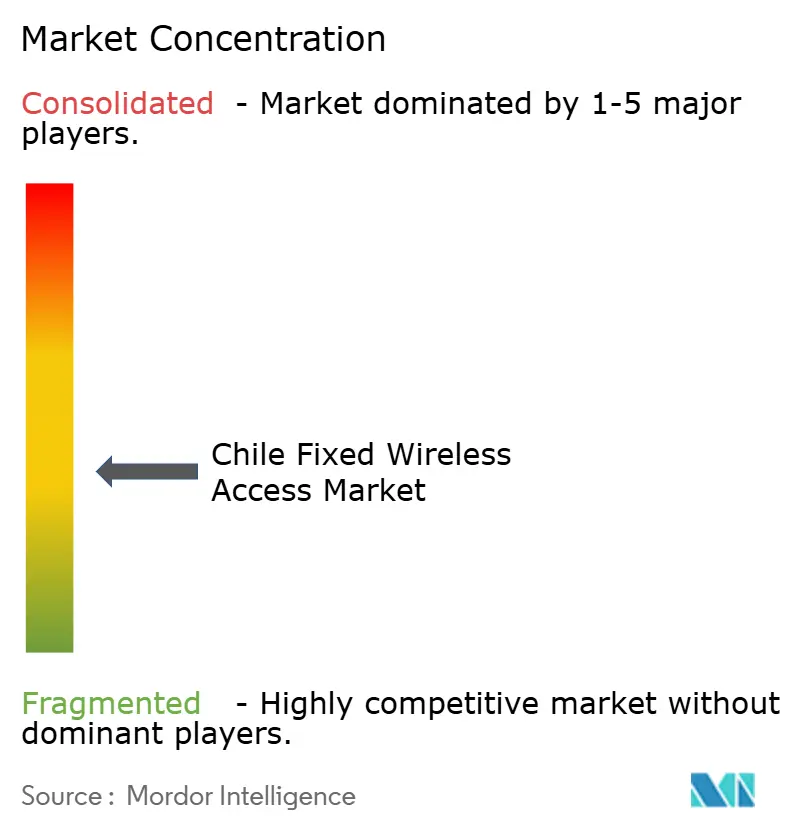
| Market Concentration | Medium |
Major Players *Disclaimer: Major Players sorted in no particular order Image © Mordor Intelligence. Reuse requires attribution under CC BY 4.0. | |
Chile Fixed Wireless Access Market Analysis by Mordor Intelligence
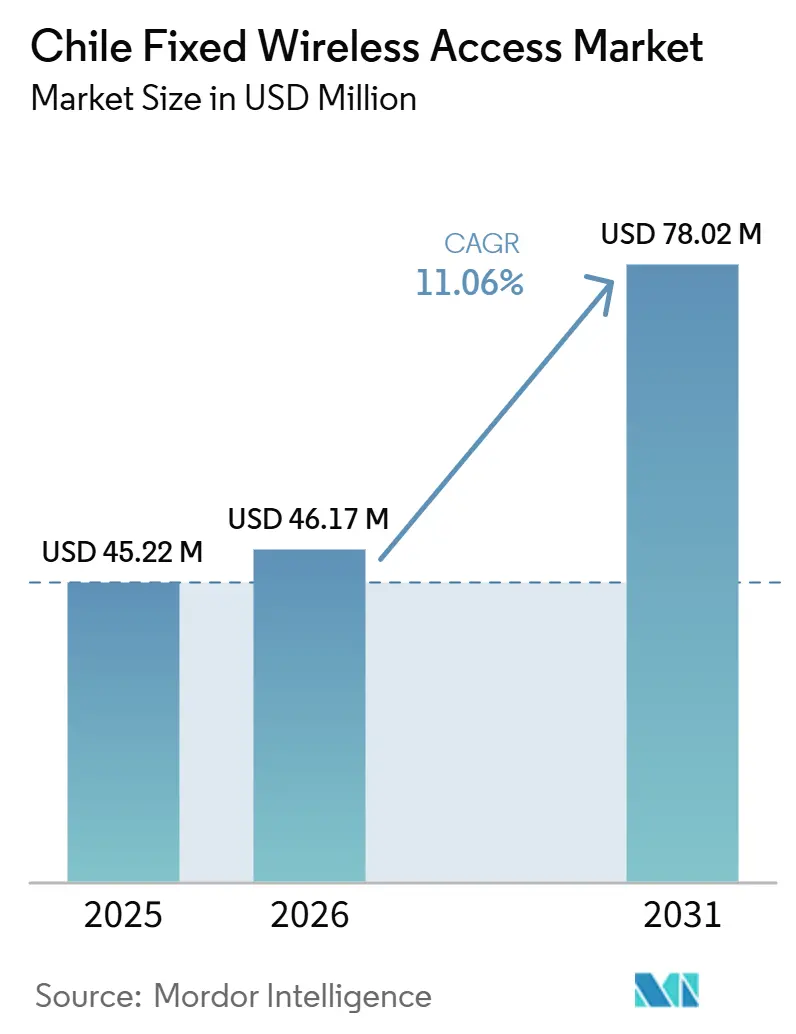
The Chile Fixed Wireless Access Market size is expected to increase from USD 45.22 million in 2025 to USD 46.17 million in 2026 and reach USD 78.02 million by 2031, growing at a CAGR of 11.06% over 2026-2031. Growth is being supported by wider 5G rollout, which is improving the business case for last-mile wireless broadband across dense cities, outer urban belts, and remote municipalities. The Chile fixed wireless access market is also gaining from persistent fiber gaps in low-density areas, where terrain, distance, and deployment cost still limit fixed-line expansion. Operators are using FWA to shorten service launch timelines, meet coverage obligations tied to spectrum holdings, and extend broadband reach without waiting for longer fiber construction cycles. Competition remains intense because Chile has very low fixed broadband pricing, which is pushing providers to focus more on resilience, backup links, enterprise continuity, and public-sector demand rather than relying solely on price-led household offers. Spectrum limits in the 3.5 GHz band remain a constraint, but carrier investment, network consolidation, and broader 5G adoption are keeping the Chile fixed wireless access market on a steady growth path.
Key Report Takeaways
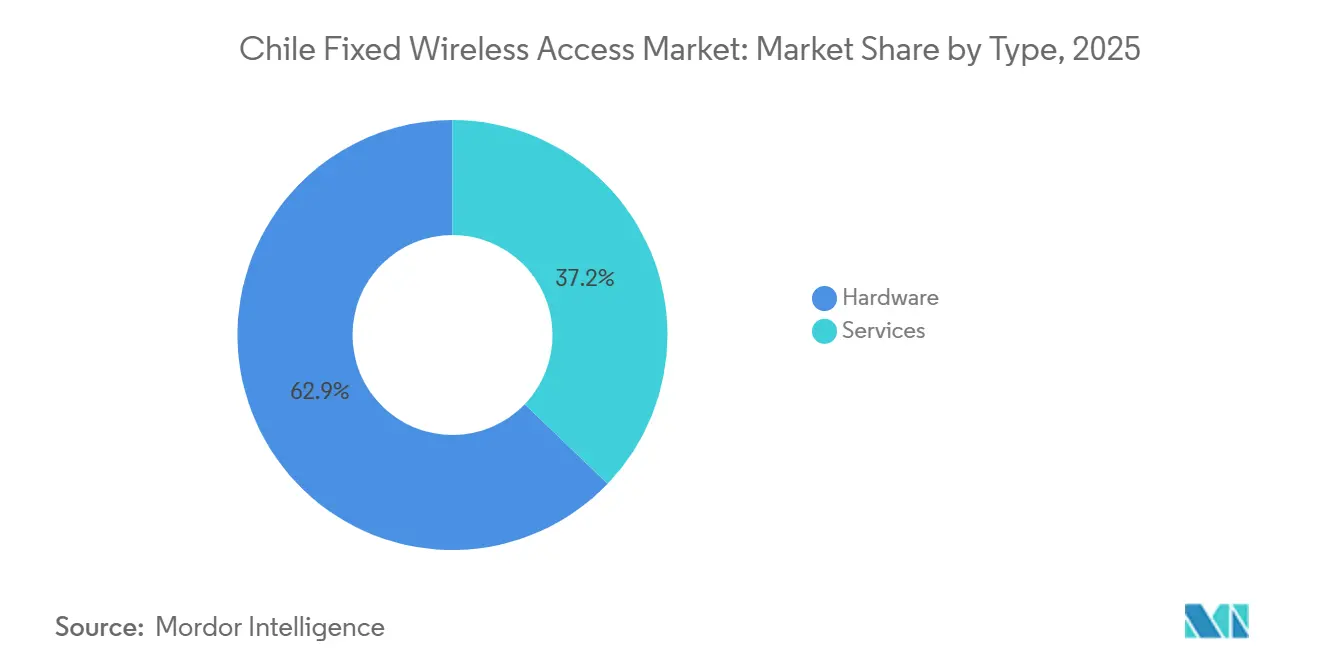
- By type, hardware held 62.85% of revenue share in the Chile fixed wireless access market in 2025, while services are projected to expand at a 13.25% CAGR through 2031.
- By application, residential accounted for 73.42% of revenue share in the Chile fixed wireless access market in 2025, while the government and public safety segment is projected to expand at a 14.05% CAGR through 2031.
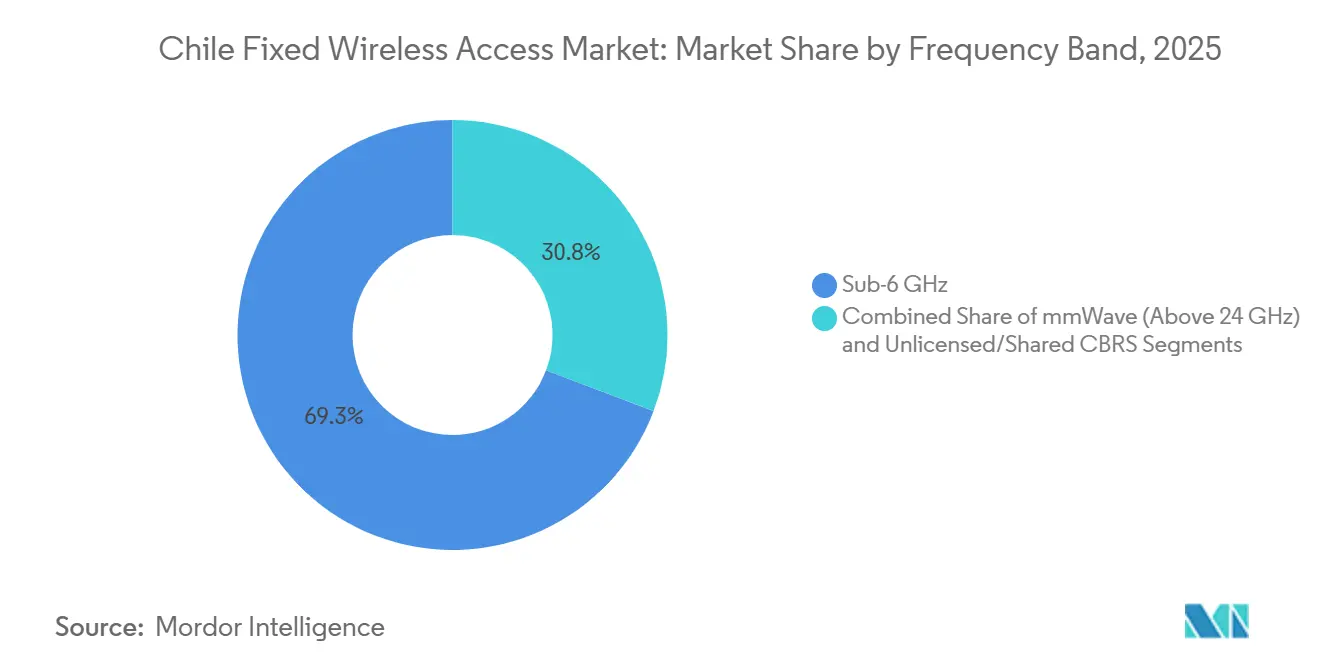
- By frequency band, sub-6 GHz captured 69.25% of revenue share in the Chile fixed wireless access market in 2025, while mmWave (above 24 GHz) is projected to expand at a 15.20% CAGR through 2031.
- By deployment mode, indoor CPE held 66.10% of revenue share in the Chile fixed wireless access market in 2025, while self-install window-mount CPE is expected to grow at a 13.11% CAGR through 2031.
Note: Market size and forecast figures in this report are generated using Mordor Intelligence’s proprietary estimation framework, updated with the latest available data and insights as of January 2026.
Chile Fixed Wireless Access Market Trends and Insights
Drivers Impact Analysis*
| Driver | (~) % Impact on CAGR Forecast | Geographic Relevance | Impact Timeline |
|---|---|---|---|
| Accelerating 5G Coverage in Urban and Semi-Urban Chile | +3.2% | National, with early gains in Santiago, Valparaíso, and Concepción | Short term (≤ 2 years) |
| Fiber Gaps in Low-Density Municipalities and Outlying Communities | +2.1% | Aysén, Magallanes, La Araucanía, and Atacama | Medium term (2-4 years) |
| FWA as a Faster Time-to-Revenue Alternative to Last-Mile Fiber Builds | +1.8% | National, prioritized in peri-urban zones | Short term (≤ 2 years) |
| Demand for Backup Connectivity Among SMEs and Public Institutions | +1.4% | National, concentrated in Santiago and regional capitals | Medium term (2-4 years) |
| Self-Install CPE Lowering Acquisition and Field Service Costs | +0.9% | National | Short term (≤ 2 years) |
| Rural Connectivity Subsidies and Public-Private Broadband Programs | +0.7% | Rural Ñuble, Coquimbo, Aysén, and Magallanes | Long term (≥ 4 years) |
| Source: Mordor Intelligence | |||
Accelerating 5G Coverage in Urban and Semi-Urban Chile
Chile’s 5G rollout remains the strongest growth driver for the Chile fixed wireless access market because it directly improves the economics of serving homes, small businesses, and institutions over existing mobile networks. Mobile 5G connections reached 10,367,754 in March 2026, up 59% from a year earlier, placing Chile among the earliest countries in South America where 5G was surpassing 4G in new connection additions.[1]Subsecretaría de Telecomunicaciones de Chile, “Informe del Sector Telecomunicaciones – Primer Trimestre 2026,” SUBTEL, subtel.gob.cl As operators added more 5G capacity in Santiago, Valparaíso, and Concepción, they widened the addressable base for FWA without needing a separate access network for every new subscriber.[2]Subsecretaría de Telecomunicaciones de Chile, “Concurso 5G Recauda Cerca de 90 Millones de Dólares para el Estado Chileno,” SUBTEL, subtel.gob.cl This matters because the same network build used to manage mobile traffic can also support fixed broadband overlays, lowering launch costs and speeding up the commercial rollout. Entel’s 2026 investment plan included CLP 376 billion (USD 420 million) for Chile, with a stated focus on 5G leadership and fixed broadband expansion, which supports the same shared infrastructure logic behind FWA growth. The combined effect is a wider service footprint, lower per-connection cost, and better operating conditions for the Chile fixed wireless access market.
Fiber Gaps in Low-Density Municipalities and Outlying Communities
Fiber remained strong at the national level, but access remained uneven, leaving clear room for the Chilean fixed wireless access market in rural and low-density areas. Chile’s long north-to-south shape, mountain barriers, and remote communities make last-mile fiber difficult to justify in a meaningful share of populated localities, so FWA fills a role that fiber does not fully solve. WOM completed its 7,553 km National Fiber Optic project in June 2025 across 161 communities, yet it mainly strengthened aggregation and backbone reach rather than fully addressing the final access gap at the household level. That leaves FWA in a durable position in areas such as Aysén, Magallanes, and La Araucanía, where each added 5G site can support more users over time and improve the economics of rural broadband delivery. The Chile fixed wireless access market, therefore, benefits not from a temporary service gap, but from a geographic access problem that is likely to persist through the forecast period.
FWA as a Faster Time-to-Revenue Alternative to Last-Mile Fiber Builds
The Chile fixed wireless access market is also being helped by the fact that FWA can be deployed and monetized much faster than a full fiber-to-the-home build. Operators can activate service in newly covered localities within months, while fiber projects often need much longer civil works, permitting, and trenching cycles before revenue begins. This speed matters in Chile because spectrum awards come with coverage obligations, and carriers need practical ways to reach those required areas on time. Claro’s June 2024 spectrum win in the 3.5 GHz band came with obligations to cover 100 new localities and 1,500 km of roads with 5G services, making FWA a practical route to faster compliance and service activation. Faster launch also improves cash flow because operators can start adding subscribers before a full fixed-line footprint is in place. This is why the Chile fixed wireless access market is increasingly tied to a spectrum monetization strategy as much as to broadband access demand itself.
Demand for Backup Connectivity Among SMEs and Public Institutions
Demand for backup connectivity is creating a more resilient layer of demand in the Chile fixed wireless access market beyond household broadband. Small and medium-sized enterprises, local authorities, and public institutions increasingly need a secondary connection path when their primary fixed link fails, especially in sectors where service interruption incurs immediate operating costs. This need is particularly evident in mining, logistics, agriculture, and municipal services, where real-time coordination depends on stable network connectivity across dispersed locations. That changes the revenue mix because redundancy buyers usually care more about continuity, uptime, and deployment speed than about the lowest price. Public safety and emergency response also support this pattern because agencies want broadband access that is not tied to a single physical network or infrastructure provider. As a result, the Chile fixed wireless access market is gaining support from use cases that are less exposed to consumer price pressure and more aligned with service reliability.
Restraints Impact Analysis*
| Restraint | (~) % Impact on CAGR Forecast | Geographic Relevance | Impact Timeline |
|---|---|---|---|
| Limited Mid-Band Spectrum Depth for Sustainable Capacity Scaling | -1.8% | National, particularly Santiago and major urban centers | Medium term (2-4 years) |
| Strong Price Competition from Fiber and Fixed Broadband Bundles | -1.5% | National, concentrated in Santiago Metropolitan Region | Short term (≤ 2 years) |
| Terrain, Distance, and Line-of-Sight Constraints Outside Core Corridors | -0.8% | Southern regions, Andes corridors, and island communities | Long term (≥ 4 years) |
| Import Exposure for CPE and Network Hardware | -0.6% | National | Medium term (2-4 years) |
| Source: Mordor Intelligence | |||
Limited Mid-Band Spectrum Depth For Sustainable Capacity Scaling
Spectrum depth in the 3.5 GHz band remains the most important supply-side limit on the Chile fixed wireless access market. Under the current framework, each operator is capped at 30% of the band, or 105 MHz, which limits the amount of mid-band capacity any one carrier can hold for both mobile broadband and FWA use. As FWA subscriber density rises in Santiago and other large urban areas, operators must divide the same radio resources between household broadband demand and mobile traffic growth, potentially reducing throughput per sector. SUBTEL opened a public consultation in late 2025 for a third 5G auction in the 3.5 GHz band, but the process remained unresolved through the first half of 2026, leaving carriers in a period of planning uncertainty. Without more spectrum, denser network grids, or broader mmWave use, operators face limits on how many high-throughput users they can add in the busiest parts of the country. This does not stop growth, but it does slow the pace at which the Chile fixed wireless access market can scale in the most commercially attractive zones.
Strong Price Competition From Fiber and Fixed Broadband Bundles
Price pressure from fiber is the main demand-side restraint on the Chile fixed wireless access market, as it makes pure price competition difficult for wireless providers. Chile had the lowest fixed broadband price in South America in January 2026 at USD 3.12 per 100 Mbps, according to a study cited by SUBTEL, which shows how aggressive the local broadband pricing environment had become. That pricing challenge becomes stronger when large operators bundle fiber, pay television, and mobile services into a single offer that FWA-only players cannot easily match. The pressure also supports consolidation because scale helps operators absorb lower headline prices while protecting customer retention and cross-selling. América Móvil completed the full acquisition of ClaroVTR in July 2025, further strengthening the case for converged service packages backed by fixed and mobile assets under a single ownership structure.[3]América Móvil, “America Movil Acquires LLA’s Interest in ClaroVTR,” U.S. Securities and Exchange Commission Filing, sec.gov The result is that the Chile fixed wireless access market keeps growing, but providers need to compete more on the speed of delivery, resilience, and coverage than on tariffs alone.
*Our forecasts treat driver/restraint impacts as directional, not additive. The impact forecasts reflect baseline growth, mix effects, and variable interactions.
Segment Analysis
By Type: Hardware Leads While Services Build A Larger Recurring Revenue Base
Hardware accounted for 62.85% of the Chilean fixed wireless access market share in 2025, reflecting the central role of CPE demand as operators and internet providers expanded their installed base across homes and business locations. Most of that spending came from customer premises equipment because each new subscriber connection required a device at the user end, making hardware the first revenue layer in the adoption cycle. The Chile fixed wireless access market also saw supporting demand for access units such as femtocells and picocells, especially in enterprise settings and public-sector sites that needed controlled indoor coverage. Device design is changing the commercial model because newer platforms are being built to support indoor placement and simpler activation methods, which lower the operating cost of each new connection. Qualcomm launched its Dragonwing FWA Gen 4 Elite platform in March 2025, featuring dynamic antenna steering and RF sensing that enable indoor mmWave CPE without a technician-heavy installation process. That shift keeps hardware dominant today, but it also changes how future service revenue is created.
The services segment is smaller in current value terms, but it is projected to grow at a 13.25% CAGR from 2026 to 2031, making it the fastest-growing part of the type split. This reflects a wider move away from one-time hardware sales and toward managed connectivity offers, subscription-based CPE, service-level commitments, and monthly contracts that bundle equipment with access. For operators, that shift matters because service revenue is steadier and less exposed to one-off installation cycles than pure hardware turnover. Sercomm used FiberDays 2026 in March 2026 to present AirBroadband 5G FWA solutions designed for fiber operators looking to extend last-mile coverage without new, heavy infrastructure spending, which supports the service-led expansion model. Managed FWA plans for SMEs and public institutions are especially important because they can support higher user revenue and longer contract duration than standard residential offers. This is why the Chilean fixed wireless access industry is gradually moving from a hardware-first model to a more balanced one built on both device sales and recurring service delivery. The change does not reduce the importance of hardware, but it does make service design a stronger competitive factor. Over time, providers that combine reliable equipment, faster activation, and support services are likely to hold a better position in the Chile fixed wireless access market.


By Application: Residential Scale Remains Largest While Public Sector Demand Grows Faster
Residential accounted for 73.42% of the Chilean fixed wireless access market in 2025, reflecting the broad push to connect households in peri-urban and semi-urban areas where fiber had not reached or was still unevenly distributed. Residential demand was especially relevant around Santiago’s outer municipalities, Biobío, and La Araucanía, where FWA offered a practical option for new subscribers who still lacked a fixed-line alternative. The commercial segment served small offices, retail sites, and temporary business locations, while industrial demand expanded in mining and agriculture, where wired deployment is often harder to execute at the final access point. That application mix shows that the Chilean fixed wireless access market still operates at the household scale, even though usage needs are becoming more varied across end users.
Industrial adoption is becoming more visible as FWA moves beyond basic connectivity into operational use cases that require low latency and stable field performance. RADWIN deployed its FiberinMotion system at Minera Centinela in August 2025 to support tele-operations, driverless mining machinery, and remote worker safety monitoring in a difficult interference environment. Government and public safety are projected to expand at a 14.05% CAGR from 2026 to 2031, which makes it the fastest-growing application area in the Chile fixed wireless access market. Public funding through the Fondo de Desarrollo de las Telecomunicaciones also supports wireless last-mile deployment in locations where commercial service providers have limited incentives to build. This gives the application mix a dual character, with residential-scale development driving volume while public-sector programs and specialized industrial projects driving the fastest growth. The Chile fixed wireless access industry, therefore, combines broad household reach with a growing share of institutional and mission-critical demand. That balance is likely to keep application diversity high during the forecast period.
By Frequency Band: Sub-6 GHz Holds the Base While mmWave Gains Commercial Ground
Sub-6 GHz captured 69.25% of the market value in 2025, making it the leading frequency band in the Chile fixed wireless access market, driven by range, signal propagation, and more mature device availability. Those qualities matter in Chile because long distances, uneven topography, and mixed urban-rural demand patterns favor a band that can travel farther and perform more consistently outside ideal line-of-sight conditions. Entel, WOM, and Telefónica Chile each hold 50 MHz in the 3.5 GHz band from the first 5G auction cycle, and those holdings form the current backbone of many FWA deployments in urban and semi-urban zones. The unlicensed and shared segment remained the smallest part of the frequency mix, used mainly by wireless internet service providers and rural operators operating within spectrum-sharing frameworks. Even with growing interest in higher-capacity options, sub-6 GHz remains the most practical base layer for the Chile fixed wireless access market because it supports a broad coverage footprint with a manageable equipment cost profile.
mmWave (above 24 GHz) is projected to grow at a 15.20% CAGR from 2026 to 2031, making it the fastest-growing frequency band despite its smaller starting position. The main reason is not national reach, but dense urban capacity, because mmWave is better suited to apartment clusters, premium residential blocks, and high-traffic zones where operators need very high throughput. Qualcomm’s Dragonwing FWA Gen 4 Elite platform delivers combined FR1 and FR2 performance, with peak downlink speeds up to 12.5 Gbps through the X85 5G Modem-RF, strengthening the technical case for mmWave-based FWA in major urban centers. Entel also holds 26 GHz mmWave spectrum through its network relationship with Ericsson, providing the market with an early base for future high-capacity rollouts as devices become more accessible. The pace of mmWave growth will still depend on lower CPE cost and wider commercial availability of supporting chipsets from 2026 onward. If that cost curve continues to improve, mmWave should move from a narrow urban use case into a more regular part of the Chile fixed wireless access market. Even so, the role of mmWave is likely to remain complementary rather than replacing sub-6 GHz across the whole country. This keeps the frequency outlook balanced between national practicality and targeted high-capacity deployment.

By Deployment Mode: Indoor CPE Stays Largest as Self-Install Use Rises
Indoor CPE accounted for 66.10% of revenue in 2025, making it the leading deployment mode in the Chile fixed wireless access market, as most current connections are still centered on residential and suburban use. This setup works for urban and outer-urban households that can place a single router-modem device near a window and activate service without major external work. Outdoor CPE remained important for rural, industrial, agricultural, and coastal deployments where users need mounted antennas, stronger signal capture, and more durable field configurations. That means deployment mode in Chile is closely linked to geography, as the technical access method varies with density, terrain, and distance to the nearest radio site. Indoor CPE, therefore, remains dominant not only because it is easy to use, but also because it aligns with the largest current demand pool in the Chile fixed wireless access market.
Self-install window-mount CPE is projected to grow at a 13.11% CAGR from 2026 to 2031, making it the fastest-growing deployment approach as providers seek to reduce installation time and field service costs. Qualcomm’s Dragonwing Gen 3 Ultra platform includes Dynamic Antenna Steering Gen 2 and RF sensing features that support autonomous alignment and easier indoor or window-based setup, which directly supports this shift toward user-led installation. Self-install models are important in Chile because they can reduce the gap between order and activation from days to hours, which matters in a broadband market where users often have several provider options. The cost effect is also important because removing a technician visit makes service delivery more viable in lower-income peri-urban areas and in remote townships with weak unit economics. Sercomm’s AirBroadband portfolio, presented at FiberDays 2026, demonstrated how vendors are already building product sets around this plug-and-play model for operators seeking faster last-mile coverage. As volumes increase, the unit cost of self-install equipment should continue to decline, further strengthening its role in the Chile fixed wireless access market. This does not remove the need for outdoor systems, but it does make self-install a stronger driver of margin improvement and subscriber growth. The Chile fixed wireless access industry is therefore moving toward a deployment mix that favors simpler activation without losing the ability to serve difficult field conditions.
Geography Analysis
Santiago’s metropolitan region accounted for the largest concentration of fixed internet connections in Chile in 2026, making it the main center of activity for the Chilean fixed wireless access market. The capital and surrounding municipalities had the densest 5G infrastructure base, enabling operators to deliver higher throughput and a wider mix of sub-6 GHz and emerging mmWave services across residential and commercial areas. Competition was also strongest in this region because major operators already had extensive fixed and mobile footprints, which pushed FWA providers to compete on speed, service flexibility, and bundled offers rather than on simple access availability. In this setting, FWA was less about first-time household connectivity and more about rapid deployment for new developments, business continuity links, and premium broadband use cases in dense neighborhoods. Standalone fixed internet accounted for 55.9% of national connections in March 2026, indicating that many users were still willing to buy connectivity without legacy voice or television bundles, a pattern that supports the Chilean fixed wireless access market in metropolitan areas.
Northern Chile formed a different growth corridor because demand there was shaped more by industrial and enterprise requirements than by household broadband scale. Antofagasta, Atacama, and Tarapacá remained important for the Chile fixed wireless access market because mining operators needed low-latency, reliable wireless links across sites where fiber is hard to deploy, across pits, for moving equipment, and for dispersed operations. RADWIN’s August 2025 deployment at Minera Centinela showed that industrial users were already paying for higher-grade wireless systems to support tele-operations and machine control in difficult radio conditions. This made the north an early proving ground for advanced use cases that can later spread into nearby commercial and municipal demand.
Southern Chile presented the longest-term and most defensible access gap in the Chile fixed wireless access market, as rural household fixed internet penetration was only 23.6% in March 2026. Regions such as La Araucanía, Los Ríos, Los Lagos, Aysén, and Magallanes still faced terrain and density conditions that made many last-mile fiber builds hard to justify at the household level. SUBTEL’s last-mile and public funding programs continued to support infrastructure rollout in places such as Ñuble, Aysén, and Coquimbo, but FWA remained the more practical access technology when trenching costs remained high, or population clusters were too scattered. WOM reached authorization for all 366 mandatory 5G localities by March 2026, including geographically extreme areas such as the Juan Fernández Archipelago, Rapa Nui, Tierra del Fuego, and Antarctica, which confirmed that the serviceable footprint for fixed wireless had widened materially. That broadens the long-term opportunity for the Chile fixed wireless access market in areas where conventional fixed access is still unlikely to reach the same coverage depth within the forecast period.
Competitive Landscape
The Chile fixed wireless access market remains competitive at the service layer and fragmented at the hardware layer, which keeps concentration moderate rather than tight. Major telecom operators such as Entel, Movistar, ClaroVTR, and WOM compete alongside fixed internet providers, including GTD Grupo Teleductos and Mundo Pacífico, and no single player controls pricing across all user groups and locations. That matters because competition in Chile is shaped not only by subscriber share, but also by the ability to combine mobile networks, fixed access, and service bundles in a market with heavy pricing pressure. América Móvil completed the full acquisition of ClaroVTR in July 2025, which gave it a stronger converged platform across fixed, mobile, and pay television services and improved its ability to position bundled FWA offers. The Chile fixed wireless access market, therefore, rewards operators that can combine infrastructure scale, quicker launch, and service bundling without relying on a single national pricing strategy.
The vendor side is even more dispersed because hardware supply spans global telecom equipment companies, specialist wireless firms, and CPE manufacturers serving different parts of the access stack. Companies active across the ecosystem include Sercomm, Huawei Technologies, Nokia, Ericsson, ZTE, Cambium Networks, RADWIN, WNC Corporation, DZS, and MikroTik, and no single supplier dominates procurement across Chilean operators. Technology differentiation is becoming more important because operators want equipment that improves installation speed, signal quality, and coverage economics in difficult operating conditions. Qualcomm’s March 2025 Dragonwing FWA Gen 4 Elite launch added a 40-TOPS neural processing unit for on-device AI signal optimization, demonstrating how advanced chipset design is being used to differentiate higher-tier platforms from basic alternatives. This creates a narrower field for vendors seeking to serve the Chile fixed wireless access market at scale, especially in deployments that require both performance and a lower total cost of installation.
Competitive positioning is also being shaped by how vendors and operators respond to Chile’s need for faster access expansion and better last-mile economics. Sercomm’s FiberDays 2026 presentation focused on 5G FWA solutions for fiber operators seeking plug-and-play wireless reach, reflecting a clear market demand for hybrid access strategies. FiberHome’s support for Mundo Pacífico’s network, which earned Ookla recognition at MWC 2026 for fixed network performance, showed that regional operators in Chile can still set high technology benchmarks when they align with the right infrastructure partners. RADWIN’s deployment in Chilean mining also showed that success in this market is no longer based only on consumer broadband pricing, but increasingly on whether a supplier can solve vertical-specific performance needs. The Chile fixed wireless access market is therefore likely to remain open to multiple vendors, but stronger positions will come from execution in enterprise, rural, and self-install use cases rather than from broad, undifferentiated supply alone.
Chile Fixed Wireless Access Industry Leaders
Entel Chile S.A.
Telefónica Chile S.A.
ClaroVTR S.A.
WOM S.A.
GTD Grupo Teleductos S.A.
- *Disclaimer: Major Players sorted in no particular order

Recent Industry Developments
- April 2026: Entel announced a 2026 investment plan of CLP 575 billion (USD 648.7 million) across Chile and Peru, with CLP 376 billion (USD 420 million) directed to Chile for 5G leadership and fixed broadband expansion.
- March 2026: WOM received SUBTEL authorization for 100% of its 366 mandatory 5G localities, completing the first phase of its 5G project across sites that included the Juan Fernández Archipelago, Rapa Nui, Tierra del Fuego, and Antarctica.


Chile Fixed Wireless Access Market Report Scope
The Chile fixed wireless access (FWA) market's revenue is generated through the sale of FWA hardware, including customer premises equipment (CPE) and access units, as well as recurring subscription fees, installation and activation services, managed connectivity services, maintenance, and network support provided by fixed wireless service providers operating across Sub-6 GHz, mmWave, and CBRS frequency bands.
The Chile fixed wireless access market report is segmented by type (hardware and services), application (residential, commercial, industrial, and government and public safety), frequency band (Sub-6 GHz, mmWave (above 24 GHz), and unlicensed/shared CBRS), and deployment mode (indoor CPE, outdoor CPE, and self-install window-mount CPE). The market forecasts are provided in value (USD).
| Hardware | Consumer Premise Equipment (CPE) |
| Access Units (Femto and Picocells) | |
| Services |
| Residential |
| Commercial |
| Industrial |
| Government and Public Safety |
| Sub-6 GHz |
| mmWave (Above 24 GHz) |
| Unlicensed/Shared CBRS |
| Indoor CPE |
| Outdoor CPE |
| Self-Install Window-Mount CPE |
| By Type | Hardware | Consumer Premise Equipment (CPE) |
| Access Units (Femto and Picocells) | ||
| Services | ||
| By Application | Residential | |
| Commercial | ||
| Industrial | ||
| Government and Public Safety | ||
| By Frequency Band | Sub-6 GHz | |
| mmWave (Above 24 GHz) | ||
| Unlicensed/Shared CBRS | ||
| By Deployment Mode | Indoor CPE | |
| Outdoor CPE | ||
| Self-Install Window-Mount CPE |


Key Questions Answered in the Report
What is the size outlook for Chile fixed wireless access?
The Chile fixed wireless access market was valued at USD 45.22 million in 2025, reached USD 46.17 million in 2026, and is forecast to reach USD 78.02 million by 2031 at an 11.06% CAGR.
What is driving growth in Chile fixed wireless access services?
The main growth drivers are wider 5G coverage, rural and low-density fiber gaps, faster time-to-revenue than last-mile fiber builds, and rising demand for backup connectivity from SMEs and public institutions.
Which application leads demand in Chile?
Residential led with 73.42% of revenue in 2025 because operators continued to target households in peri-urban and semi-urban locations where fiber coverage remained uneven.
Which application is growing the fastest?
Government and public safety is projected to grow the fastest, at a 14.05% CAGR through 2031, supported by public-sector connectivity programs and emergency service requirements.
Why does sub-6 GHz remain the leading band?
Sub-6 GHz led with 69.25% of market value in 2025 because it offers better range, stronger propagation, and a more practical cost profile across Chile's mixed terrain and settlement patterns.
What is the biggest constraint on expansion?
The main restraint is limited mid-band spectrum depth in the 3.5 GHz band, followed by strong price competition from fiber and bundled fixed broadband offers in major urban markets.
Page last updated on:





