
Cheese Wax Market Size and Share
Market Overview
| Study Period | 2021 - 2031 |
|---|---|
| Market Size (2026) | USD 130.42 Million |
| Market Size (2031) | USD 168.68 Million |
| Growth Rate (2026 - 2031) | 5.28 % |
| Fastest Growing Market | Asia-Pacific |
| Largest Market | Europe |
| Market Concentration | Medium |
Major Players *Disclaimer: Major Players sorted in no particular order Image © Mordor Intelligence. Reuse requires attribution under CC BY 4.0. | |
Cheese Wax Market Analysis by Mordor Intelligence
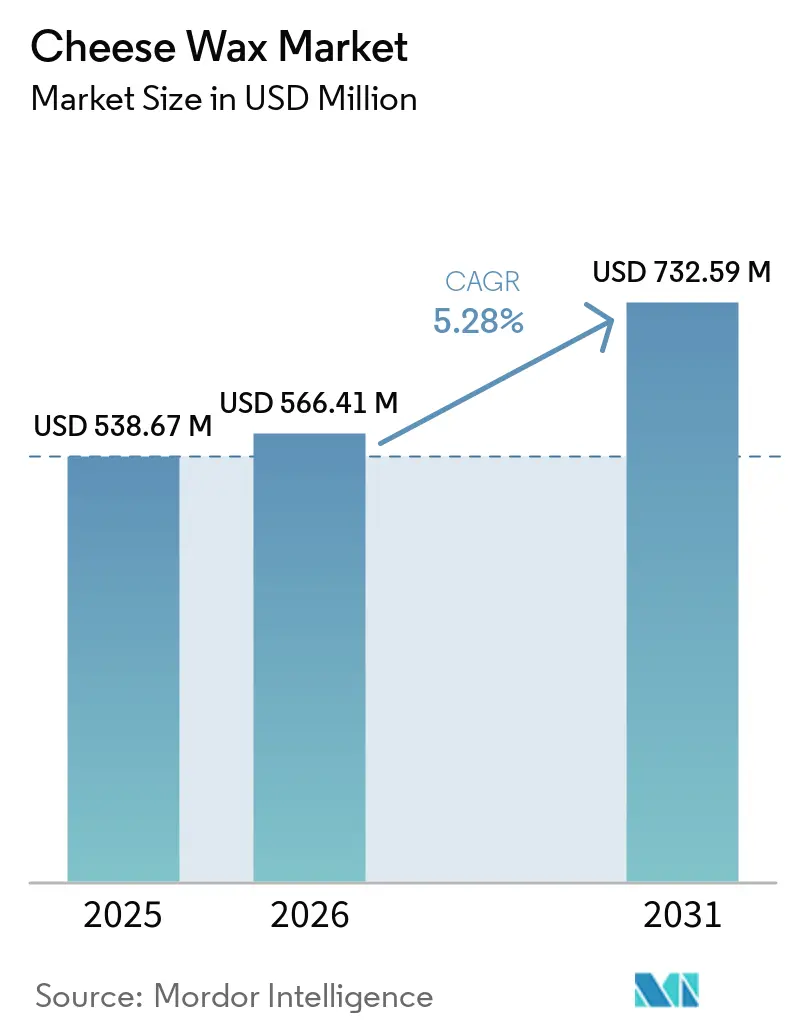
The Cheese Wax Market size is projected to expand from USD 124.21 million in 2025 and USD 130.42 million in 2026 to USD 168.68 million by 2031, at a CAGR of 5.28% between 2026 and 2031. Growth is tied to the expansion of aged, specialty, and artisan cheese production, which requires protective coatings during maturation and distribution. Wax remains important where producers need to manage moisture loss, protect the surface, and preserve the appearance of whole wheels. The cheese wax market is also shifting toward vegetable-based and mineral-oil-free formulations as food-contact requirements become more stringent in Europe. Competition increasingly depends on formulation capability, compliance documentation, and compatibility with automated coating lines, while vacuum packaging and barrier films remain alternatives for processed and portioned cheese formats.
Key Report Takeaways
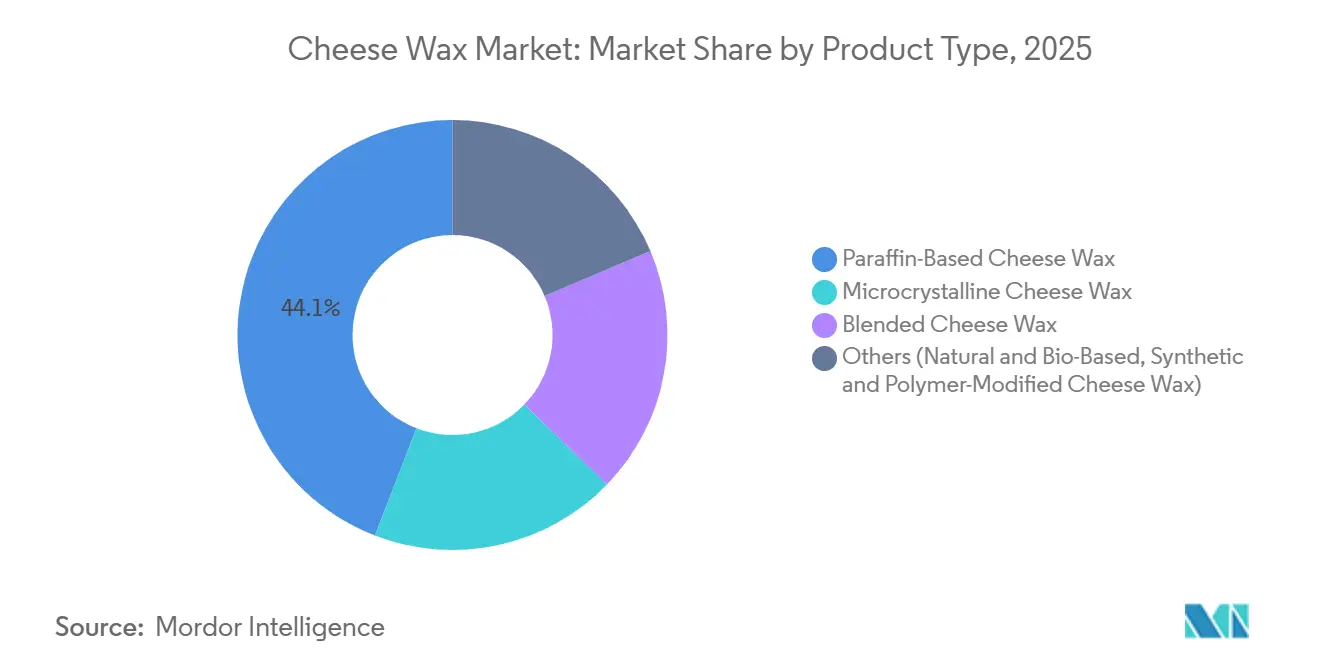
- By product type, paraffin-based cheese wax held 44.14% of the cheese wax market share in 2025, while blended cheese wax is forecast to expand at a 6.85% CAGR through 2031.
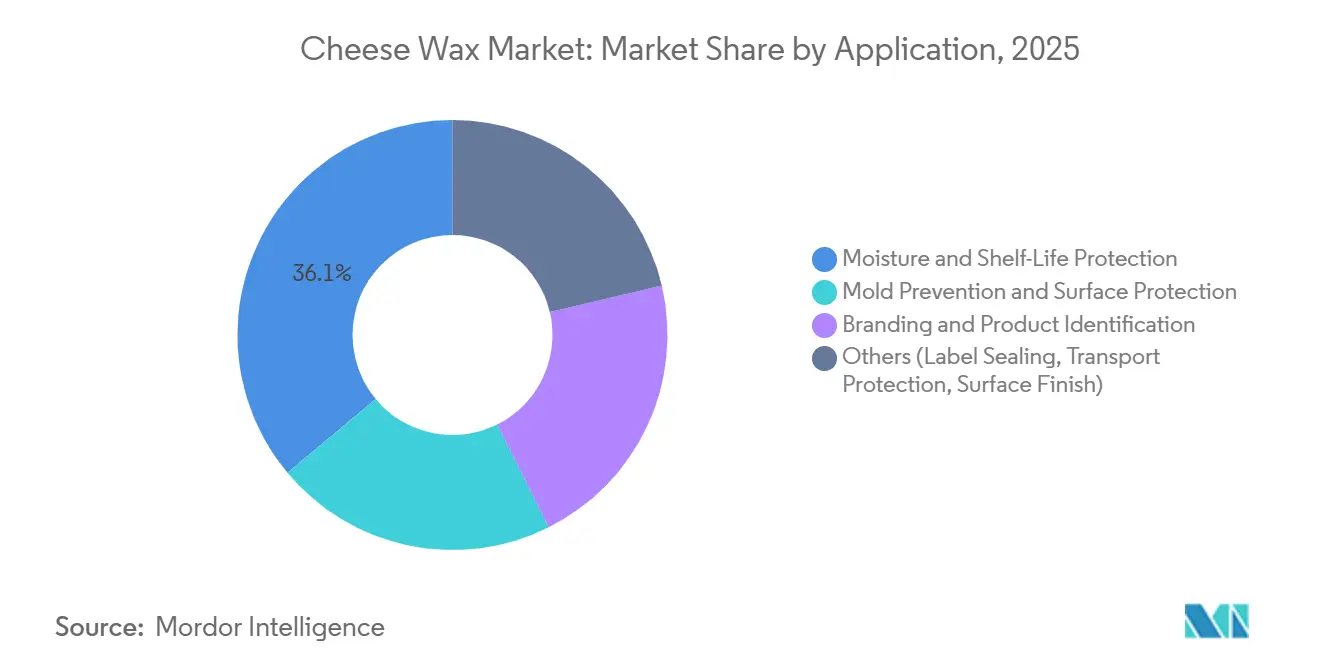
- By application, moisture and shelf-life protection accounted for 36.07% of the Cheese wax market size in 2025, while branding and product identification are projected to grow at a 6.14% CAGR through 2031.
- By geography, Europe held 38.62% of the cheese wax market share in 2025, while Asia-Pacific is forecast to record a 6.26% CAGR through 2031.
Note: Market size and forecast figures in this report are generated using Mordor Intelligence’s proprietary estimation framework, updated with the latest available data and insights as of January 2026.
Market Trends and Insights
Drivers Impact Analysis of Cheese Wax Market*
| Drivers | (~) % Impact on CAGR Forecast | Geographic Relevance | Impact Timeline |
|---|---|---|---|
| Expansion of Aged, Specialty, and Artisan Cheese Production | +1.5% | Global, concentrated in Europe and North America | Medium term (2-4 years) |
| Demand for Moisture Retention and Mold Protection During Aging | +1.2% | Global | Long term (≥ 4 years) |
| Premiumization Through Color, Gloss, and Brand Differentiation | +0.8% | Europe and North America, with early gains in Asia-Pacific | Medium term (2-4 years) |
| Adoption of Bio-Based and Fossil-Free Cheese Coatings | +0.9% | Europe's core, spillover to North America and Oceania | Short term (≤ 2 years) |
| Compatibility of Advanced Wax Grades with Automated Coating Lines | +0.7% | Global, early gains in Western Europe and North America | Medium term (2-4 years) |
| Source: Mordor Intelligence | |||
Expansion of Aged, Specialty, and Artisan Cheese Production
Specialty cheese production supports demand for protective coatings because it involves longer aging cycles and differentiated product formats. Wisconsin produced a record 1.03 billion pounds of specialty cheese in 2025, up 1.1% from the prior year and accounting for 28.2% of the state's total cheese production, according to USDA National Agricultural Statistics Service (NASS) data. This production base provides the cheese wax market with a stable outlet among producers of wheels and other formats that require surface protection. Protected designation cheese varieties in Europe also require producers to meet product and presentation specifications, which supports consistent treatment of outer surfaces. This demand is less dependent on high-output processed cheese formats that typically use films or vacuum packaging.
Demand for Moisture Retention and Mold Protection During Aging
Wax coatings help limit surface dehydration during maturation and provide a barrier against external contamination. This role is most relevant for hard and semi-hard cheeses that mature over extended periods and must retain consistent weight and surface condition. Small changes in moisture loss can affect salable yield, making coating consistency important for dairy processors. Food-contact regulations also provide established compliance pathways for approved coating materials, reducing barriers for products already in use by cheese makers. The cheese wax market therefore retains a functional role even where packaging films are available for other formats.
Premiumization Through Color, Gloss, and Brand Differentiation
Colored coatings allow producers to distinguish a cheese by origin, style, or brand at the point of sale. Paramelt offers food-approved colored cheese waxes in yellow, orange, and red, including mineral and vegetable-based options. A 2026 Salon du Fromage survey found that 48% of French consumers prioritized local and terroir-associated products, while 52% preferred simplicity and authenticity in their cheese choice[1]. These preferences support the use of colored wax as a visible marker for specialty and regional cheeses. Vegetable-pigmented coatings can meet color requirements while reducing reliance on mineral-oil-based materials, broadening the cheese wax market opportunity for premium producers.
Adoption of Bio-Based and Fossil-Free Cheese Coatings
Bio-based coatings are gaining relevance as manufacturers respond to customer preferences and evolving food safety requirements. Procudan describes ProCera Natural as a fully fossil-free cheese wax that can be used in existing production facilities without process changes. Paramelt positions Paradip Nowax as a vegetable-based, GMO-free, mineral-oil-free coating derived from vegetable oils. EU Member States endorsed a proposal on May 13, 2026, for binding maximum levels for mineral oil aromatic hydrocarbons in food, with formal adoption targeted for October 2026. This regulatory direction strengthens the case for reformulation and provides the cheese wax market with a clearer path toward bio-based products.
Restraints Impact Analysis of Cheese Wax Market*
| Restraints | (~) % Impact on CAGR Forecast | Geographic Relevance | Impact Timeline |
|---|---|---|---|
| Competition From Polymer Films, Vacuum Packaging, and Natural Rind Treatments | -0.8% | Global, most acute in North America and Northern Europe | Medium term (2-4 years) |
| Regulatory Scrutiny of Mineral Oil Hydrocarbons and Food-Contact Materials | -0.5% | Europe's core, near-term spillover to North America | Short term (≤ 2 years) |
| Inconsistent Coating Performance Across Cheese Moisture, Gas Formation, and Aging Profiles | -0.3% | Global | Long term (≥ 4 years) |
| Source: Mordor Intelligence | |||
Competition From Polymer Films, Vacuum Packaging, and Natural Rind Treatments
High-barrier films and vacuum systems compete with wax in pre-sliced, portioned, and processed cheese formats. Vacuum skin packaging can extend shelf life and provide a clean retail appearance, particularly in markets with strong demand for packaged cheese. Natural rind treatments also remain relevant for certain artisan cheeses, where minimal surface intervention is part of the product identity. These alternatives reduce the addressable market for conventional coatings in specific cheese categories. Wax remains suitable for aged hard and semi-hard wheels, where a protective surface and traditional appearance are important to the product. The cheese wax market is consequently more exposed to competition in industrial formats than in whole-wheel specialty cheese.
Regulatory Scrutiny of Mineral Oil Hydrocarbons and Food-Contact Materials
Conventional paraffin and microcrystalline waxes face scrutiny for mineral oil saturation and mineral oil aromatic hydrocarbons (MOAH). The European Food Safety Authority (EFSA) has identified certain MOAH structures as a food safety concern and has continued to publish work on mineral oil hydrocarbons[2]. EU technical guidance covers sampling, analysis, and data reporting for mineral oil hydrocarbons in food and food-contact materials. The proposed binding limits endorsed by Member States in May 2026 create a tighter reformulation timetable for suppliers serving Europe. Smaller regional producers may face higher testing and development costs if they lack internal formulation resources. This issue can disrupt supply arrangements while customers assess mineral-oil-free and bio-based alternatives.
*Our forecasts treat driver/restraint impacts as directional, not additive. The impact forecasts reflect baseline growth, mix effects, and variable interactions.
Cheese Wax Market Segment Analysis
By Product Type:
Paraffin Dominates, Blended Grades Gain GroundParaffin-based cheese wax accounted for 44.14% of the product segment in 2025, making it the largest category in the cheese wax market. Its position reflects cost-competitive supply, consistent melting behavior, and compatibility with both manual dipping and established automated equipment. Producers have used paraffin-based grades for many years across cheese types and production scales. Microcrystalline cheese wax serves a more specialized role, offering flexibility and fracture resistance. This characteristic is relevant to gas-forming cheeses, where the coating must accommodate rind changes during aging. Paramelt states that its Paradip Nowax vegetable-based range is especially suitable for coating gas-forming cheeses due to its permeability-control properties.
Blended cheese wax is the fastest-growing product type, with a forecast CAGR of 6.85% from 2026 to 2031. These products address dairy processors seeking a balance between paraffin's cost profile and improved mechanical or regulatory properties. Some blends include food-grade vegetable wax fractions, which can help control permeability for specific moisture profiles. The Codex Alimentarius Commission hosted a 2025 event on mineral oil hydrocarbons in food, addressing the need for harmonized discussion of these contaminants. This development raises interest in products that can meet changing customer requirements without requiring immediate conversion to an entirely new coating system. Natural and bio-based formulations also continue to expand from a smaller base as suppliers provide alternatives to petroleum-derived waxes.

By Application:
Functional Necessity Sustains Core, Branding Drives Premium UpsideMoisture and shelf-life protection accounted for 36.07% of the application segment in 2025, making it the largest use within the cheese wax market. This application supports hard and semi-hard cheeses that require control of dehydration and vapor exchange during maturation. Mold prevention and surface protection are closely linked uses, as a coated surface can limit exposure to external fungi during aging. These functions are important for export-quality wheels that may face long logistics chains and varying storage conditions. Food-contact regulations provide an established framework for materials used in food packaging and contact applications. Other applications include label sealing, transport protection, and surface finishing for smaller specialty producers.
Branding and product identification are the fastest-growing applications, with a projected CAGR of 6.14% through 2031. Colored wax allows producers to communicate regional identity and product differentiation to consumers. The Salon du Fromage survey reported that 48% of French respondents prioritized local and terroir-associated products when choosing cheese. Food-approved, vegetable-pigmented formulations can support both color requirements and a shift away from mineral oil-based materials. Suppliers that offer consistent color ranges and suitable food-contact documentation are better positioned to address premium applications. This segment provides the cheese wax market with a product path that connects visual identity to evolving material requirements.
Geography Analysis
Europe Cheese Wax Market
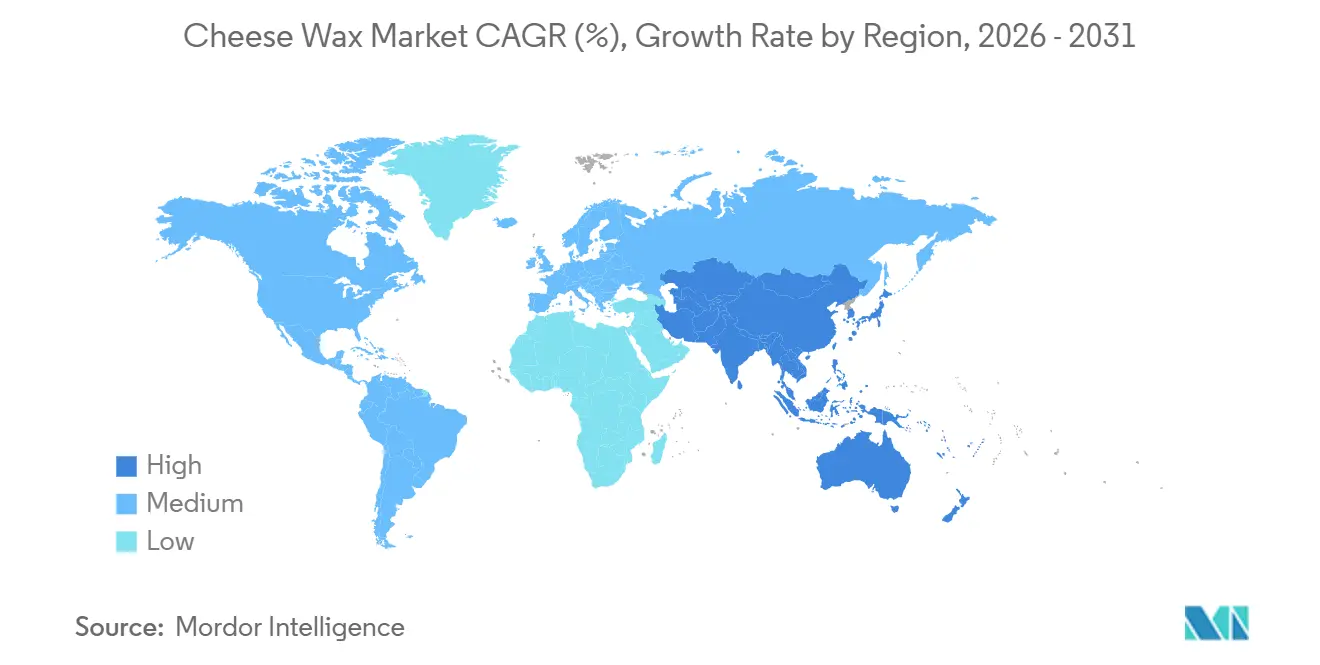
Europe held the largest regional share of the cheese wax market at 38.62% in 2025. The region has a dense base of aged and specialty cheese producers and a large ecosystem of protected designations. This production structure supports demand for coatings that protect whole cheeses and help maintain their intended appearance. Europe also has the most active near-term regulatory environment for mineral-oil-based food-contact materials. The EU action endorsed on May 13, 2026, has accelerated reformulation decisions by regional wax producers and their dairy customers.
The Americas and MEA Cheese Wax Market
North America holds the second-largest regional share of the cheese wax market, supported by specialty and artisan cheese production in the United States. USDA National Agricultural Statistics Service (NASS) data recorded Wisconsin specialty cheese production at 1.03 billion pounds in 2025, with 53 active plants. Canadian and Mexican producers also contribute to regional demand, although at lower levels. South America plays a smaller but stable role linked to domestic hard cheese production and regional trade. The Middle-East and Africa remain smaller markets, as imported and processed formats account for much of local cheese consumption.
APAC Cheese Wax Market
Asia-Pacific is forecast to grow at the highest regional rate, at a CAGR of 6.26% from 2026 to 2031. China is building a larger dairy processing base as cheese consumption expands through foodservice, bakery, and ready-meal formats. USDA Foreign Agricultural Service (FAS) forecasts Chinese cheese consumption at 223 thousand metric tons in 2026, compared with 219 thousand metric tons in 2025. OECD-FAO identifies emerging markets as the primary source of faster global cheese consumption growth, including through pizza, burger, and ready-meal channels. India offers a longer-term opportunity as urban foodservice and specialty food retail expand, while Japan and South Korea support demand for premium imported varieties through established cold chains.
Competitive Landscape
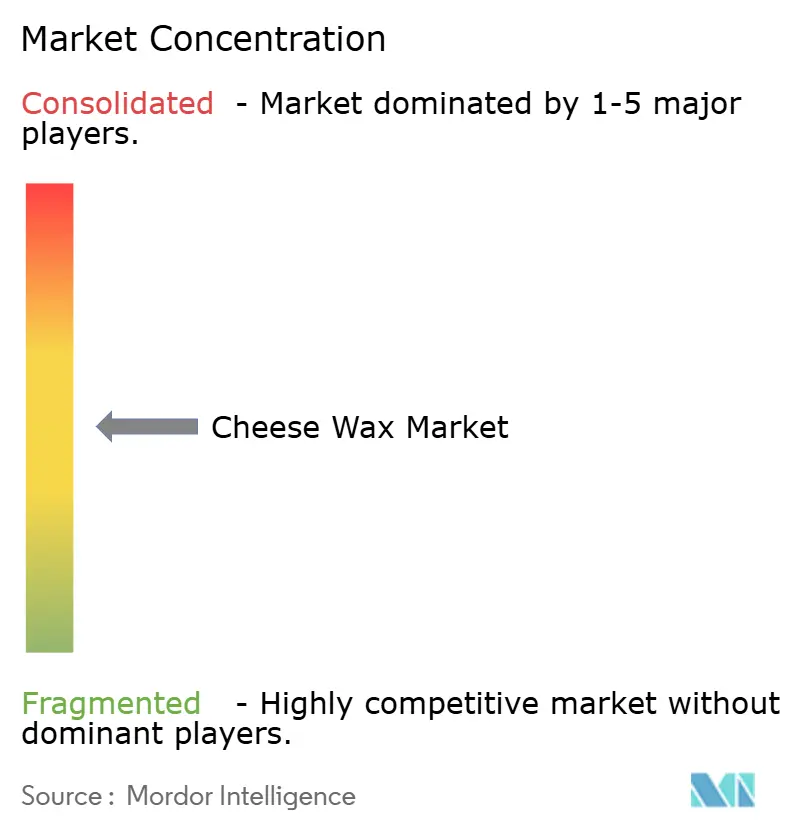
The cheese wax market is moderately fragmented. Paramelt supplies customers in more than 80 countries from 8 production facilities. In February 2026, Paramelt acquired a majority stake in Kahl GmbH & Co. KG, expanding its natural wax capabilities in Europe. This move aligns its established Paradip portfolio with a broader natural wax offering and indicates that access to natural materials and formulation expertise is becoming central to competitive positioning.
Procudan competes through its ProCera Natural platform, which it describes as a fully fossil-free cheese wax. The European Patent Office published EP 4079160 A1, describing a composition for coating cheese using beeswax-based materials and food-grade emulsifiers. Siwax Group uses food safety and quality certifications to support supplier qualifications for dairy customers. Koster Keunen, Blended Waxes Inc., Southwest Wax, BECOR BARBANZA SL, and Serowar serve natural wax or regional dairy customers.
Suppliers compete on formulation performance, certification credentials, color options, and proximity to dairy production hubs. Paramelt's acquisition of Kahl illustrates consolidation in natural wax resources and product development capabilities. Procudan's fossil-free offering represents product differentiation targeting dairy customers seeking alternatives to paraffin-based systems. Paramelt also presented Aquavate Bio at Interpack 2026, a water-based, bio-based polyhydroxyalkanoate (PHA) heat-seal coating for recyclable fiber-based food packaging structures. Opportunities are strongest where foodservice-driven cheese demand is growing faster than local coating supply capabilities. The cheese wax market is therefore likely to reward suppliers that combine compliant formulations with reliable local technical support.
Cheese Wax Industry Leaders
-
Paramelt
-
Procudan
-
Blended Waxes Inc.
-
Paramold Manufacturing LLC
-
BECOR BARBANZA SL
- *Disclaimer: Major Players sorted in no particular order
Cheese Wax Market Companies Covered in this Report
- BECOR BARBANZA SL
- Blended Waxes Inc.
- Ivarson Inc.
- Kahl GmbH & Co. KG
- Koster Keunen
- Paramelt
- Paramold Manufacturing LLC
- Procudan
- Roger A Reed Inc
- Safic-Alcan
- Serowar
- Siwax Group
- Sonneborn LLC
- SouthWest Wax
- The International Group, Inc.
Recent Industry Developments in Cheese Wax Market
- May 2026: EU Member States at the Standing Committee on Plants, Animals, Food and Feed endorsed a Commission Regulation amending Regulation (EU) 2023/915 to set binding maximum levels for mineral oil aromatic hydrocarbons (MOAH) in food, including food contact materials such as cheese wax. Formal adoption is targeted for October 2026. This represents a significant regulatory development for the cheese wax industry, creating compliance pressure that is driving reformulation timelines for bio-based and MOAH-free formulations globally.
- May 2026: Paramelt exhibited at Interpack 2026, showcasing Aquavate Bio, a water-based, bio-based polyhydroxyalkanoate (PHA) heat-seal coating co-developed with UPM. The product targets recyclable, fiber-based food packaging structures, including cheese-wrapping formats, and is certified as home compostable and fully recyclable, demonstrating commercial readiness for the next generation of bio-based food coatings.
Global Cheese Wax Market Report Scope
Cheese wax is a food-grade protective coating made from paraffin and microcrystalline wax. It is melted and applied to hard or semi-hard cheeses to seal in moisture, prevent cracking, and block mold contamination during the aging process.
The cheese wax market is segmented by product type, application, and geography. By product type, the market is segmented into paraffin-based cheese wax, microcrystalline cheese wax, blended cheese wax, and others (natural and bio-based, synthetic and polymer-modified cheese wax). By application, the market is segmented into moisture and shelf-life protection, mold prevention and surface protection, branding and product identification, and others (label sealing, transport protection, surface finish). The report also covers market size and forecasts for cheese wax across 16 countries in major regions. The market sizes and forecasts are provided in terms of value (USD).
Segmentation Overview
| Paraffin-Based Cheese Wax |
| Microcrystalline Cheese Wax |
| Blended Cheese Wax |
| Others (Natural and Bio-Based, Synthetic and Polymer-Modified Cheese Wax) |
| Moisture and Shelf-Life Protection |
| Mold Prevention and Surface Protection |
| Branding and Product Identification |
| Others (Label Sealing, Transport Protection, Surface Finish) |
| Asia-Pacific | China |
| India | |
| Japan | |
| South Korea | |
| ASEAN Countries | |
| Rest of Asia-Pacific | |
| North America | United States |
| Canada | |
| Mexico | |
| Europe | Germany |
| United Kingdom | |
| France | |
| Italy | |
| NORDIC Countries | |
| Russia | |
| Rest of Europe | |
| South America | Brazil |
| Argentina | |
| Rest of South America | |
| Middle-East and Africa | Saudi Arabia |
| South Africa | |
| Rest of Middle-East and Africa |
| By Product Type | Paraffin-Based Cheese Wax | |
| Microcrystalline Cheese Wax | ||
| Blended Cheese Wax | ||
| Others (Natural and Bio-Based, Synthetic and Polymer-Modified Cheese Wax) | ||
| By Application | Moisture and Shelf-Life Protection | |
| Mold Prevention and Surface Protection | ||
| Branding and Product Identification | ||
| Others (Label Sealing, Transport Protection, Surface Finish) | ||
| By Geography | Asia-Pacific | China |
| India | ||
| Japan | ||
| South Korea | ||
| ASEAN Countries | ||
| Rest of Asia-Pacific | ||
| North America | United States | |
| Canada | ||
| Mexico | ||
| Europe | Germany | |
| United Kingdom | ||
| France | ||
| Italy | ||
| NORDIC Countries | ||
| Russia | ||
| Rest of Europe | ||
| South America | Brazil | |
| Argentina | ||
| Rest of South America | ||
| Middle-East and Africa | Saudi Arabia | |
| South Africa | ||
| Rest of Middle-East and Africa | ||
Key Questions Answered in the Report
What is current market size of Cheese Wax Market?
The Cheese Wax Market size is projected to expand from USD 124.21 million in 2025 and USD 130.42 million in 2026 to USD 168.68 million by 2031, at a CAGR of 5.28% between 2026 and 2031.
Which cheese wax product type is growing fastest?
Blended cheese wax is projected to be the fastest-growing product type, with a 6.85% CAGR through 2031.
Which application has the greatest demand for cheese wax?
Moisture and shelf-life protection was the largest application, with 36.07% of the application segment in 2025.
Which region will grow fastest through 2031?
Asia-Pacific is projected to grow at 6.26% CAGR through 2031, supported by expanding cheese consumption and processing activity.