
Chatbot Marketing Services Market Size and Share
Market Overview
| Study Period | 2020 - 2031 |
|---|---|
| Market Size (2026) | USD 4.12 Billion |
| Market Size (2031) | USD 11.38 Billion |
| Growth Rate (2026 - 2031) | 22.53 % |
| Fastest Growing Market | Asia-Pacific |
| Largest Market | North America |
| Market Concentration | Medium |
Major Players *Disclaimer: Major Players sorted in no particular order Image © Mordor Intelligence. Reuse requires attribution under CC BY 4.0. | |
Chatbot Marketing Services Market Analysis by Mordor Intelligence
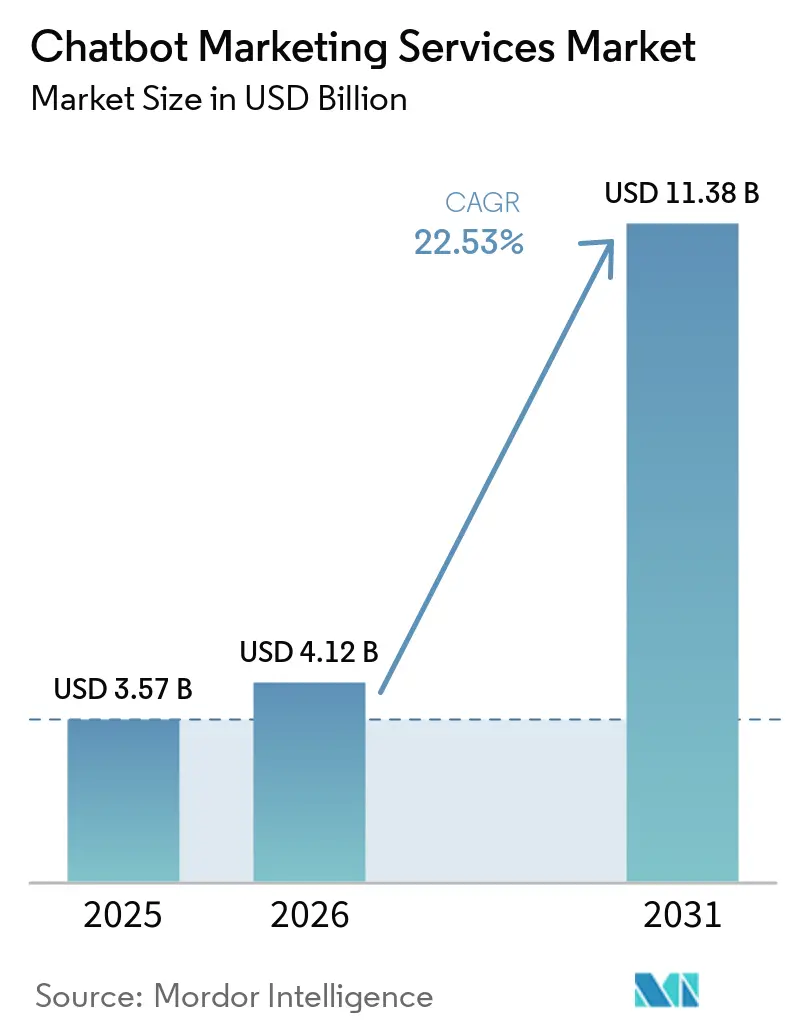
The Chatbot Marketing Services Market size is expected to increase from USD 3.57 billion in 2025 to USD 4.12 billion in 2026 and reach USD 11.38 billion by 2031, growing at a CAGR of 22.53% over 2026-2031. Generative AI is moving conversations beyond scripted answers toward responses that reflect context and brand voice in real time. Marketing teams are shifting spending away from costly broadcast channels toward conversational engagement that can be measured at the interaction level. Live behavioral data from customer data platforms and CRM systems enables more relevant exchanges than static campaigns can provide. This places integration, governance, and measurable outcomes at the center of competition in the chatbot marketing services market.
Key Report Takeaways
- By service type, Design, Development, and Deployment held 25.54% of the chatbot marketing services market share in 2025, while Analytics and Optimization are projected to expand at a 24.73% CAGR through 2031.
- By organization size, Large Enterprises accounted for 63.71% of revenue in 2025, while SMEs are expected to grow at a 23.29% CAGR through 2031.
- By end-user industry, Retail and E-commerce accounted for 25.18% of the chatbot marketing services market in 2025, while Healthcare and Life Sciences are projected to grow at a 23.82% CAGR through 2031.
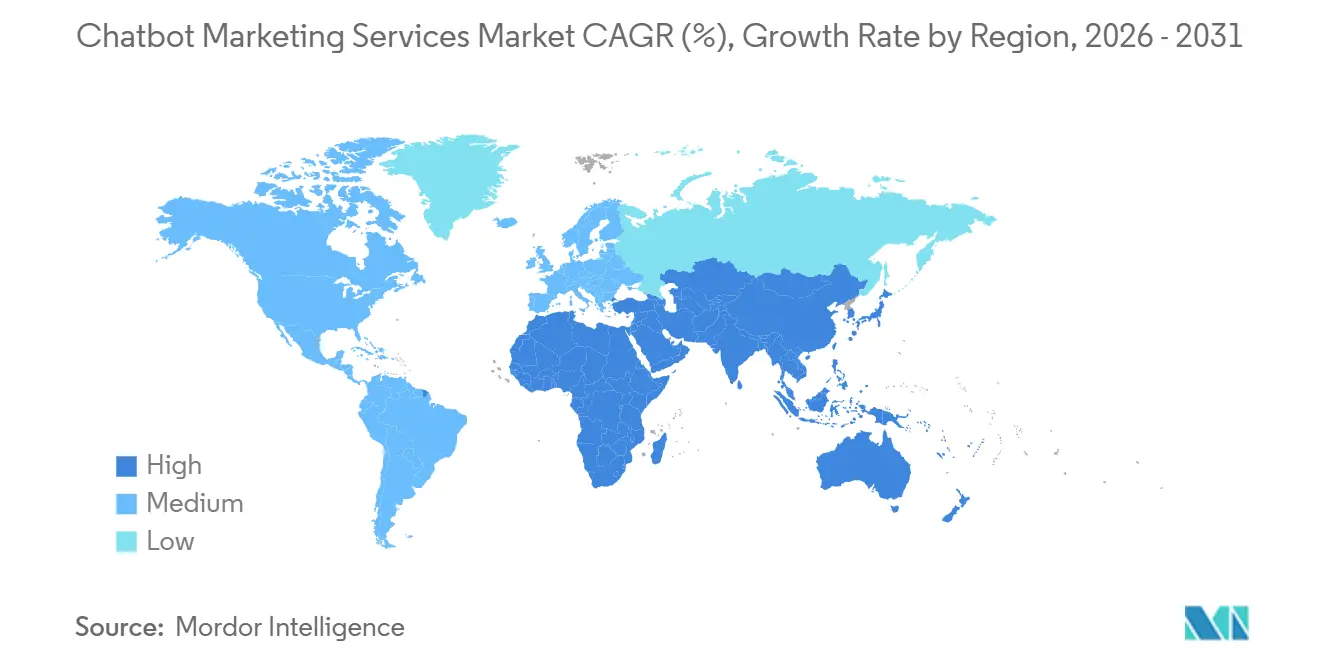
- By geography, North America held 34.76% of revenue in 2025, while Asia-Pacific is projected to grow at a 23.46% CAGR through 2031.
Note: Market size and forecast figures in this report are generated using Mordor Intelligence’s proprietary estimation framework, updated with the latest available data and insights as of January 2026.
Market Trends and Insights
Drivers Impact Analysis of Chatbot Marketing Services Market*
| Driver | (~) % Impact on CAGR Forecast | Geographic Relevance | Impact Timeline |
|---|---|---|---|
| Accelerating Shift Toward Conversational Commerce | +5.8% | Global | Short term (≤ 2 years) |
| Advancements in Generative AI for Hyper-Personalized Engagement | +5.2% | Global | Short term (≤ 2 years) |
| Rising Adoption of Messaging Apps for Brand Interaction | +3.8% | Asia-Pacific and South America | Medium term (2-4 years) |
| Cost Pressures Driving Marketing Automation | +3.0% | North America and Europe | Short term (≤ 2 years) |
| Growing Integration of Chatbots With CDP and CRM Platforms | +2.0% | North America and Europe | Medium term (2-4 years) |
| Expansion of Voice-Enabled Chatbots Across Smart Devices | +1.4% | North America and Asia-Pacific | Long term (≥ 4 years) |
| Source: Mordor Intelligence | |||
Accelerating Shift Toward Conversational Commerce
Conversational commerce is turning marketing chatbots into measurable revenue tools for the chatbot marketing services market. A 2025 study of composite retail and e-commerce organizations found that WhatsApp-enabled conversational automation delivered 270% ROI over 3 years, along with a 55% increase in conversion rates and 50% higher customer engagement than SMS and email campaigns. The study also reported a 20% increase in average order value, which supports shifting marketing budgets toward conversational channels. In July 2026, Gupshup disclosed an enterprise deployment of Meta Business Agent on WhatsApp with Treebo Hospitality Ventures. The deployment supports catalog recommendations, lead qualification, appointment booking, and in-conversation sales completion in 1 thread. Providers that enable checkout completion can pursue budgets once assigned to standalone conversion optimization tools.
Advancements in Generative AI for Hyper-Personalized Engagement
Generative AI has reduced the manual scripting needed to sustain campaign conversations in the chatbot marketing services market. Earlier systems required extensive dialogue trees for each campaign variation, whereas large language model platforms can generate campaign-specific exchanges as needed. Bloomreach made its Loomi marketing agent generally available in June 2026. Its client, 260 Sample Sale, achieved a 2.4x higher conversion rate while reducing the targeted audience by 82%. Databricks introduced CustomerLake in June 2026 with Campaign Agents that analyze customer signals, recommend next actions, and update engagement logic. These capabilities lower the marginal cost of personalization and broaden access to sophisticated engagement tools beyond the largest enterprises.
Rising Adoption of Messaging Apps for Brand Interaction
Messaging platforms are changing, where consumers expect to interact with brands through chatbot marketing services. WhatsApp reported more than 2.7 billion users globally and has become a major channel for conversational automation outside North America. Meta changed WhatsApp Business Platform pricing to a per-delivered-template-message model in July 2025. Customer-initiated service conversations became free and unlimited in November 2024, reducing ongoing costs for always-on chatbot programs. Meta’s 2026 policy restricts general-purpose AI assistants on WhatsApp while allowing purpose-specific chatbots. This distinction favors narrowly defined, task-specific tools and increases compliance demands for providers of multi-use platforms.
Cost Pressures Driving Marketing Automation
Pressure to improve marketing efficiency is supporting chatbot-led automation in the chatbot marketing services market. Klarna reported in 2024 that its AI customer service agent handled 2-thirds of customer chats, reduced average resolution time from 11 minutes to under 2 minutes, and contributed an estimated USD 40 million to annual profit. The commercial case also includes the 270% 3-year ROI reported for WhatsApp-enabled retail operators. Procurement discussions are therefore moving from basic cost reduction toward conversion improvement, revenue attribution, and customer lifetime value. Providers that demonstrate these outcomes can defend pricing more effectively than those selling efficiency alone. This shift supports demand for analytics and optimization services within the chatbot marketing services market.
Restraints Impact Analysis of Chatbot Marketing Services Market*
| Restraint | (~) % Impact on CAGR Forecast | Geographic Relevance | Impact Timeline |
|---|---|---|---|
| Privacy Concerns Around Persistent Tracking | -2.1% | Europe and North America | Short term (≤ 2 years) |
| Limited Multilingual Training Data for Niche Markets | -1.5% | Asia-Pacific, Middle East, and Africa | Medium term (2-4 years) |
| Fragmented Regulation on Conversational AI Disclosures | -1.0% | Global | Medium term (2-4 years) |
| High Churn of SME Clients Due to DIY Alternatives | -0.8% | North America and Europe | Short term (≤ 2 years) |
| Source: Mordor Intelligence | |||
Privacy Concerns Around Persistent Tracking
Persistent behavioral tracking supports long-term customer profiles, but it can conflict with data minimization requirements. The EU AI Act’s transparency rules for certain AI systems took effect on August 2, 2026, including disclosure duties for customer-facing chatbot use cases. The GDPR permits penalties of up to EUR 20 million, USD 22.6 million at the stated 2025 average rate, or 4% of global annual revenue for some violations. European Data Protection Board guidance explains that conversational data used for model training requires an appropriate lawful basis and safeguards for purpose limitation. Consent-first data flows raise implementation cost and can extend deployment schedules. Vendors that invest in privacy management practices can use governance readiness to differentiate themselves with regulated enterprise buyers.
Limited Multilingual Training Data for Niche Markets
Limited language data constrains chatbot deployments in linguistically diverse growth markets. UNESCO’s World Atlas of Languages identifies a wide gap in digital support across the world’s languages.[1] A 2025 IEEE study found that multilingual NLP systems still face difficulties with code-switching, cultural idioms, and complex scripts. Hindi, Tamil, Telugu, Swahili, and Hausa deployments can therefore require more fine-tuning than many Western European language deployments. This raises development cost and extends the time required to scale across local markets. Providers that build proprietary multilingual corpora can develop a durable advantage as the chatbot marketing services market expands in Asia-Pacific, the Middle East, and Africa.
*Our forecasts treat driver/restraint impacts as directional, not additive. The impact forecasts reflect baseline growth, mix effects, and variable interactions.
Chatbot Marketing Services Market Segment Analysis
By Service Type:
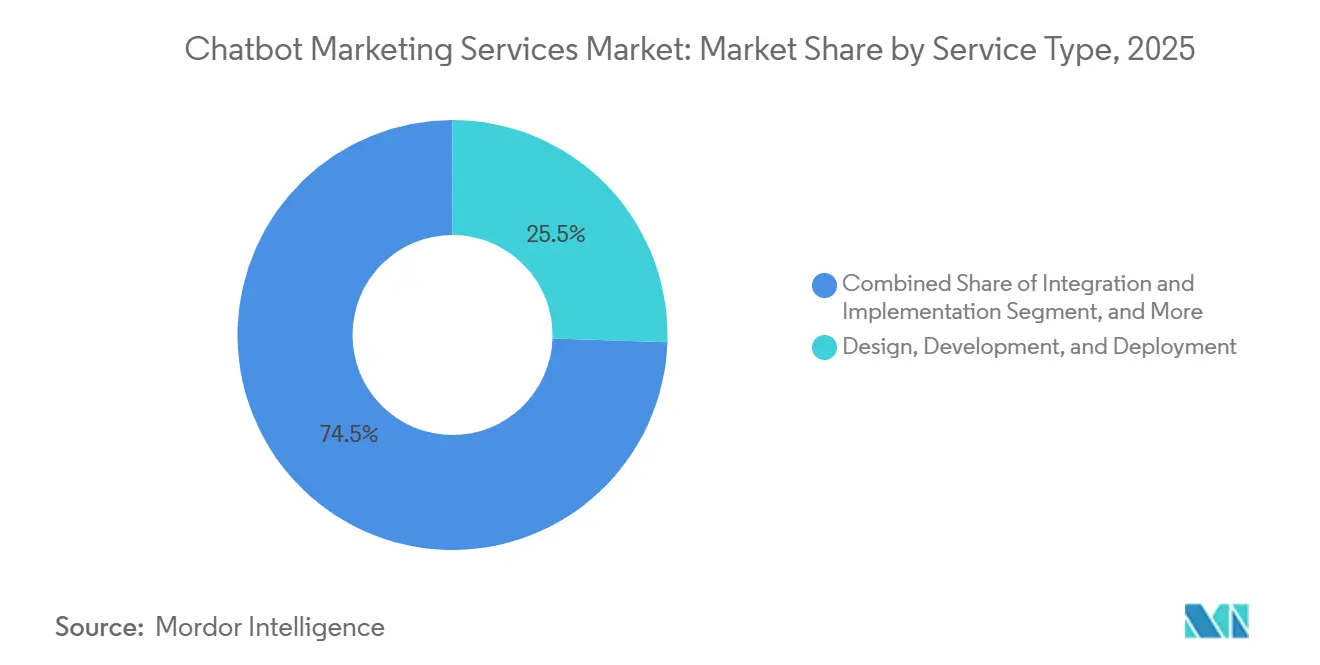
Analytics Gains Importance Alongside Deployment RevenueDesign, Development, and Deployment held 25.54% of revenue in 2025, making it the largest service type. The position reflected the investment required to move enterprise buyers from rule-based systems to generative AI-based conversational infrastructure. Platform Subscription, Integration, and Implementation sustained recurring activity through licensing and martech connectivity needs. Strategy and Consulting served early buyers who needed architecture guidance. Managed Services supported organizations that preferred outsourced operational delivery. Other Service Types covered tailored models for particular vertical needs. Analytics and Optimization is projected to grow at a 24.73% CAGR from 2026 to 2031, exceeding the overall 22.59% rate.
The chatbot marketing services market size for analytics-related work is supported by a growing need to measure performance after deployment. Brands that implemented conversational tools in 2023 and 2024 are seeking conversion attribution, sentiment tracking, and cohort engagement analysis. They need more than uptime and response-rate measures. Twilio made Conversation Intelligence and Conversation Memory generally available at SIGNAL 2026, treating analytics as core platform infrastructure.[2] Providers with deployment and analytics capabilities can increase work with existing clients rather than compete only for new accounts. Bloomreach’s 2026 result for 260 Sample Sale illustrates how analytics-based targeting can tie a smaller audience to stronger conversion performance. This changes the client conversation from system implementation to ongoing outcome improvement.

By Organization Size:
Large Enterprises Anchor Revenue While SMEs Expand FasterLarge Enterprises accounted for 63.71% of the chatbot marketing services market share in 2025. These buyers can absorb the upfront cost of integration, customization, and governance for enterprise-grade deployments. They also benefit when interaction data is captured in a unified customer record via CRM integration. Each additional interaction can improve the relevance of future chatbot exchanges. This data flow creates stickiness that standalone tools may struggle to match. Salesforce signed an agreement in June 2026 to acquire Fin for USD 3.6 billion, citing expanded AI-agent capabilities and Agentforce integration. The transaction indicates that leading platforms remain focused on higher-value enterprise and mid-market requirements.
SMEs are projected to grow at a 23.29% CAGR from 2026 to 2031, the highest rate in this segmentation. Cloud-based subscription platforms and do-it-yourself chatbot builders reduce the initial investment required to enter the chatbot marketing services market. The same accessibility can increase churn when buyers bring conversational configurations in-house. LivePerson reported that 2025 revenue fell 22% year over year to USD 243.7 million, while enterprise and mid-market revenue retention was 78%. This points to retention pressure when customers gain more control over chatbot configuration. SME providers that use outcome-based pricing and offer continuing optimization are better placed to turn high-volume adoption into recurring revenue. One-time deployment offers are less aligned with this buyer pattern.
By End-User Industry:
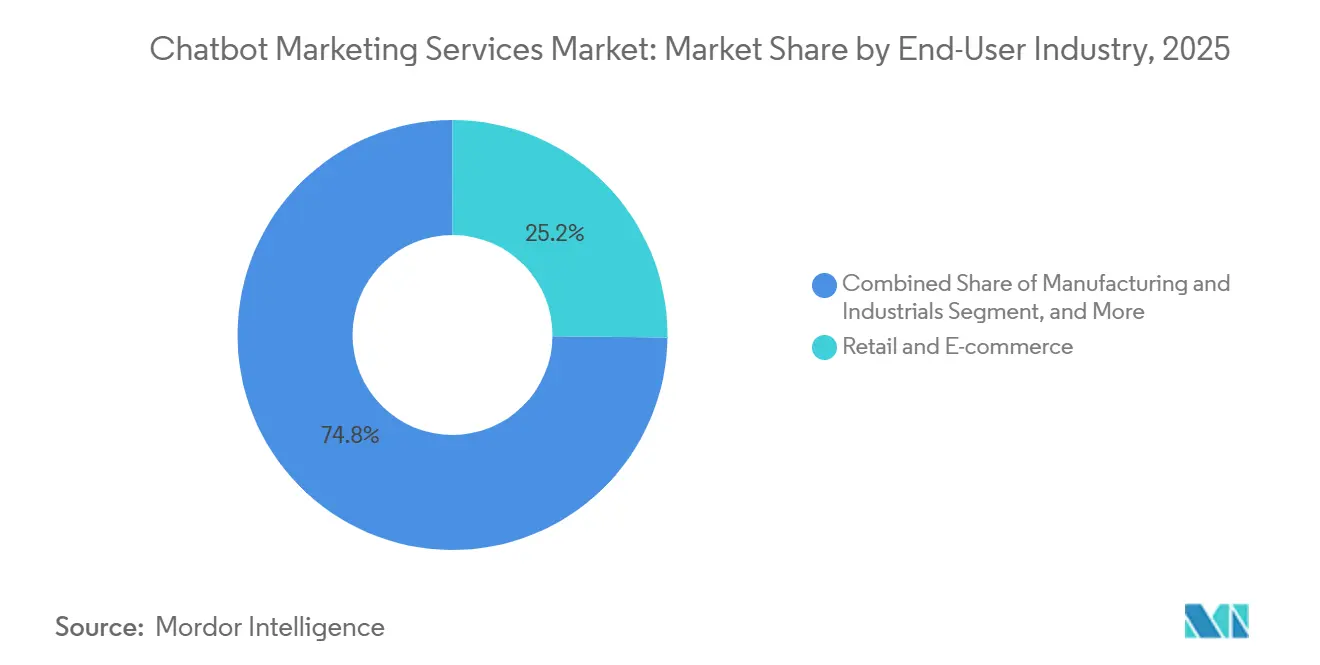
Retail Provides Scale While Healthcare Broadens Use CasesRetail and E-commerce held 25.18% of revenue in 2025, the largest end-user position. Cart recovery, product recommendations, order tracking, and post-purchase support create frequent interactions that are well-suited to chatbot automation. IT and Telecommunications, BFSI, and Travel and Hospitality also retained meaningful demand. BFSI needs strong governance and audit trails, which support demand for compliance-ready services. Media and Entertainment and Manufacturing and Industrials represented smaller but important user groups. Manufacturing demand is linked to account-based marketing automation and complex business-to-business inquiry handling. These varied applications reduce reliance on any single end-user group in the chatbot marketing services market.
Healthcare and Life Sciences are projected to grow at a 23.82% CAGR from 2026 to 2031. Lupin launched Anya in February 2026 as a patient-centric chatbot that provides disease awareness guidance in multiple Indian languages through WhatsApp and its digital platforms. The launch shows how pharmaceutical organizations can use chatbots for ongoing patient relationship management. Singapore’s National University Hospital launched MedBot in July 2025 as a generative AI medication counseling assistant integrated with electronic medical records. MedBot saved 28 man-hours each month during its initial operating period. Healthcare use cases therefore extend beyond scheduling into medication guidance, adherence reminders, intake, and follow-up. The chatbot marketing services industry must meet more demanding privacy and clinical governance expectations in this vertical.
Geography Analysis
North America Chatbot Marketing Services Market
North America accounted for 34.76% of regional revenue in 2025, the largest share. Established enterprise software systems, broad CRM use, and mature data governance practices support deep integration with marketing technology stacks. Retail and E-commerce, BFSI, and IT and Telecommunications continued to anchor enterprise procurement in the region. Salesforce’s June 2026 agreement to acquire Fin for USD 3.6 billion shows how acquisitions are expanding platform capabilities. The United States accounts for most of the region's revenue. Canada and Mexico remain earlier-stage growth areas, particularly as English-French and English-Spanish conversational capabilities improve.
Europe, APAC and South America Chatbot Marketing Services Market
Europe retained meaningful revenue through technically advanced buyers in the United Kingdom, Germany, and France. Procurement specifications increasingly require data governance architecture alongside conversational AI delivery. This raises the minimum standard for providers operating in regulated enterprise accounts. Italy, Spain, and other European countries are growing from smaller bases through digital commerce and SME digitization. Asia-Pacific is projected to grow at a 23.46% CAGR from 2026 to 2031, the fastest regional rate. Mobile-first consumers in China, India, South Korea, Japan, and Australia support this chatbot marketing services market opportunity. Lupin’s Anya launch shows the importance of language-specific healthcare deployments in India. Providers that can operate across India’s 22 constitutionally recognized languages, Mandarin, Korean, and Japanese have a stronger position in this region.[3]South America is supported by WhatsApp-first communication patterns and expanding digital commerce.
MEA and South America Chatbot Marketing Services Market
Brazil and Argentina are the main contributors, while Chile and other South American markets add incremental demand. The Middle East is led by the United Arab Emirates and Saudi Arabia, where digital transformation programs and mobile-native populations support enterprise interest. Qatar and other Middle Eastern countries remain earlier-stage markets for Arabic-language conversational marketing. Africa offers longer-term demand in South Africa, Nigeria, and Egypt because of mobile growth and younger populations. Multilingual data gaps and uneven digital infrastructure limit the near-term scale and quality of deployments across the region. These conditions leave the chatbot marketing services market dependent on local-language development and practical integration capacity.
Competitive Landscape
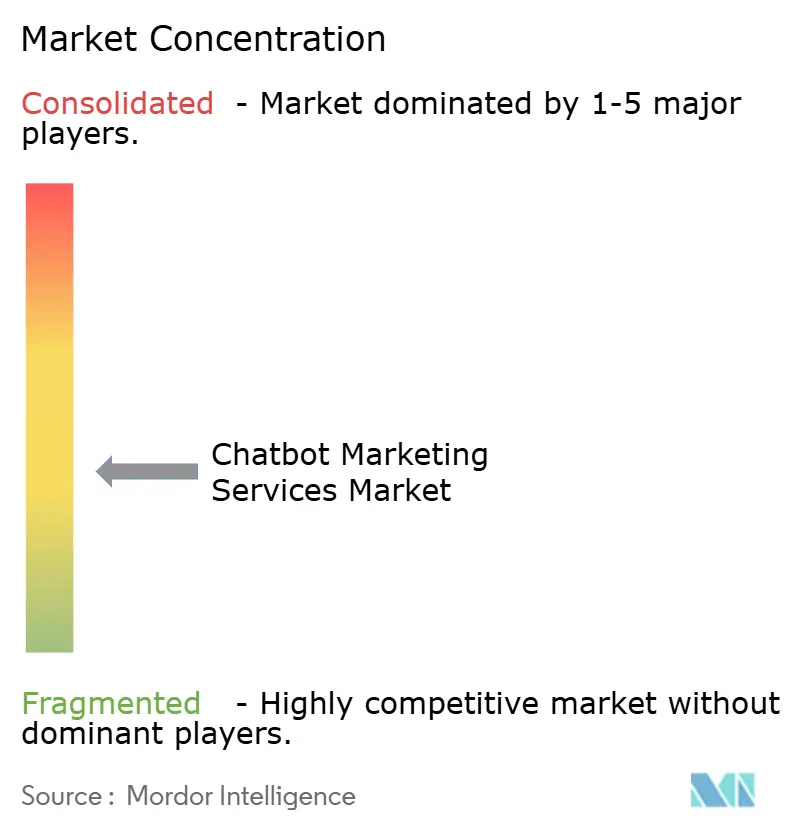
The chatbot marketing services market is moderately fragmented at the managed-service layer and is consolidating at the platform infrastructure layer. IBM, Google, Meta Platforms, Oracle, and Salesforce compete with conversational AI specialists such as LivePerson, Cognigy, Twilio, and Zendesk. HubSpot, ManyChat, Freshworks, and Zoho serve SME and mid-market customers with lighter integration-oriented offerings. Salesforce signed a definitive agreement in June 2026 to acquire Fin, formerly Intercom, for USD 3.6 billion. SoundHound AI announced an agreement in April 2026 to acquire LivePerson, combining its voice AI infrastructure with LivePerson's digital messaging capabilities. These moves show that larger vendors are expanding through the acquisition of platform capabilities.
Competition increasingly depends on integration depth and outcome attribution rather than basic conversational functions. Twilio made Conversation Intelligence and Conversation Memory generally available at SIGNAL 2026. Freshworks introduced AI Agent Studio in May 2026 as a no-code environment for domain-specific Freddy AI Agents. These products can create switching costs by connecting conversational activity with customer data and operational systems. NiCE Cognigy was named a Leader in a 2026 evaluation of conversational AI platforms for customer service.[4] The recognition signals demand for platforms that can support multilingual and regulated production environments. The chatbot marketing services market remains open to providers that can deliver comparable operating reliability in specialized settings.
Healthcare chatbot programs in South and Southeast Asia, multilingual commerce in Africa, and voice-enabled marketing across smart devices remain underdeveloped areas. Regulatory requirements and linguistic complexity can discourage broad horizontal platforms from serving these applications. Agentic systems are also challenging service models built around manual workflow management. Bloomreach reported that its Loomi agent improved conversion performance while reducing the targeted audience. This result strengthens the case for outcome-based optimization over deployment volume. Providers that depend on implementation fees alone face greater pricing pressure as clients seek continuous improvements. The chatbot marketing services market will reward firms that combine integration, analytics, multilingual capacity, and clear governance practices.
Chatbot Marketing Services Industry Leaders
-
LivePerson Inc.
-
Intercom Inc.
-
ManyChat Inc.
-
Chatfuel Inc.
-
HubSpot Inc.
- *Disclaimer: Major Players sorted in no particular order
Chatbot Marketing Services Market Companies Covered in this Report
- LivePerson Inc.
- Intercom Inc.
- ManyChat Inc.
- Chatfuel Inc.
- HubSpot Inc.
- Tidio Poland Sp. z o.o.
- Zendesk Inc.
- Twilio Inc.
- IBM Corporation
- Google LLC
- Meta Platforms Inc.
- Oracle Corporation
- Salesforce Inc.
- Freshworks Inc.
- Zoho Corporation Pvt. Ltd.
- SnatchBot Ltd.
- Cognigy GmbH
- Rulai Inc.
- Inbenta Holdings Inc.
Recent Industry Developments in Chatbot Marketing Services Market
- July 2026: Gupshup disclosed the first enterprise deployment of Meta Business Agent on WhatsApp with Treebo Hospitality Ventures, enabling catalog recommendations, lead qualification, appointment booking, and in-conversation sales completion within a single conversational flow. The deployment marks a commercially significant milestone for agentic AI in hospitality marketing.
- July 2026: LivePerson completed cutover of KnowledgeAI and Automated Conversation Summary products to Google Gemini models for global deployments, with EMEA-specific Conversation Builder migration rescheduled to a future date.
- June 2026: Salesforce signed a definitive agreement to acquire Fin, formerly Intercom, for USD 3.6 billion, targeting the integration of Fin’s AI Agent, powered by the proprietary Apex model, into the Agentforce platform. The transaction is expected to close in Q4 of Salesforce’s fiscal year 2027, pending regulatory clearance.
- June 2026: Databricks launched CustomerLake, an Agentic CDP embedded natively in the Databricks Lakehouse, introducing Campaign Agents that autonomously analyze customer signals, recommend next-best actions, and optimize engagement across channels without manual campaign management.
Global Chatbot Marketing Services Market Report Scope
The chatbot marketing services market refers to solutions and services that use AI-powered conversational agents to automate customer engagement, lead generation, campaign support, personalization, and analytics across digital channels, helping businesses improve response times, enhance user experiences, and optimize marketing performance throughout the customer journey, efficiently and at scale, globally.
The Chatbot Marketing Services Market Report is Segmented by Service Type (Strategy and Consulting, Design, Development, and Deployment, Platform Subscription, Managed Services, Integration and Implementation, Analytics and Optimization, and Other Service Types), Organization Size (Large Enterprises, and Small and Medium Enterprises), End-User Industry (Retail and E-commerce, IT and Telecommunications, BFSI, Healthcare and Life Sciences, Media and Entertainment, Travel and Hospitality, Manufacturing and Industrials, and Other End-User Industries), and Geography (North America, South America, Europe, Asia-Pacific, Middle East, and Africa). The Market Forecasts are Provided in Terms of Value (USD).
Segmentation Overview
| Strategy and Consulting |
| Design, Development, and Deployment |
| Platform Subscription |
| Managed Services |
| Integration and Implementation |
| Analytics and Optimization |
| Other Service Types |
| Large Enterprises |
| Small and Medium Enterprises |
| Retail and E-commerce |
| IT and Telecommunications |
| BFSI |
| Healthcare and Life Sciences |
| Media and Entertainment |
| Travel and Hospitality |
| Manufacturing and Industrials |
| Other End-User Industries |
| North America | United States |
| Canada | |
| Mexico | |
| South America | Brazil |
| Argentina | |
| Chile | |
| Rest of South America | |
| Europe | Germany |
| United Kingdom | |
| France | |
| Italy | |
| Spain | |
| Rest of Europe | |
| Asia-Pacific | China |
| Japan | |
| India | |
| South Korea | |
| Australia | |
| Rest of Asia-Pacific | |
| Middle East | United Arab Emirates |
| Saudi Arabia | |
| Qatar | |
| Rest of Middle East | |
| Africa | South Africa |
| Egypt | |
| Nigeria | |
| Rest of Africa |
| By Service Type | Strategy and Consulting | |
| Design, Development, and Deployment | ||
| Platform Subscription | ||
| Managed Services | ||
| Integration and Implementation | ||
| Analytics and Optimization | ||
| Other Service Types | ||
| By Organization Size | Large Enterprises | |
| Small and Medium Enterprises | ||
| By End-User Industry | Retail and E-commerce | |
| IT and Telecommunications | ||
| BFSI | ||
| Healthcare and Life Sciences | ||
| Media and Entertainment | ||
| Travel and Hospitality | ||
| Manufacturing and Industrials | ||
| Other End-User Industries | ||
| By Geography | North America | United States |
| Canada | ||
| Mexico | ||
| South America | Brazil | |
| Argentina | ||
| Chile | ||
| Rest of South America | ||
| Europe | Germany | |
| United Kingdom | ||
| France | ||
| Italy | ||
| Spain | ||
| Rest of Europe | ||
| Asia-Pacific | China | |
| Japan | ||
| India | ||
| South Korea | ||
| Australia | ||
| Rest of Asia-Pacific | ||
| Middle East | United Arab Emirates | |
| Saudi Arabia | ||
| Qatar | ||
| Rest of Middle East | ||
| Africa | South Africa | |
| Egypt | ||
| Nigeria | ||
| Rest of Africa | ||
Key Questions Answered in the Report
How large is chatbot marketing services?
The Chatbot Marketing Services Market size is expected to increase from USD 3.57 billion in 2025 to USD 4.12 billion in 2026 and reach USD 11.38 billion by 2031, growing at a CAGR of 22.53% over 2026-2031.
What is driving chatbot marketing services adoption?
Conversational commerce, generative AI, messaging-platform use, and pressure to improve marketing efficiency are supporting adoption. Customer data platform and CRM integration also helps brands use live behavioral signals in their conversations. These factors make the chatbot marketing services market more dependent on data integration and measurable engagement outcomes.
Which service type leads chatbot marketing services?
Design, Development, and Deployment led with 25.54% of revenue in 2025, while Analytics and Optimization is projected to grow at a 24.73% CAGR. This reflects continuing implementation needs alongside rising demand to measure outcomes after deployment.
Which organizations are adopting chatbot marketing services fastest?
SMEs are projected to expand at a 23.29% CAGR through 2031 as subscription platforms and do-it-yourself tools reduce entry costs. Large Enterprises still led revenue in 2025 because they can fund more extensive integration and governance requirements. The chatbot marketing services market therefore combines high-volume SME adoption with enterprise-led spending.
Which end-user sector is growing fastest?
Healthcare and Life Sciences is projected to grow at a 23.82% CAGR through 2031, supported by patient guidance and post-care communication use cases. Retail and E-commerce remained the largest end-user segment in 2025 because it has frequent transactional customer interactions. The chatbot marketing services market serves both established transaction use cases and newer patient communication needs.
Which region is growing fastest for chatbot marketing services?
Asia-Pacific is projected to grow at a 23.46% CAGR through 2031, supported by mobile-first consumers and messaging-based brand engagement. North America remained the largest region in 2025, with 34.76% of revenue. The chatbot marketing services market will require local language capabilities to capture demand across diverse regions and operate reliably across differing data governance requirements.