
Central and Eastern Europe Prefabricated Buildings Market Size and Share
Market Overview
| Study Period | 2021 - 2032 |
|---|---|
| Forecast Data Period | 2027 - 2032 |
| Base Year Market Size (2026) | USD 6.02 Billion |
| Market Size (2027) | USD 6.40 Billion |
| Market Size (2032) | USD 8.70 Billion |
| Growth Rate (2027 - 2032) | 6.33 % |
| Market Concentration | Low |
Major Players *Disclaimer: Major Players sorted in no particular order Image © Mordor Intelligence. Reuse requires attribution under CC BY 4.0. | |
Central and Eastern Europe Prefabricated Buildings Market Analysis by Mordor Intelligence
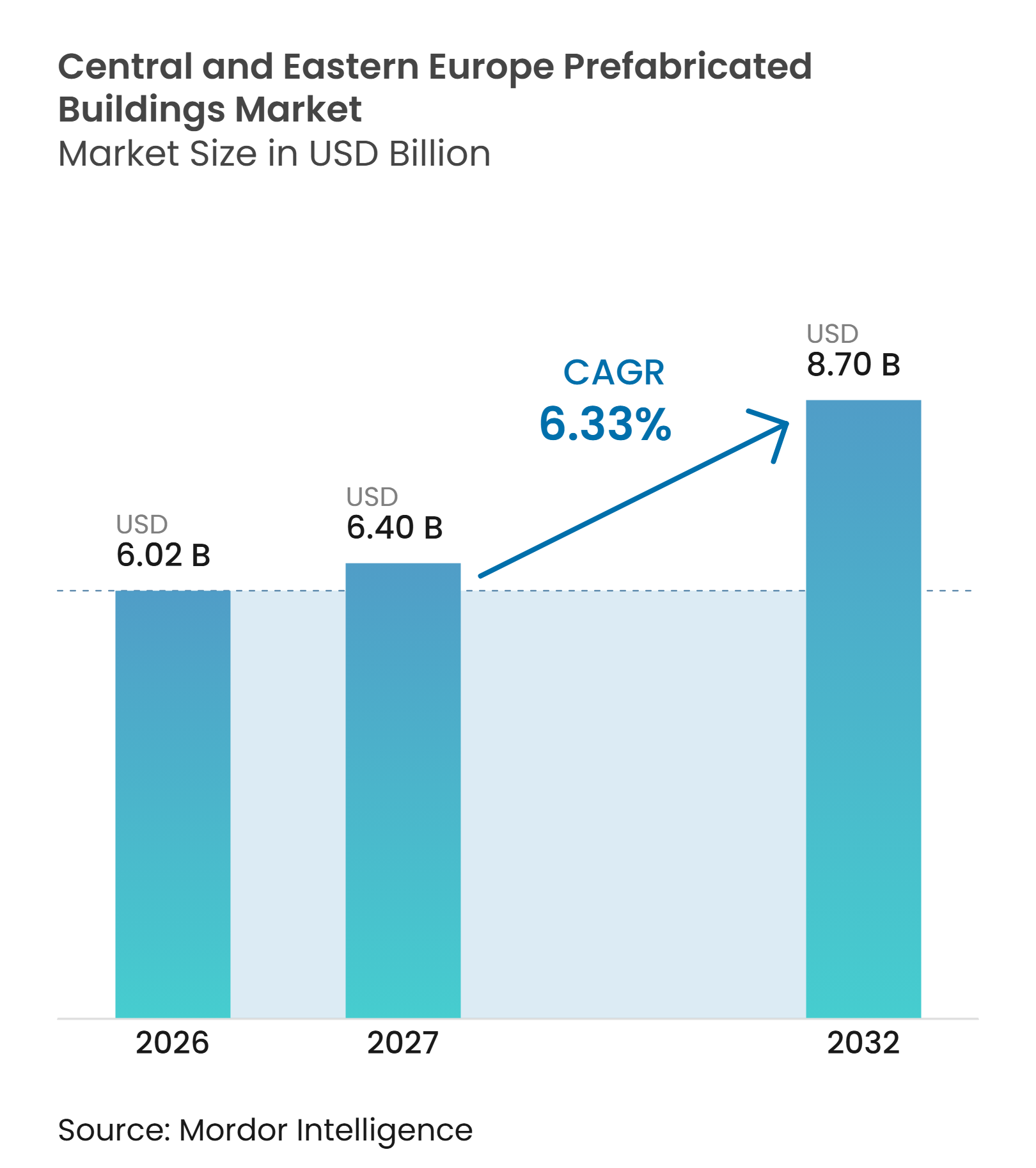
The Central And Eastern Europe Prefabricated Buildings Market size was valued at USD 6.02 billion in 2026 and is estimated to grow from USD 6.40 billion in 2027 to reach USD 8.70 billion by 2032, at a CAGR of 6.33% during the forecast period (2027-2032).
The Central and Eastern Europe prefabricated buildings market is gaining traction as developers and contractors increasingly adopt off-site construction to address labor shortages, rising project costs, and the need to shorten construction timelines. Persistent shortages of skilled construction workers are driving the use of factory-produced structural components, modular units, and insulated building panels, particularly in residential, industrial, and commercial projects. Housing deficits and urban expansion in Poland and Romania are strengthening demand for prefabricated residential buildings, while investments in logistics facilities, manufacturing plants, warehouses, and public infrastructure are creating opportunities for industrial and non-residential applications. Additionally, EU energy-efficiency requirements and building renovation initiatives are promoting the adoption of insulated wall and roof panels, energy-efficient building envelopes, and advanced prefabricated systems. Poland remains the region's primary manufacturing and supply hub, supported by its established construction materials industry and export-oriented production base. Romania offers significant opportunities for demand growth, driven by housing development and expanding industrial activity. Competitive positioning increasingly favors manufacturers that provide integrated design, engineering, automated production, digital building modeling, and on-site installation capabilities.
Key Report Takeaways
- By material type, timber accounted for 37.8% of the Central and Eastern Europe prefabricated building market share in 2026, and is forecast to grow at a 7.21% CAGR through 2032.
- By application, residential construction accounted for 45.5% of the Central and Eastern Europe prefabricated building market size in 2026, while others, including industrial, institutional, infrastructure, and energy, are positioned to grow at a 7.31% CAGR through 2032.
- By product type, modular buildings held 42.8% of the market size in 2026, whereas panelized & componentized systems are forecast to grow at a 7.65% CAGR through 2032.
- By Geography, Poland accounted for 32.3% of the market share in 2026, while Romania is projected to expand at a 7.91% CAGR through 2032.
Note: Market numbers in this report are based on Mordor Intelligence's proprietary estimation framework, which combines nine months of actuals with Q4 projections for base year 2026.
Market Trends and Insights
Drivers Impact Analysis of Central and Eastern Europe Prefabricated Buildings Market*
| Driver | (~) % Impact on CAGR Forecast | Geographic Relevance | Impact Timeline |
|---|---|---|---|
| Construction Labor Shortages and Aging Skilled Workforce | +1.4% | CEE-wide, most acute in Poland, Czech Republic, and Bulgaria | Short term (≤ 2 years) |
| Housing Shortfalls and Social-Housing Delivery Pressure | +1.2% | Poland, Romania, Czech Republic, and Hungary | Medium term (2-4 years) |
| EU Energy-Performance and Industrialized-Renovation Funding | +1.0% | EU-wide, strongest in Poland, Romania, Bulgaria, and Croatia | Long term (≥ 4 years) |
| Faster, More Predictable Project Delivery | +0.7% | CEE-wide, with highest relevance in public-sector procurement | Short term (≤ 2 years) |
| Factory Automation, BIM, and Design-for-Manufacture Adoption | +0.6% | Poland, Czech Republic, and Slovakia | Medium term (2-4 years) |
| Poland-Led Export Manufacturing and Cross-Border Delivery | +0.4% | Poland, with spillover to the Czech Republic and Slovakia | Long term (≥ 4 years) |
| Source: Mordor Intelligence | |||
Construction Labor Shortages and Aging Skilled Workforce
The shortage of skilled construction workers is a major reason buyers are considering factory-built alternatives. FIEC expects the EU construction sector to require an additional 2 million workers by 2030 and has identified labor shortages as a serious challenge. The European Labor Authority identified carpenters, joiners, concrete placers, and structural metal fabricators among the occupations facing shortages, with 57% of construction shortages assessed as medium to high severity. In the Czech Republic, 57% of construction enterprises cited labor shortages as a key barrier in Q1 2026. The Central and Eastern Europe prefabricated buildings market therefore benefits when developers place greater value on predictable execution rather than on the availability of individual trades.[1]
Housing Shortfalls and Social-Housing Delivery Pressure
Housing needs across the region are strengthening the case for repeatable building methods. The OeNB reported structural mismatches between housing demand and supply, with limited rental availability and building stock that does not meet current quality or energy expectations. Poland had nearly 16.2 million residential units at the end of 2025, yet large cities continued to face local shortages. Romania completed 1.1 dwellings per 1,000 inhabitants, compared with the EU average of 1.7, while overcrowding and limited rental options remained significant. The Central and Eastern Europe prefabricated buildings market can serve public programs that need to deliver standardized housing within fixed funding periods.
EU Energy-Performance and Industrialized-Renovation Funding
Energy renovation policy is creating a second source of demand beyond new construction. The recast Energy Performance of Buildings Directive requires national renovation plans that set a path toward a zero-emission building stock by 2050. The European Commission identifies major EU financing streams for building renovation through established EU instruments. The Social Climate Fund provides support to countries with high levels of energy poverty. These programs support the prefabricated buildings market in Central and Eastern Europe by favoring insulated wall, roof, and floor systems that can be manufactured to consistent energy-performance specifications.
Faster, More Predictable Project Delivery
Public clients increasingly need reliable project schedules when using time-bound EU funding. Factory production can shift 60% to 90% of productive work into controlled settings, reducing exposure to weather and on-site labor disruptions. Pekabex reported prefabrication volume of 100,000 m³ in Q2 2025, up 9% year on year, and targeted output above 220,000 m³ for the full year. Standardized buildings can also make repeat orders easier for public buyers, as manufacturers can reuse their engineering and production processes. This gives the Central and Eastern Europe prefabricated buildings market a practical advantage in social housing, student accommodation, and other projects with fixed completion dates.
Restraints Impact Analysis of Central and Eastern Europe Prefabricated Buildings Market*
| Restraint | (~) % Impact on CAGR Forecast | Geographic Relevance | Impact Timeline |
|---|---|---|---|
| High Upfront Factory Investment and Scale Thresholds | -1.3% | CEE-wide, most acute in Hungary, Slovakia, and Romania | Long term (≥ 4 years) |
| Cross-Border Certification and National-Code Fragmentation | -0.9% | All cross-border manufacturing corridors across CEE | Medium term (2-4 years) |
| Oversized-Load Logistics and Site-Access Constraints | -0.6% | Poland-Germany, Romania-Hungary, and intra-CEE transport corridors | Short term (≤ 2 years) |
| Limited Circularity, Design Standardization, and Buyer Trust | -0.4% | CEE-wide, most pronounced in Romania and Bulgaria | Long term (≥ 4 years) |
| Source: Mordor Intelligence | |||
High Upfront Factory Investment and Scale Thresholds
A modern prefabrication plant requires significant investment before it can reach efficient production levels. UIPI identified high upfront costs and limited access to tailored financing as barriers, as standard construction financing does not meet the front-loaded cash needs of modular factories. This is a greater challenge in Hungary, Slovakia, and Romania, where demand pipelines can be less certain. ERBUD ceased investment in MOD21 in August 2026 after five years of cumulative losses, showing the risk of maintaining factory capacity without stable project demand. The Central and Eastern Europe prefabricated buildings market needs steadier order flow and financing structures that recognize factory production cycles.[2]
Cross-Border Certification and National-Code Fragmentation
Common EU rules do not eliminate all national requirements for building approvals. The European Commission’s EPC Atlas maps more than 85 energy performance certificate and Smart Readiness Indicator schemes across the EU27. Czech BIM legislation improves domestic data standards, but it does not establish mutual acceptance of specifications approved in other countries. Producers exporting from Poland or the Czech Republic may still need country-specific engineering work and certifications. These requirements add to costs and slow the cross-border expansion of the prefabricated buildings market in Central and Eastern Europe.
*Our forecasts treat driver/restraint impacts as directional, not additive. The impact forecasts reflect baseline growth, mix effects, and variable interactions.
Central and Eastern Europe Prefabricated Buildings Market Segment Analysis
By Material:
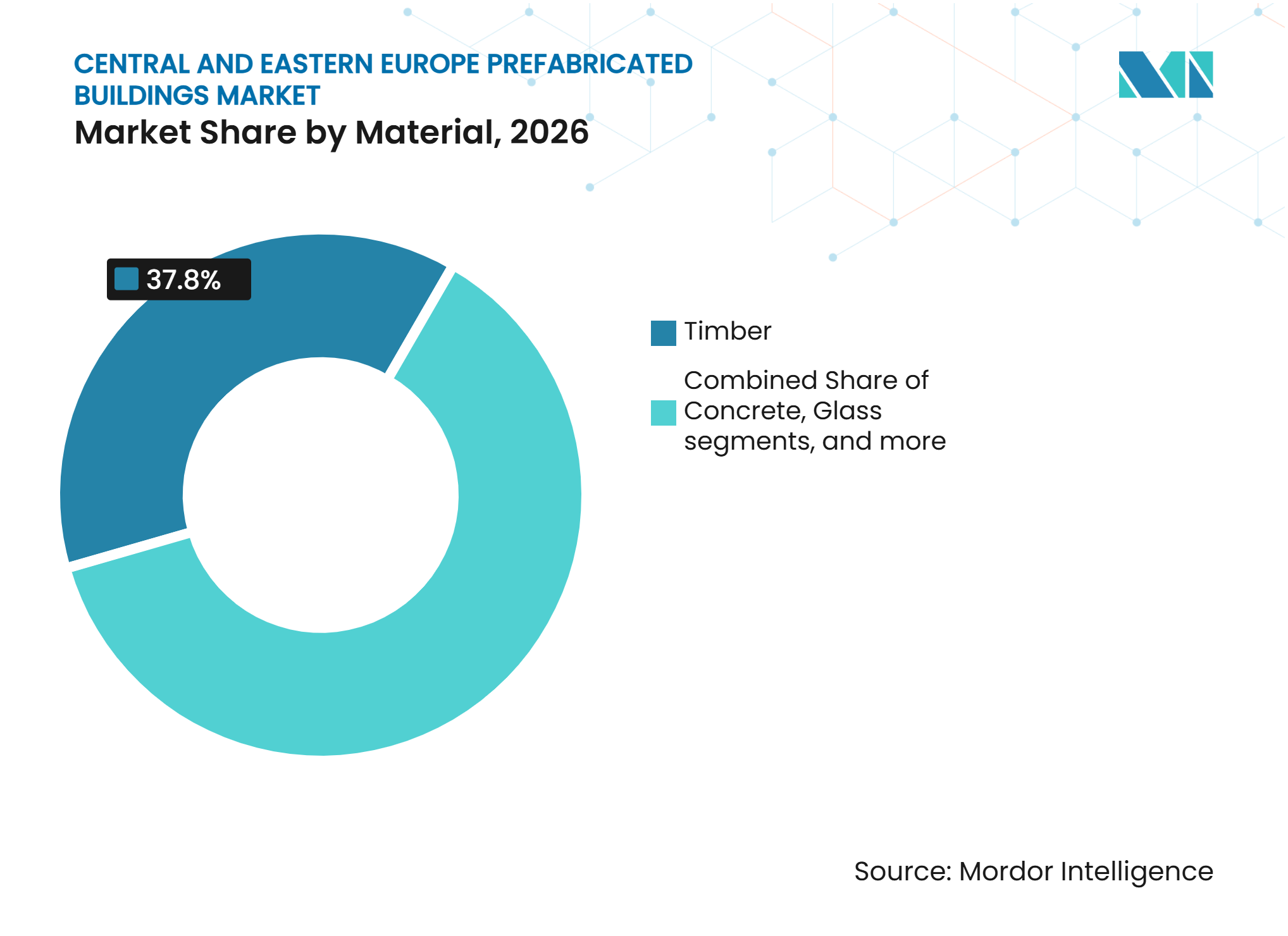
Timber Leads Through Established Export Capacity and CLT AdoptionTimber accounted for 37.8% of the market size in 2026, equal to USD 2.28 billion. Its lead reflects Poland’s established timber-frame manufacturing base and long-running export links with Scandinavia, Germany, and Benelux. Timber is also the fastest-growing material category, with a 7.21% CAGR forecast from 2027 to 2032. This position combines demand for standard residential buildings with a growing use of higher-performance cross-laminated timber. The Central and Eastern Europe prefabricated buildings market is seeing wider use of timber as engineered wood moves beyond smaller homes.
Allcon completed Poland’s first CLT office building in Wiele in December 2025 using 601 m³ of locally sourced CLT panels. The project offers a commercial reference for mass-timber prefabrication in offices and institutional buildings. Concrete remains important for multi-story housing, infrastructure, and institutional structures, with Pekabex among the specialized precast suppliers. Glass is mainly used in facades and curtain walls. At the same time, metal is used in industrial, logistics, and agricultural buildings requiring clear spans. Hybrid systems and insulated panels are also becoming more relevant as energy performance requirements push manufacturers to combine structural and insulating functions in a single product.



By Application:
Residential Leads the Market, While Other Applications Record the Fastest GrowthResidential accounted for 45.5% of the Central and Eastern Europe prefabricated buildings market in 2026, valued at USD 2.74 billion. Poland’s TBS and SIM social-housing structures and Romania’s municipal delivery pipeline support this scale. Housing shortages and limited availability of skilled site labor make repeatable residential systems more attractive to public and private buyers. Unihouse reported that modular-segment sales rose 14% year on year in 2025, while its backlog grew 183%, reflecting demand for factory-built housing. Residential activity gives the Central and Eastern Europe prefabricated buildings market a stable volume base that supports factory utilization.
The others category is forecast to expand at 7.31% from 2027 to 2032, supported by institutional, infrastructure, industrial, and energy-related projects. Hospital expansion, defense facilities, and technical buildings for renewable energy and grid assets broaden the range of projects that can use prefabricated systems. Commercial buildings form the second-largest application group and include offices, retail, hospitality, and mixed-use developments. Developers use prefabrication to reduce on-site disruption and align completion with lease or occupancy schedules. Pekabex delivered the Tribera Warsaw student residence for the 2026/27 academic year after construction began in March 2025, underscoring the value of rapid occupancy in student accommodation.
By Product Type:
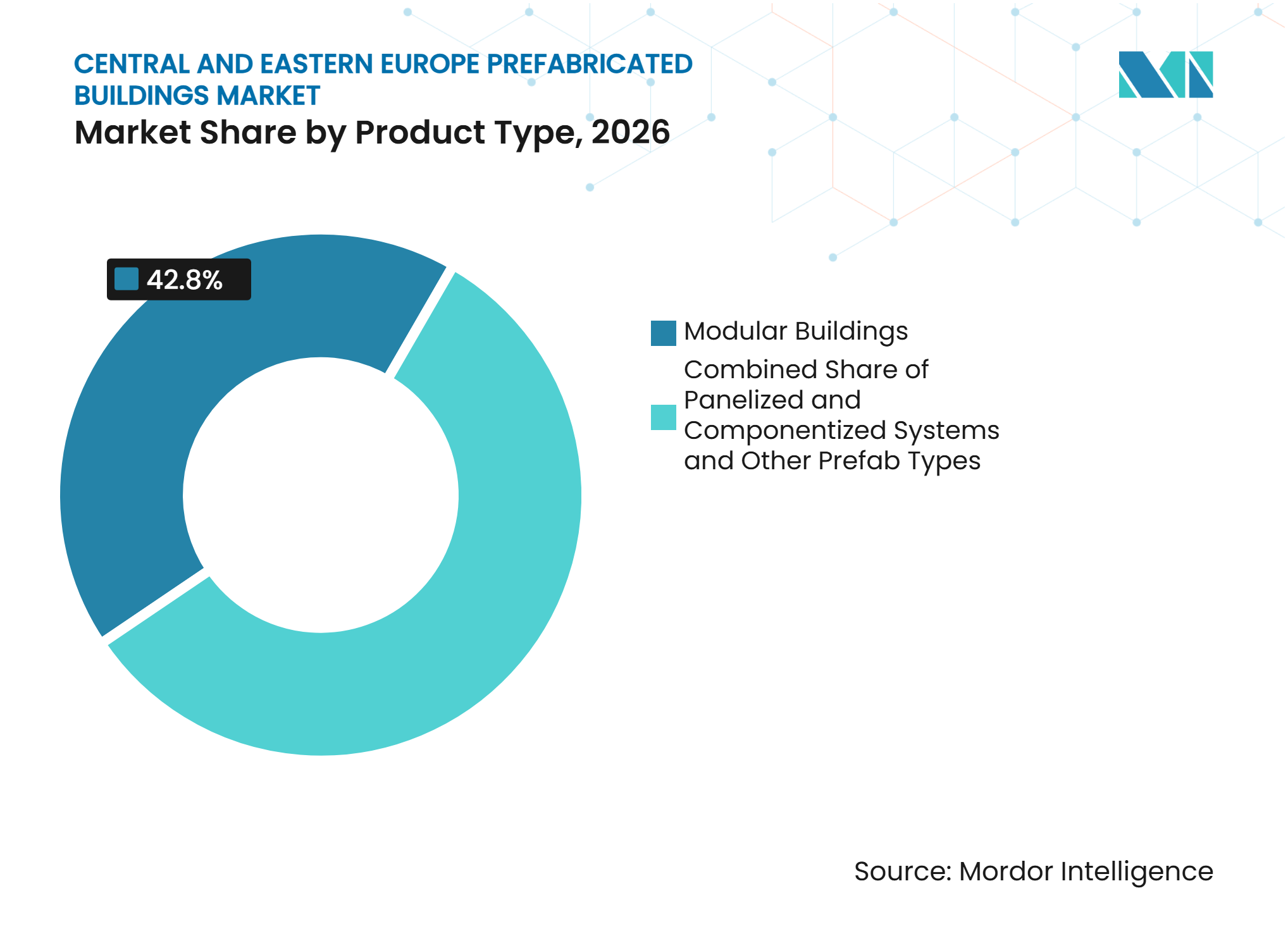
Modular Buildings Hold the Largest Market Share, While Panelized & Componentized Systems Record the Fastest GrowthModular buildings accounted for 42.8% of the 2026 total, equal to USD 2.58 billion. The format brings a high share of work into the factory and can reduce the time needed for final site assembly. Social housing and defense buyers value near-finished units because they reduce the number of trades that must work at the same location. Poland’s manufacturers have supplied completed volumetric units to Germany, Norway, and Sweden. This export record supports the prefabricated buildings market in Central and Eastern Europe, where public buyers want a clear, repeatable delivery model.
Panelized & componentized systems are forecast to grow at 7.65% from 2027 to 2032, the fastest pace among product formats. They have a lower capital requirement than full volumetric modular production and can be used for energy renovation without moving residents out of a whole building. Bathroom pods, kitchen pods, stair units, balcony units, and structural insulated panels provide a simpler entry point for smaller producers looking to expand into more complex systems. Timber-module producers are increasing the content of their units by including mechanical, electrical, and plumbing services before delivery. This can create higher contract values because buyers receive more complete buildings from a single supplier.

Geography Analysis
Poland
Poland accounted for 32.3% of the 2026 total, valued at USD 1.94 billion. Its manufacturers have a mature production base across timber, concrete, panels, and modular systems, while Germany, Scandinavia, and the United Kingdom remain key export destinations. Domestic social housing is becoming more important alongside exports, and Pekabex added a fifth hollow-core slab line in June 2026. The Energy Performance of Buildings Directive supports demand for insulated, repeatable assemblies by requiring national plans to achieve a zero-emission building stock by 2050.
Romania
Romania is forecast to expand at a 7.91% CAGR from 2027 to 2032, the highest rate among the listed CEE geographies. The country completed 1.1 new dwellings per 1,000 inhabitants, compared with an EU average of 1.7, while permits remained below levels needed to close the supply gap. The REDESIGN project developed a minimum energy performance standards framework for Romania, supporting renovation programs that use insulated prefabricated panels. Romania’s prospects are strongest where social housing, energy renovation, and public infrastructure requirements overlap.[3]
Czech Republic, Hungary, and Rest of Central and Eastern Europe
The Czech Republic is progressing toward more digital public procurement through its June 2025 law on construction information management. This framework supports BIM-linked procurement and could make prefabricated systems easier to specify for public projects. Hungary recorded a 74.85% year-on-year increase in the value of prefabricated building imports in 2025, to USD 68.13 million, indicating that demand is outpacing domestic production capacity. Bulgaria launched a BIM digitization investment program in November 2025 as part of its National Recovery and Resilience Plan. Slovakia benefits from proximity to Austrian and German architectural and compliance expectations. These markets share a need for better digital coordination and clearer approval processes, and the Central and Eastern Europe prefabricated buildings market can benefit when local buyers adopt standardized specifications and BIM-based project information.
Competitive Landscape
Market Concentration
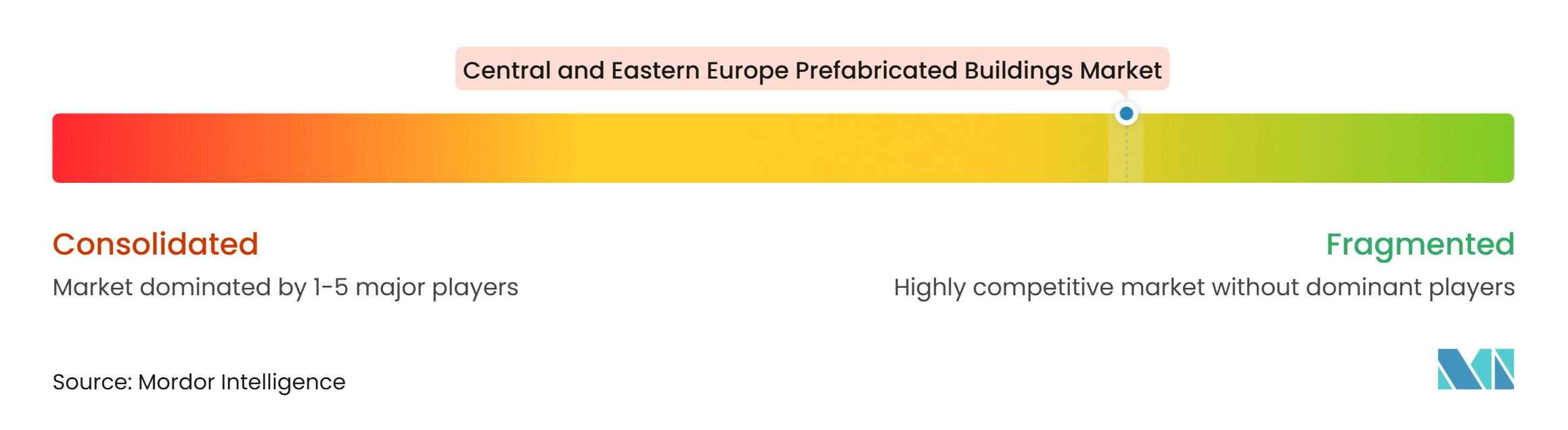
The Central and Eastern Europe prefabricated buildings market remains fragmented, with no single supplier holding a dominant regional position. Larger Polish and Czech producers integrate design, manufacturing, logistics, and site delivery, which gives them an advantage. Pekabex commissioned a fifth hollow-core slab line at Mszczonów in June 2026, adding 12,000 m³ of annual capacity. The company also reported a 9% year-on-year increase in Q2 2025 prefabrication volume to 100,000 m³. These moves strengthen its ability to serve large residential and infrastructure contracts.
ERBUD stopped investment in its MOD21 modular subsidiary in August 2026 after five years of cumulative losses. The decision shows that factory capacity alone does not assure sustainable results when project demand is uncertain. Unihouse moved in the opposite direction by entering a hospital expansion project in Bydgoszcz in September 2026. This move extends modular delivery into a permanent and clinically sensitive institutional setting. Order visibility, production discipline, and access to projects that fit factory production will continue to affect company performance.
Timber specialists are also building a distinct position in premium commercial and institutional projects. Allcon’s December 2025 completion of a CLT office building in Wiele provides a commercial mass-timber reference. Automation, BIM-linked cutting, robotic rebar placement, and design for manufacture are increasingly important where producers have sufficient volume to fund them. Environmental management practices and certifications, such as ISO 14001 and LEED, can affect eligibility for EU-funded procurement packages. At the same time, renovation remains open because no supplier holds a dominant position in insulated retrofit assemblies across Romania, Hungary, and Bulgaria.
Central and Eastern Europe Prefabricated Buildings Industry Leaders
-
Unihouse S.A.
-
Danwood S.A.
-
Pekabex S.A.
-
ERBUD S.A. / MOD21
-
KOMA Modular s.r.o.
- *Disclaimer: Major Players sorted in no particular order
Central and Eastern Europe Prefabricated Buildings Market Companies Covered in this Report
- Unihouse S.A.
- Danwood S.A.
- Pekabex S.A.
- ERBUD S.A. / MOD21
- KOMA Modular s.r.o.
- WOLF Systembau Gesellschaft m.b.H. / WOLF System Poland
- DMD Modular Sp. z o.o.
- Modular Plus SRL
- Masterplast Nyrt.
- Weinmann Haus Kft.
- WAREX spol. s r.o.
- Modulos Home s.r.o.
- FINE Slovakia s.r.o. / ModularnaStavba.sk
- KODIMA s.r.o.
- Kolodom s.r.o.
- iMODUL s.r.o.
- LSH Készházak Zrt.
- Kp Sales House Kft.
- MODUM House SRL
- BioBuilds Europe SRL
- EDSTREX s.r.o.
- Dorna ECO HOUSE SRL
Recent Industry Developments in Central and Eastern Europe Prefabricated Buildings Market
- October 2026: Unihouse S.A. is selected as the preferred modular contractor for the design-and-build expansion of University Hospital No. 2 in Bydgoszcz, Poland. The contract marks Unihouse's entry into permanent, clinically sensitive institutional construction and reflects growing confidence in modular delivery in the medical sector.
- September 2026: Pekabex S.A. delivered the Tribera Warsaw student residential building, construction of which commenced in March 2025, in time for the 2026/27 academic year, using extensive prefabricated precast concrete elements.
- August 2026: ERBUD Group formally ceases all investment in MOD21, its modular construction subsidiary, following five years of cumulative losses. Capital is reallocated to the Group's construction, renewable energy, and industrial services pillars.
Central and Eastern Europe Prefabricated Buildings Market Report Scope
The Central and Eastern Europe Prefabricated Buildings Market Report is Segmented by Material (Concrete, Glass, Metal, Timber, Other Materials), by Application (Residential, Commercial, Others), by Product Type (Modular Buildings, Panelized & Componentized Systems, and Other Prefab Types), and by Geography (Poland, Romania, Czech Republic, and More). The Market Forecasts are Provided in Terms of Value (USD).
Segmentation Overview
| Concrete |
| Glass |
| Metal |
| Timber |
| Other Materials |
| Residential |
| Commercial |
| Others, Including Industrial, Institutional, Infrastructure, and Energy |
| Modular Buildings |
| Panelized & Componentized Systems |
| Other Prefab Types |
| Poland |
| Romania |
| Czech Republic |
| Hungary |
| Rest of Central and Eastern Europe |
| By Material | Concrete |
| Glass | |
| Metal | |
| Timber | |
| Other Materials | |
| By Application | Residential |
| Commercial | |
| Others, Including Industrial, Institutional, Infrastructure, and Energy | |
| By Product Type | Modular Buildings |
| Panelized & Componentized Systems | |
| Other Prefab Types | |
| By Geography | Poland |
| Romania | |
| Czech Republic | |
| Hungary | |
| Rest of Central and Eastern Europe |
Key Questions Answered in the Report
What is the forecast for prefabricated buildings in Central and Eastern Europe?
The Central and Eastern Europe prefabricated buildings market is projected to grow from USD 6.02 billion in 2026 to USD 8.7 billion by 2032 at a 6.33% CAGR from 2027 to 2032.
Which material drives demand for prefabricated buildings in Central and Eastern Europe?
Timber leads with a 37.8% share in 2026 and is forecast to grow at a 7.21% CAGR through 2032.
Which application has the greatest demand for prefabricated buildings in Central and Eastern Europe?
Residential construction leads with a 45.5% share in 2026, supported by social-housing needs and demand for faster delivery.
Which product format has the largest share in Central and Eastern Europe?
Modular buildings account for 42.8% of the 2026 total, while panelized & componentized systems are forecast to grow the fastest at 7.65% through 2032.
Which country offers the fastest growth opportunity for prefabricated buildings?
Romania is forecast to grow at a 7.91% CAGR from 2027 to 2032, supported by housing needs, infrastructure delivery, and renovation activity.
What is holding back wider use of prefabricated buildings in Central and Eastern Europe?
High factory investment, country-specific certification requirements, transport limits, and limited buyer confidence continue to slow wider adoption.