
Cellulose Sponge Market Size and Share
Market Overview
| Study Period | 2022 - 2032 |
|---|---|
| Market Size (2027) | USD 2.10 Billion |
| Market Size (2032) | USD 2.59 Billion |
| Growth Rate (2027 - 2032) | 4.27 % |
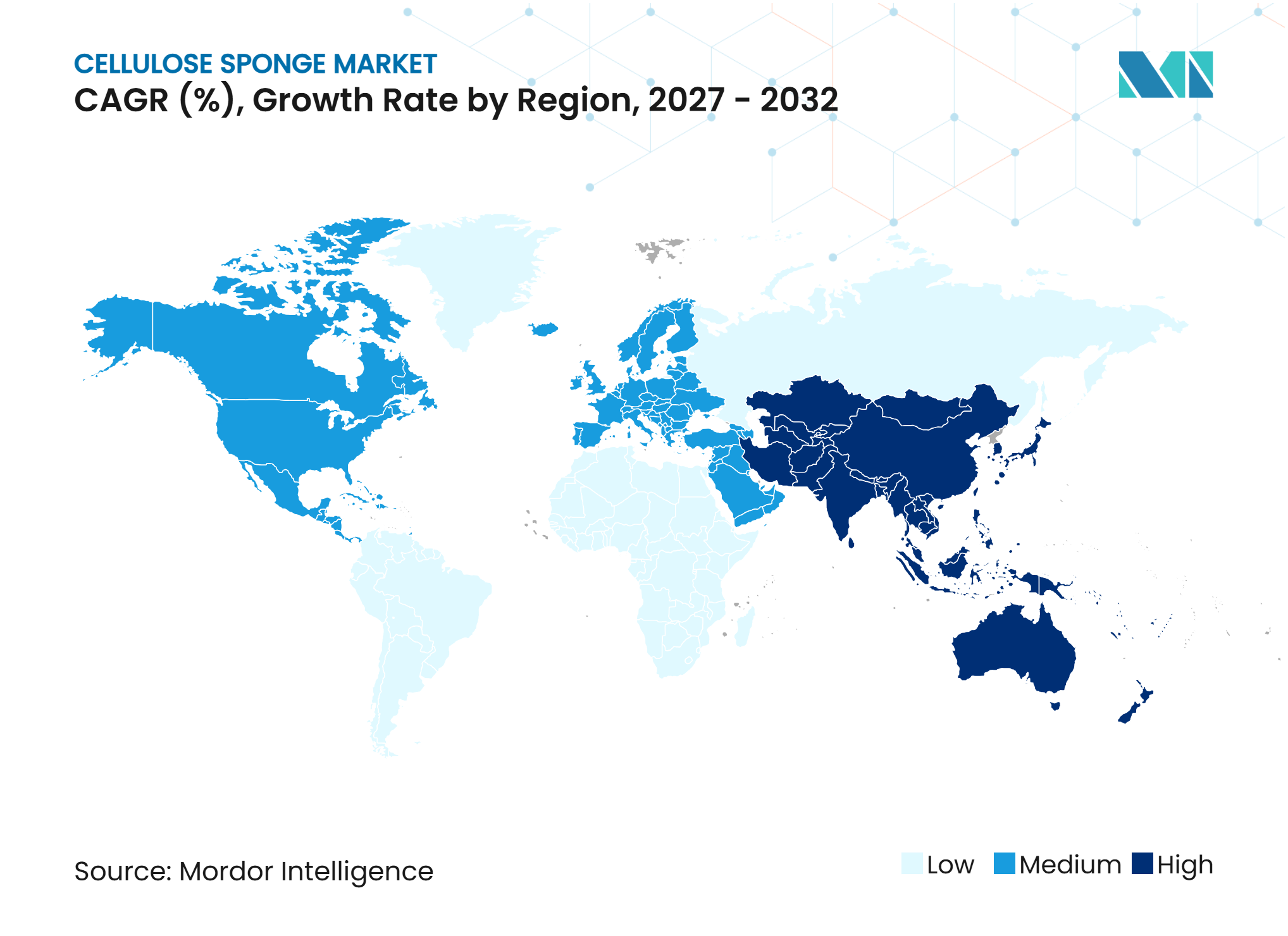
| Fastest Growing Market | Asia-Pacific |
| Largest Market | North America |
| Market Concentration | Medium |
Major Players *Disclaimer: Major Players sorted in no particular order Image © Mordor Intelligence. Reuse requires attribution under CC BY 4.0. | |
Cellulose Sponge Market Analysis by Mordor Intelligence
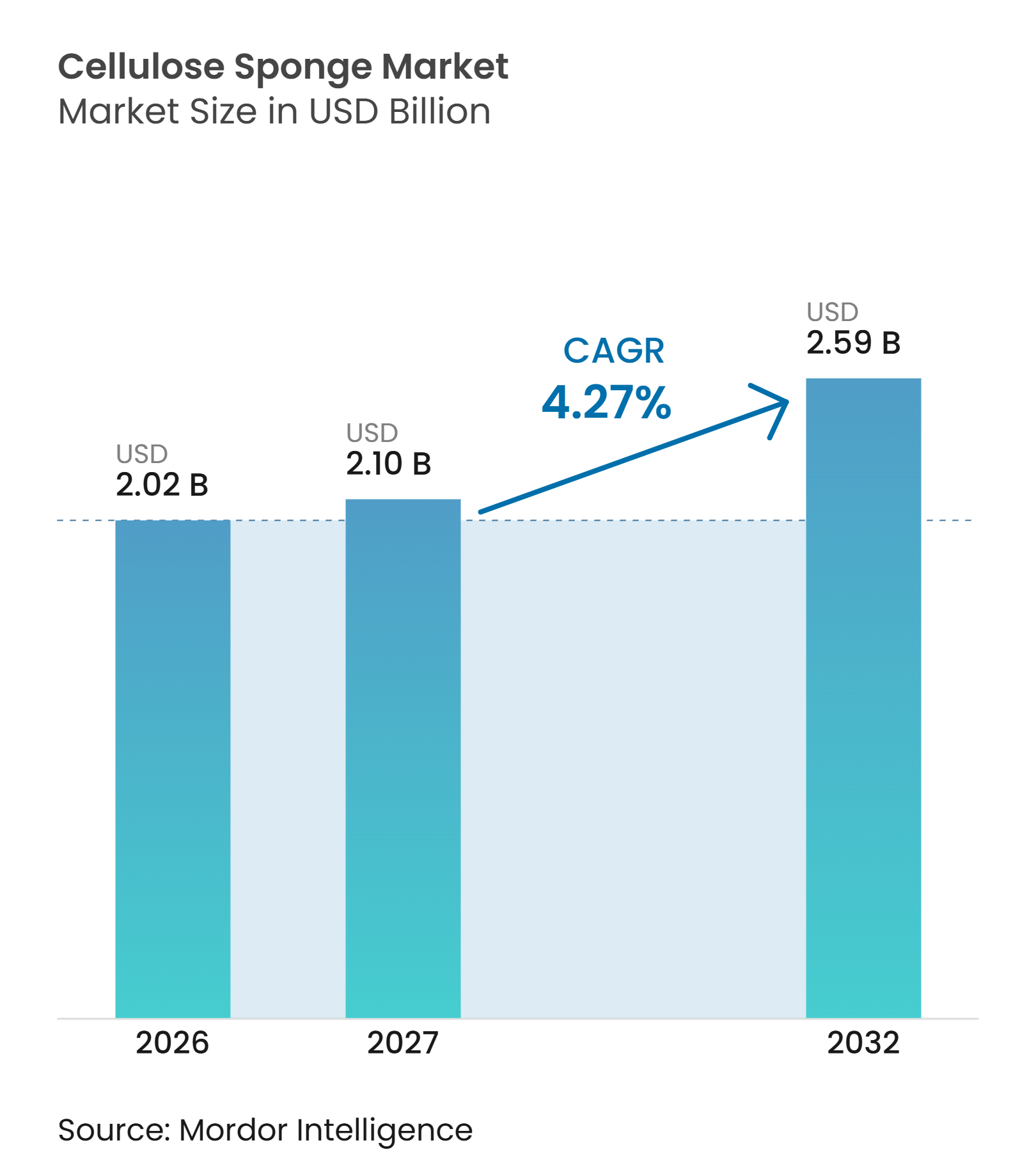
The global cellulose sponge market size was valued at USD 2.02 billion in 2026 and is estimated to grow from USD 2.10 billion in 2027 to reach USD 2.59 billion by 2032, at a CAGR of 4.27% during the forecast period (2027-2032). The cellulose sponge market benefits from procurement policies and retail programs that favor biobased cleaning materials over petroleum-derived foam products. The household, hospitality, and institutional sectors provide recurring demand because absorbent cleaning tools are replenished frequently. Medical uses create an additional growth path as high-absorbency cellulose formats show strong performance in wound care and hemostatic applications. Producers are responding through material development, private-label supply, and new product launches, while low-priced microfiber and reusable alternatives continue to constrain retail pricing. Wood pulp supply conditions also shape margins, which favor manufacturers with established sourcing relationships and integrated operations.
Key Report Takeaways
- By type, natural cellulose sponge held 60.12% of the cellulose sponge market share in 2026, while synthetic cellulose sponge is projected to advance at a 5.43% CAGR through 2032.
- By raw material, wood pulp held 70.45% of the cellulose sponge industry share in 2026, while hemp fibers are projected to advance at a 5.89% CAGR through 2032.
- By application, household held 55.67% of the cellulose sponge market size in 2026, while medical is projected to advance at a 6.18% CAGR through 2032.
- By geography, North America held 44.71% of the cellulose sponge market share in 2026, while Asia-Pacific is projected to advance at a 5.81% CAGR through 2032.
Note: Market numbers in this report are based on Mordor Intelligence's proprietary estimation framework, which combines nine months of actuals with Q4 projections for base year 2026.
Market Trends and Insights
Drivers Impact Analysis of Cellulose Sponge Market*
| Driver | (~) % Impact on CAGR Forecast | Geographic Relevance | Impact Timeline |
|---|---|---|---|
| Shift from Petroleum-Based Sponges to Biodegradable Cellulose Formats | +2.0% | Global, with early acceleration in EU and North America | Short term (≤ 2 years) |
| Expansion of Household, Hospitality and Institutional Cleaning Demand | +1.3% | Global, with APAC core | Medium term (2-4 years) |
| Rising Medical and Personal Care Use of High-Absorbency Cellulose | +0.9% | North America and EU, spillover to APAC | Medium term (2-4 years) |
| Retailer and E-Commerce Preference for Sustainability-Led Private Labels | +0.6% | North America and EU | Short term (≤ 2 years) |
| Reconfigurable Pore Size and Automated Customization for Technical Applications | +0.3% | Global, with early gains in Germany and Japan | Long term (≥ 4 years) |
| Source: Mordor Intelligence | |||
Shift from Petroleum-Based Sponges to Biodegradable Cellulose Formats
Regulatory direction and retailer procurement policies support a move away from petroleum-derived absorbent materials. The Council of the European Union agreed with Parliament in June 2025 on updated detergent rules intended to improve safety and environmental information[1]. The United States Department of Agriculture updated the BioPreferred Program, with the rule effective January 8, 2025, which supports federal purchasing of qualifying biobased products. These measures make product composition and supplier documentation more important for institutional buyers. Manufacturers with ISO 9001 and ISO 14001 documentation can better support retailers that need clearer environmental and quality records. This creates a sustained opportunity in the cellulose sponge market for manufacturers that can demonstrate material composition, traceability, and compliance readiness across large customer programs.
Expansion of Household, Hospitality and Institutional Cleaning Demand
The cellulose sponge market remains closely tied to kitchen and bath cleaning, where water retention and recovery after use support everyday utility. Hospitality and institutional operators continue to favor multipurpose cleaning tools that can reduce waste across routine cleaning activities across hotels, foodservice sites, public facilities, and other high-turnover settings. This demand is reinforced by purchasing practices that prioritize certified sustainability credentials in commercial cleaning contracts. Freudenberg Group’s O-Cedar and Vileda brands have established retail positions that can support wider distribution across physical and online channels. E-commerce gives specialized producers and private-label suppliers a route to customers without the same dependence on conventional shelf listings. The shift supports a wider cellulose sponge market in which suppliers combine competitive unit economics, dependable product availability, and validated cleaning performance.
Rising Medical and Personal Care Use of High-Absorbency Cellulose
Medical use is adding value to the cellulose sponge market because high-absorbency formats serve needs beyond household cleaning. A 2025 study reported that a chitosan, cellulose, and tannic acid biocomposite sponge achieved 4,404% water absorption and 5,460% blood absorption. A separate 2025 publication found that an all-cellulose pulp-carboxymethyl cellulose (CMC) sponge reduced bleeding volume by 81% compared with standard gauze and degraded in soil within 30 days. These results support clinical demand for more functional absorbent products with more scope for documented clinical use cases and less reliance on commodity retail pricing. They also raise the importance of validated performance records and medical-grade quality systems. For the cellulose sponge market, this creates a higher-value path for producers that can meet these requirements and serve clinical customers consistently.
Retailer and E-Commerce Preference for Sustainability-Led Private Labels
Private-label programs give retailers a practical way to add biobased cleaning tools to their assortments. Cellulose formats are suited to this approach because their raw materials and manufacturing processes are already established at commercial scale for both branded and retailer-owned assortments. The cellulose sponge market can therefore reach price-sensitive buyers without relying only on heavily branded products. Online sales also allow smaller suppliers to reach buyers directly and test specialized products. Vileda introduced the Pro Clean range in Italy in July 2025 with probiotic and enzyme technology, positioning hygiene and service life as product differentiators. Product features that address hygiene concerns help the cellulose sponge market protect pricing where basic sponge products compete primarily on pack price.
Restraints Impact Analysis of Cellulose Sponge Market*
| Restraint | (~) % Impact on CAGR Forecast | Geographic Relevance | Impact Timeline |
|---|---|---|---|
| Price Pressure from Synthetic, Microfiber and Reusable Cloth Alternatives | -0.7% | Global, most acute in North America and APAC price-sensitive channels | Short term (≤ 2 years) |
| Volatility in Wood Pulp and Reinforcing-Fiber Costs | -0.4% | Global, with APAC core | Medium term (2-4 years) |
| Hygiene, Odor and Short Service-Life Concerns in Wet Use | -0.2% | Global | Long term (≥ 4 years) |
| Source: Mordor Intelligence | |||
Price Pressure from Synthetic, Microfiber and Reusable Cloth Alternatives
Microfiber cloths, melamine foam blocks, and reusable silicone scrubbers compete for many of the same cleaning tasks as cellulose sponges. Microfiber products are often promoted for durability and machine washability, which can strengthen their lifetime-value proposition. Competition is strongest in discount and price-sensitive retail formats, where multipack synthetic products can be offered at low prices. Spontex Industrial, a brand of Newell Brands, launched its Flex & Wash microfiber sponge range in 2025, showing that established cleaning brands are also serving hybrid material preferences. The cellulose sponge market needs clear differentiation in absorption, compostability, or tested longevity to avoid margin pressure in high-volume channels where shelf price remains the main purchase criterion for many shoppers. Suppliers that cannot demonstrate those attributes remain more exposed to price-led substitution.
Volatility in Wood Pulp and Reinforcing-Fiber Costs
Wood pulp is widely available, but its price and supply conditions do not always translate into stable costs for downstream sponge manufacturers. The Food and Agriculture Organization (FAO) reported 189 million tonnes of global wood pulp production in 2024 and record international trade of 73 million tonnes[2]. This scale supports availability, yet manufacturers still face changing freight, fiber, and contract conditions across regions. Reinforcing materials and specialty additives add further exposure for products designed for higher wet strength or abrasive use. The cellulose sponge market is therefore more favorable to manufacturers with long-term procurement arrangements or broader sourcing networks. Mid-sized producers without those arrangements can face compressed margins even when end-user demand is steady, particularly when short purchasing commitments limit their ability to absorb rapid cost changes.
*Our forecasts treat driver/restraint impacts as directional, not additive. The impact forecasts reflect baseline growth, mix effects, and variable interactions.
Cellulose Sponge Market Segment Analysis
By Type:
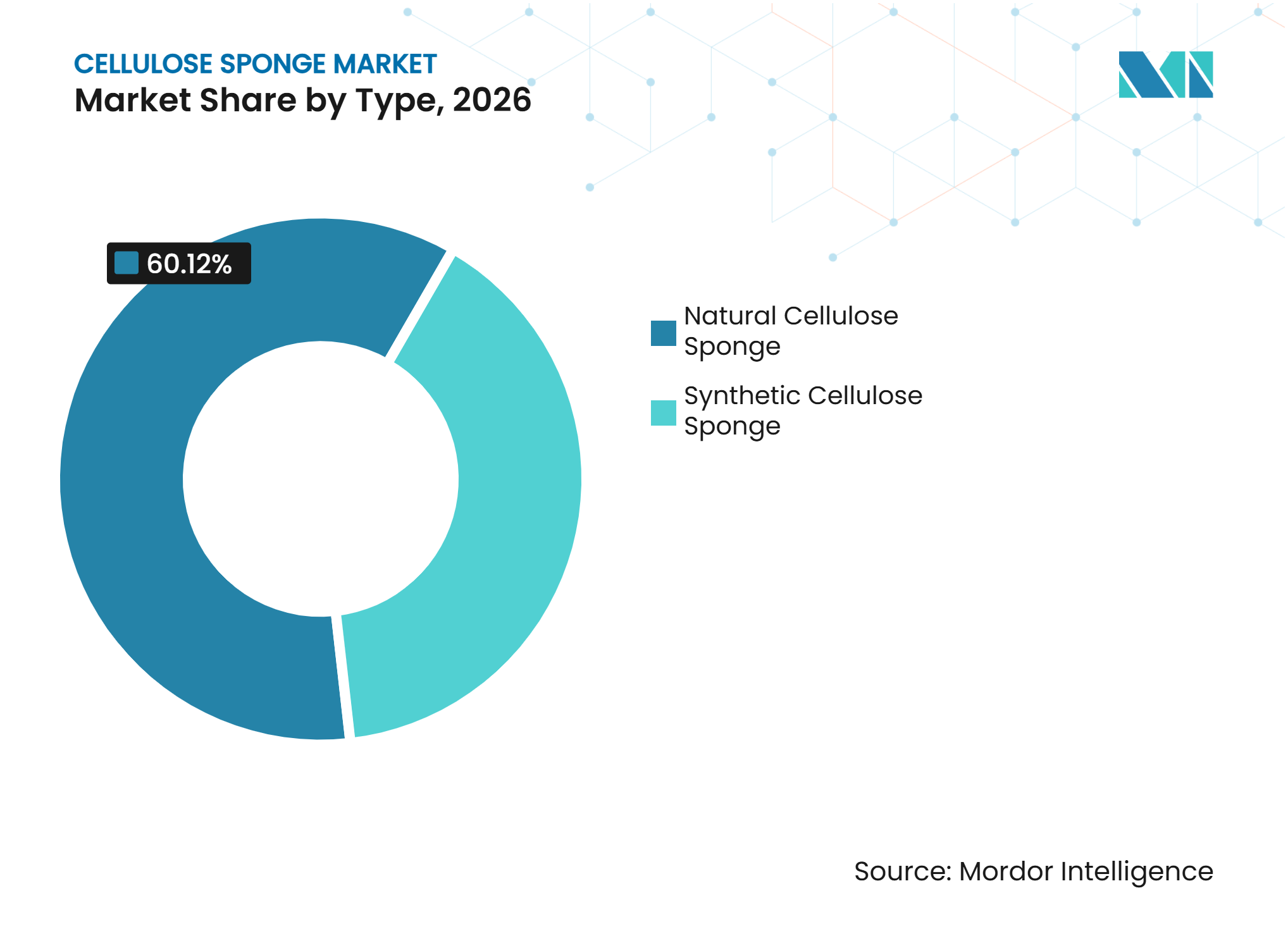
Natural Cellulose Sponge Leads, While Synthetic Cellulose Sponge ExpandsNatural cellulose sponge held 60.12% of the cellulose sponge market share in 2026, supported by consumer familiarity, reliable absorption, and biodegradability credentials. Natural products are commonly made from wood pulp through the viscose process, with sodium sulfate crystals used to form pores. This production approach can support varied manufacturing scales and helps preserve broad supply availability. Retail sustainability programs in North America and Western Europe continue to favor formats that can be positioned around renewable material inputs. Patent activity also points to competition in differentiated variants rather than only in standard products. The European Patent Office recorded a 2025 opposition proceeding involving Kalle GmbH and Carl Freudenberg KG on an abrasive cellulose sponge cloth. These formats allow producers to improve cleaning performance while retaining a cellulose-based product position. Natural grades therefore remain important in the cellulose sponge market where buyers seek a familiar material and a practical balance of cost and function.
Synthetic cellulose sponge is forecast to expand at a 5.43% CAGR through 2032, as chemically modified and viscose-blend formats support more engineered applications. Producers can adjust pore architecture and wet tensile strength for industrial, technical, and medical uses. Functionalization research shows that cellulose structures can be tailored through surface treatment and crystallinity control. This gives engineered variants a different competitive position from standard cleaning sponges. Natural formats generally compete through price-performance balance and material familiarity. Synthetic variants increasingly compete through application engineering, test results, and product specifications. The distinction creates room for specialized producers that can meet precise customer requirements. It also raises development and quality-control demands for suppliers seeking technical end uses.


By Raw Material:
Wood Pulp Dominates as Hemp Fibers Build MomentumWood pulp accounted for 70.45% of the cellulose sponge market size in 2026, reflecting its deep integration into established viscose-based production. It provides dependable technical performance and is supported by a broad supply network across major pulp-producing regions. The Food and Agriculture Organization reported record international wood pulp trade in 2024, which underpins sourcing availability for manufacturers. Sodium sulfate crystals, softeners, flax, polyester grids, and specialty additives support pore formation, softness, reinforcement, or other product properties. Armaly Brands Inc. uses flax reinforcement in cellulose sponge products, showing how secondary fibers can add tensile performance. These materials do not replace wood pulp as the base structure in established manufacturing. Instead, they help producers tailor durability, texture, and cleaning performance for target uses. Wood pulp will remain central while manufacturers balance its cost exposure against its proven processing characteristics.
Hemp fibers are forecast to grow at a 5.89% CAGR through 2032, supported by a clearer policy environment for industrial fiber uses. The National Hemp Industry Coalition of America published its Fit for Purpose policy in 2025, calling for rules that distinguish industrial hemp fiber from other hemp uses. A November 2025 statement from the U.S. Senate described provisions intended to protect industrial hemp fiber, grain, seed, and stock uses. Hemp can provide useful tensile strength for abrasive cleaning and industrial-wipe products. Existing lines remain optimized for wood pulp, which means adoption will likely depend on the ability to process mixed-fiber inputs consistently. Traceability and fiber certification will also matter as industrial hemp supply chains develop. Producers that build mixed-fiber capabilities can differentiate their raw material offering. This progression gives the cellulose sponge market another route to differentiate products, although supply reliability and processing compatibility will still determine adoption.
By Application:
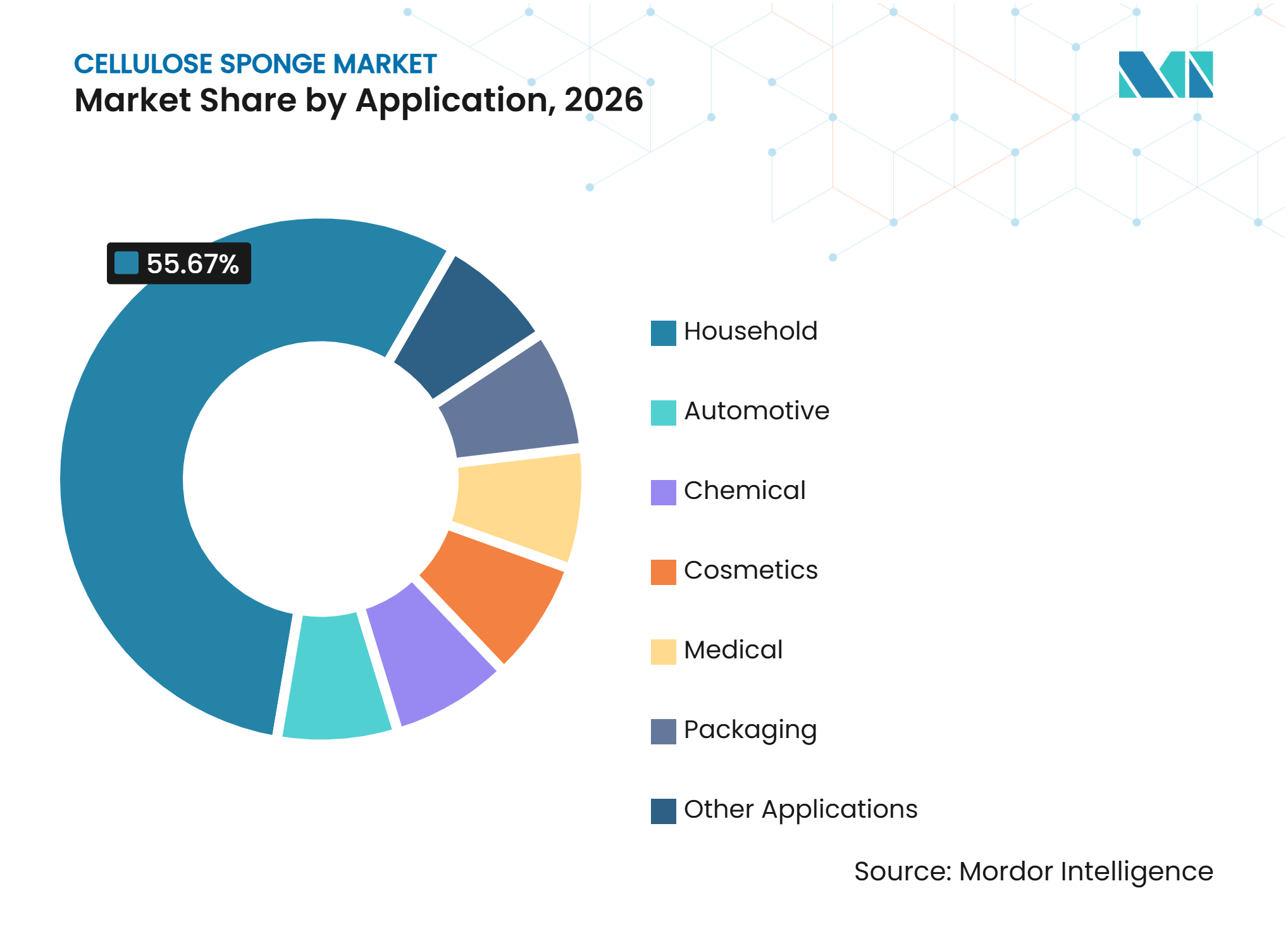
Household Anchors Revenue While Medical Redefines ValueHousehold held 55.67% of the cellulose sponge market industry in 2026 because kitchen and bath cleaning products have a recurring replacement cycle. Consumer demand remains relatively durable because these products are low-cost necessities used in routine cleaning. Private-label programs and digital retail are changing which formats gain traction within the household category. Suppliers can use product design, packaging, and sustainability claims to distinguish otherwise comparable cleaning products. Automotive, chemical, cosmetics, and packaging uses make up the remaining application base. In cosmetics and packaging, cellulose can offer absorbency, a gentle texture, and a disposal profile that differs from synthetic foam. These uses provide smaller but relevant opportunities for product adaptation. Household demand will continue to anchor demand for the cellulose sponge market even as higher specification uses gain attention.
Medical is forecast to grow at a 6.18% CAGR through 2032. Research from 2025 supports this position with data on high water and blood absorption in cellulose-based biocomposite products. Other work reported lower bleeding volume relative to standard gauze for an all-cellulose pulp-CMC sponge. Manufacturers serving this area must develop quality systems suited to regulated healthcare supply. ISO 13485 is relevant to medical-device quality management, while FDA requirements can affect materials intended for relevant body-contact uses. These requirements create barriers for suppliers that lack validated records and consistent manufacturing controls. Personal care overlaps with this opportunity through compressed cosmetic sponges and dermatology-related dressing formats. The application can therefore raise the value profile of cellulose materials beyond conventional household cleaning.


Geography Analysis
North America
North America held 44.71% of the cellulose sponge market share in 2026, supported by mature household, institutional, and hospitality cleaning demand. Retail sustainability commitments and established distribution networks support demand for biobased cleaning tools. The USDA BioPreferred update that took effect in January 2025 supports qualifying federal procurement of biobased products. Freudenberg Group launched O-Cedar Punch Scrub Sponges in the United States on August 31, 2026, using thermo-active technology and fruit-shaped designs to defend premium positioning. Domestic sourcing incentives, online retail access, and institutional purchasing requirements make the region a priority for capacity and retail partnerships.
Asia-Pacific
Asia-Pacific is forecast to grow at a 5.81% CAGR through 2032. Urbanization, higher disposable incomes, healthcare expansion, and modern retail development underpin demand across several markets. China imported 30.26 million tonnes of pulp in 2024, equal to 41.9% of global pulp imports, according to the Food and Agriculture Organization. India’s expanding healthcare infrastructure and formal retail channels are widening demand for higher-value absorbent formats. Japan and South Korea remain relevant for personal care and cosmetics products that require controlled pore size and low-lint performance.
Distinct Dynamics Across Remaining Regions
Europe, South America, and the Middle East and Africa broaden the geographic base of the cellulose sponge market through different demand conditions. Europe is shaped by sustainability requirements and manufacturing specialization, including the EU’s 2025 agreement on revised detergent rules, while Corazzi Fibre reports activity in more than 70 countries. South America benefits from expanding pulp capacity and growing modern retail activity, while retail modernization and hospitality investment are expanding the customer base in the Middle East and Africa.
Competitive Landscape
Market Concentration
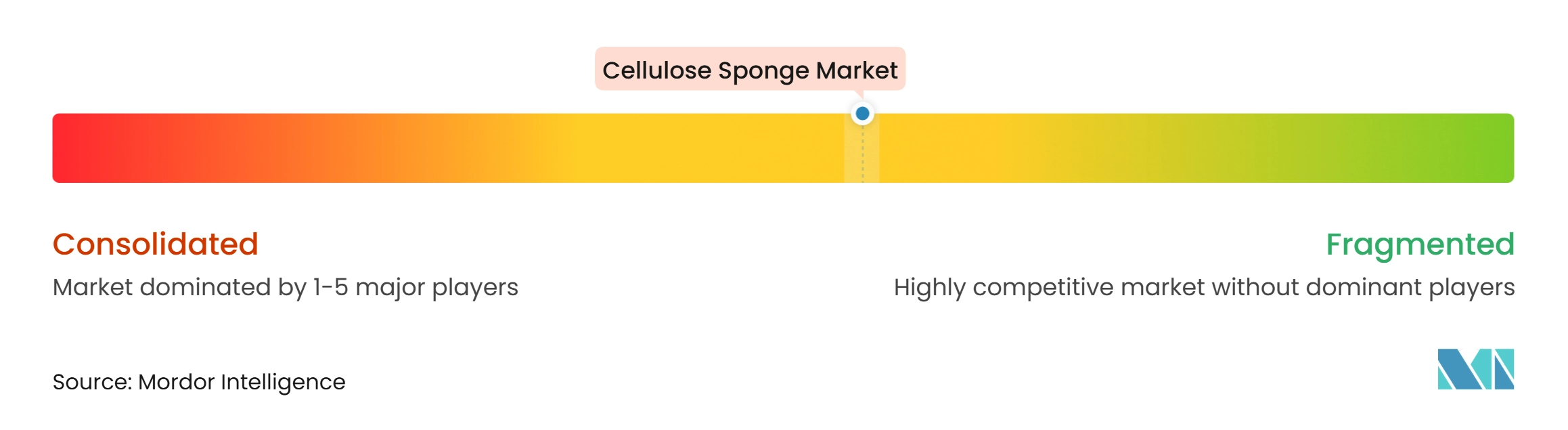
The cellulose sponge market is moderately concentrated, with top players including 3M, Freudenberg Group, Newell Brands, Armaly Brands Inc., and Clean Solutions Group. Freudenberg Group serves the category through Vileda, O-Cedar, and Wettex, while Newell Brands includes Spontex Industrial in its Home and Commercial Solutions portfolio. The distribution layer is more dispersed because companies can market cleaning products without operating primary sponge manufacturing facilities, as illustrated by The Clorox Company's presence in consumer cleaning. Competition therefore depends on both production capability and access to retail or institutional customers.
Freudenberg Group completed its takeover offer for Nilfisk on April 15, 2026. Kalle GmbH also reinforced its financial capacity through its May 2025 refinancing, while the 2025 Kalle GmbH and Freudenberg Group patent opposition proceeding shows that intellectual property remains relevant in performance-focused sponge cloth products. These moves reinforce positions through portfolio expansion, financial capacity, and protected product features. Specialized producers can still compete in medical and industrial uses where buyers need performance records and auditable sustainable sourcing. This competitive structure gives suppliers with validated quality and reliable delivery an advantage.
3M remains active in consumer cleaning through Scotch-Brite and completed its per- and polyfluoroalkyl substances (PFAS) manufacturing phase-out at the end of 2025. Vileda launched Punch Sponges in Canada in September 2026, while Spontex Industrial added Flex & Wash in 2025, showing how leading brands are responding to product-format shifts. The cellulose sponge market rewards companies that can supply standard household products as well as specialized formats. It also favors suppliers that demonstrate material sourcing, quality, and dependable delivery to major retailers and institutions across routine household, professional cleaning, and specialized-use channels in several major regions.
Cellulose Sponge Industry Leaders
-
3M
-
Freudenberg Group
-
Newell Brands
-
Armaly Brands Inc.
-
Clean Solutions Group
- *Disclaimer: Major Players sorted in no particular order
Cellulose Sponge Market Companies Covered in this Report
- 3M
- Armaly Brands Inc.
- Clean Solutions Group
- Corazzi Fibre S.r.l.
- Freudenberg Group
- Industrial Commercial Supply
- Kalle GmbH
- Newell Brands
- Sponge Technology Corp. LLC
- Spongezz Inc.
- Spontex Industrial
- Suvic Products Limited
- The Clorox Company
Recent Industry Developments in Cellulose Sponge Market
- September 2026: Vileda launched Punch Sponges in Canada in lemon, apple, and orange variants, following their August 2026 U.S. debut under the O-Cedar brand. The coordinated North American rollout expanded the availability of branded cellulose sponge formats in household cleaning products.
- July 2025: HLSUS Co,.Ltd, a cellulose sponge-cloth manufacturer in China, established and upgraded its second production line to expand manufacturing capacity. The investment supported greater production availability of cellulose sponge cloth for household cleaning and related applications.
Global Cellulose Sponge Market Report Scope
Cellulose sponges are porous, absorbent materials primarily manufactured from regenerated cellulose derived from natural plant-based sources such as wood pulp and other fibers. They offer high water absorption, flexibility, softness, and biodegradability, making them suitable for cleaning, wiping, polishing, and other specialized applications.
The Cellulose Sponge Market is segmented by type, raw material, application, and geography. By type, the market is segmented into natural cellulose sponge and synthetic cellulose sponge. By raw material, the market is segmented into hemp fibers, sodium sulfate crystals, softeners, wood pulp, flax, polyester, and other raw materials. By application, the market is segmented into household, automotive, chemical, cosmetics, medical, packaging, and other applications. The report also covers the market size and forecasts for cellulose sponge in 15 countries across major regions. For each segment, the market sizing and forecasts have been done on the basis of value (USD).
Segmentation Overview
| Natural Cellulose Sponge |
| Synthetic Cellulose Sponge |
| Hemp Fibers |
| Sodium Sulfate Crystals |
| Softeners |
| Wood Pulp |
| Flax |
| Polyester |
| Other Raw Materials |
| Household |
| Automotive |
| Chemical |
| Cosmetics |
| Medical |
| Packaging |
| Other Applications |
| Asia-Pacific | China |
| India | |
| Japan | |
| South Korea | |
| ASEAN Countries | |
| Rest of Asia-Pacific | |
| North America | United States |
| Canada | |
| Mexico | |
| Europe | Germany |
| United Kingdom | |
| France | |
| Italy | |
| NORDIC Countries | |
| Rest of Europe | |
| South America | Brazil |
| Argentina | |
| Rest of South America | |
| Middle East and Africa | Saudi Arabia |
| South Africa | |
| Rest of Middle East and Africa |
| By Type | Natural Cellulose Sponge | |
| Synthetic Cellulose Sponge | ||
| By Raw Material | Hemp Fibers | |
| Sodium Sulfate Crystals | ||
| Softeners | ||
| Wood Pulp | ||
| Flax | ||
| Polyester | ||
| Other Raw Materials | ||
| By Application | Household | |
| Automotive | ||
| Chemical | ||
| Cosmetics | ||
| Medical | ||
| Packaging | ||
| Other Applications | ||
| By Geography | Asia-Pacific | China |
| India | ||
| Japan | ||
| South Korea | ||
| ASEAN Countries | ||
| Rest of Asia-Pacific | ||
| North America | United States | |
| Canada | ||
| Mexico | ||
| Europe | Germany | |
| United Kingdom | ||
| France | ||
| Italy | ||
| NORDIC Countries | ||
| Rest of Europe | ||
| South America | Brazil | |
| Argentina | ||
| Rest of South America | ||
| Middle East and Africa | Saudi Arabia | |
| South Africa | ||
| Rest of Middle East and Africa | ||
Key Questions Answered in the Report
What is the size of the cellulose sponge market?
The cellulose sponge market size was valued at USD 2.02 billion in 2026 and is estimated to grow from USD 2.10 billion in 2027 to reach USD 2.59 billion by 2032, at a CAGR of 4.27% during the forecast period (2027-2032).
Which type held the largest share in 2026?
Natural cellulose sponge held a 60.12% share in 2026, supported by familiarity, absorbency, and biodegradability.
Which raw material is forecast to grow fastest through 2032?
Hemp fibers are forecast to grow at a 5.89% CAGR through 2032, supported by emerging industrial-fiber policy and its tensile-strength potential.
Which application is forecast to grow fastest through 2032?
Medical is forecast to grow at a 6.18% CAGR, supported by high absorption and lower bleeding volume than standard gauze.