
Cellular Glass Market Size and Share
Market Overview
| Study Period | 2021 - 2031 |
|---|---|
| Market Size (2026) | USD 2.14 Billion |
| Market Size (2031) | USD 2.84 Billion |
| Growth Rate (2026 - 2031) | 5.82 % |
| Fastest Growing Market | Asia-Pacific |
| Largest Market | Europe |
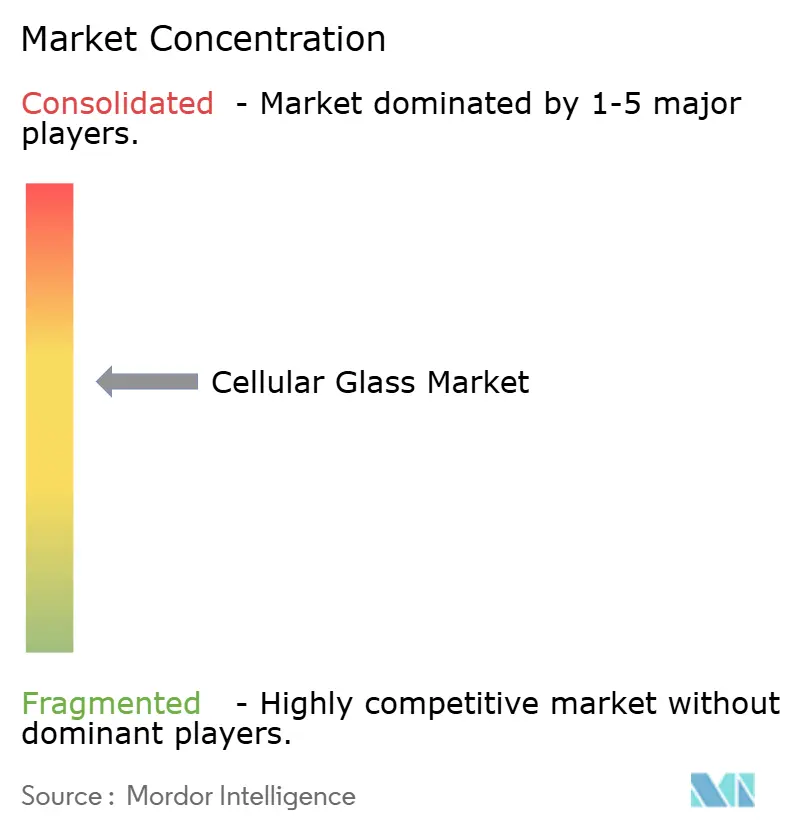
| Market Concentration | Medium |
Major Players *Disclaimer: Major Players sorted in no particular order Image © Mordor Intelligence. Reuse requires attribution under CC BY 4.0. | |
Cellular Glass Market Analysis by Mordor Intelligence
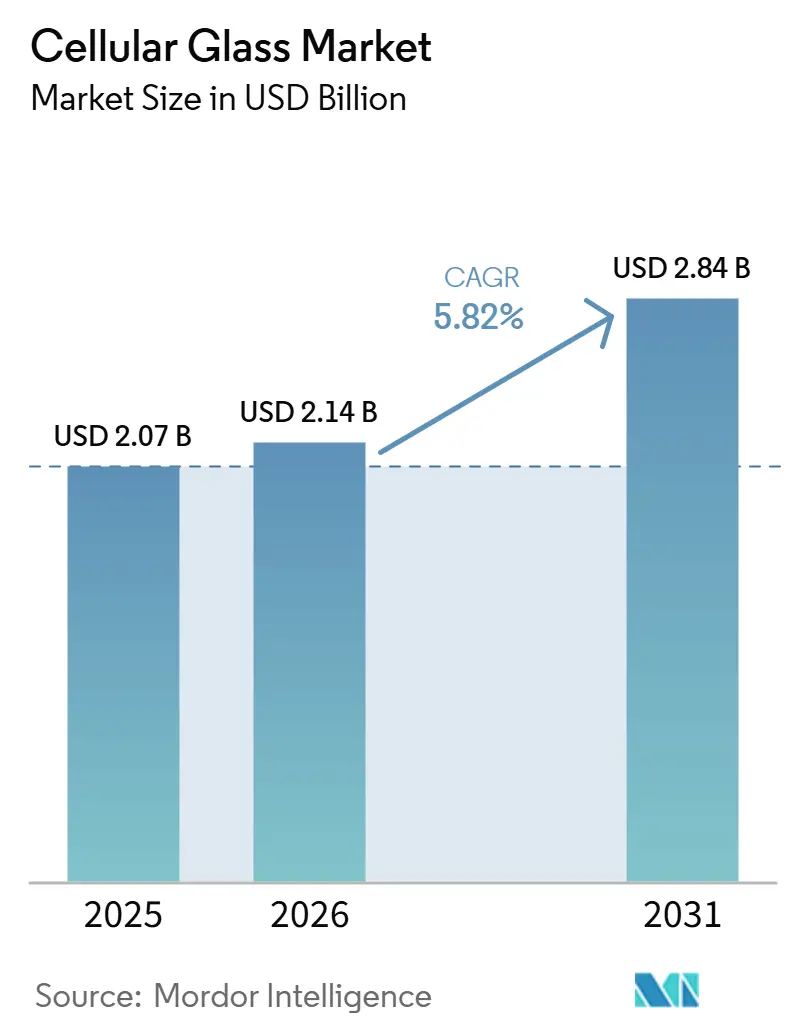
The Cellular Glass Market size is projected to be USD 2.07 billion in 2025, USD 2.14 billion in 2026, and reach USD 2.84 billion by 2031, and is expected to grow at a CAGR of 5.82% from 2026 to 2031. The cellular glass market is being shaped by tighter building energy codes, stronger fire safety requirements, and growing demand for insulation systems that maintain performance over long service lives in harsh operating conditions. Demand is also rising because the material combines water resistance, vapor resistance, non-combustibility, and compressive strength in a single system, making it suitable for commercial buildings, industrial facilities, and below-grade construction. Retrofit activity across Europe and North America is providing steady support to the market, as building owners are placing greater emphasis on lifecycle performance and lower replacement needs in occupied buildings. The cellular glass market is also gaining broader use in liquefied natural gas (LNG), hydrogen, petrochemical, and district heating projects, as these applications require insulation that remains stable under extreme temperature swings and continuous moisture exposure. Competition in the cellular glass market remains moderate, with Owens Corning competing through its FOAMGLAS product line alongside several European and Asian suppliers that compete on local manufacturing reach, application depth, and sustainability documentation.
Key Report Takeaways
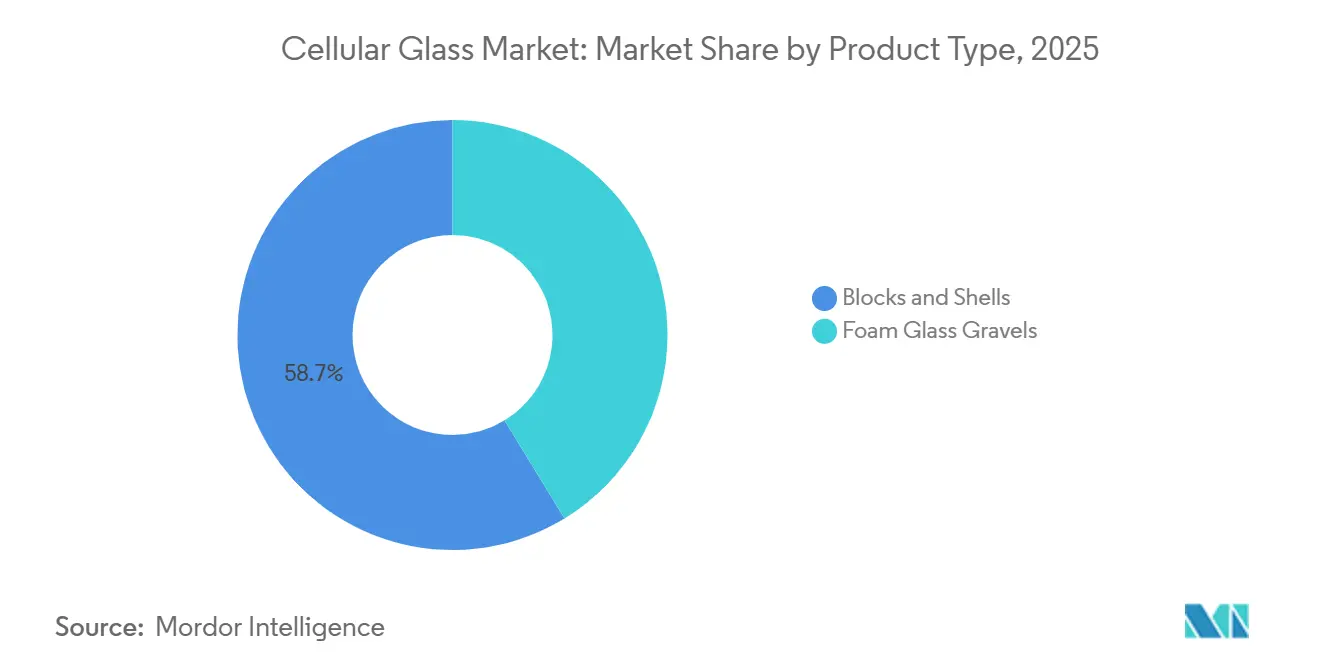
- By product type, Blocks and Shells held 58.72% revenue share in 2025, while Foam Glass Gravels are forecast to expand at a 6.73% CAGR through 2031.
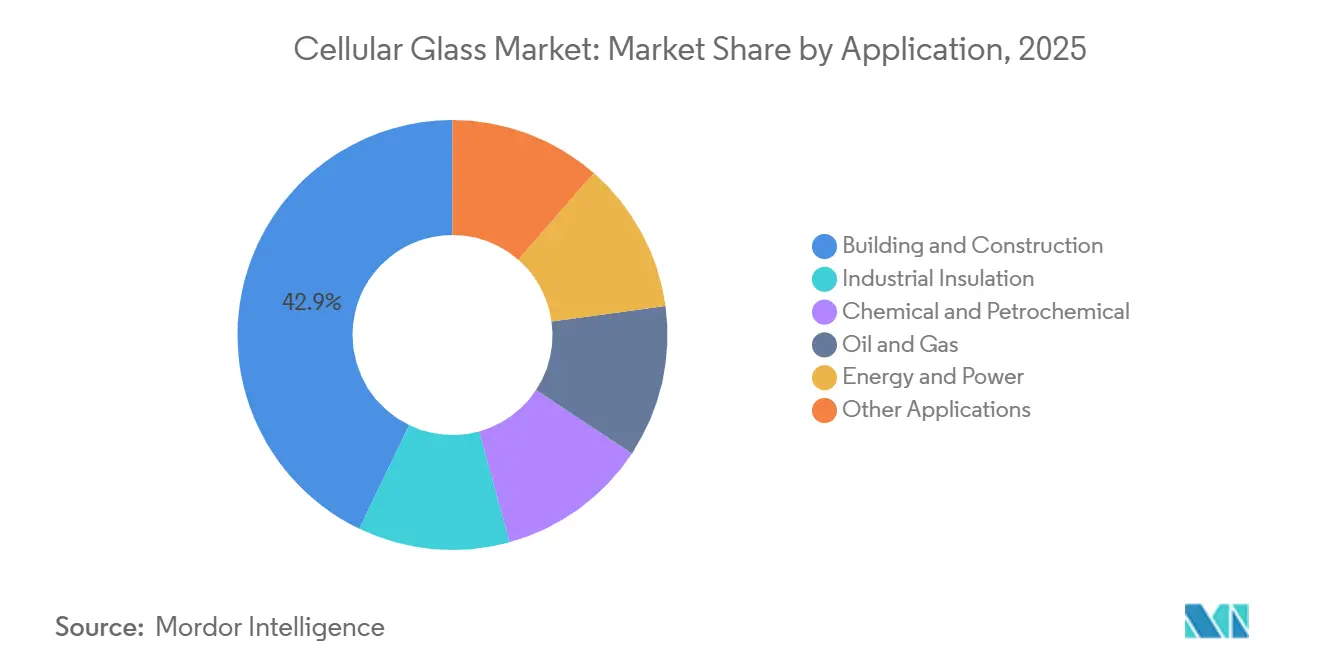
- By application, Building and Construction accounted for a 42.86% share in 2025, while Industrial Insulation is projected to grow at a 6.88% CAGR through 2031.
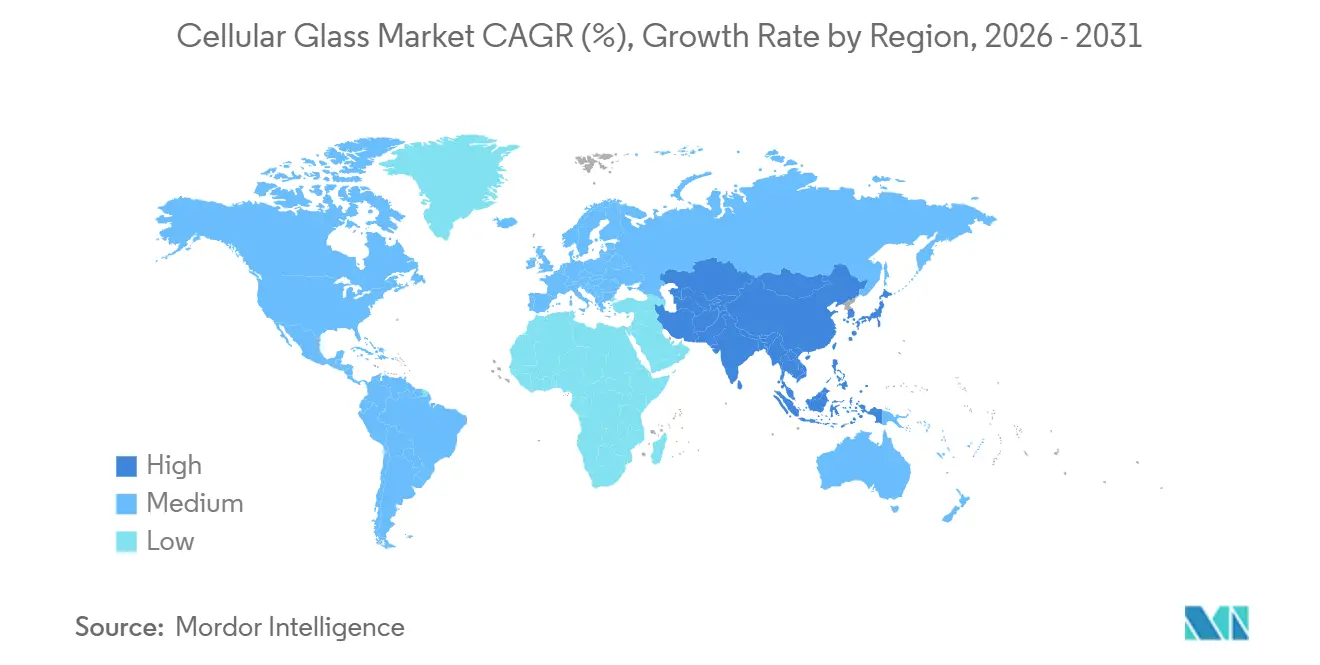
- By geography, Europe held 36.92% of revenue in 2025, while Asia-Pacific is projected to grow at a 6.52% CAGR through 2031.
Note: Market size and forecast figures in this report are generated using Mordor Intelligence’s proprietary estimation framework, updated with the latest available data and insights as of January 2026.
Market Trends and Insights
Drivers Impact Analysis of Cellular Glass Market*
| Drivers | (~) % Impact on CAGR Forecast | Geographic Relevance | Impact Timeline |
|---|---|---|---|
| Rising Demand for Fire-Resistant Insulation Materials | +1.5% | Global, with concentrated impact in North America, Europe, and the Middle East | Short term (≤ 2 years) |
| Increasing Adoption of Green Buildings and Net-Zero Construction Projects | +1.2% | Global, highest intensity in Europe and North America | Medium term (2-4 years) |
| Growing Preference for Sustainable and Energy-Efficient Building Solutions | +1.0% | Europe, North America, with spillover to Asia-Pacific | Medium term (2-4 years) |
| Increasing Retrofit and Renovation Activities in Mature-Market Building Stock | +0.9% | Europe, with secondary gains in North America and Australia | Medium term (2-4 years) |
| Rising Demand for Moisture-Resistant, High-Durability Insulation in Cryogenic and Liquefied Natural Gas (LNG) Infrastructure | +0.7% | Asia-Pacific core, with spillover to the Middle East, Africa, and North America | Long term (≥ 4 years) |
| Source: Mordor Intelligence | |||
Rising Demand for Fire-Resistant Insulation Materials
Fire performance is a key reason the cellular glass market continues to gain specification support in regulated construction environments. Cellular glass is classified as A1 non-combustible under EN 13501-1, placing it among a narrow group of insulation materials that can meet strict fire requirements without additional chemical treatment or fire-retardant systems. Project teams in the United States, Europe, and other major building markets are giving greater attention to façade and assembly fire performance during early design review. Once a project fire strategy requires a non-combustible solution, substitution risk decreases because many polymer-based alternatives no longer qualify on equal terms. This pattern is supporting the cellular glass market in commercial buildings, industrial plants, and dense urban projects where code compliance and long-term risk management carry more weight than lower upfront insulation costs.
Increasing Adoption in Green Building and Net-Zero Construction Projects
Green building frameworks are providing the cellular glass market with a steady source of demand, as material selection now carries greater weight in certification-led commercial projects. Cellular glass suits these projects because it is commonly produced from waste glass cullet and avoids petrochemicals, blowing agents, and volatile organic compounds in the finished material profile. GLAVEL strengthened this position with third-party-verified environmental documentation for foamed glass aggregate and a Declare label, giving architects clearer lifecycle and material health information during specification[1]GLAVEL Inc., “Foam Glass Gravel Environmental Product Declaration (EPD),” GLAVEL, glavel.com. Certifying architects often influence insulation choices in premium commercial projects before contractors compare installed bids. As a result, the cellular glass market is gaining traction in projects where transparent material documentation, recycled content, and indoor environmental quality carry procurement value.
Growing Preference for Sustainable and Energy-Efficient Building Solutions
The cellular glass market is also benefiting from a broader shift toward insulation systems that demonstrate stable thermal performance over their installed life, rather than competing primarily on purchase price. EN 17956:2024 supports this shift by placing technical insulation within a more structured performance framework for pipes, ducts, vessels, and equipment, giving industrial buyers a clearer basis for comparing long-term efficiency. Cellular glass fits this context because its thermal conductivity remains competitive across a wide operating range and its closed-cell structure limits moisture uptake, which can otherwise reduce thermal performance over time. Procurement teams are also requesting stronger documentation, and manufacturers with updated Environmental Product Declarations are better placed to meet this requirement. This supports the cellular glass market because buyers can more readily compare documented performance, which generally favors suppliers that provide verified results over those relying on estimated values.
Increasing Retrofit and Renovation Activities in Mature-Market Building Stock
Retrofit activity is a durable growth driver for the cellular glass market, particularly in Europe, where regulations are directing the worst-performing buildings toward renovation. Directive (EU) 2024/1275 requires Member States to submit national renovation plans by December 2026, and the related 2025 delegated regulation sets a cost-optimal method for minimum energy performance requirements. Cellular glass is suited for retrofit work because it combines moisture control and thermal performance in a single layer, reducing assembly complexity and limiting trade overlap in occupied buildings. This practical advantage is relevant in flat-roof and below-grade applications, where alternative systems often require additional drainage layers or vapor barriers to achieve the same functional result. The cellular glass market benefits when owners prioritize fewer replacement cycles, simpler assemblies, and stronger long-term performance in regulated renovation programs.
Restraints Impact Analysis of Cellular Glass Market*
| Restraints | (~) % Impact on CAGR Forecast | Geographic Relevance | Impact Timeline |
|---|---|---|---|
| Higher Initial Cost Compared to Conventional Insulation Alternatives | -0.9% | Global, with the strongest effect in South America, Southeast Asia, and parts of Eastern Europe | Short term (≤ 2 years) |
| Limited Awareness and Distribution Network Coverage in Emerging Markets | -0.5% | South America, Southeast Asia, the Middle East, Africa, and Eastern Europe | Medium term (2-4 years) |
| Fragility and Risk of Mechanical Damage During Transportation and Installation | -0.4% | Global, especially in markets with a limited trained installation capacity | Short term (≤ 2 years) |
| Source: Mordor Intelligence | |||
Higher Initial Cost Compared to Conventional Insulation Alternatives
High upfront cost remains a key commercial restraint on the cellular glass market. The manufacturing process relies on energy-intensive glass melting and tightly controlled foaming cycles, which keep delivered costs above those of mineral wool, expanded polystyrene, and polyisocyanurate in many project comparisons. This is most relevant in residential and light commercial construction, where buyers typically compare materials on initial installed cost per unit area rather than total service-life economics. Price sensitivity is high in South America, Southeast Asia, and parts of Eastern Europe, where local production capacity is also limited. As a result, the cellular glass market in these regions remains concentrated in industrial plants and high-value commercial projects, where buyers are more willing to pay for moisture resistance, fire safety, and long service life.
Fragility and Risk of Mechanical Damage During Transportation and Installation
Mechanical fragility is another practical constraint on the cellular glass market, though it does not affect the material's thermal or moisture performance once installed. Cellular glass is brittle, and breakage during transport, storage, or installation can increase waste rates and raise the effective installed cost of a project. This issue is more pronounced where logistics routes are long or where contractors have limited experience handling the material. Vibrating operating environments may also require additional isolation measures, adding design complexity and weakening the cost case relative to flexible alternatives. Manufacturers are addressing this through pre-cut shapes, prefabricated components, and installer training programs, but the cellular glass market requires a broader skilled trade base in emerging regions before this restraint is meaningfully reduced.
*Our forecasts treat driver/restraint impacts as directional, not additive. The impact forecasts reflect baseline growth, mix effects, and variable interactions.
Cellular Glass Market Segment Analysis
By Product Type:
Blocks and Shells Anchor Demand, Gravels Unlock New ApplicationsBlocks and Shells held 58.72% of the cellular glass market share in 2025, reflecting the central role of formed products in the cellular glass market. Their market position stems from flat-roof systems, below-grade waterproofing, and industrial insulation for pipes, tanks, and equipment, where pre-shaped geometry reduces field cutting and allows for more controlled installation. This advantage is particularly relevant in cryogenic projects, as storage tanks and transfer systems require dimensional stability under repeated thermal cycling between ambient and sub-zero service conditions. Blocks and Shells are also well established in specifications that prioritize fire performance, moisture resistance, and long service life.
Foam Glass Gravels are projected to grow at a 6.73% CAGR through 2031, making this the fastest-growing product form in the cellular glass market. Growth is driven by sub-slab insulation, road embankments, frost-heave mitigation, and civil works, where the loose aggregate format combines drainage, insulation, and lightweight fill in a single layer. This opens the cellular glass market to civil engineering and infrastructure buyers that historically did not source traditional insulation products. GLAVEL's Environmental Product Declaration stated that its foam glass gravel, produced from 100% post-consumer recycled glass using renewable energy, carried 55% lower embodied carbon than conventional foam board assemblies. Foamit Group also expanded its facility in Forssa in late 2025, increasing small-grain cellular glass production capacity to above 100,000 cubic meters annually.



By Application:
Building and Construction Leads Revenue, Industrial Insulation AcceleratesBuilding and Construction accounted for 42.86% of the cellular glass market in 2025, keeping this segment at the center of demand. Its position is tied to flat-roof and below-grade applications, particularly in Europe, where moisture control, thermal bridging prevention, and long-term durability are key factors in system design. The construction segment is further supported by retrofit activity, as cellular glass can deliver thermal and moisture performance in a single layer, reducing the number of components required in complex envelope assemblies. This makes the product well-suited for occupied buildings, where simpler construction sequencing and lower future replacement needs are priorities. The cellular glass market maintains a strong construction base even as other applications grow faster.
Industrial Insulation is forecast to expand at a 6.88% CAGR through 2031, making it the fastest-growing application in the cellular glass market. LNG terminals across Asia and North America, refinery additions in the Middle East, and early hydrogen liquefaction projects in Japan are driving this growth, as these facilities require materials that can withstand cryogenic stress and continuous exposure to moisture. Chemical and petrochemical assets also contribute to segment growth, as cellular glass remains chemically inert against most process fluids, except strong alkalis, supporting its use in distillation columns, pipelines, and low-temperature vessels. Energy and power projects add further demand, as district heating network upgrades and buried pipe systems benefit from cellular glass's compressive strength, direct burial suitability, and long service life.
Geography Analysis
Europe Cellular Glass Market
Europe held 36.92% of the cellular glass market share in 2025, maintaining its leading position. This is supported by strict energy codes, a well-established manufacturing base, and a renovation cycle that favors materials with reliable thermal and moisture performance. Germany, France, and the United Kingdom remain the main demand centers. Germany stands out in particular, as financing support and high-performance building standards have created a durable premium segment for foundation and flat-roof insulation. The Energy Performance of Buildings Directive (EPBD) requirement for national renovation plans by December 2026 further strengthens the regional market by converting a larger portion of the existing building stock into a regulated demand pool rather than a discretionary one. Owens Corning's June 2025 investment announcement for its FOAMGLAS plant in Klášterec, Czech Republic, which targets a 50% increase in production capacity with commissioning in Q2 2026, reflects how suppliers are positioning for continued European demand in the cellular glass market[2]Owens Corning, “Owens Corning Announces Strategic Investment in FOAMGLAS Europe Insulation Plant,” FOAMGLAS, foamglas.com.
APAC Cellular Glass Market
Asia-Pacific is projected to grow at a CAGR of 6.52% through 2031, making it the fastest-growing regional market for cellular glass. China, India, South Korea, and Japan are driving this growth through a combination of LNG import infrastructure expansion, industrial insulation requirements, and commercial construction activity. China and India are significant markets, as regasification terminal additions are directly increasing demand for cryogenic storage tank insulation, transfer piping insulation, and related low-temperature equipment. Japan and South Korea add further demand through hydrogen infrastructure plans and shipbuilding-linked LNG activity, broadening the industrial use base beyond standard commercial construction.
MEA and South America Cellular Glass Market
South America, the Middle East, and Africa remain smaller regional markets for cellular glass. Demand in these regions is tied to petrochemical, LPG, LNG, and major infrastructure investment rather than routine building activity alone. Brazil and Argentina lead South American demand, though price sensitivity and limited local production keep the region dependent on imports, which increase the landed cost of an already premium material. In the Middle East and Africa, Saudi Arabia is a notable market as Vision 2030 projects and energy-efficient construction requirements are driving demand for durable thermal materials with proven long-term performance. The UAE also supports regional demand through LNG and petrochemical expansion, with industrial insulation remaining the primary entry point for broader adoption.

Competitive Landscape
The cellular glass market is moderately consolidated, with Owens Corning holding a strong position through the FOAMGLAS brand and a manufacturing footprint spanning Belgium, the Czech Republic, China, and the United States. However, the market is not tightly consolidated, as a broad group of regional specialists remains active across Europe and Asia. Companies such as GEOCELL Schaumglas, MISAPOR, GLAPOR Werk Mitterteich GmbH, Liaver GmbH, Steinbach Schaumglas, and REFAGLASS maintain competitive positions through regional strength, product specialization, and local distribution coverage. Chinese suppliers such as Anhui Huichang New Material and Zhejiang Dehe Insulation are also building export presence, supported by domestic LNG infrastructure growth and local scale. As a result, the market is led by one major global player but remains open enough for regional firms to maintain their positions where customer relationships and application support are most important.
Strategic differentiation in the cellular glass market is shifting toward sustainability documentation and application-specific technical support. Verified Environmental Product Declarations, Declare labels, and similar records are becoming increasingly important as architects, project owners, and procurement teams seek greater visibility into lifecycle performance and material health. This benefits firms such as GLAVEL and Foamit, as certified environmental documentation provides a basis for competing in specification-driven projects without requiring the scale of larger players. It also creates opportunities in foam glass gravel, particularly in North America, where documented environmental performance can be as important as price in premium green building projects.
Recent strategic moves illustrate how companies are strengthening their positions in the cellular glass market. Owens Corning completed the sale of its glass reinforcements business to Praana Group in 2026 for an enterprise value of USD 645 million, reinforcing its focus on building products in North America and Europe. The company also advanced its Czech capacity expansion for FOAMGLAS, reflecting confidence in European roofing and insulation demand. Foamit expanded its output at Forssa in late 2025, while GLAVEL used verified environmental documentation to strengthen its position in foamed glass aggregate. These moves indicate that smaller players are responding through targeted investment rather than scale. Collectively, these developments suggest that competition in the cellular glass market is increasingly based on capacity, product fit, and documentation quality, rather than price alone.
Cellular Glass Industry Leaders
Owens Corning
MISAPOR
POLYDROS,S.A.
REFAGLASS s.r.o.
ZHEJIANG ZHENSHEN INSULATION TECHNOLOGY CORP.LTD.
- *Disclaimer: Major Players sorted in no particular order
Cellular Glass Market Companies Covered in this Report
- Anhui Huichang New Material Co., Ltd.
- Earthstone International LLC
- GEOCELL Schaumglas GmbH
- Glapor Werk Mitterteich GmbH
- GLAVEL, Inc.
- Jahan Ayeg Pars Company
- Liaver GmbH and Co. KG
- MISAPOR
- Owens Corning
- POLYDROS,S.A.
- REFAGLASS s.r.o.
- Steinbach Schaumglas GmbH and Co. KG
- STES-Vladimir
- Uusioaines Oy
- Zhejiang Dehe Insulation Technology Co., Ltd.
- ZHEJIANG ZHENSHEN INSULATION TECHNOLOGY CORP.LTD.

Recent Industry Developments in Cellular Glass Market
- April 2026: Owens Corning completed the sale of its glass reinforcements business to Praana Group for an enterprise value of USD 645 million. This transaction refined the company's focus as a building products company in North America and Europe, with cellular glass insulation as a central growth platform.
- June 2025: Owens Corning announced an investment in its FOAMGLAS insulation plant in Klášterec, Czech Republic, targeting a 50% increase in production capacity, with commissioning planned for Q2 2026. The investment aims to meet growing demand in European flat-roof markets for its FOAMGLAS T3+ product line.


Global Cellular Glass Market Report Scope
Cellular glass is a rigid, lightweight, and completely inorganic insulation material manufactured from recycled glass and a foaming agent. Fused at high temperatures, it forms a closed-cell structure that is waterproof, vapor-tight, and resistant to fire, chemicals, and pests.
The cellular glass market is segmented by product type, application, and geography. By product type, the market is segmented into blocks and shells and foam glass gravels. By application, the market is segmented into building and construction, industrial insulation, chemical and petrochemical, oil & gas, energy & power, and other applications. The report also covers market size and forecasts for cellular glass across 16 countries in major regions. The market sizes and forecasts are provided in terms of value (USD).
| Blocks and Shells |
| Foam Glass Gravels |
| Building and Construction |
| Industrial Insulation |
| Chemical and Petrochemical |
| Oil & Gas |
| Energy & Power |
| Other Applications |
| Asia-Pacific | China |
| India | |
| Japan | |
| South Korea | |
| Rest of Asia-Pacific | |
| North America | United States |
| Canada | |
| Mexico | |
| Europe | Germany |
| United Kingdom | |
| France | |
| Italy | |
| Russia | |
| Rest of Europe | |
| South America | Brazil |
| Argentina | |
| Rest of South America | |
| Middle-East and Africa | Saudi Arabia |
| South Africa | |
| Rest of Middle-East and Africa |
| By Product Type | Blocks and Shells | |
| Foam Glass Gravels | ||
| By Application | Building and Construction | |
| Industrial Insulation | ||
| Chemical and Petrochemical | ||
| Oil & Gas | ||
| Energy & Power | ||
| Other Applications | ||
| By Geography | Asia-Pacific | China |
| India | ||
| Japan | ||
| South Korea | ||
| Rest of Asia-Pacific | ||
| North America | United States | |
| Canada | ||
| Mexico | ||
| Europe | Germany | |
| United Kingdom | ||
| France | ||
| Italy | ||
| Russia | ||
| Rest of Europe | ||
| South America | Brazil | |
| Argentina | ||
| Rest of South America | ||
| Middle-East and Africa | Saudi Arabia | |
| South Africa | ||
| Rest of Middle-East and Africa | ||


Key Questions Answered in the Report
What is current market size of Cellular Glass Market?
The Cellular Glass Market size is projected to be USD 2.07 billion in 2025, USD 2.14 billion in 2026, and reach USD 2.84 billion by 2031, and is expected to grow at a CAGR of 5.82% from 2026 to 2031.
Which product type leads to cellular glass demand today?
Blocks and Shells led with 58.72% share in 2025 because they remain central to flat-roof, below-grade, pipe, tank, and cryogenic insulation applications.
Which application is growing the fastest through 2031?
Industrial Insulation is the fastest-growing application at a 6.88% CAGR, supported by LNG terminals, refinery additions, and early hydrogen liquefaction projects.
Why is Europe the leading regional demand center?
Europe held a 36.92% share in 2025 due to strict energy codes, a strong renovation pipeline, and a mature base of cellular glass manufacturers and installers.
Page last updated on:





