
CBD Nutraceuticals Market Size and Share
Market Overview
| Study Period | 2022 - 2032 |
|---|---|
| Market Size (2027) | USD 13.32 Billion |
| Market Size (2032) | USD 22.63 Billion |
| Growth Rate (2027 - 2032) | 11.18 % |
| Fastest Growing Market | Asia-Pacific |
| Largest Market | North America |
| Market Concentration | Medium |
Major Players *Disclaimer: Major Players sorted in no particular order Image © Mordor Intelligence. Reuse requires attribution under CC BY 4.0. | |
CBD Nutraceuticals Market Analysis by Mordor Intelligence
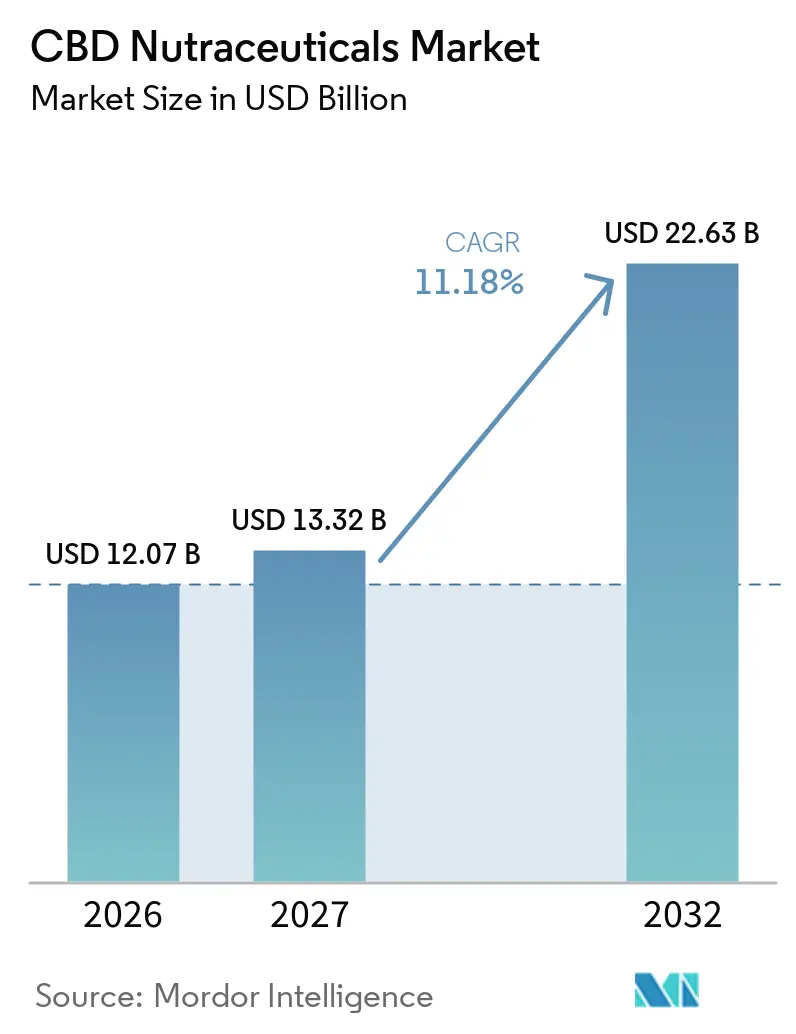
The CBD nutraceuticals market size is projected to expand from USD 12.07 billion in 2026 and USD 13.32 billion in 2027 to USD 22.63 billion by 2032, registering a CAGR of 11.18% between 2027 to 2032. The CBD nutraceuticals market is supported by consumer demand for plant-derived products used for sleep, stress management, recovery, and pain management. Regulatory decisions are creating a clearer path for compliant products in selected countries, while stricter rules are increasing the cost of selling products with inadequate documentation. The June 2025 safety assessment by the UK food authorities established a 10 mg daily intake level for CBD isolate for healthy adults and advised warnings for several consumer groups. The CBD nutraceuticals market also faces a divide between brands that can support dosage, quality, and labeling requirements and brands that rely on products exposed to enforcement risk.
Key Report Takeaways
- By product type, CBD tinctures held 45.4% revenue share in 2026, while CBD functional beverages are forecast to expand at a 12.5% CAGR through 2032.
- By end-user, adults held 96.5% of the CBD nutraceuticals market share in 2026, while children recorded the highest projected CAGR at 12.3% through 2032.
- By distribution channel, drug stores and pharmacies held 36.2% revenue share in 2026, while convenience stores are forecast to expand at a 13.1% CAGR through 2032.
- By geography, North America held 56.3% revenue share in 2026, while Asia-Pacific recorded the highest projected CAGR at 13.6% through 2032.
Note: Market numbers in this report are based on Mordor Intelligence's proprietary estimation framework, which combines nine months of actuals with Q4 projections for base year 2026.
Market Trends and Insights
Drivers Impact Analysis of CBD Nutraceuticals Market*
| Driver | (~) % Impact on CAGR Forecast | Geographic Relevance | Impact Timeline |
|---|---|---|---|
| Rising Awareness of CBD Health Benefits | +2.5% | Global | Short term (≤ 2 years) |
| Plant-Based and Natural Wellness Shift | +2.2% | Global, led by North America and Europe | Medium term (2-4 years) |
| Extraction and Formulation Advances | +1.8% | Global | Medium term (2-4 years) |
| Product Innovation and Delivery Formats | +1.5% | North America, Europe, and Asia-Pacific | Short term (≤ 2 years) |
| Functional and Fortified Food Integration | +1.2% | North America and Europe | Medium term (2-4 years) |
| Sports Nutrition and Fitness Adoption | +0.8% | North America and Asia-Pacific | Long term (≥ 4 years) |
| Source: Mordor Intelligence | |||
Rising Awareness of CBD Health Benefits
Consumer awareness continues to support demand in the CBD nutraceuticals market, even though formal health claim approvals remain limited. A 2025 survey of elite-level Canadian athletes found that 38% had used CBD, while 93% of users reported better sleep and 90% reported improved relaxation. The World Anti-Doping Agency does not list CBD as a prohibited substance, which supports its acceptance among athletes and fitness-focused consumers. Clinical safety findings also shape how consumers and regulators assess products. A 2025 randomized clinical trial reported liver enzyme elevations above 3 times the upper limit of normal in 8 of 151 participants taking consumer-representative CBD doses. Transparent dose labeling and independent quality certification therefore carry greater value for brands serving pharmacy and institutional channels.
Shift Toward Plant-Based and Natural Wellness Products
The CBD nutraceuticals market benefits from a broader move toward botanical wellness products that consumers can use without a prescription. This demand is connected to consumer interest in accessible products for calm, sleep, recovery, and routine wellness. A 2025 randomized crossover trial found that a 50 mg CBD dose increased self-reported calm and reduced perceived exertion in trained runners. The findings support product positioning around specific use occasions rather than broad wellness language. Charlotte's Web reported that its comprehensive sleep support category was its fastest-growing category by the end of 2025. Products designed for a distinct need, such as sleep, focus, or recovery, are better aligned with how consumers evaluate plant-based supplements.
Advancements in Extraction and Formulation Technologies
The CBD nutraceuticals market is increasingly shaped by bioavailability, onset time, taste, and product consistency rather than cannabinoid concentration alone. A 2025 study showed that supercritical carbon dioxide co-extraction of hemp flowers and oilseeds can produce CBD-rich oils with adjustable cannabinoid concentration, essential fatty acids, and tocopherols in a single process. This approach can support cleaner ingredient lists and more efficient production. A separate 2025 study found that nanostructured lipid carriers made through hot-melt extrusion improved oral CBD bioavailability in pharmacokinetic models. Charlotte's Web used AZUCA TiME INFUSION technology in Brightside gummies and reported several sold-out stock keeping units during the 2025 Memorial Day weekend. Faster and more predictable delivery gives brands a clear way to differentiate products in crowded retail settings.
Product Innovation and Diverse Delivery Formats
Tinctures, capsules, gummies, protein products, beverages, and fortified foods give the CBD nutraceuticals market routes to both experienced users and first-time buyers. Wider format availability reduces the barrier for consumers who do not want a conventional supplement routine. A 2025 systematic review and meta-analysis of 21 placebo-controlled trials found a moderate statistically significant effect for pure CBD in social anxiety disorder. A 2025 mouse study also linked CBD with changes in the gut microbiome and improved treadmill performance, adding scientific interest to recovery-focused formulations. Single-serve beverages and gummies are particularly suited to convenience retail, where an impulse purchaser is less likely to choose a tincture. Functional and fortified food formats, together with sports nutrition use, extend the CBD nutraceuticals industry beyond traditional supplement use.
Restraints Impact Analysis of CBD Nutraceuticals Market*
| Restraint | (~) % Impact on CAGR Forecast | Geographic Relevance | Impact Timeline |
|---|---|---|---|
| Regulatory Uncertainty and Fragmented Frameworks | -1.8% | Global | Medium term (2-4 years) |
| FDA Restrictions on CBD in Food and Supplements | -1.5% | North America, led by the United States | Short term (≤ 2 years) |
| Limited Clinical Evidence for Health Claims | -1.0% | Global | Long term (≥ 4 years) |
| Contamination and Adulteration Risks | -0.7% | Global | Medium term (2-4 years) |
| Source: Mordor Intelligence | |||
Regulatory Uncertainty and Fragmented Frameworks
The CBD nutraceuticals market faces different product rules across countries, which raises compliance costs and complicates global product launches. A 2025 update from CVUA Karlsruhe reported that all 72 reviewed CBD-enriched food products were not marketable under the EU Novel Food Regulation, and 64% were assessed as harmful because of THC or CBD levels above safety thresholds[1]. A 2025 scientific review concluded that evidence does not substantiate CBD health claims at food-relevant doses below 300 mg per day and noted liver and drug-interaction risks. These findings reinforce the need for stronger safety dossiers, product testing, and cautious consumer communication. Singapore's zero-tolerance policy and Thailand's developing finished-product rules also prevent one standard product from serving the full Asia-Pacific region. Limited clinical evidence and contamination risk remain closely linked because both weaken consumer confidence and invite stricter oversight.
FDA Restrictions on CBD in Food and Supplements
The United States remains a difficult regulatory environment for CBD products sold as foods or dietary supplements. The regulatory analysis states that Section 781 of H.R. 5371 sets a 0.4 mg total THC limit per container for hemp products intended for human ingestion, effective November 12, 2026[2]. The Food and Drug Administration continued issuing warning letters through the second quarter of 2025 against disease claims and packaging that could appeal to children. This approach increases the value of clear labeling, controlled dosage, and documented manufacturing systems. The draft also identifies a 2026 CMS model for eligible senior oncology patients, which may create a limited institutional pathway for compliant products. The CBD nutraceuticals market therefore has a stronger opportunity for brands that can meet healthcare and retail expectations at the same time.
*Our forecasts treat driver/restraint impacts as directional, not additive. The impact forecasts reflect baseline growth, mix effects, and variable interactions.
CBD Nutraceuticals Market Segment Analysis
By Product Type:
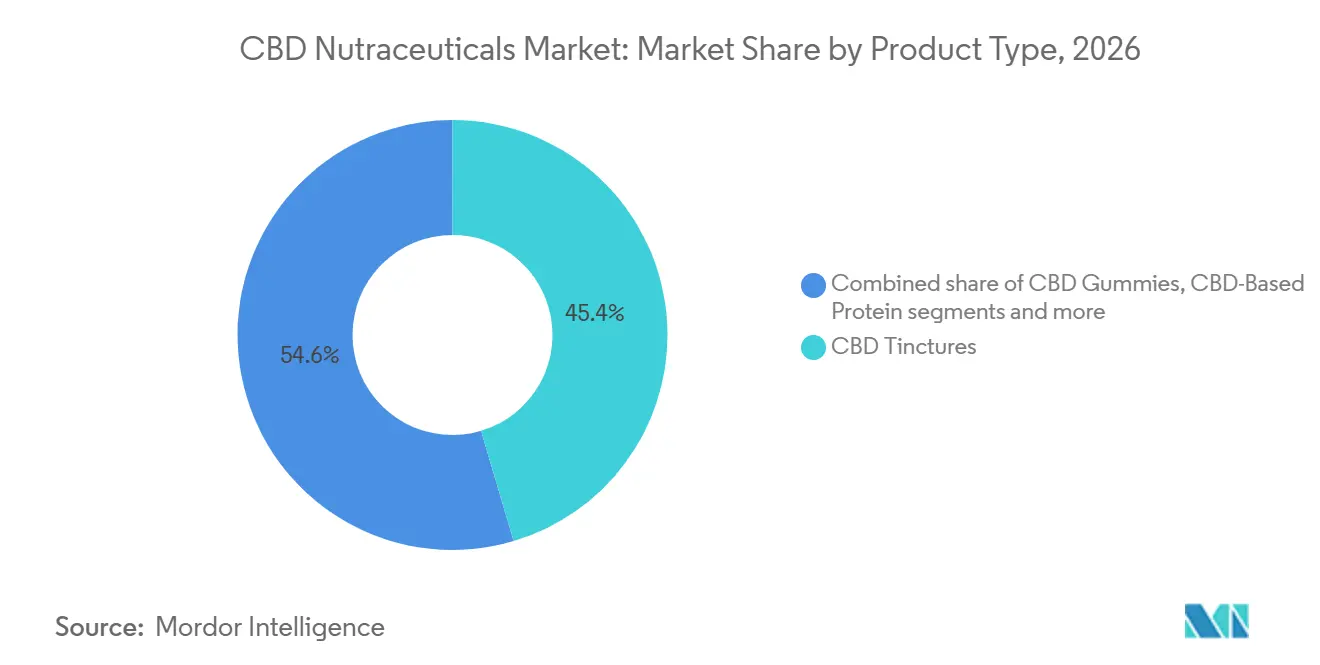
Tinctures Lead Current Demand While Functional Beverages Grow FastestCBD tinctures accounted for 45.4% of revenue in 2026. Their position reflects dose precision, fast sublingual use, and a comparatively simple formulation process. Consumers use tinctures for regular sleep, stress, and recovery routines where a consistent dose is important. Capsules and softgels appeal to consumers who prefer convenience and discretion over rapid onset. Gummies broaden access because their familiar format can reduce hesitation among first-time users.
CBD functional beverages are forecast to grow at a 12.5% CAGR through 2032, making them the fastest-growing product type. The CBD nutraceuticals market size for this format is supported by consumers who prefer a drink routine to a supplement regimen. A 2025 study of solid self-nanoemulsifying CBD delivery systems reported improved solubility and bioavailability, addressing historical absorption and quality challenges. CBD-based protein, baked foods, and fortified foods remain smaller emerging categories that rely on a clear functional proposition. Compliant authorization can become a shelf-access advantage as grocery and convenience retailers consider more CBD beverage products.

By End-User:
Adults Supply Volume While Children Remain a Clinical-Led OpportunityAdults held 96.5% of revenue in 2026, giving them the dominant position in the CBD nutraceuticals industry. This concentration reflects the primary purchasing population and regulatory guidance against CBD use by children. Adults aged 25 to 44 commonly use products for recovery, performance, and stress management. Consumers aged 45 and older increasingly seek support for sleep quality and chronic pain management. The draft identifies a CMS model that initially focuses on senior oncology patients and may support physician-recommended adult use.
Children are projected to record a 12.3% CAGR through 2032, although their use case remains narrow and tightly controlled. Growth is concentrated in clinical formulations for anxiety, sleep disturbances, and autism spectrum disorder-related irritability. The draft identifies DeFloria's AJA001 oral CBD solution as a Phase 2 clinical pathway for autism spectrum disorder-related irritability. The UK food authorities advise that children should not consume CBD because of remaining safety data gaps. Commercial activity in this group is therefore more likely to remain pharmaceutical-grade rather than mainstream consumer supplementation.
By Distribution Channel:
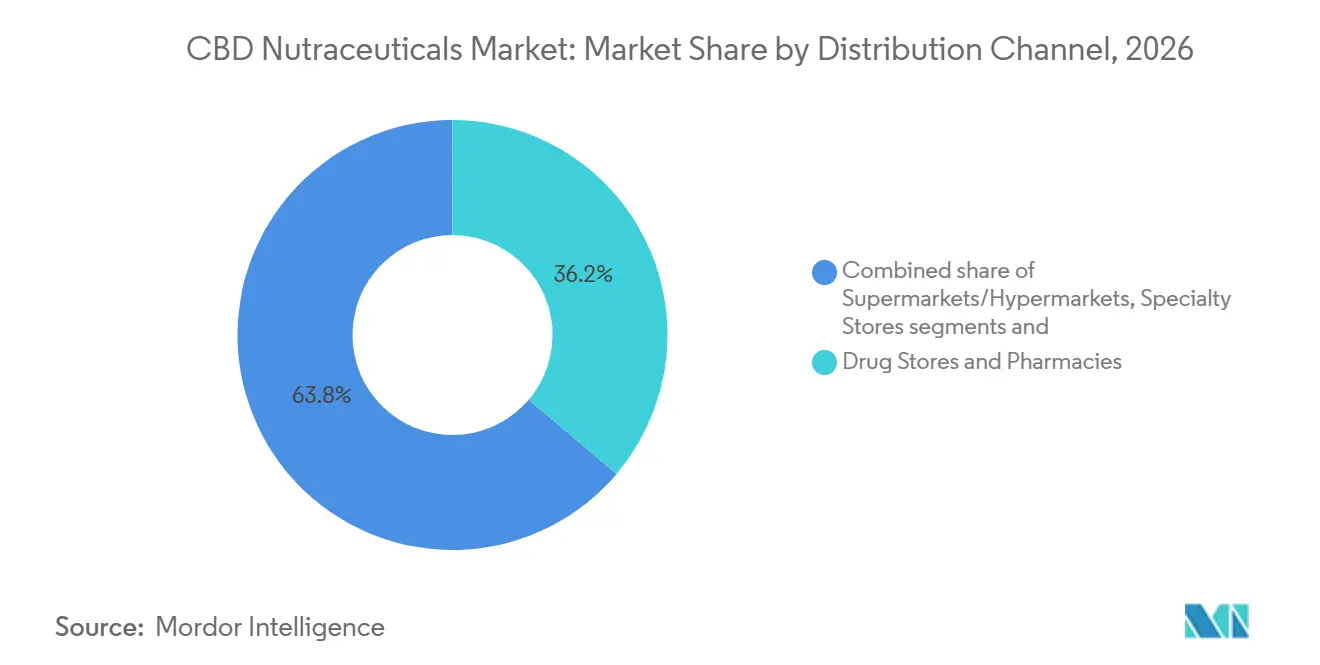
Pharmacies Support Trust While Convenience Stores Expand AccessDrug stores and pharmacies held 36.2% of revenue in 2026, the largest share of the CBD nutraceuticals market by distribution channel. Pharmacy placement gives consumers a stronger sense of product safety, dosage accuracy, and quality control. Specialty stores serve shoppers seeking more detailed guidance on formulation and use. Online retail stores support direct-to-consumer economics for established brands, but disease claims can create compliance exposure. Supermarkets, hypermarkets, and other channels bring products into mass retail, where brand familiarity and simple formats matter most.
Convenience stores are forecast to grow at a 13.1% CAGR through 2032. This channel attracts consumers making an impulse purchase rather than undertaking detailed product research. Low-dose beverages and gummies are more suitable for this setting than tinctures. The draft cites May 2025 IRI data showing 51% growth in UK CBD soft drinks over the preceding 12 months, with convenience and grocery distribution acting as the main enabler. Child-accessible retail locations also increase the importance of label warnings and packaging controls under evolving UK, European, and U.S. rules.
Geography Analysis
North America CBD Nutraceuticals Market
North America held 56.3% of the CBD nutraceuticals market share in 2026, with the United States contributing the largest portion of regional revenue. The regional lead reflects its mature retail network, broad brand activity, and established consumer awareness. The Section 781 regulatory analysis indicates that a container-level THC limit could prompt reformulation and product withdrawals after November 2026. Brands that can document compliance may gain shelf space as weaker products leave the channel. Charlotte's Web is identified in the draft as a launch partner in the proposed CMS pathway for senior oncology patients.
Europe CBD Nutraceuticals Market
Europe does not have a final CBD food authorization under the EU Novel Food framework, which constrains legal market development. The CBD nutraceuticals market size in the region nevertheless reflects persistent consumer interest in products sold through fragmented national channels. The UK safety assessment provides a more defined route for highly purified CBD isolate, with a 10 mg daily intake level and warning labels for children, pregnant women, and people taking prescription medicines. Neuraxpharm's early 2026 purchase of the Swiss Hemplix brand shows that pharmaceutical operators are preparing for clearer regional rules. Germany, the United Kingdom, France, and the Netherlands remain the largest opportunity areas, while Poland, Belgium, Sweden, and Italy are at earlier adoption stages.
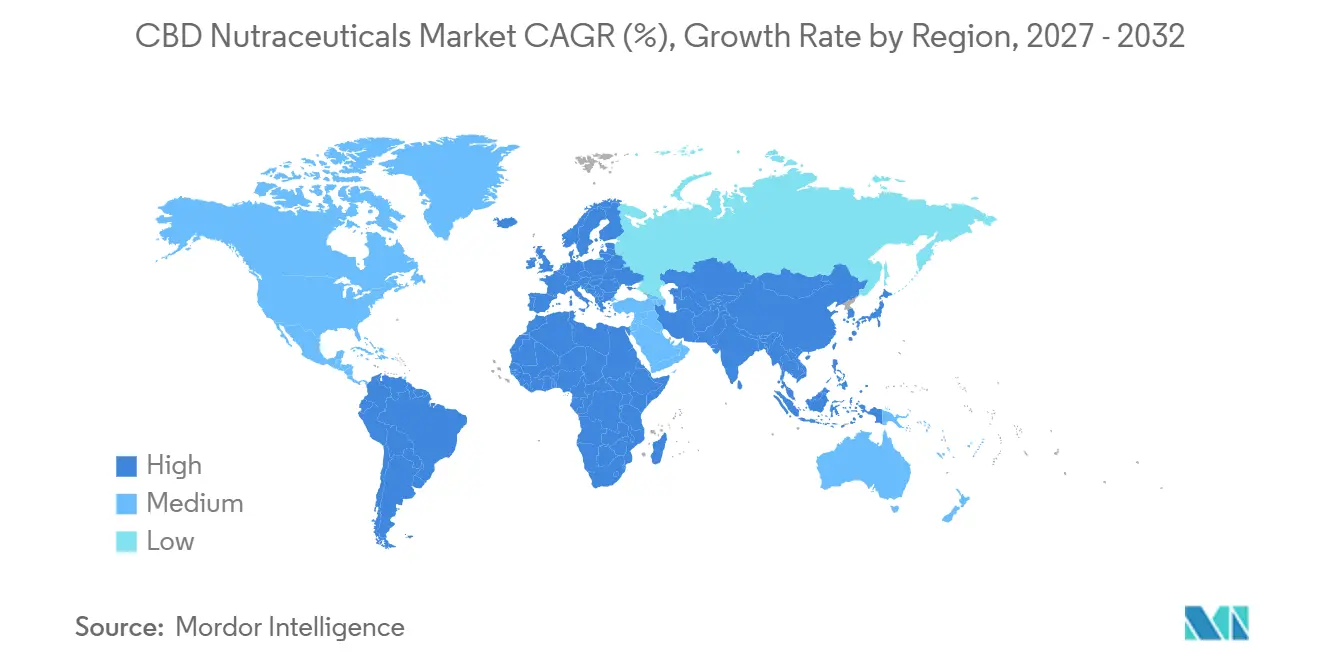
APAC CBD Nutraceuticals Market
Asia-Pacific is projected to grow at a 13.6% CAGR through 2032, the fastest regional rate in the CBD nutraceuticals market. Regulatory liberalization in Australia, Thailand, and South Korea supports this outlook. Australia's Therapeutic Goods Administration has narrowed the gap between prescription access and pharmacist-accessible CBD products. Thailand permits licensed hemp cultivation, although finished-product rules remain under development.
Competitive Landscape
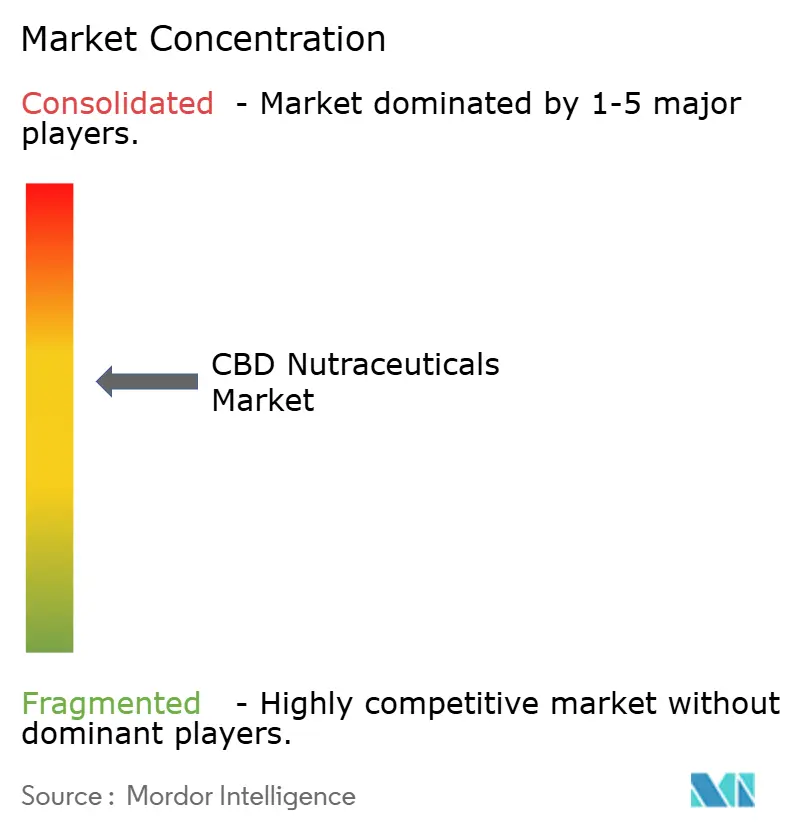
The CBD nutraceuticals market has a moderate concentration profile, with established brands competing against numerous specialty operators. Charlotte's Web, Medterra, and cbdMD compete through quality certification, differentiated formulations, and multichannel access. Charlotte's Web completed an NSF 455-2 dietary supplement current good manufacturing practice audit with zero findings in 2025, strengthening its quality position. Quality documentation is especially valuable in pharmacy and institutional negotiations. Companies that cannot support reliable testing, labels, and product records are more exposed to enforcement and delisting.
cbdMD closed an all-equity acquisition of Bluebird Botanicals in January 2026, adding consumer brand assets, patented processes, and compliance documentation. In September 2026, cbdMD entered an agreement to acquire Twinlab brands, expanding into legacy supplements, sports nutrition, beauty, weight loss, and longevity wellness. These actions reduce dependence on hemp-derived revenue and broaden the company's customer base. Splash Beverage Group also announced a non-binding letter of intent to merge with Medterra in March 2026. Consolidation favors operators that can spread regulatory and manufacturing costs across a wider product portfolio.
Charlotte's Web has used AZUCA TiME INFUSION technology to offer a 5 to 15 minute onset in its Brightside gummy range, making delivery speed a practical point of differentiation. Its DeFloria program is developing AJA001 as an FDA-regulated oral CBD solution for autism spectrum disorder-related irritability, creating a clinical pathway outside standard consumer wellness products. Lazarus Naturals and CBDistillery focus on high-potency and value-oriented products for cost-sensitive adult users. ENDOCA emphasizes European manufacturing, while Joy Organics focuses on precise formulations.
CBD Nutraceuticals Industry Leaders
-
Charlotte's Web Holdings, Inc.
-
CV Sciences, Inc.
-
Green Roads
-
Medterra
-
Elixinol
- *Disclaimer: Major Players sorted in no particular order
CBD Nutraceuticals Market Companies Covered in this Report
- Charlotte's Web Holdings, Inc.
- CV Sciences, Inc.
- Medterra
- Green Roads
- Elixinol
- Bluebird Botanicals
- Diamond CBD
- Irwin Naturals, Inc.
- Medical Marijuana, Inc.
- Foria Wellness
- Isodiol International Inc.
- ENDOCA
- Garden of Life
- MEDTERRA
- Joy Organics
- NuLeaf Naturals, LLC
- CBDistillery
- Lazarus Naturals, Inc.
- HempFusion Wellness, Inc.
- Hemp Bombs
Recent Industry Developments in CBD Nutraceuticals Market
- September 2026: cbdMD entered an asset purchase agreement to acquire Twinlab, Reserveage, Metabolife, and Alvita Tea, with combined trailing-12-month revenues of USD 30 million. The transaction extends cbdMD's platform into legacy supplements and sports nutrition while reducing hemp-derived revenue concentration ahead of Section 781.
- March 2026: Splash Beverage Group announced a non-binding letter of intent to merge with Medterra CBD, LLC. The companies stated that Medterra generated USD 52 million in revenue and was profitable in fiscal 2025. The proposed transaction was presented as a way to create a public cannabinoid wellness platform, and both parties identified the CMS Medicare CBD pilot as a medium-term institutional demand driver.
- February 2026: Neuraxpharm completed the acquisition of Switzerland-based S.T.U. GmbH, owner of the Hemplix CBD brand. The purchase enables the European central nervous system pharmaceutical company to enter the CBD nutraceuticals market through an established Swiss regulatory and distribution framework. It also reflects interest from pharmaceutical operators that are preparing for a more formal European product environment.
- January 2026: cbdMD closed an all-equity asset purchase of substantially all Bluebird Botanicals assets. The acquisition added a decade-long consumer following, patented-process technologies, and regulatory compliance documentation. cbdMD said that consolidated supply chain operations would support its goal of positive EBITDA.
Global CBD Nutraceuticals Market Report Scope
The CBD Nutraceuticals Market refers to the market for nutraceutical products formulated with cannabidiol (CBD), a non-intoxicating compound derived from cannabis plants, and marketed for wellness and nutritional purposes, subject to applicable regulatory requirements. By product type, the market is segmented into CBD tinctures, capsules and softgels, CBD gummies, CBD-based protein, CBD functional beverages, CBD baked foods and fortified foods, and other product types. By end-user, the market is divided into adults and children. By distribution channel, the market is segmented into supermarkets/hypermarkets, convenience stores, specialty stores, drug stores and pharmacies, online retail stores, and other distribution channels. Geographically, the market covers North America, Europe, Asia-Pacific, South America, and the Middle East and Africa, with country-level coverage across major markets within each region. Market size and growth forecasts are presented in terms of value (USD).
Segmentation Overview
| CBD Tinctures |
| Capsules and Softgels |
| CBD Gummies |
| CBD-Based Protein |
| CBD Functional Beverages |
| CBD Baked Foods and Fortified Foods |
| Other Product Types |
| Adults |
| Children |
| Supermarkets/Hypermarkets |
| Convenience Stores |
| Specialty Stores |
| Drug Stores and Pharmacies |
| Online Retail Stores |
| Other Distribution Channels |
| North America | United States |
| Canada | |
| Mexico | |
| Rest of North America | |
| Europe | Germany |
| United Kingdom | |
| Italy | |
| France | |
| Spain | |
| Netherlands | |
| Poland | |
| Belgium | |
| Sweden | |
| Rest of Europe | |
| Asia-Pacific | China |
| India | |
| Japan | |
| Australia | |
| Indonesia | |
| South Korea | |
| Thailand | |
| Singapore | |
| Rest of Asia-Pacific | |
| South America | Brazil |
| Argentina | |
| Colombia | |
| Chile | |
| Peru | |
| Rest of South America | |
| Middle East and Africa | South Africa |
| Saudi Arabia | |
| United Arab Emirates | |
| Nigeria | |
| Egypt | |
| Morocco | |
| Turkey | |
| Rest of Middle East and Africa |
| By Product Type | CBD Tinctures | |
| Capsules and Softgels | ||
| CBD Gummies | ||
| CBD-Based Protein | ||
| CBD Functional Beverages | ||
| CBD Baked Foods and Fortified Foods | ||
| Other Product Types | ||
| By End-User | Adults | |
| Children | ||
| By Distribution Channel | Supermarkets/Hypermarkets | |
| Convenience Stores | ||
| Specialty Stores | ||
| Drug Stores and Pharmacies | ||
| Online Retail Stores | ||
| Other Distribution Channels | ||
| By Geography | North America | United States |
| Canada | ||
| Mexico | ||
| Rest of North America | ||
| Europe | Germany | |
| United Kingdom | ||
| Italy | ||
| France | ||
| Spain | ||
| Netherlands | ||
| Poland | ||
| Belgium | ||
| Sweden | ||
| Rest of Europe | ||
| Asia-Pacific | China | |
| India | ||
| Japan | ||
| Australia | ||
| Indonesia | ||
| South Korea | ||
| Thailand | ||
| Singapore | ||
| Rest of Asia-Pacific | ||
| South America | Brazil | |
| Argentina | ||
| Colombia | ||
| Chile | ||
| Peru | ||
| Rest of South America | ||
| Middle East and Africa | South Africa | |
| Saudi Arabia | ||
| United Arab Emirates | ||
| Nigeria | ||
| Egypt | ||
| Morocco | ||
| Turkey | ||
| Rest of Middle East and Africa | ||
Key Questions Answered in the Report
What is the expected value of CBD nutraceuticals by 2032?
The sector is forecast to reach USD 22.63 billion by 2032, growing at an 11.18% CAGR from 2027 to 2032. The estimate reflects broader use across sleep, stress, recovery, and pain management routines, together with wider retail availability for compliant products, improved delivery formats, better formulation quality, and stronger consumer preference for plant-derived wellness options across retail channels worldwide.
Which CBD product type has the largest share?
CBD tinctures lead with 45.4% share in 2026 because consumers value dose precision and fast sublingual use. Their simple format also supports consistent use across several wellness needs.
Which CBD format is growing fastest?
CBD functional beverages are forecast to grow at a 12.5% CAGR through 2032. Consumer preference for beverage routines and improving water-soluble delivery technologies support this outlook.
Why are pharmacies important for CBD sales?
Drug stores and pharmacies held 36.2% share in 2026, as consumers associate these locations with product safety and dosage accuracy. Pharmacy placement can also support more disciplined labeling and quality expectations.