
Carpet Cleaner Market Size and Share
Market Overview
| Study Period | 2021 - 2032 |
|---|---|
| Market Size (2026) | USD 0.87 Billion |
| Market Size (2032) | USD 1.15 Billion |
| Growth Rate (2026 - 2032) | 5.62 % |
| Fastest Growing Market | Europe |
| Largest Market | North America |
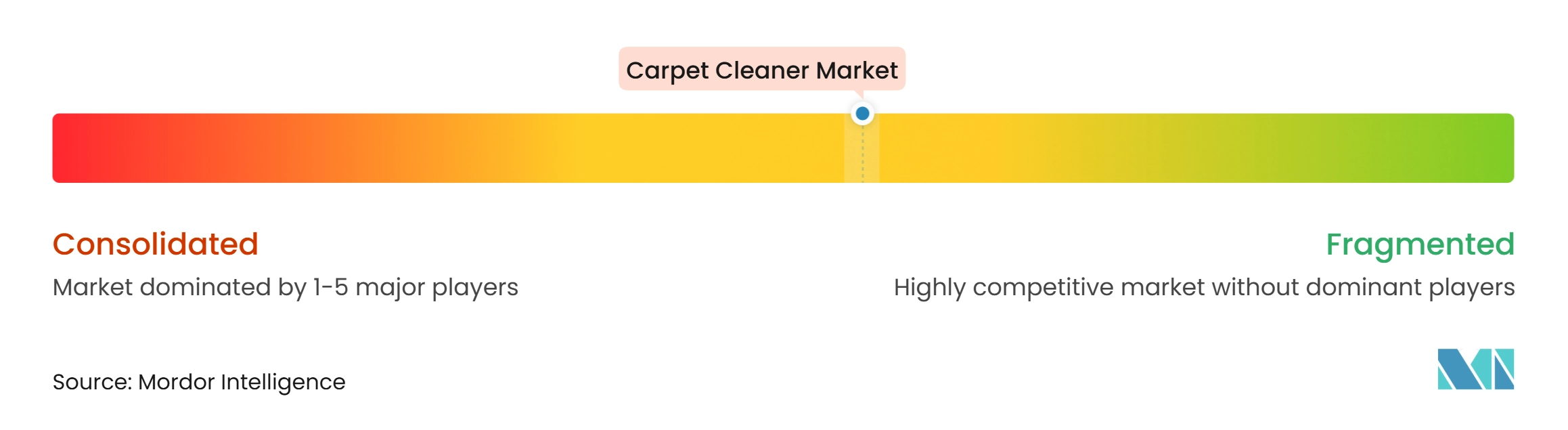
| Market Concentration | Medium |
Major Players *Disclaimer: Major Players sorted in no particular order Image © Mordor Intelligence. Reuse requires attribution under CC BY 4.0. | |
Carpet Cleaner Market Analysis by Mordor Intelligence
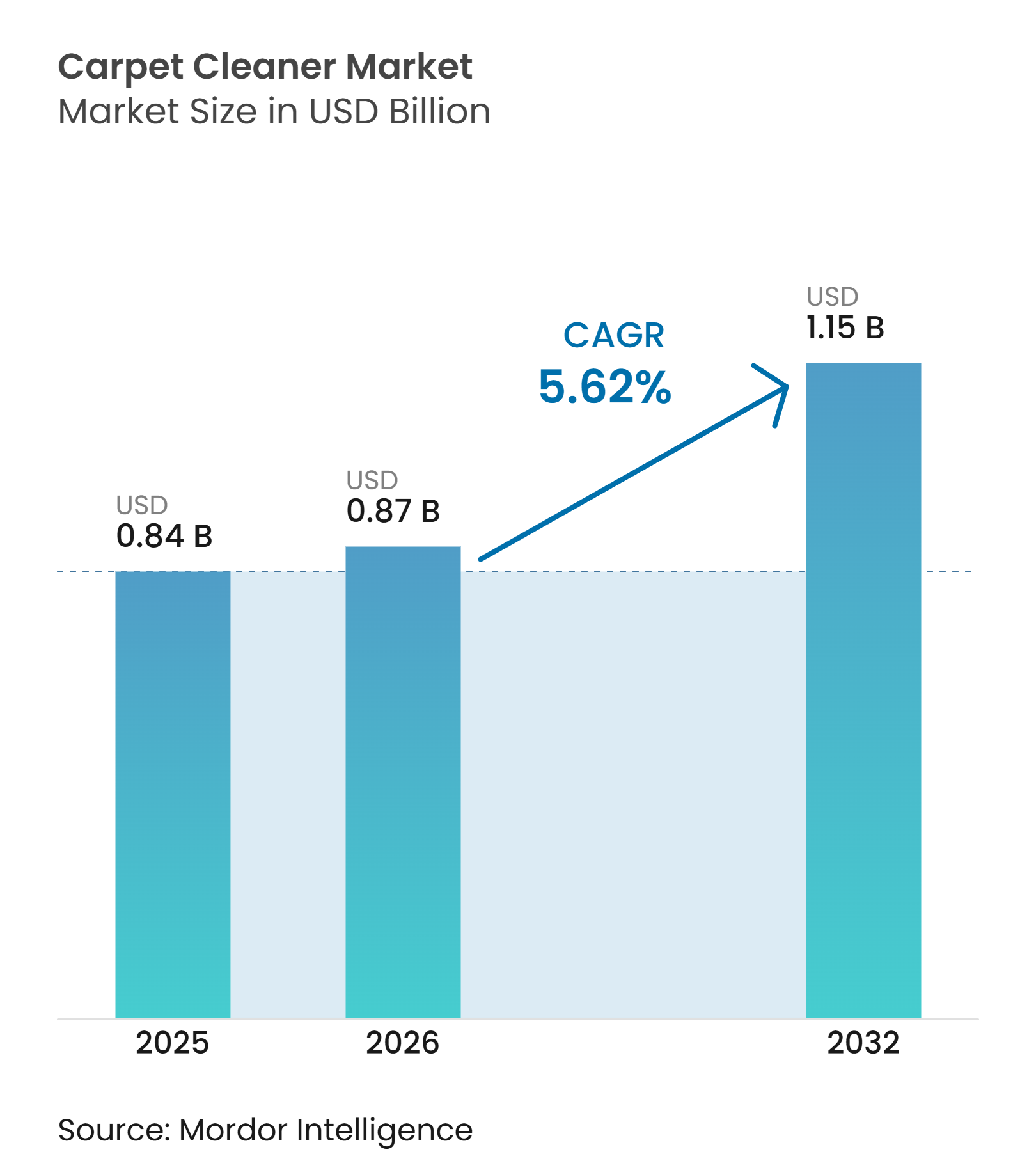
The carpet cleaner market size is projected to expand from USD 0.84 billion in 2026 and USD 0.87 billion in 2027 to USD 1.15 billion by 2032, registering a CAGR of 5.6% between 2027 and 2032. The global carpet cleaner market is supported by recurring commercial cleaning needs in hotels, health care facilities, offices, schools, and retail properties with carpeted areas that require dependable cleaning schedules. Buying decisions in the global carpet cleaner market increasingly favor equipment that reduces drying time, controls water use, supports documented cleaning routines, and fits established facility-maintenance programs and recurring procurement cycles, while giving operators practical options for different carpet conditions, room sizes, access limitations, and cleaning frequencies across commercial and residential settings. Product development also centers on connected equipment, robotic operation, and self-cleaning features, although adoption is strongest among larger commercial users that can absorb higher equipment costs and integrate new systems into established workflows. Hard flooring continues to limit new-carpet demand in some commercial projects, but the installed carpet base still requires regular maintenance across active commercial properties. Consumer demand is expected to strengthen through portable products and online retail, while contract cleaning remains the main source of commercial equipment revenue because professional users typically require larger machines, service support, and recurring consumables.
Key Report Takeaways
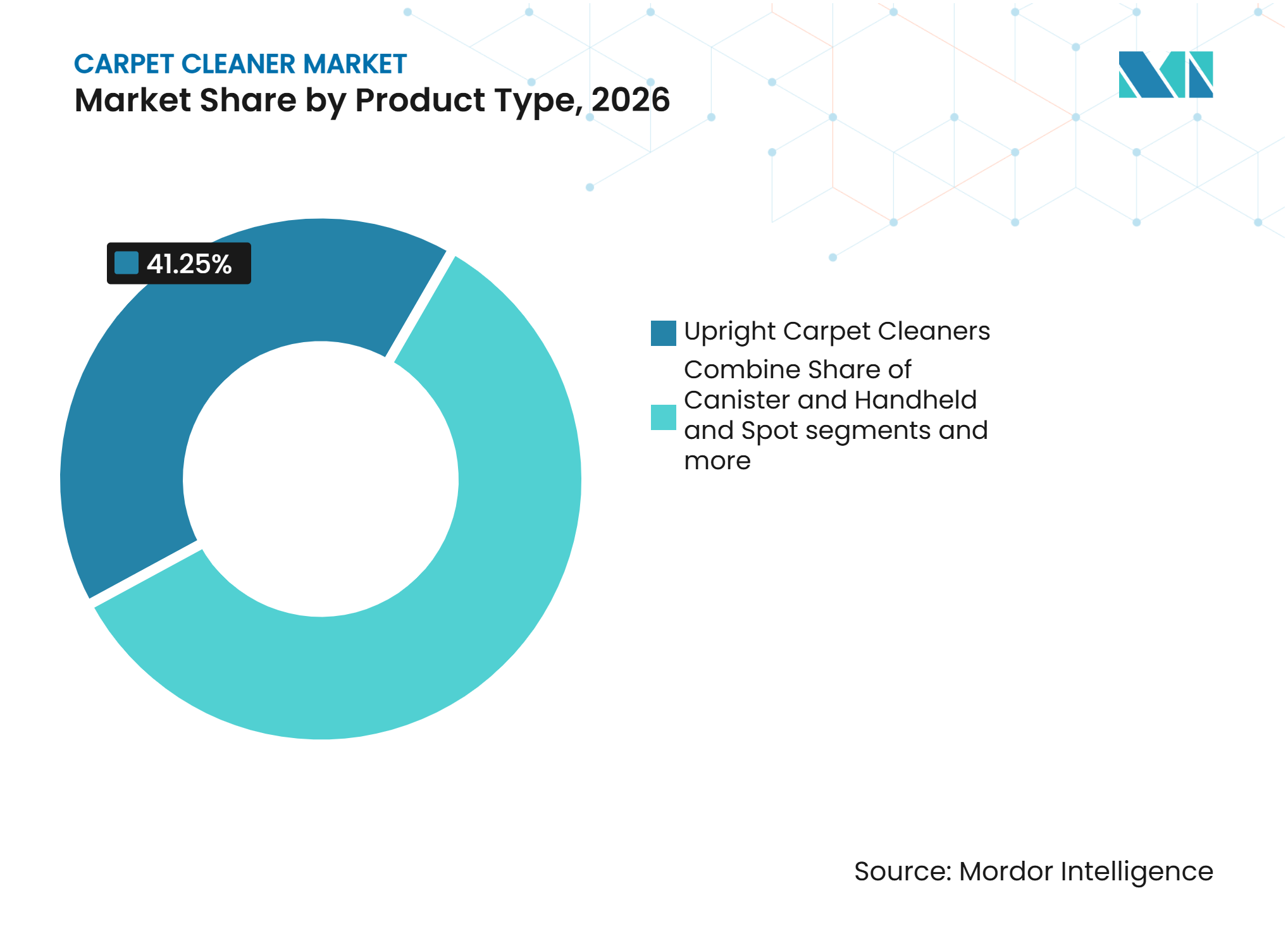
- By product type, upright carpet cleaners held 41.25% of the global carpet cleaner market share in 2026, while handheld and spot carpet cleaners are forecast to expand at a 6.18% CAGR through 2032.
- By cleaning method, carpet extractors held 65.15% of the global carpet cleaner market revenue share in 2026, while carpet steamers are forecast to expand at a 6.37% CAGR through 2032.
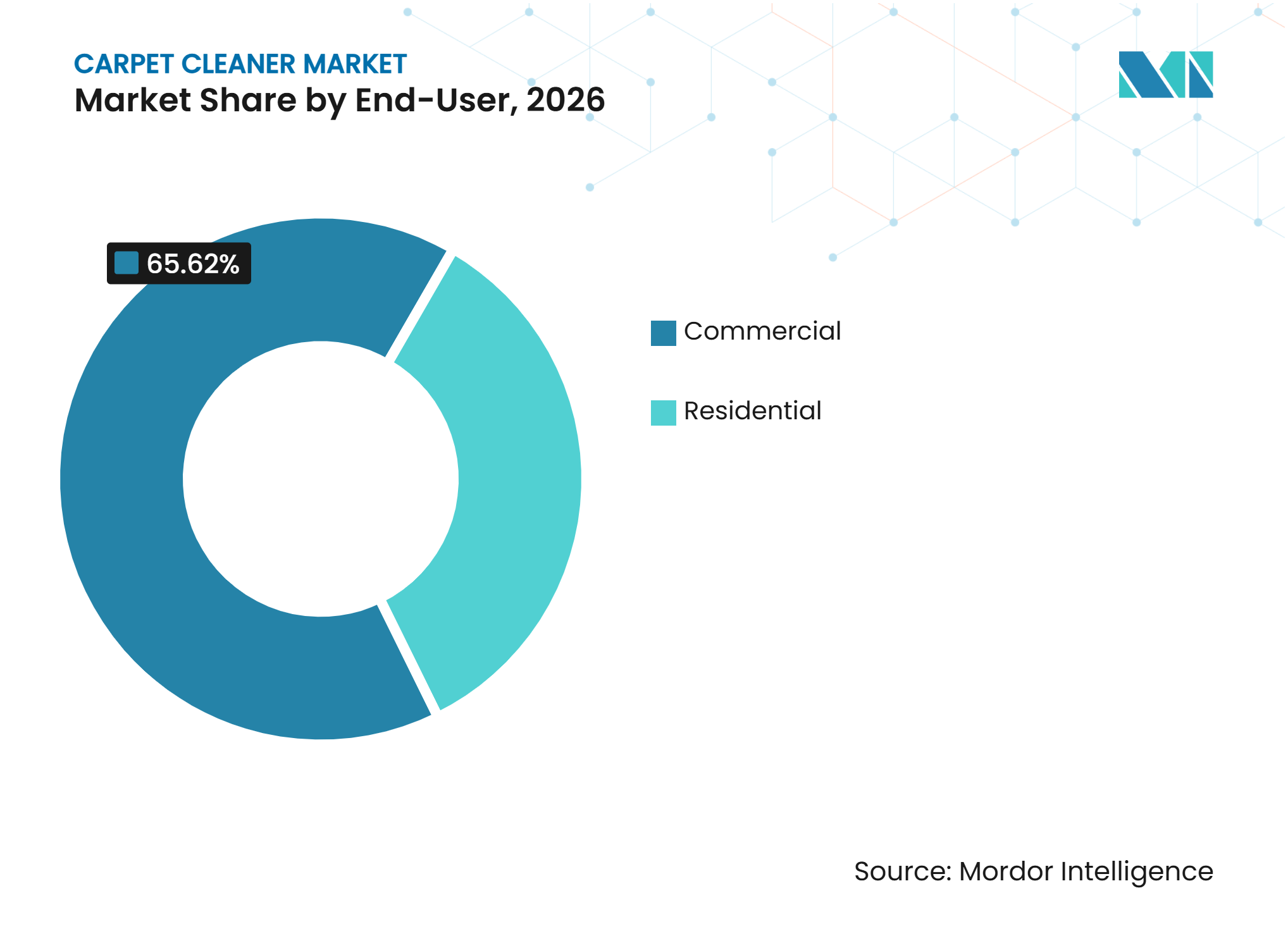
- By end user, commercial users held 65.62% of the global carpet cleaner market revenue share in 2026, while residential users are forecast to expand at a 6.53% CAGR through 2032.
- By distribution channel, business-to-business and direct sales held 62.58% of the global carpet cleaner market revenue share in 2026, while business-to-consumer and retail channels are forecast to expand at a 6.84% CAGR through 2032.
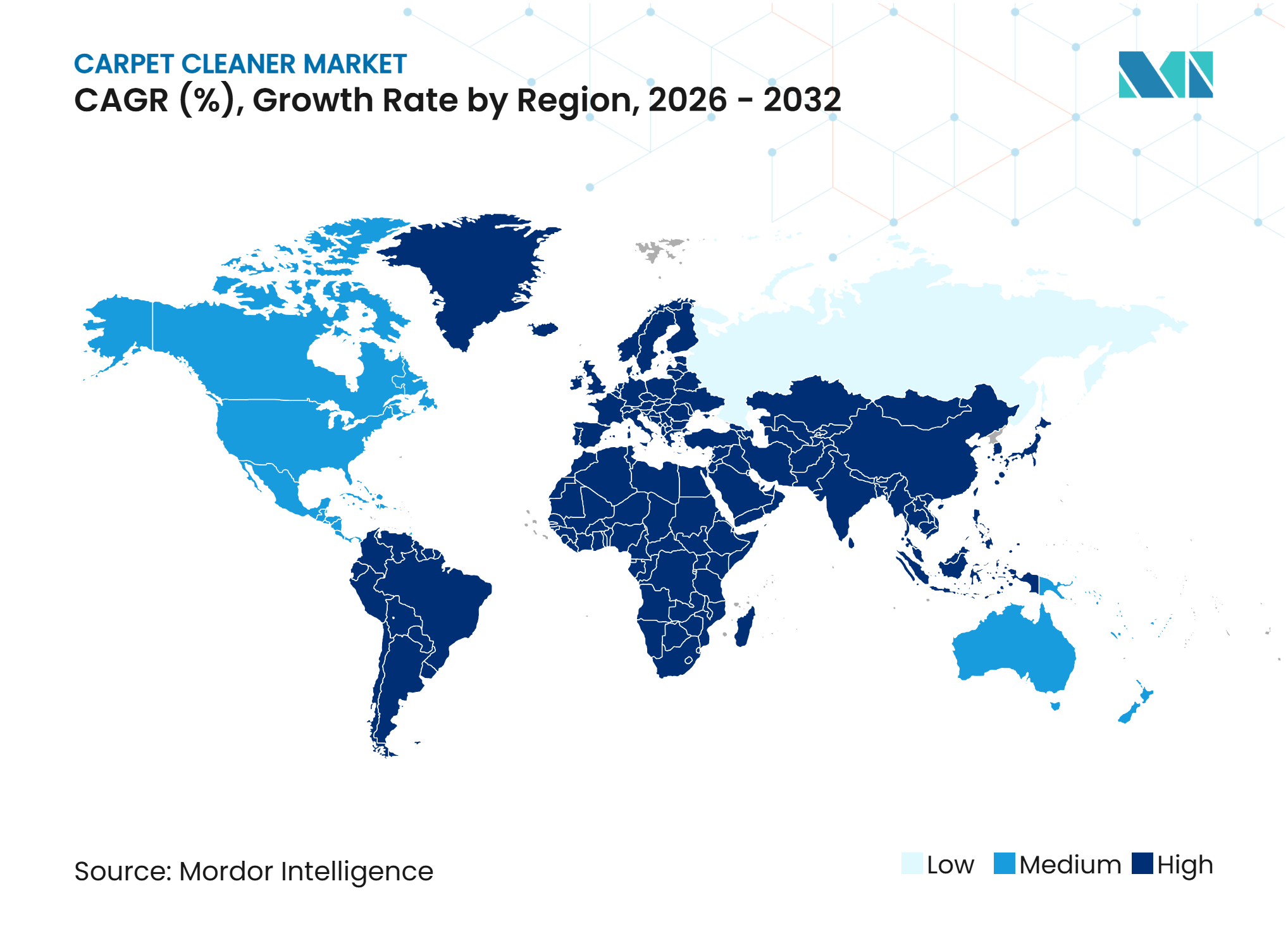
- By geography, North America held 39.16% of the global carpet cleaner market revenue share in 2026, while Europe is forecast to expand at a 7.16% CAGR through 2032.
Note: Market numbers in this report are based on Mordor Intelligence's proprietary estimation framework, which combines nine months of actuals with Q4 projections for base year 2026.
Market Trends and Insights
Drivers Impact Analysis of Carpet Cleaner Market*
| Driver | (~) % Impact on CAGR Forecast | Geographic Relevance | Impact Timeline |
|---|---|---|---|
| Rising Hygiene and Indoor-Air-Quality Awareness | +1.3% | Global; strongest in North America, Northern Europe, and urban Asia-Pacific | Short term (≤ 2 years) |
| Expansion of Carpeted Hospitality and Commercial Facilities | +0.9% | MEA, Asia-Pacific, and South America hospitality build-outs; North America senior-living and corporate | Medium term (2-4 years) |
| Growth of Professional and Contract Cleaning Services | +0.8% | North America and Europe; spill-over to Asia-Pacific facility management hubs | Medium term (2-4 years) |
| Product Innovation in Extraction, Steam, and Low-Moisture Cleaning | +0.8% | Global, with early adoption in commercial-grade North America and Europe | Long term (≥ 4 years) |
| Carpet Maintenance Requirements in High-Traffic Facilities | +0.6% | North America, Europe, MEA hospitality and healthcare hubs | Short term (≤ 2 years) |
| Water-Saving Demand for Encapsulation and Dry-Cleaning Systems | +0.4% | Global; led by water-stressed markets in MEA, Asia-Pacific, and Western United States | Long term (≥ 4 years) |
| Source: Mordor Intelligence | |||
Rising Hygiene and Indoor Air Quality Awareness
The global carpet cleaner market benefits from heightened attention to indoor air quality in buildings with heavily used carpeted spaces. Regular removal of dust and embedded particles is important for offices, health care facilities, airports, and schools that maintain documented cleaning programs and seek consistent maintenance outcomes. The International Sanitary Supply Association stated that Leadership in Energy and Environmental Design version 5 allows commercial buildings to earn points for green-cleaning initiatives, including low-emitting and energy-efficient equipment[1]. These requirements encourage facility managers to treat carpet cleaning as part of routine building operations rather than a discretionary service that can be deferred when property budgets are under pressure. BISSELL stated that its Revolution HydroSteam Professional combines cleaning functions intended to address household allergens and soil in carpeted surfaces[2]. The global carpet cleaner Market is expected to benefit as buyers connect cleaning outcomes with occupant comfort and building standards.
Expansion of Carpeted Hospitality and Commercial Facilities
Hospitality properties continue to require cleaning equipment for guest rooms, corridors, ballrooms, and other carpeted areas that receive frequent use. Carpet remains relevant in hospitality interiors where acoustic control and interior design requirements support its use. Hotel operators require equipment that can remove soil between guest stays while limiting room downtime and avoiding disruption to daily service routines. Low-moisture and encapsulation methods are relevant where operators seek to reduce water and chemical use. These operating needs support demand for extractors, steamers, and portable equipment in the global carpet cleaner market. New hospitality facilities and renovation work in Asia-Pacific, the Middle East and Africa, and South America are expected to widen the addressable customer base, subject to local capital spending conditions, procurement practices, and the availability of local service networks.
Growth of Professional and Contract Cleaning Services
Outsourced cleaning contracts remain a core route through which commercial users procure carpet cleaning equipment. Multi-site office, retail, hotel, and health care operators use service agreements to standardize cleaning frequency and equipment specifications. In 2025, Tennant Company and L&T Technology Services agreed to establish a dedicated Offshore Development Centre in India to develop digital features for industrial and commercial cleaning equipment. That agreement indicates continued supplier interest in India and other Asia-Pacific facility-management markets, where commercial development and formal cleaning contracts can increase demand for professional equipment. Direct procurement also creates aftermarket revenue from maintenance, accessories, cleaning solutions, repair services, and replacement components used throughout the equipment life cycle. Formal contract cleaning is expected to support predictable replacement demand, particularly where service providers manage broad property portfolios.
Product Innovation in Extraction, Steam, and Low-Moisture Cleaning
Manufacturers are differentiating equipment through faster drying, automation, reduced water use, and digital controls. In 2026, Tennant Company reported third-quarter robotics sales of USD 37.3 million, up 71% from the prior-year period [3]. The result shows that autonomous cleaning equipment is gaining greater commercial relevance, even though robotic equipment serves a broader floor-care category rather than carpet cleaning alone. In September 2026, BISSELL launched the Revolution ExpressClean upright carpet and upholstery cleaner with a stated 30-minute dry time and self-cleaning features. Faster drying is valuable to hotels and offices because it limits access restrictions after cleaning and helps staff return rooms or common areas to service. Innovation is expected to narrow the practical difference between consumer and professional equipment in selected applications, particularly where users value portable formats, quick setup, and shorter drying times.
Restraints Impact Analysis of Carpet Cleaner Market*
| Restraint | (~) % Impact on CAGR Forecast | Geographic Relevance | Impact Timeline |
|---|---|---|---|
| Competition from Hard-Flooring Alternatives | -0.7% | North America (commercial), Western Europe (renovation); spill-over to Asia-Pacific and South America | Long term (≥ 4 years) |
| High Upfront Cost of Professional-Grade Equipment | -0.5% | Asia-Pacific, South America, and MEA emerging markets; SME professional cleaners globally | Medium term (2-4 years) |
| Carpet-Fiber and Backing Compatibility Risk | -0.2% | Global; relevant wherever specialty or luxury fibers are prevalent | Medium term (2-4 years) |
| Water-Recovery, Drying-Time, and Wastewater-Handling Constraints | -0.2% | Occupied commercial buildings; water-scarce regions globally | Short term (≤ 2 years) |
| Source: Mordor Intelligence | |||
Competition from Hard-Flooring Alternatives
Commercial carpet revenue declined 2%, while hard-surface revenue increased 3%, according to Floor Daily. The shift was material because new flooring choices influence future demand for carpet maintenance equipment. Floor Covering News reported that carpet share loss had slowed in acoustically sensitive settings, including offices and senior living facilities. This pattern means the installed carpet base continues to support cleaning demand even as some new projects choose hard surfaces. The restraint is strongest in renovations where low-maintenance hard surfaces are selected to reduce ongoing cleaning requirements. Equipment suppliers can partly limit exposure by serving mixed-floor facilities and emphasizing the value of carpet care in hospitality and institutional settings.
High Upfront Cost of Professional-Grade Equipment
Professional extractors and steam units remain a significant capital purchase for small contractors and emerging-market cleaning providers. Limited access to financing can lead buyers to choose lower-priced equipment with fewer features, lower capacity, or less comprehensive service support. This constraint is relevant in parts of Asia-Pacific, South America, and the Middle East and Africa where service margins can be narrow. Nilfisk reported that its Americas organic revenue declined 4.9%, citing softer demand conditions and order intake pressures[4]. Equipment rental, service contracts, and subscription arrangements can lower the initial cost barrier for selected customers and may allow smaller operators to access more capable equipment without a large upfront purchase. These options are expected to remain more accessible to large commercial accounts than to small independent operators.
*Our forecasts treat driver/restraint impacts as directional, not additive. The impact forecasts reflect baseline growth, mix effects, and variable interactions.
Carpet Cleaner Market Segment Analysis
By Product Type:
Portable Products Increase Consumer AccessUpright carpet cleaners held 41.25% of the global carpet cleaner market revenue share, supported by tank capacity, steady extraction performance, and coverage of larger carpeted spaces. Upright formats serve households and small commercial users who need a familiar machine layout and simple operation. Product refreshes from consumer brands support the format through retail stores and online channels where product comparison and convenience influence purchase decisions. Canister models remain relevant in smaller homes and apartments where portability and storage space matter. Other product types include truck-mounted systems and robotic machines used in specialized professional settings.
Handheld and spot carpet cleaners are forecast to grow at a 6.18% CAGR through 2032, exceeding the overall Global Carpet Cleaner Market growth rate. In February 2025, BISSELL launched the Little Green Mini portable deep cleaner at 7 pounds to address apartments, vehicles, and pet households. Compact products support targeted stain removal rather than whole-room cleaning. This use case suits consumers seeking quick treatment of pet messes, spills, and upholstery stains. Online visibility and lower ticket prices are expected to broaden adoption of portable equipment.



By Cleaning Method:
Extractors Retain the Commercial LeadCarpet extractors held 65.15% of the global carpet cleaner market revenue share because they provide deep cleaning for heavily soiled commercial carpets. Hotels, health care networks, schools, and large offices use extractors where soil removal and water recovery are essential. Hot-water extraction remains closely associated with restorative cleaning practices and carpet-care programs. Suppliers differentiate extractors through tank size, heat retention, recovery performance, and portable or truck-mounted configurations. Professional users select these features according to floor area, cleaning frequency, access requirements, staffing levels, and the need to manage equipment transport.
Carpet steamers are forecast to grow at a 6.37% CAGR through 2032. Steam-based products appeal to users that prioritize reduced drying time and limited disruption in occupied properties. BISSELL described its HydroSteam Professional as a machine that uses steam in its carpet cleaning process. Growth in steamers does not remove the need for extractors because deep rinsing remains necessary for many commercial cleaning tasks. Buyers are expected to compare equipment on drying performance, water consumption, and ease of operation as well as cleaning results.
By End User:
Commercial Demand Provides the Largest Revenue BaseCommercial users held 65.62% of the global carpet cleaner market revenue share, led by hospitals, hotels, corporate campuses, schools, and retail chains. These customers operate formal carpet-maintenance programs that create recurring equipment demand. Multi-site operators commonly procure through direct supplier contracts, distributors, and cleaning service networks. Commercial customers also value service support, spare parts, and cleaning accessories because downtime can affect building operations, tenant access, and scheduled maintenance work. The global carpet cleaner industry therefore remains dependent on established facility-management demand.
Residential users are forecast to grow at a 6.53% CAGR through 2032. Pet ownership, hybrid work patterns, and the availability of compact extraction equipment support household demand. Products priced below USD 300 can make deep cleaning more accessible to consumers than professional-grade equipment. Online retail allows buyers to compare formats and select tools for specific needs, including stains, upholstery, and vehicle interiors. Brands with broad retail distribution and clear product education are expected to be well positioned in the residential segment.

By Distribution Channel:
Direct Commercial Sales Remain CentralBusiness-to-business and direct sales held 62.58% of the global carpet cleaner market revenue share, reflecting the large role of commercial purchasers in revenue. These channels include direct sales teams, distributors, service contracts, and rental arrangements. Tennant Company reported direct commercial sales in more than 25 countries and distributor reach in more than 100 markets. Direct channels can support longer customer relationships because equipment sales often include service and consumable requirements. Facility budgets and contract renewal schedules also make commercial procurement relatively predictable for suppliers that maintain service coverage and dependable equipment availability.
Business-to-consumer and retail channels are forecast to grow at a 6.84% CAGR through 2032. Online platforms allow consumers to research compact cleaners and buy them without a commercial distributor. BISSELL launched the Revolution ExpressClean through Amazon and its own website before wider retail distribution. This direct-to-consumer approach can reach buyers when they are actively searching for stain-removal equipment. Retail growth is expected to shift unit demand toward consumer equipment while commercial direct sales remain the larger revenue channel.
Geography Analysis
North America
North America held 39.16% of the global carpet cleaner Market share, supported by commercial carpet in offices, senior-living properties, hotels, and health care facilities. Floor Daily reported that commercial carpet revenue reached USD 2.86 billion, while hard-surface revenue reached USD 2.11 billion. Long-term facility-management contracts support regular purchasing and replacement of professional equipment. The International Sanitary Supply Association identified Leadership in Energy and Environmental Design version 5 as a framework that recognizes green-cleaning initiatives in building operations. This regulatory influence encourages facilities to consider energy use and cleaning methods when upgrading equipment. The region also has a large consumer retail base for upright and portable cleaners, supported by established product distribution, online purchasing options, and widespread familiarity with household cleaning equipment. Suppliers are expected to focus on faster drying and low-disruption performance because commercial users must maintain access to busy facilities.
Europe
Europe is forecast to expand at a 7.2% CAGR through 2032, the fastest regional rate in the supplied Global Carpet Cleaner Market data. The region benefits from commercial renovation activity and demand for water-efficient cleaning processes. Eco-certification expectations and operational sustainability goals strengthen interest in low-moisture equipment, particularly where users seek to reduce water use and disruption. Northern European buyers often place particular value on cleaning chemicals and equipment that reduce environmental impacts. the United Kingdom, Germany, France, and the Benelux countries represent active settings for professional extractors and steamers. Southern European hotel renovation activity adds demand for cleaning systems that can prepare rooms and common areas with short downtime. Equipment suppliers are expected to compete on efficient water use, drying performance, and reliable service coverage.
Asia-Pacific, South America, Middle East and Africa
Asia-Pacific is the third-largest geographic segment in the Global Carpet Cleaner Market, with urbanization, commercial real estate development, and facility-management professionalization supporting demand. In 2025, Tennant Company and L&T Technology Services agreed to develop industrial and commercial cleaning technologies in India, demonstrating supplier interest in the region. Nilfisk reported 3.9% organic revenue growth in Asia-Pacific, driven by markets outside China. South America offers additional demand from retail and hospitality development, although import costs, currency volatility, and limited financing can constrain premium equipment purchases. Middle East and Africa demand is linked to luxury hospitality projects and commercial development in Gulf cities. South Africa and Nigeria provide early opportunities as institutional buyers formalize cleaning procurement. Suppliers that provide financing, local service, and water-efficient equipment are expected to have an advantage across these mixed regions.
Competitive Landscape
Market Concentration
BISSELL, Alfred Kärcher, Tennant Company, and Nilfisk are prominent suppliers in the global carpet cleaner market and the wider professional cleaning equipment space. BISSELL maintains a strong consumer presence through the HydroSteam, Little Green, and Revolution product lines. Tennant Company competes in commercial cleaning through connected equipment, robotics, and a direct and distributor sales network. Nilfisk continues to serve professional users through its broad cleaning equipment portfolio and operational restructuring. Mytee Products, Daimer Industries, EDIC, Santoemma, Goodway Technologies, Rotowash, and IP Cleaning address specialist or regional professional requirements.
In 2026, Tennant Company completed acquisitions of Reinigungstechnik 4 You in Germany, Clean Machine Falkenberg AB in Sweden, and Repax AB in Sweden to increase channel access in direct-presence markets. In 2026, Tennant Company also introduced BrainOS Clean 2.0 and SelfPath artificial intelligence features for its robotic cleaning platform, expanding automated navigation capabilities. These moves strengthen its position in connected commercial cleaning rather than only conventional equipment sales and extend its ability to serve direct-presence markets. In September 2026, BISSELL launched Revolution ExpressClean with a stated 30-minute dry time and simultaneous online availability. This product strategy focuses on consumer convenience and household cleaning outcomes.
In 2026, Nilfisk closed its Brooklyn Park manufacturing facility and moved United States large-machine production to Querétaro, Mexico, while opening an Arkansas distribution center. The move reflects the importance of cost control, production utilization, and parts availability in professional equipment competition. Suppliers also pursue recurring revenue through service contracts, accessories, maintenance, digital monitoring, and support arrangements that can extend customer relationships. The market remains moderately concentrated among global leaders, but specialist manufacturers maintain positions in restoration and smaller contractor channels. Competitive success is expected to depend on product reliability, service reach, water efficiency, and the ability to meet both commercial and consumer requirements.
Carpet Cleaner Industry Leaders
-
BISSELL Inc.
-
Alfred Kärcher SE & Co. KG
-
Techtronic Industries Company Limited
-
Nilfisk Holding A/S
-
Tennant Company
- *Disclaimer: Major Players sorted in no particular order
Carpet Cleaner Market Companies Covered in this Report
- BISSELL Inc.
- Alfred Kärcher SE & Co. KG
- Techtronic Industries Company Limited
- Nilfisk Holding A/S
- Tennant Company
- Rug Doctor LLC
- Reckitt
- The Clorox Company
- Zep Inc.
- Ecolab Inc.
- Diversey Holdings LTD
- Church & Dwight Co., Inc.
- Sprayway Inc.
- Cleanfix Reinigungssysteme AG
- Daimer Industries, Inc.
- Mytee Products, Inc.
- EDIC
- Numatic International Ltd.
- Santoemma Srl
- TRUVOX International
Recent Industry Developments in Carpet Cleaner Market
- November 2026: Tennant Company launched the P1 VAC, its first autonomous robotic vacuum, combining autonomous vacuuming, dust mopping, and an edge-sweeping side brush that directs debris into the cleaning path. Third-quarter 2026 robotics sales reached USD 37.3 million, up 71% year over year, while net sales reached USD 322.3 million, up 6.2% year over year.
- September 2026: BISSELL launched the Revolution ExpressClean upright carpet and upholstery cleaner at USD 229.99, featuring a stated 30-minute carpet dry time, an antimicrobial brush roll, and two cleaning modes.
- June 2025: Tennant Company and L&T Technology Services signed an agreement to establish a dedicated Offshore Development Centre in India that focuses on connected and digital features for cleaning equipment.
- February 2025: BISSELL launched the Little Green Mini portable deep cleaner, a 7-pound compact product designed for small apartments, cars, and pet households.
Global Carpet Cleaner Market Report Scope
Segmentation Overview
| Upright Carpet Cleaners |
| Canister Carpet Cleaners |
| Handheld and Spot Carpet Cleaners |
| Other Product Types |
| Carpet Extractors |
| Carpet Steamers |
| Residential |
| Commercial |
| B2C/Retail | Multi-brand Stores |
| Exclusive Brand Outlets | |
| Online | |
| Other Distribution Channels | |
| B2B/Direct Sales |
| North America | Canada |
| United States | |
| Mexico | |
| South America | Brazil |
| Peru | |
| Chile | |
| Argentina | |
| Rest of South America | |
| Europe | United Kingdom |
| Germany | |
| France | |
| Spain | |
| Italy | |
| BENELUX (Belgium, Netherlands, Luxembourg) | |
| NORDICS (Denmark, Finland, Iceland, Norway, Sweden) | |
| Rest of Europe | |
| Asia-Pacific | India |
| China | |
| Japan | |
| Australia | |
| South Korea | |
| South-East Asia | |
| Rest of Asia-Pacific | |
| Middle East & Africa | United Arab Emirates |
| Saudi Arabia | |
| South Africa | |
| Nigeria | |
| Rest of Middle East & Africa |
| By Product Type | Upright Carpet Cleaners | |
| Canister Carpet Cleaners | ||
| Handheld and Spot Carpet Cleaners | ||
| Other Product Types | ||
| By Cleaning Method | Carpet Extractors | |
| Carpet Steamers | ||
| By End-User | Residential | |
| Commercial | ||
| By Distribution Channel | B2C/Retail | Multi-brand Stores |
| Exclusive Brand Outlets | ||
| Online | ||
| Other Distribution Channels | ||
| B2B/Direct Sales | ||
| By Geography | North America | Canada |
| United States | ||
| Mexico | ||
| South America | Brazil | |
| Peru | ||
| Chile | ||
| Argentina | ||
| Rest of South America | ||
| Europe | United Kingdom | |
| Germany | ||
| France | ||
| Spain | ||
| Italy | ||
| BENELUX (Belgium, Netherlands, Luxembourg) | ||
| NORDICS (Denmark, Finland, Iceland, Norway, Sweden) | ||
| Rest of Europe | ||
| Asia-Pacific | India | |
| China | ||
| Japan | ||
| Australia | ||
| South Korea | ||
| South-East Asia | ||
| Rest of Asia-Pacific | ||
| Middle East & Africa | United Arab Emirates | |
| Saudi Arabia | ||
| South Africa | ||
| Nigeria | ||
| Rest of Middle East & Africa | ||
Key Questions Answered in the Report
What is the forecast growth rate for the global carpet cleaner market?
The global carpet cleaner market is forecast to grow at a 5.6% CAGR from 2027 to 2032, reaching USD 1.15 billion by 2032. In the Global Carpet Cleaner Market, the forecast reflects recurring commercial replacement needs, the value of faster drying in occupied buildings, and rising consumer purchases of compact cleaning equipment.
Which carpet cleaner product type has the largest share?
In the global carpet cleaner market, upright carpet cleaners held 41.3% of revenue in 2026, supported by their ability to clean larger carpeted areas.
Which cleaning method leads carpet cleaning equipment demand?
In the global carpet cleaner market, carpet extractors held 65.2% of revenue in 2026 because commercial users require deep soil removal and water recovery.
Which end-user group buys the most carpet cleaning equipment?
In the global carpet cleaner market, commercial users held 65.6% of revenue in 2026, led by hotels, health care facilities, offices, schools, and retail properties.
Which region leads carpet cleaning equipment demand?
In the global carpet cleaner market, North America held 39.2% of revenue in 2026, supported by its large commercial carpet base and mature contract-cleaning system.