
Cardiovascular Needle Market Size and Share
Market Overview
| Study Period | 2020 - 2031 |
|---|---|
| Market Size (2026) | USD 104.33 Million |
| Market Size (2031) | USD 149.17 Million |
| Growth Rate (2026 - 2031) | 7.41 % |
| Fastest Growing Market | Asia-Pacific |
| Largest Market | North America |
| Market Concentration | Medium |
Major Players *Disclaimer: Major Players sorted in no particular order Image © Mordor Intelligence. Reuse requires attribution under CC BY 4.0. | |
Cardiovascular Needle Market Analysis by Mordor Intelligence
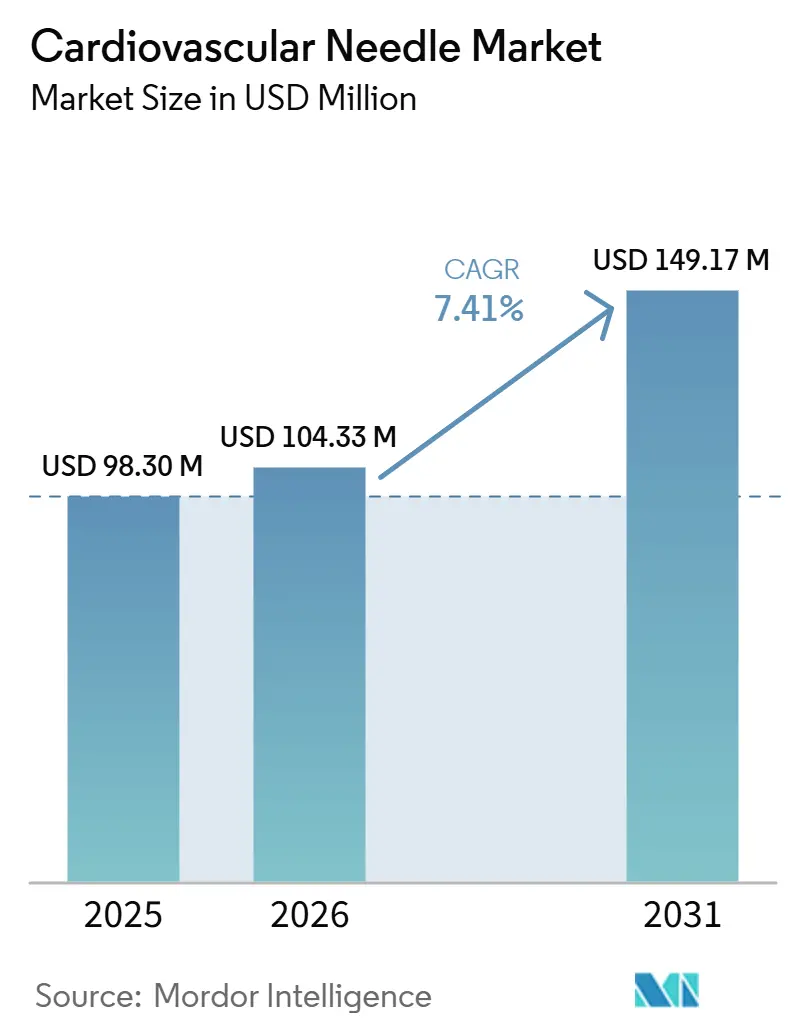
The cardiovascular needle market is projected to be USD 98.30 million in 2025, USD 104.33 million in 2026, and reach USD 149.17 million by 2031, growing at a CAGR of 7.41% from 2026 to 2031. The cardiovascular needle market is supported by the persistent burden of cardiovascular disease, which caused 19.8 million deaths in 2022 and represented 32% of all deaths worldwide. The cardiovascular needle market also benefits from aging populations and a rising absolute disease load, because global cardiovascular incident cases increased from 34.74 million in 1990 to 66.81 million in 2021 even as age standardized rates declined in many places. Product expectations are moving toward stronger alloys, cleaner tissue passage, and better handling consistency, which gives the cardiovascular needle market a clearer premium layer than standard stainless steel lines can offer. Suppliers are also using sterile procedure kits and robotic-compatible designs to protect pricing and deepen hospital relationships as the cardiovascular needle market becomes more procedure specific. A key limit remains the shift toward transcatheter valve interventions, so the best opportunities in the cardiovascular needle market sit with companies that can hold value in open, complex, and workflow-sensitive cardiac surgery settings.
Key Report Takeaways
- By product type, round bodied needles led with 52.16% share in 2025, and they are also projected to grow at the fastest 7.86% CAGR through 2031.
- By usage, single-use needles held 53.43% of the cardiovascular needle market share in 2025, while multiple-use needles are forecasted to expand at the highest 8.13% CAGR through 2031.
- By application, coronary artery bypass graft surgery accounted for 43.14% of cardiovascular needle market in 2025, while open-heart surgery is expected to advance at the fastest 9.41% CAGR through 2031.
- By end-user, hospitals captured 45.32% share in 2025, while ambulatory surgical centers are projected to record the highest 8.53% CAGR through 2031.
- By geography, North America captured 47.25% share in 2025, while Asia-Pacific is projected to record the highest 10.32% CAGR through 2031.
Note: Market size and forecast figures in this report are generated using Mordor Intelligence’s proprietary estimation framework, updated with the latest available data and insights as of January 2026.
Market Trends and Insights
Drivers Impact Analysis of Cardiovascular Needle Market*
| Driver | (~) % Impact on CAGR Forecast | Geographic Relevance | Impact Timeline |
|---|---|---|---|
| Rising Global Cardiovascular Disease Burden | +2.1% | Global | Short term (≤ 2 years) |
| Shift Toward Single-Use Sterile Needles | +1.6% | APAC core, spill-over to North America | Medium term (2-4 years) |
| Growth in CABG and Open-Heart Procedure Volumes | +1.4% | Global, led by North America and Europe | Medium term (2-4 years) |
| Expansion of Robotic and Minimally Invasive Cardiac Surgery | +0.8% | North America and Europe, early gains in South Korea and Japan | Medium term (2-4 years) |
| Adoption of Atraumatic Needle Geometries for Tissue Preservation | +0.6% | North America, emerging in Europe | Short term (≤ 2 years) |
| Rising Demand for Premium Needles in Ambulatory Cardiac Centers | +0.5% | Global | Long term (≥ 4 years) |
| Source: Mordor Intelligence | |||
Rising Global Cardiovascular Disease Burden
The cardiovascular needle market has a durable demand base because the global cardiovascular disease burden continues to expand in absolute terms. Global incident cases increased from 34.74 million in 1990 to 66.81 million in 2021, which represented a 92.3% rise over the period.[1]V.A. Luyckx et al., “Global, Regional, and National Burden of Cardiovascular Disease, 1990-2021: Results From the 2021 Global Burden of Disease Study,” Journal of the American College of Cardiology / PubMed Central, pmc.ncbi.nlm.nih.gov This pattern matters because lower age standardized rates have not reduced the number of patients who still move into advanced care pathways and eventually require surgery. The cardiovascular needle market therefore remains tied not only to disease prevalence, but also to the expanding number of patients reaching severe multivessel, structural, or repeat cardiac interventions. Each open cardiac procedure requires multiple needles across anastomosis, tissue approximation, and closure steps, so case growth translates into recurring unit demand.
Shift Toward Single-Use Sterile Needles
The cardiovascular needle market is also being shaped by a stronger push toward sterile, traceable, single-use instruments in accredited surgical settings. The WHO guideline on bloodstream and other infections associated with intravascular catheter use reinforces strict sterile technique expectations for vascular procedures and related instrument handling. In practice, this raises the compliance floor for cardiac centers that want consistent documentation and lower infection risk across procedure flows. Even though multiple-use needles are growing faster, the single-use segment still benefits from hospital policies that favor known sharpness, known sterility status, and ready integration into preassembled procedure kits. That combination supports premium pricing when manufacturers can package the needle as part of a broader surgical workflow rather than as a stand-alone commodity.
Growth in CABG and Open-Heart Procedure Volumes
The cardiovascular needle market is closely linked to CABG and other open-heart procedures because these cases remain needle intensive and technically demanding. Germany performed 28,843 isolated CABG procedures in 2024, and the reported on-pump to off-pump ratio of 2.5 to 1 confirms that many centers still rely on needle-heavy surgical workflows.[2]A. Beckmann et al., “German Heart Surgery Report 2024: The Annual Updated Registry of the German Society for Thoracic and Cardiovascular Surgery (DGTHG),” The German Heart Surgery Report, bishtref.com This matters because on-pump procedures require specialized suturing steps in vessel anastomosis, tissue repair, and closure, which sustain demand for multiple needle types in a single case. The cardiovascular needle market is therefore being supported not only by procedure count, but also by the number of needle passes required in complex repairs. As case complexity rises, manufacturers that match needle geometry to specific surgical tasks can capture a larger share of wallet inside the operating room.
Expansion of Robotic and Minimally Invasive Cardiac Surgery
The cardiovascular needle market is entering a new design phase as robotic and minimally invasive cardiac surgery programs expand. In January 2026, the da Vinci 5 system received FDA 510(k) clearance for multiple cardiac indications, including mitral valve repair, tricuspid valve repair, atrial septal defect repair, patent foramen ovale closure, and internal mammary artery mobilization for coronary revascularization.[3]Intuitive Surgical, “Da Vinci 5 Cleared for Cardiac Procedures,” GlobeNewswire, globenewswire.com Robotic manipulation changes the performance demands placed on surgical needles because the device must tolerate repeated gripping, torque, and penetration through variable tissue without losing tip integrity. That pushes the cardiovascular needle market toward stronger alloys, better surface treatments, and more consistent geometry control than standard lines usually provide. It also favors manufacturers that can validate product performance within robotic workflows before these programs scale across major heart centers.
Restraints Impact Analysis of Cardiovascular Needle Market*
| Restraint | (~) % Impact on CAGR Forecast | Geographic Relevance | Impact Timeline |
|---|---|---|---|
| Substitution by Transcatheter and Sutureless Cardiac Techniques | -1.5% | North America and Europe | Long term (≥ 4 years) |
| Price Sensitivity in Cost-Constrained Public Health Systems | -1.0% | APAC core, Middle East and Africa, South America | Long term (≥ 4 years) |
| Sterility, Quality, and Traceability Compliance Burden | -0.7% | Global | Medium term (2-4 years) |
| Limited Differentiation in Mature Standard Needle Offerings | -0.5% | North America and Europe | Short term (≤ 2 years) |
| Source: Mordor Intelligence | |||
Substitution By Transcatheter and Sutureless Cardiac Techniques
A major restraint on the cardiovascular needle market is the continued substitution of open surgical valve procedures by transcatheter and sutureless approaches. In Germany during 2024, transcatheter procedures represented 54.9% of all isolated heart valve procedures, which shows that the procedural mix has already shifted materially in a mature cardiac surgery system. The cardiovascular needle market will therefore see stronger growth in applications that remain difficult to convert to catheter-based treatment. Companies with heavy exposure to surgical valve lines face more pressure than companies with broader coverage across bypass, repair, and hybrid procedures.
Limited Differentiation in Mature Standard Needle Offerings
A second restraint is the limited differentiation that still exists across mature stainless steel needle lines in the cardiovascular needle market. When product performance differences are small, procurement teams often focus on price, contract terms, and packaging rather than on brand preference alone. This reduces pricing power for suppliers that do not have a clear advantage in robotic handling, alloy strength, coating performance, or procedure specific configurations. It also makes it harder for smaller manufacturers to fund development spending, because margin erosion in standard products weakens the ability to invest in better platforms. Suppliers that cannot show a measurable workflow or handling benefit are more likely to remain exposed to tender-led competition and replacement risk.
*Our forecasts treat driver/restraint impacts as directional, not additive. The impact forecasts reflect baseline growth, mix effects, and variable interactions.
Cardiovascular Needle Market Segment Analysis
By Product Type:
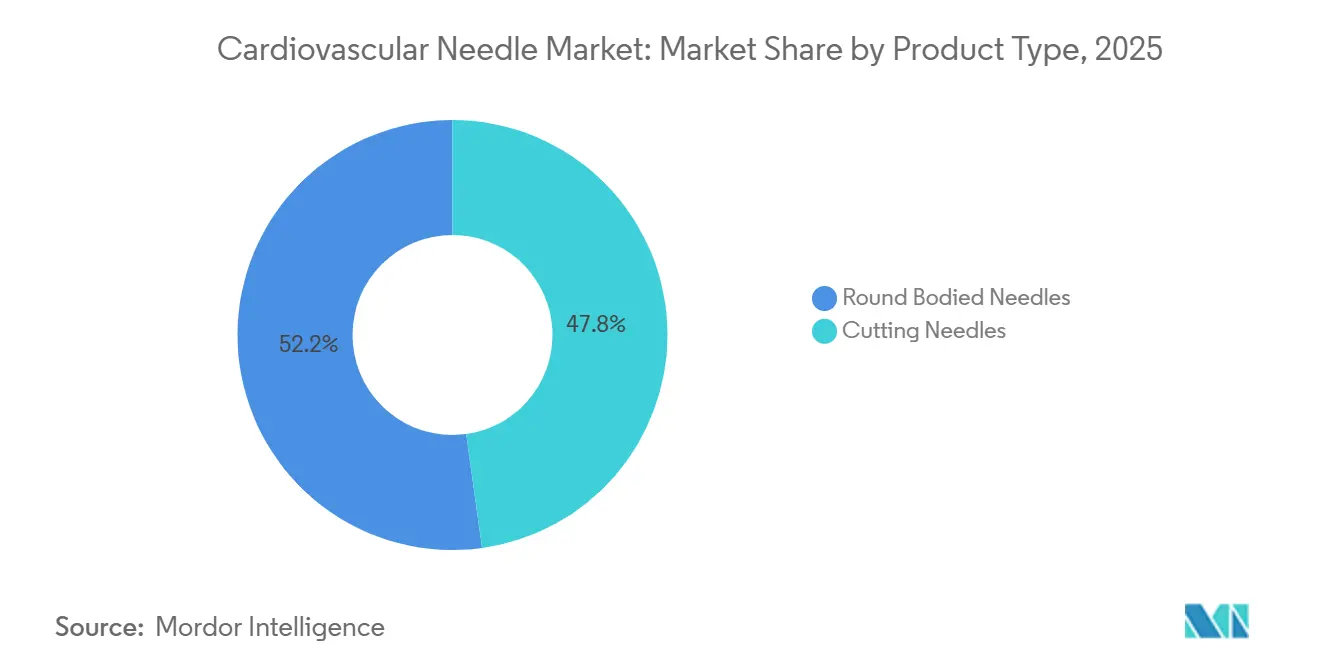
Round Bodied Needles Remain the Reference FormatRound bodied needles held 52.16% of cardiovascular needle market share in 2025. Their position reflects the central role of atraumatic tissue passage in vascular anastomosis, where the surgeon needs clean penetration without cutting fragile vessel walls. In open cardiac repair, this geometry helps preserve graft and native vessel integrity during repeated passes, which is why it remains the preferred format in many high-acuity settings. Cutting needles still serve an important role in tougher tissue, especially where surgeons must pass through fibrous structures such as calcified annuli, pericardium, or closure tissue.
The cardiovascular needle market for round bodied needles is expected to expand at 7.86% CAGR through 2031, which suggests that the leading format is not losing momentum as procedure requirements become more specialized. Robotic and minimally invasive procedures strengthen this pattern because thinner profiles and stable tip behavior become more important when the surgeon works through instrument interfaces rather than by direct hand motion. In the cardiovascular needle market, that kind of documented handling improvement gives round bodied formats a better chance of defending premium pricing than standard commodity lines can achieve.


By Usage:
Single-Use Scale and Multiple-Use Growth Can CoexistSingle-use needles held 53.43% share in 2025, which kept them in the leading position within the cardiovascular needle market. Their scale is supported by infection control discipline, surgeon preference for factory calibrated sharpness, and the ease of documenting sterility across each procedure. Single-use products also fit naturally into prepacked procedure kits, which reduces setup time and gives suppliers more scope to bundle value rather than compete only on unit price. For private hospitals and large cardiac centers, those workflow advantages often matter as much as the needle itself.
Multiple-use needles are anticipated to be the fastest-growing usage segment at 8.13% CAGR through 2031, which shows that the cardiovascular needle market is not moving in one uniform direction. Growth in this segment reflects the cost logic of public and budget-sensitive systems that need to expand procedure volumes without matching every increase in demand with higher consumables spending. In those settings, controlled resterilization protocols make multiple-use formats economically attractive when hospitals can manage quality and handling standards internally. The cardiovascular needle market is becoming more segmented by care model and reimbursement setting than by simple product labeling alone.
By Application:
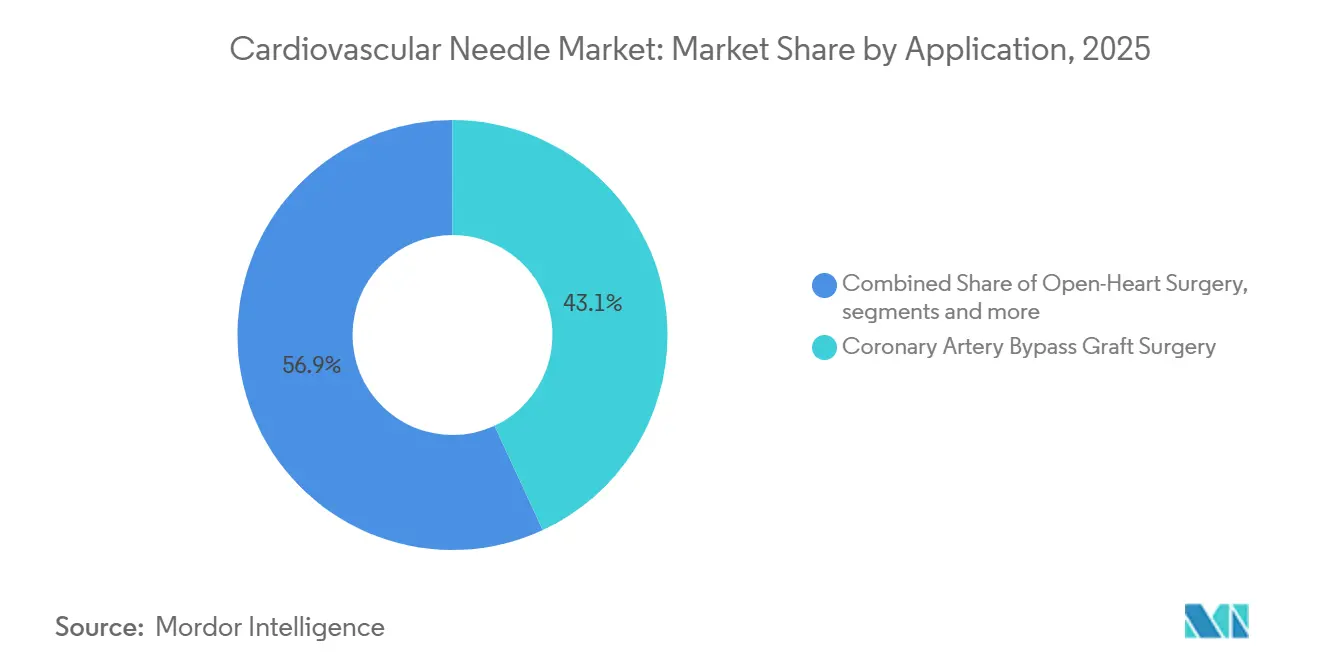
CABG Remains the Demand Anchor While Open-Heart Surgery Grows FasterCoronary artery bypass graft surgery accounted for 43.14% of cardiovascular needle market in 2025, which made it the largest application by a wide margin. CABG consumes a high number of needles per case because the procedure involves repeated suturing across proximal and distal anastomoses, tissue approximation, and closure steps. This keeps bypass surgery at the center of the cardiovascular needle market even when less invasive treatment options gain more attention in broader cardiac care. For suppliers, CABG is valuable not only because of case numbers, but also because per-case needle consumption stays high.
Open-heart surgery is expected to be the fastest-growing application at 9.41% CAGR through 2031, which indicates that the cardiovascular needle market is still gaining from complex surgical repair rather than retreating from it. Cardiac valve procedures face a more mixed outlook because transcatheter substitution is stronger in advanced systems, especially where hospital economics support TAVR expansion. Smaller applications such as transplant and other cardiovascular procedures remain important for premium suppliers because these cases demand precision, length options, and size matched needle-suture combinations.

By End-User:
Hospitals Still Lead While Ascs and Specialty Centers Widen Procurement ChannelsHospitals held 45.32% of the end-user segment in 2025, which reflects their long-standing role as the primary setting for open cardiac surgery. The cardiovascular needle market remains closely tied to hospital systems because CABG, valve repair, perfusion support, and post-operative intensive care still require the infrastructure of full-service surgical centers. Large hospitals also buy across a wider range of needle formats, since they perform a broader mix of procedures and support more surgeons with varying technique preferences.
Ambulatory surgical centers are projected to grow at the fastest 8.53% CAGR through 2031, which signals an important change in how the cardiovascular needle market will be accessed over time. Selected cardiac procedures are moving outward from the hospital setting, and that widens the need for standardized products that simplify setup, documentation, and consistent performance in leaner care environments. The cardiovascular needle market is therefore gaining a second route to commercial growth, one built on specialized outpatient and focused cardiac settings rather than only on large hospital chains.
Geography Analysis
North America Cardiovascular Needle Market
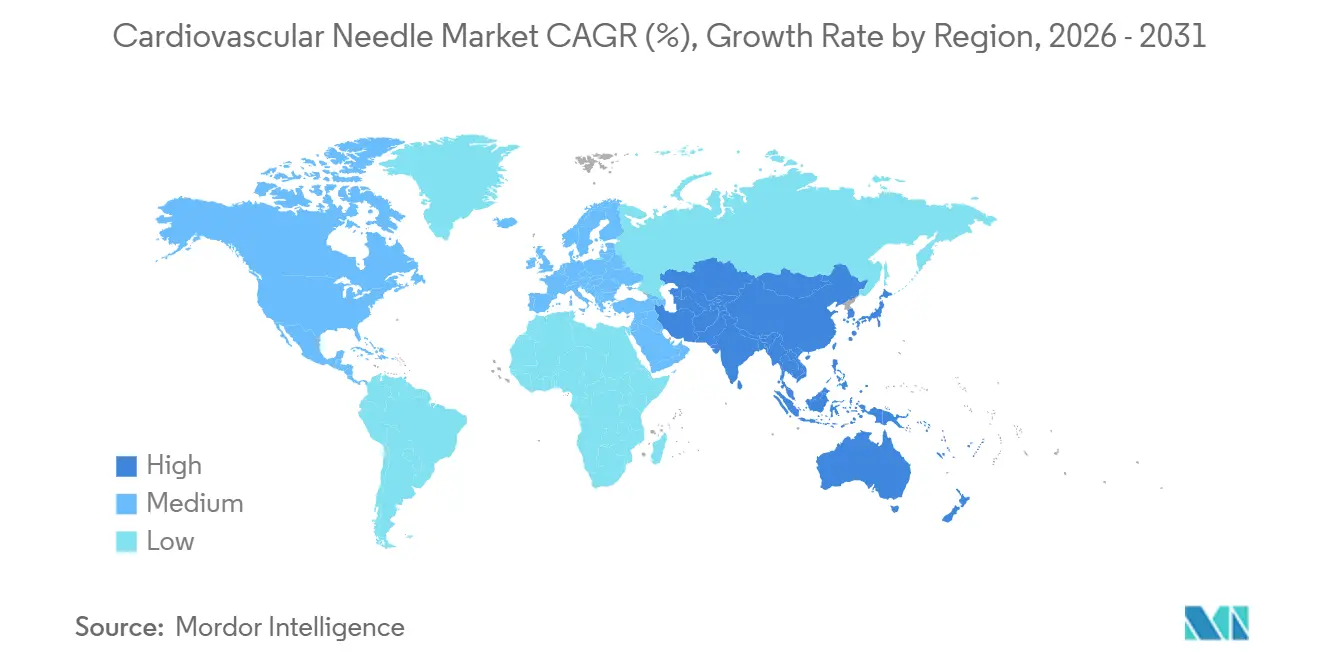
North America held 47.25% of cardiovascular needle market share in 2025, which kept it as the largest regional block. The region benefits from mature reimbursement structures, high surgical intensity in complex cardiac cases, and strong procurement ties between hospital systems and established suppliers. The cardiovascular needle market in North America also favors premium lines because hospitals are more likely to value handling consistency, sterile packaging, and documented performance in workflow-sensitive procedures. Regulatory discipline and bundled purchasing behavior also make entry harder for smaller suppliers that lack broad portfolios or validation support.
Europe Cardiovascular Needle Market
Europe remained the second-largest region, with Germany, France, and the United Kingdom anchoring procedure demand. France also remained a meaningful cardiac surgery market, and the ESC Atlas reported CABG rates of 266 procedures per million people in 2024. At the same time, the cardiovascular needle market in Europe faces more pressure from transcatheter valve substitution and from the added regulatory overhead associated with EU MDR compliance.
APAC, MEA and South America Cardiovascular Needle Market
Asia-Pacific is projected to be the fastest-growing region at 10.32% CAGR through 2031, which gives the cardiovascular needle market size its strongest expansion path outside mature Western systems. Growth in the region is supported by broader cardiac care modernization, rising procedure capacity, and the widening role of private and public providers in advanced surgery. Japan stands out for premium demand characteristics because precision instrumentation and quality expectations support higher value products even in a mature environment. The Middle East and Africa and South America add a second growth layer for the cardiovascular needle market, where improving cardiac center capability creates room for both volume expansion and higher per-case product value.

Competitive Landscape
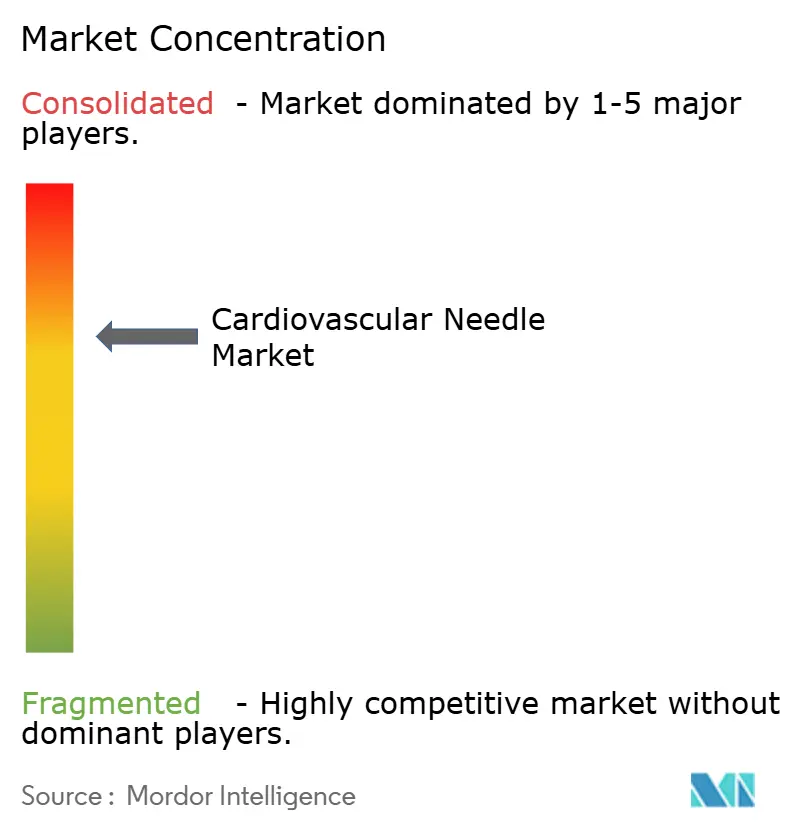
The cardiovascular needle market is moderately concentrated, with Ethicon, B. Braun Melsungen AG, and Becton Dickinson forming the most visible part of the premium competitive layer. These companies benefit from brand recognition, broad relationships with hospital systems, and the ability to pair needles with related suturing or vascular access portfolios. The next layer includes manufacturers such as MANI, Inc., Terumo Corporation, Barber of Sheffield, FSSB Surgical Needles GmbH, and Quality Needles Pvt. Ltd., which compete through regional reach, procedure fit, and pricing flexibility. This structure keeps the cardiovascular needle market competitive because no single supplier appears dominant across all product categories, end users, and geographies. It also means product differentiation matters more at the high end of the market than in standard stainless steel lines where procurement teams can switch more easily.
Strategic moves in the cardiovascular needle market are increasingly centered on performance claims, workflow fit, and adjacent procedure ecosystems. Intuitive Surgical's January 2026 clearance for the da Vinci 5 in multiple cardiac indications creates another strategic opening, because validated compatibility with robotic workflows can shape future supplier preference inside heart centers. Becton Dickinson's April 2026 launch of the BD CentroVena One system shows how adjacent procedural simplification in high-acuity vascular settings can strengthen broader relationships with cardiac care providers.
The most consistent strategy pattern in the cardiovascular needle market is procedure-kit integration, where the supplier sells a workflow solution rather than a loose instrument. A second pattern is validation for specialized use cases, especially robotic or premium tissue-preservation settings where documented performance can justify higher pricing. The cardiovascular needle market still has room for regional specialists, but the clearest whitespace sits in robotic-specific geometries, premium alloy platforms, and single-use formats that combine traceability with operating room convenience.
Cardiovascular Needle Industry Leaders
Becton, Dickinson and Company
B. Braun Melsungen AG
Medtronic plc
Teleflex Incorporated
Ethicon US, LLC
- *Disclaimer: Major Players sorted in no particular order
Cardiovascular Needle Market Companies Covered in this Report
- B. Braun
- Barber of Sheffield Ltd.
- Beckton Dickinson
- Boston Scientific
- Cardinal Health
- Cook Group
- CP Medical, Inc.
- Ethicon
- FSSB Surgical Needles GmbH
- KLS Martin Group
- MANI, Inc.
- Medtronic
- Merit Medical Systems
- Quality Needles Pvt. Ltd.
- Scanlan International
- Sklar Surgical Instruments
- Smiths Group
- Surtex Instruments Ltd.
- Symmetry Surgical
- Teleflex
- Terumo

Recent Industry Developments in Cardiovascular Needle Market
- April 2026: Becton Dickinson commercially launched the BD CentroVena One, the first all-in-one central venous catheter insertion system integrating the guidewire, needle, syringe, and catheter into a single streamlined device. The product positions BD to capture share in high-acuity cardiac ICU environments requiring simplified, single-clinician central-line placement.
- January 2026: Intuitive Surgical received FDA 510(k) clearance for the da Vinci 5 surgical robotic system across nine cardiac indications, including mitral valve repair, tricuspid valve repair, IMA mobilization for coronary revascularization, and atrial septal defect repair. This clearance establishes a new category of robotic-compatible cardiovascular needle demand, as the system requires suture needles tolerant of robotic instrument torque profiles and high-cycle manipulation.


Global Cardiovascular Needle Market Report Scope
According to the report’s scope, the cardiovascular needle market refers to the global industry focused on the development, manufacturing, and commercialization of specialized surgical needles used in cardiovascular procedures. These needles are designed for precise tissue penetration and suturing during cardiac and vascular surgeries, enabling secure wound closure and vessel or tissue repair.
The cardiovascular needle market is segmented into product type, usage, application, end-user, and geography. By product type, the market is segmented into round bodied needles and cutting needles. By usage, the market is segmented into single-use and multiple-use. By application, the market is segmented into coronary artery bypass graft surgery, open-heart surgery, cardiac valve procedures, heart transplant, and other cardiovascular surgeries. By end-user, the market is segmented into hospitals, ambulatory surgical centers, cardiac specialty clinics, and other end-users. By geography, the market is segmented into North America, Europe, Asia-Pacific, the Middle East and Africa, and South America. The report also covers the estimated market sizes and trends for 17 countries across major regions globally. The report offers values (USD) for all the above segments.
| Round Bodied Needles |
| Cutting Needles |
| Single-Use |
| Multiple-Use |
| Coronary Artery Bypass Graft Surgery |
| Open-Heart Surgery |
| Cardiac Valve Procedures |
| Heart Transplant |
| Other Cardiovascular Surgeries |
| Hospitals |
| Ambulatory Surgical Centers |
| Cardiac Specialty Clinics |
| Other End-Users |
| North America | United States |
| Canada | |
| Mexico | |
| Europe | Germany |
| United Kingdom | |
| France | |
| Italy | |
| Spain | |
| Rest of Europe | |
| Asia-Pacific | China |
| Japan | |
| India | |
| Australia | |
| South Korea | |
| Rest of Asia-Pacific | |
| Middle East and Africa | GCC |
| South Africa | |
| Rest of Middle East and Africa | |
| South America | Brazil |
| Argentina | |
| Rest of South America |
| By Product Type | Round Bodied Needles | |
| Cutting Needles | ||
| By Usage | Single-Use | |
| Multiple-Use | ||
| By Application | Coronary Artery Bypass Graft Surgery | |
| Open-Heart Surgery | ||
| Cardiac Valve Procedures | ||
| Heart Transplant | ||
| Other Cardiovascular Surgeries | ||
| By End-User | Hospitals | |
| Ambulatory Surgical Centers | ||
| Cardiac Specialty Clinics | ||
| Other End-Users | ||
| By Geography | North America | United States |
| Canada | ||
| Mexico | ||
| Europe | Germany | |
| United Kingdom | ||
| France | ||
| Italy | ||
| Spain | ||
| Rest of Europe | ||
| Asia-Pacific | China | |
| Japan | ||
| India | ||
| Australia | ||
| South Korea | ||
| Rest of Asia-Pacific | ||
| Middle East and Africa | GCC | |
| South Africa | ||
| Rest of Middle East and Africa | ||
| South America | Brazil | |
| Argentina | ||
| Rest of South America | ||


Key Questions Answered in the Report
What is the expected size of the cardiovascular needle market by 2031?
The cardiovascular needle market is forecasted to reach USD 149.17 million by 2031 from USD 98.30 million in 2025 to USD 104.33 million in 2026, at a 7.41% CAGR over 2026-2031.
Which product type leads demand in cardiovascular needles?
Round bodied needles lead demand with 52.16% share in 2025, and they are also expected to be the fastest-growing product type at a 7.86% CAGR through 2031.
Why are single-use needles still important if multiple-use formats are growing faster?
Single-use needles remain important because they held 53.43% share in 2025 and align with sterility, traceability, and procedure-kit needs in accredited cardiac centers.
Which regions matter most for future expansion?
North America remains the largest regional market with 47.25% share in 2025, while Asia-Pacific is projected to be the fastest-growing region at a 10.32% CAGR through 2031.
Page last updated on:





