
Carbon Fiber Wrap Market Size and Share
Market Overview
| Study Period | 2022 - 2032 |
|---|---|
| Market Size (2027) | USD 2.38 Billion |
| Market Size (2032) | USD 3.45 Billion |
| Growth Rate (2027 - 2032) | 7.67 % |
| Fastest Growing Market | Asia-Pacific |
| Largest Market | Asia-Pacific |
| Market Concentration | Low |
Major Players *Disclaimer: Major Players sorted in no particular order Image © Mordor Intelligence. Reuse requires attribution under CC BY 4.0. | |
Carbon Fiber Wrap Market Analysis by Mordor Intelligence
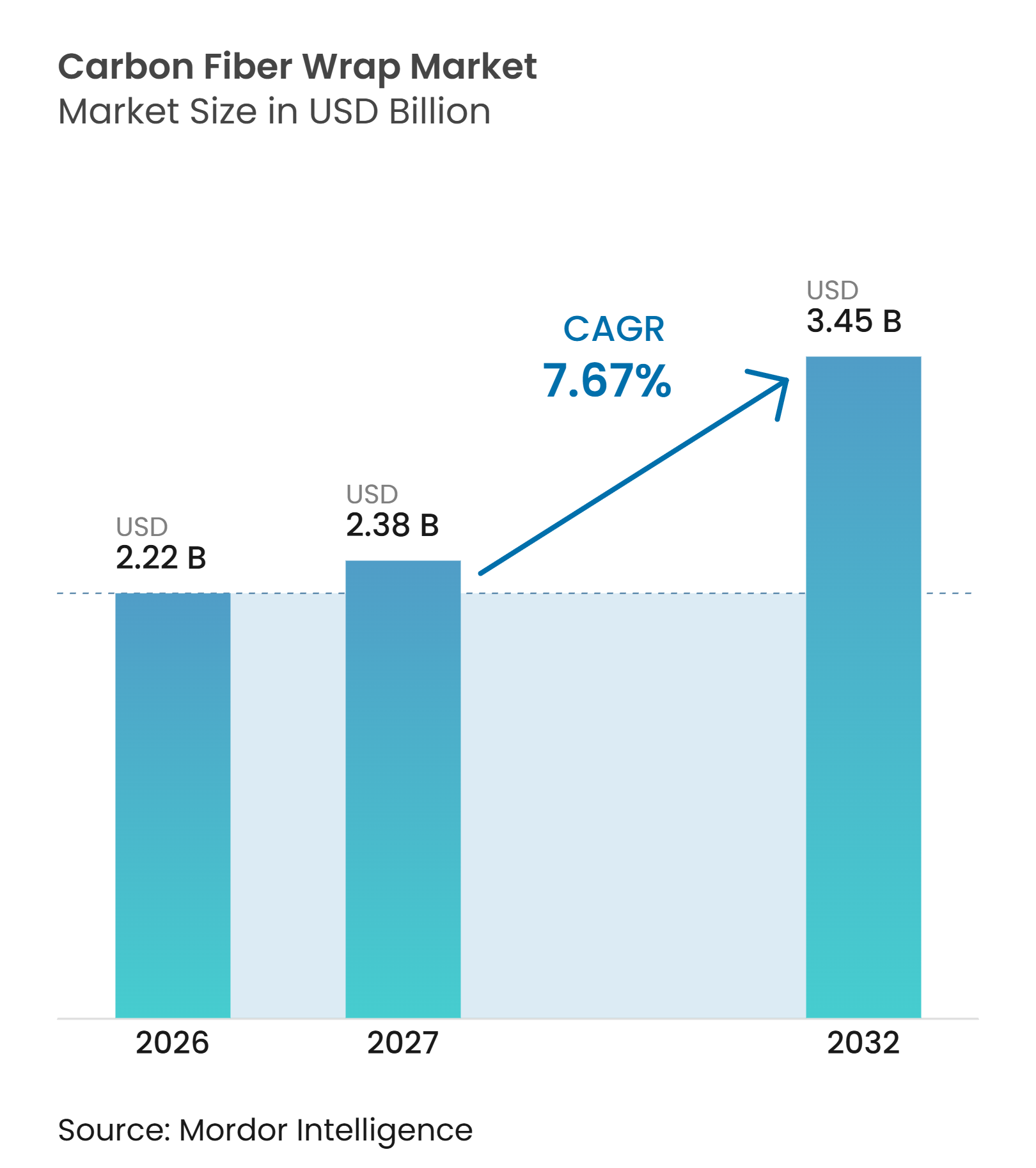
The Carbon Fiber Wrap market size was valued at USD 2.22 billion in 2026 and is estimated to grow from USD 2.38 billion in 2027 to USD 3.45 billion by 2032, at a CAGR of 7.67% during the forecast period (2027-2032). Demand is expanding beyond automotive styling to include decorative films and engineered composite wrap systems. Vehicle personalization, electric vehicle design requirements, repainting compliance costs, and infrastructure repair needs each support different segments of the carbon fiber wrap market. This mix provides suppliers with opportunities in both consumer-facing and specification-led applications. It also requires distributors and installers to develop technical capability for products with different installation and compliance requirements. Competition in the carbon fiber wrap market is shaped by established film producers, regional manufacturers with flexible production, and the growing overlap between wrap films and protective coatings.
Key Report Takeaways
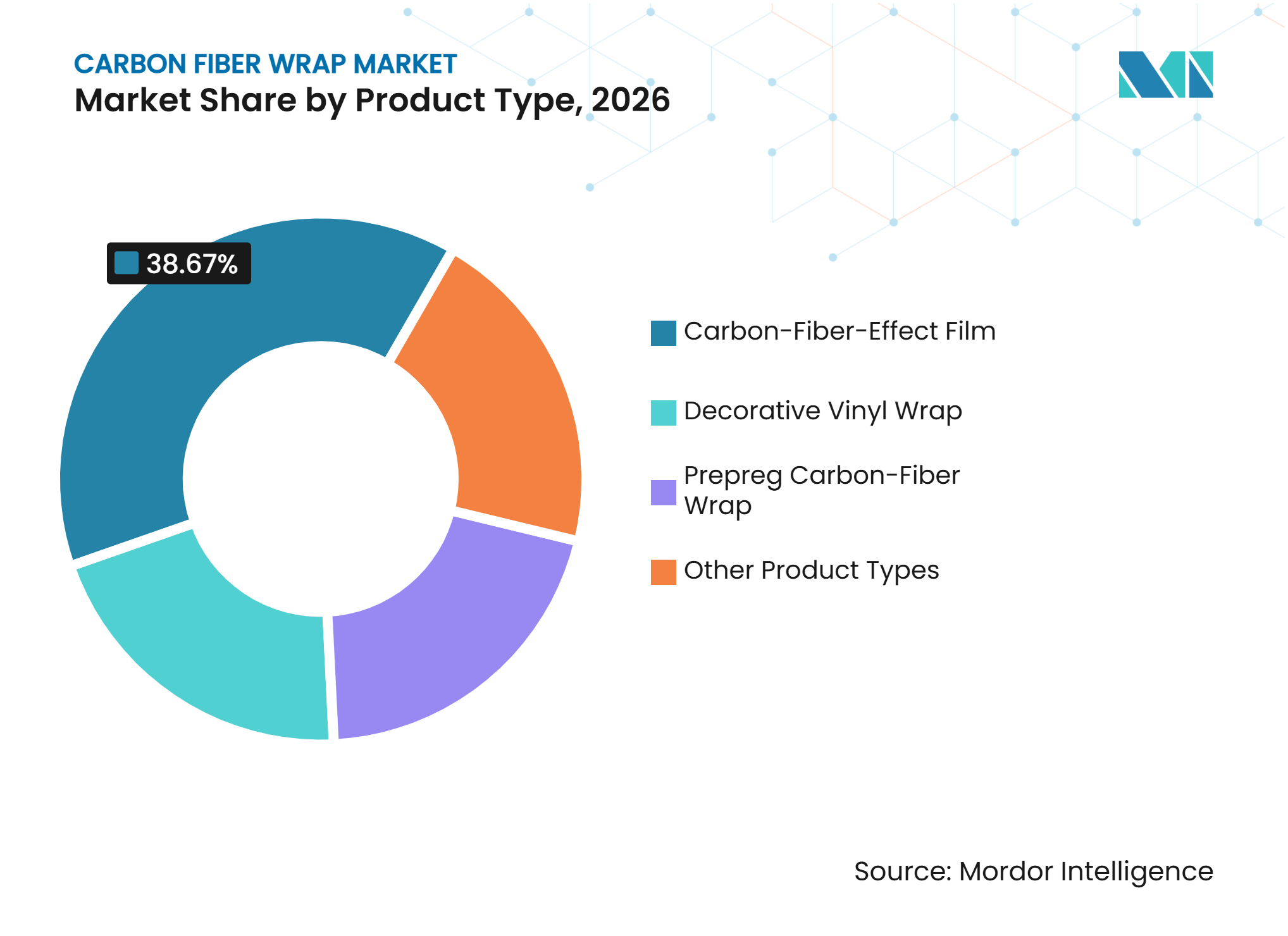
- By product type, Carbon-Fiber-Effect Film held 38.67% of Carbon Fiber Wrap market share in 2026, while Prepreg Carbon-Fiber Wrap is forecast to grow at an 8.17% CAGR through 2032.
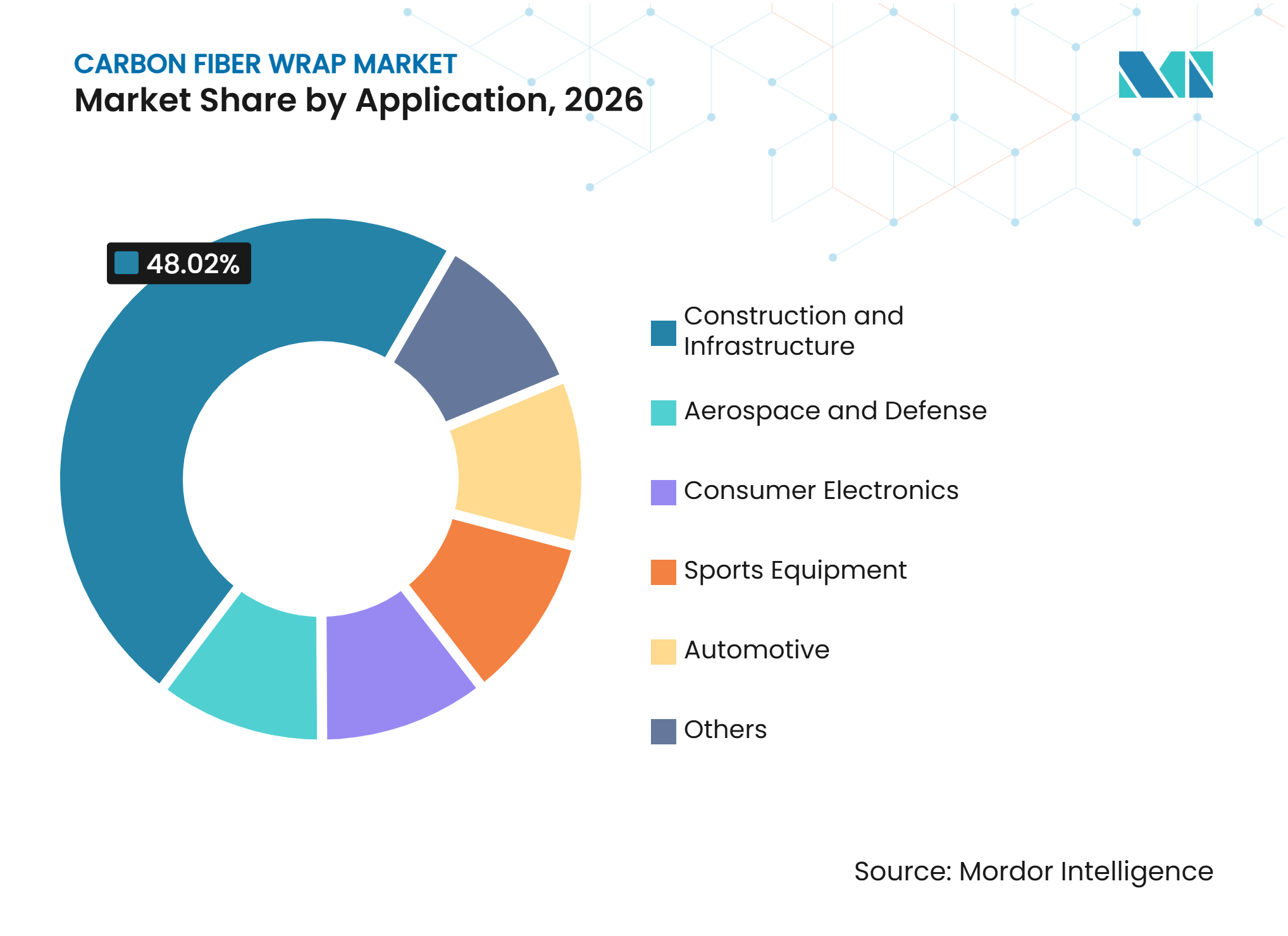
- By application, Construction and Infrastructure accounted for 48.02% of the Carbon Fiber Wrap market size in 2026, while Sports Equipment is forecast to expand at an 8.45% CAGR through 2032.
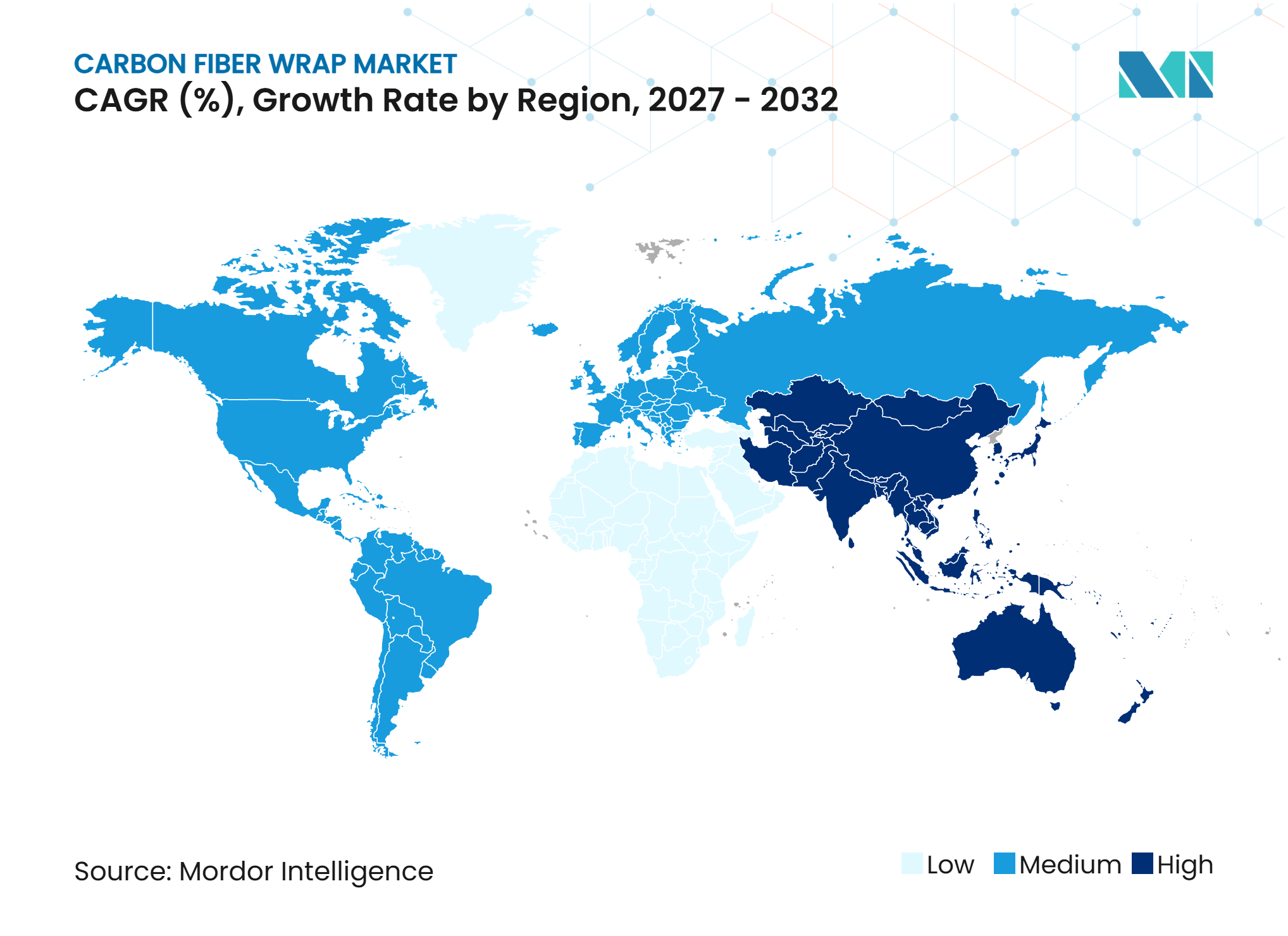
- By geography, Asia-Pacific held 45.39% of the Carbon Fiber Wrap market share in 2026 and is forecast to advance at an 8.38% CAGR through 2032.
Note: Market numbers in this report are based on Mordor Intelligence's proprietary estimation framework, which combines nine months of actuals with Q4 projections for base year 2026.
Market Trends and Insights
Drivers Impact Analysis of Carbon Fiber Wrap Market*
| Drivers | (~) % Impact on CAGR Forecast | Geographic Relevance | Impact Timeline |
|---|---|---|---|
| Rising Demand for Reversible Premium Vehicle Customization | +1.8% | Global, with intensity in APAC and North America | Medium term (2-4 years) |
| EV Lightweighting and Battery-Range Optimization | +1.5% | APAC, North America, Europe | Medium term (2-4 years) |
| Low-Volatile Organic Compound (VOC) Alternative to Conventional Repainting | +1.0% | North America and EU, spillover to APAC | Long term (≥ 4 years) |
| Growth of Installer Networks and E-Commerce Pre-Cut Kits | +0.8% | Global, with acceleration in APAC and LATAM | Medium term (2-4 years) |
| Aging Infrastructure and Rapid Composite Repair Workflows | +1.2% | North America and EU, spillover to MEA | Long term (≥ 4 years) |
| Source: Mordor Intelligence | |||
Rising Demand for Reversible Premium Vehicle Customization
Vehicle wraps appeal to buyers who want a premium appearance without making permanent changes to a vehicle's body. This is particularly relevant where resale values are high, and leasing agreements restrict paint modifications. Reversibility also makes the material suitable for fleet graphics, where vehicles can be rebranded for successive users. Producers are responding with a wider range of gloss, satin, matte, and color-flip finishes, reflecting demand for options beyond standard carbon-fiber patterns. These applications bring consumer, fleet, and commercial demand into the Carbon Fiber Wrap market through a common surface-treatment format.
EV Lightweighting and Battery-Range Optimization
Structural carbon fiber wrap formats are relevant to vehicle programs that seek lower component mass and improved energy efficiency. A 100 kg reduction in an electric vehicle can extend driving range by 10-15 km, making weight reduction an engineering target for manufacturers. Prepreg formats use carbon fiber impregnated with resin and cured under controlled conditions, allowing use in panel reinforcement where composite substitution is technically feasible. The U.S. Department of Energy supported work on steel auto bodies using carbon-fiber-reinforced epoxy, demonstrating an established development route for composite body applications[1]. The proposed SAFE Vehicles Rule III sets a measured path for fuel economy changes through model year 2031, supporting gradual material substitution rather than abrupt vehicle redesign.
Low-VOC Alternative to Conventional Repainting
Wrap films provide fleet operators with an alternative to aerosol and spray-based repainting processes. The U.S. Environmental Protection Agency finalized amendments to the National Volatile Organic Compound Emission Standards for Aerosol Coatings in January 2025, with compliance required by January 2027. This compliance window increases attention on application methods that avoid aerosol VOC emissions during installation. In Europe, REACH requirements and the European Chemicals Agency's work on chemical and microplastic reporting affect the formulation and disclosure requirements for polyvinyl chloride (PVC) films. California's South Coast Air Quality Management District Rule 1168 adds a stricter local consideration for adhesives. These requirements favor suppliers that can clearly document the composition of their film and adhesive, and they strengthen the case for wrap solutions among fleet operators managing compliance across multiple U.S. jurisdictions.
Growth of Installer Networks and E-Commerce Pre-Cut Kits
The Carbon Fiber Wrap market benefits when products can reach both professional installers and individual buyers. Pre-cut kits have expanded access for buyers who do not require a full professional installation. These kits support color changes, decorative finishes, and small-area applications across automobiles and consumer goods. Installer training remains important because film performance depends on surface preparation, temperature control, and application quality. TeckWrap offered intensive two-day training in Germany in 2025, demonstrating how suppliers support installation skill development through direct programs. Growth in regional training partnerships can reduce installation variability in emerging markets. The combination of e-commerce access and trained installers enables suppliers to serve diverse buyer groups without relying solely on traditional automotive distribution channels.
Restraints Impact Analysis of Carbon Fiber Wrap Market*
| Restraints | (~) % Impact on CAGR Forecast | Geographic Relevance | Impact Timeline |
|---|---|---|---|
| Skilled-Installation Cost and Quality Variability | -0.9% | Global, most severe in APAC emerging markets and MEA | Medium term (2-4 years) |
| Temperature, UV, and Edge-Lift Performance Limits | -0.7% | MEA, South America (high-UV environments) | Long term (≥ 4 years) |
| PVC, Adhesive, and End-of-Life Recycling Constraints | -0.6% | EU (REACH), North America (EPA), spillover APAC | Long term (≥ 4 years) |
| Source: Mordor Intelligence | |||
Skilled-Installation Cost and Quality Variability
Professional installation of textured and structural wrap products requires specialized tools and controlled temperature and humidity conditions. Achieving high-quality results can also require several years of experience as an installer. Certification programs remain fragmented across regions, even as supplier training programs continue to expand. TeckWrap's 2025 training program in Germany illustrates incremental efforts to develop installer capability. Premium buyers can accept higher labor costs, while demand for lower-priced options can be limited by inconsistent installation quality. Prepreg formats create an additional barrier, as structural applications require controlled curing protocols. Areas with limited installer networks, including parts of Southeast Asia, the Middle East, and sub-Saharan Africa, may not translate demand into sales as quickly as vehicle ownership and infrastructure spending suggest.
Temperature, UV, and Edge-Lift Performance Limits
Carbon-fiber-effect PVC films are rated for 5-7 years of vertical exposure under moderate European and North American climates. High-UV environments in the Middle East, South Asia, and high-altitude parts of South America can reduce their effective service life. HEXIS introduced its CF001 carbon fiber adhesive film in May 2025, featuring self-healing properties intended to enhance resistance to stone chips and minor impacts[2]. Edge lift and repeated thermal cycling remain relevant risks where temperatures fluctuate sharply between day and night. Buyers in architectural, marine, and industrial applications also lack a universally recognized thermal-performance certification for decorative vinyl wraps, leaving some procurement decisions dependent on manufacturer durability claims. These performance limits restrict broader use of carbon fiber wrap products in exterior and high-heat settings.
*Our forecasts treat driver/restraint impacts as directional, not additive. The impact forecasts reflect baseline growth, mix effects, and variable interactions.
Carbon Fiber Wrap Market Segment Analysis
By Product Type:
Effect Films Lead, While Prepreg Formats Gain Strategic GroundCarbon-Fiber-Effect Film accounted for 38.67% of revenue in 2026. Its position reflects accessible pricing, compatibility with standard dry applications, and a strong fit for aesthetic use cases. Products such as HEXIS's Skintac range and 3M 2080 carbon fiber finishes provide twill-like surface patterns without requiring structural composite expertise. The format is suited to automotive customization, consumer electronics, and branded commercial fleets. It serves buyers focused on color change, with carbon fiber texture as a secondary design choice. E-commerce has widened access to this category through pre-cut kits. The Carbon Fiber Wrap market therefore reaches buyers who may not use a professional installer for every application, helping film suppliers serve both smaller projects and full vehicle wraps.
Prepreg Carbon-Fiber Wrap is projected to expand at an 8.17% CAGR through 2032. The Carbon Fiber Wrap market size for this format is supported by aerospace, motorsport, and high-load repair applications that require real composite performance. In these uses, engineering specifications matter more than visual simulation. A 2025 lifecycle study examined carbon-fiber-reinforced polymer tubular parts for aerospace metal replacement and found material and energy advantages relative to aluminum equivalents across the production, service, and end-of-life stages. These findings can support lifecycle-based material selection in aerospace and defense procurement. Other products, including hybrid thermoplastic polyurethane (TPU)-PVC blends and paint protection film composites, serve buyers seeking both appearance and mechanical protection. Self-healing protective film concepts extend this proposition beyond conventional decorative wrap. These formats give producers with expertise in film chemistry a route to meet appearance and durability requirements simultaneously.



By Application:
Infrastructure Commands Revenue While Sports Accelerates FastestConstruction and Infrastructure commanded 48.02% of revenue in 2026. The segment relies on certified composite wrap systems for pipeline and bridge rehabilitation. Federal Highway Administration-related research on Fiber Reinforced Polymer (FRP)-strengthened concrete bridge inspection provides a structured basis for assessment and maintenance workflows. National Institute of Standards and Technology (NIST) guidance also supports the evaluation of externally applied FRP in seismic retrofit applications. These frameworks reduce uncertainty in project specifications and inspection. Demand patterns in this segment differ from those in vehicle wraps, which have a shorter expected service life and are often selected for appearance. Electric vehicle adoption may increase demand for personalization as owners seek exterior differentiation. The Carbon Fiber Wrap market thus spans functional repair work and consumer-facing design applications.
Sports Equipment is forecast to grow at an 8.45% CAGR through 2032. The Carbon Fiber Wrap market size in this application benefits from demand for lighter and stiffer bicycles, tennis rackets, golf shafts, and ski poles. Carbon fiber continues to be used across sports and recreation applications where strength-to-weight performance is important. Wrap formats add a finishing and customization layer to premium equipment, extending carbon-look surface treatments from professional-grade products to premium consumer equipment. Aerospace and Defense demand is more closely linked to prepreg and filament-wound structural formats. Consumer Electronics uses thin decorative films for laptops, smartphones, and gaming hardware, with demand driven by appearance and premium device categories, particularly in Asia-Pacific. Across these applications, suppliers must distinguish clearly between structural composite materials and decorative films.

Geography Analysis
Asia-Pacific
Asia-Pacific held 45.39% of regional revenue in 2026 and is forecast to grow at an 8.38% CAGR from 2027 to 2032. The region combines high consumption of carbon-fiber-effect and decorative films with upstream production of PVC and Thermoplastic Polyurethane (TPU) films. China supports high absolute demand through its large automotive aftermarket. South Korea and Japan support specialty products through established premium vehicle modification cultures. India adds demand through urban mobility and infrastructure rehabilitation programs. South Korea's electronics manufacturing sector also supports the use of thin decorative films in consumer devices. Thailand and Indonesia are expanding installer training partnerships, which can improve application consistency. Regional producers in Guangdong use high-output manufacturing and OEM or ODM capabilities to serve changing demand across Southeast Asia. This production and demand base makes Asia-Pacific central to the Carbon Fiber Wrap market.
North America
North America is supported by vehicle customization, a large commercial fleet base, and infrastructure rehabilitation spending. The use of Carbon Fiber Reinforced Polymer (CFRP) for bridge decks, girders, and pier strengthening is linked to technical guidance on FRP-reinforced and FRP-strengthened bridge elements. The American Society of Civil Engineers/Structural Engineering Institute (ASCE/SEI) 41 framework and National Institute of Standards and Technology (NIST) guidance also influence the evaluation of externally applied FRP in retrofit work. California's Rule 1168 increases the relevance of low-Volatile Organic Compound (VOC) adhesives and wrap products for fleet operators. Federal aerosol coating amendments introduce an additional compliance factor into surface-treatment decisions. Grimco expanded national access to 3M Personal Auto products in June 2025, improving product availability for installers. Canada contributes infrastructure remediation demand. Mexico adds automotive manufacturing and aftermarket demand. These channels make North America a region where compliance, distribution, and technical repair requirements interact.
Diversifying Growth Across Remaining Regions
Europe combines an established installer base with regulatory influence from REACH. REACH requirements for phthalates and substances of very high concern encourage the reformulation of PVC films and adhesives. ORAFOL announced a EUR 100 million investment program in Oranienburg for 2025-2027, including automation and a new manufacturing hall. Germany, the United Kingdom, and France remain important European centers of consumption. Nordic marine and infrastructure applications provide narrower opportunities for durable composite formats. Brazil and Argentina present an emerging decorative-wrap opportunity as vehicle ownership expands, although installer density remains limited. Gulf Cooperation Council countries support luxury vehicle customization, while Saudi Arabia and South Africa add interest in composite repair. Extreme UV exposure and thermal cycling limit use in some settings across the Middle East, Africa, and South America. This creates a demand for higher-UV-rated films across the Carbon Fiber Wrap market.
Competitive Landscape
Market Concentration
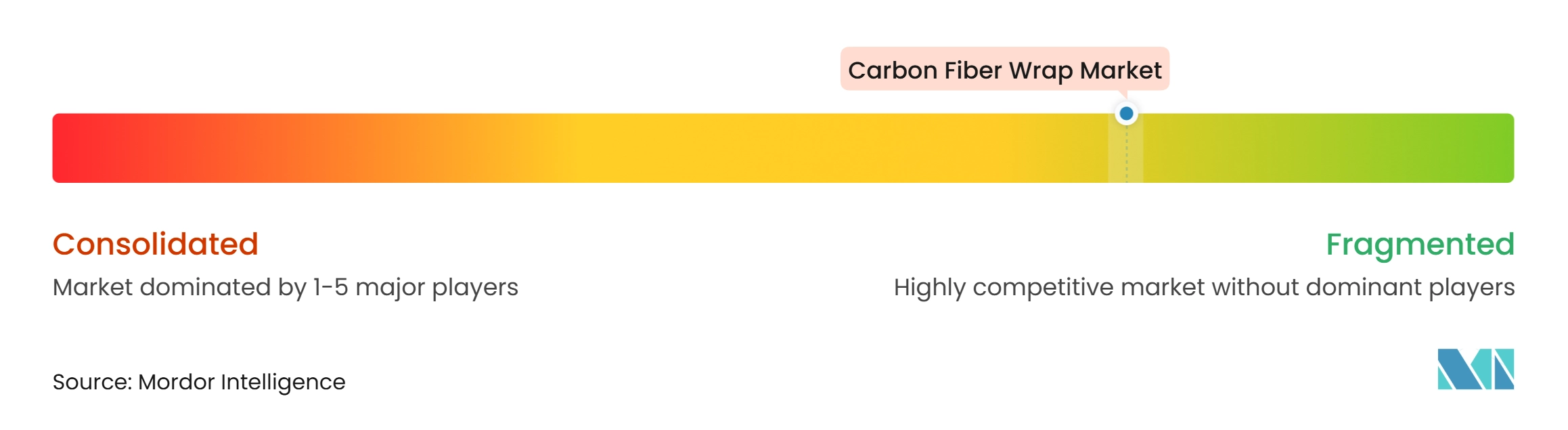
The carbon fiber wrap market is fragmented. 3M, Avery Dennison, and ORAFOL Europe have established product portfolios, installer relationships, and global distribution networks. ORAFOL's EUR 100 million investment program in Oranienburg is intended to add automation and a new production area between 2025 and 2027, supporting manufacturing capacity and product development in premium film categories. Avery Dennison reported low-single-digit growth in its Graphics and Reflectives category within its Materials Group during 2025. This category includes specialty materials relevant to vehicle and graphics applications. Premium suppliers are also combining paint-protection film chemistry with decorative wrap offerings, reflected in self-healing carbon fiber film and related protective wrap concepts.
Regional producers compete through speed, finish variety, and flexible OEM or ODM production. CARLIKE, Guangzhou Carbins, and TeckWrap represent the Guangdong-based group, targeting mid-range and entry-level demand where price, production responsiveness, and finish variety are key factors. In February 2025, HEXIS formalized a technical partnership with Prodrive for motorsport vehicle preparation, connecting professional motorsport preparation with the company's broader product credibility. Compliance requirements are also increasing the importance of formulation capability among global suppliers. REACH and U.S. VOC requirements raise the need for documentation and understanding of adhesive chemistry, placing suppliers with established research, compliance, and distribution resources in a stronger position to address those needs. The carbon fiber wrap market therefore balances premium technical capabilities against agile regional production.
A key competitive opportunity lies in addressing both decorative and functional product requirements through a unified product portfolio. Suppliers that understand surface appearance and protective film performance can serve the needs of vehicles, fleets, infrastructure, and specialty equipment. HEXIS introduced CF001 in May 2025, featuring self-healing properties designed to improve surface resistance to stone chips and minor impacts. ORAFOL's investment similarly supports scale and modernization, while Avery Dennison's continued growth in Graphics and Reflectives indicates ongoing attention to specialty material categories.
The market remains open to regional firms where customers value rapid delivery and customization. However, regulated applications will continue to favor suppliers that can verify performance and composition. Decorative and structural formats have different qualification requirements, which explains why competitive positioning differs across price tiers and applications. Premium suppliers must maintain installer support, technical documentation, and reliable distribution, while regional competitors can win business where customers prioritize finish availability and short delivery times. These two approaches can coexist because buyer requirements for certified infrastructure work differ from those for decorative vehicle projects. Product positioning must clearly indicate whether a film is intended for visual change, surface protection, or structural reinforcement. Clear positioning helps installers select the appropriate application process and avoid using a decorative material as a structural solution. This distinction remains important as the carbon fiber wrap market expands into applications with different service-life and compliance expectations.
Carbon Fiber Wrap Industry Leaders
-
3M
-
Avery Dennison Corporation
-
HEXIS S.A.S.
-
ORAFOL Europe GmbH
-
Fedrigoni S.p.A.
- *Disclaimer: Major Players sorted in no particular order
Carbon Fiber Wrap Market Companies Covered in this Report
- 3M
- Arlon Graphics, LLC
- Avery Dennison Corporation
- CARLIKE
- Fedrigoni S.p.A.
- Grafityp
- Guangzhou Carbins Film Co., Ltd.
- HEXIS S.A.S.
- KPMF
- Metro Restyling
- ORAFOL Europe GmbH
- Ritrama S.p.A.
- Rvinyl
- Teckwrap International
- VViViD Vinyl Inc.
Recent Industry Developments in Carbon Fiber Wrap Market
- December 2025: Fedrigoni Self-Adhesives launched F-Wrap Ultimate 1000, a cast vinyl designed for carbon fiber wrap vehicle wrapping. The product features a multi-layer construction and a Slide & Tack adhesive system for conformability on complex 3D surfaces, expanding the F-Wrap Ultimate range for professional automotive installers.
- October 2025: 3M added seven new colors to its 2080 Wrap Film series for carbon fiber wraps, including high-gloss, satin, matte, and color-flip finishes, in response to growing demand for specialty effects in vehicle customization and watercraft applications.
Global Carbon Fiber Wrap Market Report Scope
Carbon fiber wrap is an adhesive-backed synthetic vinyl film or textured sticker designed to replicate the visual appearance, weave pattern, and glossy finish of real woven carbon fiber. The product is widely used in automotive, aerospace, and consumer electronics applications as a cost-effective alternative to actual carbon fiber. Carbon fiber wraps are available in a range of finishes, including matte, gloss, and satin, and are applied directly to surfaces such as vehicle exteriors, interiors, and electronic device casings.
The carbon fiber wrap market is segmented by product type, application, and geography. By product type, the market is segmented into decorative vinyl wrap, carbon-fiber-effect film, prepreg carbon-fiber wrap, and other product types. By application, the market is segmented into automotive, aerospace and defense, consumer electronics, sports equipment, construction and infrastructure, and others. The report also covers market sizes and forecasts for carbon fiber wrap across 15 countries in major regions. The market sizes and forecasts are provided in terms of value (USD).
Segmentation Overview
| Decorative Vinyl Wrap |
| Carbon-Fiber-Effect Film |
| Prepreg Carbon-Fiber Wrap |
| Other Product Types |
| Automotive |
| Aerospace and Defense |
| Consumer Electronics |
| Sports Equipment |
| Construction and Infrastructure |
| Others |
| Asia-Pacific | China |
| India | |
| Japan | |
| South Korea | |
| ASEAN Countries | |
| Rest of Asia-Pacific | |
| North America | United States |
| Canada | |
| Mexico | |
| Europe | Germany |
| United Kingdom | |
| France | |
| Italy | |
| NORDIC Countries | |
| Rest of Europe | |
| South America | Brazil |
| Argentina | |
| Rest of South America | |
| Middle East and Africa | Saudi Arabia |
| South Africa | |
| Rest of Middle East and Africa |
| By Product Type | Decorative Vinyl Wrap | |
| Carbon-Fiber-Effect Film | ||
| Prepreg Carbon-Fiber Wrap | ||
| Other Product Types | ||
| By Application | Automotive | |
| Aerospace and Defense | ||
| Consumer Electronics | ||
| Sports Equipment | ||
| Construction and Infrastructure | ||
| Others | ||
| By Geography | Asia-Pacific | China |
| India | ||
| Japan | ||
| South Korea | ||
| ASEAN Countries | ||
| Rest of Asia-Pacific | ||
| North America | United States | |
| Canada | ||
| Mexico | ||
| Europe | Germany | |
| United Kingdom | ||
| France | ||
| Italy | ||
| NORDIC Countries | ||
| Rest of Europe | ||
| South America | Brazil | |
| Argentina | ||
| Rest of South America | ||
| Middle East and Africa | Saudi Arabia | |
| South Africa | ||
| Rest of Middle East and Africa | ||
Key Questions Answered in the Report
What is current market size of Carbon Fiber Wrap Market?
The Carbon Fiber Wrap market size was valued at USD 2.22 billion in 2026 and is estimated to grow from USD 2.38 billion in 2027 to USD 3.45 billion by 2032, at a CAGR of 7.67% during the forecast period (2027-2032).
Which product category drives demand for carbon fiber wraps?
Carbon-Fiber-Effect Film leads with 38.67% of revenue in 2026. It supports accessible automotive customization, consumer electronics finishes, commercial fleet graphics, and other applications that use standard dry installation methods.
Which application is growing fastest through 2032?
Sports Equipment is projected to record the highest growth at an 8.45% CAGR through 2032.
Which region has the highest demand for carbon fiber wraps?
Asia-Pacific accounted for 45.39% of revenue in 2026 and is projected to grow fastest, at an 8.38% CAGR through 2032.