
Car Wash Machine Market Size and Share
Market Overview
| Study Period | 2020 - 2032 |
|---|---|
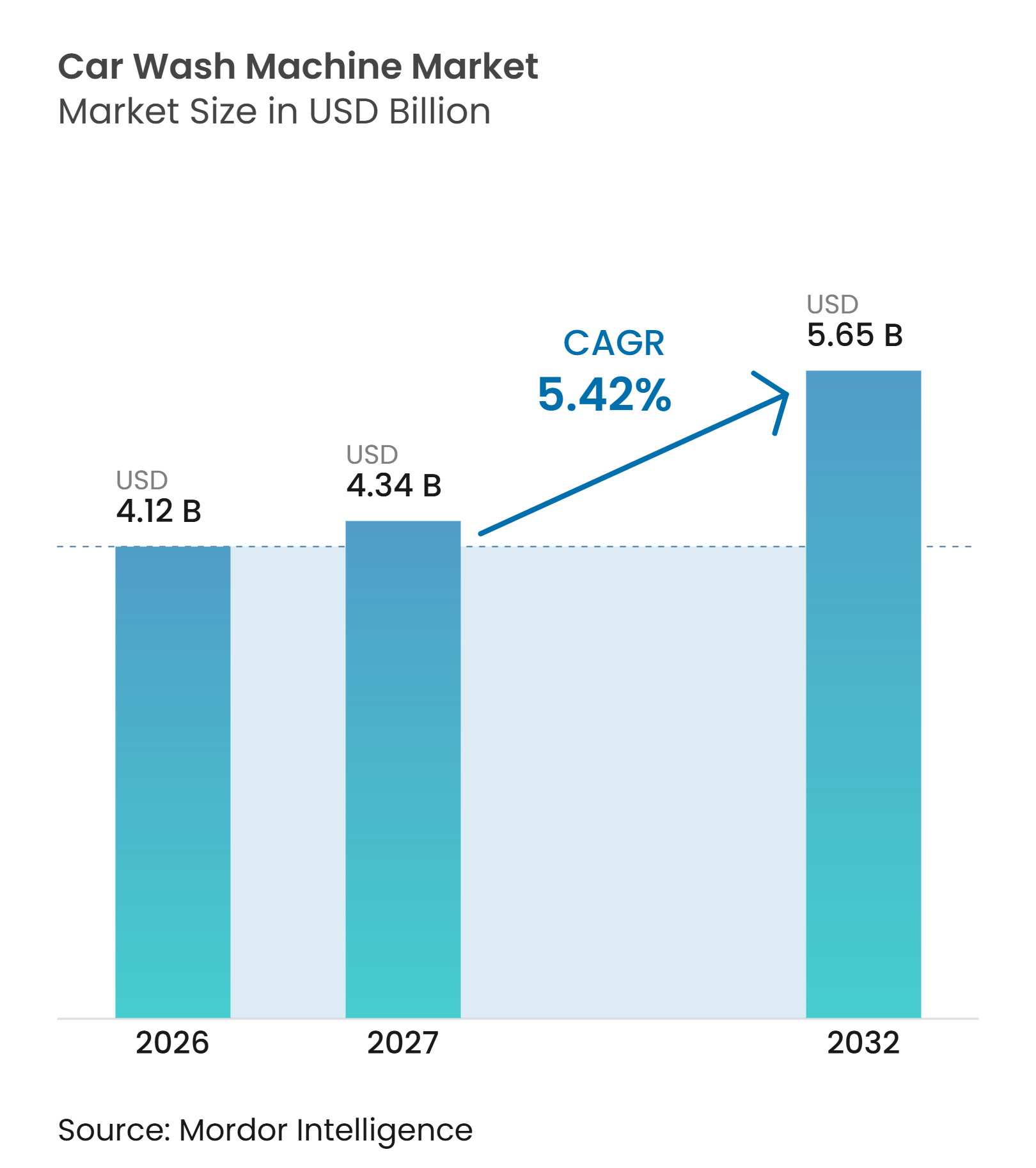
| Market Size (2027) | USD 4.34 Billion |
| Market Size (2032) | USD 5.65 Billion |
| Growth Rate (2027 - 2032) | 5.42 % |
| Fastest Growing Market | Asia-Pacific |
| Largest Market | North America |
| Market Concentration | Medium |
Major Players *Disclaimer: Major Players sorted in no particular order Image © Mordor Intelligence. Reuse requires attribution under CC BY 4.0. | |
Car Wash Machine Market Analysis by Mordor Intelligence
The car wash machine market size was valued at USD 4.12 billion in 2026 and is expected to grow from USD 4.34 billion in 2027 to USD 5.65 billion by 2032, at a CAGR of 5.42% during 2027-2032. Market growth reflects an expanding vehicle base, stricter water-use regulations, and a limited supply of wash-bay labor. These factors are increasing demand for automated and integrated car wash equipment that improves throughput, reduces labor dependence, and supports more efficient water management. Operators increasingly value equipment that combines washing, water recovery, payment systems, and remote support, as these capabilities can streamline daily operations and improve service consistency across locations. Water recycling and reclamation systems are becoming particularly important in regions with stringent water-use requirements, while remote monitoring tools enable operators to identify maintenance needs and reduce equipment downtime. Large chains are also reshaping purchasing patterns by standardizing equipment across sites, consolidating supplier relationships, and negotiating multiyear service agreements. Their scale allows them to prioritize equipment platforms that offer consistent performance, centralized management, and predictable maintenance costs. These factors are expanding replacement opportunities in the car wash machine market, as operators upgrade aging systems to meet operational, regulatory, and customer service requirements. However, new-site development is becoming more selective, with operators focusing investments on locations with favorable traffic volumes, demographics, and long-term demand potential.
Key Report Takeaways
- By machine type, in-bay automatic (rollover) systems held a 57.18% share of the car wash machine market in 2026, while tunnel/conveyor systems are projected to grow at the highest CAGR of 6.51% through 2032.
- By technology, friction/brush systems held a 59.91% share of the car wash machine market in 2026, while hybrid systems are projected to grow at the highest CAGR of 6.73% through 2032.
- By operation, fully automatic systems held a 61.25% share in 2026 and are projected to grow at the highest CAGR of 6.44% through 2032.
- By vehicle type, passenger cars held an 81.27% share in 2026, while commercial vehicles are projected to grow at a 6.35% CAGR through 2032.
- By end user, car wash operators held a 78.85% share in 2026, while fleet operators are projected to grow at the highest CAGR of 7.16% through 2032.
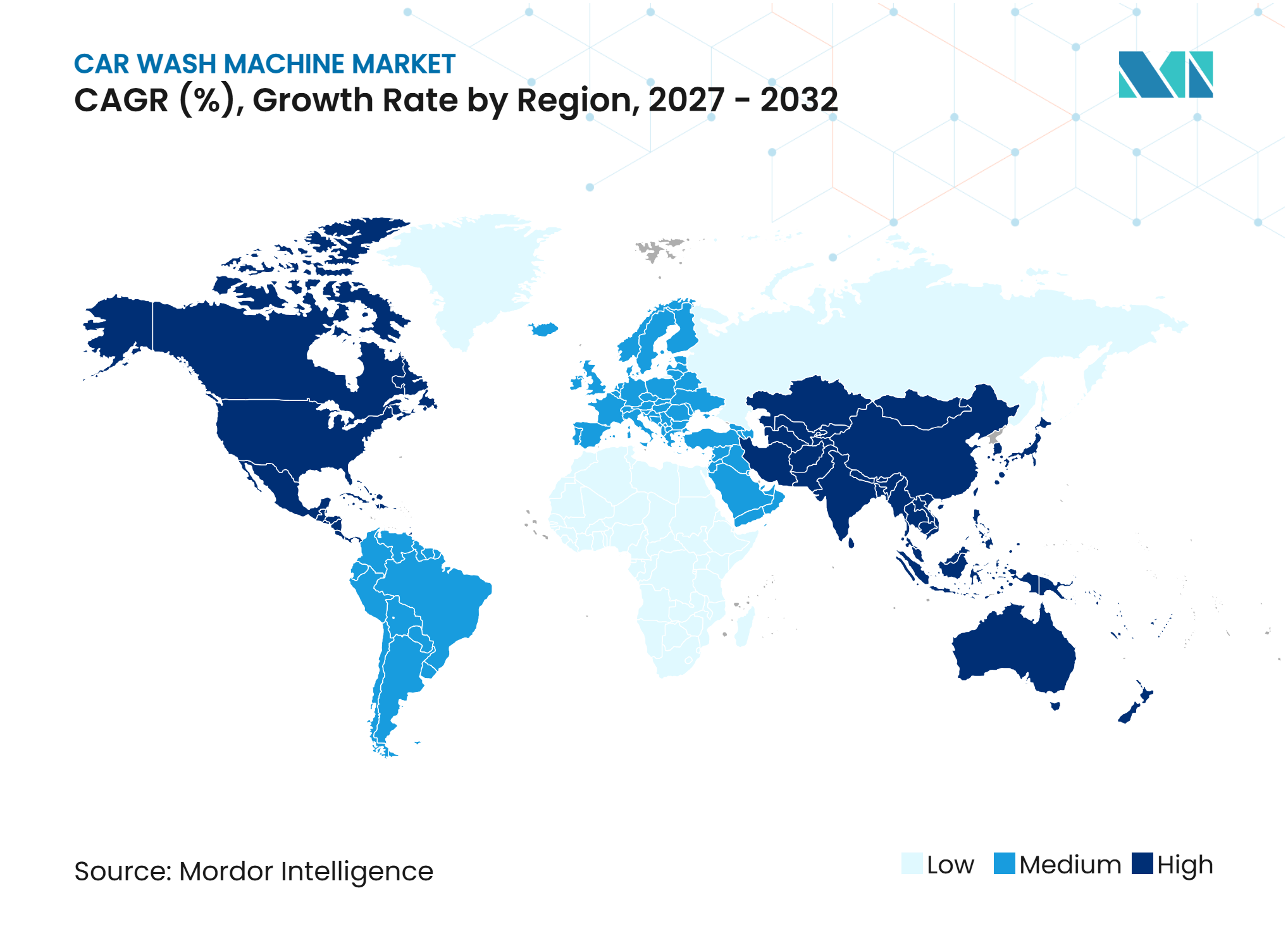
- By geography, North America held a 43.26% share in 2026, while Asia-Pacific is projected to grow at the highest CAGR of 7.11% through 2032.
Note: Market numbers in this report are based on Mordor Intelligence's proprietary estimation framework, which combines nine months of actuals with Q4 projections for base year 2026.
Market Trends and Insights
Drivers Impact Analysis of Car Wash Machine Market*
| Driver | (~) % Impact on CAGR Forecast | Geographic Relevance | Impact Timeline |
|---|---|---|---|
| Rising Express Tunnel Deployment | +1.2% | North America, with Asia-Pacific emerging | Medium term (2–4 years) |
| Vehicle Parc Growth and Higher Wash Frequency | +1.0% | Global; highest in Asia-Pacific and the Middle East | Long term (≥ 4 years) |
| Labor Scarcity Accelerating Automation | +0.9% | Global; most acute in North America and Western Europe | Medium term (2–4 years) |
| Water-Use Regulation and Reclamation Retrofit Demand | +0.7% | North America and Europe; spill-over to Asia-Pacific | Medium term (2–4 years) |
| Digital Payments, Remote Monitoring, and Connected Equipment | +0.6% | Global; led by North America and Europe | Medium term (2–4 years) |
| Lifecycle Uptime and Total-Cost-of-Ownership Differentiation | +0.5% | Global | Long term (≥ 4 years) |
| Source: Mordor Intelligence | |||
Rising Express Tunnel Deployment
Express tunnels continue to shape equipment specifications, although the focus is shifting from rapid site additions to upgrades and consolidation. Large operators use repeatable layouts, which favors standardized conveyor equipment and planned service coverage. Membership plans increase the value of rapid, consistent throughput because a wash interruption can affect recurring customer retention. The car wash machine market therefore benefits when chains replace older equipment across a portfolio instead of buying one machine for one site. Hardware margins can face pressure under centralized procurement, but service, chemicals, and connected support can provide steadier revenue. This model leaves smaller operators with fewer scale advantages and strengthens demand for franchise and group purchasing arrangements.
Vehicle Parc Growth and Higher Wash Frequency
A growing passenger vehicle base expands the number of vehicles that can use organized washing services. Higher wash frequency matters as much as vehicle ownership because it raises utilization of installed equipment. China and India are important in this respect because formal, automated formats can replace labor-based washing in dense urban areas. Electric vehicles can also support touchless and hybrid formats when operators want to reduce the risk of surface contact around sensors, cameras, and specialized finishes. The car wash machine market gains when routine washing becomes part of regular vehicle care rather than an occasional purchase. This supports equipment that can process payments quickly, retain subscription customers, and operate with limited on-site labor.
Labor Scarcity Accelerating Automation
Labor availability is pushing operators to automate payment, customer entry, and basic equipment oversight. Fully automated systems can reduce repetitive tasks while allowing staff to focus on exceptions and customer service. WashTec states that SmartCare Connect supports remote diagnosis and control-system intervention, which can reduce reliance on an on-site technical response [1]. Remote service also helps operators manage a group of sites through a common maintenance process. The value is strongest where technician coverage is limited, or labor costs are rising. The car wash machine market is therefore rewarding suppliers that combine physical equipment with dependable digital support.
Water-Use Regulation and Reclamation Retrofit Demand
Water rules are making recovery and reuse systems a central specification rather than an optional feature. The U.S. Environmental Protection Agency administers the National Pollutant Discharge Elimination System under the Clean Water Act, which provides the wider compliance setting for wastewater discharges. Germany also applies wastewater requirements through Abwasserverordnung Annex 49, creating a strong incentive for closed-loop wash-water practices. New local mandates can turn a reclaim module into a condition of site approval. This makes retrofit demand more resilient than discretionary equipment spending because compliance dates do not depend on consumer confidence. The car wash machine market is consequently moving toward integrated designs that connect washing, treatment, and monitoring.
Restraints Impact Analysis of Car Wash Machine Market*
| Restraint | (~) % Impact on CAGR Forecast | Geographic Relevance | Impact Timeline |
|---|---|---|---|
| High Upfront Capex and Site-Approval Complexity | -0.8% | Global; most acute for independent operators in North America and Europe | Medium term (2–4 years) |
| Equipment Downtime and Specialist-Service Dependence | -0.6% | Global | Medium term (2–4 years) |
| Water, Energy, and Chemical Operating-Cost Volatility | -0.5% | Global; highest in energy-intensive European markets | Medium term (2–4 years) |
| Compatibility Constraints Across Legacy Sites and Vehicle Mix | -0.4% | North America, Europe | Long term (≥ 4 years) |
| Source: Mordor Intelligence | |||
High Upfront Capex and Site-Approval Complexity
A full express tunnel requires significant spending on land, construction, equipment, water controls, and permits. Long approval cycles can postpone revenue while capital remains committed. This is a particular constraint for independent operators that do not have institutional backing or large internal development teams. German installations also face building, electrical, and wastewater compliance requirements, which can delay modernization. The car wash machine market may therefore see older equipment remain in service longer at small sites. Equipment-as-a-service arrangements could reduce this burden, but their use remains limited to more sophisticated operator groups.
Equipment Downtime and Specialist-Service Dependence
High-throughput sites lose revenue quickly when a wash line is unavailable. Proprietary controls, sensors, and motorized assemblies can require skills that are not available through every local repair network. Preventive maintenance and centralized work-order systems can improve availability, but they also deepen the operator's dependence on specialist support. WashTec lowered its 2026 outlook in September 2026 to an EBIT margin of 8–9%, citing delays in production relocation and installation-cost optimization, which shows that service execution remains difficult even for a leading supplier. The car wash machine market needs reliable parts access and trained service partners to sustain subscription-led operating models. Thin service networks remain a material obstacle in several developing regions.
*Our forecasts treat driver/restraint impacts as directional, not additive. The impact forecasts reflect baseline growth, mix effects, and variable interactions.
Car Wash Machine Market Segment Analysis
By Machine Type:
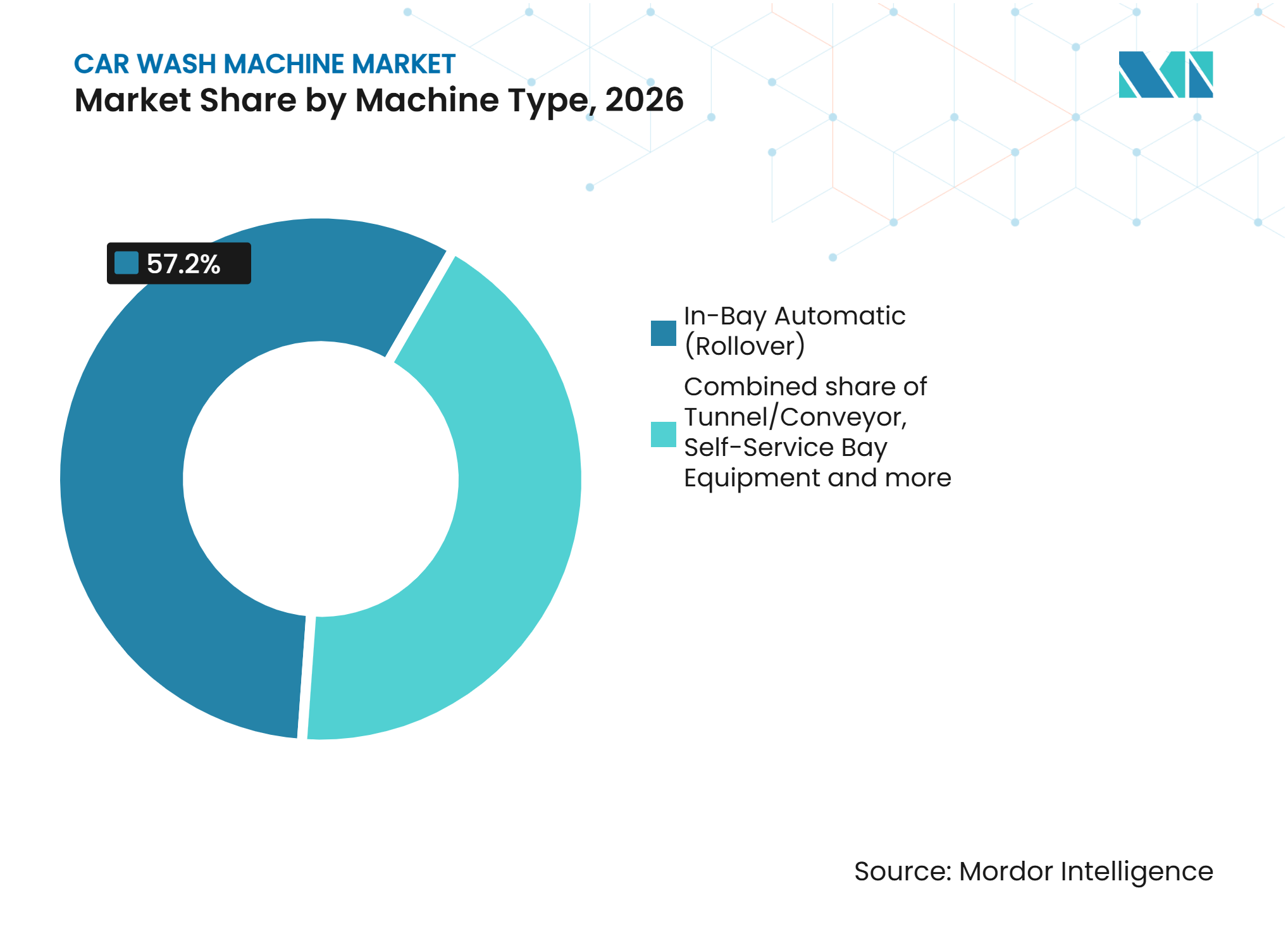
Tunnel Formats Raise Throughput RequirementsIn-bay automatic (rollover) systems held 57.18% of the car wash machine market share in 2026. Their compact design fits fuel-station forecourts, urban bays, and sites that cannot support a long conveyor line. The format remains relevant because it offers an automated experience within a smaller footprint. Self-service bays still serve price-sensitive locations, particularly where land is available and labor costs remain low. Truck and bus wash systems are a separate category because larger vehicle dimensions require wider wash envelopes, underbody cleaning, and programmable profiles. Kärcher's TB portal washes for trucks and buses combine freely moving side-brush suspension with touchscreen controls to reduce manual pre-wash work.
Tunnel/conveyor systems are projected to grow at a 6.51% CAGR through 2032, the fastest rate among machine types. The car wash machine market size for this format benefits from unlimited wash plans that need rapid vehicle flow at peak times. Chains can use tunnel layouts to standardize member entry, payment, wash sequencing, and exit handling. Larger groups also favor a format that can be specified repeatedly across new sites. This supports recurring demand for replacement parts and service as the installed base expands. Outside North America, tunnel adoption has more room to develop as subscription programs gain acceptance.



By Technology:
Hybrid Systems Address Surface SensitivityFriction/brush technology held 59.91% of revenue in 2026, giving it the largest car wash machine market share among technologies. It remains common because it provides dependable cleaning at a lower equipment cost than many specialized alternatives. Its large installed base also slows the pace of replacement because wash machinery has a long operating life. Touchless systems use high-pressure water and contour guidance to avoid direct surface contact. They appeal to premium and commercial applications but can require longer cycles and more chemical use. These trade-offs preserve a broad role for brush-based systems in standard passenger-car applications.
Hybrid systems are projected to grow at a 6.73% CAGR through 2032, the fastest rate among technologies. The car wash machine market size for hybrid equipment is supported by paint-protection film, vinyl wraps, clear coats, sensors, and other surfaces that make operators more cautious about conventional brush contact. Hybrid equipment can balance cleaning performance with lower contact risk and better control of water and chemical use. Istobal and Robotnik have described an autonomous vehicle-washing manipulator that uses 3D body profiling and adjusted wash-arm paths. This work indicates a direction toward more precise wash cycles. It also aligns with resource-efficiency requirements that favor controlled dosing and water management.
By Operation:
Automation Changes the Cost BaseFully automatic systems held 61.25% of revenue in 2026 and are projected to grow at a 6.44% CAGR through 2032. In-bay automatic and tunnel formats account for most of this value because they automate washing, payment, and vehicle flow. Rising labor costs and the need for consistent membership service make remote operation more attractive. WashTec describes CarWash Assist as a service that enables remote monitoring and direct control-system intervention. Automation can help multi-site operators support wash quality without placing a technical employee at every location.
Semi-automatic systems remain attractive for operators that retain limited staff for inspection, customer support, and quality control while automating core wash functions. Manual formats remain important in parts of Southeast Asia, India, and Sub-Saharan Africa where entry costs and labor economics support human-operated sites. Water restrictions can change that balance when informal washing cannot meet local rules. The car wash machine market supports organized operators that offer reclaim-equipped automatic service in these locations. Existing site conditions are likely to determine how quickly operators can make the transition.
By Vehicle Type:
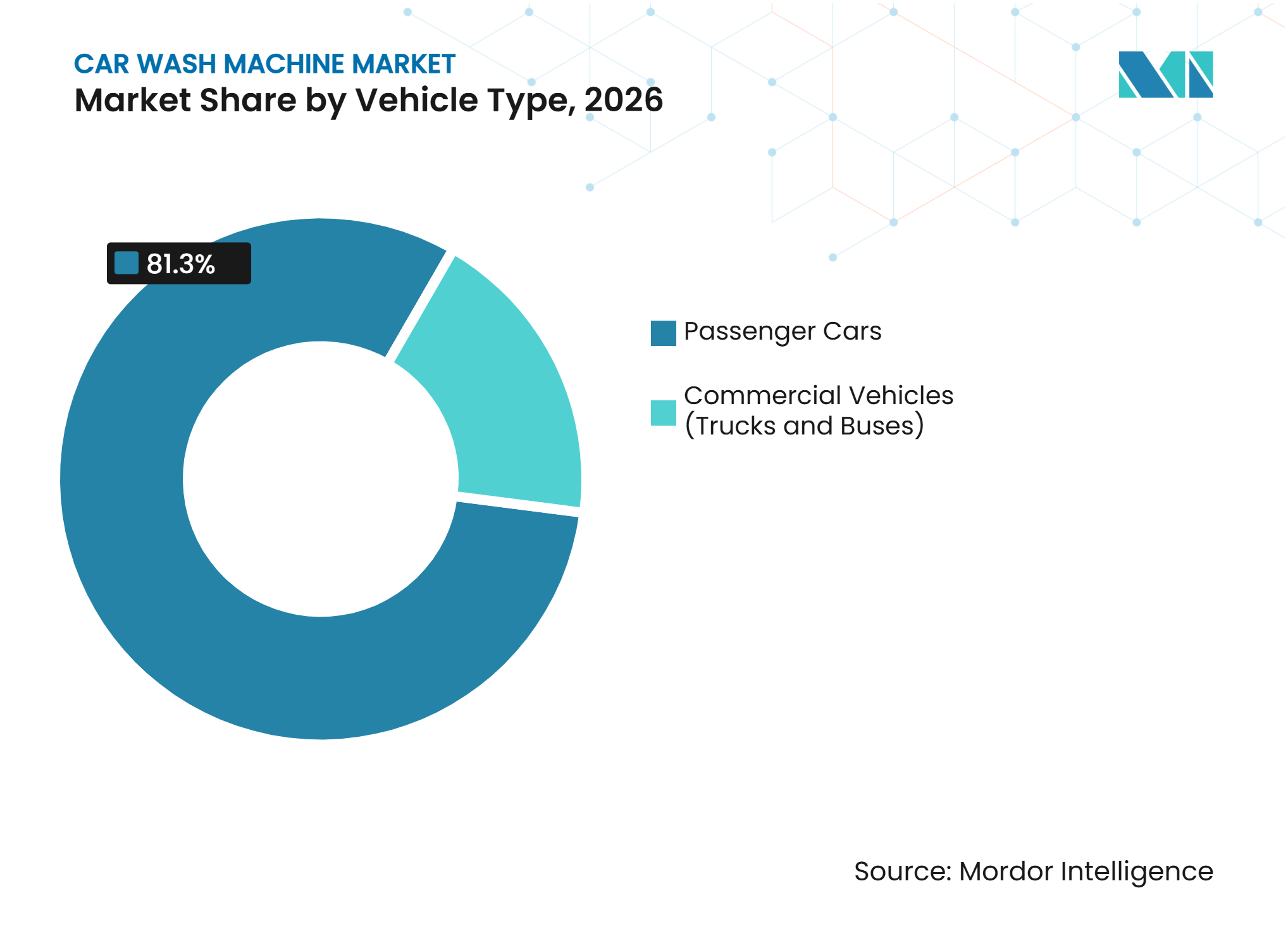
Passenger Cars Drive VolumePassenger cars accounted for 81.27% of revenue in 2026 and are forecast to grow at a 5.20% CAGR through 2032. This gives passenger cars the leading car wash machine market share by vehicle type. A rising passenger-car parc expands demand, while subscription offers can increase wash frequency for existing owners. Formal car wash models are particularly relevant in dense cities where consumers value speed and digital payment. Sensor-rich and premium vehicles also increase interest in touchless or hybrid wash options. The car wash machine market benefits when vehicle care is treated as a routine service rather than an occasional purchase.
Commercial vehicles are projected to grow at a 6.35% CAGR through 2032, the faster rate by vehicle type. They require different washing architecture, including taller gantries, stronger underbody systems, and programs that accommodate variable vehicle lengths. Fleet hygiene and corrosion-prevention practices can sustain demand even when consumer washing patterns change. Buses, logistics vehicles, and municipal fleets often need consistent wash schedules. This creates a durable specialist opportunity for suppliers with heavy-duty equipment and service capacity. Portal systems such as Kärcher's TB range illustrate the focus on reducing manual pre-wash work for truck and bus fleets. Commercial applications therefore add a distinct layer of demand to the broader car wash machine market.

By End User:
Fleets Become a Larger Procurement ChannelCar wash operators held 78.85% of end-user revenue in 2026. They remain the principal buyers because they invest directly in customer-facing wash sites. Large chains increasingly influence specifications through standardized designs and multiyear equipment programs. The acquisition of AMP Memberships by National Carwash Solutions in January 2025 linked membership-management capabilities with equipment relationships. This reflects the value of combining transactions, customer retention, and site operations. The car wash machine market increasingly serves operators that want integrated commercial systems rather than stand-alone hardware.
Fleet operators are projected to grow at a 7.16% CAGR through 2032, the highest end-user rate. Last-mile delivery, utility fleets, municipal vehicles, and commercial transport need predictable cleaning programs. Their requirements often emphasize uptime, vehicle geometry, water management, and reporting. Fuel stations remain important purchasers of in-bay systems, although their role differs across regions. Dealerships also need repeatable cleaning for vehicle handover and aftersales service. The car wash machine market can capture these channels with modular systems that fit forecourts, depots, and service centers.
Geography Analysis
North America
North America held 43.26% of the car wash machine market share in 2026. The region has dense tunnel infrastructure and broad use of subscription models, which support investment in high-throughput equipment. Consolidation has made chains more important buyers because they can place portfolio-wide orders and seek common payment, diagnostics, and maintenance systems. Mister Car Wash agreed to be acquired by Leonard Green & Partners in a USD 3.1 billion transaction in 2026. Water recovery is becoming more relevant as local permitting and wastewater rules influence equipment selection. The region remains a key replacement and service market even as new tunnel construction becomes more measured.
Asia-Pacific
Asia-Pacific is forecast to grow at a 7.11% CAGR through 2032, the highest geographic rate in the car wash machine market. Growth comes from different sources across the region, including Japan's established equipment base and India's shift toward organized, water-conscious washing. Japan's fuel-station forecourts provide an established setting for in-bay automatic systems. In India, restrictions on potable-water vehicle washing can support water-recirculating formats where local enforcement is effective. Urban Chinese sites are also adopting digital payment and unattended operating models. The region gives suppliers an opportunity to tailor compact, water-efficient systems to varied site and income conditions.
Europe, South America, and the Middle East and Africa
Europe has mature equipment demand, particularly in Germany, where water efficiency and compliance have a strong influence on investment. The car wash machine market size in Europe is supported by certification, wastewater rules, and a continuing need to upgrade aging equipment. EU wastewater policy and national requirements encourage more controlled water use and treatment. South American demand remains constrained by economic conditions and a large manual-wash base, although urban centers support gradual organized-wash growth. The Middle East and Africa benefit from frequent cleaning needs in dusty environments, especially at fuel retail and dealership locations. Premium touchless and hybrid systems can be relevant where vehicle care standards and water management requirements are both strong.
Competitive Landscape
Market Concentration

The car wash machine market is moderately concentrated at the OEM level. WashTec AG, Istobal S.A., Otto Christ AG, Dover Corporation (through OPW Vehicle Wash Solutions and Belanger), and National Carwash Solutions operate across multiple regions or formats, while Alfred Kärcher SE & Co. KG, Sonny's Enterprises, and smaller manufacturers serve specific formats and local needs. Competition centers on equipment reliability, installed service coverage, chemicals, payment links, and remote maintenance. WashTec reported 2025 revenue of EUR 498.6 million and a 9.8% EBIT margin, with revenue exceeding EUR 500 million at constant exchange rates. The results show the importance of equipment and service income in a market where new-site demand can vary.
Leading suppliers are adding digital services to physical equipment. WashTec installed its 1,500th SmartCare gantry car wash in July 2026, extending its connected installed base. Vontier acquired Sergeant Sudz in June 2025 to combine its motor control centers and automation expertise with DRB's point-of-sale, consumer engagement, tunnel control, and analytics platform [2]. Sonny's Enterprises acquired WashMetrix in 2025 to add business intelligence and performance-management capabilities to its Quivio ecosystem. These moves show that equipment providers and software platforms are competing for a larger share of site operating data.
Suppliers also compete through compact systems, water-saving retrofits, and service contracts for independent operators. Istobal has described its 2025 financial performance as supported by equipment and service growth, while expanding chemical production capacity in Spain. This model broadens recurring revenue beyond a single machinery sale. International suppliers must also meet applicable machinery and electrical requirements in export markets. Strong local technical support can be as important as the initial equipment specification.
Car Wash Machine Industry Leaders
-
WashTec AG
-
Istobal S.A.
-
Otto Christ AG
-
Dover Corporation
-
National Carwash Solutions, Inc.
- *Disclaimer: Major Players sorted in no particular order
Car Wash Machine Market Companies Covered in this Report
- WashTec AG
- Istobal S.A.
- Otto Christ AG
- Dover Corporation
- National Carwash Solutions, Inc.
- Sonny’s Enterprises, Inc.
- Motor City Wash Works, Inc.
- Daifuku Co., Ltd.
- Alfred Kärcher SE & Co. KG
- Tommy Car Wash Systems, LLC
- Coleman Hanna Car Wash Systems, LLC
- Washworld, Inc.
- D&S Car Wash Equipment Company
- PECO Car Wash Systems
- Ceccato S.p.A.
- Aquarama S.r.l.
- Autoequip Lavaggi S.r.l.
- KKE Wash Systems
- Tammermatic Group Oy
- NuStar Car Wash Systems
Recent Industry Developments in Car Wash Machine Market
- July 2026: WashTec installed its 1,500th SmartCare gantry car wash, in Finland.
- April 2026: ISTOBAL reported 2025 revenue of EUR 199 million, up 14%, and opened a new factory in Massanassa, Valencia, to double production.
- February 2026: Leonard Green & Partners agreed to take Mister Car Wash private in a transaction valued at USD 3.1 billion.
- December 2025: Franchise Equity Partners agreed to acquire IMO Car Wash from Driven Brands, covering 720 sites in the United Kingdom, Germany, nine other European countries, and Australia.
- August 2025: Sonny's Enterprises acquired WashMetrix to add business-intelligence and performance-management tools to its Quivio platform.
Global Car Wash Machine Market Report Scope
The Car Wash Machine Market Report is Segmented by Machine Type (In-Bay Automatic (Rollover), Tunnel/Conveyor, Self-Service Bay Equipment, Truck and Bus Wash Systems, and Other Machine Types), Technology (Friction/Brush, Touchless, and Hybrid), Operation (Fully Automatic, Semi-Automatic, and Manual), Vehicle Type (Passenger Cars and Commercial Vehicles), End User (Car Wash Operators, Fuel Stations, Dealerships, Fleet Operators, and Other End Users), and Geography (North America (United States, Canada, and Mexico), Europe (Germany, United Kingdom, France, Italy, Spain, Russia, and Rest of Europe), Asia-Pacific (China, Japan, India, South Korea, Australia, Southeast Asia, and Rest of Asia-Pacific), South America (Brazil, Argentina, Colombia, Chile, and Rest of South America), and Middle East and Africa (Saudi Arabia, United Arab Emirates, Turkey, South Africa, Egypt, and Rest of Middle East and Africa)). Forecasts are Provided in Terms of Value (USD) and Volume (Units).
Segmentation Overview
| In-Bay Automatic (Rollover) |
| Tunnel/Conveyor |
| Self-Service Bay Equipment |
| Truck and Bus Wash Systems |
| Other Machine Types |
| Friction/Brush |
| Touchless |
| Hybrid |
| Fully Automatic |
| Semi-Automatic |
| Manual |
| Passenger Cars |
| Commercial Vehicles (Trucks and Buses) |
| Car Wash Operators |
| Fuel Stations |
| Dealerships |
| Fleet Operators |
| Other End Users |
| North America | United States |
| Canada | |
| Mexico | |
| Europe | Germany |
| United Kingdom | |
| France | |
| Italy | |
| Spain | |
| Russia | |
| Rest of Europe | |
| Asia-Pacific | China |
| Japan | |
| India | |
| South Korea | |
| Australia | |
| Southeast Asia | |
| Rest of Asia-Pacific | |
| South America | Brazil |
| Argentina | |
| Colombia | |
| Chile | |
| Rest of South America | |
| Middle East and Africa | Saudi Arabia |
| United Arab Emirates | |
| Turkey | |
| South Africa | |
| Egypt | |
| Rest of Middle East and Africa |
| By Machine Type | In-Bay Automatic (Rollover) | |
| Tunnel/Conveyor | ||
| Self-Service Bay Equipment | ||
| Truck and Bus Wash Systems | ||
| Other Machine Types | ||
| By Technology | Friction/Brush | |
| Touchless | ||
| Hybrid | ||
| By Operation | Fully Automatic | |
| Semi-Automatic | ||
| Manual | ||
| By Vehicle Type | Passenger Cars | |
| Commercial Vehicles (Trucks and Buses) | ||
| By End User | Car Wash Operators | |
| Fuel Stations | ||
| Dealerships | ||
| Fleet Operators | ||
| Other End Users | ||
| By Geography | North America | United States |
| Canada | ||
| Mexico | ||
| Europe | Germany | |
| United Kingdom | ||
| France | ||
| Italy | ||
| Spain | ||
| Russia | ||
| Rest of Europe | ||
| Asia-Pacific | China | |
| Japan | ||
| India | ||
| South Korea | ||
| Australia | ||
| Southeast Asia | ||
| Rest of Asia-Pacific | ||
| South America | Brazil | |
| Argentina | ||
| Colombia | ||
| Chile | ||
| Rest of South America | ||
| Middle East and Africa | Saudi Arabia | |
| United Arab Emirates | ||
| Turkey | ||
| South Africa | ||
| Egypt | ||
| Rest of Middle East and Africa | ||
Key Questions Answered in the Report
What is the 2027-2032 growth outlook for car wash machines?
The car wash machine market is forecast to grow at a 5.42% CAGR and reach USD 5.65 billion by 2032.
Which machine format is forecast to grow fastest?
Tunnel/conveyor systems are forecast to grow at a 6.51% CAGR through 2032, supported by high-throughput membership models.
Why are hybrid car wash systems gaining adoption?
Hybrid systems are forecast to grow at a 6.73% CAGR through 2032 as operators address vehicle-surface sensitivity while managing water and chemical use.
Which vehicle category creates the most demand?
Passenger cars accounted for 81.27% of 2026 revenue and are projected to grow at a 5.20% CAGR through 2032.
Why does water recovery matter for wash equipment?
Wastewater and local water-use requirements make recovery systems an important part of site approval and equipment replacement decisions.
Which region offers the fastest growth?
Asia-Pacific is projected to grow at a 7.11% CAGR through 2032, supported by organized washing, automation, and water-efficient formats.