
Canada Seed Processing Machinery Market Size and Share
Market Overview
| Study Period | 2021 - 2031 |
|---|---|
| Forecast Data Period | 2026 - 2031 |
| Base Year Market Size (2025) | USD 275 Million |
| Market Size (2026) | USD 297.55 Million |
| Market Size (2031) | USD 441.26 Million |
| Growth Rate (2026 - 2031) | 8.20 % |
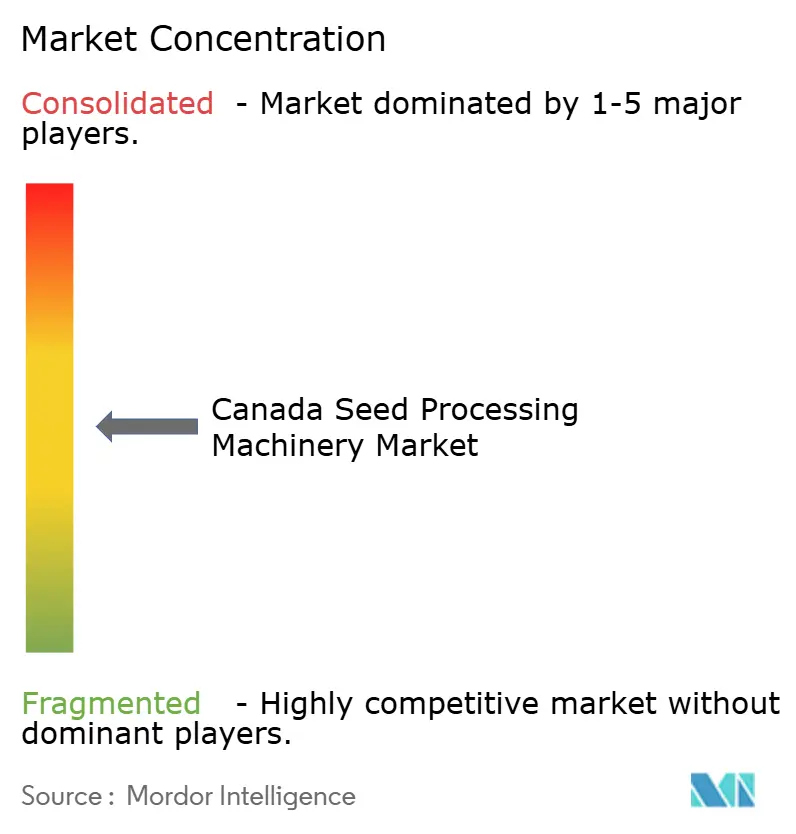
| Market Concentration | Medium |
Major Players *Disclaimer: Major Players sorted in no particular order Image © Mordor Intelligence. Reuse requires attribution under CC BY 4.0. | |
Canada Seed Processing Machinery Market Analysis by Mordor Intelligence
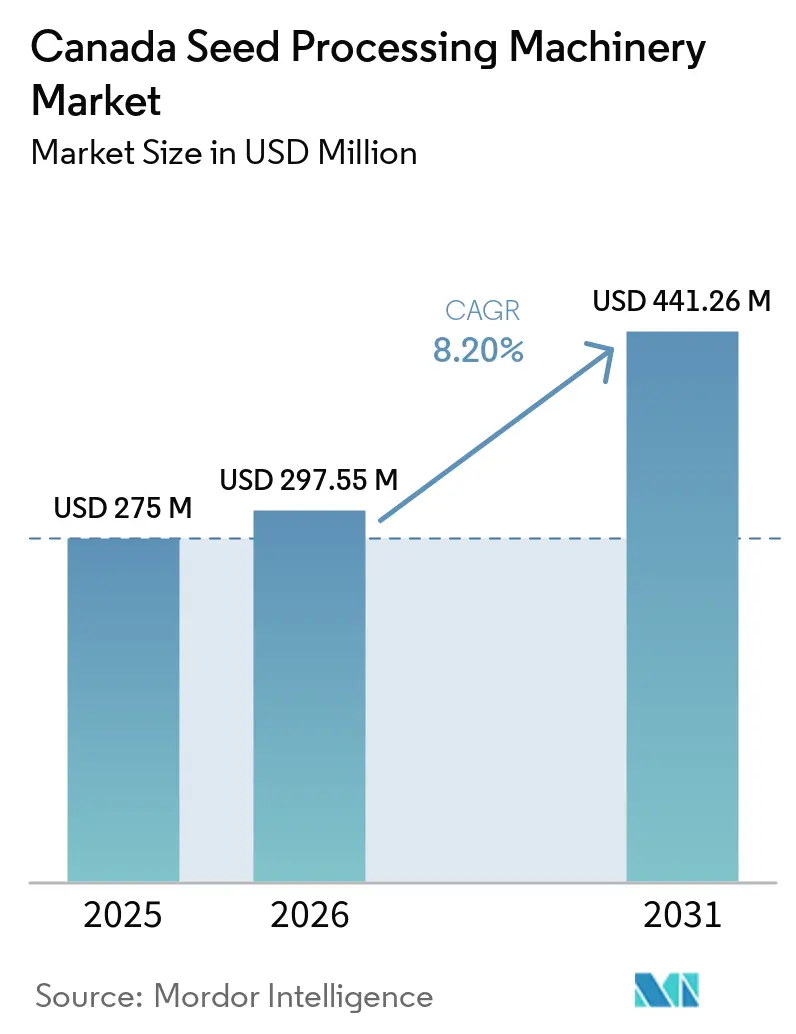
The Canada seed processing machinery market size was valued at USD 275 million in 2025 and estimated to grow from USD 297.55 million in 2026 to reach USD 441.26 million by 2031, at a CAGR of 8.20% during the forecast period (2026-2031). The Canada seed processing machinery market is supported by the need to process export-grade wheat, canola, pulses, and other seed crops with consistent quality controls. Wheat exports increased 15% year over year to 29.3 million metric tons in marketing year 2024/25[1]Source: United States Department of Agriculture Foreign Agricultural Service, “Canada Grain and Feed Update, MY 2025/2026,” USDA Foreign Agricultural Service, apps.fas.usda.gov, reflecting strong demand for grain handling and processing capacity. Certified seed production also generates recurring demand for cleaning, grading, treatment, and lot documentation equipment as quality and traceability requirements continue to evolve. Automation is becoming increasingly important as processors address labor availability, operational continuity, and digital traceability. Suppliers can strengthen competitiveness through adaptable equipment, local service capabilities, and retrofit solutions that enable existing facilities to adopt advanced digital controls without requiring complete plant reconstruction.
Key Report Takeaways
- By machinery type, cleaners accounted for the largest Canada seed processing machinery market share, 44.2%, in 2025, while optical sorters are projected to be the fastest-growing segment, registering an 8.8% CAGR through 2031.
- By operation mode, automatic systems accounted for the largest share of the Canada seed processing machinery market size, at 72.1% in 2025, while also emerging as the fastest-growing segment, registering an 8.4% CAGR through 2031.
- By end user, commercial seed processing plants accounted for the largest share, 57.3%, in 2025, while on-farm facilities are projected to be the fastest-growing segment, registering a 8.6% CAGR through 2031.
Note: Market size and forecast figures in this report are generated using Mordor Intelligence’s proprietary estimation framework, updated with the latest available data and insights as of January 2026.
Canada Seed Processing Machinery Market Trends and Insights
Drivers Impact Analysis*
| Driver | (~) % Impact on CAGR Forecast | Geographic Relevance | Impact Timeline | |
|---|---|---|---|---|
| Labor shortages and automation investment | +1.5% | Canada-wide, most acute in the Prairie Provinces and British Columbia | Short term (≤ 2 years) | |
| Expansion of certified and treated seed production | +1.2% | Saskatchewan, Alberta, Manitoba, and Ontario | Medium term (2-4 years) | |
| Export-grade purity and traceability requirements | +1.5% | Canada-wide, with primary effects along the Vancouver and Thunder Bay export corridors | Short term (≤ 2 years) | |
| Government support for agricultural technology adoption | +1.0% | Canada-wide through federal and provincial programs | Medium term (2-4 years) | |
| Prairie demand for mobile and modular processing lines | +0.8% | Alberta, Saskatchewan, and Manitoba | Medium term (2-4 years) | |
| Digital retrofit demand at legacy seed plants | +0.7% | Canada-wide, with a concentration in the Prairie Provinces | Long term (≥ 4 years) | |
| Source: Mordor Intelligence | ||||
Labor Shortages and Automation Investment
Canada’s agricultural sector recorded more than 28,200 unfilled positions during the 2022 peak season, and projected retirements exceed 85,300 through 2030[2]Source: Canadian Agricultural Human Resource Council, “Agriculture Labour Market Forecast 2023-2030,” Canadian Agricultural Human Resource Council, cahrc-ccrha.ca. The Future Skills Center also found that the agri-food sector continued to have a higher job vacancy ratio than the overall Canadian economy in 2024, and identified 103,665 agricultural jobs at high risk of automation over the next decade.[3]Source: Future Skills Centre, “The Next Frontier in Canada’s Agri-Food Sector: Technology-Driven Labour and Skills Transitions,” Future Skills Centre, fsc-ccf.ca. These conditions encourage processors to consider automatic cleaning, optical sorting, and coating systems when securing labor is difficult. The Canada seed processing machinery market benefits when equipment is evaluated for its ability to maintain operations during critical processing periods. The effect is strongest in areas where service staff and seasonal workers are scarce.
Export-Grade Purity and Traceability Requirements
The Canada Grain Act framework includes variety designation lists, grading specifications, and quality control requirements that support lot-level identity preservation. Processors handling export wheat, durum, canola, and pulses require documented purity, contaminant removal, and batch traceability throughout processing. These requirements favor optical sorters and automated packaging systems that can efficiently record batch information. As grain quality standards and documentation requirements continue to evolve, processors increasingly evaluate machinery for greater sorting accuracy, digital recordkeeping, and operational consistency. Consequently, the Canada seed processing machinery market benefits from sustained demand for advanced equipment that enhances quality assurance and traceability across export-oriented processing facilities.
Government Support for Agricultural Technology Adoption
The Sustainable Canadian Agricultural Partnership is a USD 2.56 billion (CAD 3.5 billion) federal, provincial, and territorial framework operating from 2023 to 2028[4]Source: Agriculture and Agri-Food Canada, “Minister MacAulay Announces Over CAD 116 Million to Help Farmers Adopt Clean Technologies,” Government of Canada, canada.ca. In August 2024, the Agri-Tech Innovation Initiative announced up to USD 16.5 million (CAD 22.6 million) to support 319 farming and agri-food businesses, with combined public and industry investments projected to generate up to USD 44.5 million (CAD 61 million) in improvements in production capacity and efficiency by 2027. In February 2025, the Agricultural Clean Technology Program announced more than USD 84.7 million (CAD 116 million) for 119 projects. Such programs reduce upfront investment barriers for processors evaluating automation, precision technologies, and energy-efficient equipment, thereby supporting demand for advanced seed-processing machinery across Canada.
Prairie Demand for Mobile and Modular Processing Lines
Western Canada remains the largest regional market for seed processing machinery, reflecting the importance of Saskatchewan, Alberta, and Manitoba to commercial seed production. Many processing facilities in these provinces handle multiple crop types within short post-harvest periods. Portable dryers, compact cleaners, and modular processing lines are well-suited to facilities requiring flexible layouts or incremental capacity expansion without constructing entirely new plants. These solutions also support on-farm operations processing identity-preserved seed closer to production areas. Consequently, the Canada seed processing machinery market offers opportunities for suppliers that provide both mobile equipment and scalable, integrated systems to meet the varying throughput requirements of smaller farms, co-operatives, and large commercial processors.
Restraints Impact Analysis*
| Restraint | (~) % Impact on CAGR Forecast | Geographic Relevance | Impact Timeline |
|---|---|---|---|
| High upfront equipment and installation costs | -1.5% | Canada-wide, most acute for smaller seed plants and co-operatives | Medium term (2-4 years) |
| Skilled operator and maintenance talent shortages | -1.0% | Canada-wide, especially rural Prairie communities | Medium term (2-4 years) |
| Seasonal utilization and long equipment payback periods | -0.8% | Canada-wide, compounded by short Prairie processing windows | Medium term (2-4 years) |
| Crop-specific configuration complexity | -0.6% | Western Canada, particularly multi-crop Prairie processors | Medium term (2-4 years) |
| Source: Mordor Intelligence | |||
Skilled Operator and Maintenance Talent Shortages
Automatic systems can reduce manual handling, but they require operators who can manage controls, calibration, and routine maintenance. Rural Prairie communities often have limited access to technicians when a line needs attention during the processing season. The labor conditions that encourage automation can therefore also limit the ability to use advanced equipment efficiently. This issue can lead buyers to favor suppliers that offer simple controls, training, and remote diagnostics. The Canada seed processing machinery market may see longer purchase decision cycles as plant managers assess the availability of operations and maintenance skills. Local service capability remains important for equipment suppliers working across dispersed agricultural areas.
Crop-Specific Configuration Complexity
Canadian processors may handle wheat, durum, canola, peas, lentils, chickpeas, and specialty forage crops in the same facility. Each crop can need different screen sizes, air settings, separation methods, treatment systems, and quality checks. This complexity can raise setup time and increase the risk of equipment being poorly matched to the intended crop mix. It can also make customers cautious about investing in a line designed around a narrow set of products. As a result, demand is increasing for suppliers that can provide flexible equipment configurations capable of processing multiple crop types. The Canada seed processing machinery market increasingly relies on adaptable machinery as crop production patterns continue to evolve across the Prairie provinces.
*Our forecasts treat driver/restraint impacts as directional, not additive. The impact forecasts reflect baseline growth, mix effects, and variable interactions.
Segment Analysis
By Machinery Type: Cleaners Hold the Foundation While Optical Sorters Redefine the Value Equation
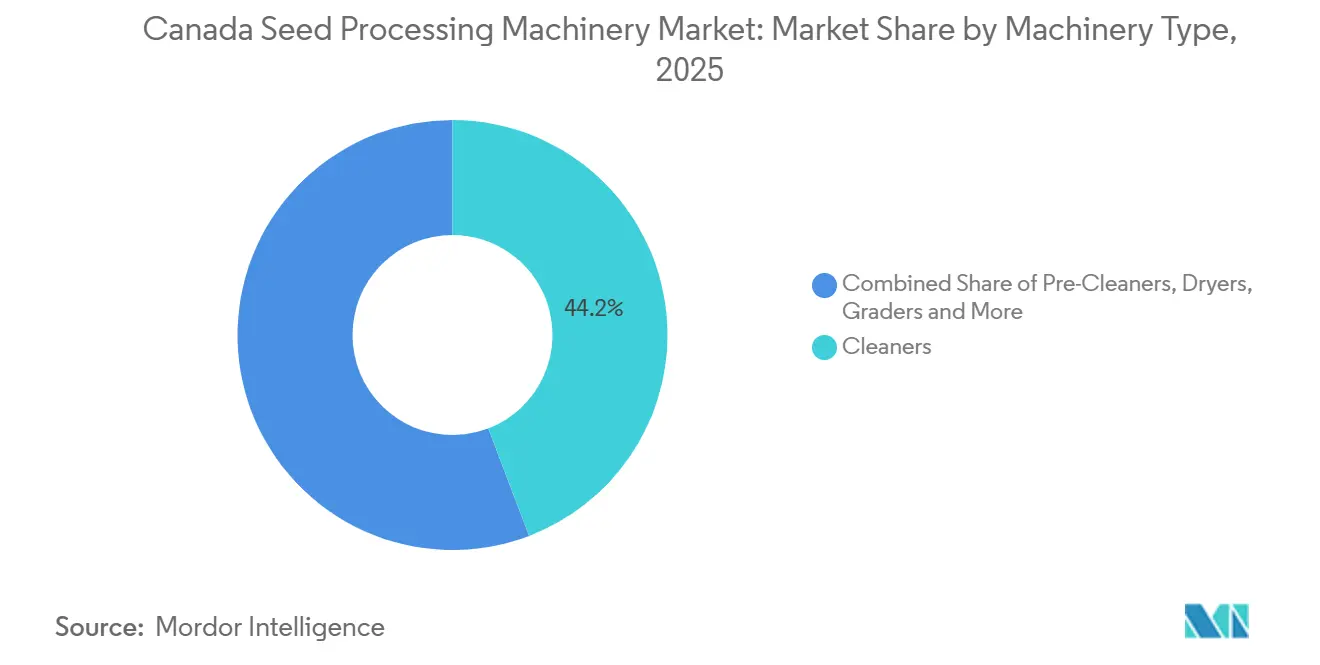
Cleaners held 44.2% of revenue in 2025 because every crop requires primary cleaning before treatment, grading, or packing. They are used across Canada for Western Red Spring (CWRS) wheat, durum, canola, peas, lentils, and forage seed, while pre-cleaners and destoners remove foreign material from incoming seed. Dryers and coaters depend on clean feedstock exiting the main cleaning circuit, and graders and separators support pulse and oilseed lots in which size uniformity affects buyer acceptance. Lentil acreage increased 4.0% and chickpea acreage increased 12.6% from 2024 to 2025, adding to the processing base. The Seeds Act framework and Canadian Food Inspection Agency (CFIA) oversight support demand for documented purity, keeping cleaners central to the Canadian seed-processing machinery market.
Optical sorters are forecast to grow at an 8.8% CAGR from 2026 to 2031, the highest rate among machinery types. They can combine multiple mechanical separation stages into a single inspection process, and Bühler AG’s SORTEX AI700 offers deep-learning functionality, real-time lot data, allergen separation, and more than 50% higher yield purity. Optical sorters and seed packagers are closely linked to export documentation and identity-preserved seed programs. Canadian Grain Commission (CGC) grade updates can require plants to reassess sorting accuracy and records. Polishers remain the smallest category by volume but are gaining use in premium pulse lots where surface appearance affects acceptance.



By Operation Mode: Automation Leads and Conversion Accelerates
Automatic systems accounted for 72.1% of revenue in 2025 and are projected to grow at an 8.4% CAGR through 2031. Commercial plants and large grain-handling facilities use these systems where manual throughput management is impractical. Their leading share and fastest growth rate reflect the continued replacement of semi-automatic legacy plants. Canada ranked 7th globally for new agri-food technology investment, as reported in the supplied source material. Investment in programmable controls, sensor retrofits, and upgrades supports the Canada seed processing machinery market by allowing staged automation.
Semi-automatic systems continue to serve smaller co-operatives, on-farm facilities, and research settings with modest batch sizes. Canadian optical sorting solutions company Nexeed Inc. reported improved purity outcomes after customers installed automatic color sorters with remote diagnostic functions. Remote diagnostics can avoid on-site service calls in rural areas where travel can cause extended downtime. Younger farm operators increasingly expect performance dashboards and mobile alerts to be standard equipment. Conversion demand, therefore, extends beyond large commercial plants and is moving the Canada seed processing machinery industry toward practical systems with digital visibility.
By End-User: Commercial Plants Anchor the Base, On-Farm Demand Accelerates
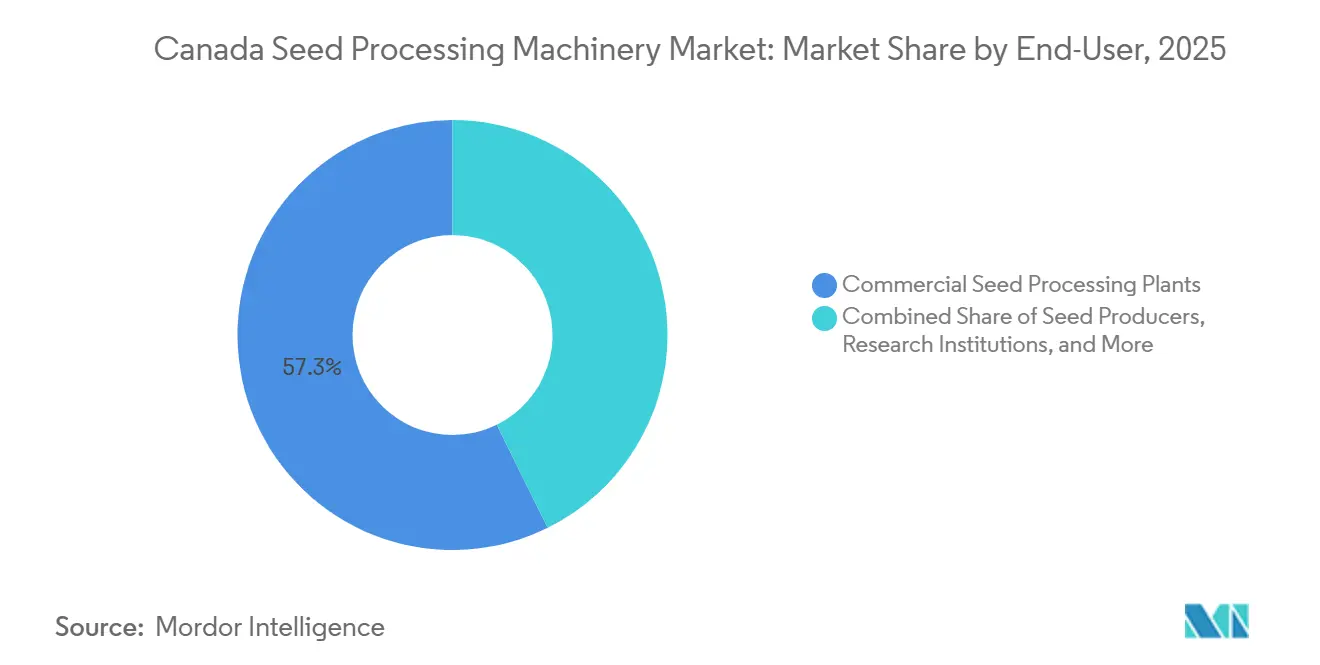
Commercial seed processing plants accounted 57.3% of end-user revenue in 2025, the largest share in the Canada seed processing machinery market. Canadian Seed Growers' Association (CSGA) data covered 1,188,692 pedigreed seed acres, 12,321 fields in 2024. These crops move through dedicated commercial cleaning and treatment plants under Canadian Food Inspection Agency (CFIA) oversight. Seed producers and grain handling facilities are the next largest end-user categories, with grain handlers adding identity-preserved treatment and packaging alongside storage assets. Research institutions are the smallest group by volume but influence demand for precision-scale equipment used in variety development and germination testing, as Canada had 2,169 certified varieties in 2024.
On-farm facilities are forecast to grow at a 8.6% CAGR from 2026 to 2031, the strongest rate across end users. Local processing can reduce transportation needs and support identity-preserved lots in specialty and organic channels. Smaller modular systems make this approach more viable for medium-scale Prairie operations. AGI’s Superior Pulses installation in Verwood, Saskatchewan, included Westeel bins, NECO mixed-flow dryers, and VIS bucket elevators for pulse processing and container export. This demand favors suppliers that can match systems to available space and crop throughput.
Geography Analysis
Western Canada has a substantial pedigreed seed processing base, supported by production across Saskatchewan, Alberta, and Manitoba. Canadian Seed Growers’ Association (CSGA) data show that Saskatchewan recorded 319,864 inspected pedigreed seed acres in 2024, while Alberta recorded 307,711 acres and Manitoba 295,252 acres. In 2025, inspected acreage increased to 361,549 acres in Saskatchewan, 333,646 acres in Alberta, and 315,095 acres in Manitoba. Wheat, barley, canola, lentils, peas, forage crops, and other seed types contribute to equipment requirements across these provinces. The diversity of crops processed supports the use of cleaning, separation, drying, handling, and related seed-processing systems.
Prairie Wind Milling developed a new seed-cleaning plant near Oyen, Alberta, with Current Group delivering a turnkey design-build solution that included electrical design, fabrication, automation, and integration of Cimbria equipment. The facility was designed around efficient process control, reliability, scalability, and integrated system operation. This project illustrates ongoing investment in automated seed-cleaning infrastructure within Alberta. British Columbia also maintains pedigreed seed production, recording 4,933 inspected acres in 2024 and 5,757 acres in 2025. Across Western Canada, differences in crop mix and processing volumes create requirements for equipment capable of handling multiple seed types and operating conditions.
Eastern Canada also maintains an established pedigreed seed production base, particularly in Ontario and Quebec. In 2024, Ontario recorded 168,772 inspected pedigreed seed acres across 662 Canadian Seed Growers’ Association members, while Quebec recorded 81,991 acres across 498 members. Ontario’s inspected acreage included soybean, hybrid corn, wheat, and other crops, while Quebec recorded substantial soybean and cereal seed acreage. Atlantic Canada also recorded pedigreed seed acreage across Prince Edward Island and New Brunswick. Separately, Prairies Economic Development Canada (PrairiesCan) received USD 24.3 million (CAD 33.8 million) over five years beginning in 2024-25 to deliver the Regional Artificial Intelligence Initiative, which supports artificial intelligence adoption across priority sectors including agriculture.
Competitive Landscape
The Canada seed processing machinery market includes global equipment manufacturers and Canadian suppliers offering cleaning, sorting, handling, automation, and integrated processing solutions. Bühler AG, Ag Growth International Inc., Westrup ApS, PETKUS Technologie GmbH, and Satake Corporation are among the companies supplying equipment and technologies applicable to seed processing. Global manufacturers compete through optical sorting, processing technology, plant engineering, automation, and service capabilities. Bühler AG reported USD 144 million (CHF 131 million) in research and development spending in 2025, equivalent to 4.8% of group turnover. The company also reported around 60 product launches globally, while its SORTEX AI700 incorporates artificial intelligence-based sorting technology for processing applications.
Satake Corporation expanded its optical sorting portfolio with the EZER1251 high-capacity optical sorter in 2025. In April 2026, Satake Corporation launched the SLASH modular optical sorter series, incorporating Red, Green, and Blue (RGB), Near-Infrared (NIR), and Short-Wave Infrared (SWIR) sensing technologies. Canadian and regional equipment suppliers, including Vistasort Technologies Ltd., Nexeed Inc., ArrowCorp Inc., and Can-Seed Equipment Ltd., provide equipment, integration, installation, or related services for grain and seed processing applications. ArrowCorp Inc. announced the acquisition of Clipper Seed Cleaners in 2025, expanding its seed and grain cleaning equipment portfolio.
Equipment modernization also plays a role in the competitive landscape as processors evaluate automation, controls, monitoring systems, and sorting technologies alongside conventional cleaning equipment. Suppliers such as Alvan Blanch Development Company Ltd and other equipment manufacturers provide processing systems applicable to seed, grain, and agricultural commodity handling. Canadian Grain Commission requirements and grain grading specifications also necessitate that processors maintain appropriate separation, grading, and quality-control capabilities. Competition in the Canada seed processing machinery market reflects differences in equipment portfolios, processing technologies, automation capabilities, engineering support, installation services, and access to after-sales support.
Canada Seed Processing Machinery Industry Leaders
Bühler AG
Ag Growth International Inc.
PETKUS Technologie GmbH
Satake Corporation
Westrup ApS
- *Disclaimer: Major Players sorted in no particular order

Recent Industry Developments
- April 2026: Satake Corporation expanded its SLASH (VQS Series) modular optical sorter globally, introducing enhanced optical sensing, artificial intelligence-assisted calibration, and compact modular design to strengthen its seed and grain processing equipment portfolio for international markets, including Canada.
- June 2025: LMC VistaSort announced the launch of VistaSort Avance, an advanced, artificial intelligence-driven optical seed-sorting system with enhanced imaging and self-learning capabilities, strengthening Canada's seed-processing machinery manufacturing and innovation ecosystem.
- June 2025: ArrowCorp Inc. acquired Clipper, a manufacturer of air-screen seed-cleaning machines, expanding its integrated grain and seed processing equipment portfolio and strengthening its manufacturing capabilities and product offerings in the Canadian seed-processing machinery market.


Canada Seed Processing Machinery Market Report Scope
Seed processing machinery encompasses equipment used in agriculture to clean, sort, grade, dry, treat, and package seeds, improving their quality and viability for planting. These machines play a critical role in removing impurities, ensuring uniformity, and safeguarding seeds from pests and diseases.
The Canada Seed Processing Machinery Market Report is Segmented by Machinery Type (Pre-Cleaners, Cleaners, Dryers, Graders, Polishers, Optical Sorters, Seed Packagers, Coaters and Treaters, Separators and Destoners, and other specialized equipment), by Operation Mode (Automatic and Semi-Automatic), and by End-User (Commercial Seed Processing Plants, Seed Producers, Research Institutions, On-Farm Facilities, and Grain Handling Facilities). The Market Forecasts are Provided in Terms of Value (USD).
| Pre-Cleaners |
| Cleaners |
| Dryers |
| Graders |
| Coaters and Treaters |
| Separators and Destoners |
| Polishers |
| Optical Sorters |
| Seed Packagers |
| Other Specialized Equipment |
| Automatic |
| Semi-Automatic |
| Commercial Seed Processing Plants |
| Seed Producers |
| Research Institutions |
| On-Farm Facilities |
| Grain Handling Facilities |
| By Machinery Type | Pre-Cleaners |
| Cleaners | |
| Dryers | |
| Graders | |
| Coaters and Treaters | |
| Separators and Destoners | |
| Polishers | |
| Optical Sorters | |
| Seed Packagers | |
| Other Specialized Equipment | |
| By Operation Mode | Automatic |
| Semi-Automatic | |
| By End-User | Commercial Seed Processing Plants |
| Seed Producers | |
| Research Institutions | |
| On-Farm Facilities | |
| Grain Handling Facilities |


Key Questions Answered in the Report
What is the Canada seed processing machinery market size?
It is estimated at USD 297.55 million in 2026 and is forecast to reach USD 441.26 million by 2031 at an 8.20% CAGR.
Which machinery type leads seed processing equipment demand in Canada?
Cleaners led with a 44.2% revenue share in 2025 because they are required across cereal, oilseed, pulse, and forage seed processing.
Which seed processing equipment category is growing fastest in Canada?
Optical sorters are forecast to grow at an 8.8% CAGR through 2031, supported by purity requirements, lot data, and export-oriented processing.
Why are automatic seed processing systems being adopted in Canada?
Automatic systems held 72.1% of revenue in 2025 and help facilities address labor shortages, throughput control, and batch documentation needs.
Page last updated on:





