
Canada Bonsai Market Size and Share
Market Overview
| Study Period | 2021 - 2031 |
|---|---|
| Forecast Data Period | 2026 - 2031 |
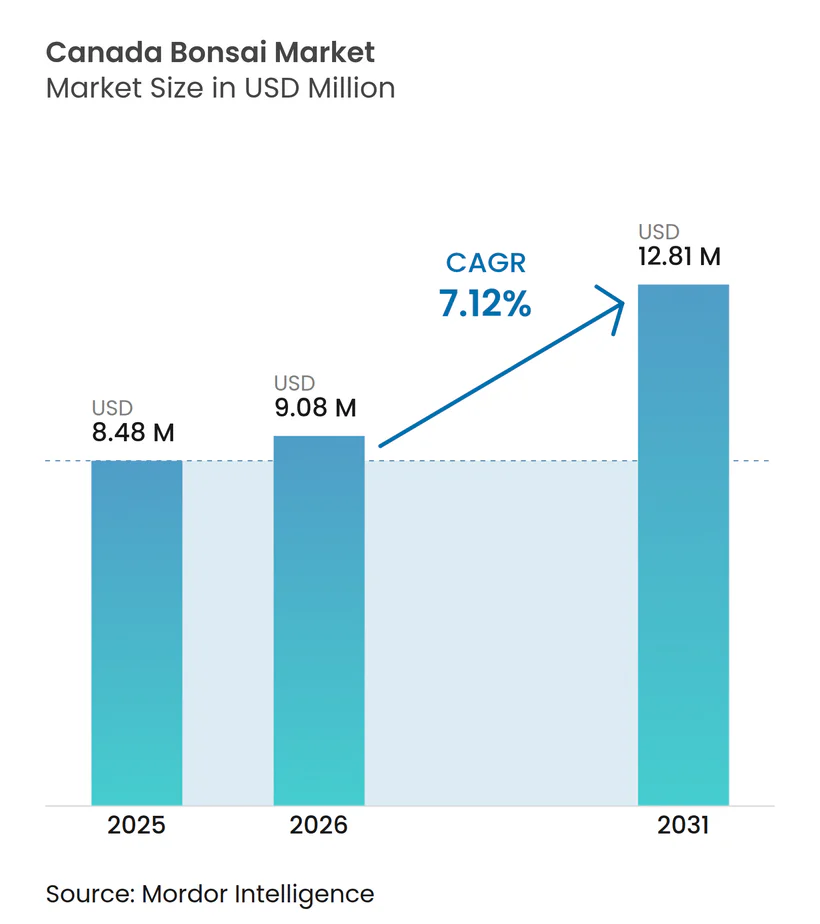
| Base Year Market Size (2025) | USD 8.48 Million |
| Market Size (2026) | USD 9.08 Million |
| Market Size (2031) | USD 12.81 Million |
| Growth Rate (2026 - 2031) | 7.12 % |
| Market Concentration | Low |
Major Players *Disclaimer: Major Players sorted in no particular order Image © Mordor Intelligence. Reuse requires attribution under CC BY 4.0. | |
Canada Bonsai Market Analysis by Mordor Intelligence
The Canada Bonsai Market size is projected to expand from USD 8.48 million in 2025 and USD 9.08 million in 2026 to USD 12.81 million by 2031, registering a CAGR of 7.12% between 2026 and 2031. The Canada bonsai market is supported by denser urban housing, higher spending on mindful leisure, and a younger group of buyers who often discover bonsai online before visiting a nursery. Balcony and indoor growing have become relevant as space limits affect plant choices in urban homes. Statistics Canada reported that 30% of Canadian households that grow plants used balconies as their main growing space in 2023, while renters had a 50% balcony-gardening rate. Bonsai fits this setting because it can be cultivated without a yard or garden bed. Its compact form also allows a collector to keep several trees in a limited living space. Supply access, care guidance, and winter survival will continue to shape which sellers and species gain traction in the Canada bonsai market.
Key Report Takeaways
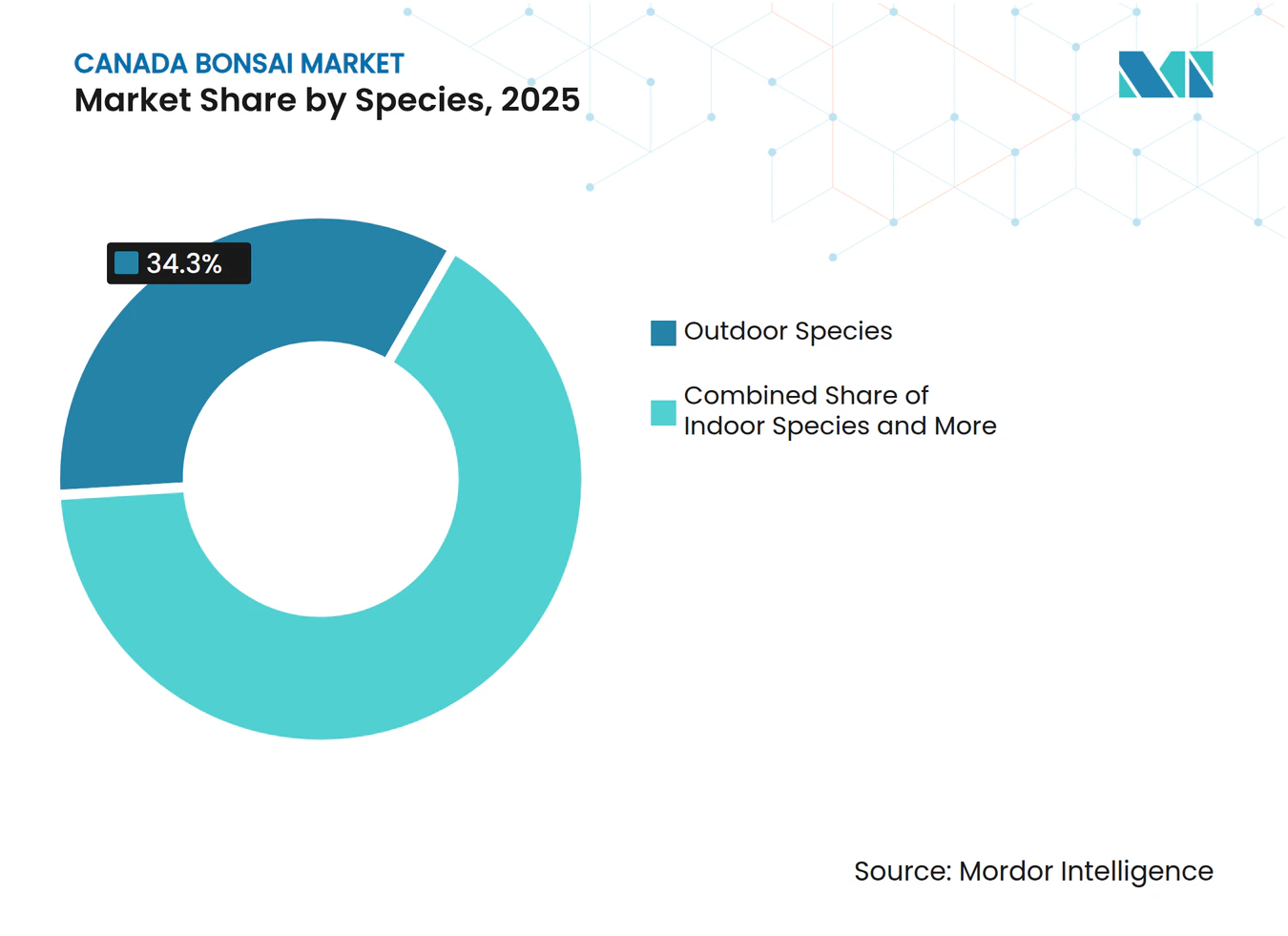
- By species, outdoor species were the largest segment with 34.3% of the Canada bonsai market share in 2025, while indoor species are the fastest segment and are forecast to grow at an 8.2% CAGR from 2026 to 2031.
- By distribution channel, offline was the largest segment with 64.1% of the Canada bonsai market size in 2025, while online is the fastest segment with an 8.5% CAGR from 2026 to 2031.
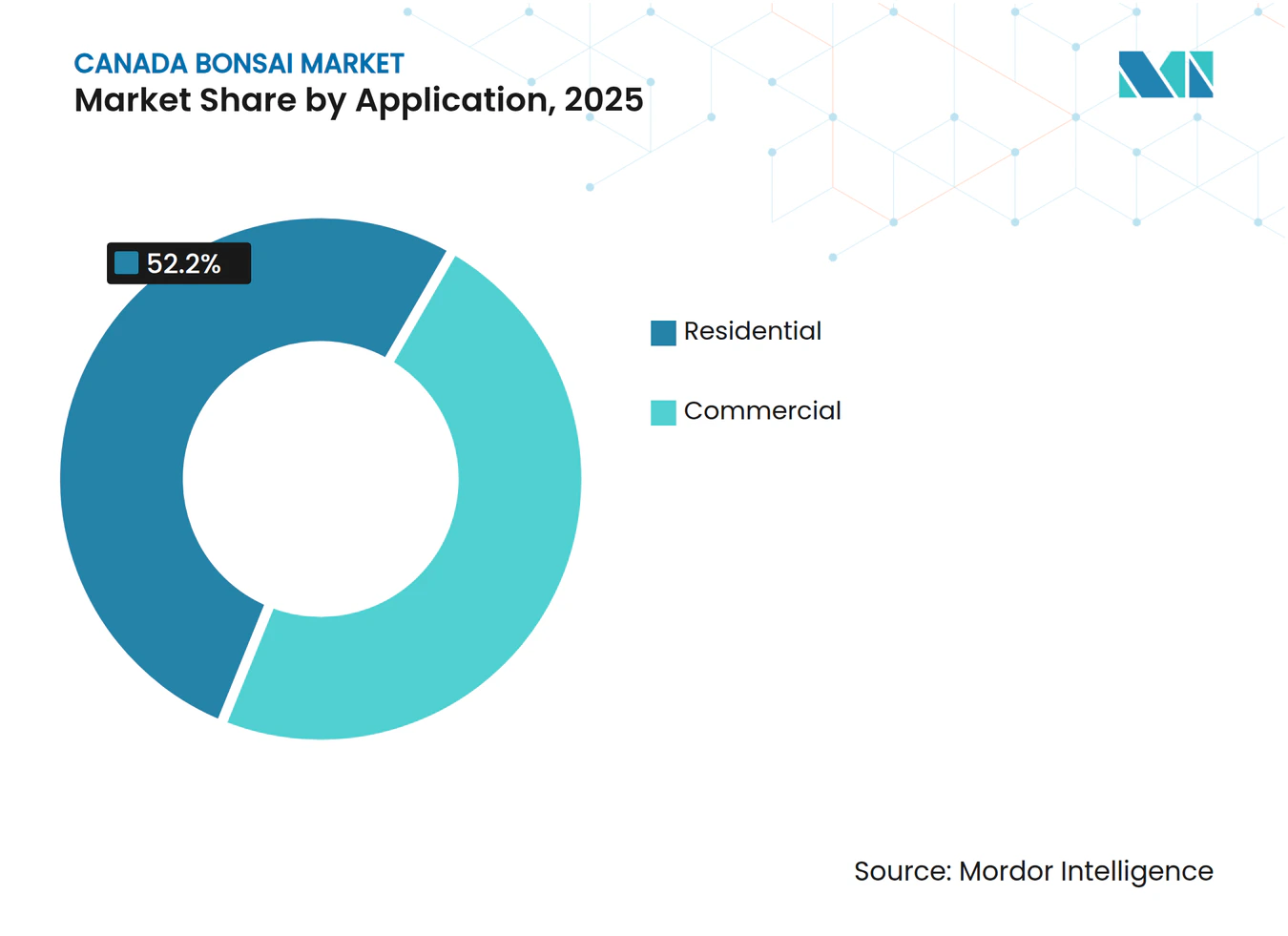
- By application, residential was the largest segment with 52.2% revenue share in 2025, while commercial is the fastest segment with a 9.5% CAGR from 2026 to 2031.
Note: Market size and forecast figures in this report are generated using Mordor Intelligence’s proprietary estimation framework, updated with the latest available data and insights as of January 2026.
Market Trends and Insights
Drivers Impact Analysis of Canada Bonsai Market*
| Driver | (~) % Impact on CAGR Forecast | Geographic Relevance | Impact Timeline |
|---|---|---|---|
| Urban apartment and balcony gardening | +1.5% | National, with early gains in Toronto, Montréal, and Vancouver | Short term (≤ 2 years) |
| Premium mindful-hobby spending | +1.2% | National, with concentration in Ontario and British Columbia | Medium term (2-4 years) |
| Omnichannel discovery and direct-to-consumer bonsai sales | +1.3% | National | Short term (≤ 2 years) |
| Biophilic commercial interiors and corporate wellness | +0.9% | National, with early gains in Toronto, Vancouver, and Calgary | Medium term (2-4 years) |
| Cold-hardy cultivar and indoor-grow-system innovation | +0.8% | National, strongest uptake in Prairie and Atlantic provinces | Long term (≥ 4 years) |
| Creator-led bonsai education and community conversion | +0.7% | National | Short term (≤ 2 years) |
| Source: Mordor Intelligence | |||
Urban Apartment and Balcony Gardening
Canada’s urban housing pattern has changed how many households keep plants. Statistics Canada found that 48% of plant-growing households in Victoria, 46% in Québec City, and 43% in Montréal used balconies as their main growing space in 2023[1]. Renters were 50% more likely than owners to garden on balconies and 31% more likely to grow plants indoors. This creates a sizable urban buyer group for container-friendly plants in the Canada bonsai market. Bonsai has a small footprint and can remain indoors through much of the year. Those attributes make it suitable for apartments where standard garden planting is not possible. The shift gives specialty retailers a reason to present bonsai as a practical indoor and balcony plant rather than only as a collector's item.
Premium Mindful-Hobby Spending
Bonsai purchases can combine plant ownership with a longer hobby that includes tools, workshops, training, and collector material. The residential buyer base includes committed hobbyists as well as occasional buyers purchasing decorative trees or gifts. Committed hobbyists tend to buy care supplies and premium materials, while occasional buyers are more price-sensitive and may not return after an initial purchase. Bonsai Ottawa listed a “Zen Path” juniper gift arrangement at CAD 245, equivalent to USD 176 at the 2025 average exchange rate stated in the supplied material[2]. The offer illustrates the premium gifting tier available to households without prior horticultural experience. This spending pattern supports demand for sellers that pair products with clear care support in the Canada bonsai market. It also explains why gifting can introduce new customers without assuming prior training or an established collection.
Omnichannel Discovery and Direct-to-Consumer Bonsai Sales
Online discovery has changed how buyers find specialist bonsai sellers in Canada. Websites, curated newsletters, and social commerce can reach customers who live far from a specialty studio. Canada Bonsai has operated online since July 2020 and reported more than 11,000 registered contacts across Canada and the United States. Its newsletter release cycle and private sale membership model create structured access to limited material. This approach reduces the importance of driving distance for buyers in provinces with few specialty stores. Sellers that use subscriber lists and species-specific demand signals can plan inventory more closely than walk-in retailers. This model also allows a limited number of specimens to be released to interested buyers in a more controlled manner.
Biophilic Commercial Interiors and Corporate Wellness
Commercial buyers are using live plants in the workplace and hospitality design. M Moser Associates’ 2025 redesign for PwC Canada identified biophilia, accessibility, and occupant autonomy as central priorities. M Moser Associates HOK’s Co-operators headquarters project in Guelph, Ontario, achieved WELL Platinum certification and includes a 34-foot-wide living wall with 3,000 plants. HOK Bonsai can fit executive suites, reception areas, and hospitality lobbies where a large living wall is unsuitable. This creates potential for specialist suppliers to build relationships with interior designers, corporate gifting networks, and facility managers. The opportunity is strongest where a small plant can provide visual interest without requiring the space of a larger installation.
Restraints Impact Analysis of Canada Bonsai Market*
| Restraint | (~) % Impact on CAGR Forecast | Geographic Relevance | Impact Timeline |
|---|---|---|---|
| Skilled care and wage-intensive maintenance | -0.6% | National | Short term (≤ 2 years) |
| Canadian winter losses and seasonal shipping constraints | -0.5% | Prairie provinces and Atlantic Canada most affected | Short term (≤ 2 years) |
| Phytosanitary compliance and cross-border supply friction | -0.4% | National, with import-dependent regions in British Columbia and Ontario most affected | Medium term (2-4 years) |
| Pest, disease, and regulated-movement exposure | -0.4% | National | Medium term (2-4 years) |
| Source: Mordor Intelligence | |||
Skilled Care and Wage-Intensive Maintenance
Bonsai trees require regular pruning, watering, repotting, and seasonal protection. These demands can discourage occasional buyers after their first purchase. In many parts of Canada, outdoor trees require cold-frame protection, garage overwintering, or careful mulching due to harsh winter conditions. Indoor tropical varieties require humidity trays, supplemental lighting, and controlled moisture levels in dry, heated homes, particularly during the long Canadian winter months. Specialist retailers must provide detailed care guidance, as customers may find tree maintenance more time-consuming and technically demanding than anticipated. Without proper support, new owners may struggle to keep their trees healthy through seasonal transitions. This care burden can reduce repeat purchasing and makes knowledgeable staff important for the Canada bonsai market. Retailers that invest in staff training and customer education are better positioned to retain buyers over time. The need for guidance is particularly relevant when buyers transition from a gift purchase to maintaining a tree across multiple seasons, as the learning curve can be steep for those without prior horticultural experience.
Canadian Winter Losses and Seasonal Shipping Constraints
Winter mortality is a recurring financial risk for outdoor bonsai owners. Junipers, Scots pines, and Amur maples can suffer losses during severe freezes or extended cold periods if roots dry out. When temperatures drop sharply or cold spells extend over several weeks, root damage can kill trees that appear healthy above ground, resulting in direct inventory losses for retailers and disappointment for buyers. Most specialist retailers restrict or suspend live-tree shipments from November through March to limit transit losses. This shortens the sales calendar and concentrates demand in the fall, making cash flow less predictable for smaller operators. Retailers with limited working capital may struggle to cover fixed costs during the off-season, particularly if autumn sales fall short of expectations. Indoor species reduce part of this problem, but their care requirements, including precise humidity levels, light conditions, and temperature ranges, still create a barrier for new buyers. Retailers must therefore account for both weather-related delivery delays and the different care needs of indoor trees, adjusting inventory planning and customer communication accordingly.
*Our forecasts treat driver/restraint impacts as directional, not additive. The impact forecasts reflect baseline growth, mix effects, and variable interactions.
Canada Bonsai Market Segment Analysis
By Species:
Outdoor Species Lead While Indoor Species Grow FastestOutdoor species held the largest share, accounting for 34.3% of the Canada bonsai market share in 2025. The category is supported by collectors who prefer cold-tolerant deciduous and conifer specimens. Junipers, Scots pines, and Japanese maples are suited to Canadian growing conditions when winter protection is used. The Société de bonsaï et de penjing de Montréal’s auctions at the Jardin botanique de Montréal help circulate field-grown material with years of collector investment. This secondary activity supports continued engagement among experienced growers. Import requirements are more difficult for large, mature outdoor specimens because their developed roots make soil-free shipment more complex. This can reinforce interest in domestically propagated cold-hardy trees for buyers who value dependable supply.
Indoor species are the fastest segment, and the Canada bonsai market size for this category is forecast to expand at an 8.2% CAGR from 2026 to 2031. First-time apartment buyers value plants that remain accessible year-round. Ficus and jade do not require the cold dormancy management associated with many outdoor species. This lowers the barrier to entry for urban buyers, although indoor care still requires attention to light, humidity, and watering. Needle tree species, especially Japanese black pine, remain an aspirational category for experienced enthusiasts in Ontario and British Columbia. Deciduous species such as Japanese maple and trident maple also attract online interest because seasonal foliage performs well in visual product discovery. Canada Bonsai’s 2025 listings included multiple Acer palmatum and Acer buergerianum cultivars.



By Distribution Channel:
Offline Channels Lead While Online Channels Grow FastestOffline channels were the largest distribution segment, holding 64.1% of the Canada bonsai market share in 2025. In-person assessment remains important for premium trees because buyers can inspect trunk movement, nebari, and branch structure before making a purchase. Physical access is particularly valuable when collectors consider older or higher-value specimens. The Bonsai Tool and Supply Company of Canada is another Ontario-based online-only seller of seed kits, pruning tools, wire, and growing media. Its national shipping model serves buyers beyond local specialty-store catchment areas. Offline sellers still have an advantage where specimen condition must be judged directly. The channel also gives buyers the opportunity to discuss care requirements before selecting a tree.
Online channels are the fastest distribution format and are forecast to grow at an 8.5% CAGR from 2026 to 2031. Direct-to-consumer sellers use newsletters, waitlists, and private-sale access to create a discovery experience around limited material. Canada Bonsai’s private membership is one example of a structured model for collector access. Bonsai Ottawa offers complimentary delivery across Ottawa and the Gatineau, Quebec area, pairing regional fulfillment with online discovery and gifting. Digital sellers can track interest by species and location, while traditional studios can combine in-store sales with care guides, educational videos, and seasonal newsletters. The Canada bonsai market will continue to retain an offline role for premium trees even as digital purchasing grows.
By Application:
Residential Buyers Lead While Commercial Demand Grows FastestResidential buyers were the largest application segment, representing 52.2% of the Canada bonsai market size in 2025. Household demand includes hobbyist purchases and gifts for holidays and culturally significant occasions. Some buyers invest in tools, workshops, and premium trees, while others buy a decorative item with a lower level of commitment. Bonsai Ottawa’s curated juniper gift arrangement demonstrates how sellers can present bonsai as a premium gift rather than a specialist horticultural purchase. This range of buyer needs requires clear care information and a selection of accessible price points. Higher attrition among occasional buyers remains an important limitation for residential sellers. Residential suppliers, therefore, need to balance premium gift presentation with information that supports post-purchase care.
Commercial is the fastest application segment, with a projected 9.5% CAGR between 2026 and 2031. The category benefits from biophilic design in workplaces, hospitality venues, healthcare waiting areas, and executive spaces. The supplied material identifies the International WELL Building Institute and the Canada Green Building Council as certification frameworks that recognize biophilic design elements. Bonsai can provide a strong visual presence in a small space, which suits reception areas and executive settings. Commercial procurement can have longer lead times and larger transaction sizes than residential sales. This makes relationships with interior designers and corporate procurement teams important to the Canada bonsai industry. These relationships can help specialists match specimen selection and care expectations to a specific commercial setting.

Geography Analysis
Ontario is the largest geography in the Canada bonsai market because it has the country’s highest concentration of specialist suppliers and collector communities. Toronto’s dense urban population and cultural links to East Asian horticultural traditions support demand across residential, commercial, and gifting uses. The province supports both hobbyist demand and premium collector purchases. Ontario is also an important location for import-focused operators and online sellers. Ontario’s specialist sellers differ from general garden retailers because they focus on collector material, care supplies, and horticultural guidance. This concentration supports a local ecosystem of enthusiasts, suppliers, and education-led retail activity. The province also provides a setting where online sellers can complement rather than replace specialist in-person services.
British Columbia is an important regional market because the Greater Vancouver area has a milder maritime climate. This extends the outdoor growing season and reduces some winter mortality risk for junipers, native conifers, and Pacific varieties. The province’s access to Pacific nursery trade corridors can improve access to Japanese pre-bonsai material compared with interior provinces. Bonsai clubs in British Columbia also help sustain collector participation. Québec has a different profile built around a bilingual buyer base and established ornamental horticulture activity. Canada Bonsai operates in English and French, reflecting the importance of bilingual digital access for this buyer group. The Ministère de l’Agriculture, des Pêcheries et de l’Alimentation du Québec reported CAD 464.1 million in ornamental horticulture receipts in 2024, equivalent to USD 338.9 million at the 2024 average exchange rate cited in the supplied material[3].
The Prairie provinces and Atlantic Canada are smaller but distinct parts of the Canada bonsai market. Alberta, Saskatchewan, and Manitoba face harsh winters that favor indoor species and cold-hardy cultivars such as Amur maple and tamarack. These trees can survive United States Department of Agriculture Hardiness Zones 2 to 3 with appropriate protection. Physical specialty stores are limited outside Calgary and Edmonton, making online channels especially relevant. Nova Scotia, New Brunswick, Newfoundland and Labrador, and Prince Edward Island share the climate constraint, although Halifax and Fredericton have growing urban gardening activity. Statistics Canada recorded indoor plant growing among growing households in Newfoundland and Labrador in 2023, the highest rate among provinces surveyed. This pattern aligns with the fastest-growing indoor species category and supports the case for sellers that can provide reliable delivery, clear care guidance, and species suited to colder conditions throughout the extended Canadian winter season. The region gives online specialists an opportunity to serve dispersed customers where store access is limited.
Competitive Landscape
Market Concentration
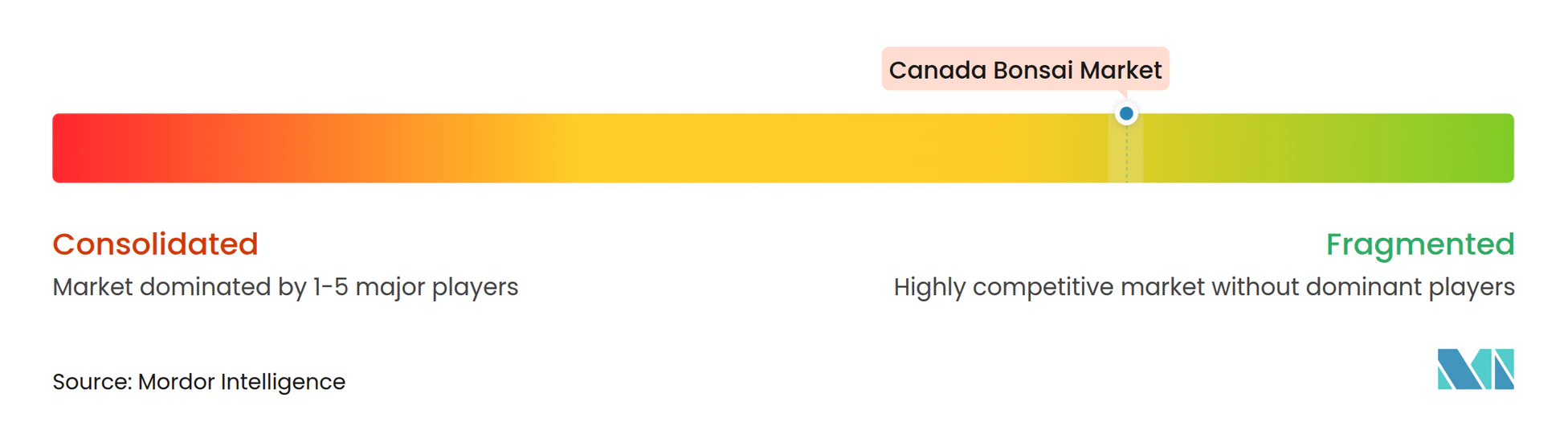
The Canada bonsai market is fragmented, and no operator holds a commanding national position in 2025. The field includes artisan studios, small-batch importers, regional community businesses, and online-native retailers. Ontario contains the highest concentration of specialist operators. Canada Bonsai and The Bonsai Tool and Supply Company of Canada use curated online catalogs, membership programs, or education-linked content rather than large retail floor networks. The lack of a reported combined share for leading operators prevents a quantified concentration calculation based on company revenue shares. Competition is therefore better understood through the variety of specialist models than through a single dominant seller. Buyers can choose among local studios, import specialists, and digital catalog businesses.
Canada Bonsai maintains sourcing relationships with Japanese nurseries and offers private-sale members access to limited material and major Japanese bonsai exhibitions, including Kokufu-ten, Taikan-ten, and Gafu-ten. This strategy focuses on collector access and dependable supply rather than broad retail scale. Bonsai Ottawa combines curated retail with workshops and local delivery across Ottawa and Gatineau. Regional studio models use workshop programming, educational events, and curated retail to build repeat local relationships. These models show that specialist operators compete through product knowledge, community participation, and fulfillment capability. Each model addresses a different part of the buyer journey, from first education to access to limited collector material. The separation also limits one company's ability to serve every regional and customer need.
Corporate procurement remains less developed than consumer retail, despite the commercial segment’s 9.5% projected CAGR. Suppliers that build regular relationships with interior design firms and facility managers may be better positioned to serve this demand. Care technology is another area of differentiation. The remote-control system described in the 2025 Proceedings of SPIE paper used sensors, irrigation control, and lighting adjustment to reduce the complexity of care. Sellers who pair trees with guidance, tools, and care systems can help buyers maintain specimens through Canadian winters. Competition in the Canada bonsai market is therefore shaped by specialized sourcing, education, local service, and the ability to reduce ownership risk. Operators who clearly explain expectations for winter protection and care may be better able to maintain customer confidence. This is important because ownership outcomes influence repeat engagement in a specialist hobby category.
Canada Bonsai Industry Leaders
-
The Tropical Bonsai Inc.
-
Tropical Expressions Inc.
-
Canada Bonsai
-
Art et Culture Bonsaï
-
Bonsai Ottawa
- *Disclaimer: Major Players sorted in no particular order
Canada Bonsai Market Companies Covered in this Report
- The Tropical Bonsai Inc.
- Tropical Expressions Inc.
- Canada Bonsai
- The Bonsai Tool & Supply Company of Canada
- Art et Culture Bonsaï
- Shikoku Bonsai Canada
- Bonsaï Gros-Bec
- Bonsai Floral Gardens
- Bonsai Ottawa
- Living Art Penjing and Bonsai
- Bonsai Botanicals
- Kim's Nature
- Les Bonsai Enr.
- Bonsaistore.co
- Sheridan Nurseries Limited
Recent Industry Developments in Canada Bonsai Market
- June 2025: Société de bonsaï et de penjing de Montréal (SBPM) expanded its commercial/community activities through its 2025 bonsai shop program at the Montréal Botanical Garden, offering bonsai materials and supplies on multiple dates through the season. Its 2025–2026 programming also continued workshops and other activities at the Japanese Pavilion.
- May 2025: Canada Bonsai formally opened its branch to United States customers moving its existing cross-border sales activity from primarily email-based orders to a dedicated online ordering channel. The 2025 launch also expanded availability of hard-to-find Japanese maple cultivars.
- December 2024: Canada Bonsai has been developing a particularly broad collection of Prunus mume (Japanese flowering apricot), with more than 90 cultivars propagated. The nursery is developing these into pre-bonsai, bonsai, garden trees, and larger landscape plants, creating a differentiated product pipeline beyond conventional bonsai trees.
Canada Bonsai Market Report Scope
A bonsai is a miniature, container-grown tree or shrub that is shaped and trained through precise pruning and wiring techniques. It is a traditional Japanese art form designed to replicate the scale, balance, and beauty of full-sized trees in nature.
The Canada Bonsai Market Report is Segmented by Species (Indoor Species, Outdoor Species, and More), by Distribution Channel (Online and Offline), and by Application (Residential, Commercial, and Others). The Market Forecasts are Provided in Terms of Value (USD).
Segmentation Overview
| Indoor Species |
| Outdoor Species |
| Needle Tree Species |
| Deciduous Tree Species |
| Online |
| Offline |
| Residential |
| Commercial |
| Others (institutional gifts, art fairs) |
| By Species | Indoor Species |
| Outdoor Species | |
| Needle Tree Species | |
| Deciduous Tree Species | |
| By Distribution Channel | Online |
| Offline | |
| By Application | Residential |
| Commercial | |
| Others (institutional gifts, art fairs) |
Key Questions Answered in the Report
What is the forecast growth rate for bonsai in Canada?
The Canada bonsai market is forecast to grow at a 7.12% CAGR from 2026 to 2031, increasing from USD 9.08 million in 2026 to USD 12.81 million in 2031. Urban housing, online discovery, and commercial biophilic design support this outlook.
Which bonsai species category is largest in Canada?
Outdoor species were the largest category in 2025, with 34.3% revenue share, supported by collector demand for cold-tolerant specimens. Junipers, Scots pines, and Japanese maples remain relevant choices when growers provide suitable winter care.
Which bonsai category is growing fastest in Canada?
Indoor species are forecast to grow at an 8.2% CAGR through 2031 as apartment buyers seek year-round cultivation options. Ficus and jade reduce the need for cold dormancy management but still require light, humidity, and moisture control.
Why are online bonsai sales growing in Canada?
Online channels are forecast to grow at an 8.5% CAGR through 2031 because newsletters, memberships, and delivery can reach buyers outside specialty-store locations. Digital sellers can also use customer interest by geography and species to guide specimen acquisition.
What is driving commercial bonsai demand in Canada?
Commercial demand is forecast to grow at a 9.5% CAGR through 2031 as workplaces, hospitality venues, and other spaces use biophilic design elements. Interior designers, corporate gifting programs, and facility managers are relevant routes to these customers.
What are the main risks for bonsai suppliers in Canada?
Winter losses, seasonal shipping limits, care complexity, and phytosanitary requirements can affect supply availability and repeat purchases. Small importers may face higher compliance costs for mature trees that require specialized soil-free packing.