
CAMARA API Ecosystem Market Size and Share
Market Overview
| Study Period | 2020 - 2031 |
|---|---|
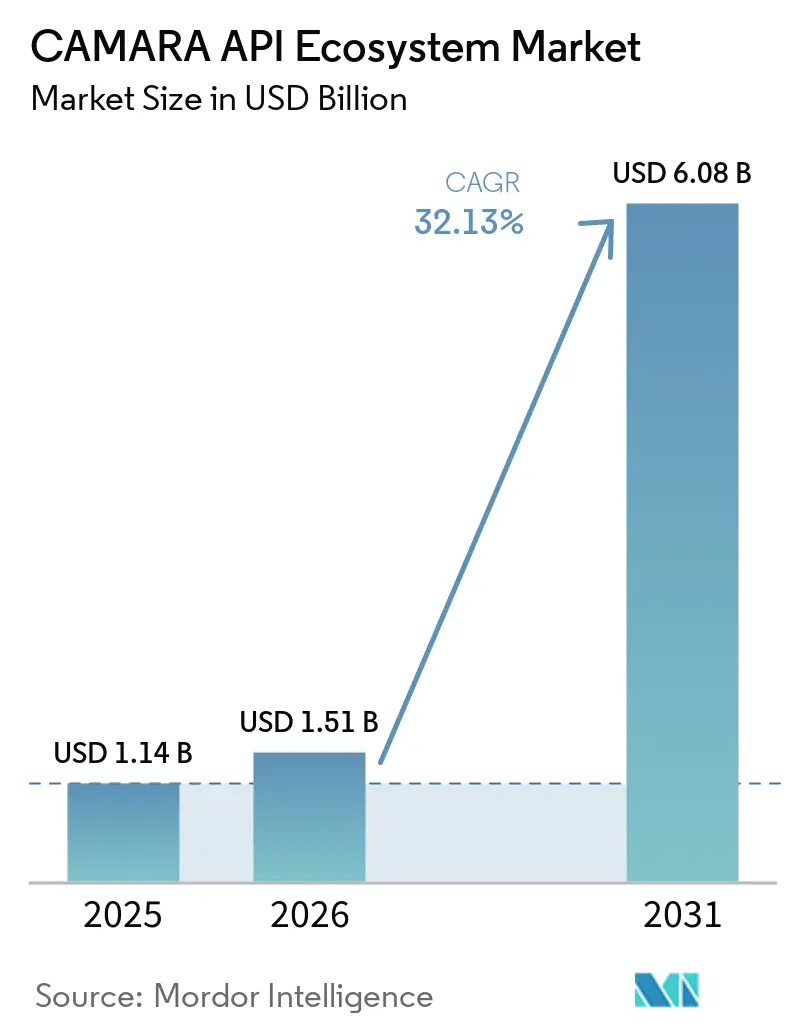
| Market Size (2026) | USD 1.51 Billion |
| Market Size (2031) | USD 6.08 Billion |
| Growth Rate (2026 - 2031) | 32.13 % |
| Fastest Growing Market | Asia-Pacific |
| Largest Market | North America |
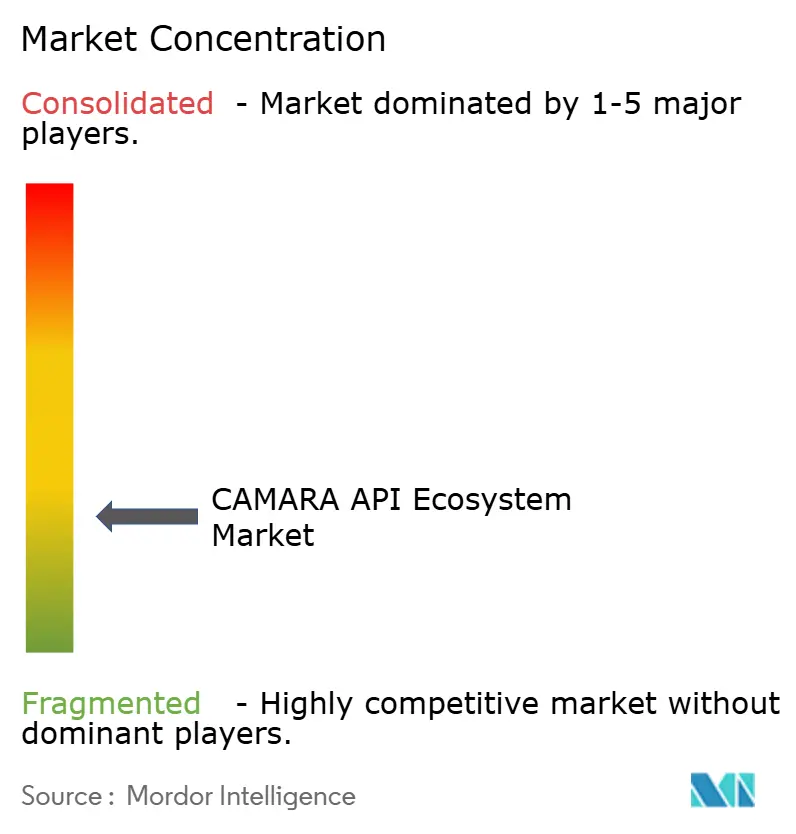
| Market Concentration | Low |
Major Players *Disclaimer: Major Players sorted in no particular order Image © Mordor Intelligence. Reuse requires attribution under CC BY 4.0. | |
CAMARA API Ecosystem Market Analysis by Mordor Intelligence
The CAMARA API Ecosystem Market size is projected to expand from USD 1.14 billion in 2025 to USD 1.51 billion in 2026, and to USD 6.08 billion by 2031, registering a CAGR of 32.13% between 2026 and 2031. The CAMARA API Ecosystem Market is being shaped by operators that expose network functions as standardized interfaces for enterprise applications. This allows enterprises to use verified network data for authentication, fraud detection, location, device status, and service quality decisions. The GSMA Open Gateway framework had aligned 86 operator groups by early 2026, representing more than 300 networks and 80% of global mobile connections. CAMARA APIs were commercially active in more than 65 markets, while reported network API revenue growth exceeded 130% at Mobile World Congress 2026. Distribution is moving beyond operator portals, as aggregators, CPaaS providers, and cloud platforms offer enterprises broader coverage with fewer integrations. The CAMARA API Ecosystem Market, therefore, depends on both standard technical specifications and practical routes to enterprise adoption.
Key Report Takeaways
- By API category, Authentication and Fraud Prevention APIs held 34.21% of the CAMARA API Ecosystem Market share in 2025, while Computing Services APIs are forecast to grow at a 33.18% CAGR through 2031.
- By API maturity, Stable APIs accounted for 62.42% of the CAMARA API Ecosystem Market share in 2025, while Initial APIs are forecast to grow at a 34.17% CAGR through 2031.
- By deployment model, Direct Operator Exposure held 41.16% of the CAMARA API Ecosystem Market in 2025, while Marketplace-Mediated Exposure is forecast to grow at a 33.27% CAGR through 2031.
- By end-user industry, Banking, Financial Services, and Insurance accounted for 31.24% of the CAMARA API Ecosystem Market in 2025, while Information Technology and Software are forecast to grow at a 34.19% CAGR through 2031.
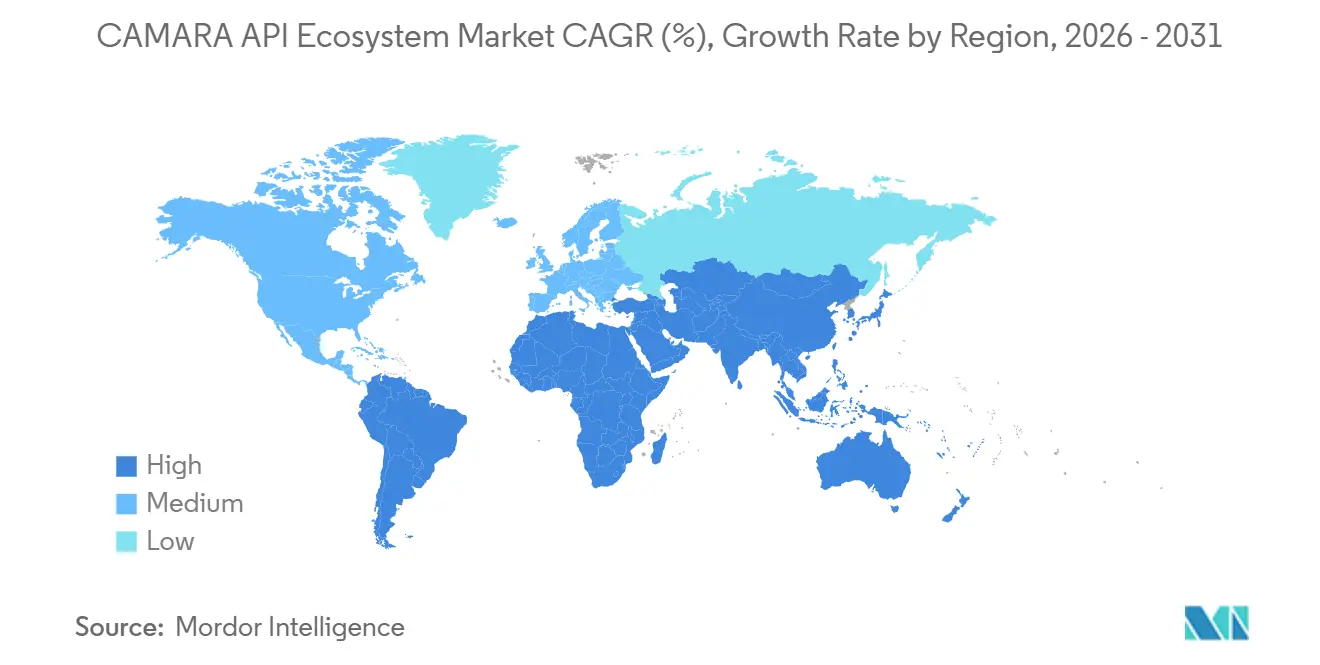
- By geography, North America held 34.12% of the CAMARA API Ecosystem Market in 2025, while Asia-Pacific is forecast to grow at a 33.21% CAGR through 2031.
Note: Market size and forecast figures in this report are generated using Mordor Intelligence’s proprietary estimation framework, updated with the latest available data and insights as of January 2026.
Market Trends and Insights
Drivers Impact Analysis of CAMARA API Ecosystem Market*
| Driver | (~) % Impact on CAGR Forecast | Geographic Relevance | Impact Timeline |
|---|---|---|---|
| Expansion of GSMA Open Gateway and CAMARA Standardization | +8.2% | Global | Short term (≤ 2 years) |
| Demand for Authentication and Fraud Prevention APIs | +6.5% | Global, concentrated in North America and Europe | Short term (≤ 2 years) |
| 5G, Edge, and IoT Monetization | +5.1% | Asia-Pacific core, with spillover to North America and Europe | Medium term (2-4 years) |
| Enterprise Demand for Real-Time Network Intelligence | +3.8% | North America and Europe, emerging in Asia-Pacific | Medium term (2-4 years) |
| Build-Once, Deploy-Everywhere API Portability | +2.9% | Global | Medium term (2-4 years) |
| Conformance Tooling and Federated Marketplace Scale | +1.7% | North America and Europe | Long term (≥ 4 years) |
| Source: Mordor Intelligence | |||
Expansion of GSMA Open Gateway and CAMARA Standardization
The CAMARA API Ecosystem Market benefits from a common framework that reduces the need for enterprises to work with a separate technical interface in each operator network. By early 2026, 86 operator groups and 61 channel partners were aligned around the GSMA Open Gateway approach.[1] The model is now centered on distribution and standardization because channel partners provide developers with a broader path to commercial APIs. Twilio reported 30.8 million CAMARA API transactions per day at Mobile World Congress 2026, demonstrating how volume can scale through a single interoperable channel. CAMARA issued 60 APIs in its Fall 2025 meta-release, including 10 stable APIs, providing operators and integrators with a clearer release schedule. The GSMA and TM Forum conformance program, available from 2025, helps certified deployments connect with marketplaces and channel partners.
Demand for Authentication and Fraud Prevention APIs
Authentication and fraud prevention remain a central source of demand in the CAMARA API Ecosystem Market because operators possess signals that other identity providers cannot replicate. These signals include SIM status, number portability records, and device swap timing. A United Kingdom bank using Sekura.[2] ID's CAMARA SIM Swap API received fraud responses in less than 1 second within its transaction approval process. Financial services, software, and government were the 3 leading target industries for developers deploying network APIs in 2025. The shift from SMS one-time passwords to network-native verification can move value from SMS aggregation to operators and CAMARA-compliant channels. Financial institutions must still establish a valid basis for personal data processing when using KYC Match or SIM Swap APIs, particularly in Europe.
5G, Edge, and IoT Monetization
The CAMARA API Ecosystem Market enables operators to commercialize capabilities that go beyond basic connectivity. Quality-on-Demand sessions, edge discovery, and device-status APIs allow applications to request or respond to network conditions. These capabilities can support premium services that require dependable performance, low latency, or network context. CAMARA's Application Profiles API lets workloads declare their compute and network requirements together, making edge placement decisions more visible to developers.[3] The TM Forum Aura Catalyst is exploring AI-RAN on shared accelerated infrastructure through CAMARA APIs. This work supports the use of edge AI as an operator revenue opportunity rather than only a network cost.
Enterprise Demand for Real-Time Network Intelligence
Enterprise demand in the CAMARA API Ecosystem Market has clustered into 2 broad application groups. Banks, e-commerce platforms, and identity providers use authentication and fraud APIs where results can be linked to transaction decisions. Logistics, automotive, and healthcare users seek network information for routing, scheduling, and workflow decisions. Quality on Demand, location, and device APIs were gaining use in media, healthcare, retail, and aviation during the first half of 2026. Orange published an implementation in July 2026 that lets AI agents call CAMARA APIs for location verification, SIM swap detection, and quality-of-service orchestration. The approach could extend demand from developer-built applications to organizations that use large language model workflows.[4]
Restraints Impact Analysis of CAMARA API Ecosystem Market*
| Restraint | (~) % Impact on CAGR Forecast | Geographic Relevance | Impact Timeline |
|---|---|---|---|
| Privacy, Consent, and Data Protection Requirements | -2.8% | Europe, with GDPR as the core framework, and Asia-Pacific national frameworks | Short term (≤ 2 years) |
| OSS/BSS and Legacy Network Integration Costs | -2.1% | Global, most acute in Europe and Asia-Pacific | Medium term (2-4 years) |
| Operator-Specific Commercial and Onboarding Friction | -1.4% | Asia-Pacific, South America, and Africa | Medium term (2-4 years) |
| Sparse Local Demand Signals Outside Leading Markets | -0.8% | Africa, parts of South America, and South and Southeast Asia | Long term (≥ 4 years) |
| Source: Mordor Intelligence | |||
Privacy, Consent, and Data Protection Requirements
Privacy and consent requirements can slow the CAMARA API Ecosystem Market, where APIs use personal information. Number verification, device location, and KYC-related functions require operators to establish a valid legal basis before commercial deployment in markets governed by GDPR or comparable laws. CAMARA's Identity and Consent Management working group stated in June 2025 that 3-legged access tokens are required for APIs with opt-in or opt-out mechanisms. This requirement can make onboarding more demanding for consumer-facing applications. A separate Consent Management API was proposed in late 2025 alongside the Consent Info API, showing that the consent architecture was still being refined. European operators may face additional review work because GDPR enforcement and legal interpretation vary across member states.
OSS/BSS and Legacy Network Integration Costs
The CAMARA API Ecosystem Market also faces deployment constraints due to legacy OSS and BSS environments. A standardized API at the developer-facing layer still needs to connect with each operator's network functions, including Network Exposure Functions, Unified Data Repositories, and Gateway Mobile Location Centers. Enea identified architectural diversity, fragmented backend systems, regulation, and inconsistent onboarding as reasons implementation costs differ across operators. Mixed 4G and 5G networks require different integration paths, and those paths are not always reusable across vendors. Smaller operators can face a heavier burden because they have fewer engineering resources for operator-specific work. This keeps a gap between the availability of a CAMARA specification and the commercial availability of an API in networks with varied infrastructure.
*Our forecasts treat driver/restraint impacts as directional, not additive. The impact forecasts reflect baseline growth, mix effects, and variable interactions.
CAMARA API Ecosystem Market Segment Analysis
By API Category:
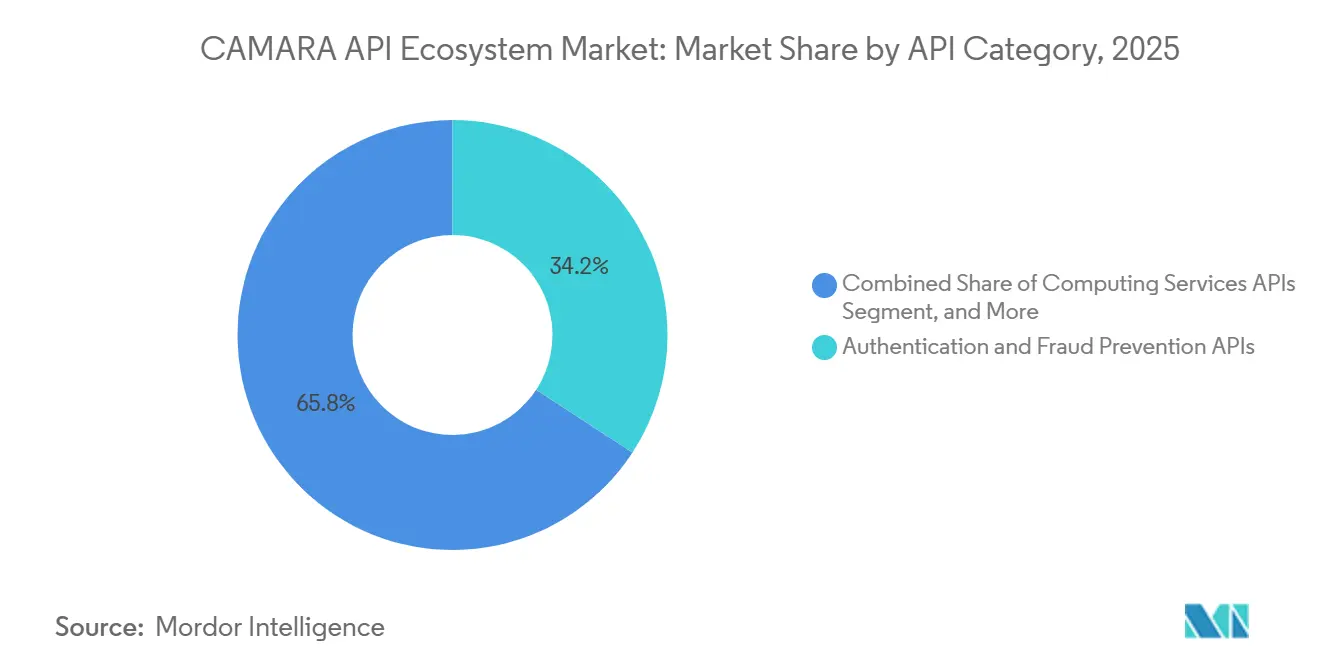
Authentication Leads Demand While Computing Services Drives GrowthAuthentication and Fraud Prevention APIs held 34.21% of the market in 2025. Banks and insurers use SIM Swap, Number Verification, and KYC to ensure fast, reliable checks. The French operators that committed to KYC Match after 2024 reported that the API helped banking clients reduce identity fraud by nearly 50%. Vodafone's CAMARA-compliant Scam Signal API improved fraud detection by 30% during a 3-month pilot with a United Kingdom bank.
Computing Services APIs are forecast to grow at a 33.18% CAGR through 2031. Simple Edge Discovery enables an application to identify an edge zone based on proximity and network performance. This can support low-latency inference without requiring developers to understand network topology. Location, communication, quality, and device APIs also serve logistics, retail, automotive, and IoT applications. Nokia's Network as Code integration with Google Cloud in March 2026 showed how CAMARA APIs can supply real-time network context for AI-agent workload decisions.

By API Maturity:
Stable APIs Support Production Deployment While Initial APIs Expand ScopeStable APIs accounted for 62.42% of the market in 2025. Enterprises favor interfaces with documented versions, compatibility commitments, and established conformance requirements. The Fall 2025 meta-release included 10 stable APIs covering fraud prevention, quality of service, and edge discovery. The release schedule provides operators with a clear point for assessing production deployment. Joint GSMA and TM Forum certification also allows service providers to cover CAMARA Service APIs and TM Forum Operate APIs through a common certification process.
Initial APIs are forecast to grow at a 34.17% CAGR through 2031. CAMARA added 23 new Initial APIs in the Fall 2025 release. The MCP Enablement Program, approved in early 2026, is adapting design guidance so AI agents can discover and use network capabilities. The Others category includes sandbox APIs such as InHomeDeviceManagement and RainfallIntensity. Personal-data APIs must meet CAMARA's identity and consent requirements before moving to stable status, which affects the pace of this maturity transition.
By Deployment Model:
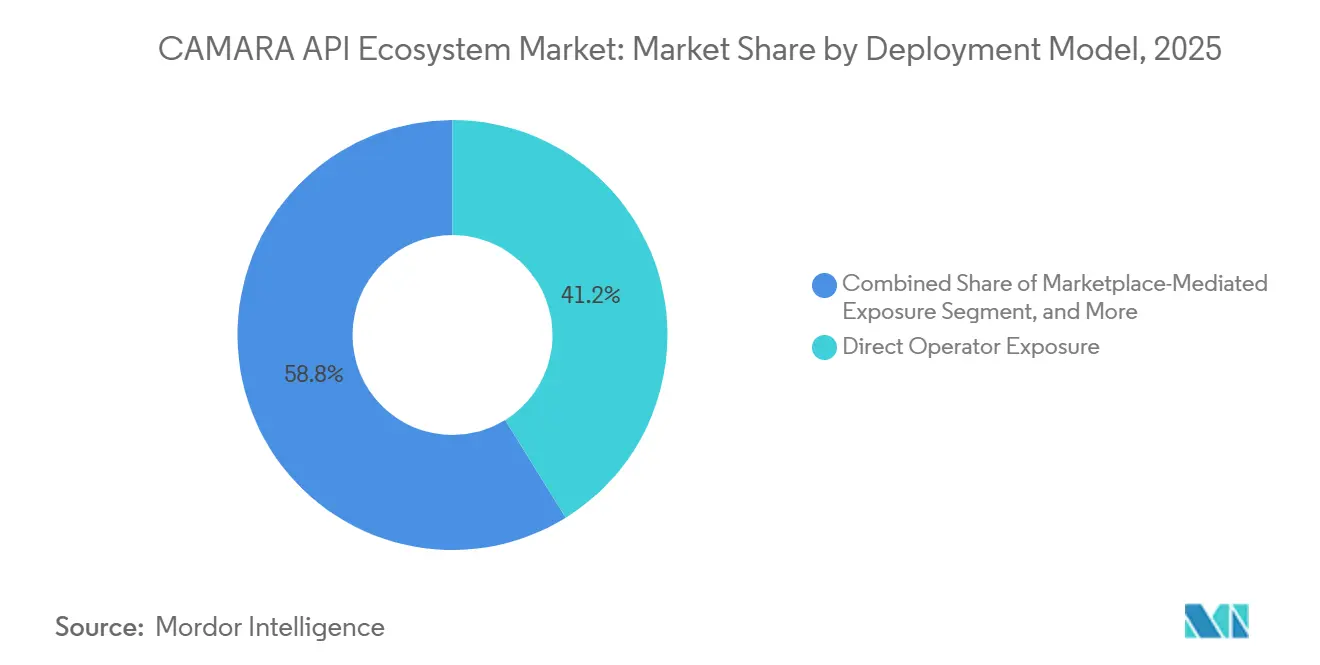
Direct Exposure Leads While Marketplace Access ExpandsDirect Operator Exposure captured 41.16% of the CAMARA API Ecosystem Market in 2025. This model was first developed in markets where major operators built developer portals and controlled the initial route to their APIs. Orange formed the LiveNet business unit to commercialize network APIs through its portal and through Aduna. Bharti Airtel, Deutsche Telekom, and Telefónica also use direct channels to show the depth of their network capabilities. Smaller operator groups often depend more heavily on aggregators because they have fewer resources to build and maintain a developer ecosystem.
Marketplace-Mediated Exposure is forecast to grow at a 33.27% CAGR through 2031. Enterprises value a single integration point when they need access across multiple operator networks. The first half of 2026 brought a stronger role for aggregation platforms, according to the GSMA Open Gateway market update. Nokia also connected Network as Code with Google Cloud's agentic AI stack in March 2026. As marketplace access expands, operators compete more on network quality and API depth, while aggregators compete for developer access and enterprise relationships.
By End-User Industry:
BFSI Anchors Spending While IT and Software Expands UseBanking, Financial Services, and Insurance held 31.24% of the CAMARA API Ecosystem Market in 2025. The sector has a strong need to prevent identity fraud and already has processes for integrating external verification services. Financial services were the leading target industry among developers with deployed network APIs in 2025. The GSMA described SIM Swap APIs as tools that can reduce fraud exposure during onboarding, protect against account takeover, and support additional checks for high-risk transactions. Retail, healthcare, government, telecommunications, and media also offer use cases around verification, location, consent, and service quality.
Information Technology and Software is forecast to grow at a 34.19% CAGR through 2031. Software firms can consume CAMARA APIs and embed them in enterprise platforms, which widens their use beyond a single internal workflow. TikTok used CAMARA Number Verification APIs to replace SMS one-time passwords, supporting faster sign-ups and stronger conversions. The MCP Enablement Program makes network APIs available within AI development frameworks. Healthcare also showed a preference for direct operator engagement, with 70% of healthcare-affiliated developers using a deployed network API working directly with operators in 2025.
Geography Analysis
North America CAMARA API Ecosystem Market
North America held 34.12% of the CAMARA API Ecosystem Market in 2025. The region benefited from early Open Gateway commitments by AT&T, T-Mobile, and Verizon. Vonage became the first provider to offer aggregated CAMARA API access across all 3 major United States carriers in 2025. Banking and fintech demand support the move from SMS authentication to network-native verification. The region also has an established CPaaS ecosystem that helps enterprises reach multiple networks.
Europe CAMARA API Ecosystem Market
Europe is the second-largest regional area in the CAMARA API Ecosystem Market. France became the first country where Bouygues Telecom, Free, Orange, and SFR jointly launched the KYC Match API, with more than 20 companies adopting the API set by 2025. Germany, the United Kingdom, Spain, and Italy are advancing deployments of SIM Swap, Number Verification, and Age Verification. Orange's LiveNet unit and its July 2026 MCP provider implementation place France among the active markets for agent-based API use. GDPR requirements add complexity to personal data APIs.
APAC, South America and MEA CAMARA API Ecosystem Market
Asia-Pacific is forecast to grow at a 33.21% CAGR through 2031. KDDI, Singtel, Reliance Jio, Bharti Airtel, Telstra, NTT Docomo, and SoftBank operate within the regional ecosystem. KDDI contributed to the standardization of quality of service and deployed KYC APIs for local government identity verification in Japan. South America remains in the early stages, with Brazil identified for future expansion. Middle East and Africa operators are introducing SIM Swap and Number Verification APIs, while the United Arab Emirates, Saudi Arabia, and Qatar align API platforms with digital economy programs. Viettel Solutions and Aduna signed a partnership framework in March 2026 that addresses Vietnam's data-protection and cybersecurity requirements.
Competitive Landscape
The CAMARA API Ecosystem Market is fragmented at the technology layer, but distribution is becoming more concentrated. Operators own the networks, CAMARA governs the open-source specifications, and aggregators or CPaaS firms connect with developers. The GSMA reported in 2026 that aggregation platforms were becoming a more important commercial route. Aduna has support from 13 global operators and Ericsson, which reflects its focus on marketplace-mediated distribution.
Nokia competes through Network as Code, which supports CAMARA-aligned use cases, Google Cloud integration, and multivendor infrastructure. In March 2026, Nokia expanded that platform's connection with Google Cloud to support API-based agentic AI. Ericsson and Vonage support the CPaaS layer and published an MCP server proof of concept in November 2025 for tools including Device Location and SIM Swap. Infobip received GSMA Open Gateway certifications for SIM Swap and Number Verification in September 2025.
Open areas remain in AI-readable API design, conformance-certified middleware, and regional aggregation. Orange's open-source MCP provider implementation offers a reference design for AI-agent access to network APIs. Enea focuses on middleware that connects legacy operator systems with API exposure platforms. Sekura.id, now part of XConnect, and Shabodi Technologies focus on mobile identity and edge-native API orchestration respectively. The GSMA and TM Forum conformance framework raises the importance of certification for distribution partners.
CAMARA API Ecosystem Industry Leaders
-
Ericsson AB
-
Nokia Corporation
-
Cisco Systems, Inc.
-
Huawei Technologies Co., Ltd.
-
AT&T Inc.
- *Disclaimer: Major Players sorted in no particular order
CAMARA API Ecosystem Market Companies Covered in this Report
- Accenture plc
- Aduna Network S.L.
- Alkira, Inc.
- B-Yond, Inc.
- BICS SA
- Bharti Airtel Limited
- BTS Group AB
- Comviva Technologies Limited
- Enea AB
- Ericsson AB
- Graphiant, Inc.
- Heksagon Network AB
- Infobip Limited
- Kentik Technologies, Inc.
- LotusFlare, Inc.
- Nokia Corporation
- Obkio Inc.
- PhoenixNAP, LLC
- Sekura.id Limited
- Shabodi Technologies Inc.
- Sinch AB
- Syniverse Technologies, LLC
- Vonage Holdings Corp.
- Socure, Inc.
Recent Industry Developments in CAMARA API Ecosystem Market
- July 2026: Orange published an open-source Model Context Protocol server implementation that exposes its CAMARA-compliant network APIs, including SIM Swap detection, device location, and QoS capabilities, as native tools for AI assistants such as Claude Desktop and Cline, providing the ecosystem's first production-grade reference implementation for AI-driven banking fraud prevention workflows. This positions Orange as a technical reference for the CAMARA MCP Enablement Program.
- March 2026: Nokia announced the integration of its Network as Code platform with Google Cloud's agentic AI stack at MWC Barcelona 2026, enabling AI agents to access 20+ CAMARA-aligned network APIs through natural language via Google's Agent Developer Kit and Gemini models, marking a shift from API-driven to intent-driven network programmability for enterprise operators
- March 2026: Viettel Solutions, a subsidiary of Vietnam's state-owned Viettel Group, signed a network API partnership framework agreement with Aduna at MWC 2026, targeting transaction security, fraud detection, and digital identity use cases compliant with Vietnam's national data protection and cybersecurity laws, marking Aduna's first formal Southeast Asia market-entry framework.
- January 2026: NTT Docomo concluded a formal partnership agreement with Aduna, enabling Docomo's network APIs, including Number Verification and SIM Swap, to be distributed globally through Aduna's aggregator platform, extending Aduna's Asia-Pacific operator coverage and supporting enterprise fraud prevention strategies in international markets.
Global CAMARA API Ecosystem Market Report Scope
The CAMARA API ecosystem market refers to the global framework of standardized, operator-agnostic application programming interfaces (APIs) developed under the CAMARA project to seamlessly expose universal telecommunications network capabilities to third-party developers and enterprises. This ecosystem encompasses a broad range of API categories, including authentication and fraud prevention, location services, communication quality, and device information, spanning various stages of maturity from initial releases to stable, production-ready interfaces. The market includes the platforms, integration services, and exposure models, such as direct operator connections, aggregator-mediated gateways, and API marketplaces, that facilitate the deployment of these APIs. By providing a universal, open-source standard hosted by the Linux Foundation, the CAMARA API ecosystem eliminates the need for bespoke, single-carrier integrations. This enables enterprises across industries such as BFSI, retail, and healthcare to seamlessly embed secure, low-latency, and context-aware telecom capabilities into their digital applications, thereby accelerating innovation in areas such as fraud prevention, verified calling, and enhanced user experiences.
The CAMARA API Ecosystem Market Report is Segmented by API Category (Authentication and Fraud Prevention APIs, Location Services APIs, Communication Services APIs, Communication Quality APIs, Device Information APIs, Computing Services APIs, and Other API Category), API Maturity (Stable APIs, Initial APIs, and Other API Maturity), Deployment Model (Direct Operator Exposure, Aggregator-Mediated Exposure, Marketplace-Mediated Exposure, and Other Deployment Model), End-User Industry (Banking, Financial Services and Insurance, E-Commerce and Retail, Telecommunications, Information Technology and Software, Healthcare, Government and Public Sector, Media and Entertainment, and Other End-User Industries), and Geography (North America, South America, Europe, Asia-Pacific, Middle East, and Africa). The Market Forecasts are Provided in Terms of Value (USD).
Segmentation Overview
| Authentication and Fraud Prevention APIs |
| Location Services APIs |
| Communication Services APIs |
| Communication Quality APIs |
| Device Information APIs |
| Computing Services APIs |
| Other API Categories |
| Stable APIs |
| Initial APIs |
| Other API Maturity |
| Direct Operator Exposure |
| Aggregator-Mediated Exposure |
| Marketplace-Mediated Exposure |
| Other Deployment Models |
| Banking, Financial Services and Insurance |
| E-Commerce and Retail |
| Telecommunications |
| Information Technology and Software |
| Healthcare |
| Government and Public Sector |
| Media and Entertainment |
| Other End-User Industries |
| North America | United States |
| Canada | |
| Mexico | |
| South America | Brazil |
| Argentina | |
| Chile | |
| Rest of South America | |
| Europe | Germany |
| United Kingdom | |
| France | |
| Italy | |
| Spain | |
| Rest of Europe | |
| Asia-Pacific | China |
| Japan | |
| India | |
| South Korea | |
| Australia | |
| Rest of Asia-Pacific | |
| Middle East | United Arab Emirates |
| Saudi Arabia | |
| Qatar | |
| Rest of Middle East | |
| Africa | South Africa |
| Egypt | |
| Nigeria | |
| Rest of Africa |
| By API Category | Authentication and Fraud Prevention APIs | |
| Location Services APIs | ||
| Communication Services APIs | ||
| Communication Quality APIs | ||
| Device Information APIs | ||
| Computing Services APIs | ||
| Other API Categories | ||
| By API Maturity | Stable APIs | |
| Initial APIs | ||
| Other API Maturity | ||
| By Deployment Model | Direct Operator Exposure | |
| Aggregator-Mediated Exposure | ||
| Marketplace-Mediated Exposure | ||
| Other Deployment Models | ||
| By End-User Industry | Banking, Financial Services and Insurance | |
| E-Commerce and Retail | ||
| Telecommunications | ||
| Information Technology and Software | ||
| Healthcare | ||
| Government and Public Sector | ||
| Media and Entertainment | ||
| Other End-User Industries | ||
| By Geography | North America | United States |
| Canada | ||
| Mexico | ||
| South America | Brazil | |
| Argentina | ||
| Chile | ||
| Rest of South America | ||
| Europe | Germany | |
| United Kingdom | ||
| France | ||
| Italy | ||
| Spain | ||
| Rest of Europe | ||
| Asia-Pacific | China | |
| Japan | ||
| India | ||
| South Korea | ||
| Australia | ||
| Rest of Asia-Pacific | ||
| Middle East | United Arab Emirates | |
| Saudi Arabia | ||
| Qatar | ||
| Rest of Middle East | ||
| Africa | South Africa | |
| Egypt | ||
| Nigeria | ||
| Rest of Africa | ||
Key Questions Answered in the Report
How large is the CAMARA API Ecosystem Market?
The CAMARA API Ecosystem Market is projected to grow from USD 1.51 billion in 2026 to USD 6.08 billion by 2031 at a 32.13% CAGR.
What is driving demand for CAMARA APIs?
Authentication and fraud prevention lead demand because operators can provide SIM, number, and device signals for real-time transaction checks.
Which API category has the largest share?
Authentication and Fraud Prevention APIs led with 34.21% in 2025.
Which deployment model is expanding fastest?
Marketplace-Mediated Exposure is projected to grow at a 33.2% CAGR through 2031 as enterprises seek fewer integration points.
Which end-user sector has the largest demand?
Banking, Financial Services and Insurance held 31.24% in 2025, supported by identity-fraud prevention needs.
What is slowing adoption of CAMARA APIs?
Privacy and consent rules, plus OSS and BSS integration work, can delay commercial API deployment.