
Calibration Equipment and Services Market Size and Share
Market Overview
| Study Period | 2020 - 2031 |
|---|---|
| Market Size (2026) | USD 9.27 Billion |
| Market Size (2031) | USD 11.75 Billion |
| Growth Rate (2026 - 2031) | 4.84 % |
| Fastest Growing Market | Asia-Pacific |
| Largest Market | Asia-Pacific |
| Market Concentration | Medium |
Major Players *Disclaimer: Major Players sorted in no particular order Image © Mordor Intelligence. Reuse requires attribution under CC BY 4.0. | |
Calibration Equipment and Services Market Analysis by Mordor Intelligence
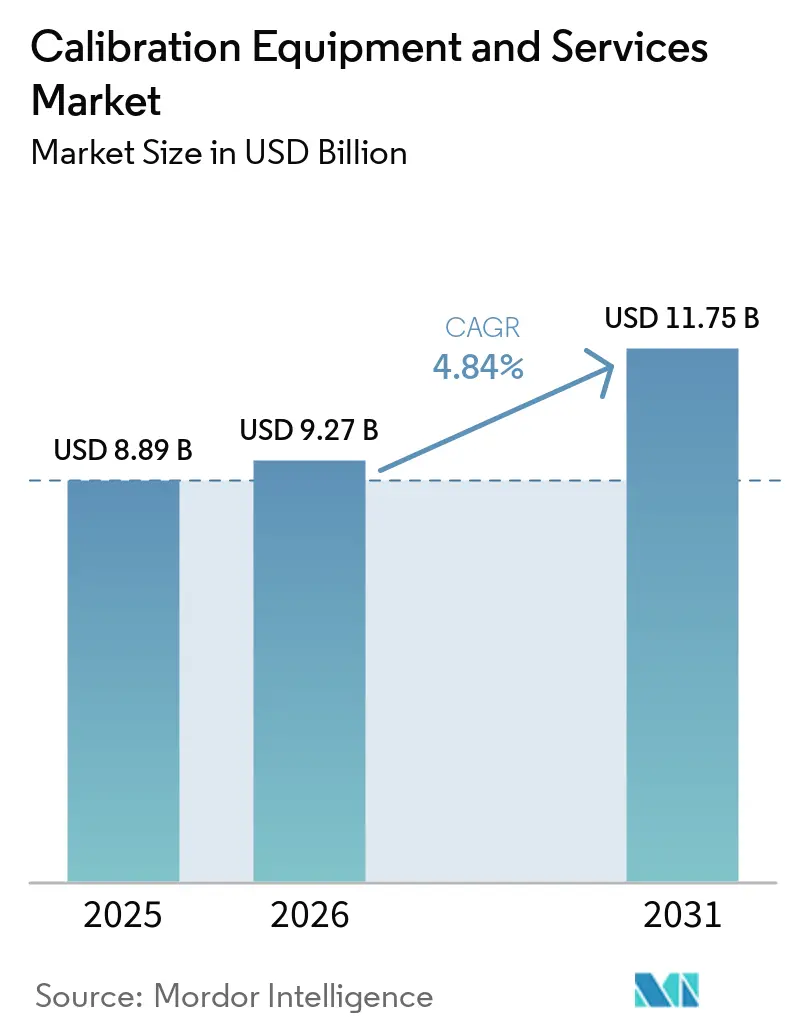
The calibration equipment and services market size is projected to expand from USD 8.89 billion in 2025 and USD 9.27 billion in 2026 to USD 11.75 billion by 2031, registering a CAGR of 4.84% between 2026 to 2031. Measurement traceability requirements, industrial automation, and wider use of outsourced accredited work support demand across the calibration equipment and services market. Semiconductor, biopharmaceutical, and aerospace facilities require more frequent verification as their instruments become more complex. Providers are therefore extending service contracts and adding digital records that can connect with customer quality systems. This change favors laboratories that can provide ISO/IEC 17025 traceability, reliable turnaround, and machine-readable certificates. Basic calibration work faces price pressure, while digitally integrated service offerings retain stronger value because they support compliance and asset management needs.
Key Report Takeaways
- By offering, calibration services held 58.29% of the calibration equipment and services market share in 2025 and are projected to expand at a CAGR of 5.56% through 2031.
- By equipment type, electrical calibration equipment accounted for 24.56% of the equipment segment in 2025, while multifunction process calibrators are projected to expand at a CAGR of 5.81% through 2031.
- By service type, laboratory calibration held 64.89% of the services segment in 2025, while on-site calibration is projected to expand at a CAGR of 6.25% through 2031.
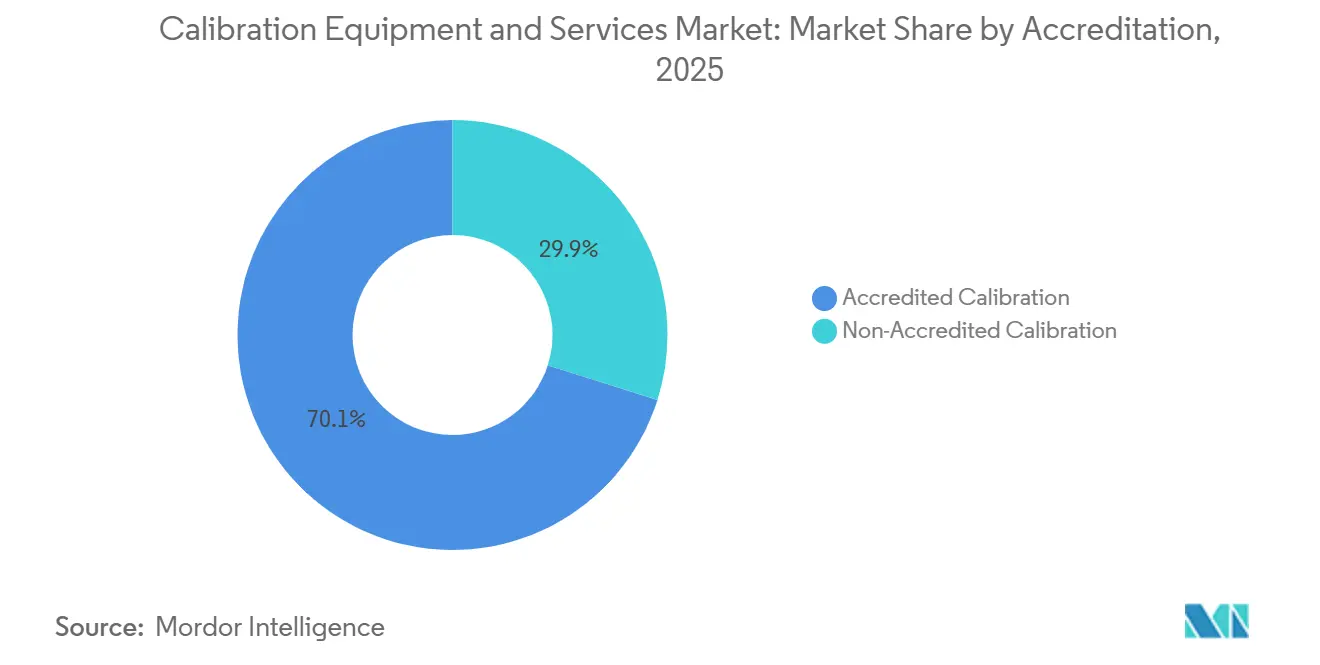
- By accreditation, accredited calibration held 70.11% of the calibration equipment and services market share in 2025 and is projected to expand at a CAGR of 5.34% through 2031.
- By end-use industry, manufacturing held 23.76% of the end-use segment in 2025, while electronics and semiconductor is projected to expand at a CAGR of 5.93% through 2031.
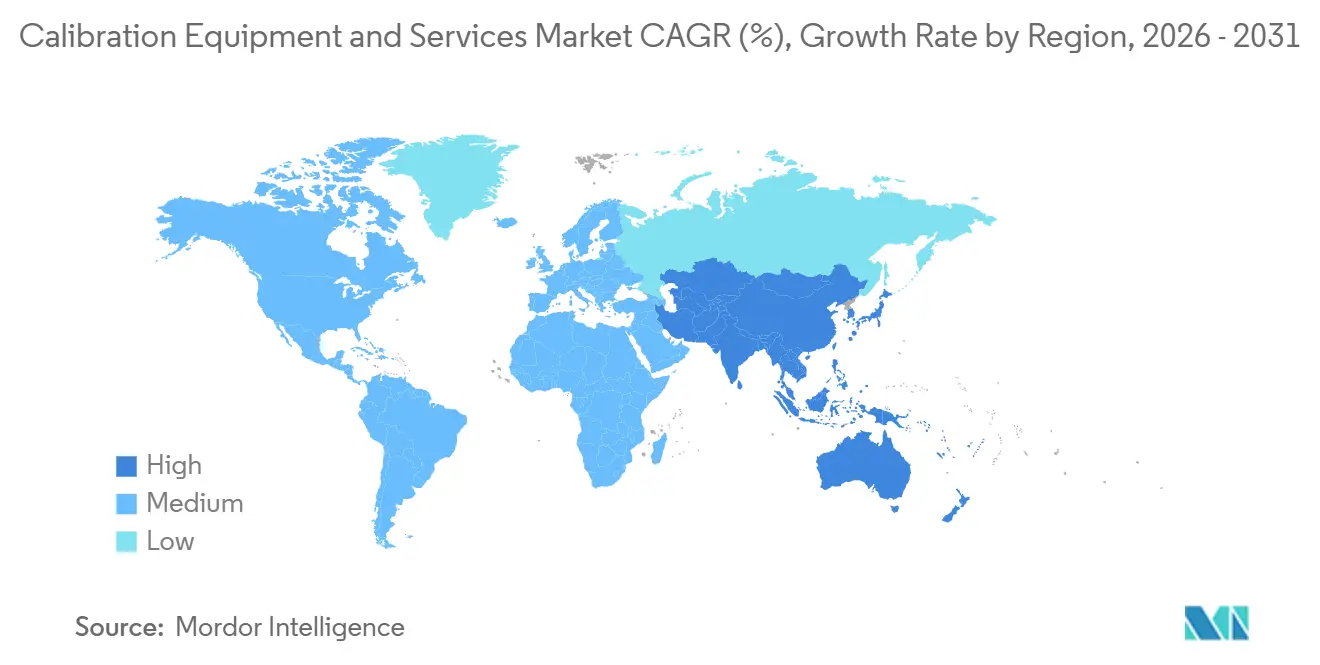
- By geography, Asia-Pacific held 31.33% of the calibration equipment and services market share in 2025 and is projected to expand at a CAGR of 5.60% through 2031.
Note: Market size and forecast figures in this report are generated using Mordor Intelligence’s proprietary estimation framework, updated with the latest available data and insights as of January 2026.
Market Trends and Insights
Drivers Impact Analysis of Calibration Equipment and Services Market*
| DRIVER | (~) % IMPACT ON CAGR FORECAST | GEOGRAPHIC RELEVANCE | IMPACT TIMELINE |
|---|---|---|---|
| Increasing Regulatory Compliance and Quality Standards | +1.7% | Global | Medium term (2-4 years) |
| Rising Automation and Industrial Digitization | +1.2% | Global | Medium term (2-4 years) |
| Growth of Precision Manufacturing and High-Accuracy Applications | +0.8% | APAC core, spill-over to North America and EU | Long term (≥ 4 years) |
| Increasing Outsourcing of Calibration Activities | +0.6% | North America and EU | Short term (≤ 2 years) |
| Expansion of Safety-Critical Industries | +0.4% | North America, EU, APAC | Medium term (2-4 years) |
| Growing Adoption of Digital Calibration Management Solutions | +0.3% | Global | Long term (≥ 4 years) |
| Source: Mordor Intelligence | |||
Increasing Regulatory Compliance and Quality Standards
Regulatory compliance is a major source of demand for the calibration equipment and services market. ISO/IEC 17025 accreditation has become a practical market-access requirement for laboratories serving pharmaceutical, aerospace, and medical device customers.[1] National accreditation bodies apply this framework to confirm laboratory competence and traceability. The U.S. Food and Drug Administration updated its Laboratory Accreditation Program guidance in July 2026 to recognize ISO/IEC 17025:2023 accreditation for relevant calibration laboratories. Medical device requirements under 21 CFR Part 820 and EU Medical Device Regulation 2017/745 also increase the need for controlled records. Risk-based scheduling can reduce calibration frequency for stable instruments, but it also extends traceable calibration to a larger instrument population. Providers that combine accredited work with accessible digital records are better placed to meet audit requirements.
Rising Automation and Industrial Digitization
Automation increases the number of sensors, transmitters, and actuators that need traceable verification in the calibration equipment and services market. Each added measurement point affects closed-loop control and, therefore, requires dependable reference standards. NIST developed the SLowFlowS standard for semiconductor process gases with expanded uncertainty from 0.056% to 0.098% across flows from 0.01 cm³/min to 1,000 cm³/min.[2] This work shows how advanced production systems create demand for calibration infrastructure that did not previously exist. Fluke updated its calibration portfolio in 2025 with products aimed at more efficient digital measurement workflows. Connected instruments can build drift histories over time and support more informed scheduling. That capability shifts part of provider revenue from one-off laboratory events toward software-supported service agreements.
Growth of Precision Manufacturing and High-Accuracy Applications
Precision manufacturing is increasing the calibration intensity in the calibration equipment and services market as tolerance requirements become tighter. NIST CalNet provides research-grade on-wafer S-parameter calibration kits that extend measurement traceability beyond 100 GHz. These requirements are especially relevant for advanced semiconductor production and high-frequency electronic systems. Keysight introduced scale-up validation solutions for AI data centers in February 2026, including stressed-signal calibration functions for high-speed interconnect testing. Aerospace, defense, and automotive testing also require documented measurement uncertainty for safety and performance work. German automotive sites use DAkkS-accredited calibration services for traction-force measurement systems. This environment supports specialized laboratories and manufacturers that can provide high-accuracy tools with recognized traceability.
Increasing Outsourcing of Calibration Activities
Outsourcing is expanding because many manufacturers cannot maintain compliant metrology programs at the same cost as specialist providers. Third-party providers held 46% of global calibration spending in the supplied research base. Transcat acquired Essco Calibration Laboratory for USD 84 million in August 2025, its largest acquisition at that point, to build greater scale in accredited services. It then acquired SCM Metrology and Laboratories S.A. in Costa Rica for USD 13 million in April 2026. These transactions show how scale can spread accreditation overhead and reference-standard costs across larger customer bases. Integration between a customer’s quality systems and a provider’s laboratory information system also creates switching costs. AMETEK Programmable Power appointed Transcat as an exclusive distribution and calibration partner across the United States and South America in February 2026.
Restraints Impact Analysis of Calibration Equipment and Services Market*
| RESTRAINT | (~) % IMPACT ON CAGR FORECAST | GEOGRAPHIC RELEVANCE | IMPACT TIMELINE |
|---|---|---|---|
| High Cost of Advanced Calibration Equipment and Services | -0.8% | Global | Short term (≤ 2 years) |
| Shortage of Skilled Calibration Professionals | -0.5% | North America and EU | Long term (≥ 4 years) |
| Availability of Low-Cost Alternatives and In-House Calibration | -0.3% | APAC core, spill-over to Middle East and Africa | Medium term (2-4 years) |
| Long Equipment Replacement Cycles and Limited Calibration Frequency | -0.2% | Global | Long term (≥ 4 years) |
| Source: Mordor Intelligence | |||
High Cost of Advanced Calibration Equipment and Services
High equipment and service costs can limit adoption in the calibration equipment and services market, particularly for smaller manufacturers and providers in emerging markets. Multifunction calibrators, precision pressure references, and temperature-controlled laboratories require significant capital investment. Accreditation adds costs for proficiency testing, reference-standard maintenance, and environmental controls. The supplied research base indicates that these requirements can add 15-25% to operating costs compared with non-accredited alternatives. High-specification documenting calibrators with software integration were growing at 5-7% in revenue terms, while entry-level products faced 2-3% annual price compression. Lead times of 12-20 weeks for advanced tools can also delay replacement and create compliance challenges. This cost divide leaves basic work exposed to price competition while maintaining a premium for specialized accredited work.
Shortage of Skilled Calibration Professionals
A limited supply of qualified personnel constrains the calibration equipment and services market in North America and Europe. Advanced uncertainty analysis, equipment characterization, and digital certificate management require technical skills across measurement science, statistics, and industrial processes. Training systems do not produce these skills at the pace required by expanding manufacturing capacity. Accredited laboratories cannot add workload indefinitely without expanding their qualified workforce. This can lengthen turnaround times when regulated customers need rapid service. Automated workflows can reduce repetitive tasks, but they still need trained engineers for validation and maintenance. The shortage, therefore, affects capacity and service quality rather than simply increasing labor costs.
*Our forecasts treat driver/restraint impacts as directional, not additive. The impact forecasts reflect baseline growth, mix effects, and variable interactions.
Calibration Equipment and Services Market Segment Analysis
By Offering:
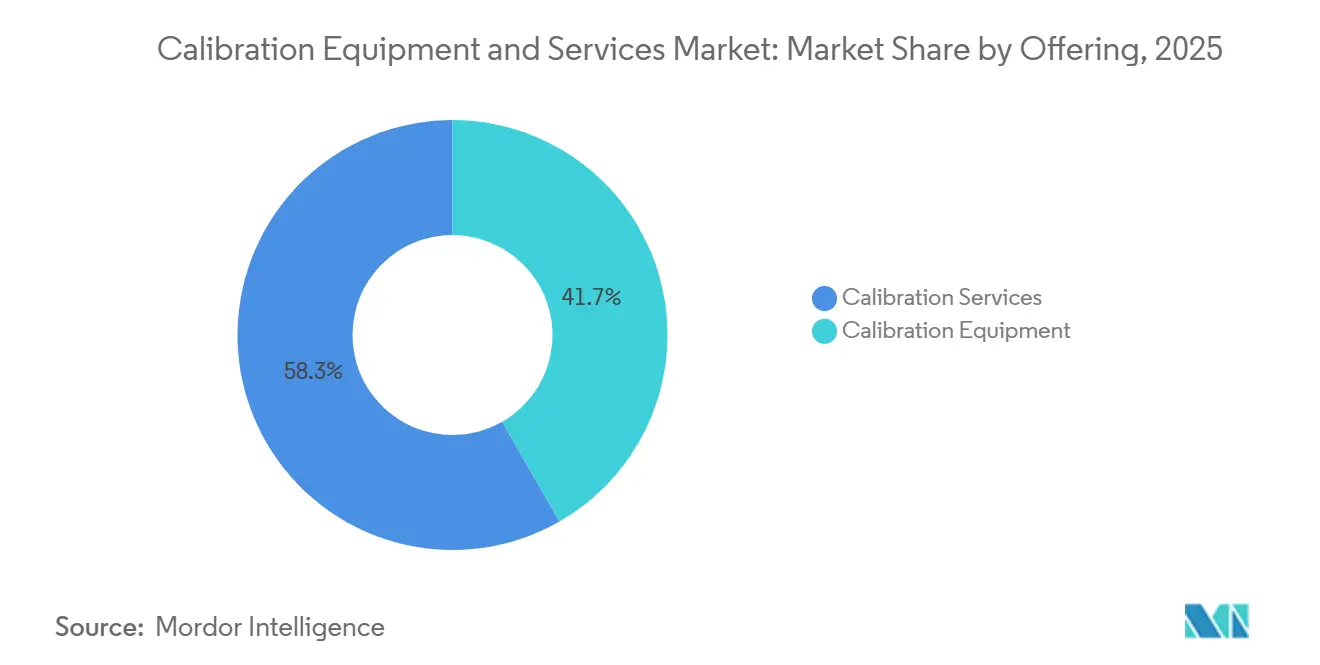
Services Maintain the Lead Over Equipment DemandCalibration services held 58.29% of the calibration equipment and services market share in 2025. This position reflects the preference for outsourced verification rather than investment in a full internal instrument estate. Automation expands the number of instruments that require routine checks. Specialist providers can use their reference standards across many clients, reducing the cost of each event. That structure makes outsourcing more practical for facilities with varied equipment and limited in-house metrology teams. Calibration services are projected to expand at a CAGR of 5.56% through 2031. Life sciences, aerospace and defense, and semiconductor customers support this growth because their documentation requirements are difficult to meet through informal internal programs. These users also need dependable scheduling and certificates that can enter their quality records.
Equipment remains important because service providers and internal laboratories need reliable reference tools. The calibration equipment and services market size for equipment benefits from a shift toward automated and software-integrated devices, though no separate equipment value is provided. Manufacturers are developing products for both basic industrial work and high-precision laboratories. Fluke launched the 5530A Basic Multi-Product Calibrator in August 2025 for industrial workloads at a lower price point. The company also introduced a Null Meter option for the 8588A Reference Multimeter with 0.2-0.5 ppm accuracy and automated measurement collection.[3] This approach addresses routine industrial users and laboratories that need high accuracy. Better cost-to-accuracy ratios can widen the base of instruments that require traceable verification. Equipment suppliers also gain opportunities when their products work with calibration management software and service networks.
By Equipment Type:
Electrical Equipment Leads While Multifunction Tools Gain GroundElectrical calibration equipment held 24.56% of the equipment segment in 2025. It supports a broad installed base that includes power supplies, multimeters, RF signal generators, and oscilloscopes. This breadth makes electrical work essential across industrial and laboratory settings. Semiconductor fabrication plants in Taiwan and South Korea require electrical traceability for advanced process control. Pressure and temperature equipment serve major workloads in oil and gas, chemicals, and pharmaceuticals. Flow calibration benefits from energy-metering requirements. Dimensional calibration supports aerospace, automotive, and precision-tooling supply chains. Other products, including gas and humidity standards, meet specialized needs in environmental monitoring and HVAC systems.
Multifunction process calibrators are projected to expand at a CAGR of 5.81% through 2031. A single device can manage pressure, temperature, and electrical parameters during field work. This reduces technician travel and the number of separate reference standards needed during plant turnarounds. The advantage matters when a continuous-process facility has limited time for calibration. The calibration equipment and services market is also influenced by higher-frequency electrical testing. NIST’s CalNet work signals a need for stronger traceability in demanding semiconductor and high-frequency applications. Keysight’s AI data center validation systems address new testing requirements for high-speed interconnects. Providers can use specialized equipment to support premium work that is less exposed to basic product pricing pressure.
By Service Type:
Laboratory Work Leads While On-Site Delivery Speeds UpLaboratory calibration held 64.89% of the services segment in 2025. Controlled laboratory conditions support high-precision comparisons that field settings cannot always provide. The supplied research base identifies temperature stability within ±0.5°C and relative humidity below 70% as relevant conditions for reference-standard work. Laboratories can centralize high-value standards and maintain consistent quality processes. They are well-suited to complex equipment that requires stable environmental conditions. This format also supports full documentation and access to specialist technical staff. Laboratory services remain important to the calibration equipment and services market because regulated customers require records that can withstand audits. Their leading position reflects the need for repeatable, controlled measurement environments.
On-site calibration is projected to expand at a CAGR of 6.25% through 2031. It avoids the downtime associated with shipping production-critical instruments to external laboratories. Continuous-process refineries and semiconductor fabs can limit disruption when technicians calibrate flow transmitters and monitoring systems at the facility. This service model also gives providers closer access to installed equipment and customer operations. HCT and Daejin Semiconductor signed a memorandum of understanding in July 2026 to expand calibration service activity in South Korean semiconductor and electronics facilities. The agreement reflects demand for accredited work close to fabrication sites. Remote calibration is also emerging for connected electrical and dimensional equipment. It can provide drift data that support predictive scheduling and recurring service arrangements. The model does not replace controlled laboratory work, but it broadens the service options available to customers.
By Accreditation:
Accredited Work Becomes the Core Qualification StandardAccredited calibration held 70.11% of the calibration equipment and services market share in 2025. It is also projected to expand at a CAGR of 5.34% through 2031. This simultaneous lead in share and growth shows that accreditation has become a baseline requirement in regulated sectors. ISO/IEC 17025 provides a recognized basis for laboratory competence and measurement traceability. The supplied research base states that more than 72% of industrial enterprises prioritize accredited providers. Such customers need certificates that can support quality audits and product documentation. Accredited laboratories, therefore, have an advantage where measurement risk is high. This applies especially to pharmaceutical, aerospace, medical device, and semiconductor activities.
Non-accredited services still serve internal checks, general-purpose instruments, and cost-sensitive applications. They remain relevant in locations where formal accreditation infrastructure is developing. However, ISO/IEC 17025 status alone does not ensure a durable price premium. Customers also consider turnaround time, digital certificate quality, and system compatibility. The calibration services and equipment industry is moving from paper records toward electronic certificates that can connect to quality-management platforms. This can reduce administrative work and improve access to calibration histories. Intertek has expanded laboratory capacity in manufacturing regions, including its Rotterdam facility in 2026. HCT’s simultaneous KOLAS and A2LA accreditation illustrates how dual recognition can help a specialist serve semiconductor customers with cross-border documentation needs. Providers that combine accreditation with efficient information management can differentiate even as the accreditation standard becomes more common.
By End-Use Industry:
Manufacturing Leads While Electronics and Semiconductor AccelerateManufacturing held 23.76% of the end-use segment in 2025. The segment includes process, discrete, and hybrid facilities with diverse measurement needs. Chemical sites use flow meters, while automotive assembly lines depend on torque tools and other controlled devices. Aerospace and defense, oil and gas, and automotive are the next-largest end-use groups in the supplied research base. Their work is tied to safety certification and quality-management requirements. Pharmaceutical and biotechnology customers have lower instrument volumes but higher revenue per instrument. Medical devices and healthcare also require strict records and regular verification. Once a laboratory is integrated into a customer’s quality system, switching can be difficult. Manufacturing, therefore, remains the broad revenue base for the calibration equipment and services market.
Electronics and semiconductor is projected to expand at a CAGR of 5.93% through 2031. Advanced fabrication equipment requires calibration at nanometer-scale tolerances. AI chips and advanced packaging are also expanding across East Asia and the United States. NIST’s universal microscopy calibration standards support traceability for scanning electron microscopy and atomic force microscopy from 0.1 nm uncertainty.[4] This illustrates the demanding measurement conditions within the segment. Power and utilities, food and beverage, and other sectors add steady requirements tied to process safety, custody transfer, and environmental monitoring. Their growth is less dependent on leading-edge technology but still requires dependable legal metrology and quality systems. Suppliers with technical depth can use semiconductor demand to build capabilities that later apply across other precision applications.
Geography Analysis
APAC Calibration Equipment and Services Market
Asia-Pacific held 31.33% of the calibration equipment and services market share in 2025 and is projected to expand at a CAGR of 5.60% through 2031. China’s metrology calibration services market reached CNY 12.6 billion, equivalent to USD 1.74 billion, in 2025. Semiconductor localization, new energy vehicle production, and the 14th Five-Year Metrology Development Plan support the country’s demand for traceable services.[5] India benefits from electronics manufacturing and pharmaceutical export compliance requirements. Singapore, Malaysia, Thailand, and Vietnam form an integrated electronics and semiconductor corridor with growing calibration needs. Mutual recognition arrangements under ILAC make it easier for regional providers to support cross-border customers. Local accredited facilities give multinational manufacturers access to shorter service routes and familiar documentation practices.
North America and Europe Calibration Equipment and Services Market
North America is the second-largest regional market in the supplied research base. The FDA, Federal Aviation Administration, and NIST create a dense set of measurement requirements for pharmaceutical, aerospace, and defense customers. These sectors need high-frequency calibration and short turnaround times. Transcat expanded its North American service network through the USD 84 million Essco acquisition in 2025. Europe has a large accredited laboratory base, led by Germany with more than 1,200 DAkkS-accredited facilities, representing 28% of the European Union total. Automotive IATF 16949 requirements and medical device conformity rules support demand in the region. In July 2026, TÜV SÜD National Engineering Laboratory received a GBP 15.4 million contract, equivalent to USD 20 million, for the National Measurement System NEL Flow Programme. This investment supports primary flow metrology and the broader accredited laboratory network.
MEA and South America Calibration Equipment and Services Market
South America and the Middle East and Africa are earlier-stage areas for the calibration equipment and services market. Industrial infrastructure, mining, and import compliance requirements are increasing the need for calibrated equipment. Transcat’s April 2026 acquisition of SCM Metrology in Costa Rica created a service platform for life sciences and precision manufacturing customers in South America. Bureau Veritas acquired GeoAssay in Chile in March 2025 to deepen its minerals testing presence in the copper value chain. Brazil provides a large regional base through petrochemicals, agriculture, and automotive production. Saudi Arabia and the UAE are increasing investment in advanced manufacturing, pharmaceuticals, food, and renewable energy. These developments create room for accredited laboratories that can work near new industrial sites. The smaller installed base also gives providers an opportunity to establish long-term customer relationships as local compliance systems mature.
Competitive Landscape
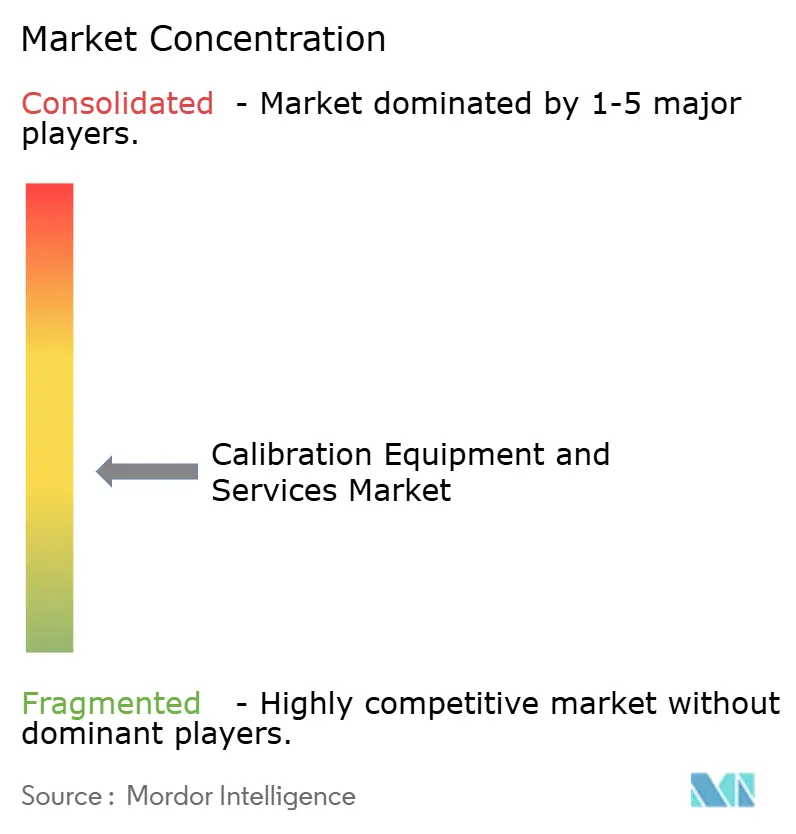
The calibration equipment and services market is moderately fragmented. No company holds a dominant global position across both calibration services and equipment. Bureau Veritas, Intertek, SGS, TÜV SÜD, and DEKRA operate broad testing, inspection, and certification networks. Fluke, Keysight, WIKA, and Yokogawa are important equipment specialists. Transcat and Trescal focus more directly on calibration services. Bureau Veritas reported EUR 6,466.4 million (USD 7.3 billion) in consolidated revenue for 2025 and 6.5% organic growth. DEKRA invested EUR 127 million (USD 147.15 million) in 2025, including spending on its Battery Test Center at Lausitzring and Automotive Test Center of Excellence in Michigan. These organizations are expanding capacity while adding adjacent testing capabilities connected with electrification and digital systems.
Geographic density is an important competitive strategy in the calibration equipment and services market. SGS opened a UKAS-accredited facility in Manchester in January 2026 to expand hardlines, electrical, and electronic testing services. Intertek expanded its Europoort laboratory in Rotterdam in July 2026 to support petroleum and sustainable fuel testing. Transcat’s acquisitions of Essco and SCM Metrology show another route to network growth. These moves bring laboratories closer to regulated manufacturing clusters and reduce turnaround risks. Providers can also spread reference-standard and accreditation costs across more locations. Regional specialists still compete effectively when they have strong local knowledge and appropriate accreditations. HCT’s KOLAS and A2LA position supports its focus on South Korean semiconductor customers. Large firms must match specialist responsiveness while maintaining consistent processes across their networks.
Equipment companies are linking hardware with software to make their offerings more useful over the instrument lifecycle. Fluke’s CalStudio platform is designed to combine MET/TEAM and MET/CAL workflows into a digital traceability environment. This approach can convert equipment sales into recurring software and service relationships. The leading opportunity is a service model that combines instrument-health monitoring, predictive scheduling, and on-site response. Traditional laboratories may have technical capacity but limited connected-data tools. Equipment-only suppliers may sell products without field service coverage. The calibration equipment and services market therefore favors providers that can combine both capabilities. Basic calibration workloads remain price sensitive, but specialized digital offerings can maintain value through workflow integration. The available evidence does not provide a combined top-player share, so a numeric concentration score cannot be reliably derived from the supplied data.
Calibration Equipment and Services Industry Leaders
-
Fluke Corporation
-
Keysight Technologies
-
Endress+Hauser Group Services AG
-
Rohde & Schwarz
-
Tektronix, Inc.
- *Disclaimer: Major Players sorted in no particular order
Calibration Equipment and Services Market Companies Covered in this Report
- Fluke Corporation
- Keysight Technologies
- Endress+Hauser Group Services AG
- Rohde & Schwarz
- Tektronix, Inc.
- WIKA Instruments Ltd.
- Yokogawa Electric Corporation
- Mitutoyo Europe GmbH
- Mahr GmbH
- Ametek Inc.
- SGS SA
- Bureau Veritas
- Intertek Group plc
- TÜV SÜD
- DEKRA SE
- Transcat Inc.
- Illinois Tool Works Inc.
- NATIONAL INSTRUMENTS CORP.
- Additel Corporation
- Mettler Toledo
Recent Industry Developments in Calibration Equipment and Services Market
- July 2026: TÜV SÜD National Engineering Laboratory was awarded a GBP 15.4 million (USD 20 million) contract by the UK Department for Science, Innovation and Technology for the National Measurement System NEL Flow Programme, strengthening primary flow metrology infrastructure that supports accredited calibration services across UK industry.
- July 2026: HCT signed a strategic memorandum of understanding with Daejin Semiconductor to jointly expand calibration services in the semiconductor and electronics industries. HCT holds simultaneous KOLAS and A2LA accreditation and gains a distribution and customer referral channel into the electronics components supply chain.
- April 2026: Transcat, Inc. acquired SCM Metrology and Laboratories S.A. in Costa Rica for USD 13 million, establishing an operational presence in South America and a service platform for multinational life sciences and precision manufacturing customers in regulated free trade zones.
- February 2026: AMETEK Programmable Power appointed Transcat as its exclusive distributor, certified calibration partner, and rental provider for programmable power and test systems across the United States and South America.
Global Calibration Equipment and Services Market Report Scope
The calibration equipment and services market comprises the global industry that provides physical tools, automated systems, and professional verification solutions for testing, adjusting, and certifying the accuracy of measuring instruments. The market serves critical sectors, including manufacturing, aerospace, healthcare, and electronics, ensuring that devices such as pressure gauges, multimeters, and medical equipment comply with stringent regulatory requirements and international quality standards. Ongoing demand for precision, safety, and operational reliability across industrial and laboratory applications drives the market.
The Calibration Equipment and Services Market Report is Segmented by Offering (Calibration Equipment, and Calibration Services), Equipment Type (Electrical Calibration Equipment, Pressure Calibration Equipment, Temperature Calibration Equipment, Flow Calibration Equipment, Dimensional Calibration Equipment, Multifunction Process Calibrators, and Other Equipment Types), Service Type (Laboratory Calibration, and On-Site Calibration), Accreditation (Accredited Calibration, and Non-Accredited Calibration), End-user Industry (Industrial Manufacturing, Aerospace and Defense, Automotive, Oil and Gas, Pharmaceuticals and Biotechnology, Medical Devices and Healthcare, Electronics and Semiconductor, Power and Utilities, Food and Beverage, and Other End-User Industries), and Geography (North America, South America, Europe, Asia-Pacific, and Middle East and Africa). The Market Sizes and Forecasts are Provided in Terms of Value in (USD).
Segmentation Overview
| Calibration Equipment |
| Calibration Services |
| Electrical Calibration Equipment |
| Pressure Calibration Equipment |
| Temperature Calibration Equipment |
| Flow Calibration Equipment |
| Dimensional Calibration Equipment |
| Multifunction Process Calibrators |
| Other Equipment Types |
| Laboratory Calibration |
| On-Site Calibration |
| Accredited Calibration |
| Non-Accredited Calibration |
| Industrial Manufacturing |
| Aerospace and Defense |
| Automotive |
| Oil and Gas |
| Pharmaceuticals and Biotechnology |
| Medical Devices and Healthcare |
| Electronics and Semiconductor |
| Power and Utilities |
| Food and Beverage |
| Other End-User Industries |
| North America | United States | |
| Canada | ||
| Mexico | ||
| South America | Brazil | |
| Argentina | ||
| Rest of South America | ||
| Europe | Germany | |
| United Kingdom | ||
| France | ||
| Italy | ||
| Spain | ||
| Rest of Europe | ||
| Asia-Pacific | China | |
| Japan | ||
| India | ||
| South Korea | ||
| ASEAN | ||
| Rest of Asia-Pacific | ||
| Middle East and Africa | Middle East | Saudi Arabia |
| United Arab Emirates | ||
| Turkey | ||
| Rest of the Middle East | ||
| Africa | South Africa | |
| Nigeria | ||
| Rest of Africa | ||
| By Offering | Calibration Equipment | ||
| Calibration Services | |||
| By Equipment Type | Electrical Calibration Equipment | ||
| Pressure Calibration Equipment | |||
| Temperature Calibration Equipment | |||
| Flow Calibration Equipment | |||
| Dimensional Calibration Equipment | |||
| Multifunction Process Calibrators | |||
| Other Equipment Types | |||
| By Service Type | Laboratory Calibration | ||
| On-Site Calibration | |||
| By Accreditation | Accredited Calibration | ||
| Non-Accredited Calibration | |||
| By End-user Industry | Industrial Manufacturing | ||
| Aerospace and Defense | |||
| Automotive | |||
| Oil and Gas | |||
| Pharmaceuticals and Biotechnology | |||
| Medical Devices and Healthcare | |||
| Electronics and Semiconductor | |||
| Power and Utilities | |||
| Food and Beverage | |||
| Other End-User Industries | |||
| By Geography | North America | United States | |
| Canada | |||
| Mexico | |||
| South America | Brazil | ||
| Argentina | |||
| Rest of South America | |||
| Europe | Germany | ||
| United Kingdom | |||
| France | |||
| Italy | |||
| Spain | |||
| Rest of Europe | |||
| Asia-Pacific | China | ||
| Japan | |||
| India | |||
| South Korea | |||
| ASEAN | |||
| Rest of Asia-Pacific | |||
| Middle East and Africa | Middle East | Saudi Arabia | |
| United Arab Emirates | |||
| Turkey | |||
| Rest of the Middle East | |||
| Africa | South Africa | ||
| Nigeria | |||
| Rest of Africa | |||
Key Questions Answered in the Report
What is the size of the calibration equipment and services market?
The calibration equipment and services market size is projected to expand from USD 8.89 billion in 2025 and USD 9.27 billion in 2026 to USD 11.75 billion by 2031, registering a CAGR of 4.84% between 2026 to 2031.
What is driving demand for calibration services and equipment?
Accreditation requirements, industrial automation, and precision applications in semiconductor, aerospace, and life sciences are supporting demand. ISO/IEC 17025 provides the recognized framework for competence and traceability in testing and calibration laboratories. More connected instruments also create a wider base of assets that must be verified to maintain dependable process control.
Which offering leads revenue in this sector?
Calibration services led with 58.29% share in 2025 and are projected to grow at a CAGR of 5.56% through 2031. External providers can spread the cost of reference standards and specialist staff across multiple customer sites. Their value rises further when they can integrate certificates with a customer’s quality and asset-management records.
Which service delivery method is growing the fastest?
On-site calibration is projected to expand at a CAGR of 6.25% through 2031 because it can reduce downtime for production-critical assets. The approach is particularly relevant for continuous-process facilities, offshore assets, and semiconductor fabs where instrument shipment can interrupt operating schedules. Laboratory calibration remains essential where controlled environmental conditions are required.
Which end-use application is growing fastest?
Electronics and semiconductor is projected to expand at a CAGR of 5.93% through 2031, supported by advanced process controls and high-precision measurement needs. Semiconductor equipment requires traceability at very small tolerances, while AI data center and advanced packaging activity increases demand for high-frequency electrical testing. These requirements favor providers with specialized standards and documented uncertainty capabilities.
Which region leads demand for calibration services and equipment?
Asia-Pacific held 31.33% share in 2025 and is projected to grow at a CAGR of 5.60% through 2031. China’s semiconductor localization, India’s manufacturing expansion, and the electronics corridor across Southeast Asia support the regional demand base. Accredited laboratories located near these manufacturing centers can provide shorter routes for regular calibration and related documentation.