
Calcium Formate Market Size and Share
Market Overview
| Study Period | 2022 - 2032 |
|---|---|
| Market Size (2027) | USD 0.79 Billion |
| Market Size (2032) | USD 1.04 Billion |
| Growth Rate (2027 - 2032) | 5.63 % |
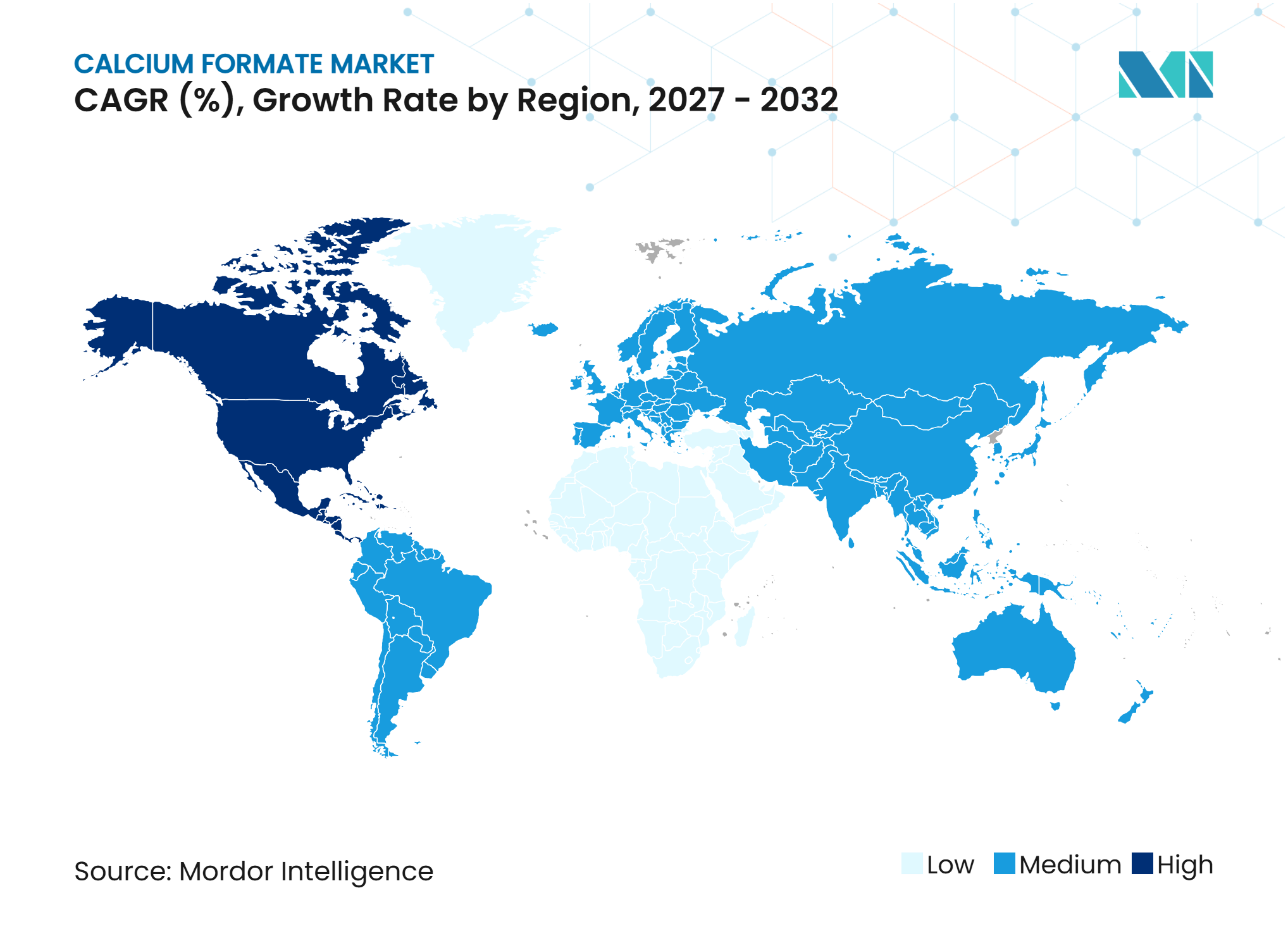
| Fastest Growing Market | North America |
| Largest Market | Asia-Pacific |
| Market Concentration | Low |
Major Players *Disclaimer: Major Players sorted in no particular order Image © Mordor Intelligence. Reuse requires attribution under CC BY 4.0. | |
Calcium Formate Market Analysis by Mordor Intelligence
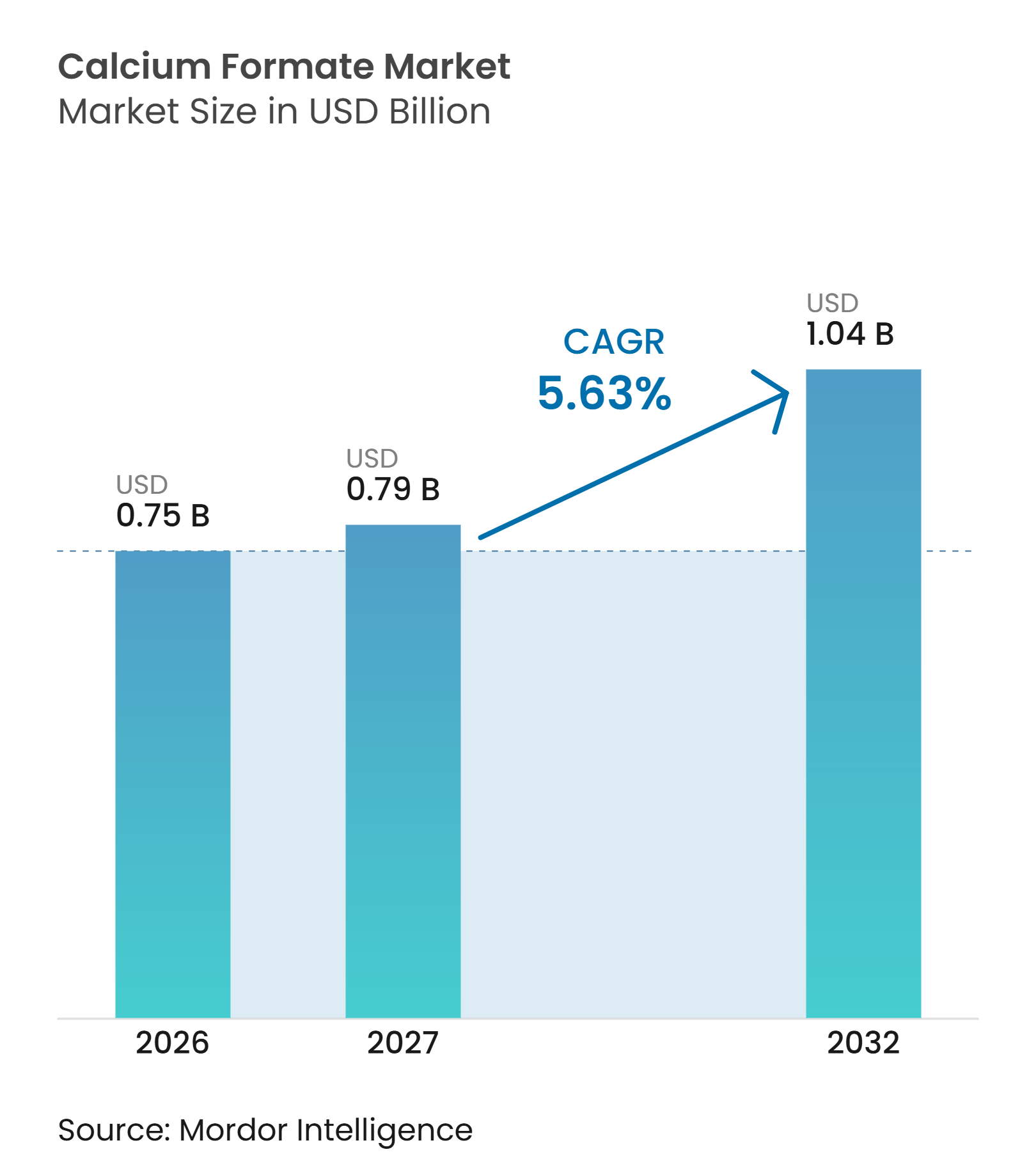
The calcium formate market size was valued at USD 0.75 billion in 2026 and is estimated to grow from USD 0.79 billion in 2027 to USD 1.04 billion by 2032, at a CAGR of 5.63% during the forecast period (2027-2032). The calcium formate market is supported by two distinct demand bases: construction chemicals and animal nutrition. In construction, the material promotes early strength development in cement and mortar without introducing chloride. In animal nutrition, it functions as a feed acidifier within regulated formulations. As a result, construction activity and livestock industry regulations influence the calcium formate market through separate channels. This dual-market structure reduces exposure to a slowdown in either end use.
Key Report Takeaways
- By grade, Industrial Grade held 59.21% of the calcium formate market share in 2026, while Feed Grade is projected to expand at a 6.45% CAGR through 2032.
- By form, Powder accounted for 68.36% of the calcium formate market share in 2026, while Granules are forecast to grow at a 6.81% CAGR through 2032.
- By application, Concrete Setting represented 45.13% of the calcium formate market size in 2026, while Feed Additives are expected to grow at a 6.98% CAGR through 2032.
- By geography, Asia-Pacific held 41.78% of the calcium formate market share in 2026, while North America is forecast to grow at a 6.72% CAGR through 2032.
Note: Market numbers in this report are based on Mordor Intelligence's proprietary estimation framework, which combines nine months of actuals with Q4 projections for base year 2026.
Market Trends and Insights
Drivers Impact Analysis of Calcium Formate Market*
| Drivers | (~) % Impact on CAGR Forecast | Geographic Relevance | Impact Timeline |
|---|---|---|---|
| Expansion of Dry-Mix Mortar and Tile Adhesive Production | +1.6% | Asia-Pacific core, including China, India, and Vietnam, with spillover to the Middle East and Africa and South America | Medium term (2-4 years) |
| Antibiotic Growth-Promoter Restrictions Increasing Feed Acidifier Adoption | +1.4% | Global, with greater regulatory pressure in Europe and North America and expanding enforcement in Asia-Pacific | Long term (≥ 4 years) |
| Chloride-Free Early-Strength Performance in Concrete and Mortars | +0.9% | North America and Europe, with adoption growing in Asia-Pacific | Medium term (2-4 years) |
| Co-Production Opportunities from Pentaerythritol and Formic Acid Chains | +0.5% | Europe and Asia-Pacific integrated petrochemical sites | Long term (≥ 4 years) |
| Encapsulated Calcium Formate Formulations for Targeted Gut Delivery | +0.4% | North America and Europe premium feed markets, with early adoption in Asia-Pacific | Long term (≥ 4 years) |
| Source: Mordor Intelligence | |||
Expansion of Dry-Mix Mortar and Tile Adhesive Production
Dry-mix mortar and tile adhesive production supports industrial-grade consumption in the calcium formate market. Factory-made mortar is replacing site-mixed material in parts of Southeast Asia as specifications become more consistent. This shift can increase additive intensity because formulated mortars require controlled setting behavior, predictable workability, and early strength. Calcium formate is relevant in this context as it supports setting acceleration and early strength in cold-weather and high-performance mortar systems. WACKER presented cementitious tile adhesive technology for Asian porcelain tile applications at the East Asia Drymix Mortar Conference in 2025, indicating continued technical development in this application area. As construction spending changes across the region, suppliers need flexible distribution and technical support outside China's established supply corridors.
Antibiotic Growth-Promoter Restrictions Increasing Feed Acidifier Adoption
Restrictions on antibiotic growth promoters are supporting the feed-grade segment of the calcium formate market. Calcium formate competes with other organic acids while also providing calcium and helping manage feed acidity. This combination is relevant to diets designed around gut health, nutrient use, and reduced reliance on routine antimicrobial inputs. European Regulation (EC) No 1831/2003 provides the regulatory framework for additives used in animal nutrition. China's GB 7300.806-2025 standard introduces purity, heavy-metal, and labeling requirements for feed-grade calcium formate, increasing the importance of documented quality control. Varying approval conditions across destination markets make certification review necessary before a producer or buyer selects a feed formulation.
Chloride-Free Early-Strength Performance in Concrete and Mortars
Chloride-free early-strength performance is a primary reason for the industrial use of calcium formate. The material supports cement hydration without the corrosion concerns associated with chloride-containing admixtures in reinforced concrete. A 2025 Journal of Engineering Sciences study reported that an accelerating admixture containing calcium formate supported early cement hydration and reduced permeability when used with waterproofing chemistry[1]. This technical profile is relevant for infrastructure and precast work, where durability requirements guide material selection and project specifications. Cold-weather construction also supports its use where contractors require earlier strength development within short installation windows. Adoption of EN 480 and ASTM C494 principles in developing markets can further strengthen demand for compliant admixtures.
Encapsulated Calcium Formate Formulations for Targeted Gut Delivery
Encapsulation is moving part of the calcium formate market beyond commodity acidification. Kemin's FORMYL product uses calcium formate and citric acid in an encapsulated feed formulation intended for gastrointestinal delivery. Such delivery systems can help move active ingredients beyond the stomach and into later parts of the digestive tract. A 2025 Journal of Animal Science study found that calcium formate used in weaned piglet diets increased measures of calcium digestibility compared with limestone. This creates a distinction between low-cost powder used for pH management and higher-value products designed for targeted gut-health applications. Premium feed formulations can depend more on formulation expertise, field evidence, certification, and customer support than on the base chemical alone.
Restraints Impact Analysis of Calcium Formate Market*
| Restraints | (~) % Impact on CAGR Forecast | Geographic Relevance | Impact Timeline |
|---|---|---|---|
| Formic Acid, Methanol, Energy, and Freight Cost Volatility | -0.8% | Global, with greater exposure in China and Europe | Short term (≤ 2 years) |
| Substitution by Calcium Chloride, Calcium Nitrate, and Other Accelerators | -0.5% | Global, particularly price-sensitive markets in South America and the Middle East and Africa | Medium term (2-4 years) |
| Feed-Grade and Industrial-Grade Segregation Limits Cross-Application Flexibility | -0.3% | Global, particularly for small and mid-sized producers | Long term (≥ 4 years) |
| Source: Mordor Intelligence | |||
Formic Acid, Methanol, Energy, and Freight Cost Volatility
Calcium formate production costs are tied to formic acid prices, which, in turn, are influenced by methanol, energy, and freight costs. Changes in these input costs can be difficult to pass through to customers, as suppliers typically operate under longer-term agreements with mortar and feed customers. Supply disruptions at major formic acid plants can tighten feedstock availability and reduce the pool of qualified suppliers available to buyers. In October 2025, BASF completed construction of an industrial heat pump system at its Ludwigshafen site to supply low-carbon steam for chemical production. BASF also offers a lower-product-carbon-footprint formic acid product in China, indicating that lower-carbon feedstocks are becoming a competitive consideration. Buyers can reduce supply concentration risk by qualifying sources across multiple geographies and maintaining adequate inventory coverage.
Substitution by Calcium Chloride, Calcium Nitrate, and Other Accelerators
Calcium chloride remains a competing accelerator in applications where corrosion of reinforced concrete is not a primary concern. It can appeal to price-sensitive buyers in projects that do not require chloride-free specifications or long-term durability safeguards. Calcium nitrate and other accelerator systems also compete in applications where customers prioritize specific handling, temperature, or performance attributes. Calcium formate suppliers can respond by linking chloride-free performance to project durability and compliance requirements. This distinction is particularly relevant in reinforced structures, where material compatibility affects long-term asset performance and maintenance planning. In feed applications, calcium formate competes with other organic acids and animal nutrition products, making product validation and technical service important factors in the market.
*Our forecasts treat driver/restraint impacts as directional, not additive. The impact forecasts reflect baseline growth, mix effects, and variable interactions.
Calcium Formate Market Segment Analysis
By Grade:
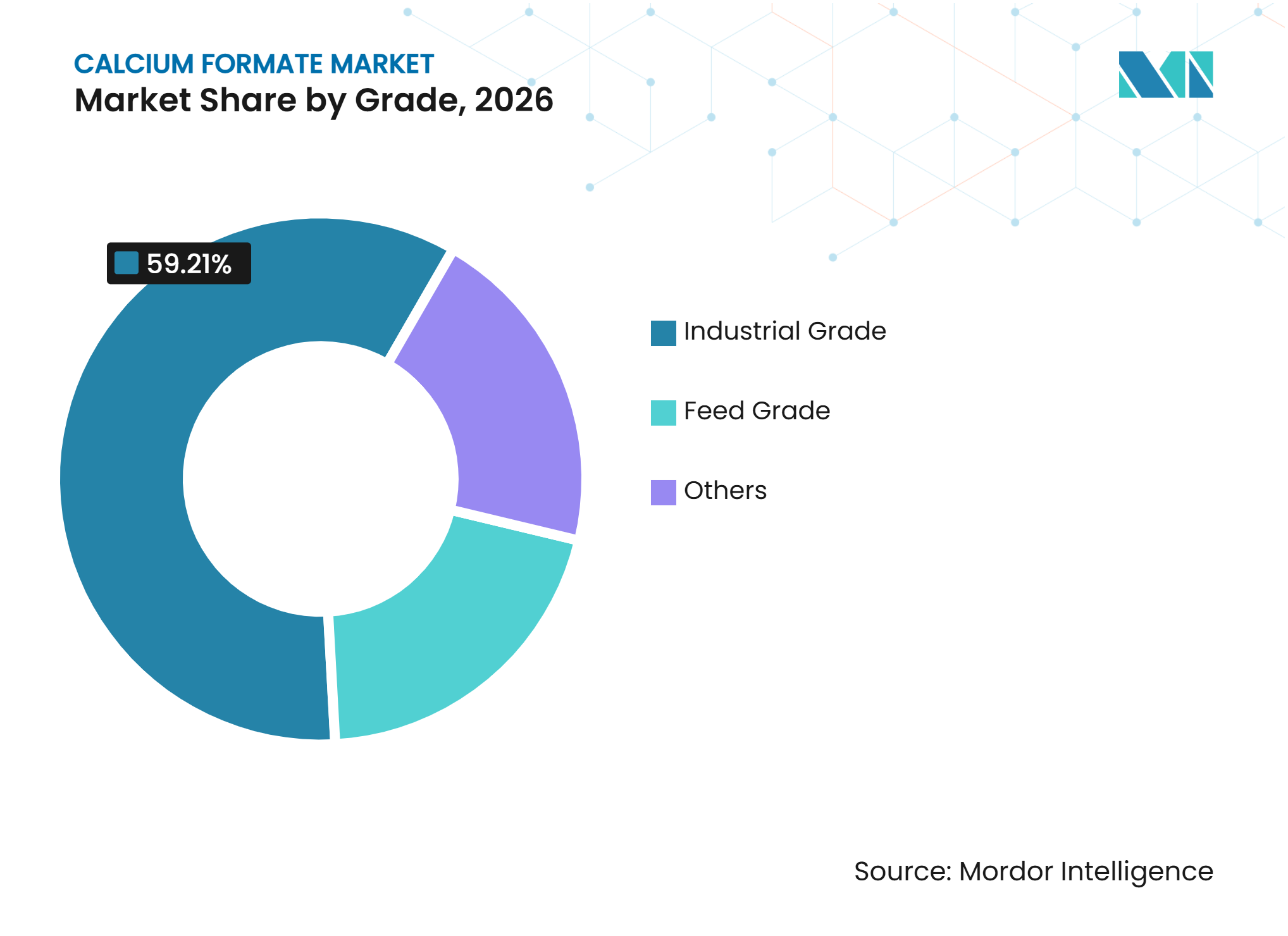
Industrial Grade Leads, While Feed Grade Expands FasterIndustrial grade held 59.21% of the calcium formate market share in 2026. It is widely used as a concrete admixture and a tile adhesive accelerator, giving it a strong position in the construction chemicals market. The grade can serve applications that do not require feed-additive certification, allowing manufacturers to supply a broad construction customer base with material aligned to industrial specifications. Industrial customers typically focus on early strength, mortar compatibility, consistent assay, and dependable supply. These requirements support use in dry-mix mortar, tile adhesive, precast concrete, and infrastructure work.
Feed grade is projected to expand at a 6.45% CAGR through 2032. The segment benefits from antibiotic-reduction programs and greater attention to the documentation of feed quality. China's feed-grade standard increases the importance of purity and heavy-metal controls for material supplied into regulated channels. European animal-nutrition rules also require producers to operate within established additive requirements. Technical and specialty grades are used in smaller applications, including leather tanning and flue-gas desulfurization. Grade separation can limit switching between industrial and feed channels while creating a clearer quality position for compliant suppliers.



By Form:
Powder Retains Broad Use, While Granules Fit Automated HandlingPowder accounted for 68.36% of the calcium formate market share in 2026. It is compatible with dry mortar batching and feed compounding, supporting broad use across the two main demand chains. Powder dissolves readily and can be dispersed consistently when handling controls are in place. Its established use means large processors understand storage, transfer, and dosing requirements. These characteristics make powder the standard option in many high-volume formulations. Liquid forms remain limited to specialized industrial uses where on-site solution preparation is not practical.
Granules are forecast to grow at a 6.81% CAGR through 2032. Feed facilities that use automated dispensing systems may favor granular products because they can reduce dust exposure and improve handling. Granules can also lower caking risk and improve dosing consistency in feed mills. These operational benefits can support a price premium over powder for customers with modern material-handling equipment. Higher granule use is expected where processors invest in precision feeding infrastructure. Those facilities may also be more willing to adopt encapsulated and functional formulations.
By Application:
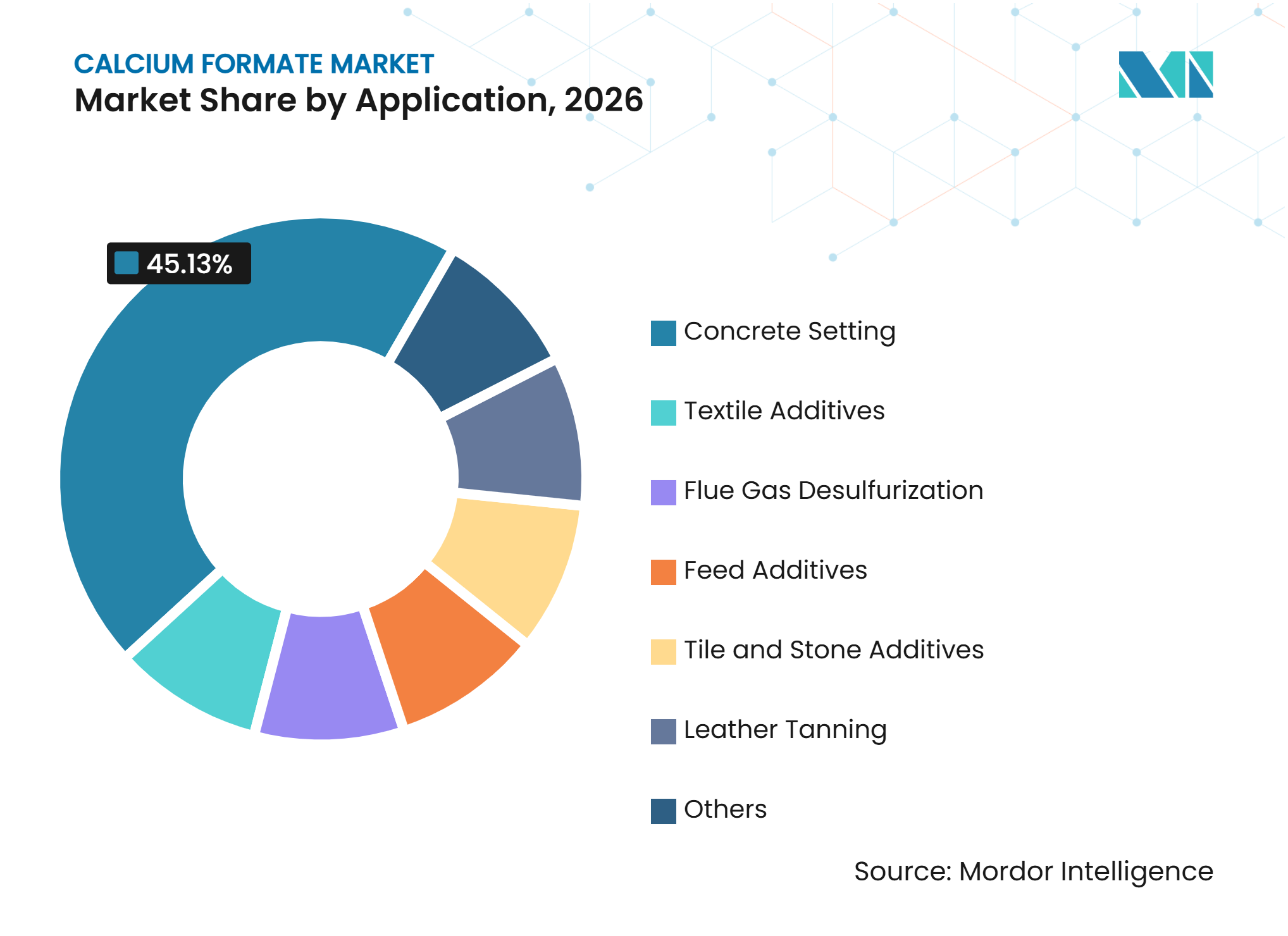
Concrete Setting Remains the Largest Use, While Feed Additives Grow FasterConcrete setting accounted for 45.13% of the calcium formate market in 2026. This application is supported by construction activity in Asia-Pacific and demand for non-chloride performance in reinforced structures. Calcium formate supports hydration and early-strength development in mortar and concrete systems, and benefits cement performance and permeability control through accelerating admixtures. This application requires coordination with admixture formulators, contractors, and construction-material distributors, and places product consistency and technical documentation at the center of industrial-grade supplier selection.
Feed additives are expected to grow at a 6.98% CAGR through 2032. This growth is associated with alternatives to antibiotic growth promoters and broader interest in gut health management. Calcium formate provides acidity control while contributing calcium to the diet. Encapsulation offers suppliers a means to differentiate feed products, as demonstrated by Kemin's formulation work. Tile and stone additives remain an important application area, driven by the development of dry-mix mortar. Leather tanning, flue-gas desulfurization, and textile additives remain smaller applications with stable but limited growth prospects.

Geography Analysis
Asia-Pacific
Asia-Pacific held 41.78% of the calcium formate market share in 2026. China serves as both a major production base and a major end-use market, supporting regional-scale industrial and feed applications. Construction demand is concentrated in dry-mix mortar, tile adhesive, and concrete applications. India, Vietnam, and Indonesia present additional opportunities for demand as construction supply chains become more formalized. WACKER's 2025 presentation on tile-adhesive technology for Asian applications reflects continued product development in regional dry-mix mortar systems. China's GB 7300.806-2025 standard has also raised the importance of feed-grade quality management, creating a clearer distinction between material intended for animal nutrition and material used in construction chemicals.
North America
North America is forecast to expand at a 6.72% CAGR through 2032. The region benefits from demand for non-chloride admixtures in reinforced concrete applications. Bridge decks, parking structures, and marine assets require careful attention to corrosion and durability. ASTM C494 provides a relevant performance framework for chemical admixtures used in concrete. Animal nutrition represents a second demand channel, as buyers seek feed programs that reduce reliance on antibiotic growth promoters. This combination gives the regional calcium formate market exposure to distinct construction and livestock demand streams. Producers with technical service capabilities and regulatory documentation are better positioned to serve these applications.
Europe, South America, and Middle East and Africa
Europe has a mature feed-grade base, as its animal nutrition regulations have long governed additive use. Regulation (EC) No 1831/2003 remains an important reference for compliance in feed applications[2]. Germany, the United Kingdom, and Nordic countries also support demand for non-chloride construction admixtures in durability-focused projects. South America is more closely tied to construction demand, with Brazil and Argentina serving as key consumption centers. Lower-cost calcium chloride can limit adoption of calcium formate in projects without strict specifications. The Middle East and Africa present emerging potential from construction activity and industrial livestock production, though premium feed-grade penetration can be constrained by uneven regulatory enforcement and limited handling infrastructure.
Competitive Landscape
Market Concentration
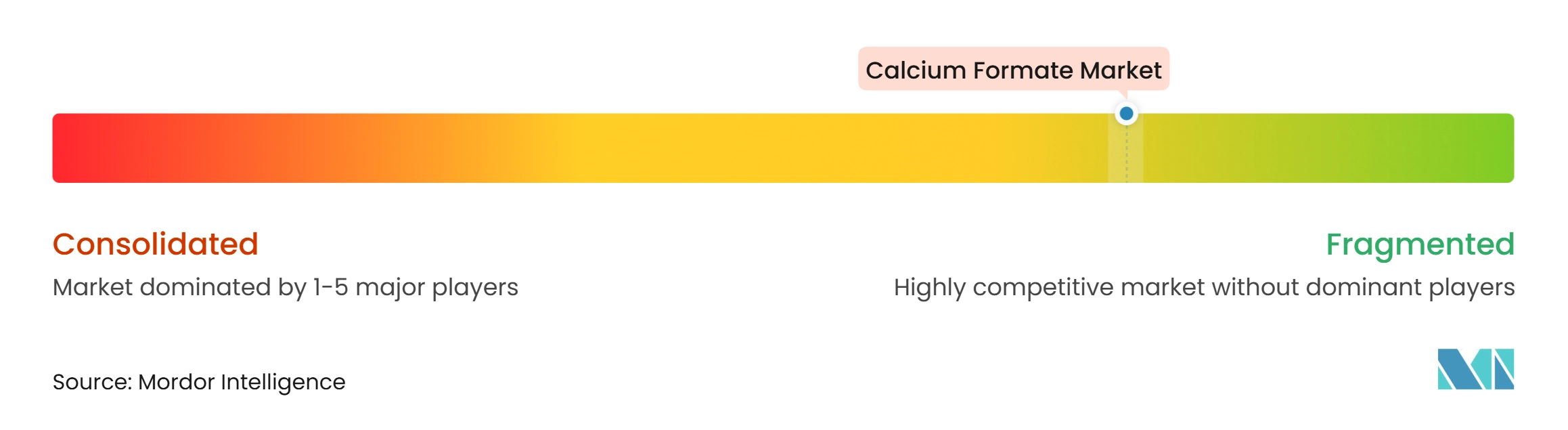
The calcium formate market is fragmented. Chinese producers compete through high-capacity and cost-focused supply. Chongqing Chuandong Chemical registered a wholly owned subsidiary in Hong Kong in April 2025, indicating a step toward international expansion. Henan Botai and other Chinese producers also compete across domestic and export channels. This market position can create pricing pressure for suppliers that do not offer differentiated grades or services. Reliable supply, product quality, and customer qualification support remain important competitive factors.
Western specialty chemical companies compete more directly in higher-specification applications. BASF's lower-product-carbon-footprint formic acid offering in China is one example of a feedstock-based lower-carbon strategy. BASF's Ludwigshafen heat-pump project is another example of investment linked to lower-carbon chemical production. Perstorp opened a specialty chemicals laboratory in Shanghai in April 2025 to support customer application development in Asia. These moves indicate how technical support and lower-carbon production can support premium positioning. Regulatory documentation and application knowledge can also reduce the relevance of simple price comparisons.
Encapsulation is a further area of competition for suppliers serving the animal nutrition market. Kemin's FORMYL product demonstrates how delivery technology can create a differentiated calcium formate offering. Kemin also published a 2025 patent application on peroxyacid-based control of spore-producing organisms in animal feed. European market participants must maintain substance information under the Registration, Evaluation, Authorization and Restriction of Chemicals (REACH), which can add a fixed compliance burden for smaller suppliers. The competitive gap is therefore widest between low-cost uncoated material and more specialized, documented feed formulations.
Calcium Formate Industry Leaders
-
Perstorp
-
LANXESS
-
Chongqing Chuandong Chemical (Group) Co., Ltd.
-
GEO
-
Zibo Ruibao Chemical Co.,Ltd
- *Disclaimer: Major Players sorted in no particular order
Calcium Formate Market Companies Covered in this Report
- American Elements
- BASF
- Chongqing Chuandong Chemical (Group) Co., Ltd.
- GEO
- Gujarat Narmada Valley Fertilizers & Chemicals Limited
- Henan Botai Chemical Building Materials Co., Ltd.
- Jiangxi Kosin Frontier Technology Co., Ltd.
- Kemin Industries, Inc.
- Kemira Oyj
- LANXESS
- Perstorp
- Shandong Baoyuan Chemical Co., Ltd.
- Shandong Feicheng Acid Chemicals Co., Ltd.
- Sidley Chemical Co.,Ltd
- Zibo Ruibao Chemical Co.,Ltd
Recent Industry Developments in Calcium Formate Market
- October 2025: BASF commenced construction of one of the world's largest industrial heat pump systems at its Ludwigshafen Verbund site to supply low-carbon steam for formic acid production. The investment is part of BASF's decarbonization roadmap and is expected to reduce the carbon footprint of calcium formate by up to 98% when powered by renewable electricity.
- October 2025: China issued national standard GB 7300.806-2025 (Feed Additives - Part 8: Calcium Formate), establishing mandatory purity, heavy-metal, and labeling requirements for feed-grade calcium formate. Effective November 2026, the standard tightened quality governance across China's calcium formate supply chain and raised certification requirements for both domestic producers and importers.
Global Calcium Formate Market Report Scope
Calcium formate is a calcium salt of formic acid. It appears as an odorless, white-to-yellowish crystalline powder or solid that is soluble in water. The compound is widely used across multiple industries, including construction, animal feed, leather tanning, and chemical manufacturing. In construction, calcium formate functions as a concrete accelerator, reducing setting time and improving early strength development.
The calcium formate market is segmented by grade, form, application, and geography. By grade, the market is segmented into industrial grade, feed grade, and others. By form, the market is segmented into powder, granules, and liquid. By application, the market is segmented into feed additives, tile and stone additives, concrete setting, leather tanning, textile additives, flue gas desulfurization, and others. The report also covers market sizes and forecasts for calcium formate across 15 countries in major regions. The market sizes and forecasts are provided in terms of value (USD).
Segmentation Overview
| Industrial Grade |
| Feed Grade |
| Others |
| Powder |
| Granules |
| Liquid |
| Feed Additives |
| Tile and Stone Additives |
| Concrete Setting |
| Leather Tanning |
| Textile Additives |
| Flue Gas Desulfurization |
| Others |
| Asia-Pacific | China |
| India | |
| Japan | |
| South Korea | |
| ASEAN Countries | |
| Rest of Asia-Pacific | |
| North America | United States |
| Canada | |
| Mexico | |
| Europe | Germany |
| United Kingdom | |
| France | |
| Italy | |
| NORDIC Countries | |
| Rest of Europe | |
| South America | Brazil |
| Argentina | |
| Rest of South America | |
| Middle East and Africa | Saudi Arabia |
| South Africa | |
| Rest of Middle East and Africa |
| By Grade | Industrial Grade | |
| Feed Grade | ||
| Others | ||
| By Form | Powder | |
| Granules | ||
| Liquid | ||
| By Application | Feed Additives | |
| Tile and Stone Additives | ||
| Concrete Setting | ||
| Leather Tanning | ||
| Textile Additives | ||
| Flue Gas Desulfurization | ||
| Others | ||
| By Geography | Asia-Pacific | China |
| India | ||
| Japan | ||
| South Korea | ||
| ASEAN Countries | ||
| Rest of Asia-Pacific | ||
| North America | United States | |
| Canada | ||
| Mexico | ||
| Europe | Germany | |
| United Kingdom | ||
| France | ||
| Italy | ||
| NORDIC Countries | ||
| Rest of Europe | ||
| South America | Brazil | |
| Argentina | ||
| Rest of South America | ||
| Middle East and Africa | Saudi Arabia | |
| South Africa | ||
| Rest of Middle East and Africa | ||
Key Questions Answered in the Report
What is current market size of Calcium Formate Market?
The calcium formate market size was valued at USD 0.75 billion in 2026 and is estimated to grow from USD 0.79 billion in 2027 to USD 1.04 billion by 2032, at a CAGR of 5.63% during the forecast period (2027-2032).
Which calcium formate application is growing fastest?
Feed Additives is forecast to grow at a 6.98% CAGR through 2032, supported by demand for feed acidifiers and gut-health formulations.
Why is calcium formate used in concrete?
It supports early strength and offers a chloride-free option for reinforced concrete and mortar formulations.
Which region leads calcium formate demand?
Asia-Pacific held a 41.78% share in 2026, supported by construction chemicals and feed applications.