
Calcium Fluoride Market Size and Share
Market Overview
| Study Period | 2021 - 2031 |
|---|---|
| Market Size (2026) | USD 1.81 Billion |
| Market Size (2031) | USD 2.70 Billion |
| Growth Rate (2026 - 2031) | 8.32% CAGR |
| Fastest Growing Market | Asia-Pacific |
| Largest Market | Asia-Pacific |
| Market Concentration | Medium |
Major Players *Disclaimer: Major Players sorted in no particular order Image © Mordor Intelligence. Reuse requires attribution under CC BY 4.0. | |
Calcium Fluoride Market Analysis by Mordor Intelligence
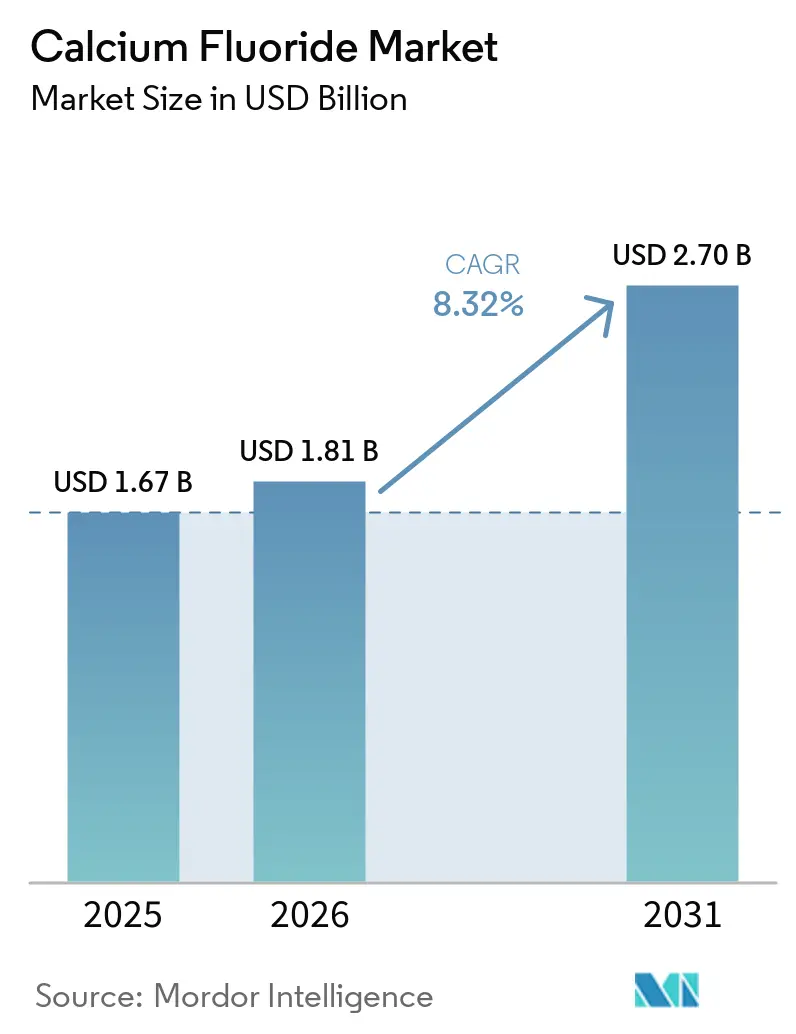
The Calcium Fluoride Market size was valued at USD 1.67 billion in 2025 and is estimated to grow from USD 1.81 billion in 2026 to reach USD 2.70 billion by 2031, at a CAGR of 8.32% during the forecast period (2026-2031). The calcium fluoride market serves hydrofluoric acid production, metallurgical fluxing, and high-purity optical applications, each of which requires material with different quality and processing characteristics. Hydrofluoric acid links calcium fluoride to refrigerants, fluoropolymers, lithium hexafluorophosphate (LiPF₆) battery electrolytes, and semiconductor chemicals across several large and specialized manufacturing chains. Supply conditions remain important because high-purity acid spar is required for several expanding uses, while bulk material may not meet the requirements of chemical and optical customers. Producers are responding through downstream integration, premium-grade processing, and efforts to diversify supply beyond conventional mining in response to these differences. Across these uses, the calcium fluoride market combines a large bulk-material base with smaller applications that require higher purity, reliable specifications, long qualification periods, and dependable delivery to technically demanding industrial end users across the global fluorine value chain.
Key Report Takeaways
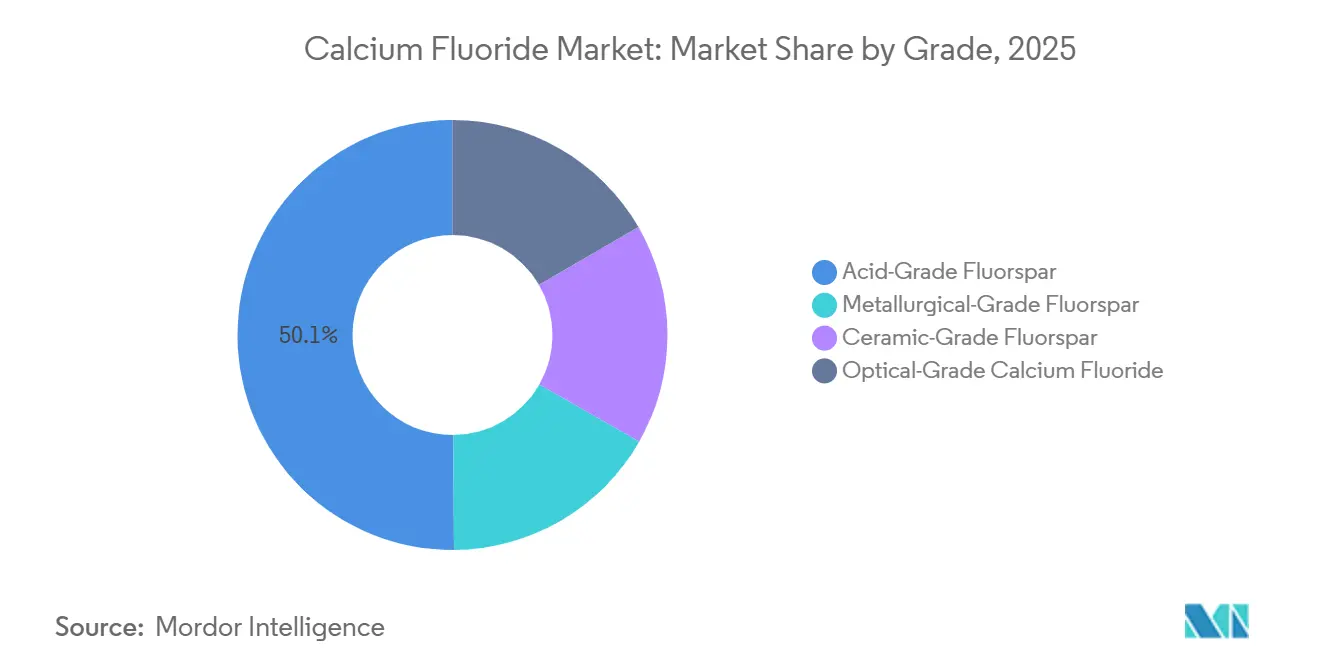
- By grade, acid-grade fluorspar held 50.12% of the calcium fluoride market share in 2025, while optical-grade calcium fluoride is projected to advance at a 9.13% CAGR through 2031.
- By application, hydrogen fluoride production held 45.34% of the calcium fluoride market share in 2025, while steelmaking and iron casting are projected to advance at a 9.67% CAGR through 2031.
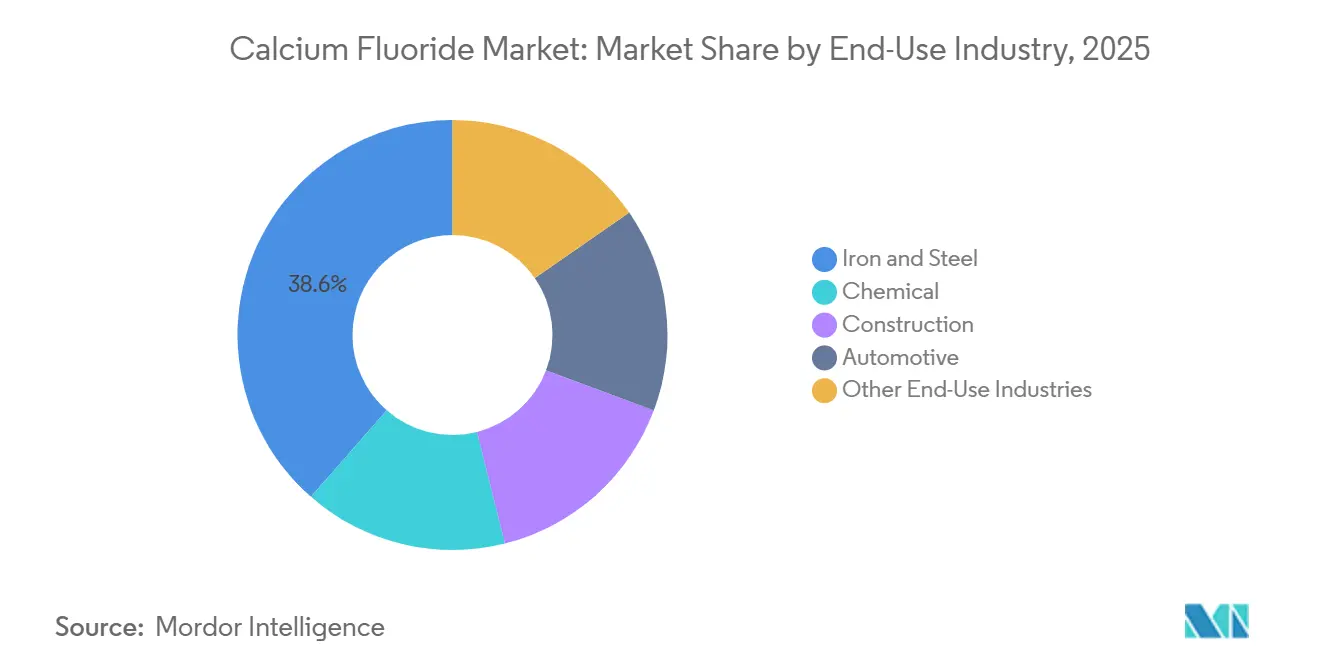
- By end-use industry, iron and steel held 38.56% of the calcium fluoride market share in 2025 and are projected to advance at a 10.04% CAGR through 2031.
- By geography, Asia-Pacific held 41.64% of the calcium fluoride market share in 2025 and is projected to advance at a 9.56% CAGR through 2031.
Note: Market size and forecast figures in this report are generated using Mordor Intelligence’s proprietary estimation framework, updated with the latest available data and insights as of January 2026.
Global Calcium Fluoride Market Trends and Insights
Drivers Impact Analysis*
| Driver | (~) % Impact on CAGR Forecast | Geographic Relevance | Impact Timeline |
|---|---|---|---|
| Expansion of Hydrofluoric Acid and Fluorochemical Production | +2.8% | Global, concentrated in China, India, and EU chemical hubs | Long term (≥ 4 years) |
| Growth in Steelmaking and Aluminum Smelting Flux Consumption | +2.1% | Asia-Pacific core | Medium term (2–4 years) |
| Semiconductor, UV Lithography, and Infrared Optics Demand | +1.2% | East Asia (Taiwan, South Korea, Japan, China) and North America | Long term (≥ 4 years) |
| Fluorspar Supply-Security Policies and Domestic-Capacity Incentives | +0.9% | North America, EU, India; spill-over to ASEAN and MEA | Medium term (2–4 years) |
| Recovery of Fluorine from Phosphate and Industrial Waste Streams | +0.5% | EU, North Africa, APAC phosphate-processing geographies | Long term (≥ 4 years) |
| Source: Mordor Intelligence | |||
Expansion of Hydrofluoric Acid and Fluorochemical Production
Hydrofluoric acid production is the largest structural demand source for acid-grade fluorspar. It connects the calcium fluoride market to refrigerants, fluoropolymers, LiPF₆ battery electrolytes, and semiconductor etching gases. Each of these value chains needs fluorine chemistry at an early production stage, which preserves the material’s role across products with different demand cycles. Demand is distributed across several chemical uses, which limits dependence on a single downstream sector and gives suppliers exposure to both established and emerging applications. Orbia Fluor & Energy Materials stated in its second-quarter 2026 results that it expected favorable fluorine pricing to continue through the second half of 2026 while investing in battery materials and medical propellants[1]Orbia, “Second Quarter 2026 Financial Results,” Orbia, finance.yahoo.com. Battery-grade acid spar requires at least 97.5% calcium fluoride with controlled arsenic and phosphorus levels, creating stricter requirements than standard acid spar. This quality threshold can restrict usable supply even where broader mineral volumes appear adequate, since material that fails those controls cannot readily serve battery-grade customers.
Growth in Steelmaking and Aluminum Smelting Flux Consumption
Metallurgical-grade fluorspar supports basic oxygen furnace (BOF) and electric arc furnace (EAF) steelmaking by reducing slag viscosity and helping remove sulfur and phosphorus. Electric arc furnaces accounted for 29% of global crude steel output of 1,885 million metric tons in 2024, and their role has been increasing as producers change production routes. Electric arc furnaces can generate more slag per metric ton of steel than basic oxygen furnaces because of their scrap and direct-reduced-iron charge mix. This operating feature supports fluorspar demand beyond what total steel output alone suggests and makes the quality of metallurgical material important to furnace operations. Aluminum smelting also requires fluoride-based materials in the Hall-Héroult process, creating recurring demand for fluorspar-related inputs throughout the operating life of smelting cells. Capacity additions in Southeast Asia and Gulf Cooperation Council markets provide additional support for metallurgical consumption and widen the regional base of demand.
Semiconductor, UV Lithography, and Infrared Optics Demand
Optical-grade calcium fluoride is required for deep ultraviolet (DUV) lithography at a 193 nm wavelength because fused silica has unsuitable absorption at that wavelength. The calcium fluoride market benefits from demand for large-aperture crystals with low birefringence and consistent optical properties. Production requires strict control of impurities and refractive-index uniformity, particularly for larger optical components used in precision equipment. Nikon describes fluorite as a material that requires exacting crystal-growth and processing capabilities for precision optics. Semiconductor fabrication, infrared imaging, autonomous sensing, defense equipment, and industrial inspection all use high-purity optical material and draw on the same specialized production capabilities. Long qualification cycles can keep established suppliers important while newer producers seek entry into this category, because customers must verify consistent material performance.
Fluorspar Supply-Security Policies and Domestic-Capacity Incentives
Canada, the United States, and the European Union have designated fluorspar as a critical mineral, increasing attention to supply-chain diversification. These policies can support mines, processing projects, and long-term offtake arrangements outside established producing regions. Domestic projects matter because buyers of acid-grade material need predictable access to qualified feedstock that meets their downstream process requirements. The calcium fluoride market can benefit when public programs encourage investment in domestic capacity and new processing routes. China has also pursued domestic supply development as mine conditions and local supply requirements have evolved. Such policy activity raises the importance of traceable sources, qualified processing, and long-term procurement arrangements for buyers that cannot easily substitute the material.
Restraints Impact Analysis*
| Restraint | (~) % Impact on CAGR Forecast | Geographic Relevance | Impact Timeline |
|---|---|---|---|
| Concentrated Mine Supply and Export-Policy Exposure | -1.8% | Global | Medium term (2–4 years) |
| Environmental, Safety, and Permitting Requirements for Fluorspar and Hydrogen Fluoride Operations | -1.2% | China (primary), EU and North America | Short term (≤ 2 years) |
| Impurity-Specification Mismatch Between Bulk and Optical-Grade Material | -0.5% | East Asia (production), Global (semiconductor buyers) | Long term (≥ 4 years) |
| Source: Mordor Intelligence | |||
Concentrated Mine Supply and Export-Policy Exposure
The calcium fluoride market remains exposed to concentrated mine supply and changes in export policy. China is central to global output and processing, making its domestic balance important for international buyers and for contract negotiations involving acid-grade material. Imports from Mongolia and Sub-Saharan Africa have gained relevance as Chinese supply conditions have changed. Mexico also remains important to North American supply because its reserves and producing assets support regional buyers. The need to secure qualified acid spar can increase the value of multi-year supply agreements, particularly for fluorochemical and semiconductor customers. Buyers seeking non-Chinese material can face limited immediate alternatives when high-purity requirements apply and when mines cannot quickly alter their product mix.
Environmental, Safety, and Permitting Requirements for Fluorspar and Hydrogen Fluoride Operations
Mine safety enforcement can interrupt fluorspar production and tighten spot availability within a short period. Hydrofluoric acid operations face separate compliance requirements because anhydrous hydrofluoric acid is a hazardous material that needs extensive process-safety and transport controls. These obligations raise the capital needed to operate compliant mining and fluorochemical facilities and require operators to maintain specialized handling systems. Safety-related production curtailments can also keep inventories tight when demand remains firm. Regulatory requirements, therefore, limit the speed of near-term capacity additions, even when price conditions encourage investment. The calcium fluoride market must account for the cost and timing of compliance at both mines and downstream chemical operations.
*Our forecasts treat driver/restraint impacts as directional, not additive. The impact forecasts reflect baseline growth, mix effects, and variable interactions.
Segment Analysis
By Grade: Optical-Grade Calcium Fluoride Gains Ground as High-Purity Demand Accelerates
Acid-grade fluorspar held 50.12% of 2025 revenue. Its leading position reflected the volume of feedstock required for hydrofluoric acid production and the wide range of chemicals made from hydrofluoric acid. Hydrofluoric acid supported refrigerants, fluoropolymers, battery electrolytes, and semiconductor chemicals. Acid-grade material is needed to meet the quality requirements of these downstream users, particularly where trace impurities can affect chemical processing. Metallurgical-grade fluorspar contained 60% to 85% calcium fluoride and was used primarily as a flux in steelmaking. The calcium fluoride market also included ceramic-grade material, which supported glass and ceramic production as a flux and opacifier. Demand for ceramic-grade material was more closely linked to construction and manufacturing cycles than demand for acid-grade material.
Optical-grade calcium fluoride is projected to advance at a 9.13% CAGR from 2026 to 2031. The segment serves deep ultraviolet lithography, infrared imaging, and ultraviolet laser applications, where optical transmission and crystal consistency are essential. These uses require 193 nm transmission properties that commercially scalable substitutes do not provide. The calcium fluoride market assigns greater value to this material because it requires stringent purity and crystal-quality control throughout production. Optical-grade material can command prices 20 to 50 times higher than bulk metallurgical material. New capacity projects target 99.99% purity to serve premium optical requirements. Segment growth depends on technical performance and qualification success, rather than mineral output alone.



By Application: Hydrogen Fluoride Production Leads, While Steelmaking and Iron Casting Accelerate
Hydrogen fluoride production held 45.34% of the 2025 application revenue. This application was the starting point for downstream refrigerants, fluoropolymers, electrolyzer membranes, and semiconductor etching gases. Its scale gave acid-grade fluorspar a durable role in the calcium fluoride industry. Refrigerant transitions under the Kigali Amendment have moved users away from legacy hydrofluorocarbons (HFCs) toward hydrofluoroolefins (HFOs). These newer refrigerants continue to require hydrofluoric acid in their production chains. In aluminum metallurgy, aluminum fluoride and synthetic cryolite are used in the Hall-Héroult process. Glass manufacturing also uses fluorspar, but its growth remained tied to construction activity.
Steelmaking and iron casting are projected to advance at a 9.67% CAGR through 2031. Electric arc furnace capacity additions in India, Southeast Asia, and the Gulf Cooperation Council support demand for metallurgical-grade material. Electric arc furnace operations can require greater slag-management inputs than basic oxygen furnace production. That requirement strengthens demand for fluorspar with an effective calcium fluoride content of at least 80% for many operators. The calcium fluoride market also benefits when steel producers increase direct-reduced-iron use alongside scrap. This creates a link between metallurgical demand and changes in steelmaking technology. The application combines established steel demand with new capacity growth in several regions. It also benefits from the continued need for controlled slag chemistry in steel production.
By End-Use Industry: Iron and Steel Dominates Across Both Share and Growth
Iron and steel held 38.56% of 2025 revenue and are projected to advance at a 10.04% CAGR through 2031. This position reflected the scale of metallurgical consumption and capacity programs in growing steel markets. Fluorspar improved slag fluidity and supported the removal of sulfur and phosphorus in steel production. The chemical industry includes hydrofluoric acid producers, fluoropolymer compounders, refrigerant blenders, and battery-material manufacturers. This end-use profile gave the calcium fluoride industry both bulk metallurgical demand and specialized chemical demand. It also linked mineral demand with manufacturing activity in several downstream sectors.
The construction industry uses calcium fluoride in glass, cement, and ceramics, where its flux properties can reduce kiln temperatures. These applications remained tied to construction activity and could show less pricing power than chemical or optical uses. Automotive demand is an emerging source of consumption through LiPF₆ battery electrolytes, fluoroelastomer seals, and HFO vehicle air-conditioning refrigerants. Secondary feedstock recovery may affect long-term demand for primary material in some metallurgical applications. In regions with strong metal-recycling networks, these circuits could replace 15% to 20% of primary fluorspar requirements. The calcium fluoride market must, therefore, account for both expanding end uses and the gradual rise of recovered fluoride inputs. These recovered inputs can moderate primary-material demand without replacing it entirely.
Geography Analysis
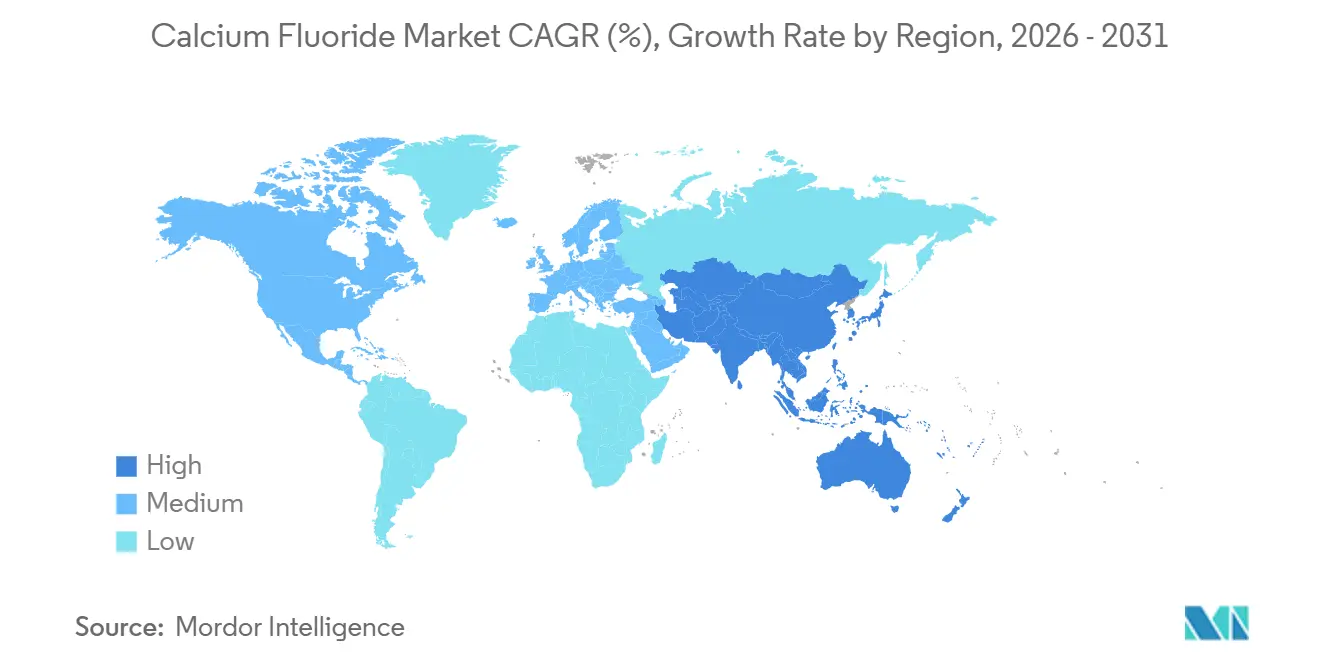
Asia-Pacific held 41.64% of 2025 revenue and is projected to advance at a 9.56% CAGR through 2031. The region functions as the main center for consumption, mining, and downstream processing, which gives it influence over both material availability and customer demand. China has the largest concentration of hydrofluoric acid, fluoropolymer, and battery material capacity. These production chains make regional supply flows important to pricing and availability, particularly for acid spar that must meet chemical and battery-material specifications. India’s steel expansion adds demand for metallurgical-grade material. Southeast Asian aluminum capacity also supports recurring fluorspar-related consumption. Japan and South Korea remain important buyers of premium acid spar for advanced fluorochemical and semiconductor uses.
North America and Europe are developing more domestic supply options while remaining significant import markets. Canada Fluorspar Inc. resumed production at St. Lawrence, Newfoundland, and projected output above 100,000 metric tons of acid spar concentrate in 2026[2]Canada Fluorspar Inc., “Canada Fluorspar Reopens Newfoundland Critical Mineral Mine,” Financial Post, financialpost.com. In Europe, Registration, Evaluation, Authorisation and Restriction of Chemicals (REACH) requirements influence purity standards for acid-grade and optical-grade material. Germany and France provide a stable base of hydrofluoric acid and fluoropolymer demand. Nordic countries represent a smaller high-purity demand area linked to the semiconductor-equipment supply chain. The calcium fluoride market in these regions places added value on compliant, traceable supply because customers require reliable material quality alongside greater security of supply.
South America and Middle East and Africa are smaller in value but have strategic roles in supply and demand. Brazil has phosphate-processing infrastructure that can generate fluorosilicic acid waste for potential secondary calcium fluoride recovery. South Africa remains an export supplier to Asian buyers. Gulf Cooperation Council aluminum projects are creating additional demand through Hall-Héroult cell additions and aluminum fluoride use. Saudi Arabia and the United Arab Emirates are relevant because smelter growth requires recurring fluoride inputs. Supply networks reaching Southern Africa can help European and Middle Eastern buyers diversify procurement. These regions can become more important as buyers seek options beyond established Chinese supply chains and seek to reduce exposure to concentrated sources of raw material.

Competitive Landscape
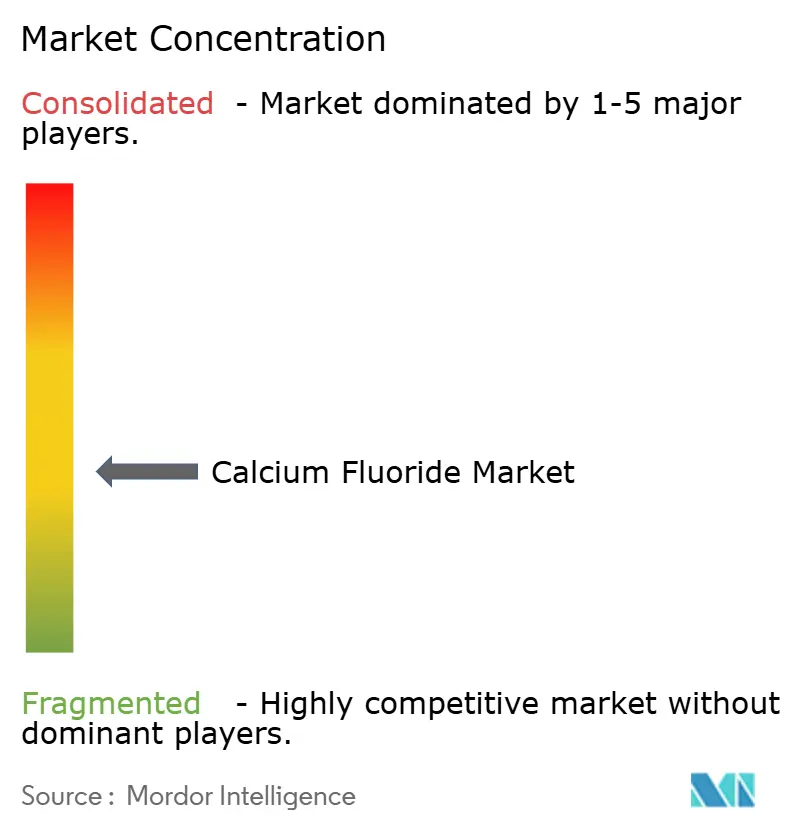
The calcium fluoride market is moderately concentrated, with the top five players including Orbia Fluor & Energy Materials, China Kings Resources Group Co., Ltd., China Minmetals Corporation, Fluorsid, and Minersa Group. Orbia Fluor & Energy Materials is a major non-Chinese participant through its Mexico mine and integrated fluorochemical operations. The company’s mine-to-market approach connects mineral supply with hydrofluoric acid, refrigerants, and battery electrolytes, allowing it to participate across several stages of the fluorine value chain. This structure gives vertically integrated producers an advantage in supplying qualified downstream customers that need continuity in both material quality and delivery. Competition is strongest where suppliers can combine reliable feedstock, process control, and long-term commercial relationships. Bulk supply remains important, but premium-grade capacity shapes access to higher-value end uses.
Solvay stated in its full-year 2025 results that it was restructuring its fluorine business, with transformation expenses expected to decline from 2027. This move may affect how Solvay positions its specialty fluorochemical operations and how it manages its cost base in those activities. Orbia has also invested in downstream opportunities, including battery materials and medical propellants. Fluorsid has developed a route to convert fluorosilicic acid waste into synthetic acid-grade calcium fluoride. This approach could allow phosphate-adjacent operations to enter the acid spar supply chain without conventional mining assets. These strategic moves show that competitive positions are shaped by integration, processing technology, and access to alternative fluorine feedstocks, rather than by mine ownership alone.
European suppliers, including British Fluorspar Ltd. and Minersa Group, can benefit when hydrofluoric acid producers and refrigerant blenders diversify procurement. Their position depends on compliance, material quality, and the ability to provide supplies outside China. Downstream buyers can address this gap through long-term offtake commitments and multiple sourcing arrangements that balance quality, logistics, and policy exposure. The calcium fluoride market remains shaped by the balance between large Chinese supply chains and specialized non-Chinese supply options. The overall structure across the calcium fluoride market supports moderate concentration in mining while retaining fragmentation in downstream distribution, processing, and customer-specific material qualification.
Calcium Fluoride Industry Leaders
Orbia Fluor & Energy Materials
China Kings Resources Group Co., Ltd.
China Minmetals Corporation
Fluorsid
Minersa Group
- *Disclaimer: Major Players sorted in no particular order

Recent Industry Developments
- May 2026: AE Fuels expanded its Fluorite Ridge Project in New Mexico to 81 mining claims spanning approximately 7 km, advancing exploration and metallurgical work on a potential domestic fluorspar resource. The project could strengthen the U.S. supply of calcium fluoride for hydrofluoric acid and other fluorochemical applications.
- May 2026: Mont Royal Resources reported successful processing tests at its Ashram Project in Quebec that upgraded fluorspar to 97.8% CaF₂, exceeding the typical 97% acid-grade threshold. The result demonstrates the potential to produce high-purity calcium fluoride alongside rare-earth recovery, supporting an additional supply of acid-grade fluorspar.


Global Calcium Fluoride Market Report Scope
Calcium fluoride is an inorganic compound valued for its chemical stability, low solubility, and optical properties, with natural fluorspar serving as an important source for industrial processing. It is used as a feedstock, flux, and functional material in chemical processing, metallurgy, glass production, and specialized optical applications.
The Calcium Fluoride Market is segmented by grade, application, end-use industry, and geography. By grade, the market is segmented into acid-grade fluorspar, metallurgical-grade fluorspar, ceramic-grade fluorspar, and optical-grade calcium fluoride. By application, the market is segmented into hydrogen fluoride production, aluminum metallurgy, steelmaking and iron casting, glass manufacturing, and other applications. By end-use industry, the market is segmented into iron and steel, chemical, construction, automotive, and other end-use industries. The report also covers the market size and forecasts for calcium fluoride in 15 countries across major regions. For each segment, the market sizing and forecasts have been done on the basis of value (USD).
| Acid-Grade Fluorspar |
| Metallurgical-Grade Fluorspar |
| Ceramic-Grade Fluorspar |
| Optical-Grade Calcium Fluoride |
| Hydrogen Fluoride Production |
| Aluminum Metallurgy |
| Steelmaking and Iron Casting |
| Glass Manufacturing |
| Other Applications |
| Iron and Steel |
| Chemical |
| Construction |
| Automotive |
| Other End-Use Industries |
| Asia-Pacific | China |
| India | |
| Japan | |
| South Korea | |
| ASEAN Countries | |
| Rest of Asia-Pacific | |
| North America | United States |
| Canada | |
| Mexico | |
| Europe | Germany |
| United Kingdom | |
| France | |
| Italy | |
| NORDIC Countries | |
| Rest of Europe | |
| South America | Brazil |
| Argentina | |
| Rest of South America | |
| Middle East and Africa | Saudi Arabia |
| South Africa | |
| Rest of Middle East and Africa |
| By Grade | Acid-Grade Fluorspar | |
| Metallurgical-Grade Fluorspar | ||
| Ceramic-Grade Fluorspar | ||
| Optical-Grade Calcium Fluoride | ||
| By Application | Hydrogen Fluoride Production | |
| Aluminum Metallurgy | ||
| Steelmaking and Iron Casting | ||
| Glass Manufacturing | ||
| Other Applications | ||
| By End-Use Industry | Iron and Steel | |
| Chemical | ||
| Construction | ||
| Automotive | ||
| Other End-Use Industries | ||
| By Geography | Asia-Pacific | China |
| India | ||
| Japan | ||
| South Korea | ||
| ASEAN Countries | ||
| Rest of Asia-Pacific | ||
| North America | United States | |
| Canada | ||
| Mexico | ||
| Europe | Germany | |
| United Kingdom | ||
| France | ||
| Italy | ||
| NORDIC Countries | ||
| Rest of Europe | ||
| South America | Brazil | |
| Argentina | ||
| Rest of South America | ||
| Middle East and Africa | Saudi Arabia | |
| South Africa | ||
| Rest of Middle East and Africa | ||


Key Questions Answered in the Report
What is the size of the calcium fluoride market?
The calcium fluoride market stands at USD 1.81 billion in 2026 and is projected to reach USD 2.70 billion by 2031.
Which calcium fluoride grade held the largest revenue share in 2025?
Acid-grade fluorspar held a 50.12% revenue share in 2025 because hydrofluoric acid production required substantial qualified feedstock.
Which application is projected to grow fastest?
Steelmaking and iron casting are projected to advance at a 9.67% CAGR through 2031, supported by electric arc furnace capacity additions.
Which region leads the calcium fluoride demand?
Asia-Pacific held 41.64% of revenue in 2025 and is projected to advance at a 9.56% CAGR through 2031.
Page last updated on:





