
Calcium Chloride Market Size and Share
Market Overview
| Study Period | 2021 - 2031 |
|---|---|
| Market Size (2026) | USD 2.32 Billion |
| Market Size (2031) | USD 2.98 Billion |
| Growth Rate (2026 - 2031) | 5.13 % |
| Fastest Growing Market | Asia-Pacific |
| Largest Market | North America |
| Market Concentration | Medium |
Major Players *Disclaimer: Major Players sorted in no particular order Image © Mordor Intelligence. Reuse requires attribution under CC BY 4.0. | |
Calcium Chloride Market Analysis by Mordor Intelligence
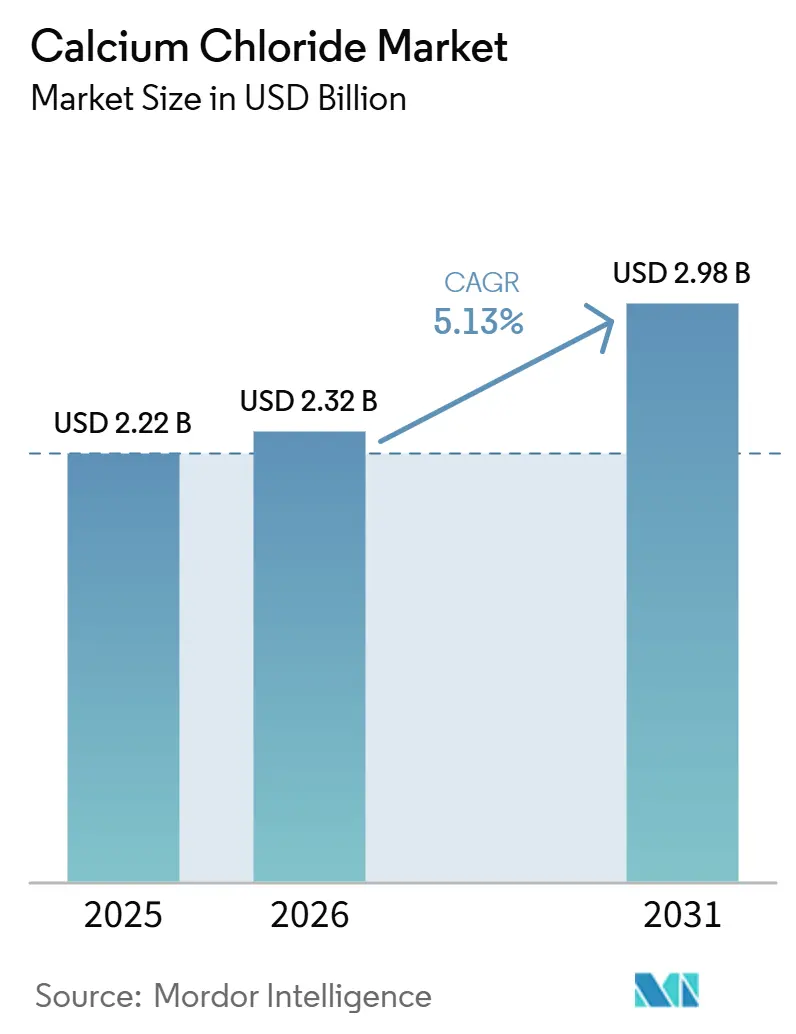
The Calcium Chloride Market was valued at USD 2.22 billion in 2025 and is estimated to grow from USD 2.32 billion in 2026 to reach USD 2.98 billion by 2031, at a CAGR of 5.13% during the forecast period (2026–2031). Demand comes from both seasonal de-icing work and year-round uses in oilfields, food processing, pharmaceuticals, construction, water treatment, refrigeration, and specialty chemical processing. This mix gives producers some protection when activity in a single end-use area slows, because municipal, industrial, food, and energy customers do not follow the same purchasing cycle. North American municipal demand and unconventional well completions continue to support established suppliers, while infrastructure projects widen the calcium chloride market opportunity in developing economies. Producers are directing more capacity toward food grade and pharmaceutical grade material because buyers require closer control over purity, storage, traceability, packaging, and handling. The calcium chloride market is becoming more dependent on product quality, supply reliability, local distribution, technical support, and customer-specific formulations than on aggregate revenue growth alone.
Key Report Takeaways
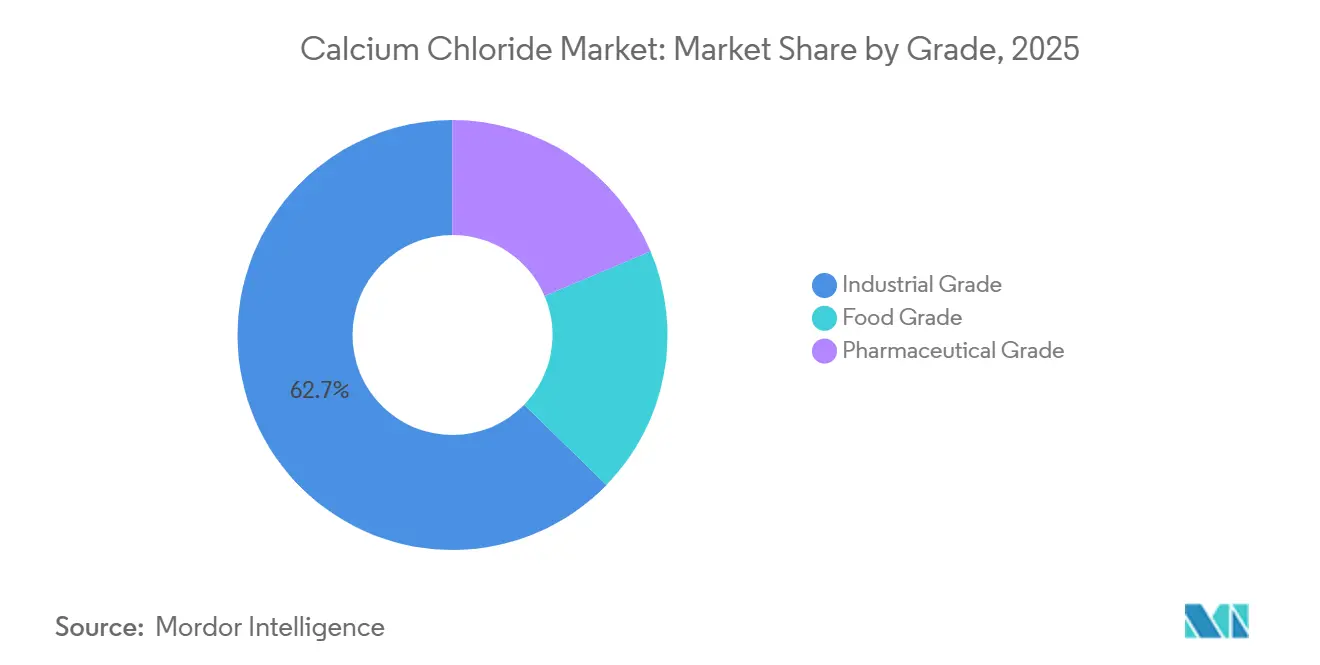
- By grade, industrial grade held 62.71% of the calcium chloride market share in 2025, while pharmaceutical grade is projected to grow at a 5.82% CAGR through 2031.
- By product type, flakes held 43.86% of the calcium chloride market share in 2025, while pellets and prills are projected to grow at a 5.24% CAGR through 2031.
- By application, de-icing and dust control accounted for 34.95% of the calcium chloride market size in 2025, while construction and concrete acceleration is projected to grow at a 6.14% CAGR through 2031.
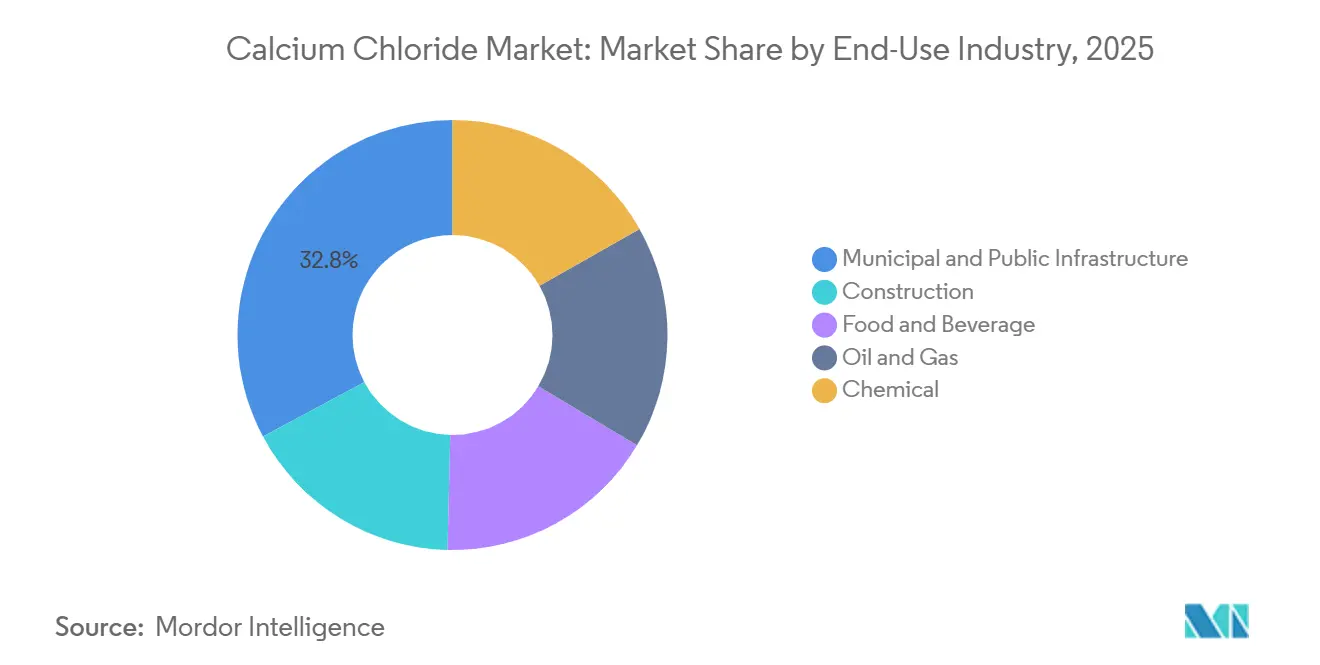
- By end-use industry, municipal and public infrastructure accounted for 32.83% of the calcium chloride market share in 2025, while construction is projected to grow at a 6.03% CAGR through 2031.
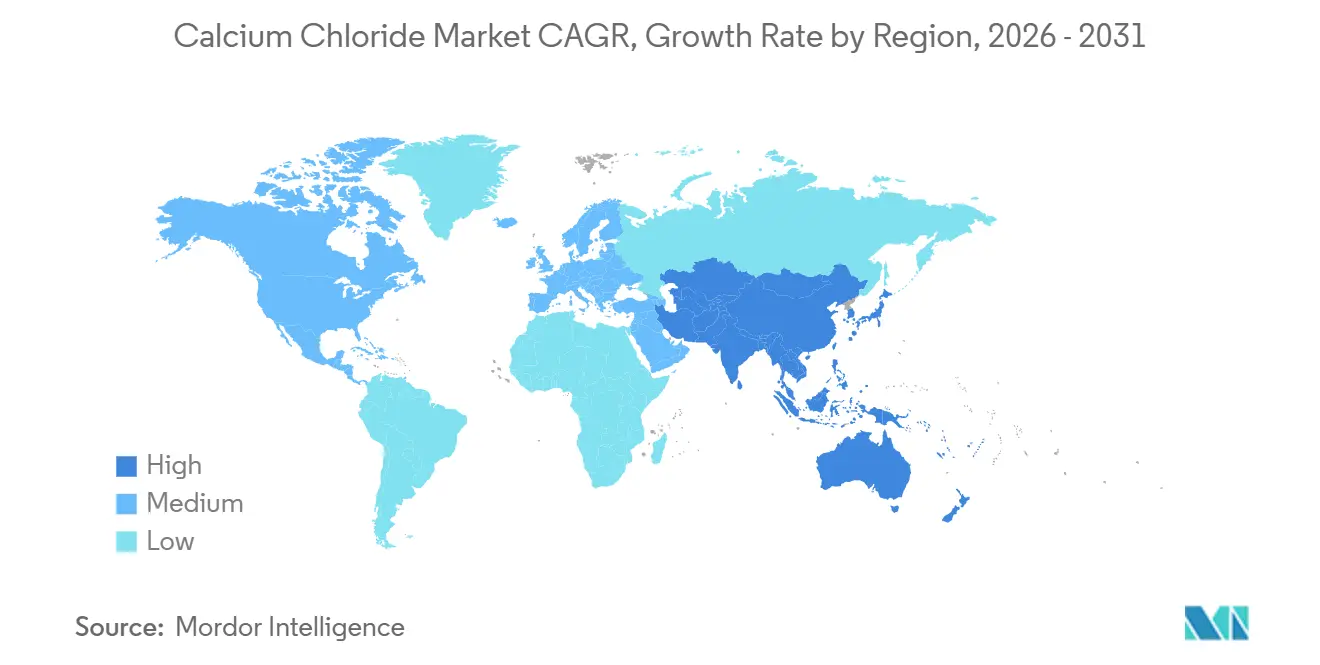
- By geography, North America held 36.22% of the calcium chloride market share in 2025, while Asia-Pacific is projected to grow at a 6.11% CAGR through 2031.
Note: Market size and forecast figures in this report are generated using Mordor Intelligence’s proprietary estimation framework, updated with the latest available data and insights as of January 2026.
Market Trends and Insights
Drivers Impact Analysis of Calcium Chloride Market*
| Driver | (~) % Impact on CAGR Forecast | Geographic Relevance | Impact Timeline |
|---|---|---|---|
| Growing Use of Calcium Chloride in Oil and Gas Drilling and Well Completion Operations | +1.2% | North America (Permian, Appalachian), Middle-East and Africa, Offshore APAC | Medium term (2-4 years) |
| Increasing Preference for High-Performance De-Icing and Dust Control Solutions | +1.3% | North America, Europe (Nordic and Eastern) | Short term (≤ 2 years) |
| Expanding Application of Calcium Chloride in Construction for Concrete Acceleration and Soil Stabilization | +0.8% | APAC (China, India), Middle-East, South America | Medium term (2-4 years) |
| Growing Demand from the Food Processing Industry as a Firming, Preserving, and Coagulating Agent | +0.6% | APAC (Southeast Asia, Japan), Europe, North America | Long term (≥ 4 years) |
| Increasing Adoption of Calcium Chloride in Industrial Refrigeration and Cold Storage Systems | +0.4% | APAC, Europe | Long term (≥ 4 years) |
| Source: Mordor Intelligence | |||
Growing Use of Calcium Chloride in Oil and Gas Drilling and Well Completion Operations
The calcium chloride market benefits from demand for clear brines used in drilling, completion, and workover work across conventional, offshore, and unconventional wells. The U.S. Energy Information Administration reported that U.S. crude oil and natural gas rotary rigs averaged 546 in January 2026, supporting completion-fluid demand in the Permian Basin and Appalachia[1]. TETRA Technologies reported USD 631.0 million in 2025 revenue and USD 113.6 million in adjusted Earnings Before Interest, Taxes, Depreciation, and Amortization (EBITDA) for its Completion Fluids & Products division, with revenue up 5% and adjusted EBITDA up 14% from 2024. The reported performance reflects continued demand from deepwater and unconventional completions, where fluid quality and supply continuity are important. Offshore activity in the Gulf of Mexico, together with activity in India and China, broadens the demand base beyond North America. Completion schedules remain important for inventory planning because they can lag changes in reported drilling activity.
Increasing Preference for High-Performance De-Icing and Dust Control Solutions
The calcium chloride market continues to depend on winter road treatment, especially in the Great Lakes region, Canada, and Northern Europe. The U.S. Environmental Protection Agency identifies road-treatment salt as a contributor to freshwater salinization and provides salt-management information for reducing related risks[2]. This policy focus favors documented products that can deliver consistent performance while allowing agencies to better control applications. Municipal buyers are balancing road-safety requirements with efforts to reduce chloride loading in sensitive watersheds and nearby water bodies. The same products support dust control on unpaved mining roads and construction sites where operators must manage airborne particles and surface conditions. This gives suppliers a reason to offer application guidance, liquid systems, storage support, and formulation documentation rather than only dry material.
Expanding Application of Calcium Chloride in Construction for Concrete Acceleration and Soil Stabilization
Construction activity supports the calcium chloride market because the material helps contractors work in cold conditions and manage difficult soils. Research published in 2025 described the role of accelerator additives in fast-setting, high-performance ready-mix concrete. A 2025 concrete pavement publication examined calcium chloride-accelerated high-early-strength concrete for slab repair and replacement. Research on expansive soil found that calcium chloride and cement can be used together to improve soil behavior and manage subgrade instability. The American Society of Concrete Contractors provides technical guidance on acceptable calcium chloride use, including the need to manage reinforcement corrosion risk. Infrastructure programs in China, India, the Gulf states, and Southeast Asia support use in concrete acceleration, repair work, and soil stabilization.
Growing Demand from the Food Processing Industry as a Firming, Preserving, and Coagulating Agent
Food processing offers the calcium chloride market a more stable source of demand than weather-dependent de-icing. The U.S. Food and Drug Administration lists calcium chloride under 21 Code of Federal Regulations (CFR) §184.1193 for food uses that include firming, coagulation, pH control, and processing functions. Codex Alimentarius lists calcium chloride as a food additive E509, which supports its use across relevant food-processing categories. The United States Department of Agriculture (USDA) discussed calcium chloride handling in a 2024 technical report, including its role in food-related processing. Dairy, tofu, brewing, and canned-vegetable applications require a reliable food grade supply, controlled storage, and traceable handling practices. These uses can reduce the seasonal concentration of revenue that is common in road-treatment sales and support steadier production planning.
Restraints Impact Analysis of Calcium Chloride Market*
| Restraint | (~) % Impact on CAGR Forecast | Geographic Relevance | Impact Timeline |
|---|---|---|---|
| High Corrosion Risks and Associated Maintenance Costs in Infrastructure and Transportation Assets | -0.4% | North America, Europe | Short term (≤ 2 years) |
| Storage, Handling, and Packaging Challenges Due to the Hygroscopic Nature of Calcium Chloride | -0.3% | Global, with acute exposure in high-humidity APAC and tropical markets | Medium term (2-4 years) |
| Availability of Alternative De-Icing Chemicals and Dust Control Products | -0.4% | North America (chloride-sensitive watersheds), Europe (Nordic and urban municipalities) | Medium term (2-4 years) |
| Source: Mordor Intelligence | |||
High Corrosion Risks and Associated Maintenance Costs in Infrastructure and Transportation Assets
Corrosion risk remains a constraint on the calcium chloride market in road, bridge, airport, parking, pipeline, and vehicle applications. The Transportation Research Board documented the costs associated with chloride-based de-icers and their effects on infrastructure. A 2024 study examined repair-cost uncertainty for reinforced concrete exposed to chloride ingress. These costs make procurement teams more attentive to corrosion performance, especially for bridge decks, runways, parking structures, and public assets. Suppliers can respond with inhibited formulations and clearer product documentation, but these measures add cost and may narrow the difference with alternatives. Alternative de-icers can gain attention where municipalities give greater weight to asset protection, runoff concerns, and long-term maintenance expenses.
Storage, Handling, and Packaging Challenges Due to the Hygroscopic Nature of Calcium Chloride
The calcium chloride market faces handling limits because the material absorbs moisture readily and can progressively lose its physical integrity in unsuitable storage. OxyChem’s calcium chloride handbook details storage, handling, materials compatibility, and liquid-product requirements. Moisture exposure can cause clumping, liquefaction, purity loss, container damage, and practical handling hazards during storage and distribution. These risks are particularly relevant in humid climates and in supply chains with limited specialized warehousing, sealing, or dehumidification. Food grade and pharmaceutical grade shipments need stronger control because product integrity and traceability are central to customer qualification and release. Distribution costs can rise with the quality level required by the end user, particularly where suppliers must serve distant customers from limited regional storage capacity.
*Our forecasts treat driver/restraint impacts as directional, not additive. The impact forecasts reflect baseline growth, mix effects, and variable interactions.
Calcium Chloride Market Segment Analysis
By Grade:
Industrial Grade Dominates, but Pharmaceutical Grade Drives Margin ExpansionIndustrial grade held 62.71% of the calcium chloride market share in 2025, reflecting its wide use in de-icing, dust control, oilfield brines, and construction. These uses generally prioritize functional performance, large available volume, and practical concentration tolerances over pharmaceutical-level purity. Pharmaceutical grade is forecast to grow at a 5.82% CAGR through 2031, supported by medical applications that need pharmacopoeia specifications, sterile manufacturing conditions, and controlled handling. Food grade and pharmaceutical grade are important to suppliers seeking higher-value sales and a less seasonal demand base.
The U.S. Food and Drug Administration framework under 21 CFR §184.1193 and the Codex E509 listing give food processors a defined basis for calcium chloride use. This supports demand from dairy, brewing, canned vegetables, tofu, and related processing activities. Solvay launched expanded food grade and pharmaceutical grade calcium chloride from Rheinberg, Germany, in February 2025, with EN 233 and British Pharmacopoeia (BP)/United States Pharmacopeia (USP)-certified calcium chloride dihydrate for European dairy and pharmaceutical customers. Tokuyama produces calcium chloride as a soda-ash co-product at Shunan City in Japan and supplies industrial and food-related uses through its domestic network.

By Product Type:
Flakes Anchor Revenue While Pellets and Prills Capture Higher-Value ApplicationsFlakes held 43.86% of the calcium chloride market share in 2025 because they are widely used in de-icing, construction, and dust control. Their rapid dissolution, familiar handling profile, and broad availability make them suitable for high-volume applications. Pellets and Prills are projected to grow at a 5.24% CAGR through 2031 because oilfield, food-processing, and pharmaceutical users need controlled, lower-dust products. Product selection increasingly depends on dosing precision, storage needs, transportation conditions, and the operating environment at the point of use.
Nedmag supplies calcium chloride in liquid and prill forms for industrial and food-related applications. Prills can support operations where a consistent form and predictable dissolution are important. Liquid calcium chloride is used for anti-icing before snowfall and can reduce dry residue on road surfaces. Powder serves narrower uses that need fine particle distribution and controlled handling.
By Application:
De-Icing and Dust Control Dominate While Construction and Concrete Acceleration Gains MomentumDe-icing and dust control accounted for 34.95% of the calcium chloride market size in 2025, making it the largest application. Municipal contracts and airport safety requirements provide recurring demand for this segment and give suppliers visibility into seasonal inventory needs. Construction and concrete acceleration is projected to grow at a 6.14% CAGR through 2031, the highest rate among applications. Contractors use calcium chloride to support work during cold periods, shorten project timing, and improve the management of time-sensitive repair activity.
Oil and gas drilling and completion fluids remain specialized uses because calcium chloride brines serve operations that need clear, solids-free fluids. The U.S. rig count and TETRA’s 2025 completion-fluid performance indicate ongoing activity in this application. Food and beverage processing, water treatment, industrial refrigeration, and chemical processing provide additional demand. Higher-concentration liquids and specialized forms help end users reduce handling volume and improve dosing control.
By End-Use Industry:
Municipal and Public Infrastructure Anchors Revenue While Construction Drives GrowthMunicipal and public infrastructure accounted for 32.83% of the market demand in 2025, supported by recurring road-safety procurement. Transportation agencies in North America and Northern Europe plan for winter maintenance through regular tender cycles and set purchasing requirements before the season begins. Construction is projected to grow at a 6.03% CAGR through 2031. Road construction, concrete work, and soil stabilization support this demand in China, India, the Gulf Cooperation Council states, and South America.
Food and beverage end use is supported by the material’s recognized roles in food processing. The oil and gas demand remains tied to drilling and completion activity. Baker Hughes reported 587 active U.S. drilling rigs for the week ending July 24, 2026, 45 units higher than the same week in 2025. The chemical industry includes refrigeration brines and specialty processing needs, which can be less exposed to municipal de-icing patterns.
Geography Analysis
North America Calcium Chloride Market
North America held 36.22% of the calcium chloride market share in 2025, supported by municipal de-icing demand and oilfield activity. The Great Lakes, the Northeastern United States, the Canadian Prairies, Texas, New Mexico, and Alberta are important demand areas because they combine cold-weather road needs with active energy operations. Natural brine resources in Michigan and California support local supply and cost advantages for producers with access to them. TETRA’s reported 2025 completion-fluid performance reflects demand beyond the winter de-icing season. U.S. Environmental Protection Agency salt-management resources also influence municipal purchasing by focusing attention on freshwater impacts, product performance, and chloride-loading outcomes.
APAC Calcium Chloride Market
Asia-Pacific is projected to grow at a 6.11% CAGR through 2031. Construction in China and India supports concrete acceleration and soil stabilization, particularly where project schedules face cold-weather or difficult-soil conditions. Food grade demand in Japan and South Korea adds a separate base, while Southeast Asian healthcare and injectable-drug manufacturing support pharmaceutical grade requirements. Chinese producers use soda-ash co-production to supply cost-competitive industrial material for domestic construction users and export markets. India offers demand across highways, concrete work, dairy processing, and other food applications, which gives suppliers several routes to grow.
Europe and South America Calcium Chloride Market
Europe’s demand is led by Germany, the United Kingdom, and Nordic countries, serving as key centers for de-icing and high-purity demand. Solvay’s February 2025 Rheinberg product launch supports European dairy and pharmaceutical customers with certified calcium chloride dihydrate. Eastern European road expansion can support further de-icing use in locations with limited distribution coverage. Semiconductor manufacturing in Germany and Central Europe creates demand for specialized industrial processing materials. In South America, Brazil and Argentina use calcium chloride for mining dust suppression and food processing. The contrast between regions requires suppliers to match local grade requirements, logistics coverage, and seasonal sales patterns.
Competitive Landscape
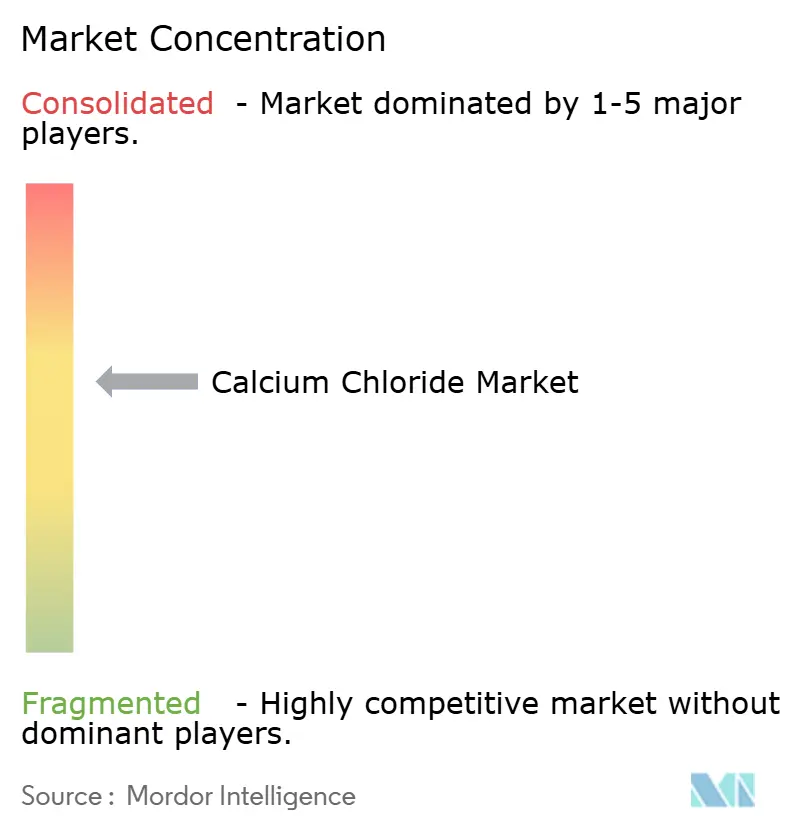
The calcium chloride market is moderately concentrated, with the top five players including Occidental Chemical Corporation (OxyChem), TETRA Technologies, Inc., Solvay, TANGSHAN SANYOU CHEMICAL INDUSTRIES CO., LTD., and Cargill, Incorporated. Chinese producers, including Shandong Haihua Group, Tangshan Sanyou Chemical Industries, Weifang Haibin Chemical, and Weifang Taize Chemical Industry, compete strongly in standard industrial grades. Their presence increases price competition in emerging markets and export channels, while food grade and pharmaceutical grade sales remain more difficult because buyers require formal quality controls.
TETRA is continuing to develop high-density brine products, including PureFlow and anhydrous brine technology, for deepwater well completions. Solvay expanded its food grade and pharmaceutical grade line at Rheinberg in February 2025, targeting European dairy and pharmaceutical customers. Tokuyama continues to supply liquid and granular calcium chloride from its integrated Japanese production base. These moves show that large suppliers use product grade, form, supply integration, and technical specification to protect their positions. Pharmaceutical grade supply in emerging Asia-Pacific health-care markets and inhibited de-icing formulations remain important opportunities where local supply is limited or environmental requirements are increasing.
OxyChem’s chlor-alkali operations produce calcium chloride as a co-product, which can reduce exposure to calcium-chloride-specific demand changes. This structure helps integrated suppliers support large seasonal orders while balancing production across their broader chemicals operations. Smaller producers may find it harder to match the same pricing, availability, and geographic coverage during demand shifts. Packaging, storage, logistics, and technical support are central to a supplier’s competitive position because moisture control and product handling affect customer qualification.
Calcium Chloride Industry Leaders
-
Occidental Chemical Corporation (OxyChem)
-
TETRA Technologies, Inc.
-
Solvay
-
TANGSHAN SANYOU CHEMICAL INDUSTRIES CO., LTD.
-
Cargill, Incorporated
- *Disclaimer: Major Players sorted in no particular order
Calcium Chloride Market Companies Covered in this Report
- Aarti Industries Ltd.
- Cargill, Incorporated
- Gulbrandsen Chemicals Pvt. Ltd.
- Nedmag B.V.
- Occidental Chemical Corporation (OxyChem)
- Shandong Haihua Group Co., Ltd.
- Solvay
- TANGSHAN SANYOU CHEMICAL INDUSTRIES CO., LTD.
- TETRA Technologies, Inc.
- Tiger Calcium
- Tokuyama Corporation
- Ward Chemical
- Weifang Haibin Chemical Co., Ltd.
- Weifang Taize Chemical Industry Co., Ltd.
- Zirax
Recent Industry Developments in Calcium Chloride Market
- January 2026: Nobian began direct delivery of calcium chloride from Frankfurt following the conclusion of a long-term supply agreement with Tetra Chemicals Europe. This development expanded Nobian's essential chemicals portfolio and provided customers with shorter supply chains and direct access to Nobian's customer service.
- November 2025: Nuberg EPC secured a contract to build a 120-tpd chlor-alkali expansion and an 80-tpd calcium chloride plant in Oman, commissioned by Al Ghaith Chemical Industries LLC at Sur Industrial City. The project supported Oman's industrial development and downstream chemical sector under Oman Vision 2040.
Global Calcium Chloride Market Report Scope
Calcium chloride is a highly soluble inorganic salt widely used for its moisture-absorbing, de-icing, accelerating, and brine-forming properties. It is used across construction, oil and gas, food processing, water treatment, and chemical manufacturing applications due to its versatility, high hygroscopicity, and performance under varying environmental conditions.
The Calcium Chloride Market is segmented by grade, product type, application, end-use industry, and geography. By grade, the market is segmented into industrial grade, food grade, and pharmaceutical grade. By product type, the market is segmented into flakes, pellets and prills, liquid, and powder. By application, the market is segmented into de-icing and dust control, construction and concrete acceleration, food and beverage processing, oil and gas (drilling and completion fluids), water treatment, and chemical processing and refrigeration. By end-use industry, the market is segmented into municipal and public infrastructure, construction, food and beverage, oil and gas, and chemical. The report also covers the market size and forecasts for calcium chloride in 16 countries across major regions. For each segment, the market sizing and forecasts have been done on the basis of value (USD).
Segmentation Overview
| Industrial Grade |
| Food Grade |
| Pharmaceutical Grade |
| Flakes |
| Pellets and Prills |
| Liquid |
| Powder |
| De-Icing and Dust Control |
| Construction and Concrete Acceleration |
| Food and Beverage Processing |
| Oil and Gas (Drilling and Completion Fluids) |
| Water Treatment |
| Chemical Processing and Refrigeration |
| Municipal and Public Infrastructure |
| Construction |
| Food and Beverage |
| Oil and Gas |
| Chemical |
| Asia-Pacific | China |
| India | |
| Japan | |
| South Korea | |
| Rest of Asia-Pacific | |
| North America | United States |
| Canada | |
| Mexico | |
| Europe | Germany |
| United Kingdom | |
| France | |
| Italy | |
| Russia | |
| Rest of Europe | |
| South America | Brazil |
| Argentina | |
| Rest of South America | |
| Middle-East and Africa | Saudi Arabia |
| South Africa | |
| Rest of Middle-East and Africa |
| By Grade | Industrial Grade | |
| Food Grade | ||
| Pharmaceutical Grade | ||
| By Product Type | Flakes | |
| Pellets and Prills | ||
| Liquid | ||
| Powder | ||
| By Application | De-Icing and Dust Control | |
| Construction and Concrete Acceleration | ||
| Food and Beverage Processing | ||
| Oil and Gas (Drilling and Completion Fluids) | ||
| Water Treatment | ||
| Chemical Processing and Refrigeration | ||
| By End-Use Industry | Municipal and Public Infrastructure | |
| Construction | ||
| Food and Beverage | ||
| Oil and Gas | ||
| Chemical | ||
| By Geography | Asia-Pacific | China |
| India | ||
| Japan | ||
| South Korea | ||
| Rest of Asia-Pacific | ||
| North America | United States | |
| Canada | ||
| Mexico | ||
| Europe | Germany | |
| United Kingdom | ||
| France | ||
| Italy | ||
| Russia | ||
| Rest of Europe | ||
| South America | Brazil | |
| Argentina | ||
| Rest of South America | ||
| Middle-East and Africa | Saudi Arabia | |
| South Africa | ||
| Rest of Middle-East and Africa | ||
Key Questions Answered in the Report
What is the size of the calcium chloride market?
The calcium chloride market stands at USD 2.32 billion in 2026 and is projected to reach USD 2.98 billion by 2031.
Which calcium chloride grade led the market share in 2025?
Industrial grade led with a 62.71% share in 2025 because it is used in de-icing, dust control, oilfield brines, construction, and other high-volume applications.
Which application is expected to grow fastest through 2031?
Construction and concrete acceleration is projected to grow at a 6.14% CAGR through 2031, supported by cold-weather construction, repair activity, and infrastructure work.
Why is calcium chloride used in food processing?
The material is used as a firming agent, coagulant, pH-control agent, and processing aid under the U.S. FDA framework and Codex E509 listing.