
Calcined-Clay Cement Rheology Modifiers Market Size and Share
Market Overview
| Study Period | 2021 - 2031 |
|---|---|
| Market Size (2026) | USD 151.74 Million |
| Market Size (2031) | USD 197.66 Million |
| Growth Rate (2026 - 2031) | 5.43 % |
| Fastest Growing Market | Asia-Pacific |
| Largest Market | Asia-Pacific |
| Market Concentration | Medium |
Major Players *Disclaimer: Major Players sorted in no particular order Image © Mordor Intelligence. Reuse requires attribution under CC BY 4.0. | |
Calcined-Clay Cement Rheology Modifiers Market Analysis by Mordor Intelligence
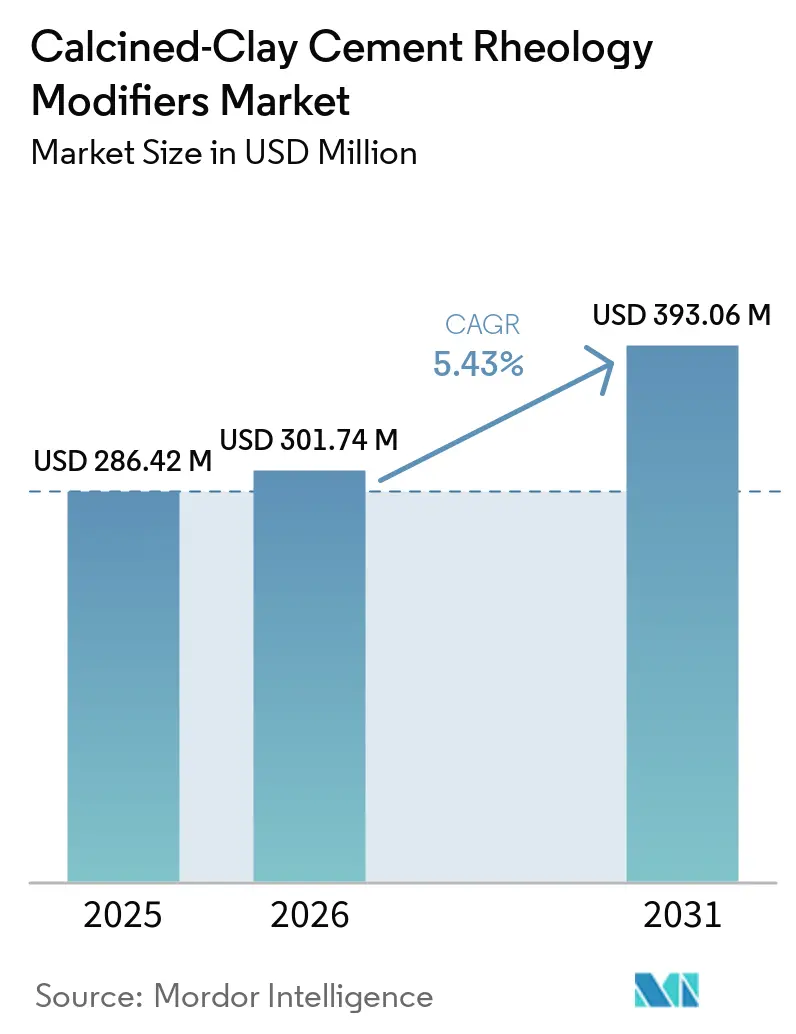
The Calcined-Clay Cement Rheology Modifiers Market size is expected to grow from USD 144.10 million in 2025 to USD 151.74 million in 2026 and is forecast to reach USD 197.66 million by 2031 at 5.43% CAGR over 2026-2031. The calcined-clay cement rheology modifiers market is being shaped by lower-clinker cement programs and the need to maintain predictable concrete performance. LC3 (Limestone Calcined Clay Cement) formulations can reduce clinker use by up to 50% and carbon dioxide emissions by 40% compared with ordinary Portland cement, but their reactive clay chemistry increases water demand, polymer adsorption, and slump loss. Public procurement rules for lower-carbon concrete are converting these technical requirements into purchasing criteria in infrastructure projects. Suppliers that tailor polymer systems to local clay sources can compete on verified performance rather than on product price alone. This opportunity is further supported by the fact that LC3 systems may require materially higher polycarboxylate ether (PCE) dosages than conventional cement formulations, thereby raising the modifier value per metric ton of cement used.
Key Report Takeaways
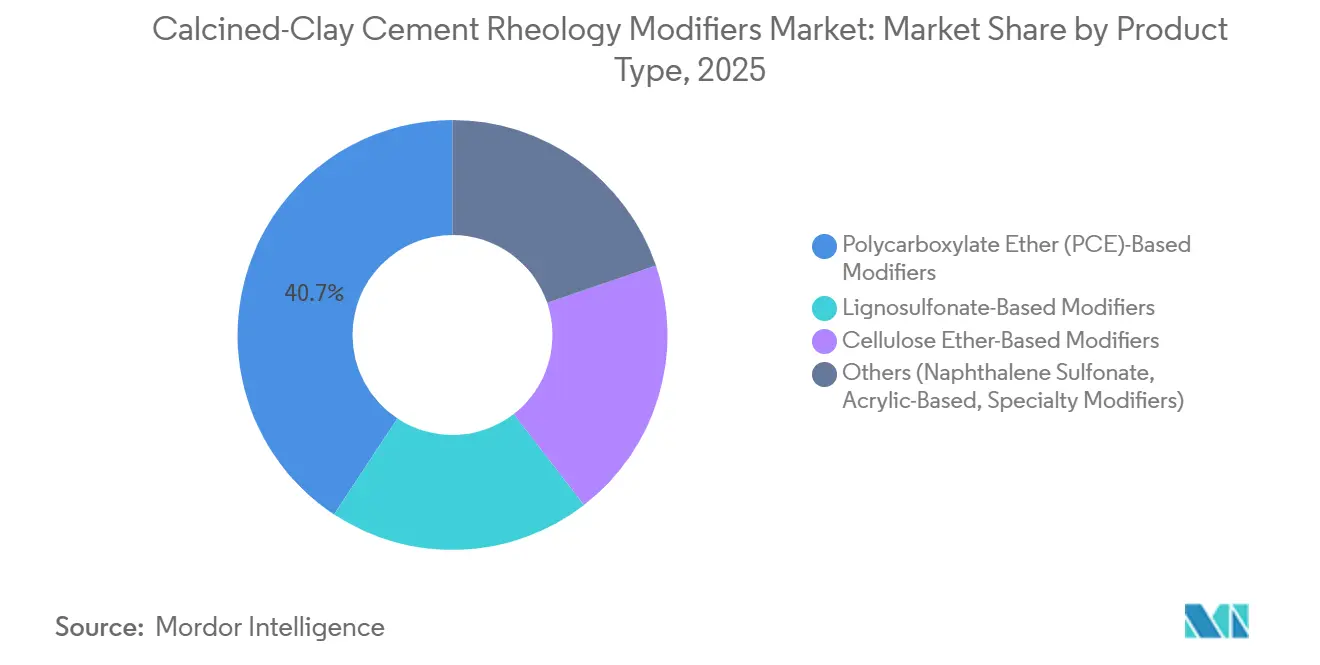
- By product type, PCE-based modifiers held 40.72% of the Calcined-Clay Cement Rheology Modifiers market share in 2025, while the category is forecast to grow at a 6.02% CAGR through 2031.
- By function, water reduction accounted for 42.35% of the Calcined-Clay Cement Rheology Modifiers market size in 2025, while workability enhancement and flow retention are forecast to grow at a CAGR of 6.18% through 2031.
- By calcined-clay cement type, LC3 (Limestone Calcined Clay Cement) systems held 52.68% of the Calcined-Clay Cement Rheology Modifiers market share in 2025 and are forecast to expand at a 7.04% CAGR through 2031.
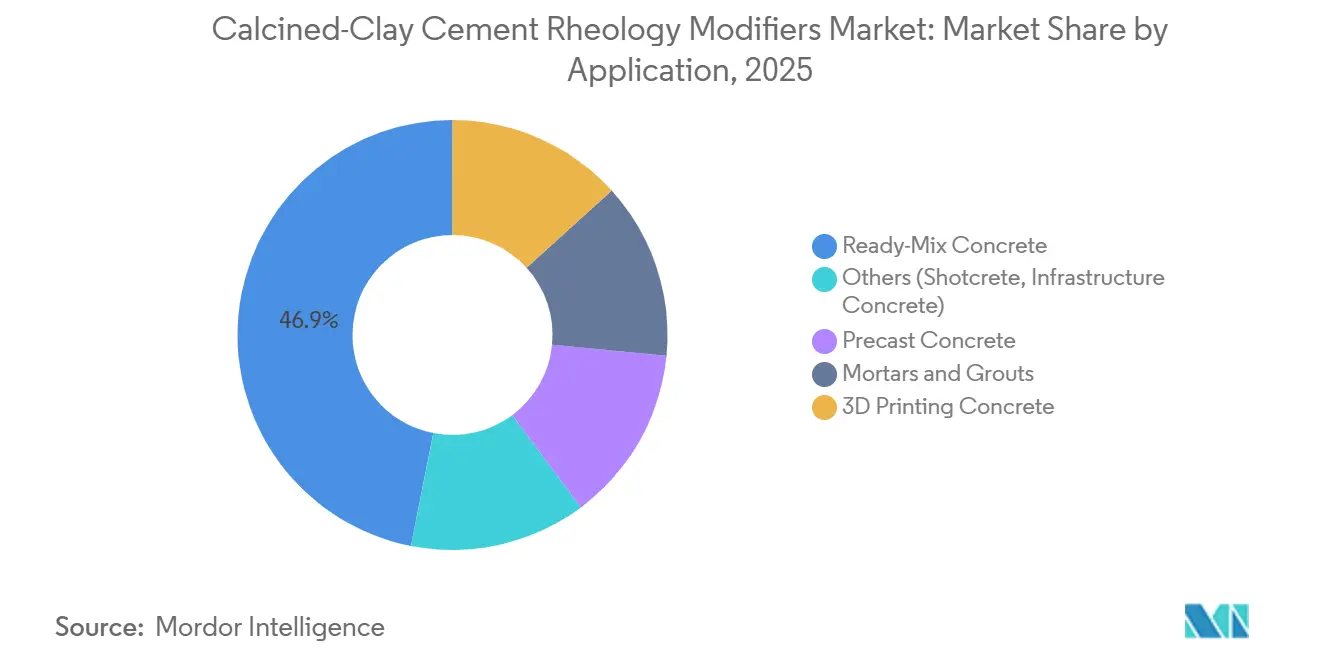
- By application, ready-mix concrete held 46.91% of market value in 2025, while 3D printing concrete is projected to grow at a 6.74% CAGR through 2031.
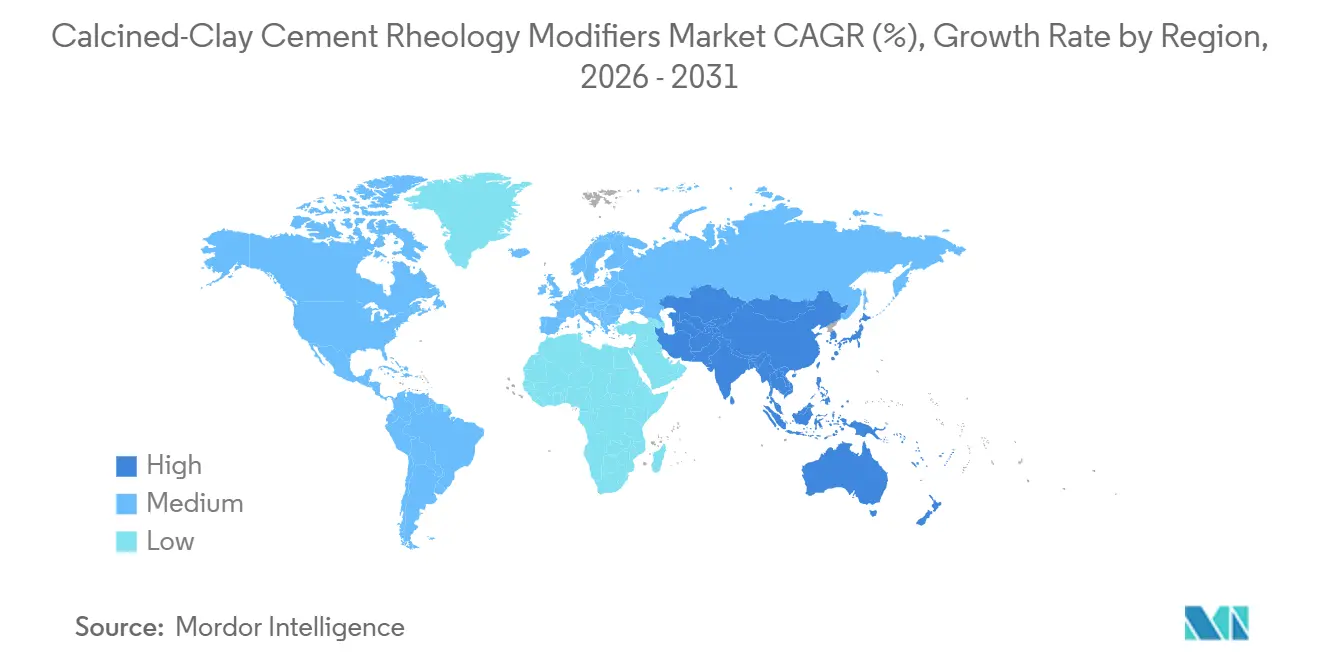
- By geography, Asia-Pacific held 41.57% of the Calcined-Clay Cement Rheology Modifiers market share in 2025 and is forecast to grow at a CAGR of 6.26% through 2031.
Note: Market size and forecast figures in this report are generated using Mordor Intelligence’s proprietary estimation framework, updated with the latest available data and insights as of January 2026.
Market Trends and Insights
Drivers Impact Analysis of Calcined-Clay Cement Rheology Modifiers Market*
| Drivers | (~) % Impact on CAGR Forecast | Geographic Relevance | Impact Timeline |
|---|---|---|---|
| Expansion of Low-Carbon Cement Standards and Procurement | +1.4% | Global, with faster uptake in the EU, Canada, Australia, and India | Short term (≤ 2 years) |
| Commercial Scale-Up of LC3 Production | +1.3% | Global, with early gains in Asia-Pacific, the Middle-East and Africa, and Latin America | Short term (≤ 2 years) |
| Rising Ready-Mix and High-Performance Concrete Usage | +0.9% | Asia-Pacific, with spillover to North America, the Middle-East, and Africa | Medium term (2-4 years) |
| Clay-Source-Specific Polymer Formulation Demand | +0.7% | Africa, India, and Southeast Asia | Medium term (2-4 years) |
| Digital and Automated Admixture Dosing | +0.5% | North America and the EU, with early use in the Asia-Pacific | Medium term (2-4 years) |
| Rheology Requirements in 3D-Printed and Specialty Concrete | +0.6% | Global, concentrated in North America, the EU, and China | Long term (≥ 4 years) |
| Source: Mordor Intelligence | |||
Expansion Of Low-Carbon Cement Standards and Procurement
Public procurement requirements are shortening the adoption path for Limestone Calcined Clay Cement (LC3)-compatible admixtures by directly incorporating lower-carbon cement into project specifications and funding conditions. Ireland requires public bodies to specify low-carbon cement from September 2024 and mandates whole-life-cycle greenhouse gas assessments for exchequer-funded projects above EUR 10 million (~USD 11.54 million) from January 2026. Canada's Housing Infrastructure Fund links major projects to a 10% reduction in embodied carbon from ready-mix concrete relative to regional baselines, underscoring the importance of mix designs that can be documented and delivered consistently. Germany's 2025 Draft Procurement Acceleration Act established a route for climate-related cement procurement requirements, while ISO 21930 and EN 15804+A2 requirements reinforce the use of verified environmental product information in European supply chains. The Global Cement and Concrete Association introduced an 8-tier carbon rating framework in April 2025, providing procurement teams with a common basis for comparing lower-carbon cement and concrete products[1]. These measures support the Calcined-Clay Cement Rheology Modifiers market because LC3 mixes require admixture systems that meet performance requirements, maintain placement reliability, and support carbon-related documentation.
Commercial Scale-Up of LC3 Production
LC3 production is moving from demonstration projects to industrial capacity, increasing the number of cement plants that require compatible rheology-modifier packages. By mid-2026, 35 industrial-scale plants were operating worldwide, another 35 were under construction, and installed capacity had reached 15 million tons per year. CIMPOR Global commissioned a 1,500-tons-per-day calcined-clay line in Souselas, Portugal, in 2026, demonstrating that large-scale production is no longer confined to a small group of early projects. JK Cement began commercial LC3 production at its Mangrol works in Rajasthan in July 2025 for infrastructure projects in Maharashtra, Gujarat, and Madhya Pradesh. Each new kiln commission requires ready-mix operators to qualify admixture packages against the new binder, evaluate local raw materials, and validate the required workability period. This process creates demand for testing, technical support, and repeat product validation within the Calcined-Clay Cement Rheology Modifiers market. The 2026 Cape Town conference reflected this shift from research toward wider industrial deployment.
Rising Ready-Mix and High-Performance Concrete Usage
Ready-mix plants must keep mixtures pumpable for 60 to 90 minutes despite transport delays, variations in ambient temperature, and different placement conditions at project sites. A 2026 field account of LC3 use at Macrotech Developers' (Lodha) Palava City found that a specialized polycarboxylate ether (PCE) with a phosphoric acid modifier extended workability to 3 hours. This outcome distinguishes tailored admixtures from standard formulations, which lose slump quickly in LC3 mixtures and can result in less predictable placement performance for operators. Ready-mix producers may place a higher value on reliable site performance than on the lowest per-unit admixture price when delay, pumping, and rejected-load risks are considered. As batching plants replace site mixing in expanding urban areas, this need gives the Calcined-Clay Cement Rheology Modifiers market a larger and more technically demanding customer base.
Clay-Source-Specific Polymer Formulation Demand
Clay mineralogy creates distinct formulation requirements for each local supply chain, limiting the suitability of a single broad-spectrum polymer across different calcined-clay sources. Kaolinite-rich clays and illite- or smectite-rich clays interact differently with PCE polymers because adsorption and intercalation losses vary with mineral structure, particle characteristics, and residual clay content. Research on calcined-clay-blended systems found that HPEG-type PCE structures can provide stronger dispersion performance than certain alternative polymer architectures, particularly when the binder has a high calcined-clay content. Chryso characterized more than 30 calcined-clay sources across Africa in 2026 to develop clay-specific polymer chemistries and match product design to local mineralogy. This approach shifts the Calcined-Clay Cement Rheology Modifiers market away from broad, interchangeable PCE products and toward clay-tailored product families. Suppliers with local testing capabilities can support these product families, respond as clay sources change, and strengthen customer retention through ongoing technical support.
Restraints Impact Analysis of Calcined-Clay Cement Rheology Modifiers Market*
| Restraints | (~) % Impact on CAGR Forecast | Geographic Relevance | Impact Timeline |
|---|---|---|---|
| Rapid Slump Loss from Reactive Clay Surface Generation | -0.8% | Global, with acute exposure in India, the Middle-East, Africa, and Southeast Asia | Short term (≤ 2 years) |
| Variability in Clay Mineralogy and Porosity | -0.6% | Africa, Southeast Asia, and Latin America | Medium term (2-4 years) |
| Higher Admixture Dosage and Formulation Cost | -0.5% | Developing markets in South and Southeast Asia and Africa | Medium term (2-4 years) |
| Incomplete Standards and Qualification Pathways | -0.4% | North America and parts of the Asia-Pacific | Long term (≥ 4 years) |
| Source: Mordor Intelligence | |||
Rapid Slump Loss from Reactive Clay Surface Generation
Rapid slump loss remains a major technical constraint to commercial LC3 use because the same clay chemistry that supports lower-clinker cement can shorten the period during which concrete remains workable. Elevated aluminate reactivity can promote ettringite formation and strong PCE adsorption, reducing the polymer available to disperse particles in the mix and causing a rapid loss of fluidity[2]. Delayed addition, PCE-LDH nanocomposites, and phosphoric acid co-modifiers can help retain flow, but they add formulation steps, testing requirements, and cost. The problem is more pronounced in India and the Middle-East, where high ambient temperatures accelerate the loss of workable consistency during transport and placement. Smaller ready-mix producers may lack the dosing controls, laboratory capacity, and technical support needed for reliable field use. Mix verification and environmental product declaration requirements can add further qualification work for suppliers serving the calcined-clay cement rheology modifiers market.
Variability in Clay Mineralogy and Porosity
Variability in mineralogy and porosity complicates universal admixture dosing, as the required polymer level varies with clay source, calcination conditions, and the physical properties of the resulting binder. A 30% Portland cement substitution with calcined clay may require PCE dosages ranging from 0.3% to above 0.6% of the binder weight, depending on residual kaolinite, quartz content, and specific surface area. Incoming clay testing is important, but many ready-mix plants in emerging markets lack the equipment or operating practices needed to perform it routinely. Changes in kiln temperature can also alter silica content and the amount of uncalcined clay, making performance less predictable from one production batch to the next. A formulation validated for one clay source can underperform when a producer changes suppliers, even if the specified cement category remains the same. This issue can increase product liability risk and weaken reorder confidence unless suppliers build local characterization and adjustment services into their offering of calcined-clay cement rheology modifiers.
*Our forecasts treat driver/restraint impacts as directional, not additive. The impact forecasts reflect baseline growth, mix effects, and variable interactions.
Calcined-Clay Cement Rheology Modifiers Market Segment Analysis
By Product Type:
PCE Chemistry Leads Through Tailored Dispersion PerformancePCE-based modifiers held 40.72% of the calcined-clay cement rheology modifiers market share in 2025 and are forecast to grow at a 6.02% CAGR through 2031. This position reflects the need for high-efficiency dispersion in LC3 systems. HPEG-based polymers can outperform MPEG- and IPEG-based variants in calcined-clay cement across several tested formulations. This distinction is significant because the polymer hierarchy used in ordinary Portland cement does not always apply to calcined-clay binders. In LC3-50 systems, PCE dosage can be materially higher than in ordinary Portland cement mixtures. Higher dosage supports PCE revenue even when cement output does not grow at the same rate.
China's GB/T 8076-2025 standard takes effect in August 2026 and tightens performance criteria for concrete admixtures. The standard favors advanced PCE formulations over older naphthalene sulfonate products. Lignosulfonate-based modifiers continue to play a role in price-sensitive markets where lower raw material costs guide purchasing decisions. Cellulose ether-based products primarily serve to modify viscosity and enhance water retention in mortars and grouts. Other products include naphthalene sulfonate, acrylic-based, and hybrid chemistries, which face pressure from formaldehyde controls and PCE performance in high supplementary-cementitious-material blends. The calcined-clay cement rheology modifiers market is therefore shifting toward polymer designs that can match a defined clay source and performance target.

By Function:
Water Reduction Leads by Share While Flow Retention Commands Higher ValueWater reduction accounted for 42.35% of the calcined-clay cement rheology modifiers market size in 2025. Calcined clay increases water demand as clinker substitution rises, making water reduction a basic requirement for many LC3 mix designs. A 2024 study reported that water demand can be up to 18% higher than ordinary Portland cement at 40% clay substitution. Viscosity modification is important in self-compacting concrete and mortars, where LC3's higher cohesiveness requires careful control. Anti-segregation and setting-time-control products also serve printing applications that require a narrow placement window. These functions provide suppliers with several routes into the calcined-clay cement rheology-modifier market beyond simple water reduction.
Workability enhancement and flow retention are forecast to grow at a 6.18% CAGR through 2031. They address the logistics interval after mixing, not only the initial spread of concrete. The 2026 Palava City fieldwork showed that a specialized PCE and phosphoric acid modifier were needed to retain workability for 3 hours. Water-reduction products are commonly evaluated against dosage cost and initial fluidity. Flow-retention products are evaluated against a reliable time window at the placement site. Suppliers that can document this result using a customer's local clay may convert a standard admixture sale into a more durable technical service relationship.
By Calcined-Clay Cement Type:
LC3 Holds the Broadest Commercial PositionLC3 systems held 52.68% market share in the calcined-clay cement rheology modifiers market in 2025 and are projected to grow at a 7.04% CAGR through 2031, the highest growth rate among the reported segment categories. LC3 can use lower-grade kaolinite with more than 40% kaolinite content, broadening its raw material base in India, West Africa, and Southeast Asia. As of mid-2026, 35 industrial plants are operational, and 35 are under construction, providing a growing basis for modifier demand. European and North American standards recognize LC3-type binders through EN 197-5 and ASTM C595 pathways, reducing a procurement barrier for designers considering these cement systems.
Metakaolin-based systems serve higher-specification applications that require early strength and chloride resistance. Their high-purity calcined kaolinite supports marine and infrastructure concrete applications. Calcined kaolinite-based cement serves a lower-purity tier where kaolinite-rich clay is available but advanced refining is limited. Other calcined-clay blends can incorporate industrial waste streams and remain an active area of research in Brazil. These binder types still require control of water demand, flow, and viscosity. The calcined-clay cement rheology modifiers market can therefore benefit from a range of calcined-clay formulations beyond LC3.
By Application:
Ready-Mix Leads While 3D Printing Requires a Distinct Mix DesignReady-mix concrete accounted for 46.91% of the calcined-clay cement rheology modifiers market in 2025. Its large daily output makes consistent slump retention more important than minor differences in per-unit modifier cost. Precast concrete is the second-largest application, as controlled production conditions allow closer dosing control and more repeatable LC3 performance. Mortars and grouts require water retention and thixotropy, supporting the use of cellulose ether and PCE-hybrid systems. Shotcrete and infrastructure concrete require stable pumpability under pressure. These applications collectively broaden the performance requirements served by the calcined-clay cement rheology modifiers market.
3D printing concrete is projected to grow at a 6.74% CAGR through 2031. Printed mixtures must balance pumpability, extrudability, and buildability within the same batch cycle. They must develop enough structural strength to prevent layer collapse while remaining pumpable until extrusion. Calcined clay can complicate this balance because its aluminate chemistry may alter structural buildup between batches. Quaternary ammonium compounds and cellulose ether-based viscosity modifiers are being assessed for printable metakaolin geopolymer and LC3 mixtures. This application offers suppliers a specialized opportunity in which material handling and early structural stability must be addressed together.
Geography Analysis
APAC Calcined-Clay Cement Rheology Modifiers Market
Asia-Pacific held 41.57% of the Calcined-Clay Cement Rheology Modifiers market share in 2025 and is forecast to grow at a 6.26% CAGR through 2031. India is scaling up LC3 production in line with IS 18189:2023. JK Cement started commercial LC3 production at Mangrol in July 2025 for projects in Maharashtra, Gujarat, and Madhya Pradesh. China's GB/T 8076-2025 standard took effect in August 2026 and supports the transition to higher-performance admixtures. Japan is studying amine-type admixtures for limestone-calcined clay cement, including methyldiethanolamine for carbonation resistance. South Korea and Indonesia add demand through infrastructure programs with stricter durability requirements.
North America, Europe and Oceania Calcined-Clay Cement Rheology Modifiers Market
North America and Europe are significant markets due to regulations that promote the disclosure, reduction, and qualification of embodied carbon. Canada requires embodied-carbon disclosure for concrete from September 2025, and its Public Transit Fund requires reductions in ready-mix concrete for major projects from 2026 to 2027. Europe's EN 197-5 recognizes CEM II/C-M (Q-LL), an LC3-compatible cement type. Australia's 2025 New South Wales Low Carbon Concrete Requirement and the ACT policy use performance-based public procurement. EU Implementing Regulation 2026/718 adds a sustainability dimension to procurement for major infrastructure contracts.
MEA and South America Calcined-Clay Cement Rheology Modifiers Market
South America, the Middle-East, and Africa remain smaller regions but offer distinct project opportunities. In Ghana, the April 2025 commissioning of the Supacem LC3 facility and Heidelberg Materials and CBI Ghana's 400,000-tons-per-year flash calciner strengthened West Africa's calcined-clay production base. Ghana's GS PAS 5:2024 permits clinker content as low as 35%, supporting local LC3 investment. Brazil is expanding research on LC3 through federal universities. Saudi Arabia and the United Arab Emirates are linking construction programs to lower-carbon material requirements. The Calcined-Clay Cement Rheology Modifiers market in these regions depends on local testing capacity, product qualification, and reliable supply of suitable clay.
Competitive Landscape
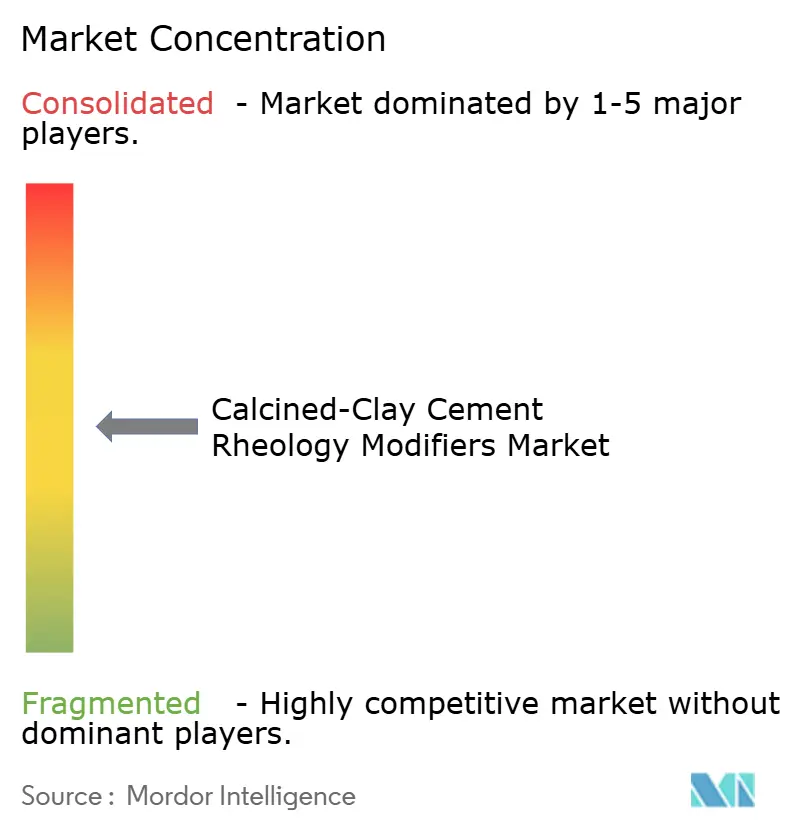
The calcined-clay cement rheology modifiers market is moderately fragmented. Sika AG, Master Builders Solutions, and Saint-Gobain Construction Chemicals operate in the higher-performance chemistry tier. Sika offers ViscoCrete-CC and SikaGrind-800 CC-A, which are specifically designed for LC3 production conditions. Saint-Gobain introduced EnviroMix C-Clay in August 2024, alongside EnviroAdd HWR, for cement grinding and concrete workability. Master Builders Solutions developed its MasterCO2re range with Intelligent Cluster System technology to manage PCE release in lower-clinker concrete.
Chinese suppliers, including Sobute New Materials, MUHU, and domestic PCE producers, compete on cost. The 2026 implementation of GB/T 8076-2025 introduces higher-quality requirements that may favor more capable formulators. Africa and Southeast Asia present opportunities for suppliers due to high clay diversity, though local qualification infrastructure remains limited. Mapei, Fosroc, MC-Bauchemie, and Kao hold regional positions that support field testing and polymer tuning. CHRYSO's work across more than 30 calcined-clay sources demonstrates how local characterization can serve as a competitive capability, making it harder for customers to replace an established supplier once a mix design has been approved.
Digital dosing is an area of competition in the calcined-clay cement rheology modifiers market. Command Alkon introduced enhanced cloud-connected multi-plant batching capabilities in April 2026. Heidelberg Materials uses Batch AI to optimize ingredient mixes in concrete production. These systems can reduce manual dosing errors and improve documentation for certified concrete programs. Key suppliers are combining polymer design, materials testing, and digital process control. The market therefore favors companies that can validate results across the full process, from raw material selection through concrete placement.
Calcined-Clay Cement Rheology Modifiers Industry Leaders
-
Sika AG
-
Saint-Gobain
-
MAPEI S.p.A.
-
BASF
-
MC-Bauchemie
- *Disclaimer: Major Players sorted in no particular order
Calcined-Clay Cement Rheology Modifiers Market Companies Covered in this Report
- Arkema
- BASF
- Chembond Chemicals Limited
- Dow
- Enaspol a.s.
- Fosroc, Inc.
- GCP Applied Technologies Inc.
- Kao Corporation
- Mapei S.p.A.
- MC-Bauchemie
- MUHU (China) Construction Materials Co., Ltd.
- RPM International Inc.
- Saint-Gobain
- Sika AG
- Sobute New Materials Co., Ltd.
Recent Industry Developments in Calcined-Clay Cement Rheology Modifiers Market
- April 2026: Heidelberg Materials and CBI Ghana Ltd. commissioned the flash calciner for LC3 in Tema, Ghana. The facility, funded under a USD 100 million plant investment, expanded West Africa's calcined-clay cement production capacity and the admixture demand base for the region's ready-mix sector.
- July 2025: JK Cement commenced commercial production of LC3 (portland calcined clay limestone cement) at its Mangrol plant in Rajasthan under IS 18189:2023. BIS certification confirmed a 40% reduction in CO2 emissions compared to ordinary Portland cement. The product targeted infrastructure projects in Maharashtra, Gujarat, and Madhya Pradesh, reflecting India's growing commercial presence in the LC3 supply chain.
Global Calcined-Clay Cement Rheology Modifiers Market Report Scope
Calcined-clay cement rheology modifiers are chemical or mineral additives used to control the flow, viscosity, and structural build-up of blended cements such as Limestone Calcined Clay Cement (LC3). They counteract the high yield stress and water absorption caused by the large surface area of calcined clay.
The calcined-clay cement rheology modifiers market is segmented by product type, function, calcined-clay cement type, application, and geography. By product type, the market is segmented into polycarboxylate ether (PCE)-based modifiers, lignosulfonate-based modifiers, cellulose ether-based modifiers, and others (naphthalene sulfonate, acrylic-based, specialty modifiers). By function, the market is segmented into water reduction, workability enhancement and flow retention, viscosity modification, and others (anti-segregation, setting time control). By calcined-clay cement type, the market is segmented into LC3 (limestone calcined clay cement), metakaolin-based cement, calcined kaolinite-based cement, and others (emerging calcined-clay cement blends). By application, the market is segmented into ready-mix concrete, precast concrete, mortars and grouts, 3d printing concrete, and others (shotcrete, infrastructure concrete). The report also covers market size and forecasts for calcined-clay cement rheology modifiers across 15 countries in major regions. The market sizes and forecasts are provided in terms of value (USD).
Segmentation Overview
| Polycarboxylate Ether (PCE)-Based Modifiers |
| Lignosulfonate-Based Modifiers |
| Cellulose Ether-Based Modifiers |
| Others (Naphthalene Sulfonate, Acrylic-Based, Specialty Modifiers) |
| Water Reduction |
| Workability Enhancement and Flow Retention |
| Viscosity Modification |
| Others (Anti-Segregation, Setting Time Control) |
| LC3 (Limestone Calcined Clay Cement) |
| Metakaolin-Based Cement |
| Calcined Kaolinite-Based Cement |
| Others (Emerging Calcined-Clay Cement Blends) |
| Ready-Mix Concrete |
| Precast Concrete |
| Mortars and Grouts |
| 3D Printing Concrete |
| Others (Shotcrete, Infrastructure Concrete) |
| Asia-Pacific | China |
| India | |
| Japan | |
| South Korea | |
| Rest of Asia-Pacific | |
| North America | United States |
| Canada | |
| Mexico | |
| Europe | Germany |
| United Kingdom | |
| France | |
| Italy | |
| Rest of Europe | |
| South America | Brazil |
| Argentina | |
| Rest of South America | |
| Middle-East and Africa | Saudi Arabia |
| South Africa | |
| Rest of Middle-East and Africa |
| By Product Type | Polycarboxylate Ether (PCE)-Based Modifiers | |
| Lignosulfonate-Based Modifiers | ||
| Cellulose Ether-Based Modifiers | ||
| Others (Naphthalene Sulfonate, Acrylic-Based, Specialty Modifiers) | ||
| By Function | Water Reduction | |
| Workability Enhancement and Flow Retention | ||
| Viscosity Modification | ||
| Others (Anti-Segregation, Setting Time Control) | ||
| By Calcined-Clay Cement Type | LC3 (Limestone Calcined Clay Cement) | |
| Metakaolin-Based Cement | ||
| Calcined Kaolinite-Based Cement | ||
| Others (Emerging Calcined-Clay Cement Blends) | ||
| By Application | Ready-Mix Concrete | |
| Precast Concrete | ||
| Mortars and Grouts | ||
| 3D Printing Concrete | ||
| Others (Shotcrete, Infrastructure Concrete) | ||
| By Geography | Asia-Pacific | China |
| India | ||
| Japan | ||
| South Korea | ||
| Rest of Asia-Pacific | ||
| North America | United States | |
| Canada | ||
| Mexico | ||
| Europe | Germany | |
| United Kingdom | ||
| France | ||
| Italy | ||
| Rest of Europe | ||
| South America | Brazil | |
| Argentina | ||
| Rest of South America | ||
| Middle-East and Africa | Saudi Arabia | |
| South Africa | ||
| Rest of Middle-East and Africa | ||
Key Questions Answered in the Report
What is current market size of Calcined-Clay Cement Rheology Modifiers Market?
The Calcined-Clay Cement Rheology Modifiers Market size is expected to grow from USD 144.10 million in 2025 to USD 151.74 million in 2026 and is forecast to reach USD 197.66 million by 2031 at 5.43% CAGR over 2026-2031.
Which product type has the leading position in this sector?
Polycarboxylate Ether (PCE)-based modifiers held 40.72% of revenue in 2025 and are projected to grow at a 6.02% CAGR through 2031.
Why are LC3 concrete mixes difficult to manage?
Reactive calcined clay can increase water demand, accelerate polymer adsorption, and cause rapid slump loss, so tailored admixture systems are often needed.
Which region is growing fast for these modifiers?
Asia-Pacific held 41.57% of revenue in 2025 and is forecast to grow at a 6.26% CAGR through 2031.