
Calcined Bauxite Market Size and Share
Market Overview
| Study Period | 2022 - 2032 |
|---|---|
| Market Size (2027) | USD 5.66 Billion |
| Market Size (2032) | USD 6.72 Billion |
| Growth Rate (2027 - 2032) | 3.48 % |
| Fastest Growing Market | Asia-Pacific |
| Largest Market | Asia-Pacific |
| Market Concentration | Medium |
Major Players *Disclaimer: Major Players sorted in no particular order Image © Mordor Intelligence. Reuse requires attribution under CC BY 4.0. | |
Calcined Bauxite Market Analysis by Mordor Intelligence
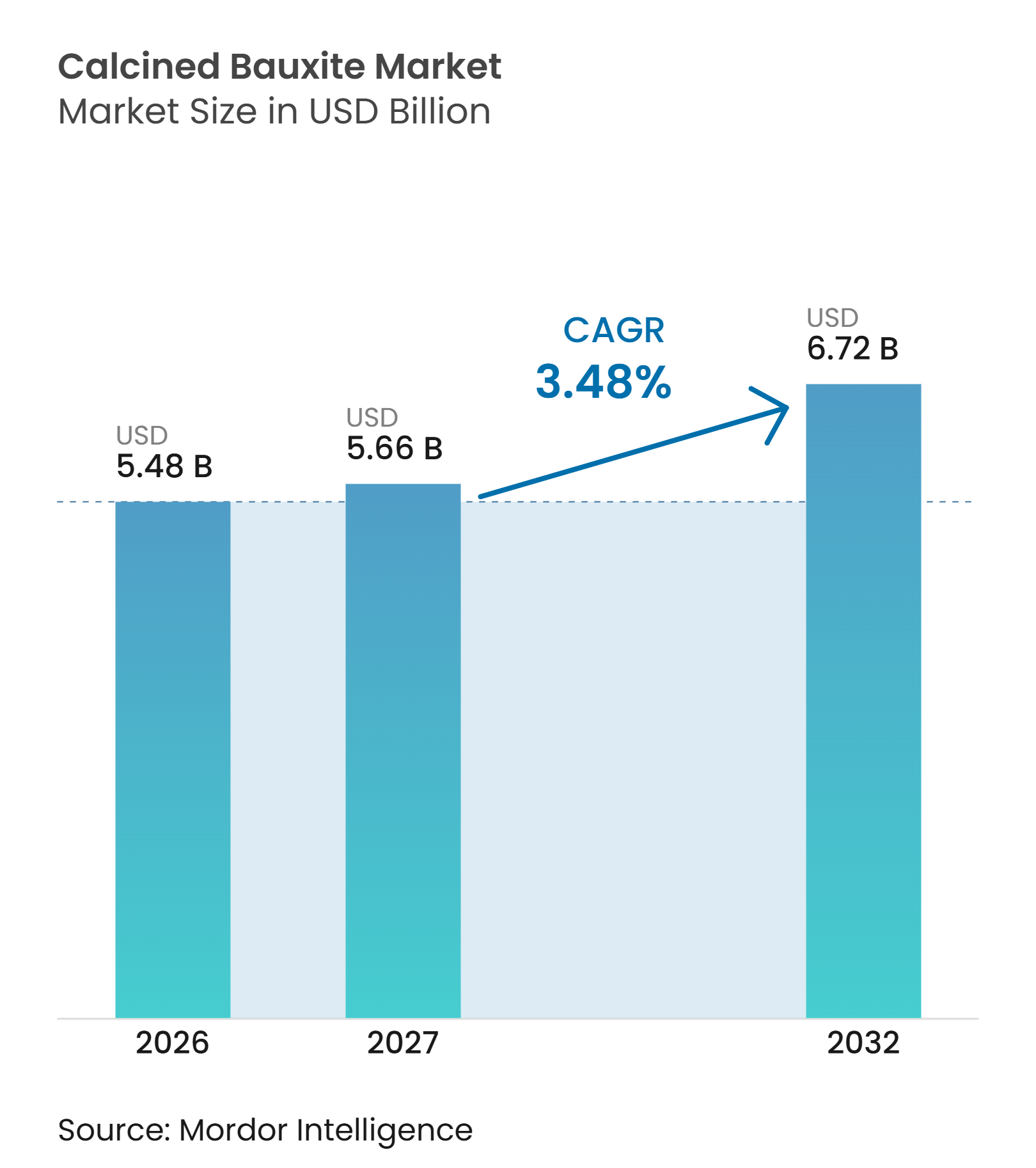
The calcined bauxite market size was valued at USD 5.48 billion in 2026 and is estimated to grow from USD 5.66 billion in 2027 to reach USD 6.72 billion by 2032, at a CAGR of 3.48% during the forecast period (2027-2032). The material remains important for high-alumina refractory products used in steelmaking, cement, glass, and foundry operations. Demand is also broadening through high-friction road surfacing, specialty ceramics, and electrical applications. China’s export license requirements for bauxite increase the value of secure supply arrangements for buyers outside China. New steel capacity in Asia supports demand for refractory inputs, while the long construction period for rotary kilns limits the speed at which new supply can respond. The calcined bauxite industry also faces higher energy costs and tighter environmental requirements, which favor integrated producers with efficient processing assets and reliable ore access.
Key Report Takeaways
- By grade, refractory grade held 64.38% of the calcined bauxite market share in 2026, while abrasive grade is projected to advance at a 3.89% CAGR through 2032.
- By application, refractory materials held 34.59% of the calcined bauxite market share in 2026, while pavement and flooring are projected to advance at a 4.34% CAGR through 2032.
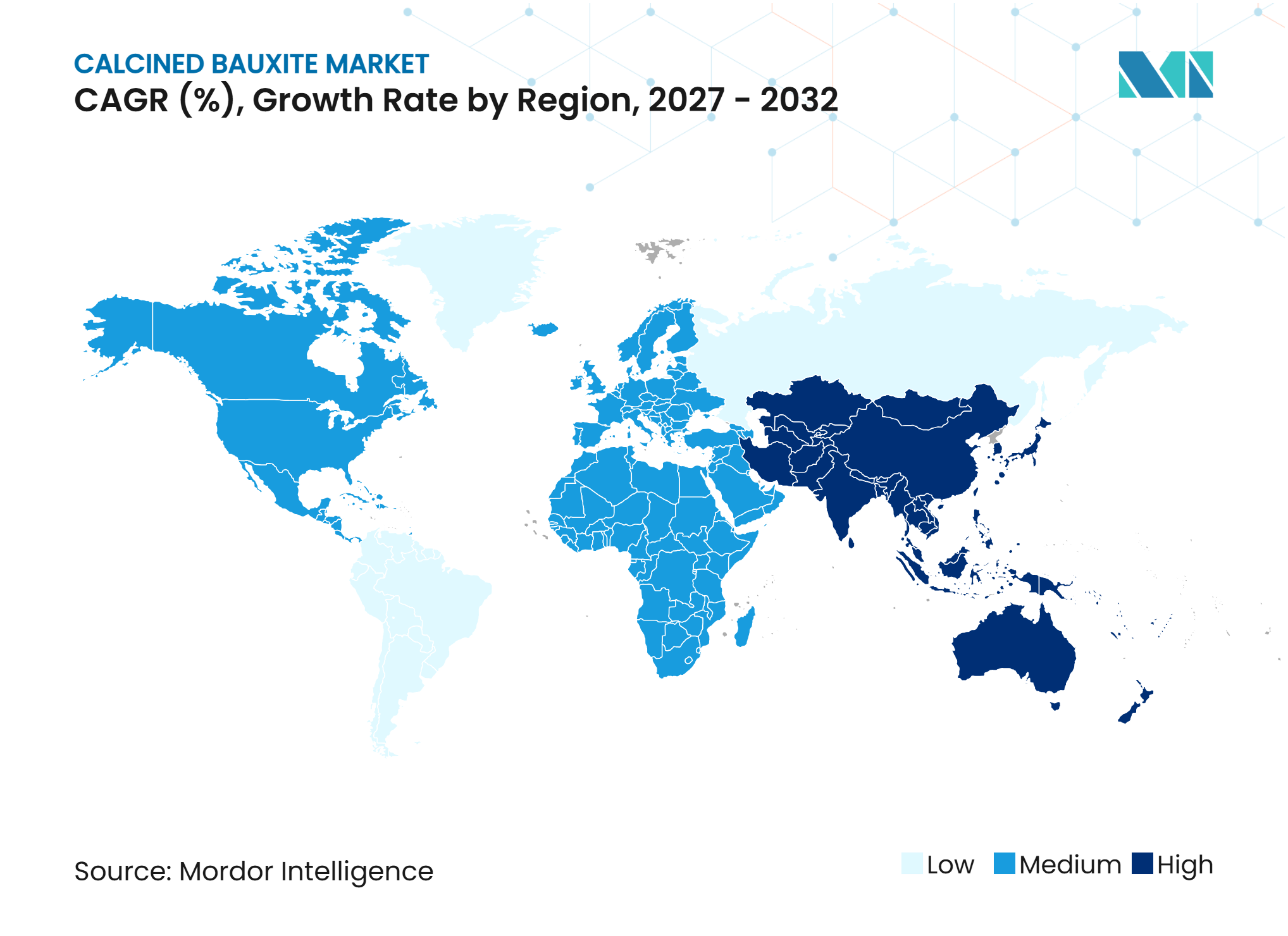
- By geography, Asia-Pacific held 65.12% of the calcined bauxite market size in 2026 and is projected to advance at a 4.12% CAGR through 2032.
Note: Market numbers in this report are based on Mordor Intelligence's proprietary estimation framework, which combines nine months of actuals with Q4 projections for base year 2026.
Market Trends and Insights
Drivers Impact Analysis of Calcined Bauxite Market*
| Driver | (~) % Impact on CAGR Forecast | Geographic Relevance | Impact Timeline |
|---|---|---|---|
| Rising Demand for High-Alumina Refractories | +1.0% | Global, led by Asia-Pacific (China, India, Japan, South Korea) | Long term (≥ 4 years) |
| Infrastructure and Steel Capacity Expansion in Asia-Pacific | +0.7% | Asia-Pacific core, spillover to MEA and South America | Medium term (2-4 years) |
| Growth in High-Friction Road Surfacing | +0.6% | North America, Europe, East Asia | Medium term (2-4 years) |
| Expansion of High-Purity Ceramics and Electronics | +0.5% | APAC core (China, Japan, South Korea), spillover to North America and Europe | Long term (≥ 4 years) |
| Premium-Grade Demand from Supply Diversification | +0.4% | North America and EU | Short term (≤ 2 years) |
| Source: Mordor Intelligence | |||
Rising Demand for High-Alumina Refractories
Steelmaking is a major source of demand for refractory-grade calcined bauxite, especially in ladle linings, tundish working linings, and blast furnace troughs. Electric arc furnace operations and continuous casting increase thermal cycling in refractory materials. This pattern can shorten replacement intervals for furnace linings. Asia is expected to add 29.8 million metric tons of steelmaking capacity from 2025 through 2027, with another 66.8 million metric tons at the planning stage. The shift toward monolithic refractories also supports alumina-rich aggregate demand because these mixes are used in repair and installation work.
Infrastructure and Steel Capacity Expansion in Asia-Pacific
Steel capacity expansion in Asia-Pacific creates direct demand for refractory linings and related high-alumina materials. Cement kilns also require refractory linings in transition zones and burner pipes as construction activity rises. India’s National Critical Mineral Mission and National Infrastructure Pipeline support both metals and construction investment. These programs reinforce the region’s demand base for industrial materials. Buyers increasingly assess raw material quality and supply consistency when selecting refractory inputs. This favors suppliers that can meet the technical requirements of large steel and cement producers.
Growth in High-Friction Road Surfacing
High-friction surface treatment supports demand in the Pavement and Flooring segment. Calcined bauxite provides polished stone value performance at bridge approaches, highway curves, and pedestrian crossings. A 2025 study found that 88# calcined bauxite aggregate retained a friction decay rate 30% slower than limestone after 120,000 polishing cycles. The same study reported dynamic friction coefficients 29.4% to 36.3% higher than limestone after prolonged polishing. Safety requirements at high-risk road locations can move spending from discretionary resurfacing into planned road-safety procurement. Replacement demand can develop as earlier installations approach the end of their service life.
Premium-Grade Demand from Supply Diversification
China included bauxite in its 2025 export license management catalog[1]. Licensed permits are required for covered exports. This requirement raises the importance of supply options in Guyana, Guinea, India, and other producing locations. North American and European buyers seek non-Chinese origin material for premium-grade applications. Supply security can become a purchasing criterion alongside price and product quality in the calcined bauxite industry. Long-term supply agreements are therefore more relevant for customers that require consistent refractory-grade material.
Restraints Impact Analysis of Calcined Bauxite Market*
| Restraint | (~) % Impact on CAGR Forecast | Geographic Relevance | Impact Timeline |
|---|---|---|---|
| Energy-Intensive Calcination and Fuel Cost Volatility | -0.6% | Global, most acute in China and Europe | Short term (≤ 2 years) |
| Environmental Restrictions on Mining and Calcination | -0.4% | China, European Union, India | Medium term (2-4 years) |
| Long Lead Times for New Kilns and Processing Assets | -0.3% | Global - new supply projects in Guyana, Vietnam, Australia | Long term (≥ 4 years) |
| Source: Mordor Intelligence | |||
Energy-Intensive Calcination and Fuel Cost Volatility
Calcination requires temperatures above 1,600 °C and uses substantial energy. Energy costs accounted for 35% to 45% of calcined bauxite production costs. The German Refractory Industry Federation reported in 2025 that high energy costs and import tariffs added pressure across the European refractory value chain. Smaller processors may have limited ability to absorb sudden cost increases. Carbon-related compliance costs add another expense for European processing assets.
Environmental Restrictions on Mining and Calcination
China’s new Mineral Resource Law took effect on July 1, 2025. The law strengthens protection for strategic mineral resources, including through rules on mining rights and environmental requirements. These requirements can limit production expansion at facilities that do not meet applicable standards. The European Union’s revised Industrial Emissions Directive sets updated requirements for industrial emissions management[2]. Compliance costs can differ materially between integrated producers and independent processors. Environmental performance is therefore becoming a competitive consideration in the calcined bauxite market.
*Our forecasts treat driver/restraint impacts as directional, not additive. The impact forecasts reflect baseline growth, mix effects, and variable interactions.
Calcined Bauxite Market Segment Analysis
By Grade:
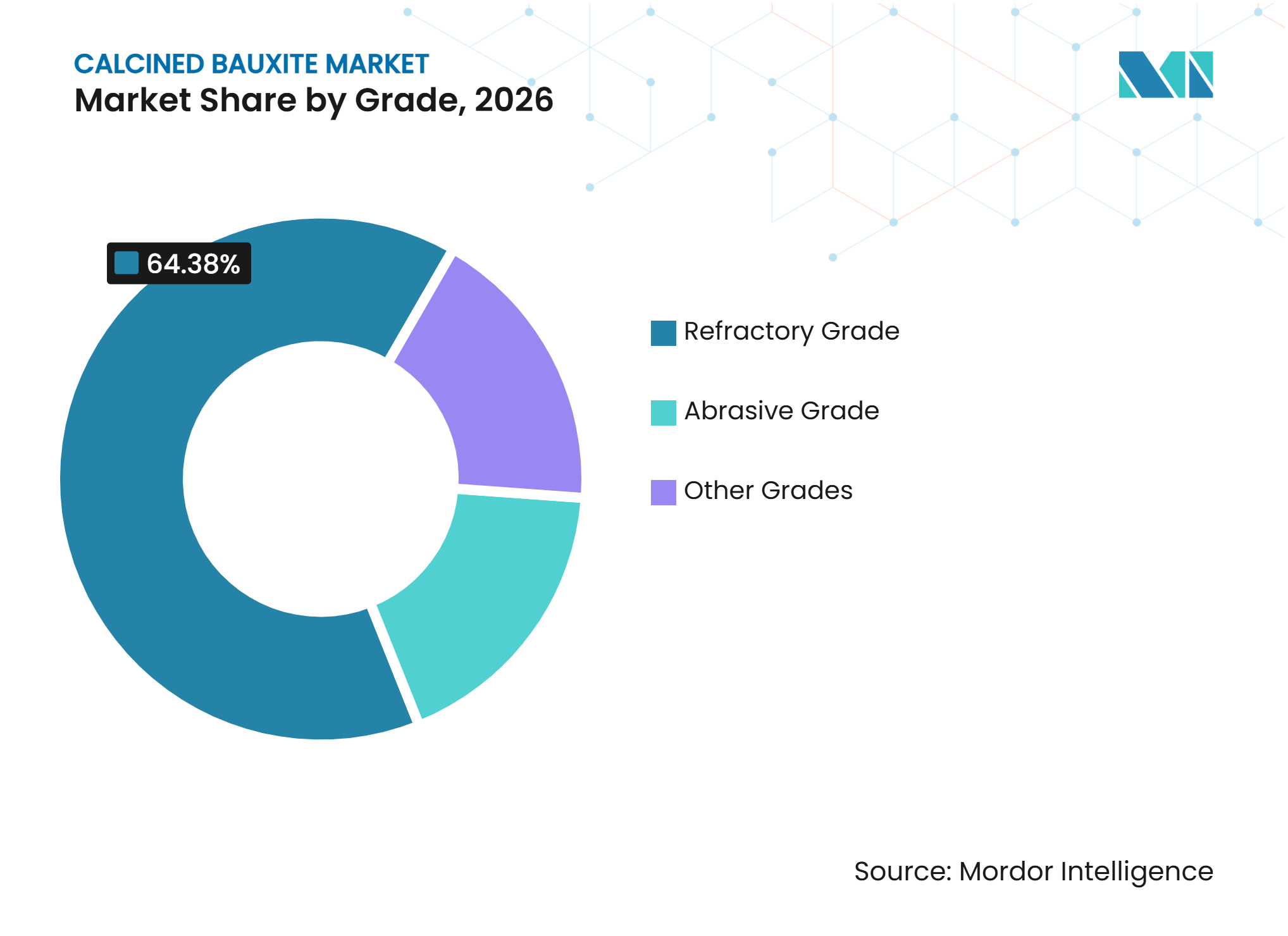
Refractory Grade Leads, While Abrasive Grade ExpandsRefractory grade held 64.38% of the global market share in 2026. It is used in linings for furnaces, ladles, kilns, and other high-temperature equipment. Steelmaking, cement production, glass manufacturing, and foundry operations require dependable refractory materials. Product specifications generally require high alumina content and low iron oxide and alkali impurities. These properties support thermal stability, low porosity, and resistance to slag, which keeps the calcined bauxite industry tied to essential industrial maintenance.
Abrasive grade is projected to advance at a 3.89% CAGR through 2032. It serves automotive finishing, aerospace machining, specialist polishing, and controlled surface preparation. Abrasive applications require hard particles, consistent grain sizing, and repeatable processing quality. Some abrasive products permit greater processing flexibility than refractory-grade products, which can reduce the barrier to new capacity. Other grades serve water treatment, welding flux, and specialized uses, allowing integrated producers to improve ore utilization.



By Application:
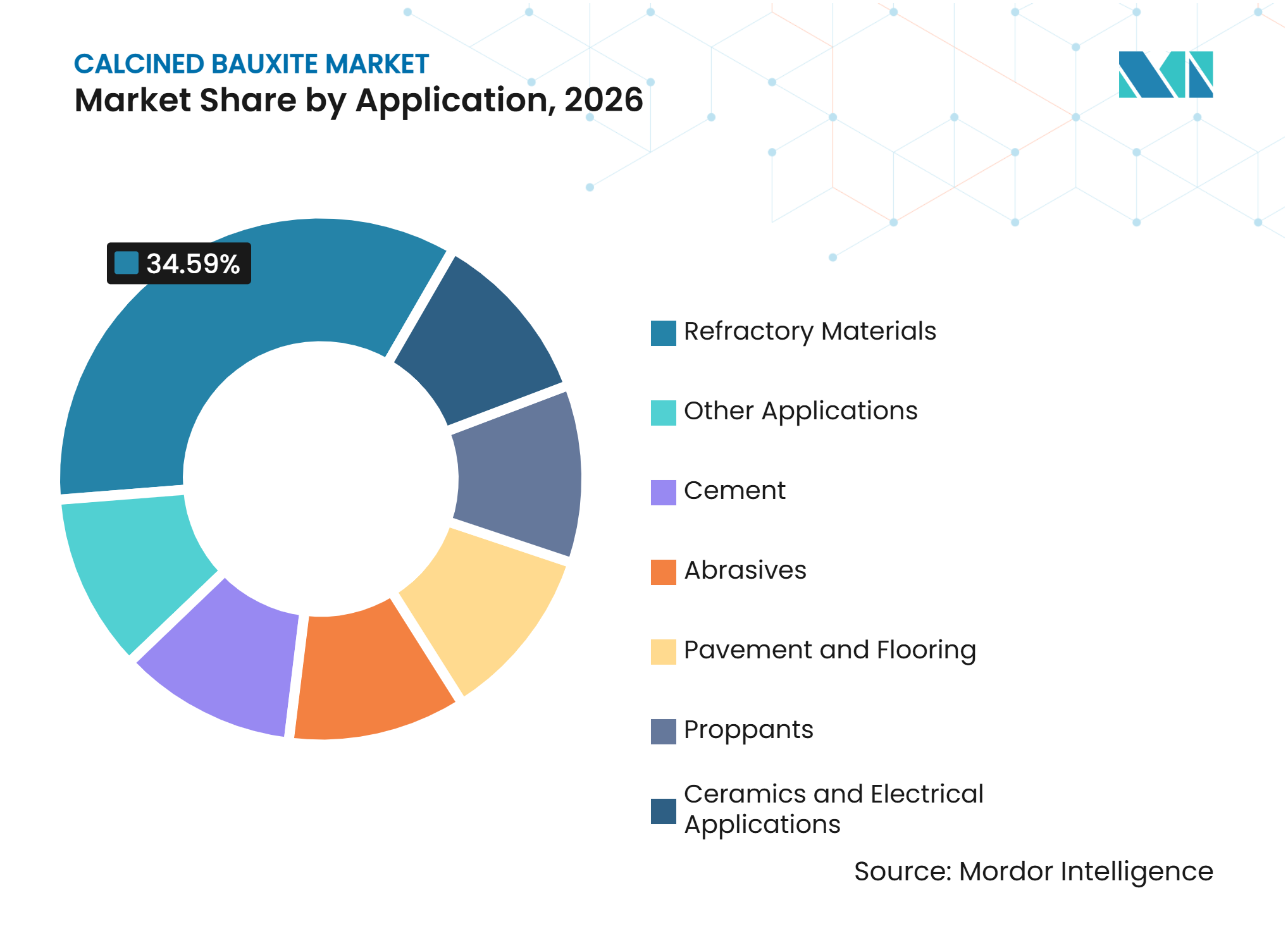
Refractory Materials Lead, While Pavement and Flooring Grow FasterRefractory materials held 34.59% of the calcined bauxite market share in 2026. Steel and cement plants use alumina-rich aggregates in equipment where lining reliability affects maintenance schedules and operating continuity. These materials protect assets exposed to repeated thermal cycling, abrasion, corrosive slag, and chemical stress. Demand remains linked to industrial output, steel capacity investment, and cement-kiln maintenance needs. The calcined bauxite market for this application is supported by its established role across several process industries.
Pavement and flooring are projected to advance at a 4.34% CAGR through 2032. High-friction surface treatment uses calcined bauxite to improve road grip at curves, bridge approaches, intersections, and pedestrian crossings. Testing shows that calcined bauxite can retain friction better than limestone under repeated polishing. Cement, abrasives, ceramics, electrical applications, and proppants provide additional demand streams. Ceramics and electrical applications reward strict quality management, traceable supply, and consistent impurity control.

Geography Analysis
Asia-Pacific
Asia-Pacific held 65.12% of the calcined bauxite market share in 2026 and is projected to advance at a 4.12% CAGR through 2032. China supports the region through production clusters in Shanxi, Guizhou, and Henan. Domestic steel production provides substantial local demand for refractory materials. China’s export licensing framework affects the availability of bauxite for overseas customers. India adds demand through planned steel capacity and infrastructure investment. Japan and South Korea support specialized ceramic and electronic applications. Quality control, supply consistency, and compliance with customer specifications remain important for suppliers serving advanced manufacturing.
North America
North America’s calcined bauxite market is supported by steelmaking, oil and gas activity, and high-friction road treatment. The region places increasing value on supply-chain security for refractory-grade bauxite. The U.S. Geological Survey reported on bauxite and alumina conditions in its 2025 mineral industry survey. Guyana remains an important supply source for North American refractory users. Safety-focused road programs support high-friction aggregates at selected locations. Canada’s metals processing facilities and Mexico’s steel and cement operations add regional demand. Procurement decisions increasingly consider origin, reliability, product quality, and delivery continuity.
Europe, South America, and Middle East and Africa
European refractory and abrasive producers operate within a stricter emissions setting under the revised Industrial Emissions Directive. These compliance factors can increase local calcination costs and intensify the need for efficient assets. European buyers assess Chinese, Guyanese, Indian, and other origin streams. South American consumption is linked primarily to steel and cement activity, while Guyana plays an important supply role. The Middle East and Africa add demand through industrial diversification, metals processing, mining-related activity, and Guinea’s resource-based export potential. The combined geography group shows how supply origins and end-use demand can be in different regions.
Competitive Landscape
Market Concentration
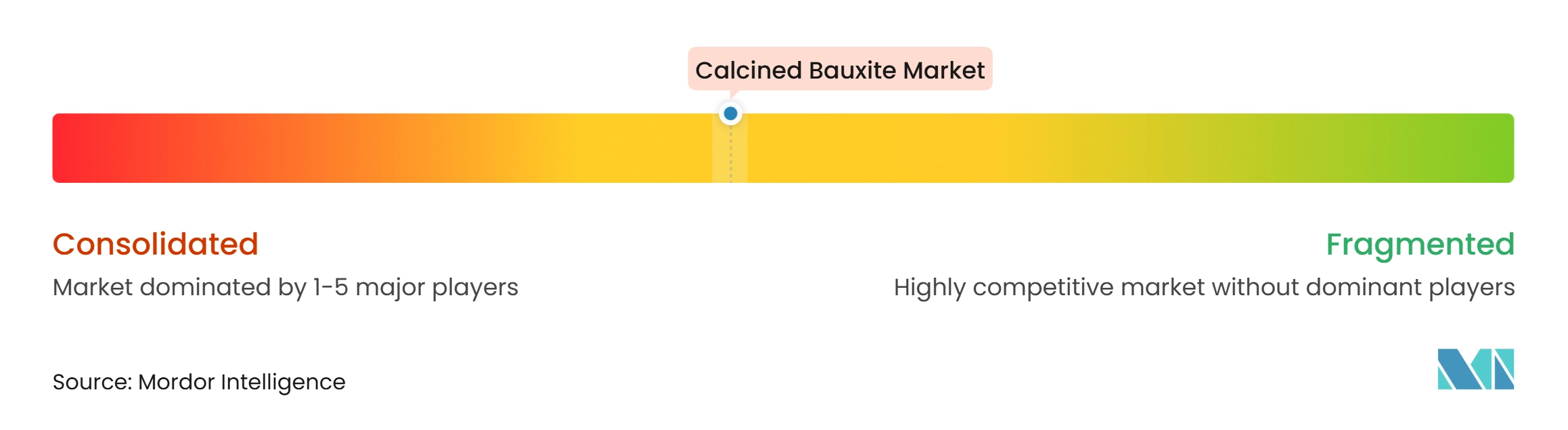
The calcined bauxite market is moderately concentrated, with top players including Bosai Minerals Group Co., Ltd., Imerys, RHI Magnesita, LKAB Minerals, and Ashapura Group of Industries. Chinese producers retain strong tonnage and cost positions because of established processing clusters, integrated supply chains, and domestic demand. Bosai Minerals Group Co., Ltd., ASHAPURA GROUP OF INDUSTRIES, Strategic Bauxite, and Guyana Industrial Minerals Inc. are associated with alternative origin supply. Imerys, RHI Magnesita, Refratechnik, and other refractory participants buy or process mineral inputs for downstream products. Boud Minerals Limited, EKC.AG, and LKAB Minerals participate in distribution and industrial minerals supply.
Securing raw material is a strategic priority because high-grade supply cannot be expanded quickly or substituted easily in demanding applications. RHI Magnesita identifies diversification, cost leadership, and sustainable raw material value creation as elements of its 2035 strategy. The company reported a 15.9% recycling rate in 2025, above its 15% global target. Recycling can reduce dependence on primary raw materials and lower emissions intensity. China’s export licensing requirements add urgency to diversification decisions outside China. Producers with reliable non-Chinese sources can be well positioned in premium-grade procurement.
Technology and product quality also shape competitive positions. Producers serving electronics and specialized ceramics must control alumina content, impurity levels, particle characteristics, and delivery consistency. Long kiln lead times limit rapid entry into premium refractory supply. Vertical integration helps downstream companies manage purchasing risk and product consistency. Alchemy Mineral, China Mineral Processing Ltd., Orient Ceratech Limited, SCABAL, and Sinocean Industrial Limited broaden the listed producer base.
Calcined Bauxite Industry Leaders
-
Bosai Minerals Group Co., Ltd.
-
Imerys
-
RHI Magnesita
-
LKAB Minerals
-
ASHAPURA GROUP OF INDUSTRIES
- *Disclaimer: Major Players sorted in no particular order
Calcined Bauxite Market Companies Covered in this Report
- Alchemy Mineral
- ASHAPURA GROUP OF INDUSTRIES
- Bosai Minerals Group Co., Ltd.
- Boud Minerals Limited
- China Mineral Processing Ltd.
- EKC.AG
- First Bauxite
- Great Lakes Minerals, LLC
- Guyana Industrial Minerals Inc.
- Imerys
- LKAB Minerals
- Orient Ceratech Limited
- Refratechnik
- RHI Magnesita
- SCABAL
- Sinocean Industrial Limited
Recent Industry Developments in Calcined Bauxite Market
- September 2026: Almatis and ROMCO Aluminates signed a term sheet for a strategic partnership to establish brown fused alumina (BFA) production in Odisha, India. The new facility is being developed with an initial capacity of 10,000 metric tons per year, with plans to increase production to 20,000 metric tons in its first quarter of commercial operations, supporting demand for calcined bauxite as a feedstock in fused alumina manufacturing.
- April 2026: National Aluminium Company Limited (NALCO) reported record bauxite excavation of 7.701 million metric tons and transportation of 7.707 million metric tons during FY2025–26. The increase in mining and material movement highlights growing upstream activity in India's bauxite supply chain, which provides the raw material for calcined bauxite production.
Global Calcined Bauxite Market Report Scope
Calcined bauxite is a high-alumina material produced by heating raw bauxite at high temperatures to remove moisture and volatile impurities, resulting in a dense and durable product. It offers high refractoriness, hardness, abrasion resistance, and thermal stability, making it suitable for applications requiring resistance to extreme temperatures and mechanical wear. It is widely used in refractory products, cement manufacturing, abrasives, road surfacing, and ceramic applications.
The Calcined Bauxite Market is segmented by grade, application, and geography. By grade, the market is segmented into refractory grade, abrasive grade, and other grades. By application, the market is segmented into refractory materials, cement, abrasives, pavement and flooring, proppants, ceramics and electrical applications, and other applications. The report also covers the market size and forecasts for calcined bauxite in 15 countries across major regions. For each segment, the market sizing and forecasts have been done on the basis of value (USD).
Segmentation Overview
| Refractory Grade |
| Abrasive Grade |
| Other Grades |
| Refractory Materials |
| Cement |
| Abrasives |
| Pavement and Flooring |
| Proppants |
| Ceramics and Electrical Applications |
| Other Applications |
| Asia-Pacific | China |
| India | |
| Japan | |
| South Korea | |
| ASEAN Countries | |
| Rest of Asia-Pacific | |
| North America | United States |
| Canada | |
| Mexico | |
| Europe | Germany |
| United Kingdom | |
| France | |
| Italy | |
| NORDIC Countries | |
| Rest of Europe | |
| South America | Brazil |
| Argentina | |
| Rest of South America | |
| Middle East and Africa | Saudi Arabia |
| South Africa | |
| Rest of Middle East and Africa |
| By Grade | Refractory Grade | |
| Abrasive Grade | ||
| Other Grades | ||
| By Application | Refractory Materials | |
| Cement | ||
| Abrasives | ||
| Pavement and Flooring | ||
| Proppants | ||
| Ceramics and Electrical Applications | ||
| Other Applications | ||
| By Geography | Asia-Pacific | China |
| India | ||
| Japan | ||
| South Korea | ||
| ASEAN Countries | ||
| Rest of Asia-Pacific | ||
| North America | United States | |
| Canada | ||
| Mexico | ||
| Europe | Germany | |
| United Kingdom | ||
| France | ||
| Italy | ||
| NORDIC Countries | ||
| Rest of Europe | ||
| South America | Brazil | |
| Argentina | ||
| Rest of South America | ||
| Middle East and Africa | Saudi Arabia | |
| South Africa | ||
| Rest of Middle East and Africa | ||
Key Questions Answered in the Report
What is the size of the calcined bauxite market?
The calcined bauxite market size was valued at USD 5.48 billion in 2026 and is estimated to grow from USD 5.66 billion in 2027 to reach USD 6.72 billion by 2032, at a CAGR of 3.48% during the forecast period (2027-2032).
What is driving demand for calcined bauxite?
Demand is supported by high-alumina refractories, steel capacity additions, road-safety surfacing, and specialized ceramic and electrical applications.
Which grade held the largest share in 2026?
Refractory grade held a 64.38% share in 2026 because it is widely used in high-temperature linings for steel, cement, glass, and foundry operations.
Which application is projected to advance fastest through 2032?
Pavement and flooring are projected to advance at a 4.34% CAGR through 2032, supported by high-friction surface treatment for road safety.