
Brazil Turf Protection Market Size and Share
Market Overview
| Study Period | 2021 - 2031 |
|---|---|
| Forecast Data Period | 2026 - 2031 |
| Base Year Market Size (2025) | USD 229.80 Million |
| Market Size (2026) | USD 240 Million |
| Market Size (2031) | USD 297.60 Million |
| Growth Rate (2026 - 2031) | 4.40 % |
| Market Concentration | Medium |
Major Players *Disclaimer: Major Players sorted in no particular order Image © Mordor Intelligence. Reuse requires attribution under CC BY 4.0. | |
Brazil Turf Protection Market Analysis by Mordor Intelligence
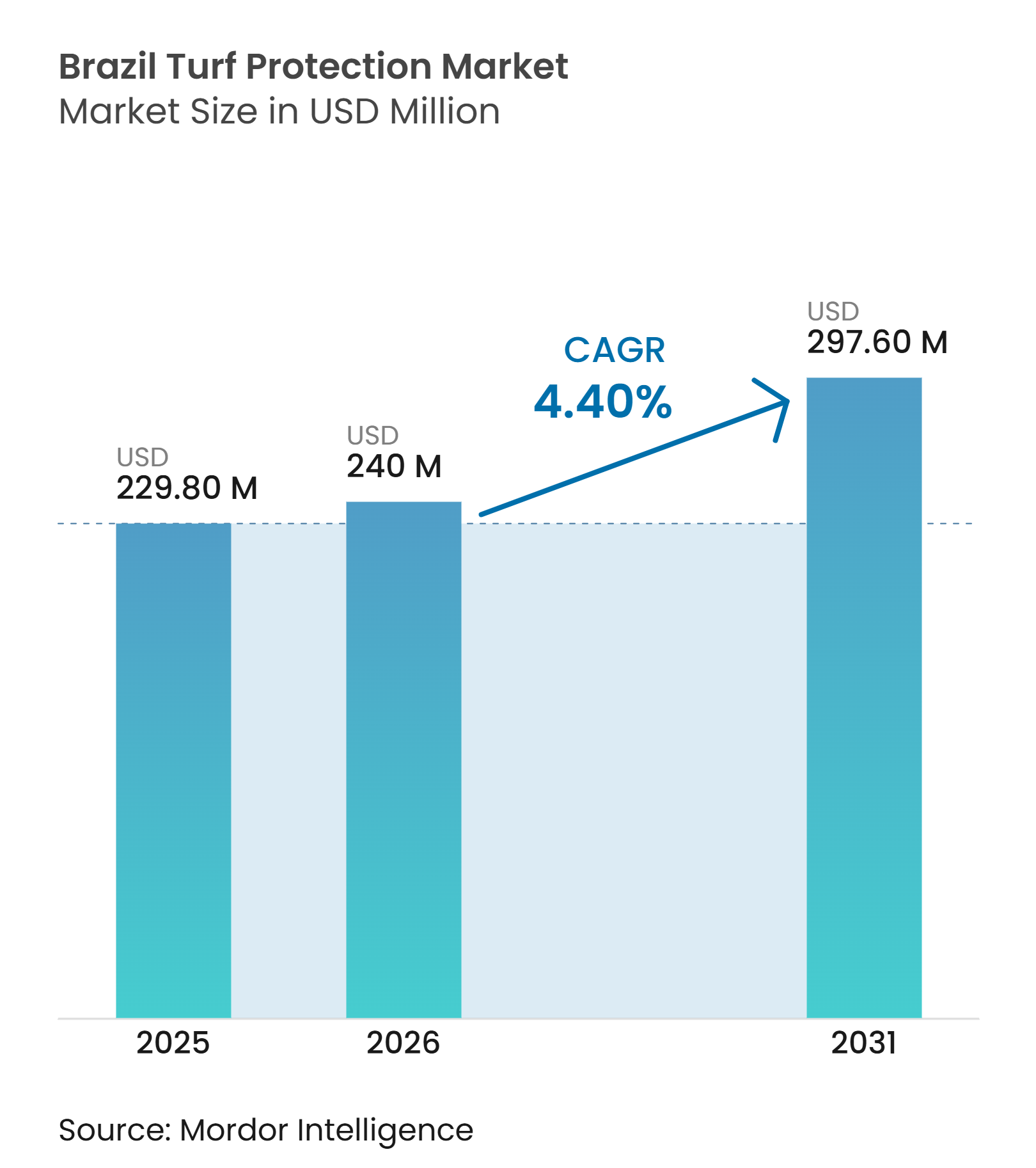
The Brazil Turf Protection Market size was valued at USD 229.80 million in 2025 and is estimated to grow from USD 240.0 million in 2026 to reach USD 297.60 million by 2031, at a CAGR of 4.40% during the forecast period (2026-2031). Brazil Turf Protection Market growth is supported by more intensive maintenance requirements at professional sports venues, municipal landscaping programs, and higher quality expectations for sod production. The FIFA Women’s World Cup 2027 is concentrating pitch conversion activity across 8 host venues, and FIFA identifies the tournament venues in Brazil as a national stadium network that includes major facilities in the Southeast, South, and Northeast. Biological inputs are becoming more relevant as their regulatory pathways have changed, and professional users are adding them to existing treatment programs rather than immediately replacing established chemistries. The Brazil Turf Protection Market also benefits from long-term green-space maintenance contracts, although price pressure remains material in public and small commercial accounts. Suppliers with turf-specific formulations, local technical support, and programs that combine chemical and biological inputs are better placed to serve higher-value customers.
Key Report Takeaways
- By product type, fungicides were the largest segment, with 37.5% of the Brazil Turf Protection Market share in 2025, while biostimulants and bio-fertilizers are the fastest-growing segment at a 9.8% CAGR from 2026 to 2031.
- By application, landscaping was the largest segment, with 42.1% of the Brazil Turf Protection Market share in 2025, while sports fields are the fastest-growing segment at a 9.4% CAGR from 2026 to 2031.
- By end user, residential customers were the largest segment with 45.4% share in 2025, while sports facility owners are the fastest-growing segment at an 8.9% CAGR from 2026 to 2031.
- By mode of action, chemical products were the largest segment with 71.2% share in 2025, while biological products are the fastest-growing segment at a 7.6% CAGR from 2026 to 2031.
- By formulation, liquid concentrate was the largest segment, with a 57.3% share in 2025, and the fastest-growing segment at a 6.3% CAGR from 2026 to 2031.
Note: Market size and forecast figures in this report are generated using Mordor Intelligence’s proprietary estimation framework, updated with the latest available data and insights as of January 2026.
Market Trends and Insights
Drivers Impact Analysis of Brazil Turf Protection Market*
| Driver | (~) % Impact on CAGR Forecast | Geographic Relevance | Impact Timeline |
|---|---|---|---|
| Expansion of professional sports turf infrastructure | +0.9% | Southeast and Northeast Brazil | Short term (≤ 2 years) |
| Growth of urban landscaping and public green spaces | +0.8% | Southeast and South Brazil | Medium term (2-4 years) |
| Rising disease and pest pressure under climate variability | +0.6% | National, strongest in Southeast and Center-West Brazil | Short term (≤ 2 years) |
| Increasing adoption of biological and integrated turf programs | +0.7% | National | Medium term (2-4 years) |
| Higher performance standards for golf, stadium and sod surfaces | +0.5% | Southeast, South, and Northeast Brazil | Medium term (2-4 years) |
| Digital scouting and precision application adoption | +0.4% | National, led by São Paulo and Minas Gerais | Long term (≥ 4 years) |
| Source: Mordor Intelligence | |||
Expansion of Professional Sports Turf Infrastructure
Brazil Turf Protection Market demand is receiving a short-term lift from preparations for the FIFA Women’s World Cup 2027, for which FIFA has confirmed 8 Brazilian host venues and renewed attention to pitch quality[1]. The supplied research identifies hybrid pitch conversions at 6 venues, including Mineirão, Mané Garrincha, Arena Pernambuco, Beira-Rio, Fonte Nova, and Castelão, where natural turf must perform consistently around synthetic reinforcement fibers. These surfaces require careful establishment, disease control, growth regulation, and recovery after major events, which increases demand for specialist maintenance programs. Grêmio Arena is replacing its pitch with Tahoma Bermudagrass; the Maracanã is scheduled to switch to Celebration Hybrid grass from December 2026; and Itograss began cultivating NorthBridge Bermudagrass in 2025 for premium sports surfaces. The Brazil Turf Protection Market therefore gains recurring demand from venue operators and the sod farms that supply specialist turf, rather than demand limited only to the tournament period.
Growth of Urban Landscaping and Public Green Spaces
Urban landscaping provides the Brazil Turf Protection Market with a broad base of demand across public parks, highway medians, residential developments, and commercial properties that require regular weed, disease, and growth management. São Paulo invested BRL 63 million (USD 11.5 million) in 2025 to deliver 1.3 million square meters of new green spaces, including 5 new parks and 4 upgraded parks, bringing the total to 120 municipal parks[2]. Fortaleza has a USD 177 million World Bank-backed program that will expand sustainably managed landscapes from 7,628 hectares to more than 10,586 hectares by January 2028. Salvador committed BRL 83 million (USD 15 million) for 320,000 square meters of new parks, while Rio de Janeiro began a BRL 83.3 million expansion of Realengo Park to 150,000 square meters. These contracts are price-sensitive but create longer maintenance cycles, allowing suppliers to build steadier local volume through contractors and distributors that can demonstrate lower total maintenance costs.
Rising Disease and Pest Pressure Under Climate Variability
Warm and humid conditions support substantial disease pressure across professionally managed turf areas, and the supplied research cites Embrapa work projecting that 46% of evaluated agricultural diseases could worsen by 2100. The same research states that fungi represented 79% of evaluated pathosystems across 32 economically important crops, which reflects the importance of fungal threats in Brazilian growing conditions. Turf managers must address brown patch, dollar spot, and gray leaf spot on Bermudagrass and zoysiagrass, particularly when longer leaf-wetness periods and warmer nights extend favorable disease conditions. Aphids, whiteflies, and thrips may also require more regular monitoring as higher temperatures support pest activity and shorten life cycles. This environment supports preventive fungicide programs and rotations that combine fungicide, insecticide, and biological options with practical field guidance.
Increasing Adoption of Biological and Integrated Turf Programs
Law No. 15,070, enacted in December 2024, removed agricultural biopesticides from the conventional pesticide framework and established a dedicated authorization approach for biological products in Brazil. The supplied research places the Brazilian biological crop protection category at BRL 5.3 billion (USD 940 million) during the 2025-26 season and reports 30% annual growth in biological treatment area across the preceding 5 seasons. The same source material reports 11% annual growth in the chemical treatment area, suggesting that biological products are expanding alongside, rather than immediately replacing, conventional programs. Stadium managers and golf course operators can use integrated pest management programs to address performance, resistance management, and sustainability requirements. Koppert B.V. announced BRL 500 million (USD 91 million) for a fourth Piracicaba facility with fungi and bacteria production lines, strengthening domestic biological supply for professional turf programs[3].
Restraints Impact Analysis of Brazil Turf Protection Market*
| Restraint | (~) % Impact on CAGR Forecast | Geographic Relevance | Impact Timeline |
|---|---|---|---|
| Registration and use restrictions for conventional chemistries | -0.5% | National | Medium term (2-4 years) |
| Limited turf-specific labels and technical data in Brazil | -0.4% | National | Long term (≥ 4 years) |
| Application drift and environmental liability exposure | -0.3% | Southeast and South Brazil | Medium term (2-4 years) |
| Budget constraints across municipal and small commercial sites | -0.3% | National, concentrated in North and Northeast Brazil | Short term (≤ 2 years) |
| Source: Mordor Intelligence | |||
Registration and Use Restrictions for Conventional Chemistries
Brazil’s pesticide registrations involve the Ministry of Agriculture and Livestock, known as MAPA, the National Health Surveillance Agency, known as ANVISA, and the Brazilian Institute of Environment and Renewable Natural Resources, known as IBAMA. The supplied research identifies ongoing toxicological reassessments for thiophanate-methyl, epoxiconazole, and procymidone, which are used in preventive programs at professional turf sites. Changes in labels, use conditions, or registrations can force managers to revise familiar disease-control programs and can complicate planning for suppliers. Law No. 14,785 of 2023 and MAPA Act No. 40 of 2025 shape the registration process, which can be demanding for companies seeking turf-specific label extensions because agricultural exposure models may not fully reflect turf use patterns. The regulatory setting favors suppliers with diversified chemical, biological, and integrated portfolios, but it can increase near-term costs for managers dependent on reassessed chemistries.
Limited Turf-Specific Labels and Technical Data
Turf is a distinct use environment, but many products available in Brazil have broader agricultural registrations, leaving buyers with fewer turf-specific labels and less localized technical data. Stadiums, golf courses, and sod farms need clear application guidance because grass varieties, surface expectations, and conditions differ substantially from field crops. Users may delay adoption of newer products when expected results have not been documented for their own operating setting. The issue is particularly relevant for biological formulations and specialized integrated programs that require clear advice on timing, compatibility, and use under Brazilian weather conditions. Local trials, field demonstrations, and investment in Brazilian turf research can reduce uncertainty and expand the range of credible turf-specific offerings.
*Our forecasts treat driver/restraint impacts as directional, not additive. The impact forecasts reflect baseline growth, mix effects, and variable interactions.
Brazil Turf Protection Market Segment Analysis
By Product Type:
Fungicides Remain the Largest Category While Biological Inputs Are the FastestFungicides held 37.5% share in 2025, making them the largest product type in the Brazil Turf Protection Market. Their position reflects persistent brown patch, dollar spot, and gray leaf spot risk on Bermudagrass and zoysiagrass. Stadiums, golf courses, and sod farms use preventive schedules because visible disease damage can undermine turf quality. Fungicides are therefore a core budget category in professionally managed programs. Herbicides also have steady demand because warm-season turf faces year-round weed competition in many regions.
Biostimulants and bio-fertilizers are the fastest product type, with Brazil Turf Protection Market size for this segment projected to grow at a 9.8% CAGR through 2031. These products support roots and plant vigor alongside conventional disease-control programs. In 2025, Syngenta AG described its objective to build a leading biological inputs position in Brazil, based on the supplied research. Its biological strategy included the 2024 acquisition of a Novartis microorganism library and partnerships with Biotrop and Provivi. Plant growth regulators retain a stable role where golf course and sod managers need uniform growth and lower mowing frequency.
By Application:
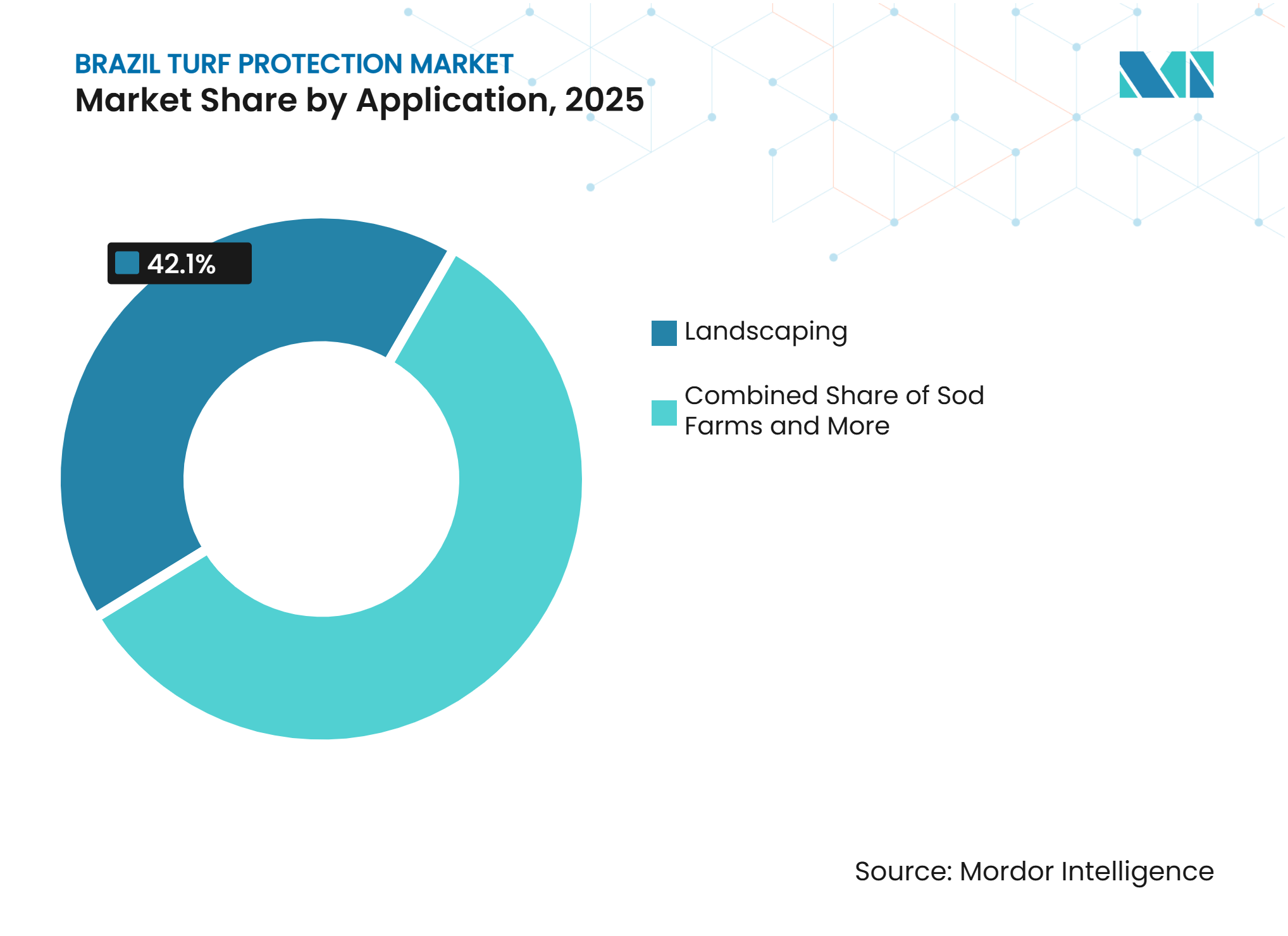
Landscaping Is the Largest Use While Sports Fields Are the FastestLandscaping accounted for 42.1% share in 2025 and was the largest application segment. Residential gardens, highway medians, commercial grounds, and municipal parks create a wide installed base for maintenance products. The segment benefits from park expansion activity in São Paulo, Rio de Janeiro, Salvador, and Fortaleza. Landscaping demand is spread across many customer types, reducing dependence on any single facility class. Its price sensitivity, however, requires suppliers to balance performance with accessible program costs.
Sports fields are the fastest application segment, and Brazil Turf Protection Market size for sports fields is forecast to rise at a 9.4% CAGR through 2031. The main near-term driver is hybrid-pitch work at the FIFA Women’s World Cup 2027 venues. The supplied research states that Mané Garrincha is scheduled to host 7 matches in 18 days, which increases the need for robust recovery programs. Golf courses are smaller in volume but can support premium product use, while sod farms need high-quality programs to serve professional surfaces. These application types make technical service a material part of the supplier offer.



By End User:
Residential Customers Are the Largest Group While Sports Facility Owners Are the FastestResidential customers were the largest end-user group with 45.4% share in 2025. Their demand is distributed across Brazil’s urbanized states and includes lawns around houses, condominiums, and local service properties. The supplied research notes that zoysiagrass, also called Esmeralda grass, represented 83.24% of sod production nursery area in 2024. This supports the relevance of residential turf across São Paulo, Minas Gerais, and other large urban areas. Commercial contractors and municipalities add recurring demand through maintenance obligations.
Sports facility owners are the fastest end-user group at an 8.9% CAGR through 2031. Professional football venues, padel sites, golf resorts, and athletics facilities need high turf standards to attract events and sponsors. They are more likely than budget-constrained accounts to use documented fungicide rotations, biological products, and precision application. Their purchasing choices can influence product standards for other professional turf users. The Brazil Turf Protection Market gains higher-value sales when these facilities adopt integrated programs with regular technical support.
By Mode of Action:
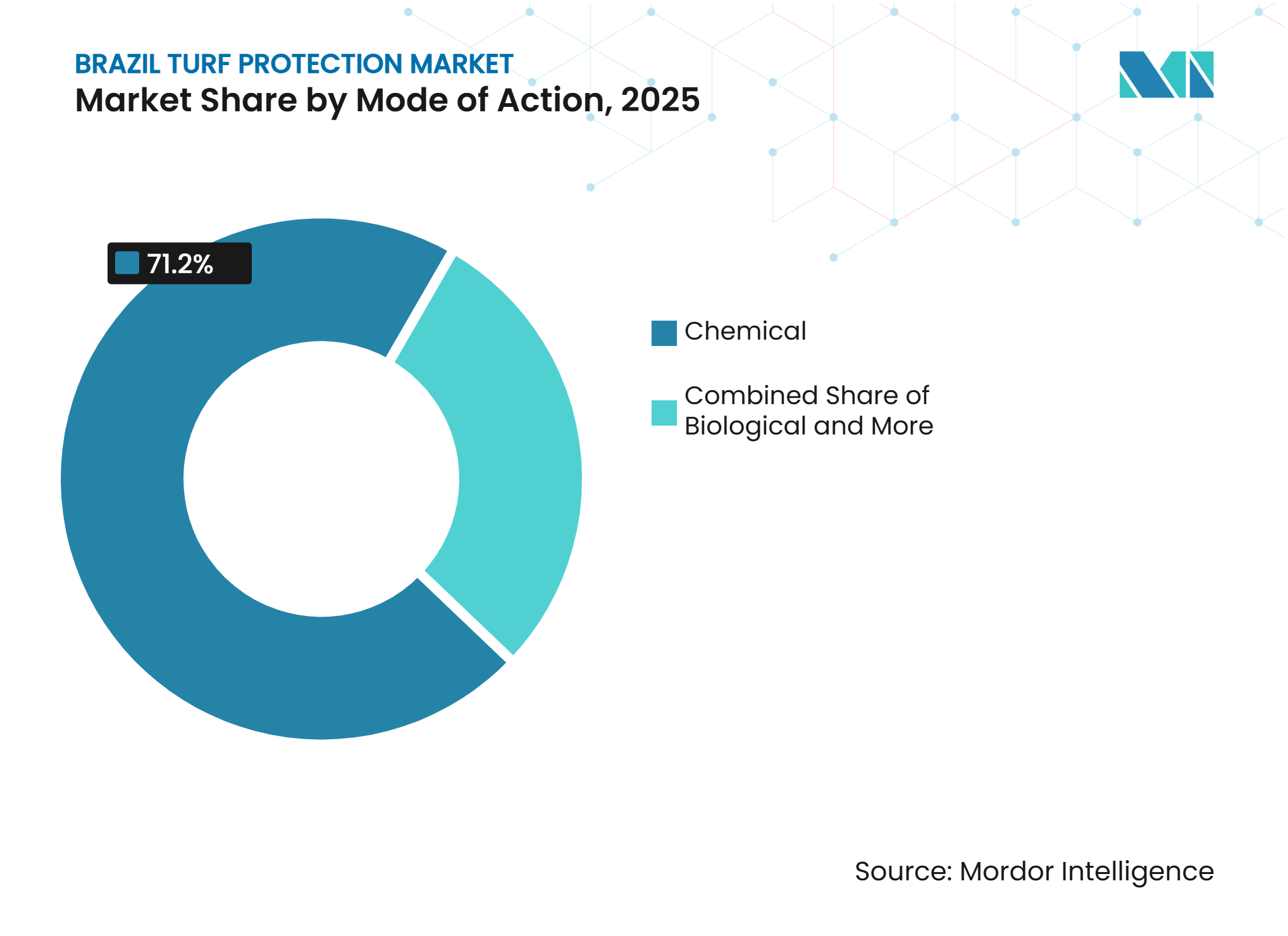
Chemical Products Are the Largest Group While Biological Products Are the FastestChemical products were the largest mode-of-action segment, holding 71.2% share in 2025. Their lead rests on broad efficacy, established registrations, and known cost-per-area performance. Professional turf managers are familiar with chemical programs for disease, insect, and weed control. Chemical products remain essential where rapid and predictable results are required. This base gives major agrochemical suppliers a strong position in the Brazil Turf Protection Market.
Biological products are the fastest mode-of-action segment, with a 7.6% CAGR projected through 2031. The authorization changes under Law No. 15,070 make biological products more accessible to the Brazilian agricultural sector. Integrated programs combine biological and chemical inputs in rotations that can help manage resistance and meet sustainability expectations. BASF SE completed its acquisition of AgBiTech in March 2026, gaining biological insect-control technologies and manufacturing assets that include operations in Brazil, according to the supplied research. Chemical and biological products can therefore remain complementary rather than competing on a strictly one-for-one basis.

By Formulation:
Liquid Concentrate Is Both the Largest and Fastest FormulationLiquid concentrate was the largest formulation, with 57.3% share in 2025. It fits the boom sprayers and backpack equipment used by professional applicators at stadiums, golf courses, and commercial landscaping sites. The formulation supports precise dilution and can allow compatible products to be applied in one pass. Labor efficiency is important at high-frequency professional maintenance sites. This makes liquid concentrate a practical choice across the Brazil Turf Protection Market.
Liquid concentrate is also the fastest formulation, with a 6.3% CAGR forecast through 2031. Growth reflects the expansion of professional applications at sports facilities and golf resorts in Southeast and South Brazil. Granular products retain a role in residential and municipal sites where broadcast spreaders are common and drift risk requires attention. Wettable powders remain relevant for selected active ingredients and high-temperature storage conditions. Their more labor-intensive mixing process limits use among high-throughput professional applicators.
Geography Analysis
Southeast Brazil held the largest regional share in 2025. São Paulo, Minas Gerais, Rio de Janeiro, and Espírito Santo form the key demand cluster, while São Paulo’s interior municipalities supply premium turf to venues, training centers, and golf sites throughout the country. The Maracanã in Rio de Janeiro and Neo Química Arena in São Paulo are the 2 host venues identified in the supplied research as already using hybrid pitches. São Paulo’s BRL 63 million (USD 11.5 million) green-space investment in 2025 also supports municipal maintenance demand. The region’s contractor and distributor density makes local technical support an important competitive factor.
South Brazil was the second major demand cluster in the supplied research. Rio Grande do Sul, Paraná, and Santa Catarina combine a productive sod base with an expanding premium golf economy. Porto Belo Golf in Santa Catarina added a visible high-value project to the region in January 2026. Beira-Rio in Porto Alegre is part of the FIFA Women’s World Cup 2027 venue network, while cooler winters create a disease profile that differs from tropical areas. This supports suppliers that can provide regional programs rather than a national rotation.
Northeast Brazil is the fastest-growing geographic area during the forecast period, driven by investments in and around Fortaleza, Salvador, and Recife. The supplied research identifies Castelão, Fonte Nova, and Arena Pernambuco as venues progressing toward hybrid pitch work, and Fortaleza’s program expands sustainably managed landscapes from 7,628 hectares to more than 10,586 hectares by January 2028. This gives the Brazil Turf Protection Market a municipal demand base beyond the tournament period. Center-West and North Brazil remain smaller contributors, although agribusiness wealth in Goiás and Mato Grosso supports higher-specification facilities, and Southeast sod farms supply production-stage inputs indirectly.
Competitive Landscape
Market Concentration
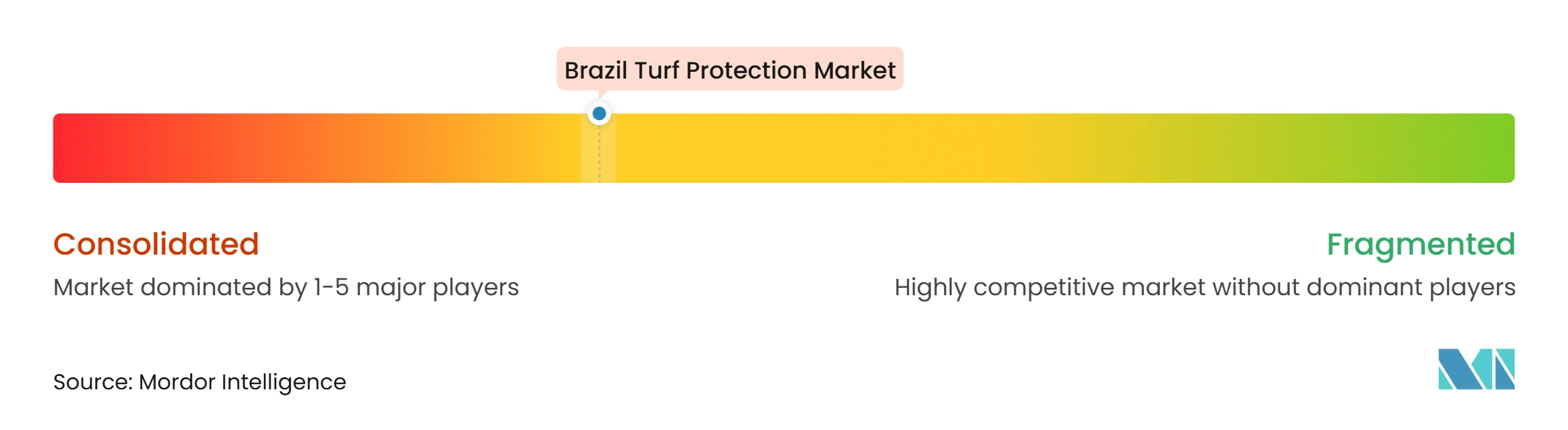
The Brazil Turf Protection Market is moderately concentrated, with Syngenta AG, Bayer AG, BASF SE, UPL Limited, and Corteva, Inc. holding advantages in registered portfolios, distribution networks, and technical sales coverage. Ourofino Group, Nortox Group, and IHARA - Indústria Química S.A. compete through local market knowledge, distributor relationships, and tropical formulation experience. Nortox Group reported revenue growth from BRL 2.2 billion in 2023 to BRL 2.9 billion in 2025, according to the supplied research. Its launches of Typhoon and Tempus insecticides illustrate how Brazilian suppliers can use focused development to strengthen their position. The supplied research does not provide the combined top-player share figures needed to calculate a concentration score.
Competition is moving toward integrated chemical and biological programs, digital application support, and stronger turf-specific labels. BASF SE completed its AgBiTech acquisition in March 2026, adding biological insect-control technologies and manufacturing facilities in Brazil, the United States, and Australia, according to the supplied research. This supports BASF SE’s ability to offer combined programs for stadium and golf customers. Koppert B.V. is building a fourth manufacturing facility in Piracicaba with a BRL 500 million (USD 91 million) investment, expanding fungi and bacteria production capacity. FMC Corporation entered a 2024 distribution agreement with Ballagro Agro Tecnologia Ltda. for fungi-based biosolutions in Brazil.
Sipcam Nichino Brasil S.A. (Sipcam Oxon S.p.A. and Nichino America, Inc.) has pursued dedicated turf formulation activity through its affiliated entity’s 2025 Carve Xtra and Linchpin launches. The launches demonstrate the value of developing materials for golf courses, lawns, sports fields, and sod production rather than relying only on broad agricultural labels. UPL Limited is positioned to grow its biological portfolio if product changes deliver turf-relevant registrations, while Albaugh, LLC, American Vanguard Corporation, Sumitomo Chemical Co., Ltd., and Nufarm Limited participate through selected active ingredients and broader agricultural histories. Local trials, clear application guidance, and service for complex sites remain the main practical routes to differentiation.
Brazil Turf Protection Industry Leaders
-
Syngenta AG
-
Bayer AG
-
BASF SE
-
Corteva, Inc.
-
UPL Limited
- *Disclaimer: Major Players sorted in no particular order
Brazil Turf Protection Market Companies Covered in this Report
- Syngenta AG
- Bayer AG
- BASF SE
- Corteva, Inc.
- UPL Limited
- FMC Corporation
- Sumitomo Chemical Co., Ltd.
- Nufarm Limited
- Ourofino Group
- Nortox Group
- IHARA - Indústria Química S.A.
- Albaugh, LLC
- Sipcam Nichino Brasil S.A. (Sipcam Oxon S.p.A. and Nichino America, Inc.)
- American Vanguard Corporation
- Koppert B.V.
Recent Industry Developments in Brazil Turf Protection Market
- August 2026: GOLFZON and GOLFZON Leadbetter opened the first GOLFZON Leadbetter Academy in South America at Porto Belo Golf All Resort in Santa Catarina. Brazil was recognized in the supplied research as one of the fastest-growing golf markets in South America, and the academy establishes a premium standard for turf management at the coastal Bermudagrass course.
- August 2026: Nortox Group launched 3 new crop protection products, continuing a diversification strategy that took revenue from BRL 2.2 billion in 2023 to BRL 2.9 billion in 2025, according to the supplied research. The launches reinforce the company’s position as a Brazilian-origin alternative to multinational suppliers in herbicide and insecticide categories.
- August 2025: Koppert B.V. announced plans to invest BRL 500 million (USD 91 million) to construct its fourth manufacturing facility in Piracicaba, São Paulo. The facility is dedicated to the production of fungi and bacteria, and the company simultaneously pursued EUR 100 million (USD 109 million) in private equity funding through Itaú BBA to expand its Brazilian capacity.
Brazil Turf Protection Market Report Scope
Turf protection refers to the use of specialized modular flooring or coverings to shield natural or synthetic grass from damage during heavy-traffic events such as concerts and stadium events. It prevents soil compaction, turf tearing, and grass suffocation while ensuring a safe, stable surface for pedestrians and equipment.
The Brazil Turf Protection Market is Segmented by Product Type (Fungicides, Herbicides, Insecticides, Plant Growth Regulators, Biostimulants, and Bio-Fertilizers), Application (Sports Fields, Golf Courses, Landscaping, and Sod Farms), End User (Sports Facility Owners, Commercial Landscape Contractors, Municipalities and Schools, Residential Customers), Mode of Action (Chemical, Biological, and Integrated Solutions), and Formulation (Granular, Liquid Concentrate, and Wettable Powder). The Market Forecasts are Provided in Terms of Value in USD.
Segmentation Overview
| Fungicides |
| Herbicides |
| Insecticides |
| Plant Growth Regulators |
| Biostimulants and Bio-Fertilizers |
| Sports Fields |
| Golf Courses |
| Landscaping |
| Sod Farms |
| Sports Facility Owners |
| Commercial Landscape Contractors |
| Municipalities and Schools |
| Residential Customers |
| Chemical |
| Biological |
| Integrated Solutions |
| Granular |
| Liquid Concentrate |
| Wettable Powder |
| By Product Type | Fungicides |
| Herbicides | |
| Insecticides | |
| Plant Growth Regulators | |
| Biostimulants and Bio-Fertilizers | |
| By Application | Sports Fields |
| Golf Courses | |
| Landscaping | |
| Sod Farms | |
| By End User | Sports Facility Owners |
| Commercial Landscape Contractors | |
| Municipalities and Schools | |
| Residential Customers | |
| By Mode of Action | Chemical |
| Biological | |
| Integrated Solutions | |
| By Formulation | Granular |
| Liquid Concentrate | |
| Wettable Powder |
Key Questions Answered in the Report
What is the projected value of Brazil turf protection by 2031?
The Brazil Turf Protection Market is forecast to reach USD 297.6 million by 2031, growing at a 4.4% CAGR from 2026. The forecast reflects demand from sports venues, landscaping, premium sod farms, municipal maintenance contracts, and professional programs that need regular disease, weed, insect, and growth management.
Which product category is largest in Brazil turf protection?
Fungicides were the largest category, holding 37.5% share in 2025 because professional turf requires regular disease prevention. Herbicides, insecticides, and growth regulators remain important for complete maintenance schedules.
Which application is growing fastest through 2031?
Sports fields are the fastest application segment at a 9.4% CAGR, supported by stadium upgrades and hybrid pitch programs. Landscaping remains the largest application because it serves many residential, commercial, and public locations.
Why are biological turf products gaining use in Brazil?
Biological products benefit from a dedicated authorization approach and are increasingly used with chemical products in integrated programs. Their role includes root support, disease prevention, resistance management, and improved turf quality at stadiums, golf courses, and specialist sod farms, rather than immediate replacement of all conventional inputs.
Which part of Brazil is growing fastest for turf protection demand?
Northeast Brazil is the fastest geographic area, supported by FIFA Women's World Cup 2027 venue work and Fortaleza's green-space program. Southeast Brazil remains the largest regional demand center.
What limits adoption of premium turf products?
Registration requirements, limited turf-specific technical data, application risk, and restricted municipal and small contractor budgets limit adoption. These factors make technical service and affordable program design important for suppliers.