
Brazil Seed Processing Machinery Market Size and Share
Market Overview
| Study Period | 2021 - 2031 |
|---|---|
| Forecast Data Period | 2026 - 2031 |
| Base Year Market Size (2025) | USD 151.73 Million |
| Market Size (2026) | USD 161.20 Million |
| Market Size (2031) | USD 218.07 Million |
| Growth Rate (2026 - 2031) | 6.23 % |
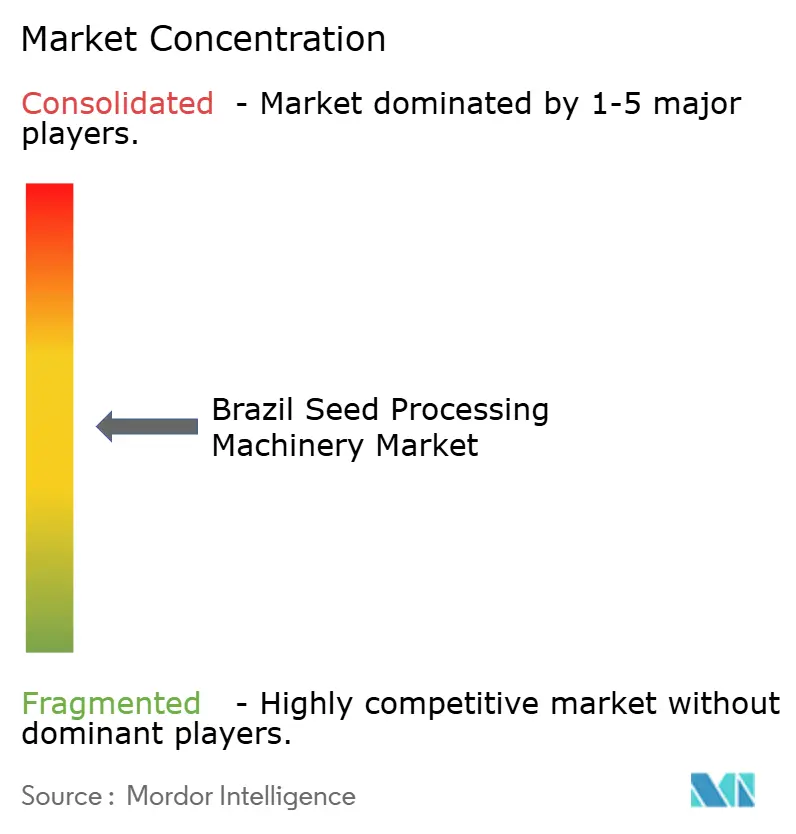
| Market Concentration | Medium |
Major Players
*Disclaimer: Major Players sorted in no particular order Image © Mordor Intelligence. Reuse requires attribution under CC BY 4.0. |
|
Brazil Seed Processing Machinery Market Analysis by Mordor Intelligence
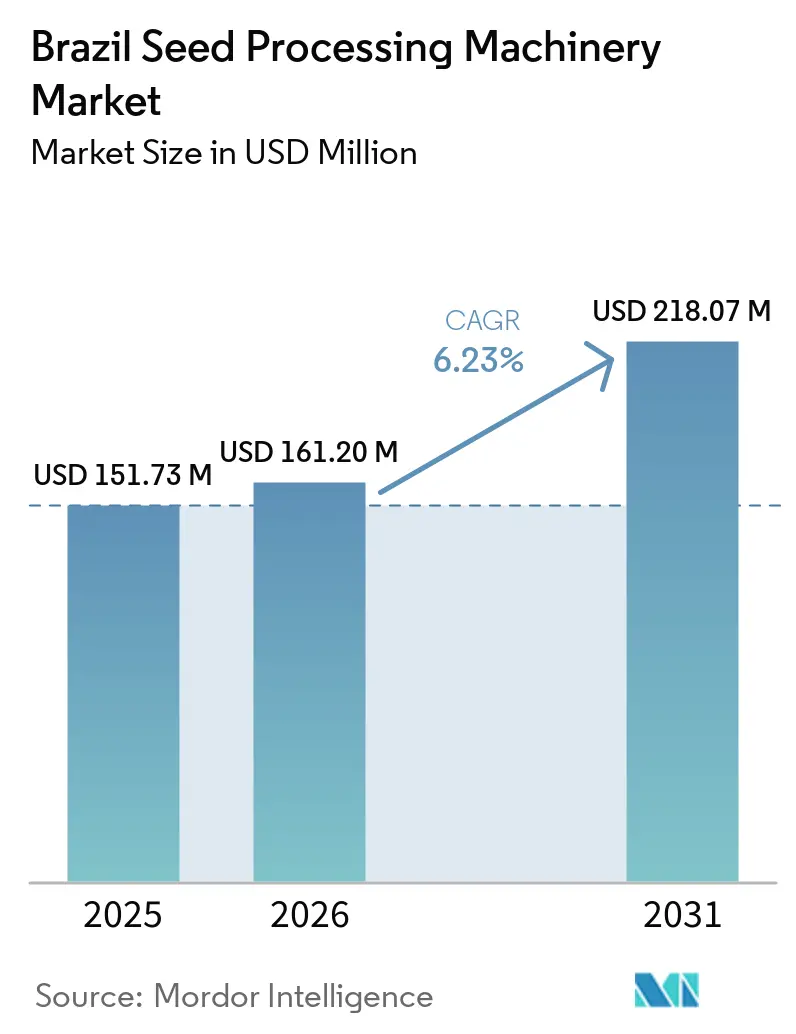
The Brazil seed processing machinery market is forecasted to grow from USD 151.73 million in 2025 to USD 161.20 million in 2026, and is forecasted to reach USD 218.07 million by 2031, at a CAGR of 6.23% over 2026–2031. Brazil's expanding grain production continues to support investments in seed multiplication and processing capacity, driving demand for advanced seed processing machinery. Overlapping main and second crop seasons make processing efficiency and high throughput critical considerations for commercial seed processors. At the same time, rising seed exports and increasing demand for premium-quality seeds are encouraging investments in equipment that enhances seed quality, traceability, and process consistency. Despite a decline in the estimated seed cultivation area, the growth in the value of the seed sector indicates a shift toward higher-value seed production, supporting continued demand for technologically advanced seed processing equipment.
Key Report Takeaways
- By machinery type, pre-cleaners was the largest segment and held 21.0% of the Brazil seed processing machinery market share in 2025, while optical sorters are the fastest growing segment and are forecast to expand at an 8.3% CAGR between 2026 and 2031.
- By operation mode, automatic was the largest segment and held 63.0% of the Brazil seed processing machinery market size in 2025, and is the fastest growing segment, forecast to expand at a 6.8% CAGR between 2026 and 2031.
- By end user, commercial seed processing plants were the largest segment, and held 38.0% of the market share in 2025, and are the fastest-growing segment, forecast to expand at a 7.0% CAGR between 2026 and 2031.
Note: Market size and forecast figures in this report are generated using Mordor Intelligence’s proprietary estimation framework, updated with the latest available data and insights as of January 2026.
Brazil Seed Processing Machinery Market Trends and Insights
Drivers Impact Analysis*
| Driver | (~) % Impact on CAGR Forecast | Geographic Relevance | Impact Timeline |
|---|---|---|---|
| Automated Optical Sorting Adoption | +1.2% | Brazil, primarily Center-West and South regions | Short term (≤ 2 years) |
| Demand for Treated and Value-Added Seeds | +1.0% | Brazil, primarily Center-West, South, and Southeast regions | Medium term (2–4 years) |
| Expansion of Commercial Seed Multiplication Centers | +1.1% | Brazil, primarily Mato Grosso, Goiás, Mato Grosso do Sul, Paraná, and São Paulo | Medium term (2–4 years) |
| Export-Oriented Seed Quality and Traceability Requirements | +0.9% | Brazil, primarily major seed-producing and export-oriented regions | Long term (≥ 4 years) |
| Need for High-Throughput Processing to Support Brazil's Safra and Safrinha Cycles | +0.8% | Brazil, primarily Center-West and South regions | Short term (≤ 2 years) |
| Localized Service Ecosystems Around Seed Processing Units | +0.6% | Brazil, primarily Center-West, South, and Southeast regions | Medium term (2–4 years) |
| Source: Mordor Intelligence | |||
Automated Optical Sorting Adoption
Camera-based, near-infrared (NIR), and AI-assisted optical sorting technologies are witnessing increasing adoption in Brazil's export-oriented seed processing facilities to improve seed purity, quality, and traceability. Growing demand for reliable defect detection, including discoloration, deformation, and immature seeds, is encouraging processors to invest in advanced sorting systems that enhance operational efficiency and support compliance with export quality standards. Modern optical sorters also facilitate digital recordkeeping and equipment calibration, helping seed processing units meet the quality and purity requirements established under the Ministry of Agriculture and Livestock (MAPA) Portaria 538. These technological advancements are anticipated to support the growth of the Brazil seed processing machinery market.
Demand for Treated and Value-Added Seeds
Growing demand for treated and value-added seeds in Brazil is encouraging commercial seed companies to adopt biological and multi-active seed treatments, driving the need for more advanced seed processing configurations. Biological treatments, such as Bradyrhizobium inoculants for soybeans and Trichoderma-based seed coatings, require lower application temperatures and minimal mechanical shear to preserve microbial viability and treatment effectiveness. These requirements favor dedicated coating lines over conventional general-purpose treatment kettles, enabling better process control and product quality. As a result, seed processors are investing in coating and treatment systems that separate biological and synthetic treatment workflows, reducing changeover time, minimizing cross-contamination risks, and improving operational efficiency. This trend is anticipated to create significant growth opportunities for coating and treatment equipment in the Brazil seed processing machinery market.
Expansion of Commercial Seed Multiplication Centers
Investment in seed beneficiation facilities is increasing in Brazil's Center-West and South regions. Polato Sementes began operating a new seed beneficiation plant in Pedra Preta, Mato Grosso, Brazil in February 2026 following an investment of BRL 100 million (USD 17.24 million). The site processes 25 metric tons per hour, and the investment doubled Polato's cultivar portfolio from 15 to 30 varieties. The facility's throughput is 25% above the market average as stated in the supplied material[1]Source: News, "Polato bets on technology and invests R$ 100 million in new seed industry in Mato Grosso," roteironoticias.com.br. In 2025, Frísia Cooperativa Agroindustrial selected Silomax to develop and modernize its seed processing unit as part of expansion plans in the South and Southeast regions. These projects support demand in Brazil's seed processing machinery market for complete processing lines rather than individual machines. Furthermore, Brazil's seed certification system requires registered seed processing units near production areas, known as Unidades de Beneficiamento de Sementes (UBS), to document and maintain their equipment configurations, supporting the expansion of compliant commercial seed processing facilities.
Export-Oriented Seed Quality and Traceability Requirements
Growing exports of high-quality seeds are increasing the need for advanced processing and traceability systems in Brazil. According to the International Trade Center Trade Map, Brazil exported USD 113 million worth of seeds, fruits, and spores for sowing (HS 1209) in 2025, up from USD 93 million in 2024, representing a 21.5% increase and highlighting the country's growing participation in the international seed trade. Export markets require strict compliance with quality standards for aflatoxin contamination, foreign material, moisture content, and seed purity, thereby encouraging processors to invest in modern cleaning, grading, sorting, and packaging equipment. Integrated processing systems that capture data across multiple processing stages strengthen seed lot traceability and facilitate compliance with export certification and audit requirements. As a result, demand for advanced seed processing machinery capable of integrating quality assurance with digital traceability is anticipated to increase, supporting growth in Brazil seed processing machinery market.
Restraints Impact Analysis*
| Restraint | (~) % Impact on CAGR Forecast | Geographic Relevance | Impact Timeline | |
|---|---|---|---|---|
| High Up-Front Machinery Cost | -0.8% | Brazil, particularly the Center-West and South regions | Medium term (2–4 years) | |
| Operator and Service-Skill Bottlenecks | -0.5% | Brazil, particularly the Center-West and South regions | Long term (≥ 4 years) | |
| Imported-Component Currency and Duty Exposure | -0.6% | Brazil, particularly the Center-West and South regions | Short term (≤ 2 years) | |
| Treatment Chemistry Changeover and Validation Downtime | -0.4% | Brazil, particularly the Center-West and South regions | Medium term (2–4 years) | |
| Source: Mordor Intelligence | ||||
High Up-Front Machinery Cost
The high capital investment required for advanced seed processing equipment continues to limit adoption among small and medium-sized seed producers in Brazil. Integrated optical sorters, precision coating and treatment lines, and high-capacity pre-cleaning systems require substantial upfront expenditure, making equipment modernization financially challenging for smaller processing facilities. Although government financing programs support machinery purchases, borrowing costs and limited access to affordable credit often delay investment decisions and equipment replacement. Consequently, many smaller processors continue to operate legacy systems, reducing processing efficiency and limiting their ability to meet evolving seed quality and regulatory requirements. These financial constraints are amticipated to restrict the broader adoption of advanced seed processing machinery across the Brazil market.
Operator and Service-Skill Bottlenecks
The adoption of advanced seed processing machinery in Brazil is constrained by the limited availability of skilled operators and technical service personnel capable of operating, calibrating, and maintaining sophisticated equipment. According to SENAI's Mapa do Trabalho Industrial 2025–2027, Brazil will need to qualify approximately 14 million professionals between 2025 and 2027, including 11.8 million workers requiring reskilling to keep pace with technological advancements across industrial sectors[2]Source: Senai, "Brazil needs to train 14 million professionals by 2027, according to SENAI," senaiac.org.br. Modern seed processing systems, including near-infrared (NIR) sensors, optical sorters, and precision seed treatment equipment, require specialized expertise to ensure accurate quality assessment and efficient operation. Although collaborations between research institutions and industry are supporting the development of AI-based seed analysis technologies and workforce training, the availability of skilled personnel remains concentrated in major seed-producing regions. As a result, processing facilities located farther from established technical and service networks often experience longer installation, commissioning, and maintenance timelines, slowing the adoption of advanced seed processing machinery across Brazil.
*Our forecasts treat driver/restraint impacts as directional, not additive. The impact forecasts reflect baseline growth, mix effects, and variable interactions.
Segment Analysis
By Machinery Type: Pre-Cleaners Lead Installed Demand and Optical Sorters Lead Growth
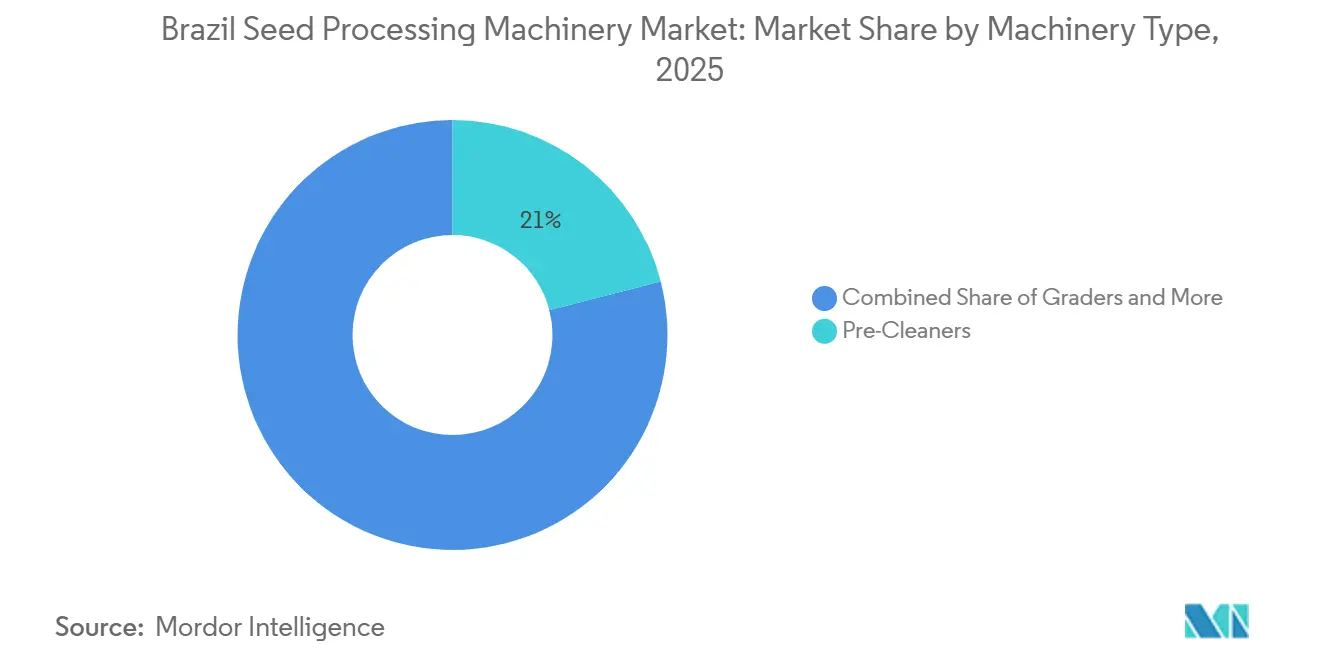
Pre-cleaners accounted for 21.0% of the Brazil seed processing machinery market in 2025, representing the largest share among machinery types. Their dominance is attributed to their role as the first stage of seed processing, where impurities such as dust, stones, chaff, and oversized materials are removed before further processing. By improving the efficiency of downstream operations and minimizing equipment wear, pre-cleaners remain a critical component of commercial seed processing lines. Cleaners and graders complement this process by improving seed purity and ensuring uniform seed size, while dryers help maintain optimal moisture levels to preserve seed viability and storage quality. The widespread adoption of these core processing machines across soybean, corn, and other field crop seed production is anticipated to sustain demand throughout the forecast period.
Optical sorters are forecast to grow at a CAGR of 8.3% during 2026–2031. The segment is benefiting from rising demand for high-quality certified seeds, increasing export-quality requirements, and the growing adoption of automation in seed-processing facilities. Equipped with cameras, near-infrared (NIR) sensors, and AI-based image analysis, optical sorters enable accurate detection of damaged, discolored, and contaminated seeds, improving processing precision and traceability. Demand for coaters and treaters is also increasing as seed producers expand the use of chemical and biological seed treatments to enhance crop performance and disease resistance. Additionally, seed packagers are gaining importance with the growing need for automated packaging, lot identification, and traceability to support regulatory compliance and export certification. Together, these advanced processing technologies are anticipated to accelerate the modernization of Brazil's seed processing industry.



By Operation Mode: Automatic Lines Set the Standard for Commercial Facilities
Automatic equipment held 63.0% of the Brazil seed processing machinery market share in 2025, and the segment is forecast to expand at a 6.8% CAGR between 2026 and 2031. Commercial processors use automatic systems for new facilities and line upgrades because they support consistent throughput and repeatable settings. Competition for skilled workers from the logistics, agro-industrial processing, and bioenergy sectors further supports the adoption of automation. Automatic configurations are likely to remain the central choice for large commercial projects in the Brazil seed processing machinery market.
Semi-automatic systems remain relevant for smaller seed producers, cooperatives, and on-farm facilities where a fully automatic line does not justify its higher initial cost. These systems offer operators a lower-cost route to cleaning, grading, treatment, and packaging capability. However, manual intervention can limit line consistency and data capture. In the Brazil seed processing machinery market, automated facilities increasingly link machine settings to seed-lot records, supporting documentation requirements under the Ministry of Agriculture, Livestock and Food Supply (MAPA) Portaria 538 and export certification workflows. Domestic entry-level automatic systems could narrow the cost gap over the forecast period, which may reduce the role of semi-automatic configurations in larger seed operations.
By End User: Commercial Plants Combine Scale, Quality Control, and Compliance
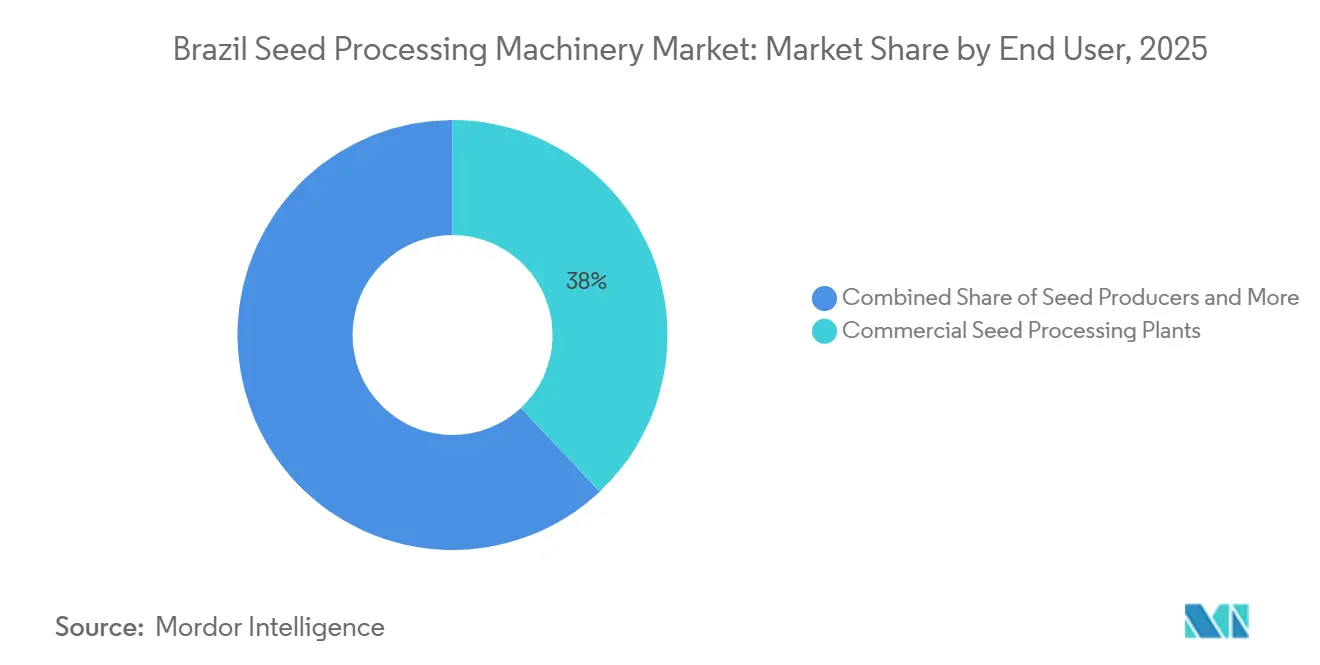
Commercial seed processing plants accounted for 38.0% of the Brazil seed processing machinery market by end user in 2025, making them the largest segment. They are also the fastest-growing segment, forecast to register a CAGR of 7.0% during 2026–2031. The segment's dominance is driven by the need for high-capacity, integrated processing lines that combine cleaning, grading, optical sorting, seed treatment, and packaging to ensure consistent seed quality and regulatory compliance. Commercial facilities also have greater financial capacity to invest in advanced automation, digital traceability, and precision processing technologies, supporting the production of certified seeds for domestic and export markets.
Seed producers, grain handling facilities, on-farm processing units, and research institutions continue to contribute to demand for seed processing machinery across Brazil. Seed producers require versatile equipment capable of handling multiple crop types, while grain handling facilities are increasingly incorporating seed processing capabilities to diversify their operations. On-farm facilities primarily utilize basic cleaning and treatment equipment to improve seed quality before planting or local distribution. Meanwhile, research institutions and breeding organizations rely on laboratory-scale and pilot processing systems for seed testing, variety development, and cultivar evaluation. Together, these diverse end users create demand for both large integrated processing lines and specialized machinery tailored to different scales of operation.
Geography Analysis
Brazil's seed processing machinery market is concentrated in the country's major seed-producing regions, where commercial cultivation of soybean, corn, cotton, and wheat supports demand for advanced seed processing infrastructure. The Central-West and South regions dominate the market due to their extensive network of certified seed producers, cooperatives, and commercial seed processing facilities. These regions are witnessing increasing investments in integrated processing lines comprising pre-cleaners, graders, optical sorters, seed treatment systems, and automated packaging equipment to improve seed quality, productivity, and compliance with Brazil's seed certification standards.
Mato Grosso is the largest regional market, supported by its position as Brazil's leading producer of soybeans and corn seeds. According to the Brazilian Agricultural Research Corporation (Embrapa), Brazil registered 3.6 million hectares of soybean seed production fields across 18 states during the 2024/25 season, with Mato Grosso accounting for 23.7% of the total seed production area, the highest share among all states[3]Source: Embrapa, "Soybean seed production in Brazil.," embrapa.br. The state's large commercial seed processing plants continue to invest in high-capacity automated machinery to meet rising demand for certified seeds and improve operational efficiency.
The South region, led by Paraná and Rio Grande do Sul, represents another key market owing to its well-established seed industry, strong cooperative network, and concentration of seed breeding and research activities. Meanwhile, Goiás and Mato Grosso do Sul are emerging as high-growth markets, driven by expanding soybean and second-crop corn cultivation, increasing certified seed production, and ongoing modernization of processing facilities. Growing adoption of automated seed processing technologies across these agricultural hubs is anticipated to support sustained demand for advanced seed processing machinery in Brazil over the forecast period.
Competitive Landscape
The Brazil seed processing machinery market is moderately concentrated. Bühler AG, Cimbria A/S, PETKUS Technologie GmbH, Satake Corporation, and Silomax Indústria e Comércio Ltda. were the leading players in the market. International full-line original equipment manufacturers (OEMs) compete through integrated lines, digital systems, and equipment performance. Brazilian manufacturers such as Silomax and Momesso compete by offering local service, aligning financing, and demonstrating familiarity with domestic crop varieties.
Leading seed processing machinery manufacturers continued to invest in research and development to enhance automation, digitalization, and seed quality management. New product launches focused on improving processing efficiency, precision sorting, and operational traceability through advanced imaging and AI-enabled technologies. In addition, AI-enabled optical sorting technologies are increasingly being applied to seed processing to enhance automated quality inspection, defect detection, and traceability, supporting the growing demand for high-quality certified seed production.
Brazilian startups are also entering the seed quality sensing segment. Singular SeedS and Neosilos use machine-learning analysis tools that can complement processing lines rather than directly replace OEM machinery. These tools can reduce reliance on manual inspection and provide additional data for seed quality decisions. The market also presents a service opportunity around aging equipment located outside established dealer networks. Technical coverage in the North and Northeast regions can influence maintenance response times and investment decisions. Suppliers with local parts availability, trained service teams, and practical upgrade options are well-positioned to address this need.
Brazil Seed Processing Machinery Industry Leaders
-
Bühler AG
-
Cimbria A/S
-
PETKUS Technologie GmbH
-
Satake Corporation
-
Silomax Indústria e Comércio Ltda.
- *Disclaimer: Major Players sorted in no particular order

Recent Industry Developments
- February 2026: Polato Sementes commenced operations at its new BRL 100 million (USD 17.24 million) Industry 4.0 seed beneficiation plant in Pedra Preta, Mato Grosso. The facility doubled capacity to 1 million sacks per year at 25 metric tons per hour with full process automation and imported United States equipment.
- September 2025: The National Supply Company (CONAB) reported Brazil's 2024/25 grain production at a record 350.2 million metric tons, representing a 16.3% year-on-year increase. The record harvest reflects strong production of major crops, particularly soybeans and corn, and is anticipated to support continued investment in seed multiplication, processing capacity, and industrial seed treatment to meet Brazil's expanding agricultural output.
- August 2025: Cooperativa Regional Agropecuária De Campos Novos invested BRL 70 million (USD 12.5 million) in a new seed-processing unit (UBS) and automated seed-treatment center (CTS) at its Unit 71 in Campos Novos, Santa Catarina. The facility added two automated treatment machines with capacities of 30 and 6 metric tons per hour, providing greater flexibility for both large and smaller seed lots.


Brazil Seed Processing Machinery Market Report Scope
Seed processing machinery encompasses equipment used in agriculture to clean, sort, grade, dry, treat, and package seeds, improving their quality and viability for planting. These machines play a critical role in removing impurities, ensuring uniformity, and safeguarding seeds from pests and diseases
The Brazil Seed Processing Machinery Market Report is Segmented by Machinery Type (Pre-Cleaners, Cleaners, Dryers, Graders, Polishers, Optical Sorters, Seed Packagers, Coaters and Treaters, Separators and Destoners, and Other Specialized Equipment), by Operation Mode (Automatic and Semi-Automatic), and by End-User (Commercial Seed Processing Plants, Seed Producers, On-Farm Facilities, and Grain Handling Facilities). The Market Forecasts are Provided in Terms of Value (USD).
| Pre-Cleaners |
| Cleaners |
| Dryers |
| Graders |
| Coaters and Treaters |
| Separators and Destoners |
| Polishers |
| Optical Sorters |
| Seed Packagers |
| Other Specialized Equipment |
| Automatic |
| Semi-Automatic |
| Commercial Seed Processing Plants |
| Seed Producers |
| Research Institutions |
| On-Farm Facilities |
| Grain Handling Facilities |
| By Machinery Type | Pre-Cleaners |
| Cleaners | |
| Dryers | |
| Graders | |
| Coaters and Treaters | |
| Separators and Destoners | |
| Polishers | |
| Optical Sorters | |
| Seed Packagers | |
| Other Specialized Equipment | |
| By Operation Mode | Automatic |
| Semi-Automatic | |
| By End User | Commercial Seed Processing Plants |
| Seed Producers | |
| Research Institutions | |
| On-Farm Facilities | |
| Grain Handling Facilities |


Key Questions Answered in the Report
What is the Brazil seed processing machinery market size?
The Brazil seed processing machinery market is USD 161.20 million in 2026 and is forecasted to reach USD 218.07 million by 2031 at a 6.23% CAGR.
Why are optical sorters being adopted by seed processors?
Optical sorters identify defects and support documented quality control, which helps facilities serve export-focused seed programs.
Which end user leads demand for seed processing equipment?
Commercial Seed Processing Plants held 38.0% in 2025 and are forecasted to expand at a 7.0% CAGR between 2026 and 2031.
What limits purchases by smaller seed facilities?
High initial equipment costs, financing rates, imported-component exposure, and shortages of skilled service staff can delay upgrades.
Page last updated on:





