
Brazil Same Day Delivery Market Size and Share
Market Overview
| Study Period | 2021 - 2032 |
|---|---|
| Forecast Data Period | 2027 - 2032 |
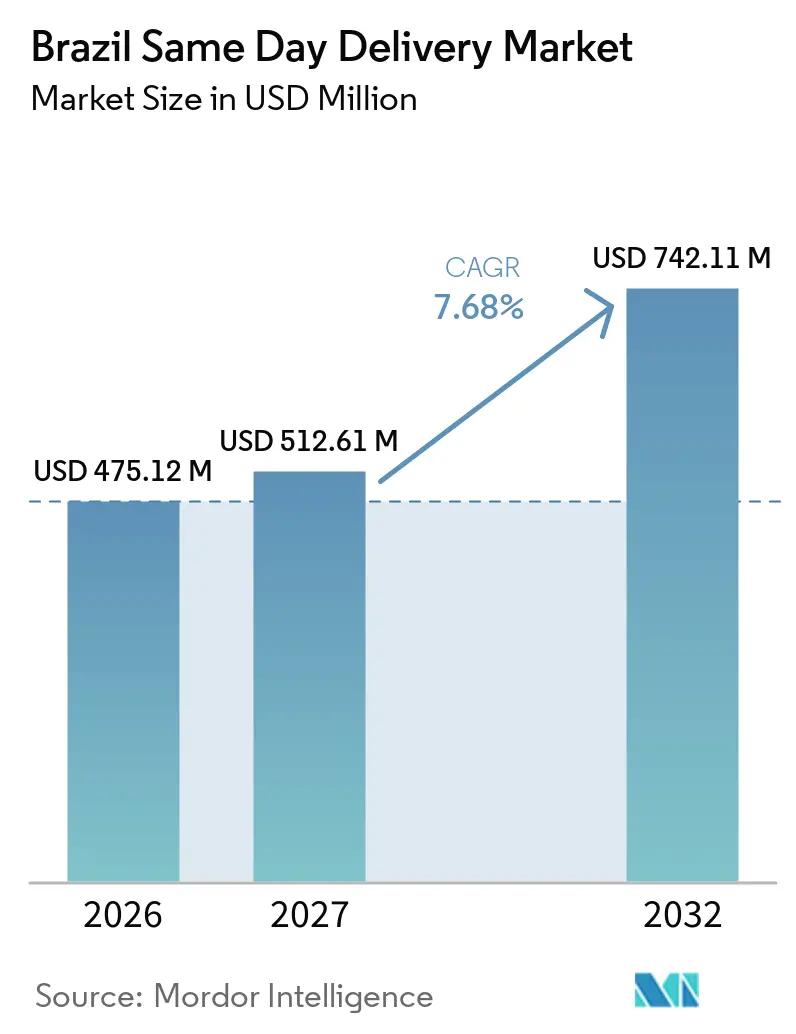
| Base Year Market Size (2026) | USD 475.12 Million |
| Market Size (2027) | USD 512.61 Million |
| Market Size (2032) | USD 742.11 Million |
| Growth Rate (2027 - 2032) | 7.68 % |
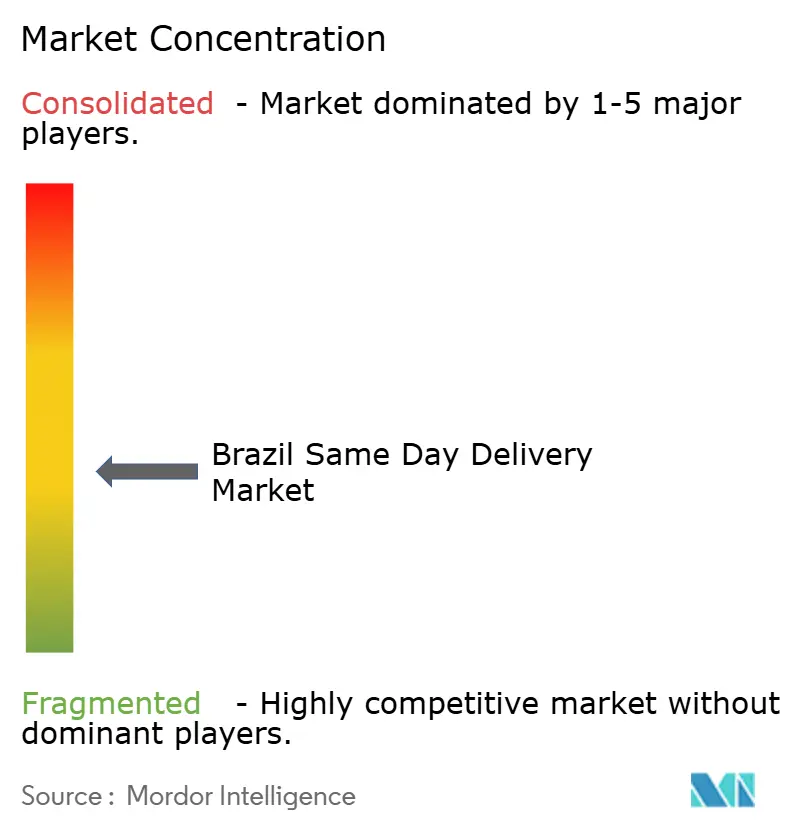
| Market Concentration | Medium |
Major Players *Disclaimer: Major Players sorted in no particular order Image © Mordor Intelligence. Reuse requires attribution under CC BY 4.0. | |
Brazil Same Day Delivery Market Analysis by Mordor Intelligence
The Brazil same day delivery market size is valued at USD 475.12 million in 2026 and estimated to grow from USD 512.61 million in 2027 to reach USD 742.11 million by 2032, at a CAGR of 7.68% during the forecast period (2027-2032).
The expansion reflects a larger online customer base and a sharper preference for rapid fulfillment in Brazil. Delivery is moving from a service feature to a deciding factor at checkout, since 57% of Brazilians require delivery within 24 hours and 40% would not complete a purchase without a same day option. The Brazil same day delivery market is therefore supported by consumer demand, denser fulfillment networks, and platform investment, although traffic delays and courier economics limit reliability and margin expansion. Companies that can position stock close to demand while maintaining compliant pharmacy and food delivery operations have a stronger basis for extending service beyond major metropolitan areas.
Key Report Takeaways
- By customer type, B2C accounts for 70.12% of Brazil same day delivery market size in 2026, while C2C is forecast to expand at an 8.31% CAGR through 2032.
- By service model, standard same day accounts for 56.37% of Brazil same day delivery market share in 2026, while scheduled same day is forecast to expand at an 8.68% CAGR through 2032.
- By shipment type, parcels and small packages account for 46.28% of Brazil same day delivery market size in 2026, while medium and large parcels are forecast to expand at a 9.18% CAGR through 2032.
- By end-user industry, e-commerce and retail accounts for 35.64% of Brazil same day delivery market share in 2026, while healthcare and pharmaceuticals is forecast to expand at a 10.34% CAGR through 2032.
- By region, Southeast accounts for 46.73% of Brazil same day delivery market size in 2026, while North is forecast to expand at a 9.34% CAGR through 2032.
Note: Market numbers in this report are based on Mordor Intelligence's proprietary estimation framework, which combines nine months of actuals with Q4 projections for base year 2026.
Market Trends and Insights
Drivers Impact Analysis of Brazil Same Day Delivery Market*
| Driver | (~) % Impact on CAGR Forecast | Geographic Relevance | Impact Timeline |
|---|---|---|---|
| E-Commerce Growth Increasing Same day Delivery Demand | +2.4% | National, with concentration in Southeast and Northeast corridors | Short term (≤ 2 years) |
| Precise Delivery Windows Raising Service-Level Expectations | +1.1% | Southeast, with spillover to South and Northeast | Medium term (2-4 years) |
| Micro-Fulfillment Expansion Improving Inventory Proximity | +1.3% | National, with the highest density in Southeast and South | Medium term (2-4 years) |
| Q-Commerce Growth Expanding Secondary-City Delivery Demand | +0.9% | Initially Southeast, then Northeast and Central-West secondary cities | Medium term (2-4 years) |
| AI Route Optimization Improving Delivery Network Efficiency | +0.6% | National, with early use in São Paulo, Rio de Janeiro, Recife, and Fortaleza | Long term (≥ 4 years) |
| Integrated Retail Delivery Increasing Multi-Category Order Volumes | +0.5% | National, led by Southeast and South, with emerging traction in North | Long term (≥ 4 years) |
| Source: Mordor Intelligence | |||
E-Commerce Growth Increasing Same day Delivery Demand
The Brazil same day delivery market benefits when sellers can spread fixed delivery capacity over a larger number of orders in the same neighborhood. Loggi found that 55% of packages reached customers within 3 days, which leaves a clear service gap for platforms offering faster options. Lower free-delivery thresholds at large marketplaces have made speed more visible to customers and placed greater pressure on independent carriers. The resulting demand extends beyond top-tier cities as smaller sellers gain access to broader domestic shipping coverage.
Micro-Fulfillment Expansion Improving Inventory Proximity
Micro-fulfillment sites shorten the distance between inventory and consumers, which is particularly valuable in congested Brazilian cities. Mercado Libre stated that it expects to end 2026 with 72 large-scale logistics centers in Brazil, 39% more than the prior year, covering more than 3.3 million m². The company reported that more than 300 robots support processing in these facilities, reducing order-processing time by 20%. Amazon and Rappi launched Amazon Now across 8 Brazilian cities in March 2026, combining dark stores and micro-distribution infrastructure for 15-minute delivery of groceries and essentials. This network design favors businesses with urban inventory access, rather than operators that depend only on distant hubs. Smaller logistics providers are more likely to need shared facilities or partnerships if they are to match the shortest service windows.
Q-Commerce Growth Expanding Secondary-City Delivery Demand
Quick commerce is adding regular delivery demand in categories that were once mainly tied to food orders. iFood stated that its Turbo service reached 130 cities by October 2026 and uses 30 artificial intelligence models per order to support courier assignment, preparation estimates, and route selection. The Brazil same day delivery market gains volume when shoppers use fast delivery for routine grocery, pharmacy, and convenience purchases rather than only for occasional orders. Worldpanel by Numerator reported that weekday delivery demand grew 20% in the 12 months to October 2025, exceeding the 10% growth in weekend demand[1]. This pattern supports the Brazil same day delivery market and investment in Fortaleza, Goiânia, and Recife, where daily order frequency can justify local capacity.
AI Route Optimization Improving Delivery Network Efficiency
Route optimization is becoming more important as operators seek to protect delivery reliability in dense urban networks. Mercado Libre reported that 59% of orders to Brazilian state capitals received same day or next day delivery in the first quarter of 2025, compared with 75% in São Paulo[2]. The difference shows why local traffic conditions and fulfillment density matter even within the same national network. Amazon described the use of artificial intelligence for logistics site selection, route design, and delivery-time personalization in Brazil. For the Brazil same day delivery market, better sequencing can help carriers use existing vehicle capacity more effectively when congestion is unavoidable. Rappi also uses predictive positioning of couriers in its pharmacy delivery operation, which links route technology with inventory availability. These systems are useful only when the underlying address, order, and traffic information remains current.
Restraints Impact Analysis of Brazil Same Day Delivery Market*
| Restraint | (~) % Impact on CAGR Forecast | Geographic Relevance | Impact Timeline |
|---|---|---|---|
| Urban Congestion Reducing Same day Delivery Reliability | -1.3% | São Paulo, Rio de Janeiro, Recife, and other major urban corridors | Short term (≤ 2 years) |
| Fuel and Labor Costs Pressuring Delivery Economics | -1.0% | National, with the highest burden in large metropolitan fleets | Medium term (2-4 years) |
| Municipal Courier Rules Increasing Operating Complexity | -0.5% | São Paulo, Rio de Janeiro, and major state capitals | Medium term (2-4 years) |
| Cold-Chain and Address Gaps Limiting Regional Coverage | -0.8% | North, Northeast, Central-West, and rural or peri-urban areas nationally | Long term (≥ 4 years) |
| Source: Mordor Intelligence | |||
Urban Congestion Reducing Same day Delivery Reliability
Traffic congestion directly reduces the predictability of the Brazil same day delivery market. TomTom recorded average congestion of 58.5% in São Paulo during 2025 and 64.7% in Recife, the highest reading among the Brazilian cities covered. São Paulo drivers lost 132 hours in peak traffic during the year, which makes short delivery windows harder to maintain. São Paulo's Zona de Máxima Restrição de Circulação also restricts truck access to central districts at stated weekday and Saturday hours, creating compliance constraints for non-VUC vehicles. Repeated late deliveries can weaken consumer confidence in a service defined by time certainty.
Fuel and Labor Costs Pressuring Delivery Economics
Courier costs place pressure on the unit economics of the Brazil same day delivery market. A 2026 Tribunal Superior do Trabalho study found that a motorcycle courier working a full monthly schedule faced operating costs that exceeded average gross platform earnings. Fuel represented the largest cost component, followed by depreciation and maintenance, highlighting the pressure on independent couriers’ take-home income. ANP recorded a national average gasoline price of BRL 6.56 (USD 1.19) per liter in late July 2026, adding to cost pressure for motorcycle-based fleets[3]. A larger labor pool does not resolve the gap between gross pay and operating expense. Operators may need surcharges, route consolidation, or higher order density to maintain courier availability without undermining service standards.
*Our forecasts treat driver/restraint impacts as directional, not additive. The impact forecasts reflect baseline growth, mix effects, and variable interactions.
Brazil Same Day Delivery Market Segment Analysis
By Customer Type:
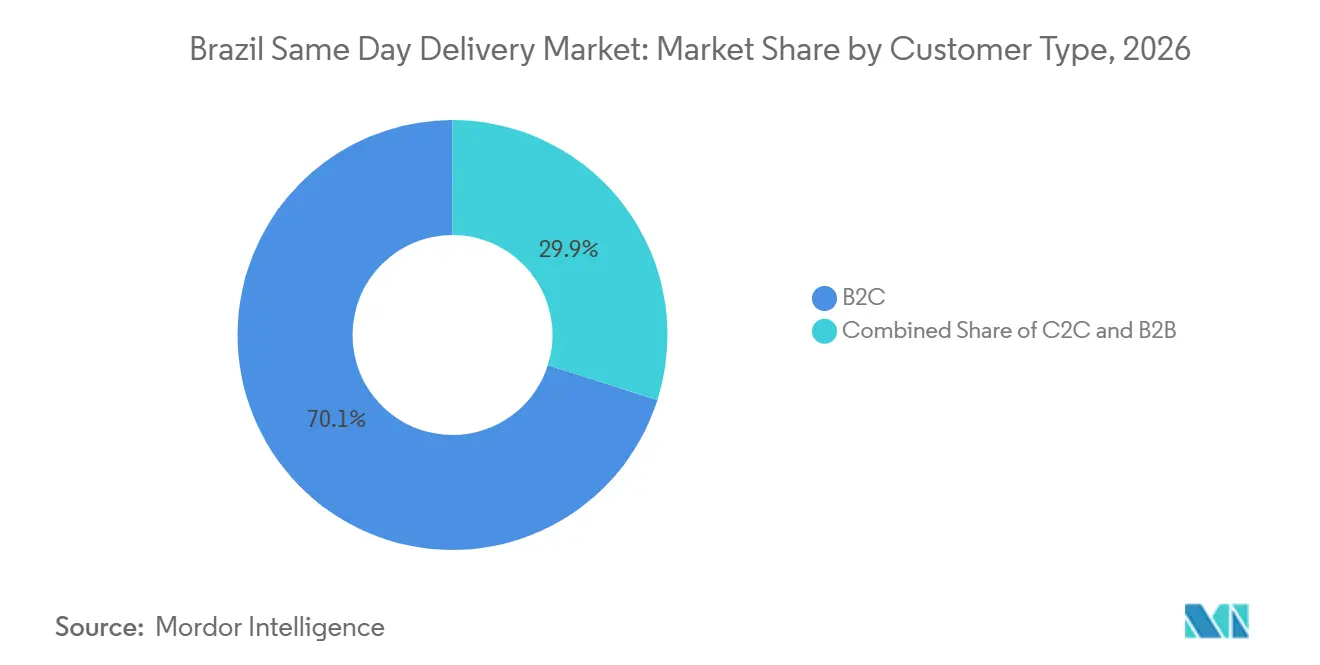
B2C Sets the Service StandardB2C accounts for 70.12% of the Brazil same day delivery market size in 2026. This customer group places the greatest weight on smooth checkout, clear delivery promises, and broad product availability. Mercado Libre stated that 76% of its deliveries were completed within 48 hours in the first quarter of 2026, reflecting the scale of consumer delivery demand it serves. Its decision to extend same-day delivery to Sundays nationwide in June 2026 further raised service expectations for frequent B2C orders. The scale of the segment encourages marketplaces to use delivery speed as a retention tool. It also puts smaller carriers under pressure to offer consistent service without the same captive order base.
C2C is forecast to record an 8.31% CAGR through 2032. Peer-to-peer resale, local transfers, and app-based courier services are broadening the need for flexible parcel movement. Uber and Loggi expanded Envio Nacional to several major cities in 2025, with Loggi handling collection and delivery to more than 5,500 municipalities. This service gives individual users a structured option for domestic parcel dispatch. B2B remains smaller by volume, but carriers such as Jadlog and DHL value it because corporate deliveries can support stronger margins. Together, these segments create a balance between high-volume consumer demand and more specialized logistics needs.

By Service Model:
Standard Same day Leads While Scheduling Gains ValueStandard same day accounts for 56.37% of the Brazil same day delivery market share in 2026. Buyers can receive items on the purchase day without paying for a narrow delivery slot. Broader windows allow platforms to group stops and reduce the need for costly last-minute changes. This model suits price-sensitive shoppers in large cities, where a delivery promise before the end of the day is often sufficient. It also allows courier networks to manage volume around traffic and weather conditions. Standard service is therefore likely to remain central where scale matters more than minute-level timing.
Scheduled same day is forecast to register at an 8.68% CAGR through 2032. Customers in professional and healthcare-related use cases increasingly value a known delivery period rather than only faster arrival. Reliable 2-hour windows can be more useful than a general same day commitment for medicines, work-related documents, and high-value orders. On-demand services are also expanding through iFood Turbo, Rappi Turbo, and Amazon Now. Their coverage remains limited by the close placement of inventory and available couriers. The Brazil same day delivery market uses a mix of standard, scheduled, and instant options to match delivery cost with customer urgency.
By Shipment Type:
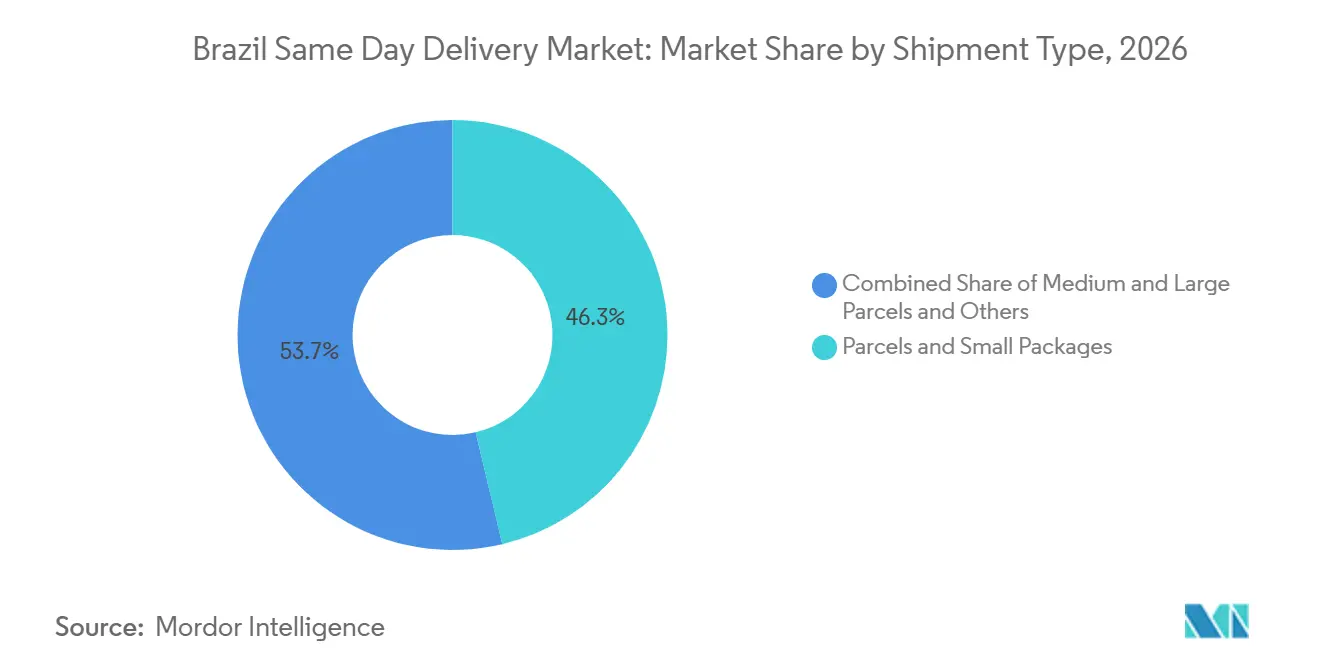
Small Parcels Lead, Larger Items Expand FasterParcels and small packages account for 46.28% of the Brazil same day delivery market share in 2026. Personal-care products, accessories, books, apparel, and small electronics are well suited to motorcycles and compact delivery vehicles. Their smaller dimensions support dense routes across urban corridors. The segment also aligns with the product mix of marketplaces and quick-commerce applications. Courier capacity can be used more efficiently when packages are light and handling time is limited. These factors keep small parcels at the core of same day operations.
Medium and large parcels are forecast to register at a 9.18% CAGR through 2032. Consumer electronics, appliances, home items, and larger pharmacy orders are expanding the range of products expected to arrive quickly. This shift requires more capable vehicles, better loading processes, and greater coordination with fulfillment centers. Documents retain a role in corporate, financial, and legal workflows where secure handoff is important. Bulky and heavy shipments remain an emerging opportunity, especially for small furniture and appliances. Their wider adoption depends on economical urban freight options and clearer operating rules for larger vehicles.
By End-User Industry:
Retail Provides Scale While Healthcare Grows FastestE-Commerce and retail accounts for 35.64% of the Brazil same day delivery market size in 2026. Marketplace operators use fast fulfillment to increase loyalty and reduce the chance that shoppers abandon their carts. Retail therefore drives much of the recurring order volume that supports dense urban routes. The Brazil same day delivery industry is especially shaped by retail platforms that can integrate storefronts, inventory, payment, and delivery. Same day options are becoming more relevant for apparel, consumer electronics, and household purchases. Retail’s scale also helps operators spread fulfillment costs across a broad set of categories.
Healthcare and pharmaceuticals are forecast to register a 10.34% CAGR through 2032. ABRAFARMA member networks recorded 57.7% growth in pharmacy deliveries during 2025, and deliveries represented 20% of pharmacy sales. ANVISA opened a process in August 2026 to regulate medicine logistics and delivery through e-commerce platforms and other digital channels. The regulatory process will be important for platforms handling prescription medicines and temperature-sensitive products. Food and grocery continues to overlap with quick commerce, while business services serve a more specialized delivery need. The mix of uses means that delivery networks must adapt to different handling, timing, and compliance requirements.
Geography Analysis
The Southeast accounts for 46.73% of the Brazil same day delivery market size in 2026. The region’s scale reflects a long-standing concentration of retailers, marketplaces, fulfillment space, and urban consumers in São Paulo and Rio de Janeiro. Mercado Libre reported that São Paulo achieved a 75% same day or next-day delivery rate in the first quarter of 2025, compared with 59% across other state capitals. Amazon Now began in São Paulo before extending to Rio de Janeiro, Campinas, and other cities, using the region as an early test environment for rapid delivery. Mercado Libre also launched one-hour prescription medicine delivery in São Paulo in September 2026. ANVISA’s digital medicine logistics process is a significant compliance factor for this model. Congestion remains a difficult constraint, with Senatran reporting that São Paulo’s vehicle fleet reached 10.1 million in 2026. Operators in the region need inventory proximity and active route management to sustain short delivery windows.
The North is expected to expand at a 9.34% CAGR from 2027 to 2032. The region is attracting fulfillment investment because additional capacity can open services for urban areas that have received slower parcel delivery in the past. Mercado Libre stated that its 2025 logistics expansion added North-facing facilities and increased the number of Manaus-area cities eligible for same day delivery. Shopee’s faster São Paulo to Manaus lane showed that targeted logistics changes can materially improve service in this geography. River freight, air transport, and limited road access make the cost structure different from Southeast city corridors. This favors well-capitalized operators and providers with established multimodal relationships. DHL announced investment aimed at infrastructure in the North and Northeast, including a new distribution hub within a plan to reach 3,300 Brazilian cities.
The Northeast is building more e-commerce logistics density through new local facilities. Shopee opened its 13th national distribution center in the Recife metropolitan area in 2025, which was its second fulfillment-model facility in Brazil. The South benefits from established urban centers, although Curitiba recorded 135 peak-hour hours lost to traffic in 2025. In the Central-West, Brasília is drawing platform activity as operators extend service beyond traditional delivery hubs. Rappi and 99Food are expanding into more cities as weekday demand becomes more relevant to infrastructure decisions. This group of regions offers distinct growth paths rather than a single national pattern. Local fulfillment, courier supply, municipal rules, and traffic conditions will determine which rapid-delivery model is viable in each city.
Competitive Landscape
The Brazil same day delivery market is moderately fragmented. MercadoLibre, Amazon Brasil, and Shopee have internalized a significant share of parcel logistics through their own networks. Independent carriers, including Jadlog, Total Express, Loggi, and J&T Express, compete with broader carrier networks and capacity investments. Jadlog opened the Nexus 87 hub in São Paulo in May 2026 after a BRL 200 million (USD 36.13 million) investment[4]. The facility is designed to process 400,000 packages a day and uses an automated sorting system. This investment shows that independent operators are using automation to compete on throughput and service quality.
Food delivery platforms form a separate competitive group in rapid delivery. iFood operates across more than 2,000 municipalities with 600,000 couriers, while Keeta and 99Food are entering with substantial investment commitments and promotional strategies. Rappi launched Turbo Farma in São Paulo in February 2026, using its own inventory, predictive courier positioning, and an on-site pharmacist to support rapid medicine delivery. Amazon and Rappi then combined their capabilities in the Amazon Now rollout across 8 cities. These moves show how fulfillment control, technology, and category expansion are becoming closely linked. CADE’s conduct framework for iFood exclusivity remains relevant as platforms expand their local delivery relationships. Competitive pressure is likely to remain strongest where coupons, rapid delivery, and merchant coverage overlap.
Technology and alternative delivery points offer another area for differentiation. Mercado Libre deployed more than 300 robots in and reduced order-processing time by 20%. The company’s fulfillment network also gives sellers an incentive to move inventory closer to demand. Pickup points and lockers remain comparatively limited in Brazil, which leaves room for carriers that can build a practical out-of-home network. This option can reduce failed delivery attempts and ease pressure in areas with difficult addresses or heavy traffic. The Brazil same day delivery industry will continue to depend on a mix of captive platform networks and specialized third-party providers.
Brazil Same Day Delivery Industry Leaders
-
MercadoLibre, Inc. (Mercado Livre)
-
Amazon.com, Inc. (Amazon Brasil)
-
Correios
-
iFood
-
Sea Group (SPX Express / Shopee)
- *Disclaimer: Major Players sorted in no particular order
Brazil Same Day Delivery Market Companies Covered in this Report
- MercadoLibre, Inc. (Mercado Livre)
- Amazon.com, Inc. (Amazon Brasil)
- iFood
- Correios
- Sea Group (SPX Express / Shopee)
- Total Express
- Loggi
- Uber Technologies, Inc.
- Lalamove
- Mottu
- Rappi
- DiDi Global Inc. (99Entrega)
- Shippify
- Ambev SA (Zé Delivery)
- Geopost (including Jadlog)
- Eu Entrego
- Azul (including Azul Cargo Express)
- Daki
- Magazine Luiza SA
- J&T Express
- DHL Group
- United Parcel Service, Inc.
Recent Industry Developments in Brazil Same Day Delivery Market
- October 2026: Mercado Libre planned to conclude 2026 with 72 large-scale logistics centers in Brazil, representing a 39% year-on-year increase. The network was expected to encompass more than 3.3 million square meters, with 20 new facilities planned to become operational during the final quarter, strengthening the company’s same-day delivery capabilities in Brazil.
- May 2026: Jadlog opened its Nexus 87 hub in São Paulo's Perus district, representing a BRL 200 million (USD 36.13 million) investment. The facility doubles Jadlog's processing capacity to 400,000 packages per day.
- April 2026: Mercado Libre acquired two logistics assets previously operated by Loggi, a distribution facility in Cajamar, SP, and a hub in São João de Meriti, RJ, both strategically located adjacent to São Paulo and Rio de Janeiro.
- February 2026: Rappi launched Turbo Farma in São Paulo, a vertically integrated pharmaceutical delivery operation using proprietary dark-store inventory, AI courier pre-positioning, and a licensed pharmacist on-site to fulfill ANVISA standards, promising 10-minute delivery within a 2 km radius.
Brazil Same Day Delivery Market Report Scope
Segmentation Overview
| B2C |
| B2B |
| C2C |
| On-Demand / Instant |
| Scheduled Same-Day |
| Standard Same-Day |
| Parcels and Small Packages |
| Documents |
| Medium and Large Parcels |
| Bulky / Heavy Shipments |
| E-commerce and Retail |
| Food and Grocery |
| Healthcare and Pharmaceuticals |
| Consumer Electronics |
| Fashion and Apparel |
| Business Services |
| Home and Furniture |
| Others |
| North |
| Northeast |
| Central-west |
| Southeast |
| South |
| By Customer Type | B2C |
| B2B | |
| C2C | |
| By Service Model | On-Demand / Instant |
| Scheduled Same-Day | |
| Standard Same-Day | |
| By Shipment Type | Parcels and Small Packages |
| Documents | |
| Medium and Large Parcels | |
| Bulky / Heavy Shipments | |
| By End-User Industry | E-commerce and Retail |
| Food and Grocery | |
| Healthcare and Pharmaceuticals | |
| Consumer Electronics | |
| Fashion and Apparel | |
| Business Services | |
| Home and Furniture | |
| Others | |
| By Region | North |
| Northeast | |
| Central-west | |
| Southeast | |
| South |
Key Questions Answered in the Report
What is the projected value of Brazil same day delivery in 2032?
The sector is projected to reach USD 742.11 million by 2032, growing at a 7.68% CAGR from 2027.
Which customer type leads rapid delivery in Brazil?
B2C leads with 70.12% revenue share in 2026, supported by large marketplace order volumes and rising consumer expectations for fast fulfillment.
Which service model is growing fastest in Brazil?
Scheduled same day is projected to register an 8.68% CAGR through 2032 as users place greater value on reliable delivery windows.
Why is healthcare delivery expanding quickly in Brazil?
Healthcare and pharmaceuticals are forecast to grow at a 10.34% CAGR through 2032, supported by expanding pharmacy delivery and ANVISA’s digital logistics review.
Which Brazilian region faces the highest demand for same day delivery?
Southeast leads with 46.73% revenue share in 2026 because of its concentration of sellers, fulfillment centers, consumers, and courier networks.
What limits fast parcel delivery in Brazilian cities?
Congestion, fuel and courier costs, municipal vehicle restrictions, and uneven cold-chain and address coverage can materially reduce delivery reliability across dense urban routes and raise operating costs.