
Brazil Robotic Lawn Mower Market Size and Share
Market Overview
| Study Period | 2021 - 2031 |
|---|---|
| Forecast Data Period | 2026 - 2031 |
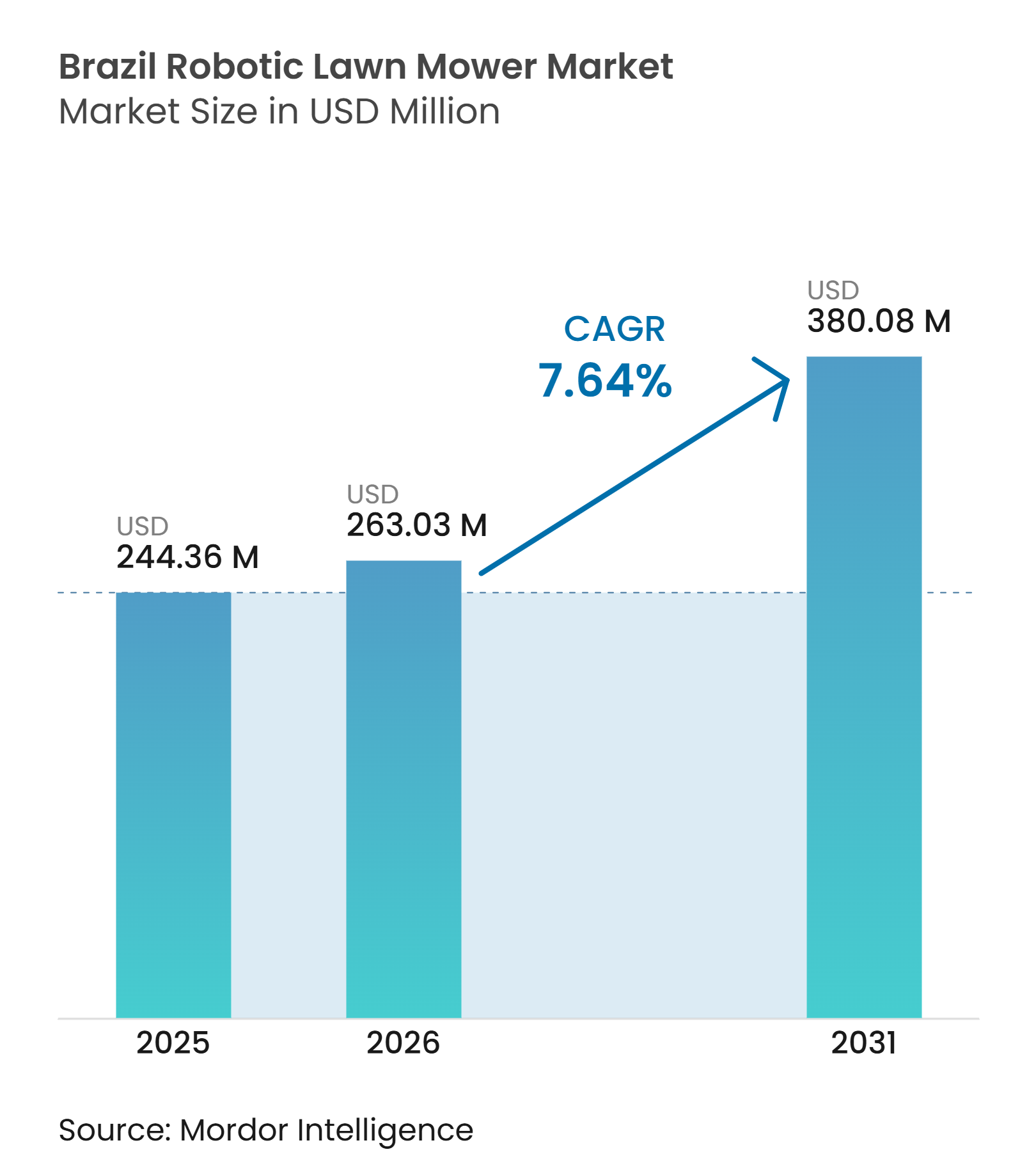
| Base Year Market Size (2025) | USD 244.36 Million |
| Market Size (2026) | USD 263.03 Million |
| Market Size (2031) | USD 380.08 Million |
| Growth Rate (2026 - 2031) | 7.64 % |
| Market Concentration | Medium |
Major Players *Disclaimer: Major Players sorted in no particular order Image © Mordor Intelligence. Reuse requires attribution under CC BY 4.0. | |
Brazil Robotic Lawn Mower Market Analysis by Mordor Intelligence
The Brazil robotic lawn mower market size was valued at USD 244.36 million in 2025 and is forecast to grow from USD 263.03 million in 2026 to reach USD 380.08 million by 2031, at a CAGR of 7.64% during the forecast period (2026-2031). Demand is centered on premium homes, condominiums, hotels, resorts, and managed commercial properties that require regular lawn care. Robotic equipment helps property managers maintain service standards when landscaping teams have limited time across multiple sites. Battery-powered mowing equipment also aligns with the broader shift away from engine-powered outdoor tools, supported by product investment from major manufacturers. Wire-free systems are expanding the addressable customer base by reducing installation work on irregular lawns. The Brazil robotic lawn mower market, therefore, offers opportunities for suppliers that combine reliable equipment, local service, and simpler setup.
Key Report Takeaways
- By range, low (less than 500 m²) accounted for 49.9% of the Brazil robotic lawn mower market share in 2025, while the high (more than 2,000 m²) is forecast to grow at a CAGR of 8.1% from 2026 to 2031.
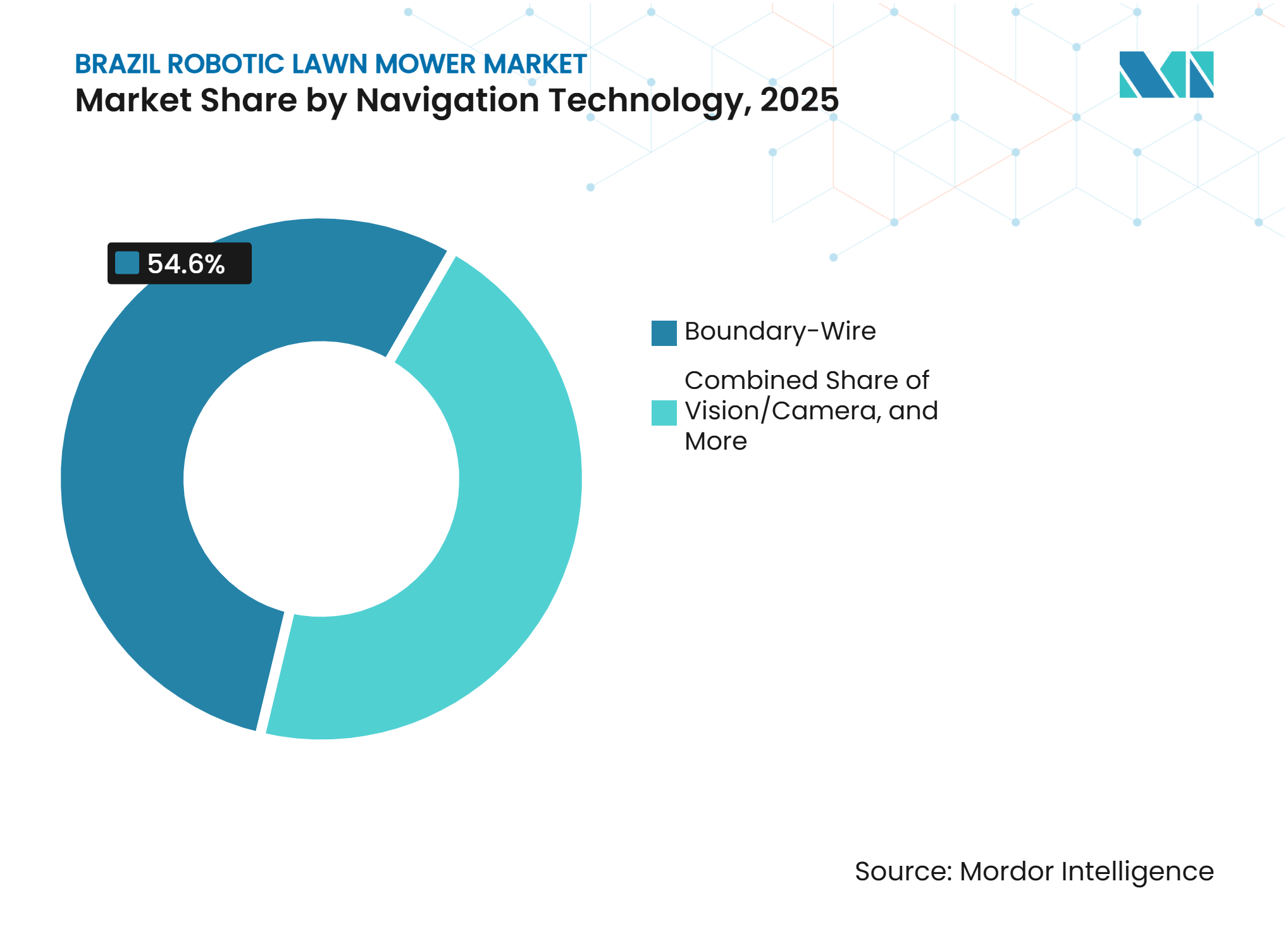
- By navigation technology, boundary-wire accounted for 54.6% of the Brazil robotic lawn mower market size in 2025, while vision/camera is forecast to grow at a CAGR of 8.8% from 2026 to 2031.
- By end user, residential accounted for 62.9% of the market share in 2025, while commercial is forecast to grow at a CAGR of 7.3% from 2026 to 2031.
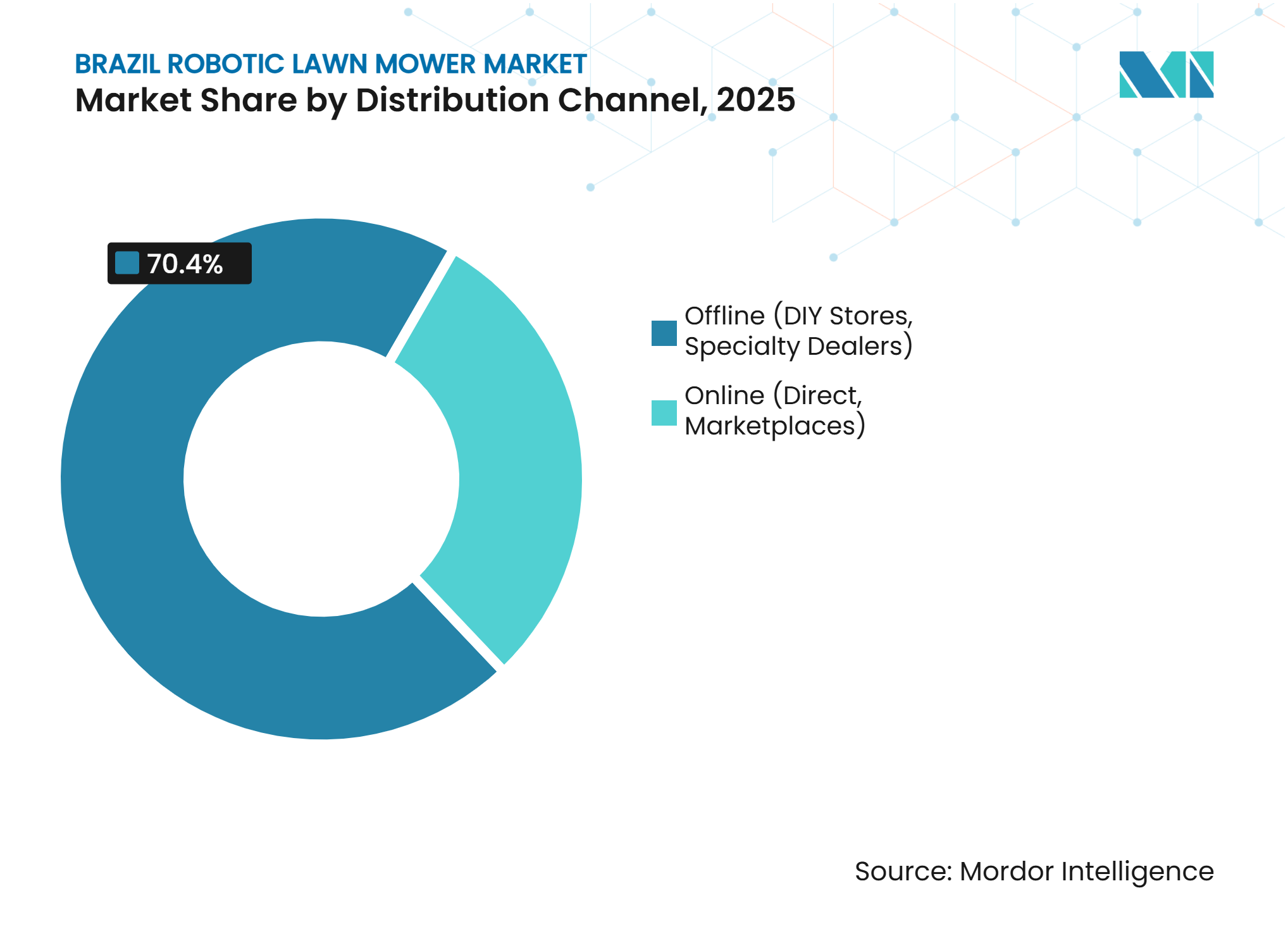
- By distribution channel, offline accounted for 70.4% of the market share in 2025, while online is forecast to grow at a CAGR of 7.7% from 2026 to 2031.
Note: Market size and forecast figures in this report are generated using Mordor Intelligence’s proprietary estimation framework, updated with the latest available data and insights as of January 2026.
Market Trends and Insights
Drivers Impact Analysis of Brazil Robotic Lawn Mower Market*
| Driver | (~) % Impact on CAGR Forecast | Geographic Relevance | Impact Timeline |
|---|---|---|---|
| Premium gated-community and hospitality landscaping demand | +1.8% | Brazil-wide, with the greatest concentration in São Paulo, Rio de Janeiro, and Minas Gerais | Medium term (2-4 years) |
| Battery-electric substitution in outdoor power equipment | +1.5% | National, supported by global product development | Long term (≥ 4 years) |
| Landscaping labor shortages and contractor productivity needs | +1.3% | National, particularly in urban and peri-urban areas | Medium term (2-4 years) |
| Retailer expansion of smart-home and premium garden equipment | +1% | National, with early gains in São Paulo, Rio de Janeiro, Belo Horizonte, and Curitiba | Short term (≤ 2 years) |
| Brazilian demand for wire-free navigation on complex properties | +1.2% | Brazil-wide, especially on multi-zone estates and commercial lawns | Medium term (2-4 years) |
| Local weatherproofing and thick-grass performance improvements | +0.9% | Brazil-wide, particularly in tropical and subtropical zones | Long term (≥ 4 years) |
| Source: Mordor Intelligence | |||
Premium Gated-Community and Hospitality Landscaping Demand
Premium residential and hospitality properties are important demand centers for the Brazil robotic lawn mower market. The demand is particularly relevant to properties with large shared outdoor areas that require frequent, consistent maintenance. Brazil received 9.3 million international visitors in 2025, up 37.1% from 2024, while international visitor spending reached nearly USD 7.9 billion [1]. Hotels and resorts must maintain outdoor areas as part of the guest experience. Robotic mowing can help operators maintain consistent schedules without assigning crews to every routine cut. This demand favors suppliers that can support larger properties and provide dependable local service.
Battery-Electric Substitution in Outdoor Power Equipment
The broader shift from engine-powered equipment to battery-powered tools is influencing product development across the global outdoor power equipment industry. Major suppliers are directing product development toward lithium-ion systems and automated equipment. This trend can increase the availability of electric mowing platforms for Brazilian distributors and support the adoption of robotic lawn mowers in Brazil. Dealers can also align staff training and after-sales support around battery-powered products. Robotic mowers are well-positioned to benefit from this broader transition, as they are already designed around electric power and connected controls.
Landscaping Labor Shortages and Contractor Productivity Needs
Landscaping contractors need to serve more properties while maintaining consistent service quality. A mower that operates on a planned schedule can reduce the number of routine crew visits to a site. This can allow a contractor to allocate employees to edging, repairs, and other work that requires direct attention. The Brazil robotic lawn mower market can benefit as labor constraints make manual landscaping schedules less predictable. The value proposition is stronger at sites requiring frequent mowing across multiple lawns. Contractors also need reliable service coverage before they can incorporate automated equipment into long-term contracts.
Retailer Expansion of Smart-Home and Premium Garden Equipment
Digital retail is making premium garden equipment more accessible outside the largest cities. Brazil's e-commerce sales reached USD 36.3 billion in 2025, with 94 million people purchasing online [2]. Online marketplaces can present product specifications, accessories, and brand options to customers who lack access to a nearby specialist store. Connected equipment may be more familiar to buyers who already use app-controlled household devices. The Brazil robotic lawn mower market can benefit from this broader product visibility. Retailers still need to provide clear installation guidance and service arrangements for first-time buyers.
Restraints Impact Analysis of Brazil Robotic Lawn Mower Market*
| Restraint | (~) % Impact on CAGR Forecast | Geographic Relevance | Impact Timeline |
|---|---|---|---|
| High import costs and premium upfront pricing | -2% | National, with greatest pressure on price-sensitive buyers outside premium homes | Short term (≤ 2 years) |
| Lower-cost manual landscaping labor | -1.5% | National, particularly in smaller cities and non-premium properties | Medium term (2-4 years) |
| Uneven terrain, tall grass, and rain-related reliability limits | -1.2% | Brazil-wide, especially in tropical and subtropical regions | Long term (≥ 4 years) |
| Theft exposure and limited specialized service coverage outside major cities | -0.8% | National, with service coverage concentrated in major cities | Medium term (2-4 years) |
| Source: Mordor Intelligence | |||
High Import Costs and Premium Upfront Pricing
Import costs remain a major limitation for the Brazil robotic lawn mower market. Most established robotic mower brands sell imported finished units, which exposes retail prices to duties, taxes, freight, and distribution margins. This structure can widen the price difference between robotic units and manual alternatives. Buyers in premium households must weigh equipment costs against expected service savings, which delays adoption among buyers with smaller lawns or shorter ownership horizons. Suppliers may need to offer flexible financing, clear warranty terms, and service support to address this purchase barrier.
Lower-Cost Manual Landscaping Labor
Manual landscaping remains a viable option for many homes and small commercial sites. Monthly service arrangements are common within property management and can be bundled with broader maintenance contracts, giving buyers a predictable recurring cost rather than a large upfront equipment purchase. The Brazil robotic lawn mower market is more compelling where labor teams must service large or numerous sites, and less compelling where local providers can offer regular mowing at a manageable cost. Sales approaches must therefore address both the service value and the long-term operating cost for robotic mowers.
*Our forecasts treat driver/restraint impacts as directional, not additive. The impact forecasts reflect baseline growth, mix effects, and variable interactions.
Brazil Robotic Lawn Mower Market Segment Analysis
By Range:
Low Segment Dominates While High Segment Records Faster GrowthThe Low (Less Than 500 m²) segment accounted for 49.9% of the Brazil robotic lawn mower market size in 2025. Small residential lawns form the broadest customer base for entry-level and mid-range products. These sites are generally easier to map and maintain than large commercial grounds. The segment benefits from homeowners seeking routine lawn care with limited manual effort.
The High (More Than 2,000 m²) segment is forecast to grow at a CAGR of 8.1% from 2026 to 2031, supported by demand from large estates, resort operators, and landscaping contractors. The potential for greater labor savings across larger properties and multiple sites makes it the fastest-growing segment within the range category. The Medium (501–2,000 m²) segment serves suburban homes, small commercial sites, and mid-scale hospitality grounds. It benefits from products positioned below the most expensive wire-free models. Husqvarna AB expanded its Automower NERA and iQ ranges in 2025 across lawns from 600 m² to more than 50,000 m² [3].
By Navigation Technology:
Boundary-Wire Leads While Vision/Camera Systems AccelerateThe Boundary-Wire technology segment accounted for 54.6% of the Brazil robotic lawn mower market size in 2025, making it the largest navigation technology segment. Its position is supported by its cost advantage, reliable performance on simple lawn layouts, and distributor experience in recommending and installing these systems. These factors support adoption among first-time buyers.
The Vision/Camera segment is forecast to grow at a CAGR of 8.8% from 2026 to 2031. The technology addresses challenges associated with obstructed satellite signals, irregular boundaries, and multi-zone layouts that can complicate other navigation approaches. GNSS and RTK-GPS technologies are suitable for open commercial lawns, although reference equipment can increase setup requirements. Segway Inc. launched six product series in February 2026, including products designed for professional commercial turf management. Vision/Camera systems are gaining traction as buyers increasingly prioritize easier setup and flexible mapping capabilities.


By End User:
Residential Segment Dominates While Commercial Use ExpandsThe Residential segment accounted for 62.9% of the Brazil robotic lawn mower market share in 2025. Premium homeowners, condominium associations, and small gated communities form the broad demand base. These users adopt automated mowing to maintain lawns while reducing routine manual effort. Familiarity with app-controlled home equipment can further support the adoption of connected mower features.
The Commercial segment is forecast to grow at a CAGR of 7.3% from 2026 to 2031, supported by demand from businesses that evaluate robotic equipment based on recurring labor requirements rather than household convenience. Brazil’s travel and tourism sector contributed USD 167.6 billion to the economy in 2025, equivalent to 7.7% of national GDP. Hotels and other managed properties can use automated mowing schedules to maintain outdoor presentation, supporting demand for robotic lawn mowers across larger managed sites.
By Distribution Channel:
Offline Segment Dominates While Online Channel ExpandsThe Offline segment accounted for 70.4% of the Brazil robotic lawn mower market share in 2025. DIY stores and specialist dealers provide product demonstrations, installation guidance, app setup, and after-sales service, which remain important for buyers with limited experience with robotic mowing equipment. Established dealer relationships also support the positions of Husqvarna AB and ANDREAS STIHL AG & Co. KG.
The Online segment is forecast to grow at a CAGR of 7.7% from 2026 to 2031, supported by broader product access beyond established dealer networks. Brazil's e-commerce market provides an expanding digital channel for product discovery and purchases. Wire-free products can further support online purchases by reducing the need for dealer visits for physical boundary-wire installation. Improvements in remote guidance, delivery, and service options can support the expansion of online distribution across Brazil.

Geography Analysis
Southeast Brazil is the primary adoption area for the Brazil robotic lawn mower market in 2026. The region combines high-density premium residential areas, hospitality properties, specialist dealers, and developed e-commerce logistics. These conditions support both in-person sales and after-sales service. São Paulo, Rio de Janeiro, and Belo Horizonte have the strongest retail and service presence among established suppliers.
The South region, including Paraná, Santa Catarina, and Rio Grande do Sul, is the next most developed commercial area. Larger residential properties support demand for medium and high-range equipment. The Brazil robotic lawn mower market has room to expand in this region through dealers serving larger properties, though suppliers need to match equipment capability to local grass and terrain conditions.
The Center-West, Northeast, and North regions remain at an earlier stage of robotic mower adoption. These regions have lower premium residential density and thinner specialist dealer networks. Seasonal rain and dense grass growth can make consistent performance more difficult. Brazil's National Tourism Plan targets 150 million domestic tourists by 2027. The Revive Brasil program supports the redevelopment of selected historical and cultural properties for tourism-related use in states including Pernambuco, Paraíba, São Paulo, and Minas Gerais. Expanded resort activity in the Northeast could create a larger commercial opportunity beyond the Southeast and South.
Competitive Landscape
Market Concentration
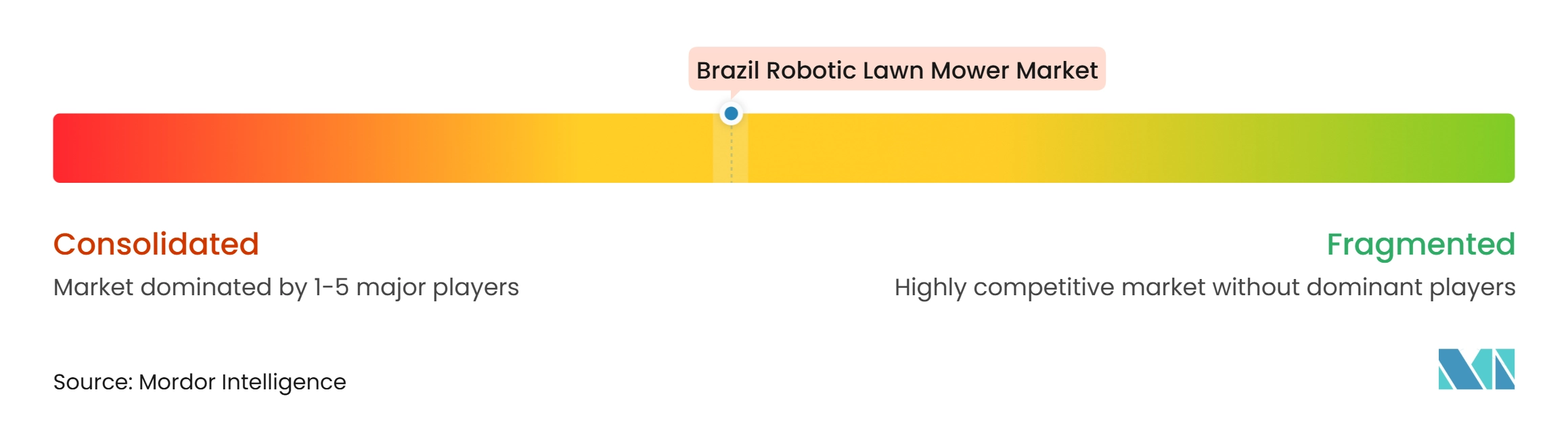
The Brazil robotic lawn mower market is moderately concentrated, with Husqvarna AB, ANDREAS STIHL AG & Co. KG, and Positec Technology Co., Ltd. among the prominent suppliers. These suppliers benefit from recognized brands, dealer relationships, and established service systems, supporting their positions in the market.
Husqvarna AB completed its largest product expansion in 2025, adding 13 boundary-wire-free robotic mower models and bringing its wire-free portfolio to 24 products. ANDREAS STIHL AG & Co. KG announced the next generation of iMOW and iMOW EVO mowers in January 2025, featuring MY iMOW app controls, smart-home integration, and gradient capability. These developments reflect the focus of established brands on connected features and expanded product portfolios. Dealer support remains important as buyers continue to value installation assistance and after-sales service, although this advantage may become less decisive as wire-free systems simplify setup.
Shenzhen Mammotion Technologies Co., Ltd. showcased its new LUBA 4 AWD series at IFA in September 2026, featuring Tri-Fusion positioning that combines LiDAR, NetRTK, and camera systems. Segway Inc. has expanded its Navimow range and entered professional service applications with the Terranox Series. Other suppliers, including Robert Bosch GmbH, STIGA S.p.A., ECOVACS ROBOTICS Co., Ltd., and Dreame Technology, also contribute to the competitive landscape. Opportunities exist for providers that strengthen regional service capabilities and offer products suited to local climate conditions.
Brazil Robotic Lawn Mower Industry Leaders
-
Husqvarna AB
-
ANDREAS STIHL AG & Co. KG
-
Positec Technology Co., Ltd.
-
Shenzhen Mammotion Technologies Co., Ltd.
-
Segway Inc. (Ninebot Limited)
- *Disclaimer: Major Players sorted in no particular order
Brazil Robotic Lawn Mower Market Companies Covered in this Report
- Husqvarna AB
- ANDREAS STIHL AG & Co. KG
- Robert Bosch GmbH
- Honda Motor Co., Ltd.
- Positec Technology Co., Ltd.
- The Toro Company
- STIGA S.p.A.
- Segway Inc. (Ninebot Limited)
- Shenzhen Mammotion Technologies Co., Ltd.
- ANTHBOT
- ECOVACS ROBOTICS Co., Ltd.
- Dreame Technology
- Sunseeker Robotics
- Yarbo
- EGO Power+ (Chervon)
Recent Industry Developments in Brazil Robotic Lawn Mower Market
- February 2026: Segway Inc. (Ninebot Limited) launched its 2026 Navimow lineup in Paris on February 3, 2026. The lineup comprises 6 product series: X4, H2, i2 AWD, i2 LiDAR, i2 LiDAR Pro, and Terranox. The company also entered professional commercial services with the Terranox Series for large-area turf management.
- February 2025: Husqvarna AB completed the largest single-season product expansion in its history, adding 13 boundary-wire-free robotic mower models. This brought its wire-free portfolio to 24 models covering 600 m2 to more than 50,000 m2.
- January 2025: ANDREAS STIHL AG & Co. KG announced the next generation of iMOW and iMOW EVO robotic mowers. The products include the MY iMOW app, gradient handling up to 40%, and smart-home system integration. EVO models support gradients of 45% and 60%.
Brazil Robotic Lawn Mower Market Report Scope
The market covers robotic lawn mowers used for autonomous grass cutting and lawn maintenance across residential and commercial applications in Brazil. It includes robotic mowing systems differentiated by their operating range, navigation technology, end user, and distribution channel.
The Brazil Robotic Lawn Mower Report is Segmented by Range (Low (Less Than 500 m2), Medium (501-2,000 m2), and High (More Than 2,000 m2)), by Navigation Technology (Boundary-Wire, Vision/Camera, and GNSS/RTK-GPS), by End-User (Residential and Commercial), and by Distribution Channel (Online (Direct, Marketplaces) and Offline (DIY Stores, Specialty Dealers)). The Market Forecasts are Provided in Terms of Value (USD).
Segmentation Overview
| Low (Less Than 500 m2) |
| Medium (501-2,000 m2) |
| High (More Than 2,000 m2) |
| Boundary-Wire |
| Vision/Camera |
| GNSS/RTK-GPS |
| Residential |
| Commercial |
| Online (Direct, Marketplaces) |
| Offline (DIY Stores, Specialty Dealers) |
| By Range | Low (Less Than 500 m2) |
| Medium (501-2,000 m2) | |
| High (More Than 2,000 m2) | |
| By Navigation Technology | Boundary-Wire |
| Vision/Camera | |
| GNSS/RTK-GPS | |
| By End-User | Residential |
| Commercial | |
| By Distribution Channel | Online (Direct, Marketplaces) |
| Offline (DIY Stores, Specialty Dealers) |
Key Questions Answered in the Report
What is the current value of robotic lawn mower market in Brazil?
The market was valued at USD 244.36 million in 2025 and is growing at a CAGR of 7.64%.
Which robotic lawn mower range is growing fastest in Brazil?
High-range mowers for lawns larger than 2,000 m² are forecast to grow at an 8.1% CAGR from 2026 to 2031.
Which navigation technology is expanding fastest?
Vision/Camera navigation is forecast to grow at an 8.8% CAGR from 2026 to 2031, driven by its ability to reduce setup constraints on complex properties.
What limits the adoption of robotic lawn mowers in Brazil?
Key barriers include the cost of imported units, competition from manual landscaping services, difficult operating conditions, theft risk, and uneven service coverage.