
Brazil Microgreens Market Size and Share
Market Overview
| Study Period | 2021 - 2031 |
|---|---|
| Forecast Data Period | 2026 - 2031 |
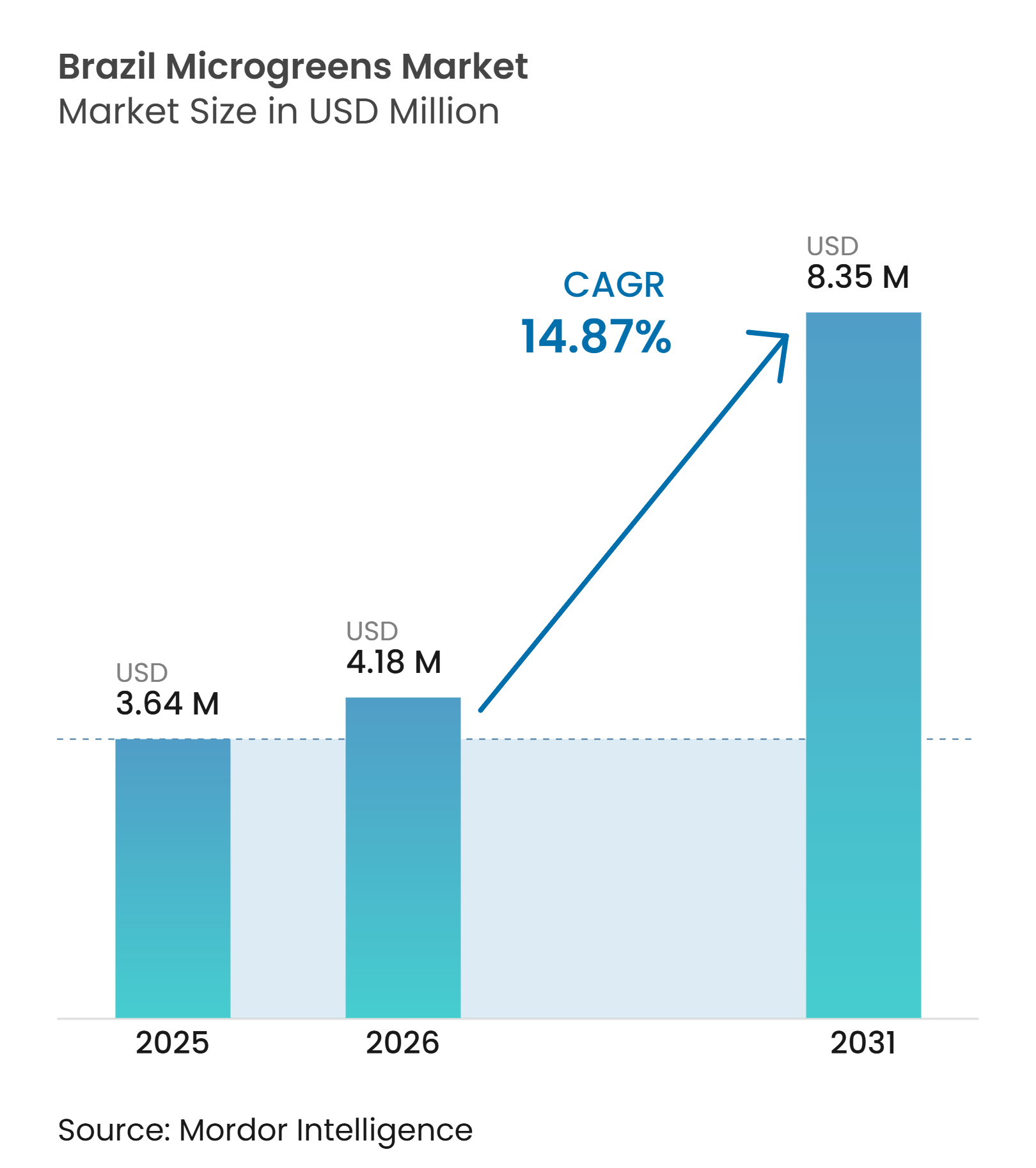
| Base Year Market Size (2025) | USD 3.64 Million |
| Market Size (2026) | USD 4.18 Million |
| Market Size (2031) | USD 8.35 Million |
| Growth Rate (2026 - 2031) | 14.87 % |
| Market Concentration | Low |
Major Players *Disclaimer: Major Players sorted in no particular order Image © Mordor Intelligence. Reuse requires attribution under CC BY 4.0. | |
Brazil Microgreens Market Analysis by Mordor Intelligence
The Brazil microgreens market size was valued at USD 3.64 million in 2025 and is estimated to grow from USD 4.18 million in 2026 to reach USD 8.35 million by 2031, at a CAGR of 14.87% during the forecast period (2026-2031). Rising urban incomes, broader interest in nutrient-dense produce, and demand from restaurants support sales in major cities. Controlled-environment farms can produce closer to consumers and reduce the freshness losses associated with long supply routes. Producers are also using subscriptions, direct delivery, and living-root formats to widen their customer base. Electricity costs limited refrigerated transport, uneven food-safety practices, and exposure to imported seed prices remain material constraints for the Brazil microgreens market.
Key Report Takeaways
- By type, Broccoli accounted for 27.5% of the Brazil microgreens market share in 2025, while Basil is forecast to grow at a CAGR of 16.2% from 2026 to 2031.
- By farming method, Indoor Farming accounted for 45.3% of the Brazil microgreens market share in 2025, while Vertical Farming is forecast to grow at a CAGR of 17.5% from 2026 to 2031.
- By growth medium, Peat Moss accounted for 33.2% of the market share in 2025, while Coconut Coir is forecast to grow at a CAGR of 15.6% from 2026 to 2031.
- By distribution channel, Restaurants accounted for 51.1% of the market share in 2025, while Other Channels are forecast to grow at a CAGR of 15.2% from 2026 to 2031.
Note: Market size and forecast figures in this report are generated using Mordor Intelligence’s proprietary estimation framework, updated with the latest available data and insights as of January 2026.
Market Trends and Insights
Drivers Impact Analysis of Brazil Microgreens Market*
| Driver | (~) % Impact on CAGR Forecast | Geographic Relevance | Impact Timeline |
|---|---|---|---|
| Rising demand for nutrient-dense premium produce | +3.2% | Brazil’s urban centers, especially São Paulo, Rio de Janeiro, and Belo Horizonte | Short term (≤ 2 years) |
| Restaurant and chef adoption of locally harvested microgreens | +2.6% | São Paulo, Rio de Janeiro, and Florianópolis | Short term (≤ 2 years) |
| Urban indoor production reducing freshness losses | +2.1% | Southeast and South Brazil, including São Paulo, Curitiba, and Florianópolis | Medium term (2-4 years) |
| Expansion of subscription and direct-to-consumer delivery | +1.8% | Major urban centers, with early adoption in São Paulo and Florianópolis | Short term (≤ 2 years) |
| Standardized substrates improving commercial yield | +1.4% | Nationwide, with early adoption in Southeast and South Brazil | Medium term (2-4 years) |
| Traceable living-root sales extending shelf life | +1.1% | Nationwide, with early use in premium retail clusters in São Paulo and Rio de Janeiro | Long term (≥ 4 years) |
| Source: Mordor Intelligence | |||
Rising Demand for Nutrient-Dense Premium Produce
Brazil’s urban consumer base is driving demand for premium fresh produce with a clear nutritional profile. Microgreens contain concentrated vitamins, minerals, and antioxidants compared with mature vegetables [1]. EMATER-MG identifies commercial production and sales practices for microgreens, supporting their use as a higher-value horticultural product [2]. The Brazil microgreens market stands to benefit as health-focused shoppers move beyond specialist stores and encounter these products in mainstream retail. This shift can expand familiarity among consumers who do not regularly dine at premium restaurants. Producers that communicate freshness, cultivation practices, and product use can make the category more accessible to new buyers.
Restaurant and Chef Adoption of Locally Harvested Microgreens
Restaurants provide an established demand base for microgreens farming in Brazil, particularly in São Paulo, Rio de Janeiro, and Florianópolis. Chef-led menus can create repeat purchasing when kitchens specify particular varieties over a season. Fazendas Bioma reported 95 points of sale across restaurants and supermarkets and BRL 50,000 (USD 9,091) in monthly revenue in September 2026. The company also reported using production planning to align orders with cultivation cycles across 25 species. This approach can limit waste and make smaller production operations more predictable. Food-service demand also helps introduce microgreens to consumers who later find them in stores or direct-delivery offerings.
Urban Indoor Production Reducing Freshness Losses
Brazil’s scale makes long-distance distribution difficult for short-shelf-life fresh products. Indoor and vertical farms can locate production closer to dense urban demand. Embrapa Hortaliças published technical guidance in 2024 on substrates used in commercial microgreen cultivation [3]. This technical support can reduce agronomic uncertainty for growers using controlled environments. Shorter supply routes allow producers to deliver fresh products without depending on extensive refrigerated distribution. The Brazil microgreens market can therefore develop city by city rather than relying solely on national produce supply chains.
Expansion of Subscription and Direct-to-Consumer Delivery
Subscription and direct-to-consumer models can convert occasional purchases into recurring orders. VerdeVida offers microgreen products and a subscription service for Brazilian consumers and restaurants. Fazendas Bioma reported that its planning system aligns orders with cultivation cycles, which helps coordinate production with expected demand. These models can reduce the uncertainty around harvest timing for small farms. They can also improve tray use when growers know demand before planting. Direct delivery gives producers another route to consumers when conventional retail distribution is limited.
Restraints Impact Analysis of Brazil Microgreens Market*
| Restraint | (~) % Impact on CAGR Forecast | Geographic Relevance | Impact Timeline |
|---|---|---|---|
| High electricity and climate-control costs | -2.3% | Nationwide, especially high-tariff industrial electricity areas | Short term (≤ 2 years) |
| Short shelf life and limited refrigerated distribution | -1.9% | Nationwide, with the strongest effect in North, Northeast, and Center-West Brazil | Medium term (2-4 years) |
| Seed supply volatility and imported-input exposure | -1.5% | Nationwide, with exposure to international seed supply disruption | Medium term (2-4 years) |
| Food-safety standardization gaps among small producers | -1.6% | Nationwide, particularly in secondary cities and rural areas | Long term (≥ 4 years) |
| Source: Mordor Intelligence | |||
High Electricity and Climate-Control Costs
Electricity is a major operating cost for indoor and vertical farms, with power consumed by grow lighting, cooling, humidity control, and climate-control backup systems. The Brazil microgreens market is exposed to this cost, as production systems depend on stable indoor conditions. Larger operators generally have more options for managing energy procurement than micro-producers. High energy costs can extend the payback period for commercial growing equipment. This pressure is most acute in regions where cooling requirements and commercial electricity tariffs are high.
Short Shelf Life and Limited Refrigerated Distribution
Microgreens require timely handling due to their limited shelf life. Refrigerated distribution is less available outside major metropolitan corridors, with this constraint being most pronounced in North, Northeast, and Center-West Brazil. Long-distance transport can reduce product quality before it reaches retail stores or food-service buyers. Local indoor production can reduce the transport burden but does not eliminate distribution requirements. Expansion into underserved cities depends on reliable cold-chain and last-mile delivery capacity.
*Our forecasts treat driver/restraint impacts as directional, not additive. The impact forecasts reflect baseline growth, mix effects, and variable interactions.
Brazil Microgreens Market Segment Analysis
By Type:
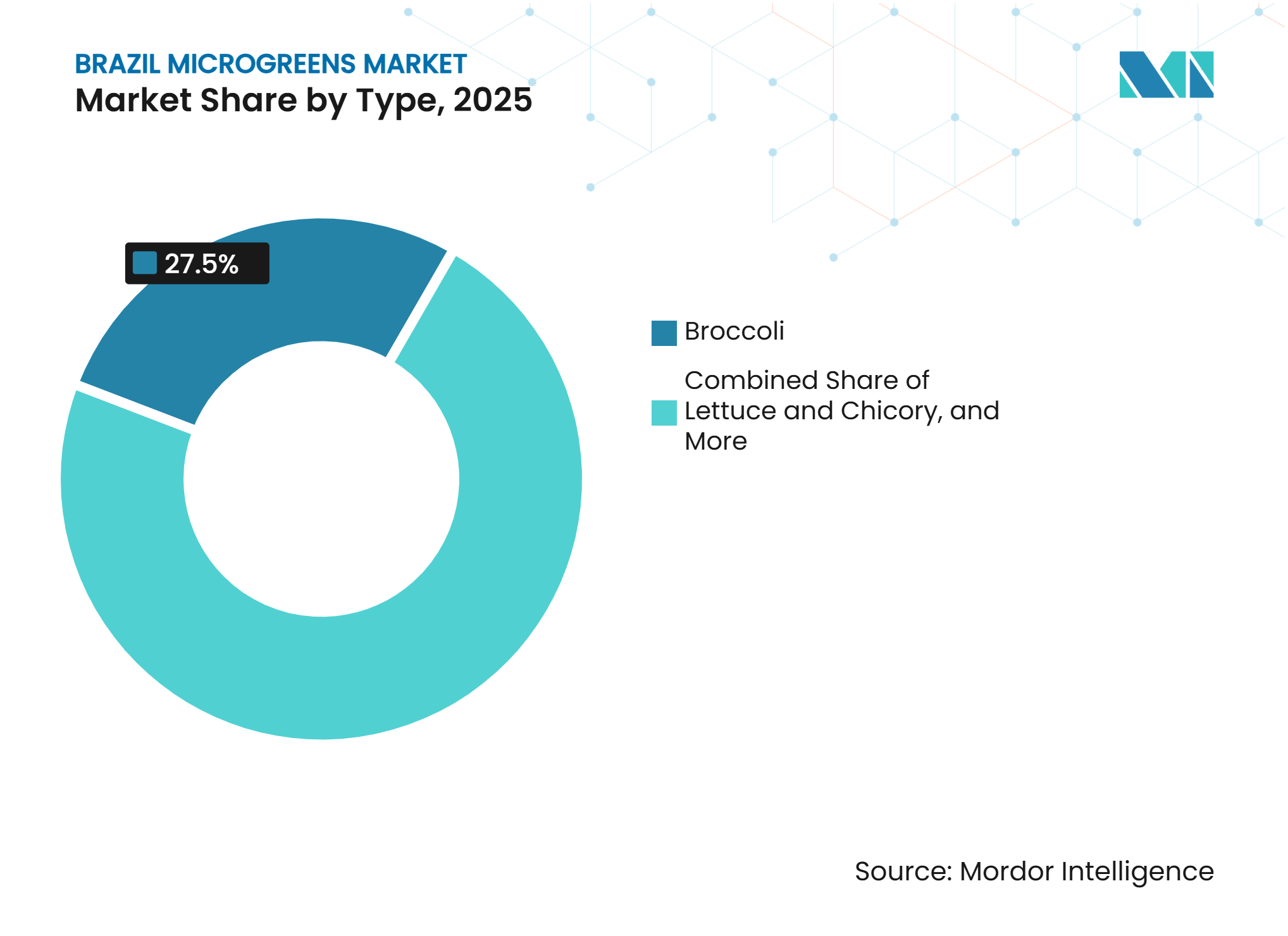
Broccoli Anchors Volume While Basil Leads GrowthBroccoli held 27.5% of the Brazil microgreens market by type in 2025. Its established commercial position reflects a rapid 7-10-day harvest cycle and broad appeal among food-service and retail buyers. Embrapa Hortaliças has published technical guidance on substrate selection for commercial microgreen production, which supports growers that require repeatable cultivation practices. Radish can be harvested in as few as 5 days and suits restaurants seeking frequent replenishment. Arugula retains a premium position in São Paulo food service. Sunflower offers a visually distinct product for retail packs. Lettuce and chicory varieties can leverage existing hydroponic familiarity while moving into higher-value microgreen formats. Peas, fennel, and carrots remain more specialized choices for fine-dining buyers. Their narrower demand requires growers to maintain reliable production for customers with specific menu needs.
Basil is forecast to grow at a 16.2% CAGR of 16.2% from 2026 to 2031, the fastest rate among the listed types. The Brazil microgreens market size for Basil benefits from demand in Italian-cuisine restaurants and premium ready-meal applications. Basil can also be used in functional beverage products, which broadens its potential use. Agristar do Brasil markets 10 microgreen cultivars to Brazilian producers through its Topseed portfolio. Wider access to commercially selected seed varieties can support more varied crop portfolios. This input availability may reduce reliance on the limited set of types currently common in domestic production. Producers can use diversified offerings to address restaurant, retail, and direct-delivery demand. The Brazil microgreens industry gains depth when growers can supply more consistent variety choices, supporting buyers that seek both familiar and more specialized options. It also gives producers more flexibility when serving multiple customer channels.



By Farming Method:
Indoor Farming Leads While Vertical Farming ExpandsIndoor Farming accounted for 45.3% of the Brazil microgreens market share in 2025. This position reflects a lower entry barrier for single-tray production compared to multi-tier vertical systems. Smaller indoor operations can suit micro-entrepreneurs serving nearby restaurants, stores, or subscribers. Commercial greenhouses retain a role in South and Southeast Brazil, where protected horticulture is already established, though their higher minimum scale and temperature-management requirements can limit their suitability for microgreens. Other methods include community rooftops and school-based programs, which support consumer familiarity and practical skills development. The Brazil microgreens market remains accessible to operators with varying capital resources. Single-tray systems allow growers to build experience before moving to denser production formats, creating a practical entry route for local operators.
Vertical Farming is forecast to grow at a CAGR of 17.5% from 2026 to 2031. Multi-tier racks increase output from a limited urban footprint and support production near consumers. This method is attracting interest where urban space is scarce and demand is concentrated. BeGreen signed a 5-year agreement with Vale S.A. in August 2025 to operate a 6,000 m² controlled-environment facility in Nova Lima, Minas Gerais. The arrangement converts underused corporate space into an urban farming site with an anchor-customer structure, which can reduce some commercial risk for operators with the scale to secure such agreements. Vertical systems also require careful management of energy use and environmental controls. Their faster growth therefore reflects higher production density rather than lower operating complexity. Operators must balance space use against power requirements and growing-system controls, making this method most relevant where concentrated demand can support regular output.
By Growth Medium:
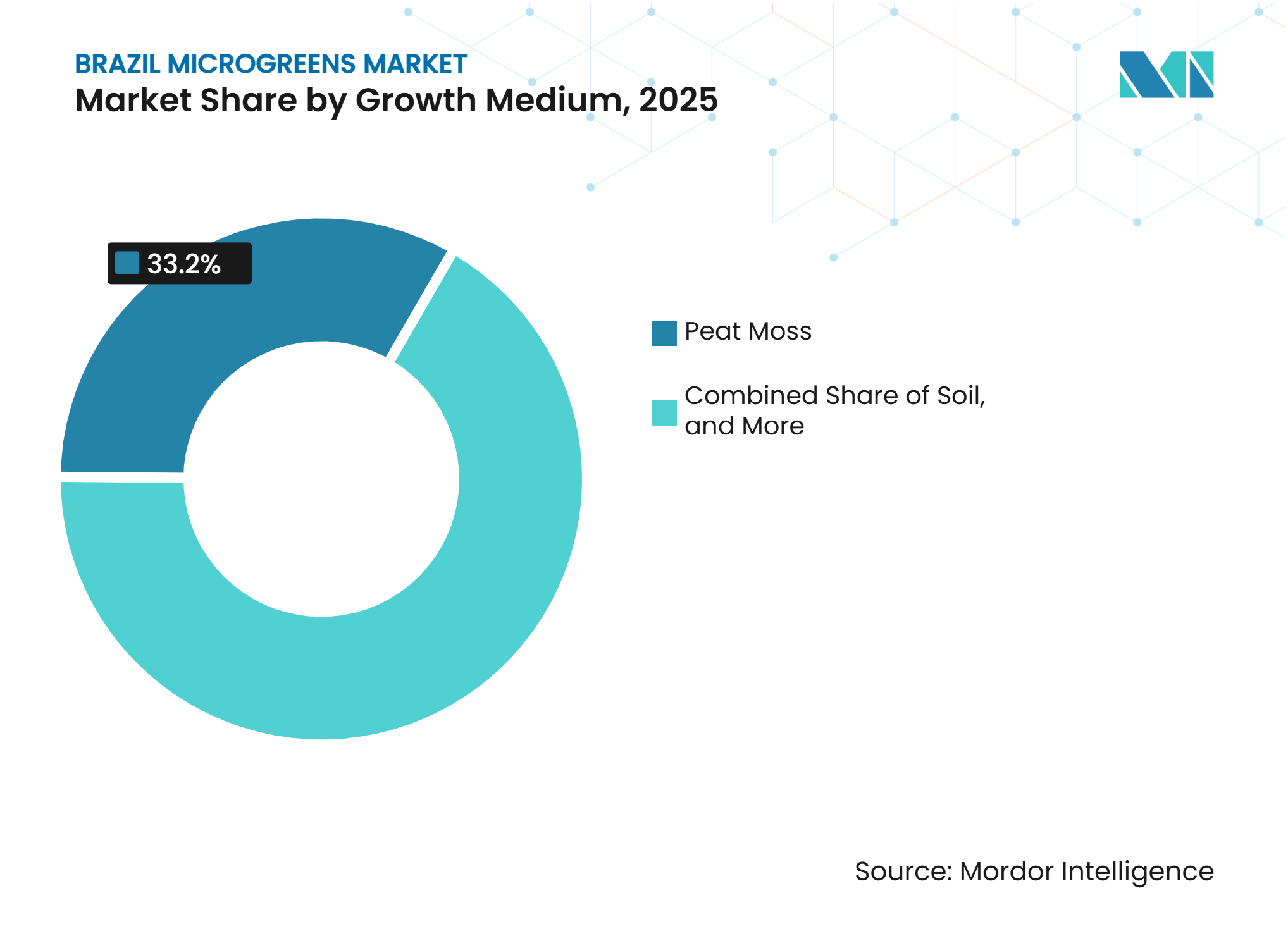
Peat Moss Leads While Coconut Coir Gains UsePeat Moss held 33.2% of the Brazil microgreens market share in 2025. It has an established position in commercial horticulture and is available through agricultural distribution networks. Soil remains common among entry-level and small-scale producers due to its wide availability, though uniformity and pathogen management can be difficult in high-turnover production. Tissue paper has a small commercial role and is more suitable for educational or home cultivation, offering limited structural support as roots develop. Other growth media include phenolic foam, jute mats, and biofiber. Floral Atlanta offers the Green-up biodegradable substrate, which is also used for microgreen production. These alternatives give growers more choices when standardizing tray preparation and can be selected based on root support and water-management needs.
Coconut Coir is forecast to grow at a CAGR of 15.6% from 2026 to 2031. Its renewable material profile, water retention, and suitability for soil-contact and hydroponic systems support adoption. Embrapa Hortaliças evaluated coconut coir in 2024 technical work on microgreen substrate selection. Fazendas Bioma filed a patent application in September 2026 for a water-soluble biofilm that embeds seeds in coconut-coir mats. The system can standardize planting preparation across decentralized sites, making coir part of an integrated production method rather than only a growing medium. Producers can use standardized substrates to improve consistency across repeated cultivation cycles. The Brazil microgreens industry may benefit when input systems are easier to replicate across locations, which is especially relevant for growers using a franchise model, as it can reduce variation between sites using the same cultivation process.

By Distribution Channel:
Restaurants Lead While Other Channels Grow FastestRestaurants held 51.1% of the Brazil microgreens market share in 2025. Their role reflects premium pricing and recurring volume from food-service buyers. Chefs also help introduce the product category to consumers through menu use. Hypermarkets and Supermarkets are an important secondary route to buyers. Brotou! Microverdes supplies supermarkets in Curitiba and São José dos Pinhais, demonstrating retail use beyond restaurant channels. Store placement makes microgreens visible to shoppers who may not encounter them in food service, which can shorten the consumer education process. The Brazil microgreens market is becoming less dependent on specialty outlets as grocery availability improves. Supermarket access places the product alongside familiar vegetables, making the category easier for shoppers to consider during regular grocery purchases.
Other Channels are forecast to grow at a CAGR of 15.2% from 2026 to 2031. This group includes subscriptions, e-commerce, direct delivery, farmers’ markets, schools, and corporate cafeterias. These channels can serve consumers who want fresh produce delivered or bought closer to home. VerdeVida’s subscription offer illustrates a direct route to restaurant and household customers. Recurring weekly orders can improve demand visibility for growers, while institutional buyers can introduce products to new consumer groups. The growth of these channels reflects a broader shift away from reliance on a single route to market. Performance depends on reliable cultivation, timely delivery, and product quality, as buyers in these channels expect fresh products on a recurring basis. Strong operational planning can help growers meet that expectation.
Geography Analysis
São Paulo state is the dominant hub of the Brazil microgreens market. Greater São Paulo had a population above 21.6 million in 2025, creating a large urban consumer base and a strong food-service market. The state hosts urban-farm operators, large retail and restaurant networks, and a developed commercial ecosystem that supports the distribution of premium and highly perishable products. The concentration of consumers, food-service establishments, and retail channels makes São Paulo a key market for microgreens production and consumption.
South Brazil, centered on Florianópolis and Curitiba, is an emerging area for microgreens farming. Fazendas Bioma reported 25 species, 95 points of sale, and BRL 50,000 (USD 9,091) in monthly revenue in Florianópolis in September 2026. Its planned national franchise network could expand production closer to buyers in secondary cities. Brotou! Microverdes has established supermarket distribution in Curitiba and São José dos Pinhais. These developments indicate the expansion of urban-farm models beyond São Paulo and support localized production of highly perishable microgreens.
North, Northeast, and Center-West Brazil represent areas with less developed commercial coverage. Cities such as Recife, Salvador, and Goiânia have growing consumer income and food-service activity. Refrigerated distribution remains less developed than in the Southeast, which limits the conventional supply of short-shelf-life products. Indoor production can address this gap, but higher cooling requirements raise break-even thresholds in warmer areas. BeGreen’s 6,000 m² Nova Lima facility provides a commercial base in Minas Gerais that can serve premium buyers across the state
Competitive Landscape
Market Concentration
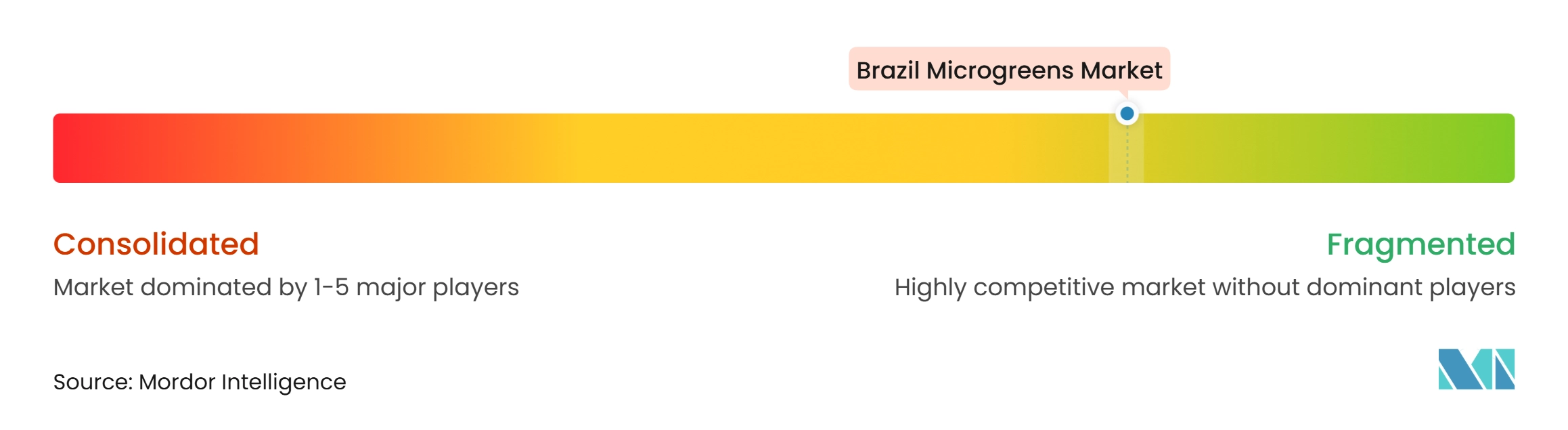
The Brazil microgreens market is fragmented, with Pink Farms, BeGreen, Fazendas Bioma, Cityfarm Agricultura Urbana, and VerdeVida among the companies operating in the market. The competitive landscape includes capitalized urban-farm startups, mid-scale direct-to-consumer operators, and micro-producers serving local customers. Larger farms compete through production capacity and controlled-environment systems, while smaller operators differentiate themselves through local delivery, subscription models, and customer loyalty.
Fazendas Bioma filed a patent application in September 2026 for a seed-embedded, water-soluble biofilm used with coconut-coir mats. The technology can support more standardized planting for franchise operations. BeGreen’s 5-year Nova Lima agreement with Vale S.A. created an anchor-customer model for a 6,000 m² controlled-environment facility. Agristar’s portfolio of 10 microgreen cultivars adds input options for Brazilian growers. These developments reflect competition across production methods, cultivation inputs, and routes to customers.
Living-root products and expansion into secondary cities remain areas of limited current coverage. Products sold with roots intact can offer consumers a longer usable life and may simplify supermarket handling. ANVISA’s RDC 843/2024 provides food and packaging regulatory pathways that formal operators can use as a quality signal. Consistent compliance may help larger producers differentiate from informal suppliers. Subscription sales, standardized substrates, and traceable living-root formats can help growers serve retail and institutional demand beyond major metropolitan areas.
Brazil Microgreens Industry Leaders
-
Pink Farms
-
BeGreen
-
Fazendas Bioma
-
Cityfarm Agricultura Urbana
-
VerdeVida
- *Disclaimer: Major Players sorted in no particular order
Brazil Microgreens Market Companies Covered in this Report
- Pink Farms
- BeGreen
- Fazendas Bioma
- Cityfarm Agricultura Urbana
- VerdeVida
- Fazenda Cubo
- Brota Company
- Pacha Mama Agroecologia
- Local Greens
- Brotou! Microverdes
- Floral Atlanta
- Agristar do Brasil
- ISLA Sementes (Sakata Seed Corporation)
- Fresh Origins
- Farmbox Greens (Charlie’s Produce)
Recent Industry Developments in Brazil Microgreens Market
- September 2026: Fazendas Bioma publicly disclosed milestone operational metrics of BRL 50,000 (USD 9,091) in monthly revenue, 95 points of sale across restaurants and supermarkets, and 1,500 microgreen units produced weekly from 25 species. It also announced plans for a national franchise network to decentralize microgreen production closer to consumers across Brazil.
- October 2025: Brazil enacted Decreto No. 12.709, establishing SISBI-POV as a unified national inspection system for vegetable-origin products. The decree creates a standardized compliance framework applicable to fresh microgreens and provides regulatory clarity for producers seeking formal supermarket supply-chain access.
- August 2025: BeGreen signed a 5-year comodato agreement with Vale S.A. to operate a 6,000 m² controlled-environment farming facility at Vale’s Nova Lima, Minas Gerais complex. The agreement uses underused industrial real estate for urban farming under an anchor-customer model.
Brazil Microgreens Market Report Scope
Microgreens are young, edible vegetable and herb seedlings harvested between the cotyledon and first true-leaf stages. They are cultivated in controlled and conventional growing systems and are primarily used as fresh ingredients for their flavor, visual appeal, and nutritional value.
The Brazil Microgreens Market Report is Segmented by Type (Broccoli, Lettuce and Chicory, Arugula, Basil, Fennel, Carrots, Sunflower, Radish, Peas, and Other Types), By Farming Method (Indoor Farming, Vertical Farming, Commercial Greenhouses, Other Farming Methods), By Growth Medium (Peat Moss, Soil, Coconut Coir, Tissue Paper, and Other Growth Media), and By Distribution Channel (Restaurants, Hypermarkets and Supermarkets, and Other Channels). The Market Forecasts are Provided in Terms of Value (USD).
Segmentation Overview
| Broccoli |
| Lettuce and Chicory |
| Arugula |
| Basil |
| Fennel |
| Carrots |
| Sunflower |
| Radish |
| Peas |
| Other Types |
| Indoor Farming |
| Vertical Farming |
| Commercial Greenhouses |
| Other Farming Methods |
| Peat Moss |
| Soil |
| Coconut Coir |
| Tissue Paper |
| Other Growth Media |
| Restaurants |
| Hypermarkets and Supermarkets |
| Other Channels |
| By Type | Broccoli |
| Lettuce and Chicory | |
| Arugula | |
| Basil | |
| Fennel | |
| Carrots | |
| Sunflower | |
| Radish | |
| Peas | |
| Other Types | |
| By Farming Method | Indoor Farming |
| Vertical Farming | |
| Commercial Greenhouses | |
| Other Farming Methods | |
| By Growth Medium | Peat Moss |
| Soil | |
| Coconut Coir | |
| Tissue Paper | |
| Other Growth Media | |
| By Distribution Channel | Restaurants |
| Hypermarkets and Supermarkets | |
| Other Channels |
Key Questions Answered in the Report
What is the current size of the Brazil microgreens market?
The Brazil microgreens market was valued at USD 4.18 million in 2026 and is forecast to reach USD 8.35 million by 2031 at a 14.87% CAGR.
Which microgreen type is growing fastest in Brazil?
Basil is the fastest-growing listed type, with a forecast CAGR of 16.2% through 2031.
Which farming method is growing fastest for Brazilian microgreens?
Vertical Farming is forecast to expand at a 17.5% CAGR from 2026 to 2031, ahead of the overall rate.
Which distribution channel is the largest for microgreens in Brazil?
Restaurants accounted for 51.1% of distribution-channel revenue in 2025, while Other Channels are forecast to grow fastest at 15.2% CAGR.
What constraints do Brazilian microgreen producers face?
Electricity costs, limited refrigerated distribution, uneven food-safety practices, and imported seed exposure remain key constraints.