
Brazil Hydroponics Market Size and Share
Market Overview
| Study Period | 2021 - 2031 |
|---|---|
| Forecast Data Period | 2026 - 2031 |
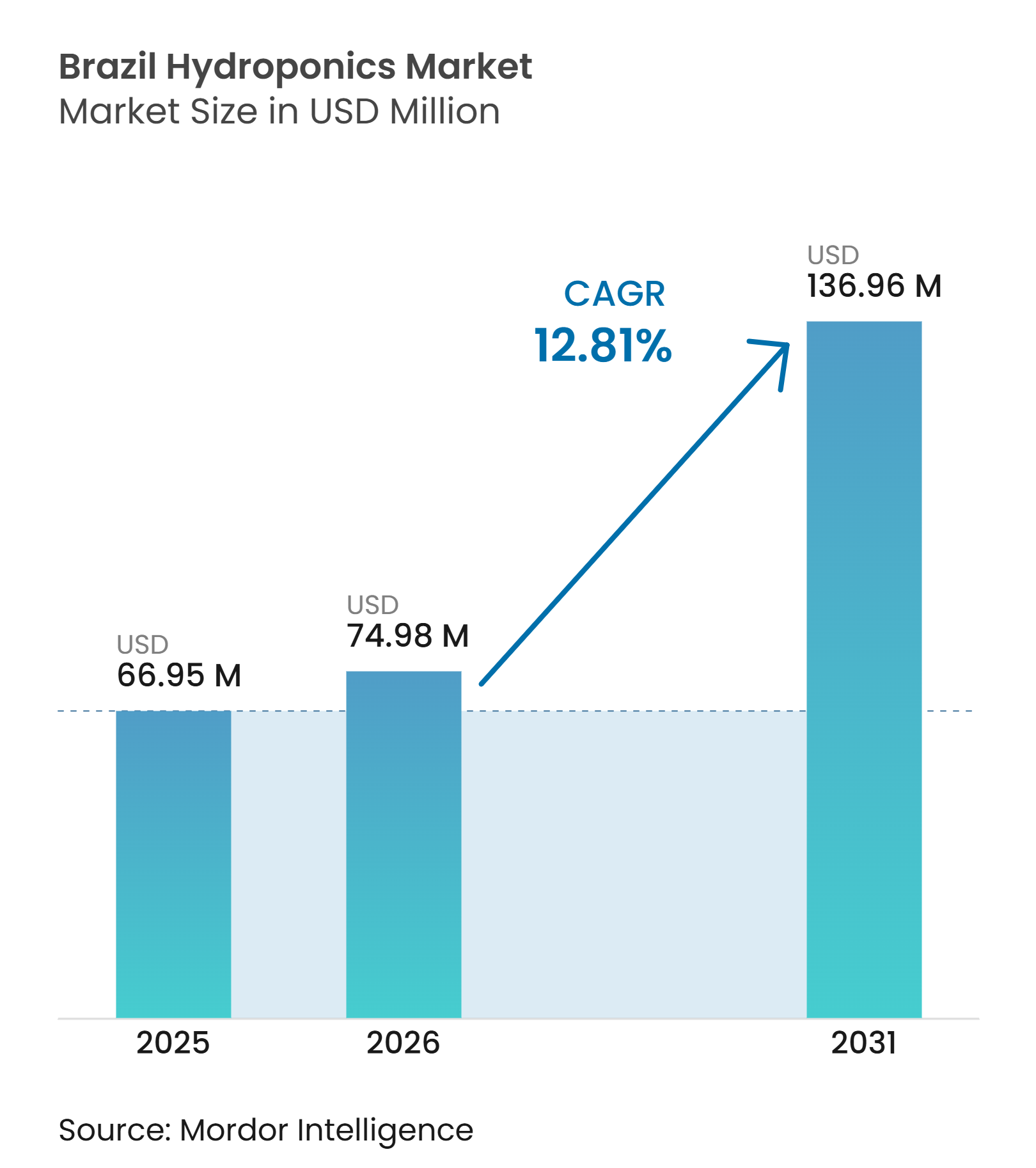
| Base Year Market Size (2025) | USD 66.95 Million |
| Market Size (2026) | USD 74.98 Million |
| Market Size (2031) | USD 136.96 Million |
| Growth Rate (2026 - 2031) | 12.81 % |
| Market Concentration | Low |
Major Players *Disclaimer: Major Players sorted in no particular order Image © Mordor Intelligence. Reuse requires attribution under CC BY 4.0. | |
Brazil Hydroponics Market Analysis by Mordor Intelligence
The Brazil hydroponics market size is estimated to be USD 66.95 million in 2025 and USD 74.96 million in 2026, projected to reach USD 136.96 million by 2031, at a CAGR of 12.81% during the forecast period (2026-2031). Brazil accounted for 42.0% of South American hydroponics output, supported by protected-horticulture capacity, agricultural research, and demand concentrated around large cities. Brazilian Agricultural Research Corporation (EMBRAPA) estimated that approximately 3,000 hectares in Brazil operated with hydroponic systems in 2025, mainly in the Southeast and South, while farm counts grew at a double-digit annual rate. Brazil's 87% urbanization rate placed a large customer base near established production sites, driving demand for leafy greens. The Brazil hydroponics market is also shaped by the inability to use the national organic label, which has encouraged pesticide-free and traceable positioning in premium channels. Water stress in the Northeast is broadening the role of controlled cultivation beyond the São Paulo area.
Key Report Takeaways
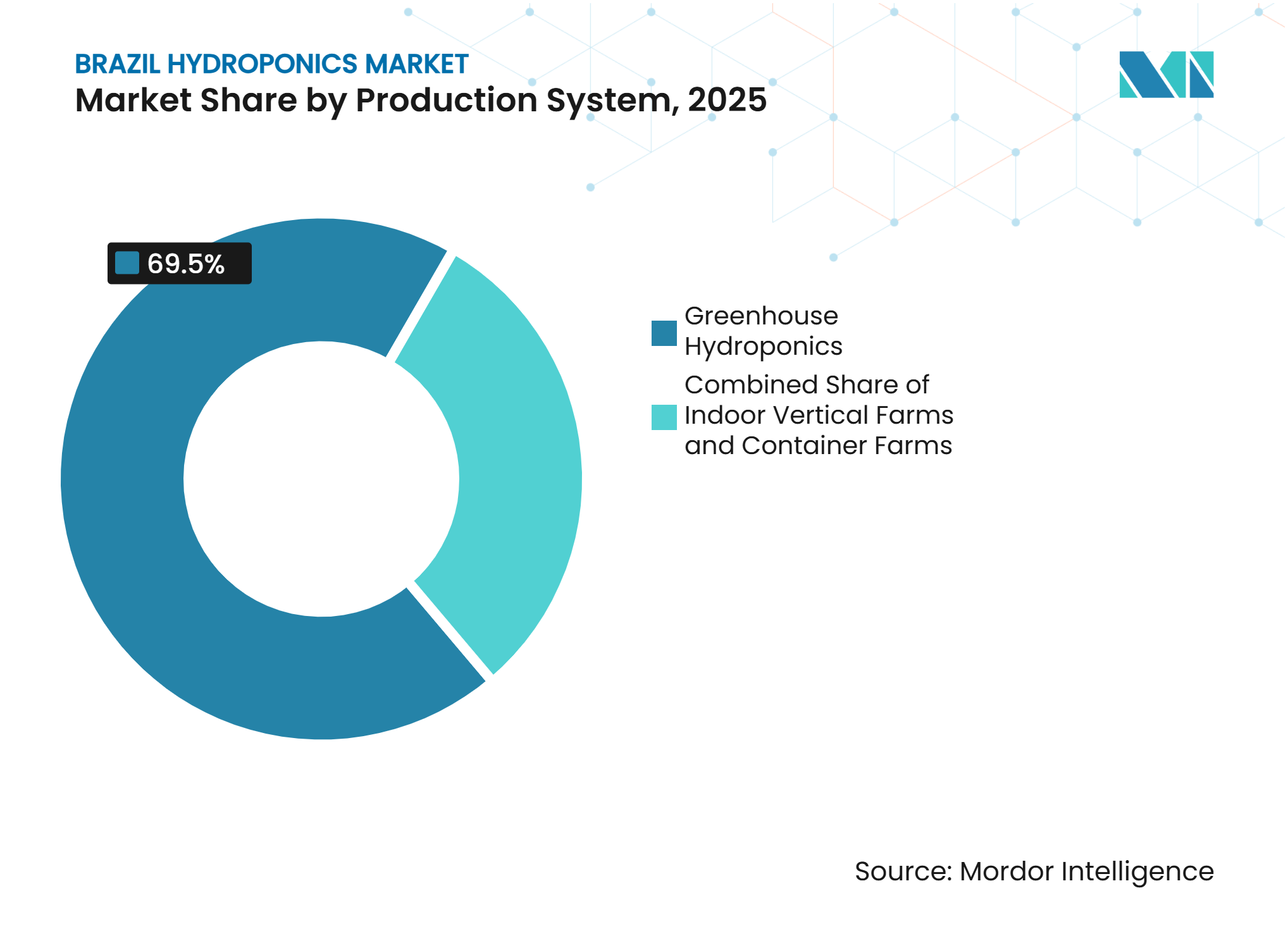
- By production system, greenhouse hydroponics accounted for the largest share, at 69.5% of the Brazil hydroponics market in 2025, while container farms are projected to grow at the fastest CAGR of 12.2% from 2026 to 2031.
- By crop type, leafy greens accounted for a 42.5% share of the Brazil hydroponics market size in 2025, while herbs and microgreens are projected to grow at the fastest CAGR of 12.9% from 2026 to 2031.
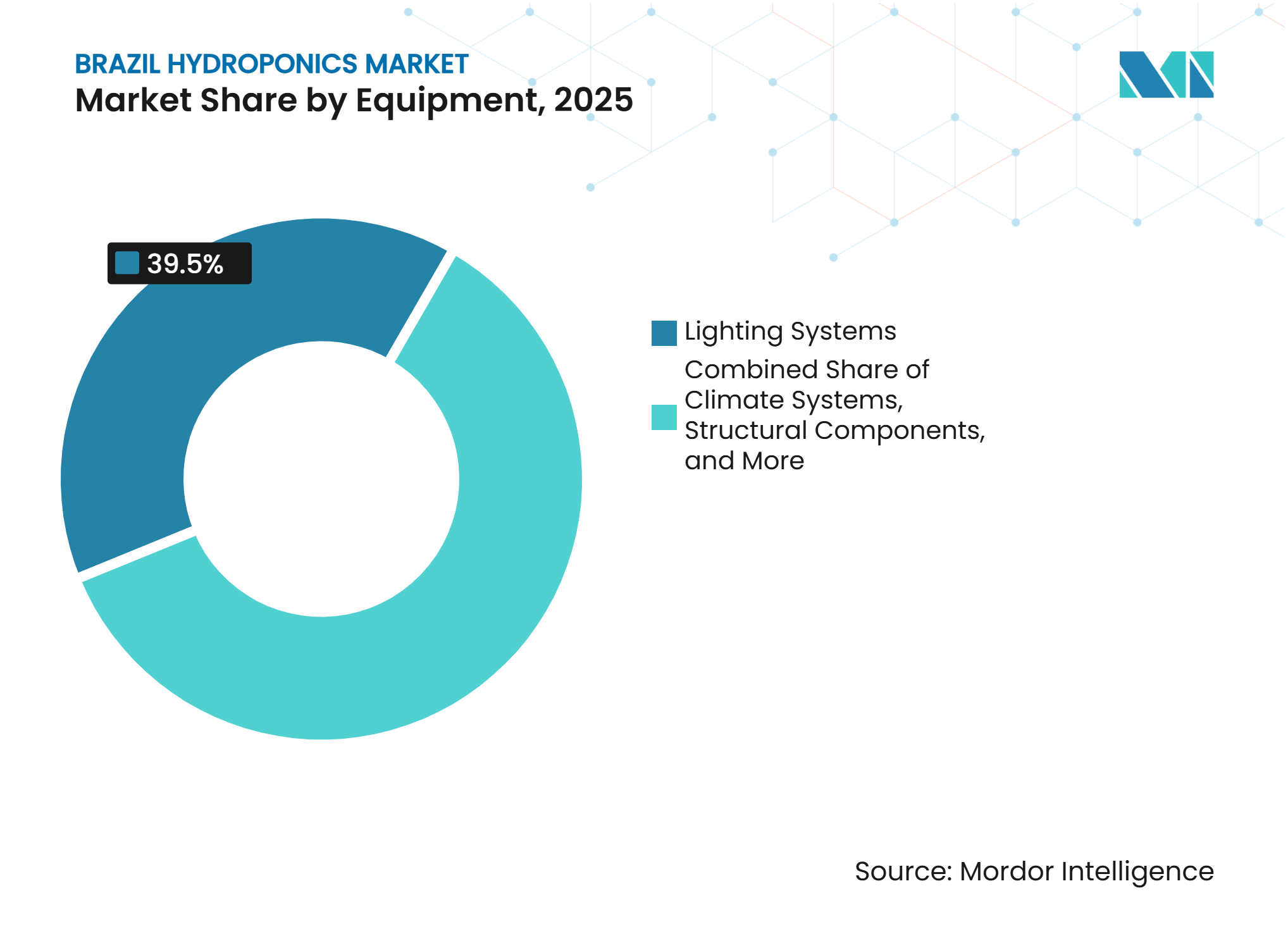
- By equipment, lighting systems held the largest share, at 39.5% of the Brazil hydroponics market in 2025, while climate systems are projected to grow at the fastest CAGR of 12.5% from 2026 to 2031.
- By production scale, large operations accounted for a 55.8% share of the Brazil hydroponics market size in 2025, while small operations are projected to grow at the fastest CAGR of 13.5% from 2026 to 2031.
Note: Market size and forecast figures in this report are generated using Mordor Intelligence’s proprietary estimation framework, updated with the latest available data and insights as of January 2026.
Market Trends and Insights
Drivers Impact Analysis of Brazil Hydroponics Market*
| Driver | (~) % Impact on CAGR Forecast | Geographic Relevance | Impact Timeline |
|---|---|---|---|
| Expansion of urban fresh produce supply | +2.80% | National, strongest in São Paulo, Belo Horizonte, Manaus | Short term (≤ 2 years) |
| Demand for year-round leafy greens and herbs | +2.50% | National, led by São Paulo and Southern retail and delivery hubs | Short term (≤ 2 years) |
| Water efficiency in drought-prone areas | +1.80% | Ceará, Paraíba, and the semi-arid Central-West | Medium term (2-4 years) |
| Demand for consistent, traceable produce | +1.90% | National, strongest in São Paulo and Rio de Janeiro premium channels | Short term (≤ 2 years) |
| Investment in controlled-environment agriculture | +1.40% | São Paulo, Ceará, Paraná, and other producing states | Medium term (2-4 years) |
| High-density production near urban centers | +1.00% | Southeast, including São Paulo metropolitan and interior cities | Long term (≥ 4 years) |
| Source: Mordor Intelligence | |||
Expansion of Urban Fresh Produce Supply
Brazil's 87% urbanization rate creates sustained demand for fresh produce near São Paulo, Belo Horizonte, Rio de Janeiro, and Manaus[1]. Locating production closer to these major consumption centers reduces the distance between harvest and retail placement, helping maintain freshness and reduce transportation requirements. Brazilian Agricultural Research Corporation has documented losses in traditional leafy-green distribution before products reach São Paulo retail outlets. Hydroponic sites located within metropolitan supply areas can therefore limit product deterioration and reduce last-mile handling. This operating model places emphasis on reliable delivery and proximity to consumers rather than yield alone. BeGreen Fazendas Urbanas operates eight units across Minas Gerais, Rio de Janeiro, São Paulo, Bahia, and Goiás, producing more than 24 metric tons of greens each month across these facilities. Its multi-state footprint demonstrates how localized production can be organized across several urban markets, supporting consistent supply closer to end consumers.
Demand for Year-Round Leafy Greens and Herbs
Controlled environments support a more consistent supply of crops than open-field farms may deliver unevenly. This consistency matters to food delivery, food processing, and retailers that purchase according to weekly specifications and require predictable volumes throughout the year. Conventional production remains exposed to weather disruption and water constraints, increasing the value of controlled cultivation systems. Hydroponic and vertical farming operators can target higher-value crops such as herbs and microgreens, which can generate greater value per kilogram than standard lettuce. These systems can also support shorter distribution channels and more frequent deliveries, reducing reliance on conventional retail distribution. Digital production records further help operators meet ready-to-eat food traceability requirements while supporting inventory planning, quality monitoring, and more responsive order fulfillment.
Water Efficiency in Drought Prone Areas
Water efficiency is a central advantage for hydroponic production in the semi-arid Northeast and drought-exposed Central-West. According to the Brazilian Agricultural Research Corporation, lettuce production under nutrient film technique hydroponics used 15 liters per kilogram, compared with 300 liters per kilogram in conventional cultivation[2]. The difference makes closed-loop systems relevant where irrigation security is limited. In 2025, Ematerce presented a BRL 15 million (USD 2.6 million) greenhouse pilot for 63 family farmers across nine water-stressed micro-regions of Ceará. Meanwhile, producers in Paraíba's Curimataú region cultivated more than 40 vegetable varieties using hydroponic systems. These initiatives demonstrate how controlled cultivation can support crop diversification and improve production efficiency under water-stressed conditions. Water-use licensing trends also favor agricultural systems that recirculate and optimize water use.
Demand for Consistent, Traceable Produce
Retailers and foodservice buyers increasingly require reliable pesticide management and traceability. Hydroponic operators can maintain crop records for each harvest in a controlled setting. Brazil's organic rules require soil-based cultivation, so hydroponic produce cannot use the national organic label. This distinction has supported pesticide-free and traceable product claims in premium retail. 100% Livre S.A. was among the first Brazilian producers to cultivate strawberries in a fully controlled hydroponic environment. The company supplies Grupo Boticário and premium retail accounts. BeGreen Fazendas Urbanas operates a 950-square-meter farm at iFood's Osasco headquarters. The site supplies the corporate cafeteria and provides a recurring customer relationship.
Restraints Impact Analysis of Brazil Hydroponics Market*
| Restraint | (~) % Impact on CAGR Forecast | Geographic Relevance | Impact Timeline |
|---|---|---|---|
| High upfront cost of greenhouses and indoor farms | -1.50% | National, most acute for mid-scale operators in secondary cities | Medium term (2-4 years) |
| Electricity cost exposure in artificial-lighting facilities | -1.20% | National, critical for enclosed indoor farms in São Paulo | Short term (≤ 2 years) |
| Shortage of specialized controlled-environment agronomy skills | -0.90% | National, with early bottlenecks in Amazon and Northeastern states | Medium term (2-4 years) |
| Dependence on imported advanced equipment and inputs | -0.80% | National, with exposure to international sourcing corridors | Long term (≥ 4 years) |
| Source: Mordor Intelligence | |||
Electricity Cost Exposure in Artificial Lighting Facilities
Electricity costs can materially affect the economics of enclosed vertical farms. Electricity represented 40% to 70% of operating costs in fully enclosed facilities[3]. Brazil's tariff flag system can increase energy charges during periods of constrained hydroelectric generation. This creates uncertainty for farms that operate light-emitting diode systems continuously. Pink Farms uses blue-red light-emitting diode arrays that the company said reduce energy use by 60% compared with conventional bulbs. The company also reported a 20% faster crop cycle. Drought creates a difficult combination because it increases interest in water-efficient cultivation while placing pressure on hydroelectric output. Operators need to manage lighting schedules and technology choices carefully.
Shortage of Specialized Controlled Environment Agronomy Skills
Hydroponic operations require skills in nutrient management, climate control, crop monitoring, and equipment maintenance. These capabilities are less established in new production regions than in the South and Southeast. The gap can slow commissioning and reduce consistency during early operating periods. Automation can reduce some routine labor needs, but it does not replace crop management knowledge. Fazendas Bioma uses an application to manage modular mini-farms remotely. Still, local teams must interpret production conditions and maintain equipment. The Amazon and Northeastern states have early capability bottlenecks as controlled cultivation expands. Training needs may be greater where systems are deployed far from established horticultural clusters.
*Our forecasts treat driver/restraint impacts as directional, not additive. The impact forecasts reflect baseline growth, mix effects, and variable interactions.
Brazil Hydroponics Market Segment Analysis
By Production System:
Greenhouses Led Installed CapacityGreenhouse hydroponics held 69.5% of Brazil’s hydroponics market by production system in 2025. High solar irradiance allows growers to supplement natural light rather than replace it fully, reducing lighting requirements compared with enclosed plant factories. Established nutrient film technique systems in São Paulo, Paraná, and Minas Gerais support the installed base. Greenhouses remain the preferred format for operators seeking manageable payback periods. Cooperatives in Paraná and São Paulo’s interior concentrate commercial lettuce and herb production in polycarbonate structures. Indoor vertical farms represent the next operating tier. BeGreen Fazendas Urbanas manages more than 10,200 square meters across eight units in five states, producing over 24 tons of greens monthly.
Container farms are projected to record the fastest CAGR of 12.2% through 2031 among Brazil’s hydroponics production systems. Retailers and logistics operators are piloting modular units in secondary cities and Amazon Basin urban centers, where conventional fresh produce can face long cold-chain distances. Container systems can be installed within warehouse bays or converted cargo units, supporting deployment where large greenhouse sites are impractical. Indoor vertical farms are also expanding as operators seek production closer to dense customer bases. Embrapa researcher Ítalo Guedes stated in June 2025 that Brazil had around 20 controlled-environment vertical farms, with new units under construction in Rio de Janeiro, Vitória, Cuiabá, and Campinas. Nevertheless, greenhouses remain the principal volume format.



By Crop Type:
Leafy Greens Remain the Volume BaseLeafy greens held 42.5% of Brazil’s hydroponics market by crop type in 2025. Nutrient film technique lettuce cycles typically take 25 to 35 days under controlled conditions, compared with approximately 45 days for open-field production. Year-round replenishment contracts make leafy greens the volume base for commercial hydroponic farms. Tomatoes, cucumbers, and peppers form a second group of protected crops, with adoption increasing through Dutch-style high-wire systems. CN Agrotech Solutions is developing a protected tomato pilot in Ceará using Dutch-adapted greenhouse technology. Strawberries remain a premium crop for controlled-environment producers.
Herbs and microgreens are projected to record the fastest CAGR of 12.9% through 2031 among Brazil’s hydroponics crop types. Demand is supported by high-end restaurants, food-delivery platforms, and corporate catering. Fazenda Cubo supplies more than 40 specialty varieties to gourmet customers. Growers are expanding portfolios beyond leafy greens to include herbs, edible flowers, fruiting crops, and mushrooms, improving revenue potential per square meter. Tomatoes, cucumbers, and peppers provide further greenhouse diversification, while strawberries offer another premium option. Nevertheless, leafy greens remain essential for maintaining regular commercial production volumes.
By Equipment:
Lighting Retains the Largest BaseLighting systems held 49.5% of Brazil’s hydroponics market by equipment in 2025. LED upgrades are being adopted across greenhouse supplemental lighting and indoor installations. In enclosed farms, lighting can represent one of the largest equipment costs because artificial illumination is required throughout production cycles. Replacement of fluorescent and high-pressure sodium fixtures is also supporting demand for more efficient lighting technologies. The installed lighting base serves both established producers and new entrants. Irrigation components and pumps represent another substantial installed-base category, as nutrient film technique and drip systems require regular plumbing and equipment replacement. Structural components are benefiting from greenhouse construction across Brazil’s Southeast and South, while automation and control platforms support remote monitoring and management of modular sites.
Climate systems are projected to record the fastest CAGR of 12.5% through 2031 among Brazil’s hydroponics equipment categories. Precise temperature, humidity, cooling, and carbon dioxide management can support higher-value crop programs and more consistent production conditions. These systems also facilitate environmental monitoring and batch-level production records for commercial buyers. Automation and control systems are gaining importance as remote monitoring capabilities improve. Irrigation equipment continues to track greenhouse construction more closely than broader technology adoption, while lighting remains essential for indoor production and greenhouse retrofits. Structural products benefit from expansion in established regional clusters, but climate control is increasingly becoming a key operational differentiator for complex crop programs.

By Production Scale:
Large Operations Hold the LeadLarge operations held 55.8% of Brazil’s hydroponics market by production scale in 2025. Access to capital, automated packaging lines, cold-chain logistics, and retail contracts favor operators capable of maintaining higher production volumes. Verdureira Agroindústria uses nutrient film technique and deep-water culture systems and supplies packaged ready-to-eat salads to national retail customers. Medium-scale farms typically serve regional supermarket groups and corporate accounts. However, these operators can face financing constraints because they fall between family-farm credit limits and the investment requirements of typical venture capital deals. Ibrahort has identified this financing gap as a persistent constraint. Large operators can also spread fixed infrastructure and operating costs across greater output, improving economies of scale.
Small operations hold the fastest projected CAGR at 13.5% through 2031 in the Brazil hydroponics market size by production scale. Franchise and modular-farm models are lowering technical and capital barriers for smaller entrepreneurs. Fazendas Bioma received USD 122,000 through Brazil's Tecnova program in 2024[4]. It is scaling nationally through a franchise model. Medium-scale farms remain important suppliers to regional buyers, although financing remains a challenge. Small producers in São Paulo, Minas Gerais, and Paraná are expanding rapidly by farm count. Large operations still set the baseline for national retail supply.
Geography Analysis
The Southeast holds the largest concentration of the Brazil hydroponics market. São Paulo leads in commercial greenhouse, indoor vertical, and container-farm capacity. The state benefits from proximity to premium retail buyers and foodservice customers. In April 2026, the Fundo de Expansão do Agronegócio Paulista allocated USD 68.4 million in rural credit and sustainability incentives. Minas Gerais is the second-largest Southeastern market. BeGreen Fazendas Urbanas has its principal facility in Belo Horizonte. Rio de Janeiro is expanding through its premium restaurant and delivery economy.
The Southern states form Brazil's second major hydroponic cluster. Paraná, Santa Catarina, and Rio Grande do Sul have more than 30 years of protected-horticulture experience. Cooperative structures lower the knowledge barrier for new growers. Isabela Hortaliças has operated in Paraná's Ponta Grossa area for 3 decades. It now pilots gourmet lettuces and strawberry cultivation. Fazendas Bioma is based in Florianópolis and operates a franchise model from 95 retail points of sale. Espírito Santo is also expanding as family farms address labor shortages.
The Northeast and North are at an earlier development stage, but have strategic importance for food security and water efficiency. Paraíba's Curimataú producers now cultivate more than 40 vegetable varieties in a semi-arid setting. Fazendas UP Visioneer Solution Ltda. was recognized as the first vertical vegetable farm in Manaus. Superintendência da Zona Franca de Manaus (SUFRAMA) reported 95% lower water use and a 40% longer shelf life than field-grown supply transported to the city. The Brazil hydroponics market size in these regions is supported by local production needs and logistics constraints.
Competitive Landscape
Market Concentration
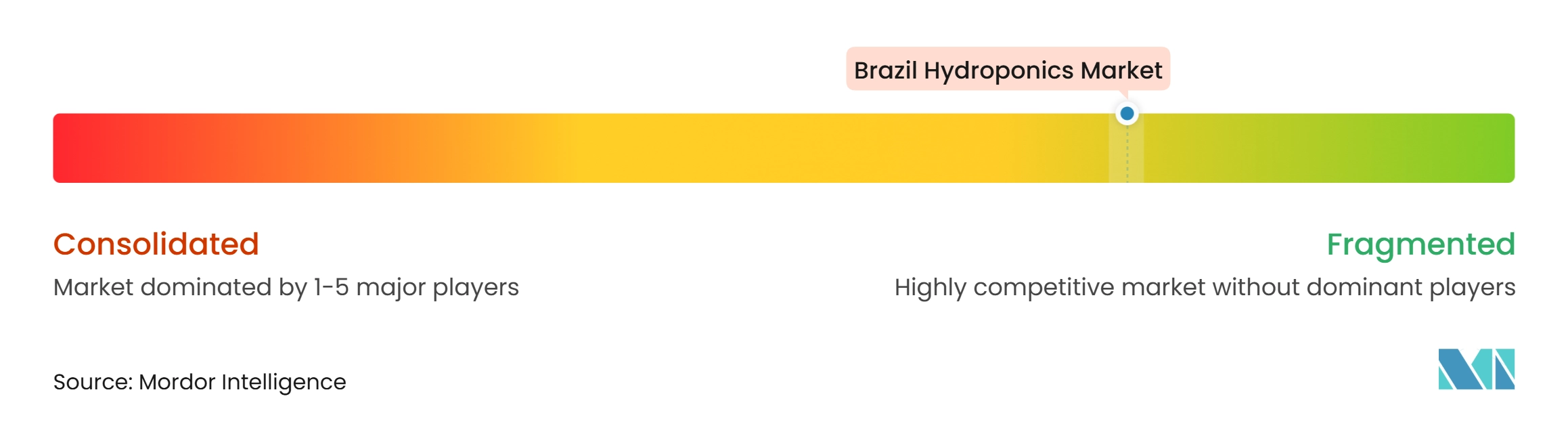
The Brazil hydroponics market is fragmented, with no producer publicly disclosing a dominant market share. Ten profiled producers serve distinct operating models across commercial greenhouse, urban vertical farming, and specialty-crop segments. Hidrohorta Zangalli supplies year-round hydroponic produce to major supermarket groups in the São Paulo region, while BeGreen Fazendas Urbanas operates urban farms across multiple locations. Fazenda Cubo and Fazendas Bioma focus on specialty crops and microgreens for premium customers. Competition therefore centers on crop consistency, channel access, product quality, and operating efficiency. The diversity of production models limits the influence of any single producer.
Commercial operators are increasingly differentiating through production technology, proximity to customers, and digital farm management. BeGreen's iFood unit in Osasco uses automated hydroponic irrigation and supplemental LED lighting, demonstrating how urban farms can combine controlled cultivation with embedded production sites. Fazendas Bioma operates a modular vertical-farm model incorporating automated irrigation, environmental monitoring, and software-based farm management. Meanwhile, established greenhouse producers such as Hidrohorta Zangalli emphasize year-round supply, quality control, and logistics to serve supermarket networks. These models indicate that competition extends beyond production capacity toward automation, reliability, distribution efficiency, and the ability to meet differentiated retail requirements.
Brazil's Ministry of Agriculture and Livestock (MAPA) maintains the National Registry of Organic Producers and requires producers selling products as organic to follow the country's organic conformity requirements. For hydroponic operators, therefore, claims such as pesticide-free production, traceability, and controlled cultivation can support product positioning but should not be presented as equivalent to certified organic status. The industry includes both locally focused farms and multi-state operators, supporting competition across retail, foodservice, catering, and direct-delivery channels. High capital requirements, energy costs, and the need for specialized infrastructure remain important constraints across operating scales.
Brazil Hydroponics Industry Leaders
-
Verdureira Agroindústria
-
Pink Farms
-
BeGreen Fazendas Urbanas
-
100% Livre S.A.
-
Mais Verdes Group
- *Disclaimer: Major Players sorted in no particular order
Brazil Hydroponics Market Companies Covered in this Report
- Verdureira Agroindústria
- Pink Farms
- BeGreen Fazendas Urbanas
- Terêfolhas
- 100% Livre S.A.
- Hidrohorta Zangalli
- Fazendas UP Visioneer Solution Ltda.
- Mais Verdes Group
- Fazenda Cubo
- Fazendas Bioma Ltda.
Recent Industry Developments in Brazil Hydroponics Market
- August 2026: Pink Farms partnered with iFood to make its vertically farmed produce available through the iFood delivery platform. The partnership enabled Pink Farms to reach consumers through a direct-to-consumer channel, expanding its distribution beyond traditional supermarket sales.
- April 2026: The São Paulo government announced approximately USD 68.4 million in new resources through the Fundo de Expansão do Agronegócio Paulista (FEAP). The new package supports rural credit, insurance subsidies, irrigation, sustainable production, and agricultural modernization.
- March 2026: Mundo Verde Hidroponia invested more than USD 200 thousand to add three additional greenhouses and new lettuce varieties. The hydroponic system recirculates irrigation water, reducing water consumption and allowing nutrient-rich water to be reused for coffee cultivation.
Brazil Hydroponics Market Report Scope
The Brazil hydroponics market covers the value of soilless crop cultivation systems where plants are grown using nutrient solutions, with or without an inert medium, across commercial and smaller-scale controlled environments.
Scope exclusions: We exclude aquaponics and soil-based greenhouse or open-field cultivation, even if similar crops are produced.
The Brazil hydroponics market report is segmented by production system (greenhouse hydroponics, indoor vertical farms, and container farms), by crop type (leafy greens, tomatoes, cucumbers, peppers, herbs and microgreens, and strawberries and other soft fruit), by equipment (lighting systems, irrigation components and pumps, climate systems, automation and control systems, and structural components), and by production scale (large operations, medium operations, and small operations). The market forecasts are provided in terms of value (USD).
Segmentation Overview
| Greenhouse Hydroponics |
| Indoor Vertical Farms |
| Container Farms |
| Leafy Greens |
| Tomatoes |
| Cucumbers |
| Peppers |
| Herbs and Microgreens |
| Strawberries |
| Other Crops |
| Lighting Systems |
| Irrigation Components and Pumps |
| Climate Systems |
| Automation and Control Systems |
| Structural Components |
| Large Operations |
| Medium Operations |
| Small Operations |
| By Production System | Greenhouse Hydroponics |
| Indoor Vertical Farms | |
| Container Farms | |
| By Crop Type | Leafy Greens |
| Tomatoes | |
| Cucumbers | |
| Peppers | |
| Herbs and Microgreens | |
| Strawberries | |
| Other Crops | |
| By Equipment | Lighting Systems |
| Irrigation Components and Pumps | |
| Climate Systems | |
| Automation and Control Systems | |
| Structural Components | |
| By Production Scale | Large Operations |
| Medium Operations | |
| Small Operations |
Key Questions Answered in the Report
What is the projected value of Brazil hydroponics by 2031?
The market is projected to reach USD 136.96 million by 2031, at a CAGR of 12.81% during the forecast period (2026-2031).
Which production system leads hydroponic cultivation in Brazil?
Greenhouse hydroponics led the production-system category with 69.5% share in 2025, aided by natural solar irradiance and existing infrastructure.
Which crops are growing fastest in Brazilian hydroponics?
Herbs and microgreens are projected to grow at the fastest CAGR of 12.9% from 2026 to 2031.
Why is hydroponics relevant to Brazil's Northeast?
Hydroponic systems use substantially less water than conventional lettuce cultivation, and Ceará and Paraíba have public and producer initiatives in water-stressed areas