
Brazil Fixed Wireless Access Market Size and Share
Market Overview
| Study Period | 2020 - 2031 |
|---|---|
| Forecast Data Period | 2026 - 2031 |
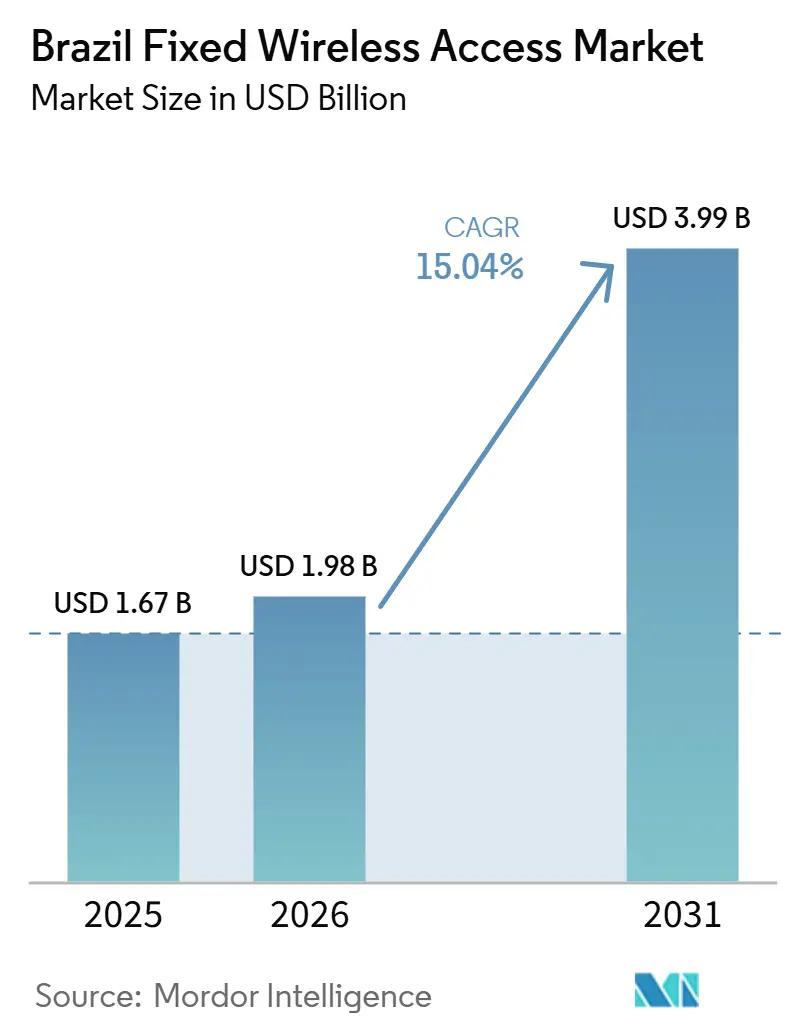
| Base Year Market Size (2025) | USD 1.67 Billion |
| Market Size (2026) | USD 1.98 Billion |
| Market Size (2031) | USD 3.99 Billion |
| Growth Rate (2026 - 2031) | 15.04 % |
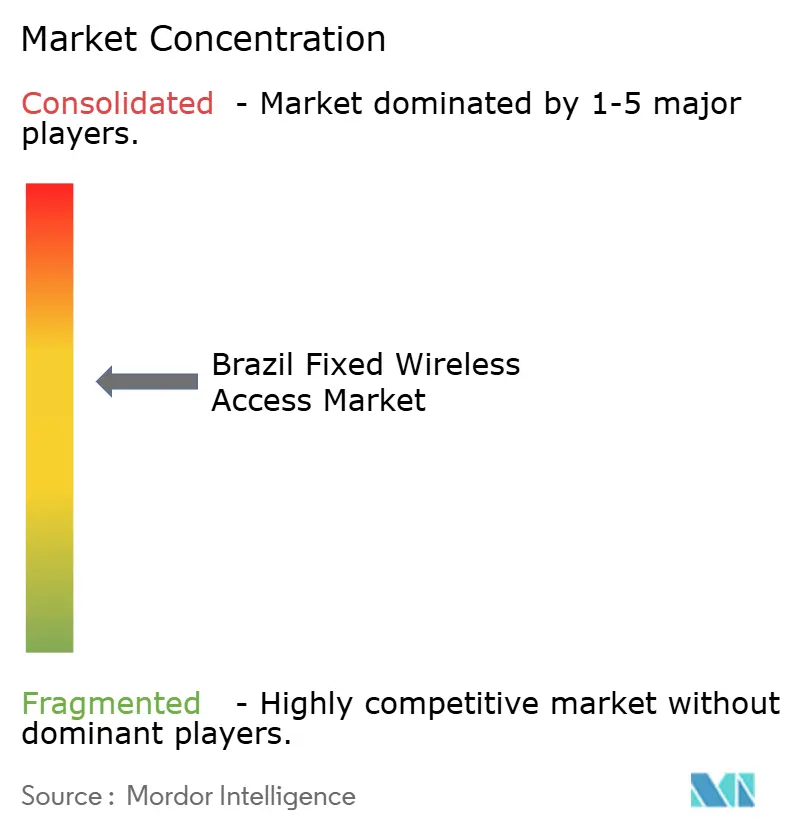
| Market Concentration | Medium |
Major Players *Disclaimer: Major Players sorted in no particular order Image © Mordor Intelligence. Reuse requires attribution under CC BY 4.0. | |
Brazil Fixed Wireless Access Market Analysis by Mordor Intelligence
The Brazil fixed wireless access market size is expected to grow from USD 1.67 billion in 2025 to USD 1.98 billion in 2026 and is forecast to reach USD 3.99 billion by 2031 at 15.04% CAGR over 2026-2031. The Brazil fixed wireless access market is expanding as 5G coverage is expanding into more municipalities, while large parts of the country still lack reliable last-mile broadband infrastructure. The policy backdrop also remains supportive, with ANATEL’s PERT 2025-2029 framework placing universal and meaningful connectivity at the center of broadband planning and keeping rural access gaps visible in public policy. The Brazil fixed wireless access market is also benefiting from the fact that wireless deployment can move faster than fiber in interior territories where trenching costs, sparse settlements, and limited backhaul have slowed fixed network expansion. Competition is taking shape between national mobile operators that bring spectrum scale and billing strength, and regional providers that move faster in underserved communities and work more closely with local public programs. Even so, the Brazil fixed wireless access market still faces pressure from spectrum timing uncertainty, aggressive fiber pricing in wealthier metro corridors, and continued dependence on imported customer premises equipment.
Key Report Takeaways
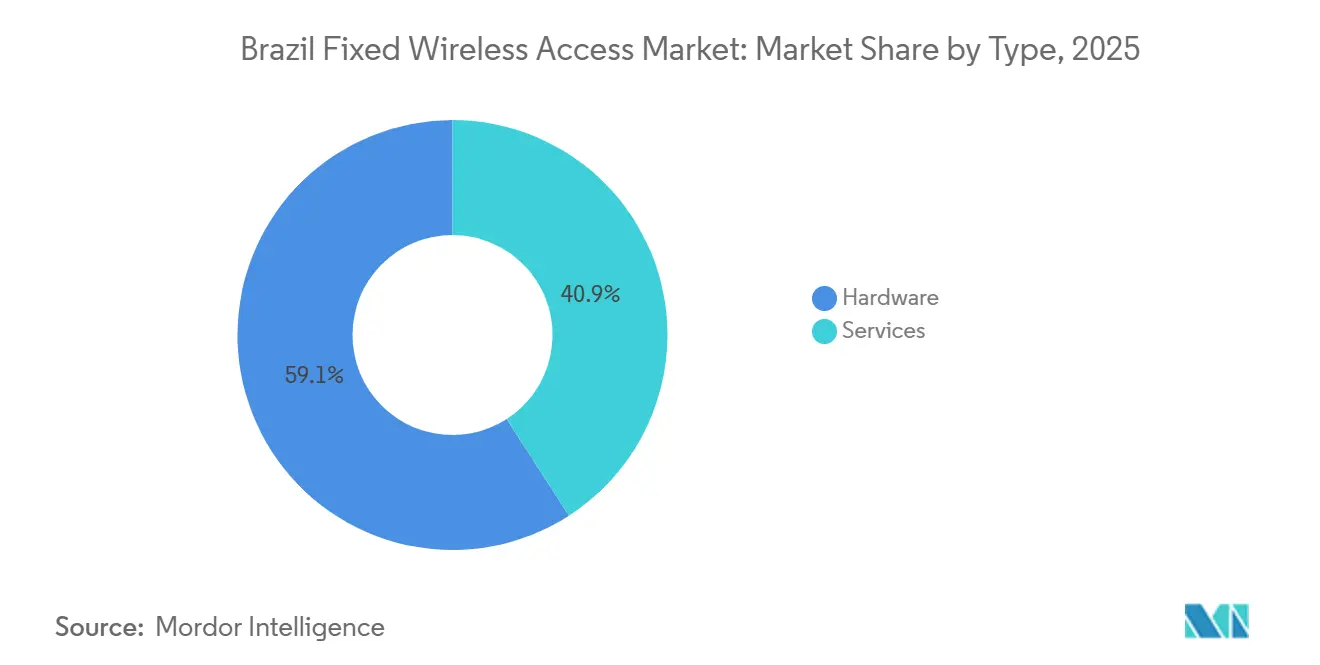
- By type, hardware accounted for 59.11% share of the Brazil fixed wireless access market size in 2025, while services are projected to expand at a 16.66% CAGR through 2031.
- By application, residential connections accounted for 66.98% of revenue in 2025, while government and public safety are projected to grow at a 16.14% CAGR through 2031.
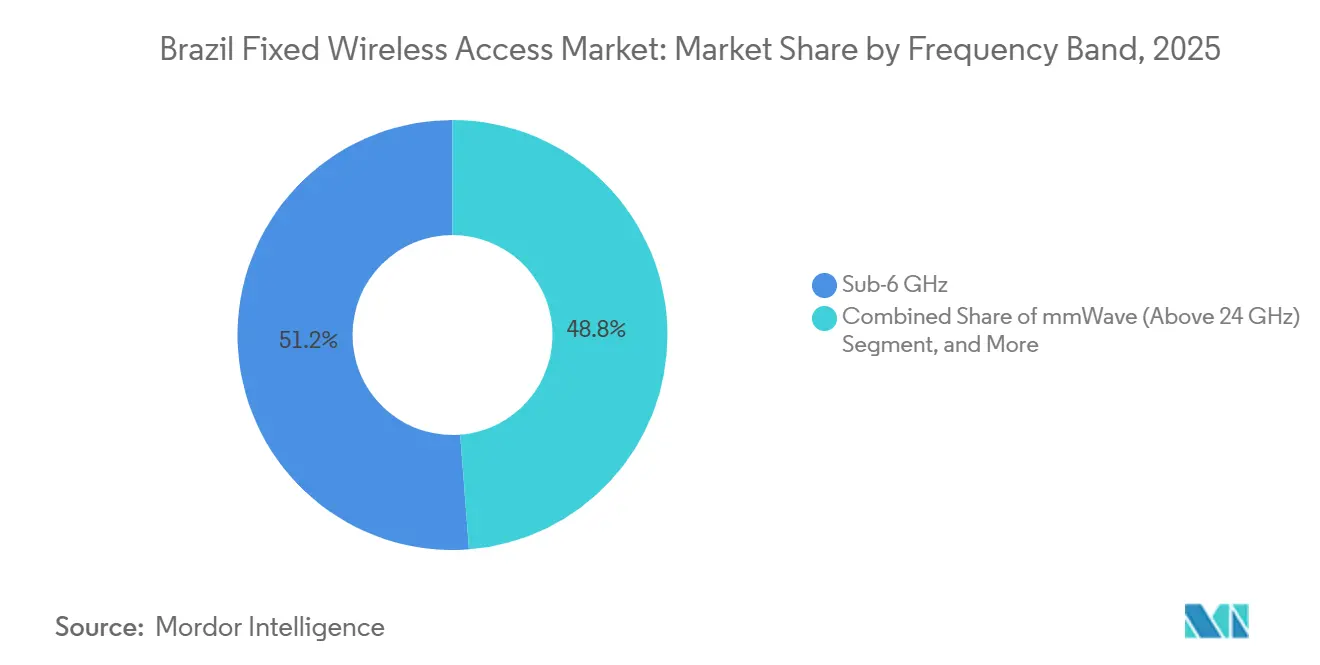
- By frequency band, sub-6 GHz accounted for 51.23% of revenue in 2025, while mmWave above 24 GHz is projected to grow at a 17.11% CAGR through 2031.
- By deployment mode, indoor CPE led with a 61.12% revenue share of the Brazil fixed wireless access market size in 2025, while self-install window-mount CPE is projected to expand at a 17.21% CAGR through 2031.
Note: Market size and forecast figures in this report are generated using Mordor Intelligence’s proprietary estimation framework, updated with the latest available data and insights as of January 2026.
Brazil Fixed Wireless Access Market Trends and Insights
Drivers Impact Analysis*
| DRIVER | (~) % IMPACT ON CAGR FORECAST | GEOGRAPHIC RELEVANCE | IMPACT TIMELINE |
|---|---|---|---|
| 5G Rollout Expanding Fixed Wireless Access Coverage | +4.5% | National, with early momentum in state capitals and mid-size cities | Medium term (2-4 years) |
| Fiber To the Home Gaps in Interior Brazil | +3.8% | North and Northeast most acute, with spillover into Centro-Oeste | Long term (≥ 4 years) |
| Affordable Last-Mile Alternative For Price-Sensitive Households | +2.9% | National, most pronounced in the Northeast and North | Medium term (2-4 years) |
| Enterprise Backup Connectivity For Branch Continuity | +1.6% | Concentrated in Southeast and South business corridors | Short term (≤ 2 years) |
| Localized Self-Install CPE Reducing Truck Rolls | +1.2% | National | Short term (≤ 2 years) |
| Rural And Semi-Urban Coverage Economics Favoring Wireless Last Mile | +1.0% | North, Northeast, and Centro-Oeste | Long term (≥ 4 years) |
| Source: Mordor Intelligence | |||
5G Rollout Expanding Fixed Wireless Access Coverage
Brazil’s 5G rollout is creating the broadest near-term opening for the Brazil fixed wireless access market because every new 5G site can also support wireless broadband access. As of early 2026, 5G had reached 1,966 municipalities, and coverage is projected to reach 2,220 cities and 80% of the population by the end of 2026. The rollout matters even more in smaller municipalities because auction obligations require operators to extend 5G beyond the largest urban centers on a fixed schedule. By the end of 2026, 30% of Brazil’s cities with fewer than 30,000 inhabitants must receive 5G coverage, and the target rises to full coverage by 2029. That requirement makes future addressable zones for the Brazil fixed wireless access market more visible than in countries where operators expand only on commercial preference. ANATEL’s updated spectrum rules under Resolutions 772 and 773 also give operators and equipment suppliers clearer technical conditions for deployment planning.[1]ANATEL, “Anatel Aprova Plano Estrutural de Redes de Telecomunicações, PERT, Edição 2025-2029,” Gov.br, gov.br
Fiber To The Home Gaps in Interior Brazil
The Brazil fixed wireless access market is also growing because fixed network gaps remain wide outside the strongest urban corridors. ANATEL’s PERT 2025-2029 identified 925 municipalities without fiber backhaul and 25,811 rural localities without wireless coverage of any kind.[2]ANATEL, “Resolução Anatel nº 772, de 16 de Janeiro de 2025,” Brazilian Official Gazette, in.gov.br Those gaps are concentrated in territories where fiber deployment is slower, more expensive, and harder to scale across dispersed settlements. A July 2025 pilot in Rio Grande do Norte showed that 5G FWA could deliver performance equivalent to fiber optics and meet the connected schools target of 1 Mbps per student from towers up to 4.7 km away. That result strengthens the commercial case for the Brazil fixed wireless access market in areas where backhaul is available or is approaching, but where direct fiber-to-home rollout remains uneconomic. It also means early providers can build durable local customer bases before fixed-line alternatives arrive in any meaningful way.
Affordable Last-Mile Alternative for Price-Sensitive Households
Affordability is another reason the Brazil fixed wireless access market is moving deeper into underserved households. Brisanet’s deployments in more than 300 remote communities showed that wireless broadband can scale in areas with little or no prior fixed access.[3]Mobile World Live Staff, “Brisanet Brazil Is Redefining Internet Access in Brazilian Homes with 5G FWA,” Mobile World Live, mobileworldlive.com The company’s March 2026 collaboration with Qualcomm extended that approach by offering discounted plans for socially vulnerable rural households in northeastern Brazil.[4]BNamericas Staff, “Brisanet, Qualcomm Team Up to Boost Connectivity in the Countryside,” BNamericas, bnamericas.com That matters because the Brazil fixed wireless access market does not need to displace fiber in these communities, it often enters where no strong fixed alternative exists. In practice, this lowers the barrier to subscriber acquisition and makes smaller-ticket plans workable for operators that can scale device and service activation efficiently. It also gives Brazil fixed wireless access market access to a customer base that has remained difficult to serve through traditional fiber economics.
Enterprise Backup Connectivity for Branch Continuity
The Brazil fixed wireless access market is also finding room in business continuity use cases, especially in branch-heavy sectors. Enterprises increasingly use FWA as a secondary connection when fiber outages would interrupt retail, logistics, or financial operations across distributed locations. The strongest demand is still centered in the Southeast and South, where branch density is higher, and the cost of downtime is easier to justify against connectivity spending. A related institutional example appeared in June 2026, when the federal government activated the first stage of its Federal Private Communications Network, a BRL 1 billion (USD 193 million) initiative operated by Telebras. While that network is separate from commercial FWA offers, it shows that wireless resilience is gaining credibility for mission-critical connectivity in Brazil. That shift expands the practical opportunity set for the Brazil fixed wireless access market beyond households and into public-sector and enterprise demand.
Restraints Impact Analysis*
| RESTRAINT | (~) % IMPACT ON CAGR FORECAST | GEOGRAPHIC RELEVANCE | IMPACT TIMELINE |
|---|---|---|---|
| Spectrum Coordination Complexity, and Renewal Risk | -1.8% | National | Medium term (2-4 years) |
| Fiber Price Competition in High-Income Urban Corridors | -1.4% | Southeast and South metros, including São Paulo, Rio de Janeiro, and Curitiba | Short term (≤ 2 years) |
| Rain Fade and Topography Constraints in Higher Frequency Bands | -0.9% | North and Northeast tropical climate zones and mountainous terrain | Long term (≥ 4 years) |
| Import-Dependent CPE Cost Structure | -0.8% | National | Medium term (2-4 years) |
| Source: Mordor Intelligence | |||
Spectrum Coordination, Complexity, and Renewal Risk
Spectrum timing still imposes a planning constraint on the Brazilian fixed wireless access market. Anatel has signaled plans for new spectrum activity through 2028, while operators are still carrying investment obligations from the 2021 5G auction cycle. Large operators have already asked for the 6 GHz tender to be deferred beyond 2026 because current 3.5 GHz rollout obligations remain heavy. Mid-cycle spectrum transfers also add operational uncertainty, as shown by Unifique’s acquisition of Ligga Telecom’s 3.5 GHz licenses across 336 municipalities in Paraná for BRL 20 million (USD 3.4 million). These moving parts complicate CPE planning, network densification decisions, and local rollout timing for the Brazil fixed wireless access market. The burden is heavier for smaller providers because they have fewer resources to manage overlapping demands for auctions, compliance, and deployment.
Fiber Price Competition in High-Income Urban Corridors
The Brazil fixed wireless access market faces direct pricing pressure from fiber in the country’s wealthiest metropolitan areas. Claro held 19.3% of national fixed broadband contracts, and Vivo held 14.8%; both operate dense fiber networks in São Paulo and Rio de Janeiro. Vivo also posted nearly 720,000 net broadband additions in 2025, while TIM expanded its fixed offer and pushed newer in-home network upgrades. In major metro corridors, fiber plans range from 300 Mbps to 500 Mbps and cost BRL 99 to BRL 150 per month, or USD 17 to USD 26, which overlaps the core addressable price band for FWA. That leaves the Brazil fixed wireless access market with a narrower urban role centered on backup connectivity, second residences, and specific local gaps where fiber has not yet arrived. As a result, a larger share of long-run expansion is shifting toward interior and rural territories where fixed competition is weaker.
*Our forecasts treat driver/restraint impacts as directional, not additive. The impact forecasts reflect baseline growth, mix effects, and variable interactions.
Segment Analysis
By Type: Hardware Revenue Base, Services Pulling Ahead
Hardware is expected to account for 59.11% of revenue in 2025, giving it the largest segment-level share of the Brazil fixed wireless access market. This lead reflects the ongoing buildout phase, as operators still require large volumes of CPE before subscriber monetization matures. Indoor routers and outdoor directional units form the core of this spending, while access units support densification in intermediate coverage zones. In practical terms, the market remains hardware-led because coverage extension and subscriber activation depend on device availability at the edge. This part of the Brazil fixed wireless access market, therefore, remains tied to procurement scale, rollout timing, and the ability to deploy equipment quickly in new service areas.
The services segment is forecast to grow at a CAGR of 16.66% through 2031, making it the fastest-expanding type category in the Brazil fixed wireless access industry. The gap between hardware share and services growth suggests that monetization is shifting toward recurring plans, managed connectivity, and support functions as device sales normalize. Nokia’s planned March 2026 expansion with TIM Brasil across 14 additional states also shows that vendors are positioning around software-enabled network value and enterprise-oriented capabilities, rather than equipment volume alone. For the Brazil fixed wireless access industry, this indicates that value creation is gradually moving from one-time hardware deployment toward longer-term service relationships. The segment outlook also points to stronger revenue resilience once the heaviest phase of initial device deployment begins to ease.


By Application: Residential Volumes Anchor, Government Connectivity Climbs Fast
Residential connections are expected to account for 66.98% of revenue in 2025, making households the primary demand base for the Brazil fixed wireless access market. This position reflects the technology’s role in municipalities where fiber remains absent, delayed, or too costly to extend to scattered users. Brisanet’s footprint across more than 300 remote northeastern communities shows how residential FWA can scale where fixed network economics remain weak. The residential base also gives operators a clear path to volume because service activation can follow new coverage faster than a full wired rollout. As long as interior broadband gaps remain wide, residential demand should continue to anchor the Brazil fixed wireless access market.
Government and public safety are projected to expand at a CAGR of 16.14% through 2031, with this portion of the Brazil fixed wireless access market size building on visible public programs. The Federal Private Communications Network, the connected schools agenda, and state-level rural 5G initiatives all support a larger institutional wireless base. A September 2024 pilot in six public schools in the Federal District reached speeds of up to 945 Mbps on the 3.5 GHz band, strengthening the case for school and public service deployments. ANATEL’s policy framework also provides public connectivity programs with a clearer structure, helping institutional demand move from the pilot stage to a funded rollout. This application group should, therefore, gain weight steadily, even though residential access remains the larger revenue base today.
By Frequency Band: Sub-6 GHz Anchors Revenue, mmWave Accelerates
Sub-6 GHz is expected to account for 51.23% of revenue in 2025, making it the leading band family across the Brazil fixed wireless access market. Its lead stems from stronger propagation in rural and semi-urban settings, a mature 3.5 GHz device ecosystem, and close alignment with Brazil’s 5G spectrum structure. Major operators have launched early 5G FWA services on mid-band infrastructure, enabling them to reuse sites and extend fixed wireless coverage with greater capital efficiency. This makes sub-6 GHz the practical workhorse for both broad coverage and early subscriber growth. It also fits the expansion profile of the Brazil fixed wireless access market because many target municipalities need reach and stability more than very high peak speeds.
mmWave above 24 GHz is projected to grow at a CAGR of 17.11%, and this segment of the Brazil fixed wireless access market size is expected to develop first in dense urban locations. The growth case remains strong because short-range, high-capacity wireless links can support enterprise campuses, venues, and concentrated traffic zones. However, tropical rain conditions create a real physical constraint. Research from São Paulo measurement sites found that rain attenuation is the main cause of unavailability in terrestrial systems operating above 10 GHz in tropical and equatorial zones. Qualcomm and Ericsson’s planned March 2026 RedCap trials in São Paulo also point to more affordable next-generation devices that could help broaden adoption over time. For now, the Brazil fixed wireless access market is likely to keep mmWave focused on carefully selected use cases rather than broad national coverage. This leaves sub-6 GHz as the revenue anchor while mmWave builds momentum in specialized urban deployments.

By Deployment Mode: Indoor CPE Dominant, Window-Mount Models Gaining
Indoor CPE is expected to account for 61.12% of revenue in 2025, giving it the leading share in the Brazil fixed wireless access market. The segment benefits from easier installation, broad compatibility with mid-band 5G networks, and familiar retail distribution through operator channels. Claro’s early residential 5G FWA offer in Brazil used an indoor Wi-Fi 6 modem, reflecting how operators initially approached household adoption. Indoor devices also reduce friction for first-time users by simplifying setup and accelerating service activation. This simplicity has helped the Brazil fixed wireless access market establish an accessible entry point in the early residential phase.
Self-install window-mount CPE is projected to grow at a 17.21% CAGR through 2031, making it the fastest-growing deployment format in the Brazil fixed wireless access industry. The growth case is tied to cost control because rural and semi-urban subscriber additions become easier when technicians do not need to travel for every activation. In the Rio Grande do Norte school pilot, external devices maintained stable 5G FWA service from towers located 1.6 km to 4.7 km away, showing how placement flexibility can improve performance. Brisanet and Qualcomm’s community-focused project also uses modems designed for self-installation in vulnerable rural areas, directly addressing last-mile economics. In the Brazil fixed wireless access industry, window-mount devices are not only a convenience feature but also a practical tool for scaling low-cost expansion. As deployment moves deeper into harder-to-reach communities, this format should gain importance faster than traditional technician-led installation models.
Geography Analysis
The Southeast is expected to hold the largest revenue base in the Brazil fixed wireless access market in 2025, as it combines the strongest enterprise demand, the deepest operator presence, and the most active 5G commercial footprint. São Paulo and Rio de Janeiro remain important development centers for product launches, business continuity use cases, and device testing on commercial networks. Qualcomm and Ericsson’s planned March 2026 5G SA RedCap trials in São Paulo demonstrate that the region is also a key testing ground for lower-complexity, more affordable wireless devices. At the same time, the Southeast has the strongest fiber competition, which limits the share of the Brazilian fixed wireless access market available for purely residential substitution in wealthier urban corridors. This keeps the regional opportunity tilted toward backup connectivity, gap coverage, and targeted local demand rather than broad household displacement.
The Northeast is the most important growth territory for the Brazil fixed wireless access market because it combines a large rural population with persistent fixed broadband gaps. ANATEL’s PERT data showed that 4G reached 99.6% of urban residents, but only 53.5% of rural residents nationwide, and this imbalance is especially pronounced across dispersed northeastern settlements. Brisanet secured BRL 360.68 million (USD 62 million) in FUST-backed financing for 404 base station towers and 50,000 FWA modems in 2025, underlining the scale of wireless investment moving into the region. In April 2026, Ceará is expected to launch a 5G Rural program with Brisanet, targeting 1,000 towers across more than 300 localities by 2029, with 300 towers scheduled for activation in 2026. These moves make the Northeast the clearest region where the Brazil fixed wireless access market is being used as a direct tool to close service gaps.
The North remains a longer-cycle opportunity because the region continues to face difficult terrain, sparse settlements, and gradual backhaul extension. The federal Norte Conectado effort is improving the conditions for future terrestrial wireless expansion as fiber reaches more municipalities in the Amazon. The Centro-Oeste is also becoming more relevant because agricultural operations need reliable connectivity for field management, logistics, and connected equipment, and Brisanet plans to enter 120 cities there in 2026. In the South, demand is steadier and more selective, with the Brazil fixed wireless access market tied more closely to enterprise backup links and rural fringe coverage than to broad unmet household access.
Competitive Landscape
The Brazil fixed wireless access market is moderately concentrated at the service layer, with three national operators holding the strongest scale positions while regional providers address local gaps more quickly. Telefônica Brasil, Claro, and TIM benefit from spectrum depth, national billing systems, and cross-selling opportunities through fixed-mobile bundles. Regional players, such as Brisanet and Algar Telecom, compete through local market knowledge, faster community-level rollouts, and stronger alignment with subsidized access programs. This structure gives the Brazil fixed wireless access market a split competitive profile, where national scale matters, but local execution continues to influence outcomes in underserved geographies. Competitive pressure also varies sharply between dense metropolitan areas and interior municipalities.
Recent and planned company moves show how this structure is evolving. Nokia expanded its partnership with TIM Brasil in March 2026, adding Nvidia AI-RAN platforms across 14 additional states and supporting a broader software and enterprise services push alongside network expansion. Brisanet’s March 2026 collaboration with Qualcomm focused on discounted rural access plans and self-installation models, highlighting a different strategy centered on underserved communities rather than premium network layering. TIM also earmarked USD 1.5 billion for 2025-2027 to expand 5G and FWA across 1,000 towns, underscoring the investment gap between national and regional competitors. In parallel, vendors in the Brazil fixed wireless access market are shifting their positioning toward integrated device, software, and managed-service value rather than focusing only on radio hardware supply.
Opportunities remain strongest where demand is visible but formal offers remain limited. Secondary-city enterprise backup connectivity is one such area, as many mid-sized firms still lack structured wireless continuity options despite rising sensitivity to outages. Government and public-sector networks represent another opportunity, with Telebras taking a leading role in the Federal Private Communications Network and reinforcing the institutional case for dedicated wireless platforms. The Brazil fixed wireless access market also has room for ultra-rural programs, where public funding can offset the weaker economics of low-density deployment. This mix keeps the market competitive, but it also favors players who can align technology choices, public programs, and rollout speed more effectively than those competing solely on price.
Brazil Fixed Wireless Access Industry Leaders
Huawei Technologies Co., Ltd.
Ericsson AB
Nokia Corporation
ZTE Corporation
Qualcomm Technologies, Inc.
- *Disclaimer: Major Players sorted in no particular order

Recent Industry Developments
- June 2026: The Brazilian federal government activated the first stage of the Federal Private Communications Network, a BRL 1 billion (USD 193 million) initiative operated by Telebras, integrating the Military Police of the Federal District, the Brazilian Army, and legislative security forces into a single encrypted wireless network fully independent of commercial telecom infrastructure. The activation initiates a deployment roadmap running through December 2027, with subsequent rollouts planned for Macapá, Rio Branco, Goiânia, and Vitória, establishing Telebras as the primary operator of government-grade wireless connectivity in Brazil.
- April 2026: The Ceará state government launched a 5G Rural program in partnership with Brisanet, committing to the deployment of 1,000 5G towers across more than 300 localities by 2029, with 300 tower activations scheduled in 2026 alone. The program targets agribusiness, education, health, and public security connectivity in communities with acute infrastructure deficits and establishes a subnational government co-investment model for rural FWA that other Brazilian states may replicate.
- March 2026: Nokia expanded its 5G network modernization partnership with TIM Brasil from São Paulo to 14 additional states across 4 regions, covering 42% of Brazil’s population. The expansion incorporates Nvidia AI-RAN platforms to deliver AI-driven enterprise connectivity services, and positions TIM Brasil’s network for 5G Advanced and future 6G capabilities, significantly upgrading the infrastructure base that supports FWA and enterprise wireless services.
- March 2026: Brisanet and Qualcomm announced the “Northeast Connected with FWA” strategic collaboration, deploying 5G FWA connectivity powered by the Qualcomm SDX62 processor to rural communities across northeastern Brazil. The initiative offers discounted plans for socially vulnerable households and targets connectivity for education, health, agrotech, and financial services, representing the first large-scale community-targeted FWA program in Brazil to combine technology subsidies with social impact objectives.


Brazil Fixed Wireless Access Market Report Scope
The Brazil Fixed Wireless Access Market Report is Segmented by Type (Hardware [Consumer Premise Equipment and Access Units] and Services), Application (Residential, Commercial, Industrial, and Government and Public Safety), Frequency Band (Sub-6 GHz, mmWave (Above 24 GHz), and Unlicensed/Shared CBRS), and Deployment Mode (Indoor CPE, Outdoor CPE, and Self-Install Window-Mount CPE). The Market Forecasts are Provided in Terms of Value (USD).
| Hardware | Consumer Premise Equipment (CPE) |
| Access Units (Femto and Picocells) | |
| Services |
| Residential |
| Commercial |
| Industrial |
| Government and Public Safety |
| Sub-6 GHz |
| mmWave (Above 24 GHz) |
| Unlicensed / Shared CBRS |
| Indoor CPE |
| Outdoor CPE |
| Self-Install Window-Mount CPE |
| By Type | Hardware | Consumer Premise Equipment (CPE) |
| Access Units (Femto and Picocells) | ||
| Services | ||
| By Application | Residential | |
| Commercial | ||
| Industrial | ||
| Government and Public Safety | ||
| By Frequency Band | Sub-6 GHz | |
| mmWave (Above 24 GHz) | ||
| Unlicensed / Shared CBRS | ||
| By Deployment Mode | Indoor CPE | |
| Outdoor CPE | ||
| Self-Install Window-Mount CPE |


Key Questions Answered in the Report
How large is the Brazil fixed wireless access market in 2026, and where is it heading by 2031?
The Brazil fixed wireless access market stands at USD 1.98 billion in 2026 and is forecast to reach USD 3.99 billion by 2031 at a 15.04% CAGR.
What is driving growth in fixed wireless access across Brazil?
The main growth factors are faster 5G rollout, the lack of fiber backhaul in many municipalities, and the lower cost of wireless last-mile deployment in remote areas.
Which segment currently leads by type?
Hardware is the leading type segment, accounting for 59.11% of revenue in 2025, as the market is still in a buildout phase that depends on CPE deployment.
Which application is expanding the fastest?
Government and public safety is the fastest-growing application, with a projected 16.14% CAGR through 2031, supported by school connectivity and public network programs.
Which part of Brazil offers the strongest expansion potential?
The Northeast offers the clearest near-term expansion path because it combines a large rural population, lower fixed broadband penetration, and active public and private rollout programs.
What are the main risks for operators and vendors?
The main risks are spectrum timing uncertainty, strong fiber price competition in wealthier metro markets, rain-related limits for higher bands, and dependence on imported CPE.
Page last updated on:





