
Bottling Line Cleaning Machinery Market Size and Share
Market Overview
| Study Period | 2021 - 2032 |
|---|---|
| Market Size (2027) | USD 45.59 Million |
| Market Size (2032) | USD 60.07 Million |
| Growth Rate (2027 - 2032) | 5.67 % |
| Fastest Growing Market | Asia-Pacific |
| Largest Market | Asia-Pacific |
| Market Concentration | Medium |
Major Players *Disclaimer: Major Players sorted in no particular order Image © Mordor Intelligence. Reuse requires attribution under CC BY 4.0. | |
Bottling Line Cleaning Machinery Market Analysis by Mordor Intelligence
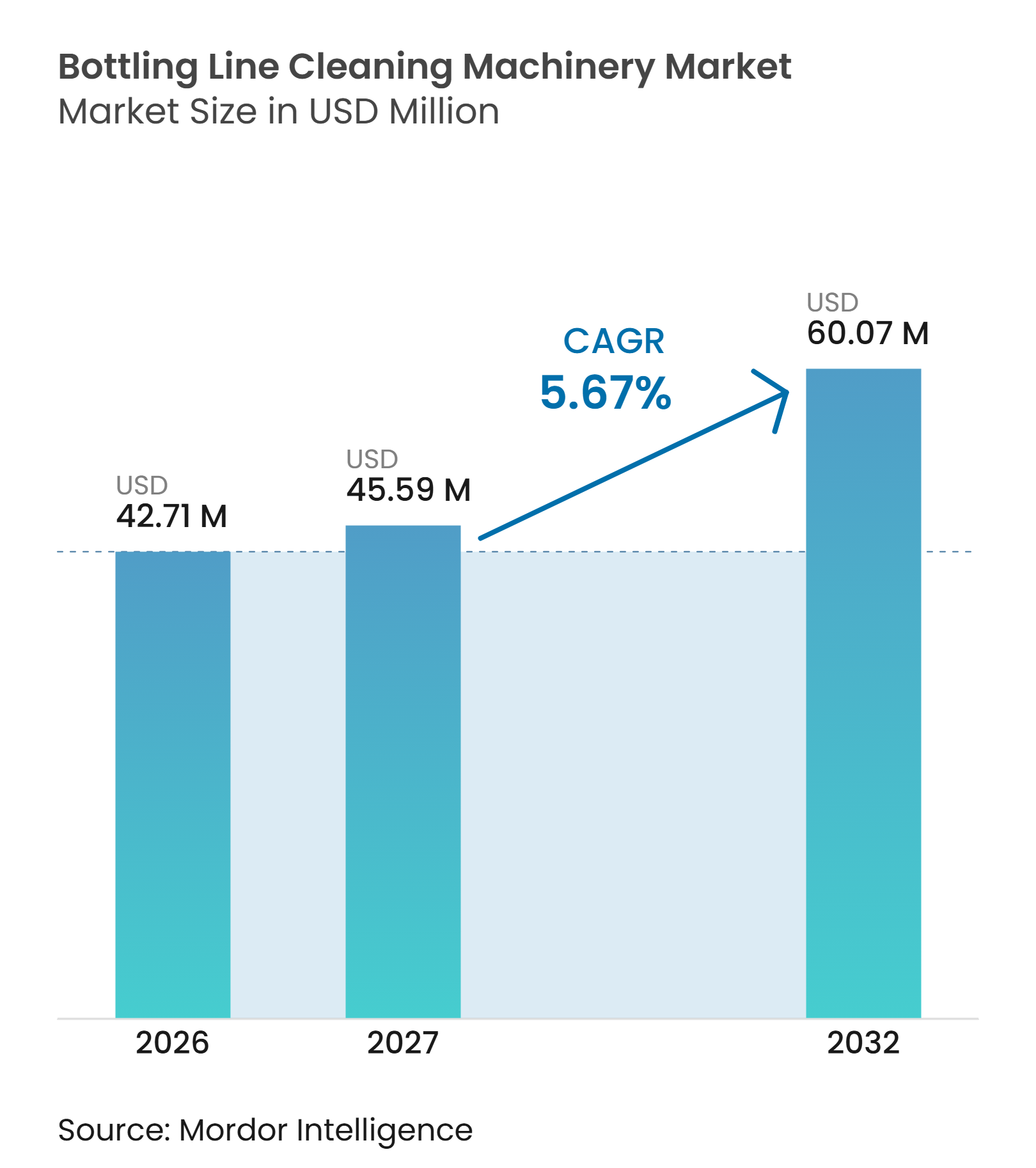
The Bottling Line Cleaning Machinery Market size was valued at USD 42.71 million in 2026 and is estimated to grow from USD 45.59 million in 2027 to reach USD 60.07 million by 2032, at a CAGR of 5.67% during the forecast period (2027-2032).
The Bottling Line Cleaning Machinery Market is supported by deposit-return rules, replacement demand, and higher hygiene requirements across bottling operations. These forces are changing purchasing decisions in beverage, food, dairy, and pharmaceutical plants. New systems must also reduce water and energy use, which raises the value of ultrasonic, heat-pump, and closed-loop technologies. Returnable packaging is concentrating cleaning volumes in dedicated facilities, favoring machines that process large volumes. Capital sensitivity remains a constraint because smaller fillers often defer replacements while larger operators invest through greenfield projects.
Key Report Takeaways
- By machine type, rotary washers held 29.32% of the Bottling Line Cleaning Machinery Market share in 2026, while combined washer-dryer systems are projected to expand at a 7.06% CAGR through 2032.
- By automation level, fully automatic systems accounted for 57.93% of the Bottling Line Cleaning Machinery Market size in 2026 and are expected to expand at a 6.24% CAGR through 2032.
- By bottle material, glass held 60.17% of market revenue in 2026, while plastic bottles are projected to expand at a 6.21% CAGR through 2032.
- By end user, breweries and soft-drink producers accounted for 38.42% of market revenue in 2026, while pharmaceutical manufacturers are expected to expand at a 6.78% CAGR through 2032.
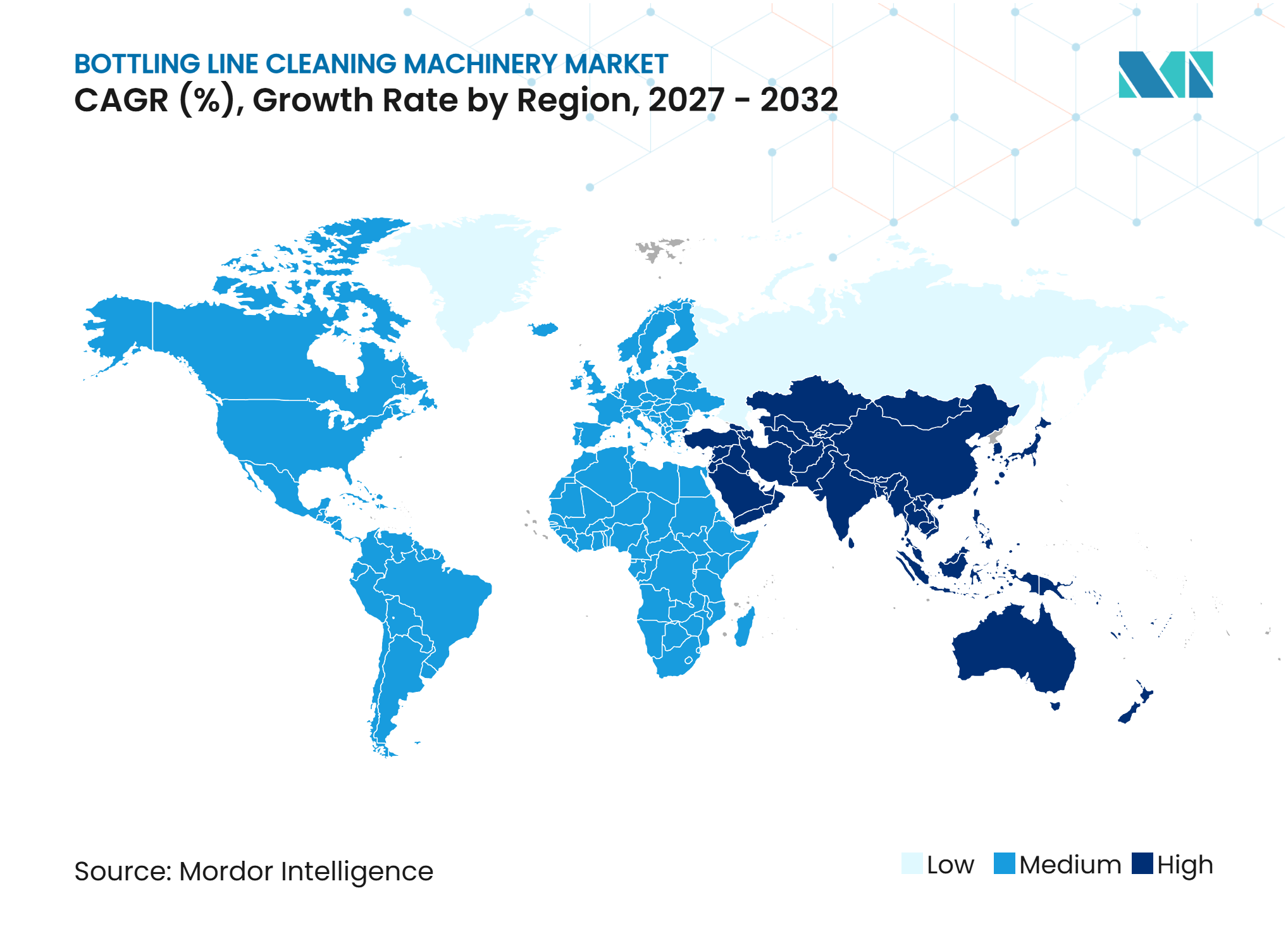
- By geography, Asia-Pacific held 33.18% of market revenue in 2026 and is projected to expand at a 6.62% CAGR through 2032.
Note: Market numbers in this report are based on Mordor Intelligence's proprietary estimation framework, which combines nine months of actuals with Q4 projections for base year 2026.
Market Trends and Insights
Drivers Impact Analysis of Bottling Line Cleaning Machinery Market*
| Driver | (~) % Impact on CAGR Forecast | Geographic Relevance | Impact Timeline |
|---|---|---|---|
| Returnable Packaging and Deposit-Return Expansion | +1.8% | Global, with early gains in Europe, Australia, and emerging Asia-Pacific markets | Medium term (2-4 years) |
| Hygiene and Contamination-Control Requirements | +1.3% | Global | Long term (≥ 4 years) |
| Automated Bottling Capacity Expansion | +1.2% | Asia-Pacific core, with spillover to South America and Middle East and Africa | Medium term (2-4 years) |
| Replacement for Lower Water and Energy Use | +0.9% | Europe and North America | Short term (≤ 2 years) |
| Ultrasonic and Heat-Pump Cleaning Retrofits | +0.5% | Europe and Asia-Pacific | Medium term (2-4 years) |
| Digital Condition Monitoring | +0.3% | Global, with early adoption in North America and Europe | Long term (≥ 4 years) |
| Source: Mordor Intelligence | |||
Returnable Beverage Packaging and Deposit-Return Expansion
Deposit-return legislation is moving packaging supply chains toward closed-loop bottle systems that need frequent washing at centralized sites. Poland’s system became operational in October 2025 and placed more than 60 million deposit-marked packages into circulation within 2 months. Western Australia expanded its scheme from July 2026 to include wine and spirit bottles, adding 200 million eligible containers annually.[1] These systems require bottles to be collected, sorted, inspected, and returned to cleaning operations before refill. Shared return loops also encourage standardized bottle formats, which help dedicated washing facilities process larger volumes consistently. This operating model supports rotary and tunnel equipment capable of handling high throughput, repeated caustic treatment, and coordinated return logistics.
Rising Hygiene and Contamination-Control Requirements
Hygiene requirements are raising the minimum technical standard for equipment used by beverage, dairy, and pharmaceutical producers. The EMA requires a documented contamination control strategy for sterile medicinal products that covers relevant container preparation activities. FDA rules require written procedures that prevent microbiological contamination in drug products. These requirements favor automated systems that document operating parameters, validate cleaning cycles, and support regular revalidation. A validated machine raises switching costs because another system requires fresh qualification and revised process documentation. This supports quality-focused purchasing across the Bottling Line Cleaning Machinery Market, especially where contamination failures can interrupt production.
Growth in Automated Beverage, Food, Dairy, and Pharmaceutical Bottling Capacity
New bottling investments in Asia-Pacific are creating direct demand for industrial cleaning equipment that matches higher line speeds. Swire Coca-Cola opened plants in Kunshan and Guangzhou in May 2026 with more than 20 production lines. Their combined annual capacity exceeded 3.1 million tonnes, increasing the company’s mainland China capacity by 10%. High-speed filling lines need cleaning equipment sized to their throughput, container type, and hygiene obligations. Cleaning equipment is integral to the operating performance of a newly commissioned bottling line. The Bottling Line Cleaning Machinery Market gains from these projects because greenfield capacity creates a linked requirement for washing, rinsing, inspection, and reliable line availability.
Replacement of Aging Washers for Lower Water and Energy Use
Replacement demand is increasing in high-volume returnable-glass markets where older systems remain in service beyond their original design period. Deutsche Umwelthilfe reported that modern bottle-cleaning equipment can reduce water use from 600 ml to 120 ml per bottle. The organization also reported energy reductions of up to 20% from improved filling-operation drives. Krones introduced its Lavasonic HI in September 2025, claiming 40% shorter treatment times and 30% lower thermal energy use. Lower water, heat, and energy requirements can shorten the economic case for replacing older machines in high-utilization plants. The Bottling Line Cleaning Machinery Market benefits when lifecycle costs outweigh the expense and disruption of retaining aging equipment.
Restraints Impact Analysis of Bottling Line Cleaning Machinery Market*
| Restraint | (~) % Impact on CAGR Forecast | Geographic Relevance | Impact Timeline |
|---|---|---|---|
| High Upfront Cost and Long Replacement Cycles | -0.8% | Global | Short term (≤ 2 years) |
| Variable Bottle Shapes, Lightweight Glass, and Adhesive Loads | -0.5% | Global, concentrated in European wine and craft-beer markets | Medium term (2-4 years) |
| Complex Installation and Retrofit Downtime | -0.4% | Global | Short term (≤ 2 years) |
| Water, Effluent, Caustic, and Sludge Constraints | -0.3% | Asia-Pacific, South America, and Middle East and Africa | Long term (≥ 4 years) |
| Source: Mordor Intelligence | |||
High Upfront Cost and Long Replacement Cycles
Large industrial washers can cost several million USD, creating a material investment barrier for small and mid-tier fillers. Their investment case depends on equipment use, expected energy savings, deposit-return obligations, and the cost of production downtime. Primary washing machinery can remain in operation for 20-25 years, which slows the number of replacement purchases in a given year. The issue is more pronounced in craft beverage and wine operations that handle lower hourly bottle volumes than large multinationals. Suppliers compete for a limited number of replacement events through financing, lifecycle-cost analysis, and long-term service agreements. This structure favors providers with broad after-sales capability in the Bottling Line Cleaning Machinery Market.
Variable Bottle Shapes, Lightweight Glass, and Adhesive Loads
Lightweight bottles and varied formats make cleaning more difficult in premium beverage applications with frequent changeovers. British Glass stated that some lightweight designs are 20% lighter than conventional returnable bottles. Thinner walls can increase exposure to mechanical impact and thermal shock during caustic treatment. Decorative labels can require longer submersion and more chemicals to remove adhesive residues from premium formats. Nonstandard bottles require adjustable carrier pockets, which add machine complexity and extend changeover time. These conditions favor flexible equipment but can weaken the return on investment when throughput remains low.
*Our forecasts treat driver/restraint impacts as directional, not additive. The impact forecasts reflect baseline growth, mix effects, and variable interactions.
Bottling Line Cleaning Machinery Market Segment Analysis
By Machine Type:
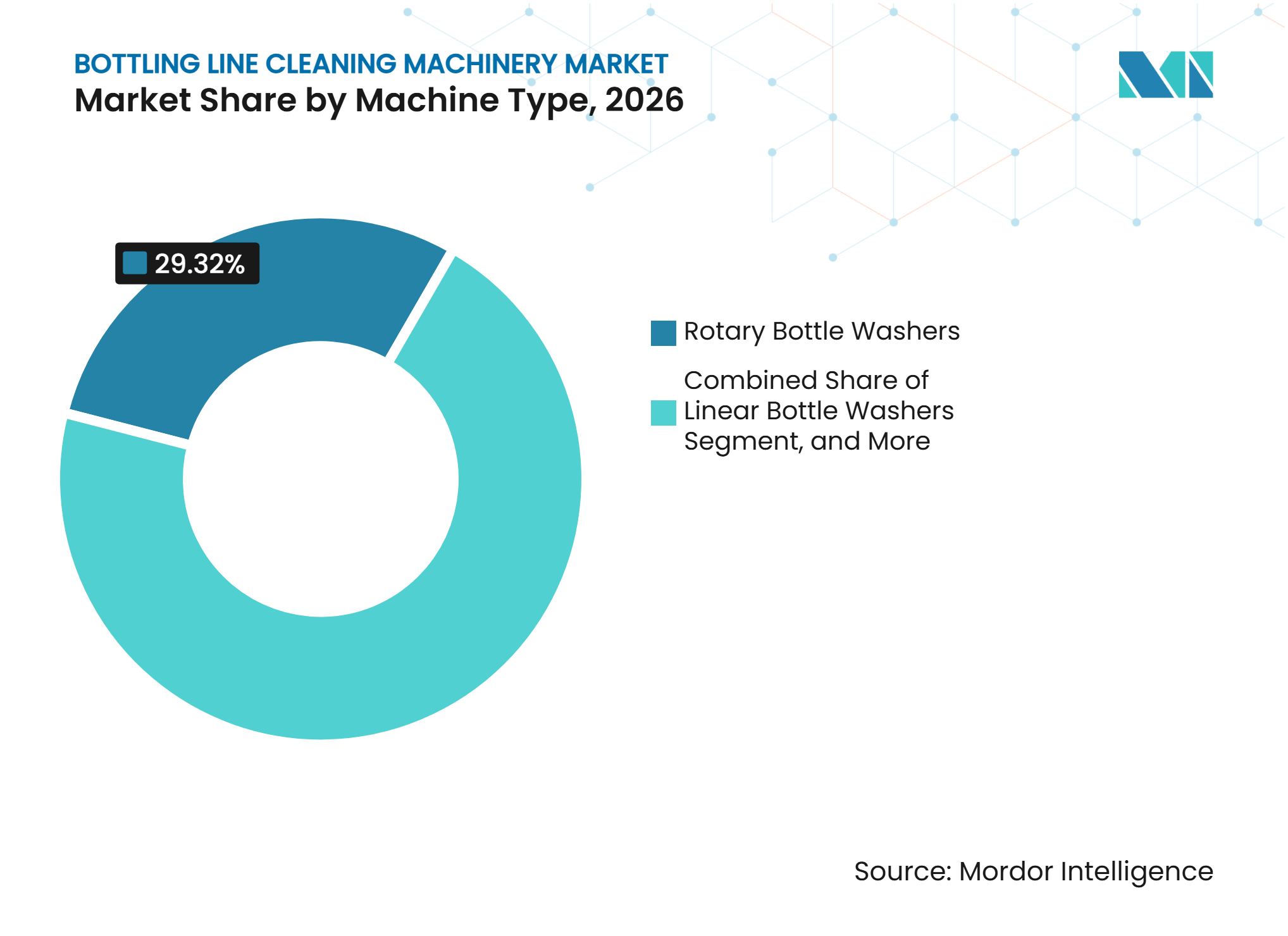
Rotary Washers Lead Volume While Combined Systems Set the Growth PaceRotary washers held 29.32% of the Bottling Line Cleaning Machinery Market share in 2026, reflecting their role in high-speed returnable-bottle operations. Their throughput suits beer, carbonated soft drinks, and mineral water plants that need continuous bottle handling. Combined washer-dryer systems are projected to expand at a 7.06% CAGR through 2032. Pharmaceutical and specialty food producers favor these integrated units because they remove handling between cleaning and drying stages. Reduced handling can limit exposure to contamination and avoid operational delays on validated production lines.
A combined unit can also simplify documentation because operators maintain a single machine record rather than separate records. Linear washers offer a compact option for lower-volume sites and plants with limited floor space. Tunnel washers serve returnable-glass lines that need full caustic immersion across repeated use cycles. Immersion washers are suitable for applications requiring longer soak periods, while rinsers and blowers support PET and aseptic lines. KHS presented the Innoclean Cascade D with modular chain-wheel sections that reduce replacement weight from 80 kg to 13 kg. This design makes maintainability an important selection criterion alongside output, cleaning consistency, and available installation space.



By Automation Level:
Fully Automatic Systems Increase Their Lead Through Digital IntegrationFully automatic systems accounted for 57.93% of the Bottling Line Cleaning Machinery Market size in 2026. They are also projected to expand at a 6.24% CAGR through 2032. Pharmaceutical requirements and continuous beverage production support unattended operation, repeatable cycles, and documented process control. Rising labor costs also strengthen the case for systems that reduce manual handling during demanding cleaning routines. Semi-automatic systems remain useful for craft breweries, wineries, and specialty food sites with limited operating hours.
Manual systems continue to be used in microbreweries and smallholder bottling, where volumes do not justify automated equipment. Automatic equipment is becoming more varied in its digital capabilities. A 2025 Coca-Cola application report showed that IO-Link valve sensors detected seal deterioration before alkaline baths needed to be drained. Early detection can prevent extended downtime, chemical disposal, and disruption to scheduled production. Digitally instrumented equipment can command a premium in high-utilization plants, while standard configurations continue to serve less complex operations.
By Bottle Material:
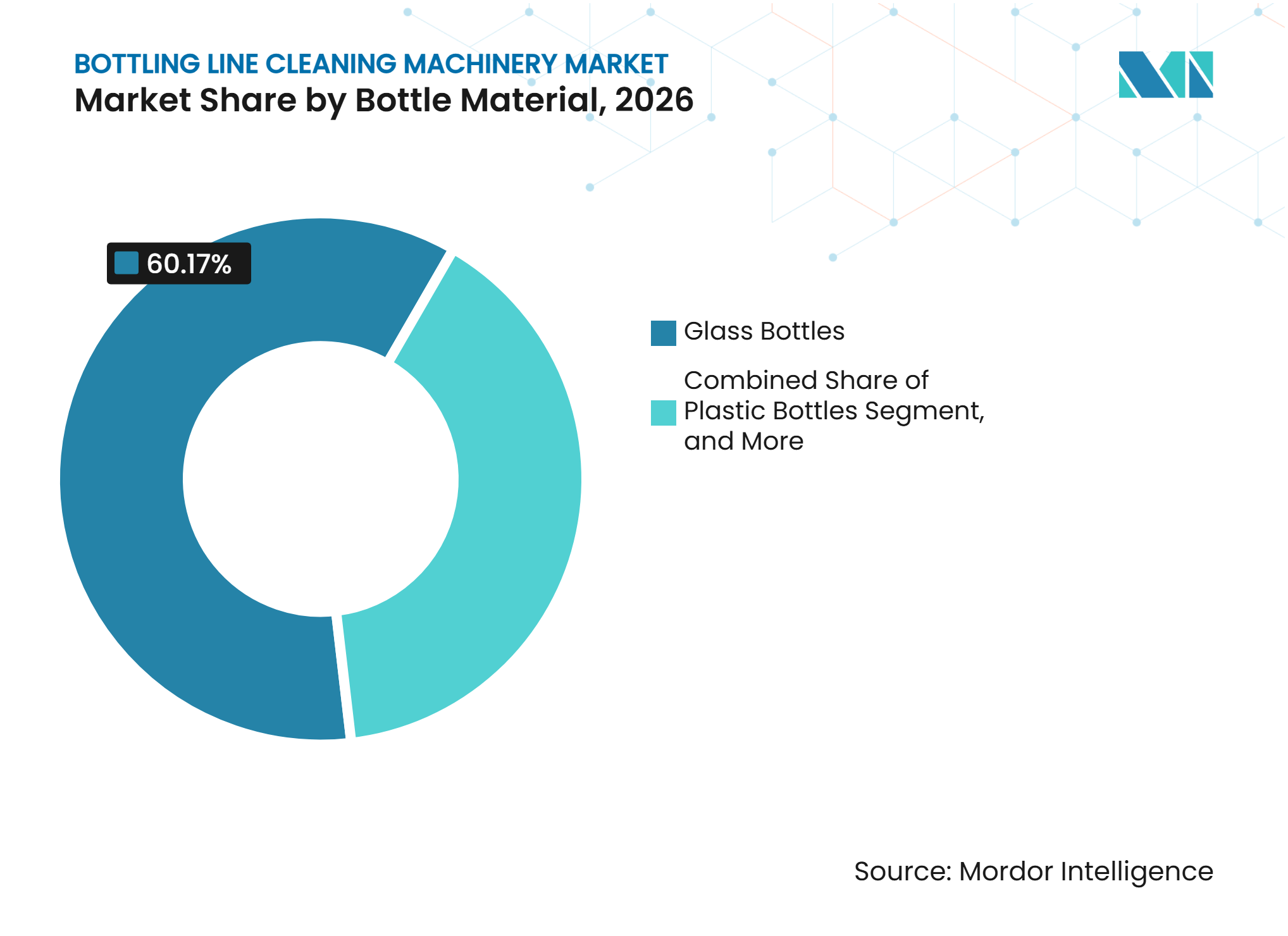
Glass Holds Volume While Plastic Adds Diverse DemandGlass accounted for 60.17% of the Bottling Line Cleaning Machinery Market share in 2026, reflecting its central role in returnable systems. Plastic bottles are projected to expand at a 6.21% CAGR through 2032. Returnable glass remains important under deposit-return programs and in established beer and soft-drink supply chains. A glass bottle can complete 20 or more wash cycles, which keeps washing assets heavily utilized. This use pattern supports continuous systems designed for high-throughput, repeatable caustic treatment.
Plastic demand reflects the use of PET and HDPE in liquid medicines, nutraceuticals, and bottled water. Metal and aluminum containers remain relevant in energy drinks, craft beer, and hard seltzer, where rinsing is usually the main cleaning step. Research on SnO₂ thin-film coatings described a 20% weight reduction in returnable glass while retaining durability during repeated alkaline washing. Lighter-coated glass may require adjustable programs to limit container stress during cleaning. Recycled PET can also change residue loads, supporting programmable carrier systems and multistage spray arrangements.

By End User:
Pharmaceutical Producers Raise Precision Requirements While Breweries Sustain DemandBreweries and soft-drink producers held 38.42% of market revenue in 2026, supported by established returnable-glass lines. Pharmaceutical manufacturers are projected to expand at a 6.78% CAGR through 2032. Pharmaceutical operators require purpose-built equipment with validated cycles under contamination-control obligations. These requirements support equipment designs that document cleaning processes and support regular qualification. Breweries and soft-drink producers sustain demand through dense returnable-glass lines in Europe and Asia-Pacific.
Bottled water producers require rapid changeovers and favor programmable rinsing and blowing equipment. Wineries and distilleries require careful handling of premium glass, while food and dairy operators need HACCP-aligned cleaning and validated CIP cycles. Contract bottlers require modular systems that process glass, PET, and aluminum containers on the same line. Pharmaceutical sites can require different equipment for interior container preparation and post-filling exterior handling. These varied requirements maintain demand for specialist configurations.
Geography Analysis
Asia-Pacific: Scale and Capacity Investment Support Regional Demand
Asia-Pacific held 33.18% of the Bottling Line Cleaning Machinery Market share in 2026 and is projected to expand at a 6.62% CAGR through 2032. China and India remain the main volume centers for new beverage capacity. Swire Coca-Cola opened 2 plants in China in May 2026, adding more than 20 production lines and more than 3.1 million tonnes of annual capacity. These projects reflect the need for cleaning equipment that matches line speed, container mix, and water-management requirements. The regional mix of capacity additions and stronger operating standards supports demand for integrated systems.
Europe: Reuse Rules and Replacement Needs Shape Equipment Decisions
Europe’s established returnable-glass base makes policy, hygiene compliance, and equipment replacement important demand factors. Reuse frameworks support long-term planning for high-throughput washing capacity that can serve standardized bottle pools. France expanded its standardized reuse system across 4 regions in 2025, and Carrefour began a wider rollout in April 2026. In Germany and Italy, aging equipment creates a direct incentive to improve water and energy performance. The Bottling Line Cleaning Machinery Market size for replacement systems is supported by strict operating requirements and extensive reuse infrastructure.
North America, South America, and Middle East and Africa: Distinct Demand Pools Emerge
North America has less returnable-glass infrastructure than Europe, but Québec’s deposit-refund modernization adds glass and other materials from March 2027.[2] The United States and Mexico rely more on rinsing and blowing equipment for new PET bottles, while Brazil and Argentina depend more on investment in breweries and soft drinks. Brazil also retains a returnable-glass base in beer, while South Africa supports specialized equipment through exports of wine and sparkling water. In the Middle East and Africa, investment is concentrated in United Arab Emirates and Saudi Arabian food-processing hubs. These markets provide varied demand routes through future deposit-return infrastructure, format flexibility, and export-grade production requirements.
Competitive Landscape
Market Concentration
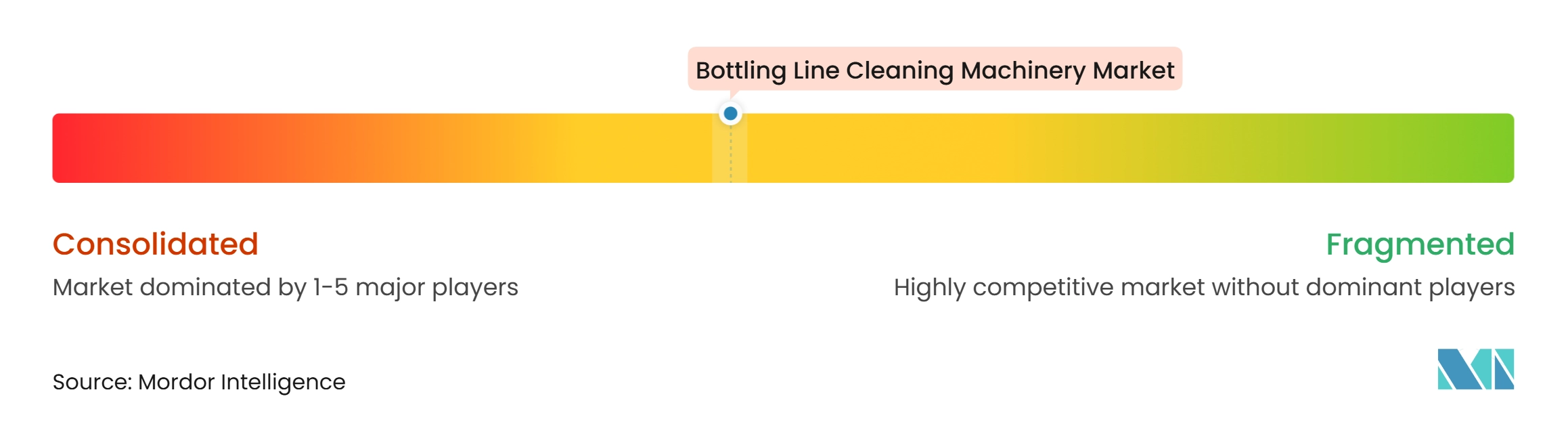
The Bottling Line Cleaning Machinery Market is moderately concentrated among premium full-line equipment suppliers, led by integrated suppliers with broad service capabilities. Krones and KHS offer filling, washing, inspection, and digital support, while Sidel is active in ultrasonic and returnable-glass washing. Krones introduced the Lavasonic HI with ultrasonic cavitation pretreatment and an integrated bottle-fastening mechanism. KHS advanced its carrier design through the ECO carrier 2.0 concept. These systems compete through lifecycle cost, cleaning performance, reduced resource use, and service depth.
European specialists, particularly Italian and Spanish manufacturers, remain important in wine, craft beer, and pharmaceutical applications. Their position relies on application expertise, careful handling of specialty containers, and local customer support rather than broad scale. Pharmaceutical bottle washing remains fragmented among smaller specialized suppliers. EMA and FDA requirements increase the value of validation documentation and process-qualification support.[3] Larger suppliers can combine compliance support with equipment supply, service contracts, and integrated line engineering.
Adjacent technologies are shaping the Bottling Line Cleaning Machinery Market, particularly in pharmaceutical applications requiring lower water use. Component-level sensor data can identify process issues before cleaning baths are drained. Mid-market manufacturers in China and India are also competing with price-focused automated washers for regional use in PET and pharmaceuticals. European specialists must retain differentiation through flexibility, engineering, and validated performance. The market remains divided between global full-line suppliers and smaller application-focused manufacturers.
Bottling Line Cleaning Machinery Industry Leaders
-
Krones AG
-
KHS GmbH
-
Della Toffola S.p.A.
-
Hilden Packaging Machines Pvt Ltd
-
Sidel Group
- *Disclaimer: Major Players sorted in no particular order
Bottling Line Cleaning Machinery Market Companies Covered in this Report
- Krones AG
- KHS GmbH
- Sidel
- Tetra Pak International S.A.
- SACMI Cooperativa Meccanici Imola S.C.
- Della Toffola S.p.A.
- SIPA S.p.A.
- Bausch+Ströbel SE + Co. KG
- IC Filling Systems S.r.l.
- TME S.p.A.
- Hilden Packaging Machines Pvt Ltd
- Akomag S.r.l.
- STENTZ
- Promec S.r.l.
- CIMEC Italia
- Tenco
- ZAMBELLI Enotech s.r.l.
- Enotecnica Pillan S.r.l.
- Manuel Bou S.L.
- GM Getränketechnik & Maschinenbau GmbH Gera
- Hugh Crane (Cleaning Equipment) Ltd.
- Prospero Equipment Corp.
Recent Industry Developments in Bottling Line Cleaning Machinery Market
- November 2026: SACMI Cooperativa Meccanici Imola S.C. announced the founding of OSMI, a new biomedical start-up in which SACMI holds a 55% stake, drawing on 25 years of internal research. The move represents SACMI's strategic diversification into precision medical device applications, expanding its perimeter beyond traditional food and beverage packaging machinery into adjacent life-science manufacturing segments.
- July 2026: Western Australia formally expanded its Containers for Change deposit-return scheme to include wine and spirit glass bottles from July 1, 2026, adding an estimated 200 million additional eligible containers annually, including 90-130 million glass bottles, to a system achieving a glass return rate of 80% across more than 4.5 billion containers collected since 2020.
- May 2026: Western Australia formally expanded its Containers for Change deposit-return scheme to include wine and spirit glass bottles from July 1, 2026, adding an estimated 200 million additional eligible containers annually, including 90-130 million glass bottles, to a system achieving a glass return rate of 80% across more than 4.5 billion containers collected since 2020.
- January 2026: Poland's universal deposit-and-return system entered full regulatory force from January 1, requiring all participating producers to market beverages exclusively in deposit-marked packaging, with a 77% collection-rate obligation and product fee penalties for shortfalls of up to PLN 3 per kilogram for non-participating producers.
Global Bottling Line Cleaning Machinery Market Report Scope
The bottling line cleaning machinery market refers to the global market for equipment and integrated machinery systems used to clean, wash, rinse, sanitize, and dry bottles before they are filled, capped, or packaged across beverage, food, pharmaceutical, and other liquid packaging industries. These machines are designed to remove dust, dirt, residues, contaminants, and microorganisms from bottles, ensuring product hygiene, maintaining quality standards, and complying with industry-specific sanitation requirements.
The Bottling Line Cleaning Machinery Market Report is Segmented by Machine Type (Rotary Bottle Washers, Linear Bottle Washers, Tunnel Bottle Washers, Immersion Bottle Washers, Bottle Rinsers and Blowers, Combined Washer-Dryer Systems, ad Other Machine Types), Automation Level (Manual, Semi-Automatic, and Fully-Automatic), Bottle Material (Glass Bottles, Plastic Bottles, and Metal and Aluminum Containers), End User (Breweries and Soft-Drink Producers, Bottled Water Producers, Wineries and Distilleries, Food and Dairy Producers, Pharmaceutical Manufacturers, and Contract Packaging and Bottling Companies), and Geography (North America, South America, Europe, Asia-Pacific, and Middle East and Africa). The Market Forecasts are Provided in Terms of Value (USD).
Segmentation Overview
| Rotary Bottle Washers |
| Linear Bottle Washers |
| Tunnel Bottle Washers |
| Immersion Bottle Washers |
| Bottle Rinsers and Blowers |
| Combined Washer-Dryer Systems |
| Other Machine Types |
| Manual |
| Semi-automatic |
| Fully-automatic |
| Glass Bottles |
| Plastic Bottles |
| Metal and Aluminum Containers |
| Breweries and Soft-Drink Producers |
| Bottled-Water Producers |
| Wineries and Distilleries |
| Food and Dairy Producers |
| Pharmaceutical Manufacturers |
| Contract Packaging and Bottling Companies |
| North America | United States |
| Canada | |
| Mexico | |
| South America | Brazil |
| Argentina | |
| Rest of South America | |
| Europe | Germany |
| United Kingdom | |
| France | |
| Italy | |
| Spain | |
| Russia | |
| Rest of Europe | |
| Asia-Pacific | China |
| India | |
| Japan | |
| Australia | |
| Rest of Asia-Pacific | |
| Middle East and Africa | Saudi Arabia |
| United Arab Emirates | |
| South Africa | |
| Rest of Middle East and Africa |
| By Machine Type | Rotary Bottle Washers | |
| Linear Bottle Washers | ||
| Tunnel Bottle Washers | ||
| Immersion Bottle Washers | ||
| Bottle Rinsers and Blowers | ||
| Combined Washer-Dryer Systems | ||
| Other Machine Types | ||
| By Automation Level | Manual | |
| Semi-automatic | ||
| Fully-automatic | ||
| By Bottle Material | Glass Bottles | |
| Plastic Bottles | ||
| Metal and Aluminum Containers | ||
| By End User | Breweries and Soft-Drink Producers | |
| Bottled-Water Producers | ||
| Wineries and Distilleries | ||
| Food and Dairy Producers | ||
| Pharmaceutical Manufacturers | ||
| Contract Packaging and Bottling Companies | ||
| By Geography | North America | United States |
| Canada | ||
| Mexico | ||
| South America | Brazil | |
| Argentina | ||
| Rest of South America | ||
| Europe | Germany | |
| United Kingdom | ||
| France | ||
| Italy | ||
| Spain | ||
| Russia | ||
| Rest of Europe | ||
| Asia-Pacific | China | |
| India | ||
| Japan | ||
| Australia | ||
| Rest of Asia-Pacific | ||
| Middle East and Africa | Saudi Arabia | |
| United Arab Emirates | ||
| South Africa | ||
| Rest of Middle East and Africa | ||
Key Questions Answered in the Report
What is the bottling line cleaning machinery market size?
The Bottling Line Cleaning Machinery Market is valued at USD 42.71 million in 2026 and is forecast to reach USD 45.59 million in 2027 before reaching USD 60.07 million by 2032. The forecast represents a 5.67% CAGR over 2027-2032.
What is driving demand for bottling line cleaning machinery?
Deposit-return systems increase the need for centralized, repeated bottle washing. Hygiene requirements, beverage-capacity additions, and replacement of older systems for lower water and energy use also support equipment demand across beverage, food, dairy, and pharmaceutical facilities.
Which machine type has the largest revenue share?
Rotary washers held 29.32% of market revenue in 2026 because they are designed for high-throughput beer, carbonated soft-drink, and mineral-water production. Combined washer-dryer systems are projected to expand at a 7.06% CAGR through 2032.
Which automation level is expanding most quickly?
Fully automatic systems held 57.93% of revenue in 2026 and are projected to expand at a 6.24% CAGR through 2032. Their use is supported by continuous beverage production, labor considerations, validated cleaning requirements, and documented process control.
Which end user is projected to expand most quickly?
Pharmaceutical manufacturers are projected to expand at a 6.78% CAGR through 2032. Operators in this segment need validated cleaning cycles and documented contamination controls, while pharmaceutical container cleaning can include both wet interior washing and dry exterior-cleaning equipment.
Which region leads bottling line cleaning machinery demand?
Asia-Pacific held 33.18% of revenue in 2026 and is projected to expand at a 6.62% CAGR through 2032. Capacity investment in China and India, together with adoption of lower-resource washing technology in Southeast Asia, supports the regional outlook.