
Bottling Line Accumulating and Collating Machinery Market Size and Share
Market Overview
| Study Period | 2021 - 2032 |
|---|---|
| Market Size (2027) | USD 1.42 Billion |
| Market Size (2032) | USD 1.98 Billion |
| Growth Rate (2027 - 2032) | 6.87 % |
| Fastest Growing Market | Middle East |
| Largest Market | Asia-Pacific |
| Market Concentration | Medium |
Major Players *Disclaimer: Major Players sorted in no particular order Image © Mordor Intelligence. Reuse requires attribution under CC BY 4.0. | |
Bottling Line Accumulating and Collating Machinery Market Analysis by Mordor Intelligence
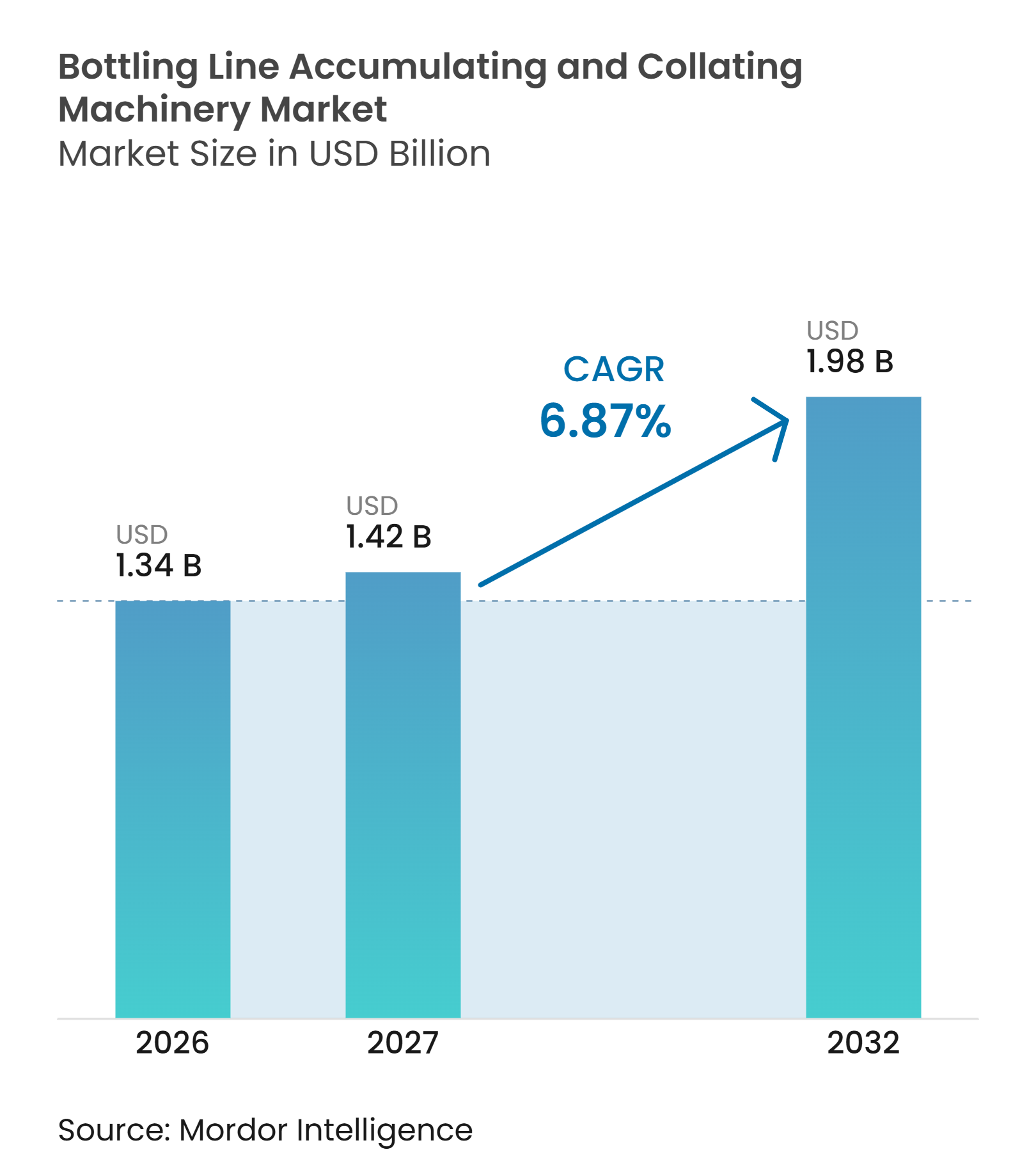
The Bottling Line Accumulating and Collating Machinery Market size is expected to grow from USD 1.34 billion in 2026 to USD 1.42 billion in 2027 and is forecast to reach USD 1.98 billion by 2032 at 6.87% CAGR over 2027-2032. Growth is tied to higher filling speeds and a broader mix of bottle, can, glass, and multipack formats across beverage, food, pharmaceutical, and personal care plants. Producers are investing in buffers and collating equipment because small stoppages after filling can reduce output across the line. Fully automatic equipment is becoming the standard for high-volume installations, while brownfield sites are favoring compact systems that use vertical space. Integrated suppliers can benefit as customers seek equipment that combines controls, accumulation, and downstream handling in one line. Capital approvals and the complexity of unstable containers may still lengthen project schedules in the Bottling Line Accumulating and Collating Machinery Market.
Key Report Takeaways
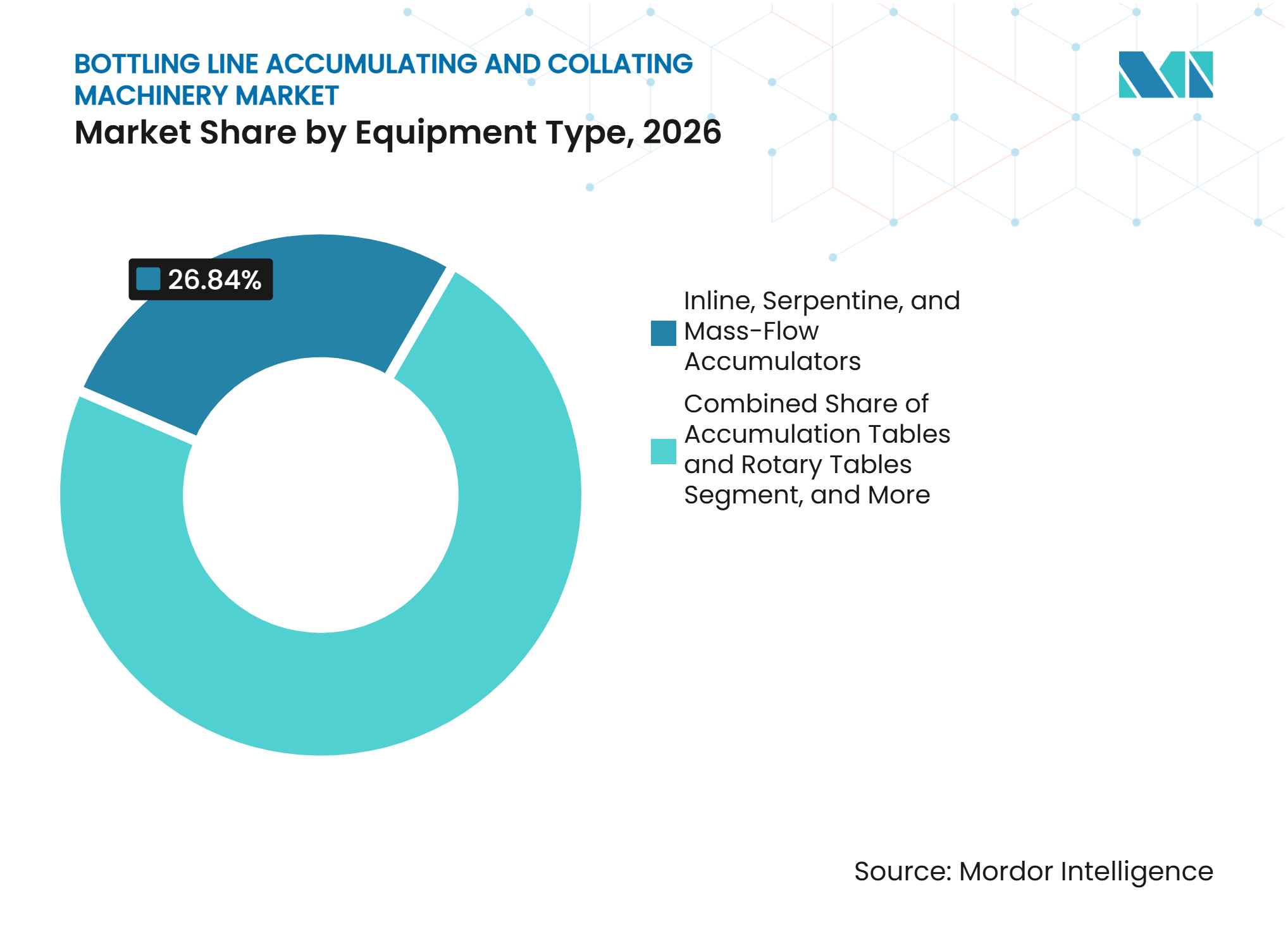
- By equipment type, inline, serpentine, and mass-flow accumulators held 26.84% of the Bottling Line Accumulating and Collating Machinery Market share in 2026, while alpine, spiral, and vertical accumulators are projected to expand at a 7.29% CAGR through 2032.
- By material type, plastic containers accounted for 52.67% of revenue in 2026, while metal and aluminum containers are expected to expand at a 7.32% CAGR through 2032 in the Bottling Line Accumulating and Collating Machinery Market.
- By container shape, round containers held 63.92% of revenue in 2026, while specialty and irregular geometry containers are projected to grow at a 7.41% CAGR through 2032.
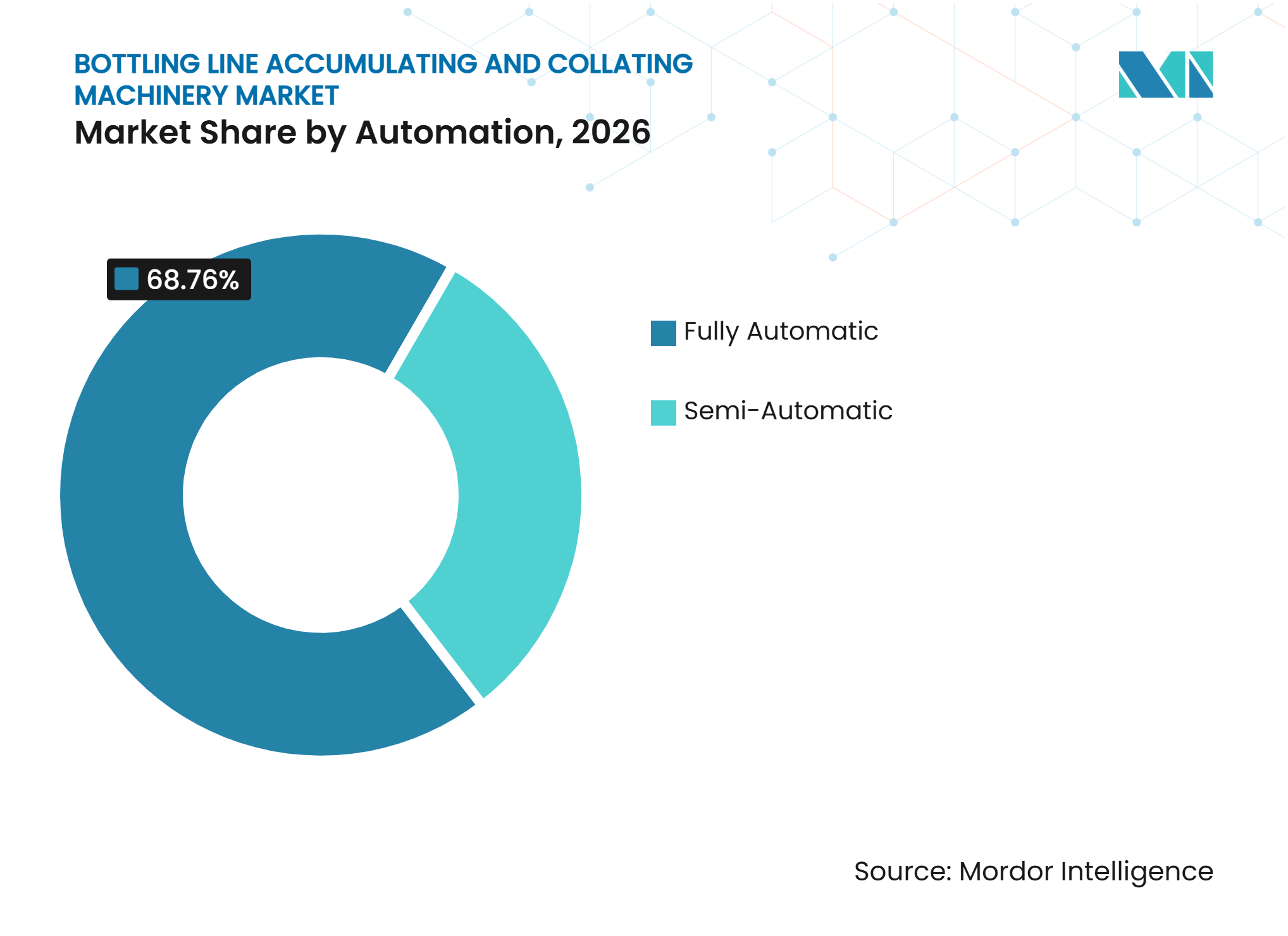
- By automation, fully automatic systems held 68.76% of revenue in 2026 and are projected to record the highest CAGR at 7.18% through 2032.
- By end user, beverage producers accounted for 48.29% of revenue in 2026, while pharmaceutical and healthcare producers are expected to expand at a 7.37% CAGR through 2032.
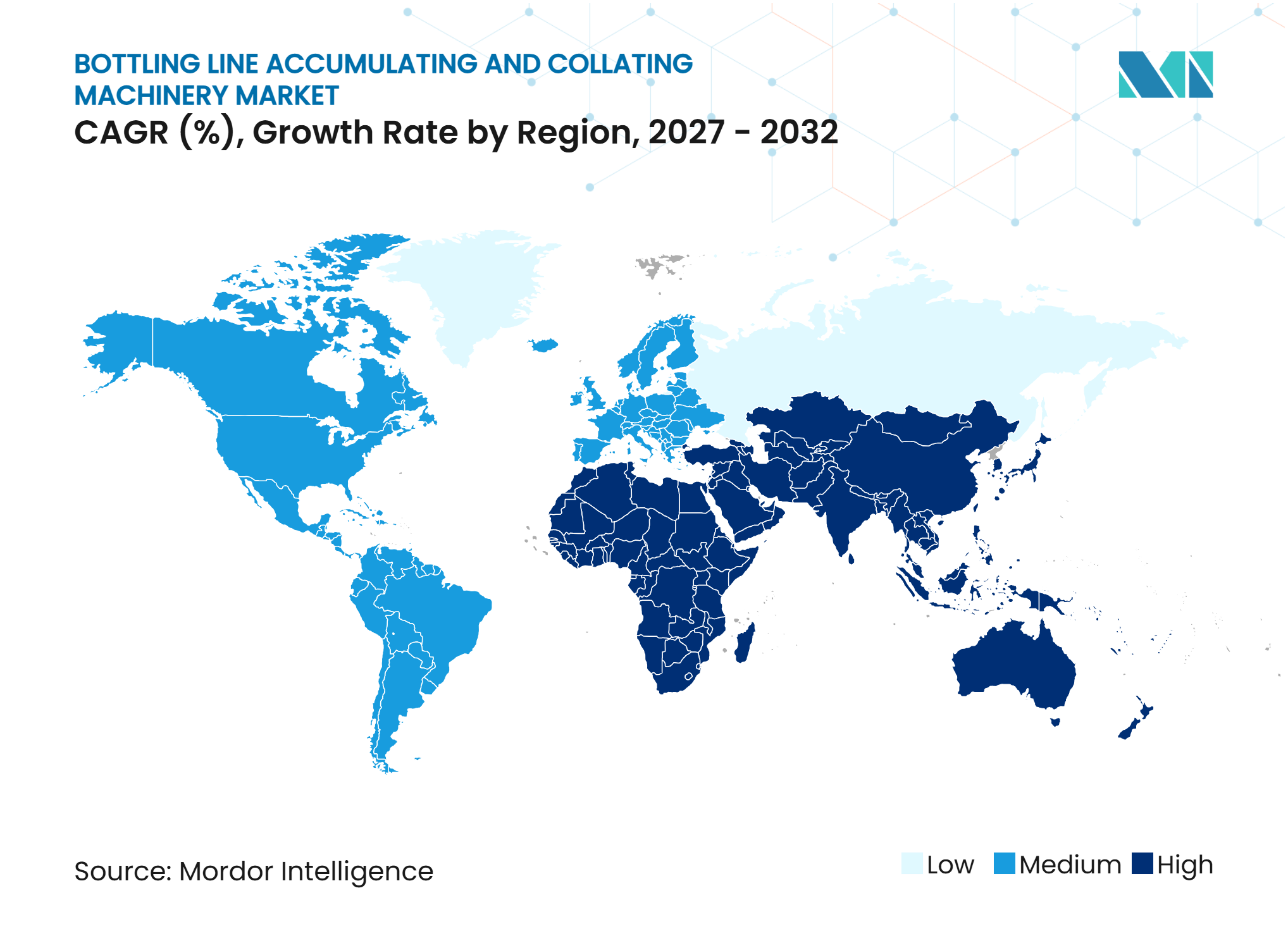
- By geography, Asia-Pacific held 34.53% of revenue in 2026, while the Middle East is projected to expand at a 7.56% CAGR through 2032.
Note: Market numbers in this report are based on Mordor Intelligence's proprietary estimation framework, which combines nine months of actuals with Q4 projections for base year 2026.
Market Trends and Insights
Drivers Impact Analysis of Bottling Line Accumulating and Collating Machinery Market*
| Driver | (~) % Impact on CAGR Forecast | Geographic Relevance | Impact Timeline |
|---|---|---|---|
| Beverage and Packaged-Food Line Automation | +2.1% | Global, with intensity in Asia-Pacific and North America | Medium term (2-4 years) |
| Rising Line-Speed Requirements and OEE Targets | +1.5% | Global | Short term (≤ 2 years) |
| Expansion of PET, Glass, Can, and Multipack Formats | +1.2% | Global, led by Asia-Pacific and Middle East | Medium term (2-4 years) |
| Labor Shortages and Demand for Unattended End-of-Line Handling | +0.9% | North America and Europe primarily, spill-over to Asia-Pacific | Short term (≤ 2 years) |
| Pressureless Handling for Lightweight and Damage-Sensitive Containers | +0.5% | Global, with intensity in Europe and North America | Long term (≥ 4 years) |
| Brownfield Retrofits for Bottleneck Removal and Flexible Changeover | +0.4% | Europe and North America, emerging in Asia-Pacific | Medium term (2-4 years) |
| Source: Mordor Intelligence | |||
Beverage and Packaged-Food Line Automation
Software-managed production lines are changing the role of accumulation equipment in bottling plants. Krones presented its Ingeniq system at drinktec 2025, and the system will be commercial in 2026, with controls that link modular line sections and adjust accumulation targets in real time. This approach makes the accumulator an active part of line control rather than a passive holding area. PMMI identifies predictive maintenance and knowledge transfer as technologies with a strong near-term impact on packaging equipment, increasing the need for connected equipment across the line.[1] Suppliers that provide sensors, servo controls, and data links can attach more service and software work to a capital project. This shift supports demand for higher-specification systems in the Bottling Line Accumulating and Collating Machinery Market.
Rising Line-Speed Requirements and OEE Targets
Higher filling speeds make a short downstream interruption more costly for a producer. Haskell documented a bottling-line case in which a 500-container buffer between the filler and overcapper increased line availability by 3.3 percentage points. That result shows why buffer capacity has become part of an overall equipment effectiveness calculation. PMMI reports that food and beverage manufacturers are obtaining productivity gains from automation, including lines that can be operated by fewer workers. Buyers are moving beyond a simple measure of buffer minutes toward systems that can anticipate stoppages and manage container queues. This raises the value placed on controls and engineering during equipment selection.
Expansion of PET, Glass, Can, and Multipack Formats
A single beverage line can process lightweight PET, returnable glass, aluminum cans, and multipacks within a short production cycle. Each format requires its own conveyor surface, guide-rail geometry, and accumulation pressure settings. Sidel signed an agreement with China Resources Beverage in November 2025 for high-speed aseptic PET lines and large-format water lines, including operations reported at 18,000 bottles per hour and 98% overall equipment effectiveness. These format changes create more complex specifications for the Bottling Line Accumulating and Collating Machinery Market. They also make it harder for a supplier of basic conveyor equipment to compete on a system that must handle several container designs. The resulting project can have broader service and validation requirements after installation.
Labor Shortages and Demand for Unattended End-of-Line Handling
Labor shortages are strengthening the case for unattended accumulation and collating systems. PMMI found that 42% of surveyed CPG companies automate loading and unloading tasks, while 64% planned to do so within 1 to 3 years. Packaging equipment projects therefore increasingly include guided interfaces and remote diagnostic capabilities. The need is most visible in North America and Europe, though it is also spreading across Asia-Pacific plants that face rising wage costs. Automated handling can reduce the need for operators to clear jams or balance buffers by hand. This favors suppliers in the Bottling Line Accumulating and Collating Machinery Market that can combine equipment design with practical line-support features.
Restraints Impact Analysis of Bottling Line Accumulating and Collating Machinery Market*
| Restraint | (~) % Impact on CAGR Forecast | Geographic Relevance | Impact Timeline |
|---|---|---|---|
| High Initial Cost and Long Capital-Approval Cycles | -1.8% | Global, with intensity in SME-heavy markets in South America and Africa | Short term (≤ 2 years) |
| Engineering Complexity for Mixed-Format and Unstable Containers | -0.9% | Global, particularly in Europe and North America where SKU count is highest | Medium term (2-4 years) |
| Limited Floor Space and Utility Constraints in Existing Plants | -0.5% | Europe and North America brownfield facilities | Medium term (2-4 years) |
| Skilled-Service and Controls-Integration Gaps in Emerging Markets | -0.3% | Africa, parts of South America, and emerging Asia-Pacific | Long term (≥ 4 years) |
| Source: Mordor Intelligence | |||
High Initial Cost and Long Capital-Approval Cycles
The purchase cost of a fully automatic system remains a significant constraint for smaller plants and lower-margin operations. Packaging World reported in 2026 that 50% of non-adopters named high cost as their main barrier, while 35% cited limited floor space. A project may also need custom engineering when containers have unusual shapes. Large CPG groups must compare these investments with primary packaging upgrades, digital programs, and sustainability spending. This can extend approval cycles for Bottling Line Accumulating and Collating Machinery Market projects from initial scoping to a purchase order. The EU Machinery Regulation 2023/1230 will apply from January 2027, creating an additional compliance factor for some European brownfield facilities.
Engineering Complexity for Mixed-Format and Unstable Containers
Multi-format lines are more difficult to engineer than installations that run a single container design. Conical, asymmetrical, and small-base containers can topple under back pressure or suffer label damage on friction-heavy surfaces. Sidel introduced Cermex RoboSELEX for these designs, using two delta robots and continuous-motion collation at up to 320 products per minute. The system illustrates why some projects move away from conventional accumulation at the case-packer infeed. Suppliers without comparable handling options face greater scope-change and commissioning risk. The challenge is particularly relevant in the Bottling Line Accumulating and Collating Machinery Market where premium packaging adds more container shapes to a shared line.
*Our forecasts treat driver/restraint impacts as directional, not additive. The impact forecasts reflect baseline growth, mix effects, and variable interactions.
Bottling Line Accumulating and Collating Machinery Market Segment Analysis
By Equipment Type:
Inline Systems Lead While Vertical Designs ExpandInline, serpentine, and mass-flow accumulators held 26.84% of Bottling Line Accumulating and Collating Machinery Market share in 2026. Their position reflects compatibility with high-throughput round PET, glass, and can formats. These systems are relatively straightforward to integrate into multi-brand line layouts. Alpine, spiral, and vertical accumulators are projected to grow at a 7.29% CAGR through 2032. Their growth is linked to retrofit sites where height is easier to use than additional floor area. Nercon developed the Serpentine 560 as a compact first-in-first-out system with micro-pitch accumulation chains for small and delicate products.
Scott Technology introduced its AccuTable at PACK EXPO 2025 and described efficiency improvements of up to 10% in European CPG installations.[2] Rotary tables remain suited to pressureless, single-file pharmaceutical and cosmetic handling, while Krones placed its Varioline 1M architecture into commercial production at Krombacher Brauerei in early 2025. The system can process up to 103,000 containers per hour and reduces the need for external curve conveyors and secondary loops. Equipment suppliers in the Bottling Line Accumulating and Collating Machinery Market are increasingly combining accumulation and collation functions in servo-driven modules.



By Material Type:
Plastic Retains Scale While Metal and Aluminum AcceleratePlastic containers accounted for 52.67% of revenue in 2026. PET remains widely used in water, carbonated soft drinks, and extended-shelf-life juice applications. Metal and aluminum containers are projected to grow at a 7.32% CAGR through 2032. This is the fastest rate among the material categories. Demand in the Bottling Line Accumulating and Collating Machinery Market reflects continuing investment in beverage cans and the value placed on closed-loop recyclability.
The Can Manufacturers Institute stated in 2025 that aluminum beverage cans represented 78% of the worldwide metal can market. Slim and specialty cans are requiring additional work on guide rails, spacing, and accumulator compatibility. Krones acquired Can Systems Worldwide in September 2025 to add can-end handling and line equipment to its portfolio. Glass remains important for returnable beer, premium spirits, and hot-fill juice, while KHS's 6.2-gram, 0.25-liter PET bottle at drinktec 2025 showed the continued shift toward pressure-sensitive lightweight designs. SIG opened an aseptic carton plant in Ahmedabad in 2025, reinforcing investment across adjacent dairy and juice packaging formats.
By Container Shape:
Round Formats Remain Core While Irregular Designs Require Specialized HandlingRound containers held 63.92% of revenue in 2026. Their geometry works with standard mass-flow and serpentine accumulation surfaces. They remain common across water, carbonated beverages, beer, dairy, and pharmaceutical syrups. Specialty and irregular geometry containers are expected to grow at a 7.41% CAGR through 2032. Their growth reflects differentiated packaging in premium beverages, cosmetics, and over-the-counter pharmaceutical products.
Sidel designed Cermex RoboSELEX for conical, asymmetrical, and small-base designs at speeds of up to 320 products per minute. These designs require modified guide rails and lower accumulation pressure. Pharmaceutical lines that handle shaped bottles also need equipment designs aligned with current good manufacturing practice requirements under 21 CFR Part 211. Standard round formats support an installed base that produces recurring demand for wear parts, spares, and software updates. Flexible and pouch formats pose a longer-term challenge for the Bottling Line Accumulating and Collating Machinery Market because their accumulation requirements differ from those of rigid-container systems.
By Automation:
Fully Automatic Systems Hold Scale and GrowthFully automatic systems held 68.76% of revenue in 2026 and are projected to expand at a 7.18% CAGR through 2032. This segment commanded the leading position in the Bottling Line Accumulating and Collating Machinery Market size because manual intervention becomes impractical as line speeds rise. At output rates above 30,000 containers per hour, automated flow control supports safer and more consistent operation. Servo-driven equipment can manage buffers without relying on operators to clear jams or adjust product flow. This remains a central procurement requirement for installations in the high-volume Bottling Line Accumulating and Collating Machinery Market.
Perrier Bottling integrated Rockwell Automation's iTRAK conveyor technology into Rémy Martin's operations in 2025. The project cut format changeover time from as long as half a day to 15 minutes. Semi-automatic systems still serve smaller batch runs, including specialty pharmaceutical and spirits packaging. However, higher labor costs and recruitment difficulties limit the range of applications in which they are preferred. The control transition is moving from relay logic and basic programmable logic controllers toward fieldbus-integrated servo systems. Compatibility with OPC UA and digital twin planning tools is increasingly relevant as buyers assess lifecycle value.

By End User:
Beverage Producers Lead While Pharmaceutical Demand Grows FastestBeverage producers accounted for 48.29% of revenue in 2026. Their spending is concentrated in high-output water, carbonated soft drink, beer, and ready-to-drink lines. Pharmaceutical and healthcare producers are expected to expand at a 7.37% CAGR through 2032. Glass vial handling, serialization, and first-in, first-out sequencing make pressureless equipment important in this segment. Regulatory compliance also narrows the suitable range of accumulation designs in the Bottling Line Accumulating and Collating Machinery Market.
Garvey's Infinity RX accumulator can handle more than 800 vials per minute without pressure buildup and is designed for clean-in-place readiness and continuous first-in-first-out flow. Tjoapack commissioned an automated vial packaging line in the Netherlands in May 2025, featuring integrated labeling, cartoning, and serialization, with an annual capacity of 20 million vials. SLMG Beverages invested in KHS InnoPET TriBlock lines capable of processing up to 48,000 non-returnable PET bottles per hour. Food and dairy plants require hygienic systems that withstand washdown cycles. Personal care, cosmetics, chemical, and household-product operations need designs that address label sensitivity, chemical resistance, or static control.
Geography Analysis
Asia-Pacific
Asia-Pacific held 34.53% of regional revenue in 2026. Growth in the Bottling Line Accumulating and Collating Machinery Market comes from capacity additions across beverage, dairy, pharmaceutical, and food production. Tech-Long and Newamstar were developing 60,000-bottles-per-hour aseptic lines in 2025 and 2026, increasing regional competition in high-speed equipment. Krones opened a USD 36.33 million manufacturing plant in Vemagal, Karnataka, in 2026 to reduce lead times for Indian customers.[3] Coca-Cola bottlers committed INR 25,760 crore (USD 3.1 billion) for expansion across 9 Indian states between 2026 and 2030.
Middle East
The Middle East is projected to grow at a 7.56% CAGR through 2032, the highest regional rate. Saudi Arabia and the UAE are supporting local beverage manufacturing through diversification programs. Abu Dhabi Refreshment Company commissioned an AED 300 million (USD 81.7 million) facility with KEZAD Group, increasing capacity by 88%. Krones secured orders for 4 filling lines for Alesayi Beverage Co. in Saudi Arabia across glass, PET, and can formats. The shift from imports to domestic production is creating opportunities in the Bottling Line Accumulating and Collating Machinery Market for suppliers capable of supporting complete lines and local service.
North America, Europe, South America, and Africa
North America continues to rely on brownfield retrofits across a large installed base of food and beverage plants, while Europe focuses on compact, energy-efficient equipment as packaging and efficiency requirements shape line specifications. KHS showed retrofit solutions at BrauBeviale 2026, including a spraying system designed to reduce spray-pump energy consumption by up to 40%. South America offers capacity opportunities in Brazil and Colombia, although capital-equipment duties can slow approvals. In Africa, Coca-Cola Hellenic Egypt opened a USD 35 million PET line in Alexandria in 2026 with a capacity of over 65,000 bottles per hour, while Eroğlu Global Holding committed USD 175 million to a carton and packaging facility in Egypt's Suez Canal Economic Zone.
Competitive Landscape
Market Concentration
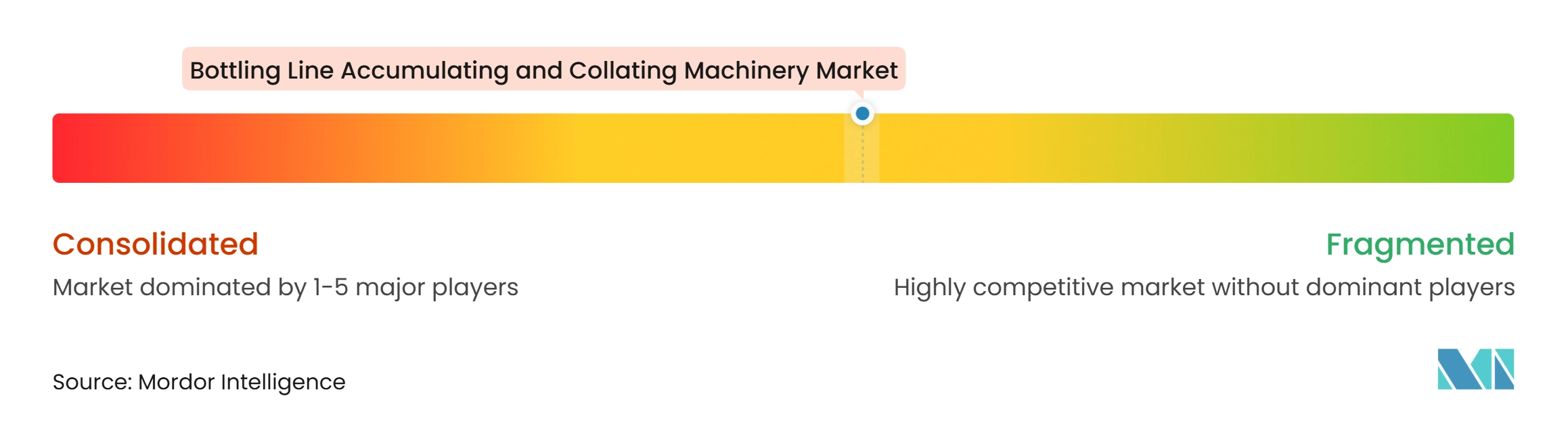
The Bottling Line Accumulating and Collating Machinery Market is moderately fragmented and includes integrated suppliers such as Krones AG, Sidel Group, and KHS GmbH. These companies compete across the Bottling Line Accumulating and Collating Machinery Market from filling to palletizing. Specialized suppliers include Garvey Corporation, ITW Hartness, Nercon Eng. and Mfg., and FlexLink Systems. Integrated suppliers seek to bundle accumulation and collation modules with controls, service agreements, and digital platforms. This approach can raise switching costs after the initial capital sale in the Bottling Line Accumulating and Collating Machinery Market.
Krones uses product architecture to differentiate its line solutions. Its Varioline 1M uses a single-end, continuous-direction-reversal layout that combines robotic pick-and-place activity with continuous inbound flow. ITW Hartness offers the DYNAC FIFO system, which uses a circular spiral layout for closely coupled production lines. FlexLink introduced the RC20 collaborative palletizing cell at Cosmoprof Worldwide Bologna 2026, bringing accumulation and palletizing under one control architecture.[4] These moves show a preference for integrated systems that reduce coordination work for customers.
Chinese suppliers such as Tech-Long and Newamstar are building a stronger position in standard-format beverage applications, while regional and application specialists preserve pricing pressure in North America and Europe. Opportunities remain in the Bottling Line Accumulating and Collating Machinery Market for compact vertical and spiral equipment at pharmaceutical and cosmetics plants with constrained floor space. Suppliers that can use line data to adjust buffer settings have a separate route to differentiation.
Bottling Line Accumulating and Collating Machinery Industry Leaders
-
Krones AG
-
Sidel Group
-
KHS GmbH
-
Garvey Corporation
-
Illinois Tool Works Inc.
- *Disclaimer: Major Players sorted in no particular order
Bottling Line Accumulating and Collating Machinery Market Companies Covered in this Report
- Krones AG
- Sidel Group
- KHS GmbH
- Garvey Corporation
- Illinois Tool Works Inc.
- Nercon Eng. & Mfg., Inc.
- FlexLink Systems AB
- Multi-Conveyor LLC
- Acasi Machinery, Inc.
- AND&OR AMERICA, LLC
- Dairy Conveyor Corp.
- Descon Conveyor Systems
- UNI-PAK CORP., INC.
- Standard-Knapp, Inc.
- Delkor Systems, Inc.
- PMI Kyoto Packaging Systems, Inc.
- JYGA CONCEPT INC.
Recent Industry Developments in Bottling Line Accumulating and Collating Machinery Market
- November 2026: KHS GmbH showcased energy-efficiency retrofit packages for reusable glass bottle filling lines at BrauBeviale 2026 in Nuremberg, November 10-12, highlighting its Liquid Efficiency Spraying System that reduces spray pump energy consumption by up to 40% through frequency-converter-regulated spray pumps, and a rolling-maintenance program for Innofill Glass fillers that cuts planned downtime to as low as 10 hours per maintenance cycle.
- October 2026: Krones AG opened a USD 36.33 million bottling machinery manufacturing plant in Vemagal, Karnataka, India, creating 550 jobs and forming part of the company's 2026 capacity-expansion program targeting India, China, and the United States, reducing lead times for Asia-Pacific customers.
- March 2026: Krones AG confirmed its full-year 2026 revenue guidance of 3%-5% growth, adjusted for currency translation effects, and an EBITDA margin of 10.7%-11.1%, supported by a Q1 2026 order intake of EUR 1,512.1 million (USD 1.66 billion), 5.3% ahead of the prior-year period, demonstrating robust customer capital spending on integrated filling and packaging lines globally.
- March 2026: FlexLink Systems AB, a Coesia company, introduced its RC20 compact collaborative palletizing cell at Cosmoprof Worldwide Bologna 2026, March 26-28, capable of handling up to 6 boxes per minute, 12 with double pick, at a maximum pallet height of 2.4 meters, integrating accumulation and palletizing in a single module targeting food, pharmaceutical, and personal care end-of-line operations.
Global Bottling Line Accumulating and Collating Machinery Market Report Scope
The bottling line accumulating and collating machinery market comprises equipment designed to manage, organize, and synchronize bottles, containers, and packaged products throughout bottling and packaging lines. This machinery accumulates products to balance production flow and collates them into predefined configurations for downstream processes, such as case packing, palletizing, and distribution.
The Bottling Line Accumulating and Collating Machinery Market Report is Segmented by Equipment Type (Bi-Directional and Recirculating Accumulators, Alpine, Spiral, and Vertical Accumulators, Inline, Serpentine, and Mass-Flow Accumulators, Standalone Collators and Grouping Systems, Bottle Laners, Combiners, and Lane Dividers, Accumulation Tables and Rotary Tables, and Other Equipment Types), Material Type (Plastic, Glass, Metal and Aluminum, and Carton and Composite Containers), Container Shape (Round Containers, Non-Round / Shaped Containers, and Specialty and Irregular Geometries Containers), Automation (Semi-Automatic, and Fully Automatic), End User (Beverage Producers, Food and Dairy Producers, Pharmaceutical and Healthcare Producers, Personal Care and Cosmetics Producers, Chemical and Household Product Producers, and Other End Users), and Geography (North America, South America, Europe, Asia-Pacific, Middle East, and Africa). The Market Forecasts are Provided in Terms of Value (USD).
Segmentation Overview
| Bi-Directional and Recirculating Accumulators |
| Alpine, Spiral, and Vertical Accumulators |
| Inline, Serpentine, and Mass-Flow Accumulators |
| Standalone Collators and Grouping Systems |
| Bottle Laners, Combiners, and Lane Dividers |
| Accumulation Tables and Rotary Tables |
| Other Equipment Types |
| Plastic |
| Glass |
| Metal and Aluminum |
| Carton and Composite Containers |
| Round Containers |
| Non-Round / Shaped Containers |
| Specialty and Irregular Geometries Containers |
| Semi-Automatic |
| Fully Automatic |
| Beverage Producers |
| Food and Dairy Producers |
| Pharmaceutical and Healthcare Producers |
| Personal Care and Cosmetics Producers |
| Chemical and Household Product Producers |
| Other End Users |
| North America | United States |
| Canada | |
| Mexico | |
| South America | Brazil |
| Argentina | |
| Rest of South America | |
| Europe | Germany |
| France | |
| Italy | |
| United Kingdom | |
| Spain | |
| Rest of Europe | |
| Asia-Pacific | China |
| Japan | |
| South Korea | |
| India | |
| Australia | |
| Southeast Asia | |
| Rest of Asia-Pacific | |
| Middle East | Saudi Arabia |
| United Arab Emirates | |
| Turkey | |
| Rest of Middle East | |
| Africa | South Africa |
| Nigeria | |
| Rest of Africa |
| By Equipment Type | Bi-Directional and Recirculating Accumulators | |
| Alpine, Spiral, and Vertical Accumulators | ||
| Inline, Serpentine, and Mass-Flow Accumulators | ||
| Standalone Collators and Grouping Systems | ||
| Bottle Laners, Combiners, and Lane Dividers | ||
| Accumulation Tables and Rotary Tables | ||
| Other Equipment Types | ||
| By Material Type | Plastic | |
| Glass | ||
| Metal and Aluminum | ||
| Carton and Composite Containers | ||
| By Container Shape | Round Containers | |
| Non-Round / Shaped Containers | ||
| Specialty and Irregular Geometries Containers | ||
| By Automation | Semi-Automatic | |
| Fully Automatic | ||
| By End User | Beverage Producers | |
| Food and Dairy Producers | ||
| Pharmaceutical and Healthcare Producers | ||
| Personal Care and Cosmetics Producers | ||
| Chemical and Household Product Producers | ||
| Other End Users | ||
| By Geography | North America | United States |
| Canada | ||
| Mexico | ||
| South America | Brazil | |
| Argentina | ||
| Rest of South America | ||
| Europe | Germany | |
| France | ||
| Italy | ||
| United Kingdom | ||
| Spain | ||
| Rest of Europe | ||
| Asia-Pacific | China | |
| Japan | ||
| South Korea | ||
| India | ||
| Australia | ||
| Southeast Asia | ||
| Rest of Asia-Pacific | ||
| Middle East | Saudi Arabia | |
| United Arab Emirates | ||
| Turkey | ||
| Rest of Middle East | ||
| Africa | South Africa | |
| Nigeria | ||
| Rest of Africa | ||
Key Questions Answered in the Report
What is the bottling line accumulating and collating machinery market size?
The market is valued at USD 1.34 billion in 2026 and is forecast to reach USD 1.98 billion by 2032 at a 6.87% CAGR.
What equipment types lead bottling line accumulation?
Inline, serpentine, and mass-flow accumulators lead with 26.84% of revenue in 2026, while vertical designs are the fastest-growing equipment type.
Why are fully automatic accumulation systems gaining adoption?
Fully automatic systems held 68.76% of revenue in 2026 because high-speed lines need automated flow control, reduced manual intervention, and more reliable buffer management.
Which end users create the strongest demand for this equipment?
Beverage producers held 48.29% of revenue in 2026, while pharmaceutical and healthcare producers are forecast to grow fastest at 7.37% CAGR through 2032.
Which region is growing fastest for accumulation and collating systems?
The Middle East is projected to grow at 7.56% CAGR through 2032 as Saudi Arabia and the UAE expand domestic beverage manufacturing capacity.
How do container formats affect equipment selection?
Lightweight, irregular, and specialty containers require adapted guide rails, low-pressure handling, and, in some cases, robotic collation solutions.