
BMX Bikes Market Size and Share
Market Overview
| Study Period | 2020 - 2032 |
|---|---|
| Market Size (2027) | USD 429.11 Million |
| Market Size (2032) | USD 538.11 Million |
| Growth Rate (2027 - 2032) | 4.63 % |
| Fastest Growing Market | Asia-Pacific |
| Largest Market | North America |
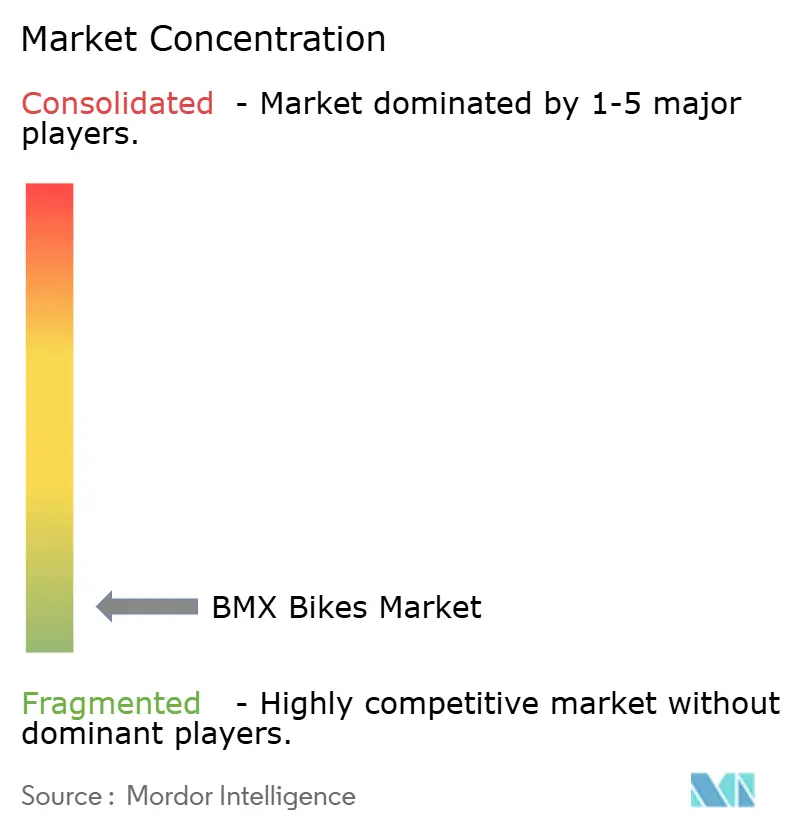
| Market Concentration | Low |
Major Players *Disclaimer: Major Players sorted in no particular order Image © Mordor Intelligence. Reuse requires attribution under CC BY 4.0. | |
BMX Bikes Market Analysis by Mordor Intelligence
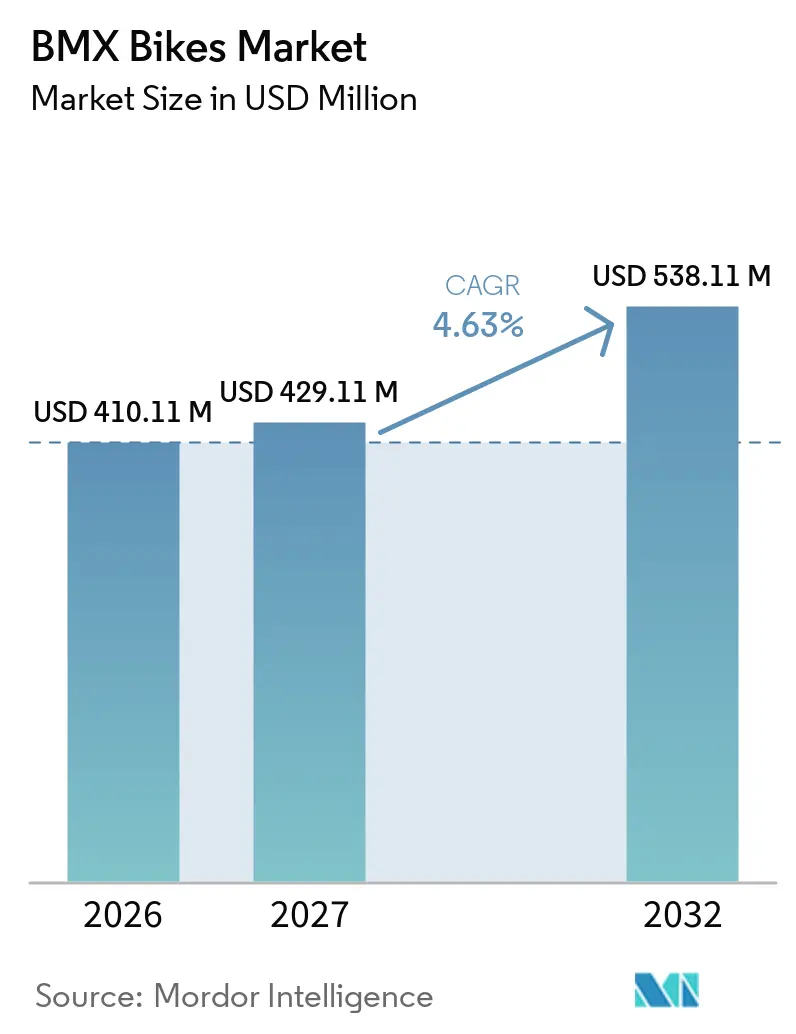
The BMX bikes market size was valued at USD 410.11 million in 2026 and is projected to expand from USD 429.11 million in 2027 to USD 538.11 million by 2032, registering a CAGR of 4.63% between 2027 and 2032. Olympic continuity supports the BMX bikes market because BMX Racing and BMX Freestyle have confirmed places at Los Angeles 2028, with 48 and 24 quota places, respectively. Participation also has a broader base, as public pump tracks and skateparks make the sport more accessible to new riders. Social content now helps specialist brands reach riders in places with limited physical retail, while direct online sales make a wider assortment available. The BMX bikes market is also moving toward higher-value purchases as adult riders, race equipment upgrades, carbon components, and online channels expand. Tariffs on steel and aluminum remain an important constraint because they increase costs for frames and complete bikes imported into the United States.
Key Report Takeaways
- By product type, freestyle BMX held a 42.11% share in 2026, while race BMX is projected to grow at a 5.83% CAGR through 2032.
- By wheel size, 20-inch bikes held a 58.74% share in 2026, while 24-inch and above models are projected to grow at a 7.14% CAGR through 2032.
- By frame material, chromoly steel held a 34.52% share in 2026, while carbon fiber is projected to grow at a 7.82% CAGR through 2032.
- By end user, kids/youth held a 52.73% share in 2026, while adults are projected to grow at a 6.93% CAGR through 2032.
- By price range, entry-level bikes held a 46.23% share in 2026, while premium bikes are projected to grow at an 8.27% CAGR through 2032.
- By distribution channel, specialty bike stores held a 43.62% share in 2026, while online sales are projected to grow at a 7.64% CAGR through 2032.
- By geography, North America held a 38.47% share in 2026, while Asia-Pacific is projected to grow at an 8.14% CAGR through 2032.
Note: Market numbers in this report are based on Mordor Intelligence's proprietary estimation framework, which combines nine months of actuals with Q4 projections for base year 2026.
Market Trends and Insights
Drivers Impact Analysis of BMX Bikes Market*
| Driver | (~) % Impact on CAGR Forecast | Geographic Relevance | Impact Timeline |
|---|---|---|---|
| Olympic and UCI Visibility Expanding BMX Participation | +1.1% | Global, strongest in France, Netherlands, United States, and Australia | Medium term (2–4 years) |
| Skatepark and Pump Track Infrastructure Investment | +0.9% | Global, led by North America, Western Europe, and Australia | Long term (≥ 4 years) |
| Youth and Family Sports Engagement | +0.8% | Global, with North America and Asia-Pacific central | Long term (≥ 4 years) |
| Social-Video Content and Rider-Led Brand Discovery | +0.6% | Global, concentrated in the United States, Brazil, United Kingdom, and Australia | Short term (≤ 2 years) |
| Component Lightweighting and Chromoly Performance Demand | +0.5% | North America and Europe, with premium spillover to Asia-Pacific | Medium term (2–4 years) |
| Direct-to-Consumer Availability and Online Assortment Expansion | +0.5% | Global, with North America and Europe leading adoption | Short term (≤ 2 years) |
| Source: Mordor Intelligence | |||
Olympic and UCI Visibility Expanding BMX Participation
The BMX bikes market benefits from a regular schedule of high-visibility international events. The 2025 UCI BMX Racing World Championships in Copenhagen drew 3,317[1] registered riders from 50 nations, while the Los Angeles 2028 qualification process keeps racing and freestyle equipment in view of riders, clubs, and families. French cycling authorities reported that BMX race licenses were 12.51% higher by March 2025 following Paris 2024 podium results. Olympic exposure encourages participation and supports demand for race-ready aluminum and chromoly equipment. Racing drives purchases of lightweight frames, race wheels, and performance components, while freestyle attracts park and street riders who may not join formal clubs. This combination gives brands access to first-time family buyers and experienced riders making planned upgrades, particularly in markets with established tracks, clubs, and local competitions.
Skatepark and Pump Track Infrastructure Investment
The BMX bikes market benefits from investment in facilities that encourage repeated riding and organized participation. The Livermore Area Recreation and Park District authorized USD 1.69 million for the Sunken Gardens Bike Pump Track in California in August 2025, while Black Diamond, Washington, opened the USD 1.75 million KJ Gardner Skatepark in July 2025[2]. Roubaix also opened a UCI-certified pump track complex in 2025 following investment in a 6,600 m² facility. These developments create accessible locations for beginner sessions, club activity, and everyday riding. New facilities can support demand for entry-level bikes, replacement parts, and safety products while introducing families to BMX. Pump tracks accommodate different skill levels and help riders progress toward freestyle or racing, making infrastructure investment a potential source of sustained local demand rather than a one-time sales opportunity.
Youth and Family Sports Engagement
Youth participation remains the volume base for the BMX bikes market, with kids/youth accounting for 52.73% of market value in 2026. Parents generally prioritize price, durability, sizing, and safety when purchasing a first BMX bike, supporting demand for entry-level and mid-range models. China recorded bicycle output of 110.8 million units in 2025[3], alongside reported growth in cycling events and amateur-club activity, supporting a wider environment for cycling participation. Smaller wheel sizes introduce children to BMX, while 18-inch and 20-inch models support progression as they grow. Durable products can help families justify the initial purchase through longer use or resale value. Brands offering connected product ranges can retain customers as their skills and physical requirements change, creating opportunities for repeat purchases of larger bikes, components, and premium models.
Social Video Content and Rider-Led Brand Discovery
The BMX bikes market increasingly relies on rider-led videos and social content to support product discovery, particularly among adult riders and consumers in areas with limited specialist retail. Videos demonstrate how frames, components, and complete bikes perform in street, park, and event settings, helping buyers understand differences in fit, parts, and riding styles before purchasing. Brands that combine rider content with clear product specifications and online ordering can shorten the path from initial interest to purchase. This channel is particularly useful for limited releases, signature models, and specialist products that may not be available through local dealers. Digital engagement also allows smaller brands to reach niche communities, while established brands can use rider partnerships and event coverage to maintain visibility among beginners and experienced riders.
Restraints Impact Analysis of BMX Bikes Market*
| Restraint | (~) % Impact on CAGR Forecast | Geographic Relevance | Impact Timeline |
|---|---|---|---|
| High Replacement Cost Relative to Casual Bicycle Use | -0.5% | Global, most acute in Asia-Pacific, South America, and Middle East and Africa | Long term (≥ 4 years) |
| Injury Risk and Safety-Equipment Requirements | -0.3% | North America, Europe, and Australia | Medium term (2–4 years) |
| Freight, Tariff, and Component-Sourcing Volatility | -0.3% | North America primarily, with effects across global supply chains | Short term (≤ 2 years) |
| Small Specialist-Channel Scale and Limited Local Availability | -0.2% | South America, Middle East and Africa, and Southeast Asia | Long term (≥ 4 years) |
| Source: Mordor Intelligence | |||
High Replacement Cost Relative to Casual Bicycle Use
The BMX bikes market faces a price barrier when families compare specialized BMX bikes with casual bicycles. BMX products use dedicated geometry, stronger wheels, and components designed for jumps and repeated impacts, which can make entry purchases more expensive than general recreational alternatives. Haro stated in 2025 that higher tariff-related costs and reduced discounting could increase prices for some juvenile models. The effect is more pronounced in Asia-Pacific, South America, and the Middle East and Africa, where entry pricing may be less aligned with household budgets. Protective equipment adds to the initial cost, particularly for families unfamiliar with BMX. Brands can reduce this barrier through durable entry-level ranges, clear sizing guidance, and dealer support that explains the benefits of frame strength and component quality.
Injury Risk and Safety-Equipment Requirements
The BMX bikes market is affected by the perceived risks of racing, ramps, and street riding, particularly among parents considering a first bicycle for their children. Helmets, knee pads, and elbow pads add to the initial purchase cost, while safety requirements at parks and tracks can vary by location. European Union personal protective equipment rules also establish conformity requirements for relevant safety products. These considerations can make BMX appear less accessible to first-time family buyers and may delay purchase decisions. However, retailers and brands can reduce uncertainty by providing clear safety guidance and recommending appropriate protective equipment. Better facility design, supervised sessions, and organized riding programs can also improve parental confidence, helping make BMX more accessible without reducing the importance of safety equipment.
*Our forecasts treat driver/restraint impacts as directional, not additive. The impact forecasts reflect baseline growth, mix effects, and variable interactions.
BMX Bikes Market Segment Analysis
By Product Type:
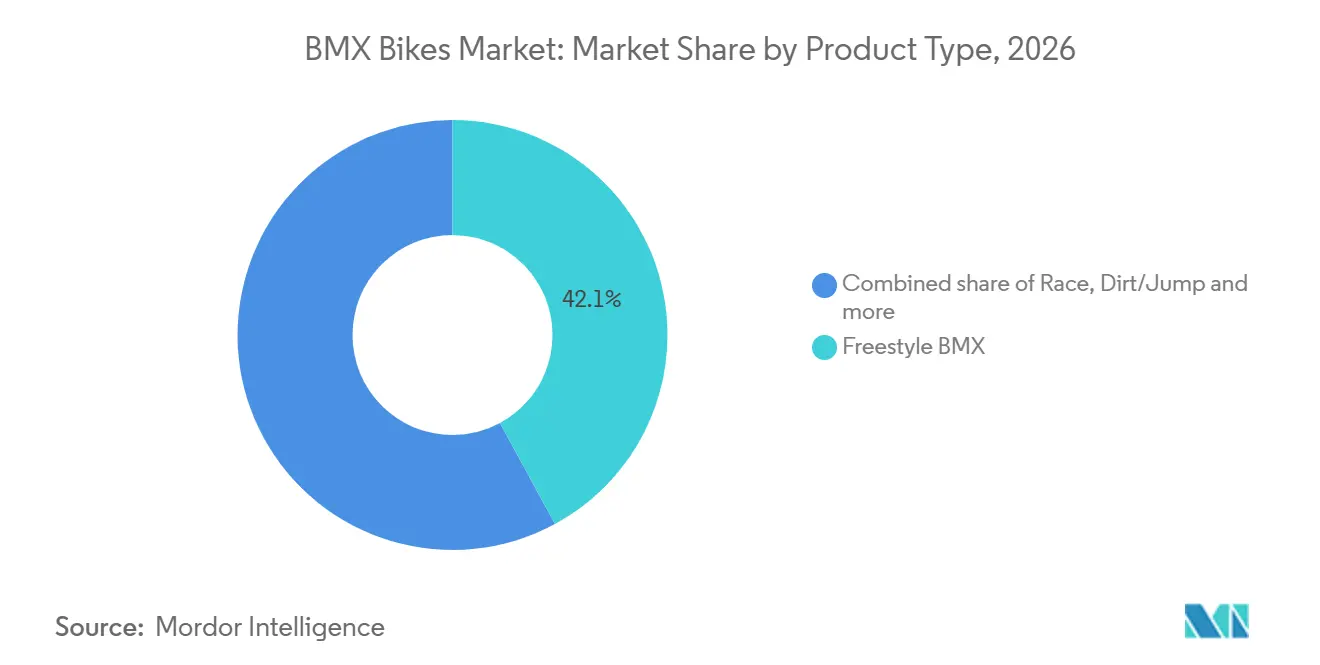
Freestyle Leads Demand While Race Gains Olympic MomentumFreestyle BMX held 42.11% of the 2026 value, making it the largest product type in the BMX bikes market because park, street, and flatland riding can take place without formal race-club membership. Its broad set of riding environments supports demand through skateparks, local street communities, and an aftermarket for frames, handlebars, tires, and pegs. Race BMX is projected to expand at a 5.83% CAGR through 2032, supported by the Olympic qualification cycle and local race activity that encourages equipment upgrades. Dirt/Jump BMX benefits from the same pump-track development that supports freestyle, while Cruiser models serve adults who want BMX-derived handling with a more relaxed fit. These differences make product choice depend on riding setting, experience, and the rider’s reason for buying.
Race products have a clearer route toward higher specifications because competitive riders focus on frame weight, fork response, and component reliability. Meybo’s 2025 Patron complete used an HSX aluminum frame and an SD Carbon V2 fork, showing the use of carbon components in production race models. Aluminum remains important for riders seeking lower weight for gate starts and sprinting, while carbon forks and frames address elite and advanced buyers who want more precise performance from a complete bike. The product range must therefore cover first-time racers, riders who are progressing through local competition, and experienced competitors making planned upgrades. In the BMX bikes industry, this progression connects participation growth with a higher average selling price and makes reliable parts availability important after the original purchase.

By Wheel Size:
20-Inch Anchors Demand While Larger Formats Follow Adult UptakeThe 20-inch format held 58.74% of 2026 market value and remains the standard wheel size for BMX competition and recreation. Its position is reinforced by broad replacement-part availability and widespread familiarity with fit and setup. Smaller 12-inch to 16-inch models introduce children to the category, while 18-inch models provide a transition toward a full 20-inch bike. The 24-inch and above category is projected to grow at a 7.14% CAGR through 2032 as adult participation expands and taller riders seek more suitable geometry. Larger formats also appeal to returning riders who want BMX-style handling without a compact, youth-oriented riding position.
WeThePeople’s 2026 range included 22-inch, 24-inch, and 27.5-inch models alongside its core 20-inch offering, reflecting efforts to serve different rider heights and intended uses. Sunday Bikes also introduced a 14-inch Primer model in its 2027 range, maintaining attention to younger first-time buyers. Larger models can appeal to adult entrants seeking casual riding, park use, or trail riding, while smaller models support early participation. This connected product range allows brands to retain customers as their physical requirements and riding preferences change over multiple purchase cycles, while maintaining the 20-inch format as the core of the market.
By Frame Material:
Chromoly Holds the Mid-Tier While Carbon Fiber Grows FastestChromoly steel held 34.52% of 2026 frame material value and remains a common choice for mid-to-high freestyle builds because of its strength, weight control, weld performance, and repairability. Hi-tensile steel serves lower-priced complete bikes for youth and beginner riders, while aluminum remains important in race formats where lower weight supports sprint performance. Carbon fiber is projected to expand at a 7.82% CAGR through 2032, following its adoption in forks and elite race frames. Material selection differentiates entry-level, mid-range, and premium products according to intended riding discipline, performance requirements, and price positioning.
Carbon-fiber bicycle frame production is concentrated in Asia, particularly Taiwan and China, using hand layup and carbon-epoxy prepreg processes. This production structure makes supplier reliability and international sourcing conditions relevant to premium ranges. Tariffs and freight costs can affect the economics of imported frames and complete bikes, while specialized tubing, alloy specifications, and integrated carbon components help brands differentiate their products. Buyers also consider durability, repairability, and predictable handling during regular use. Material choice therefore influences performance, price, serviceability, supply exposure, and the product benefits retailers can communicate to customers.
By End User:
Youth Supplies Scale While Adults Support Premium PurchasingKids/Youth held 52.73% of 2026 market value, giving this group the largest role in BMX bikes market demand. Parents generally prioritize sizing, safety, price, and durability, supporting volume in entry-level and mid-range models. Youth riders also generate demand for successive wheel-size upgrades as they grow and develop their skills. Adults are projected to grow at a 6.93% CAGR through 2032, supported by returning riders, fitness use, and Masters competition. The 2026 UCI BMX Racing World Championships in Brisbane included Challenge and Masters events, reflecting an established adult racing community.
Adult buyers are more likely to consider premium complete bikes and aftermarket components because their purchasing decisions often focus on performance, fit, and intended riding style. They may select larger wheels, higher-grade frames, or race-oriented parts according to their requirements rather than choosing solely on price. Youth participation remains strategically important because it introduces future adult customers to the category and builds familiarity with equipment and sizing. Brands that offer products for both children and adults can retain customers as their needs change, connecting initial purchases with later upgrades and supporting repeat demand over time.
By Price Range:
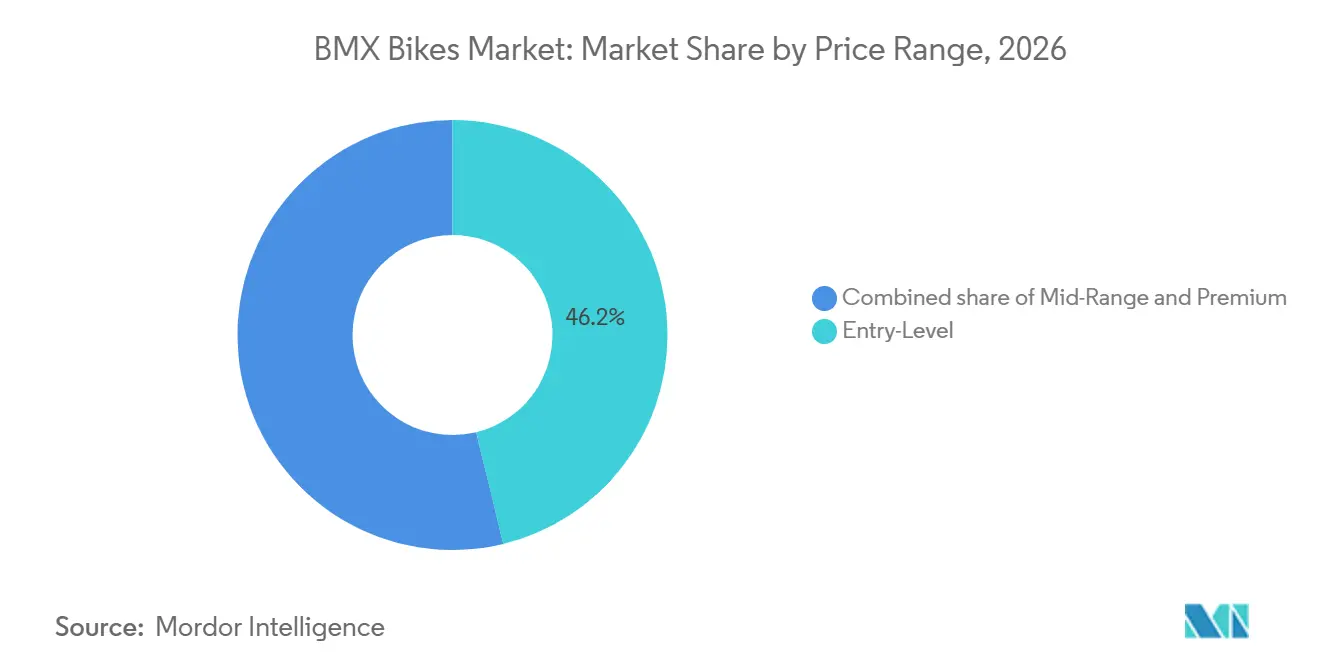
Entry-Level Leads Value While Premium Advances FastestEntry-level products held 46.23% of 2026 market value, reflecting the importance of first-time youth and family purchases. These buyers are price-sensitive and can compare BMX bikes with less specialized recreational bicycles. Tariffs on metal content add further pressure to entry-level pricing. Premium is projected to expand at an 8.27% CAGR through 2032 as adult participation, race upgrades, and advanced component availability support higher spending. Mid-range products remain important for riders seeking stronger capabilities without professional-level pricing, creating a bridge between accessible entry models and premium equipment.
Sunday Bikes introduced a redesigned lightweight aluminum Primer frame alongside pro-level signature models in its 2027 range, demonstrating how brands can address different budgets and skill levels within one portfolio. Entry products can introduce buyers to the brand, while premium models provide an upgrade path as riding skills develop. Dealers can help match products to intended use, experience, and budget. A portfolio focused only on low-priced products faces cost pressure when tariffs rise, while a premium-only range has fewer opportunities to attract first-time riders. Brands can therefore benefit from connected product ranges that combine accessible starting points with credible performance upgrades.
By Distribution Channel:
Specialty Stores Lead While Online Channels ExpandSpecialty bike stores held 43.62% of the 2026 market value because buyers often need guidance on sizing, frame geometry, components, and safety equipment. Store staff can help families select suitable first models and provide setup advice, while specialist retailers can support ongoing maintenance and component replacement. Online sales are projected to expand at a 7.64% CAGR through 2032 as brand-direct websites offer broader assortments than local stores can stock. Digital channels also make specialist products more accessible to consumers in regions with limited BMX retail coverage.
Direct sales work best when product pages explain geometry, frame size, components, and recommended rider height in accessible terms. Brands can combine online ordering with rider content and product-launch campaigns, while specialty stores remain relevant for buyers who need test rides, setup advice, or help selecting protective equipment. Mail-order and club-linked sales serve enthusiasts seeking specific frames and limited products, while mass retail caters to convenient, price-sensitive entry demand. The BMX bikes market is likely to retain multiple channels because purchasing requirements vary by location, experience, and product value. Online growth expands access but does not eliminate the value of hands-on retail advice.
Geography Analysis
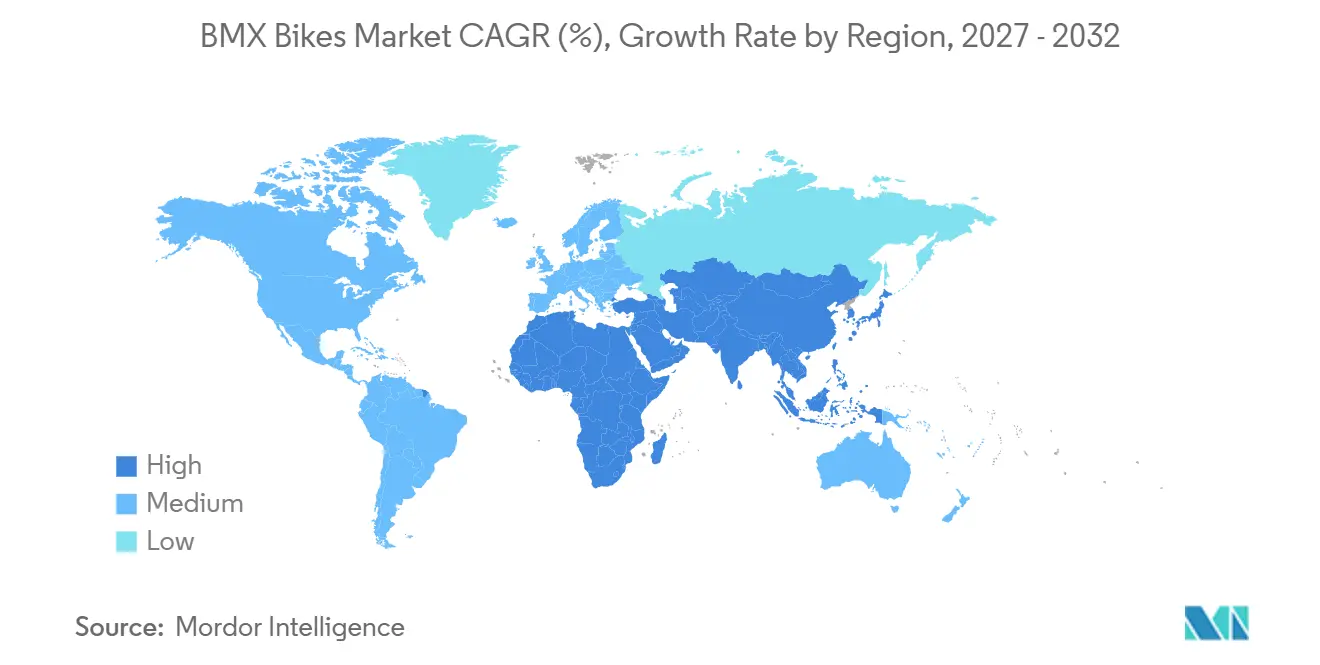
North America held 38.47% of 2026 market value and remains the largest regional base because of established tracks, specialist retailers, and a strong rider community. Los Angeles 2028 provides a direct Olympic focus, with BMX Racing and BMX Freestyle scheduled at Sepulveda Basin. However, higher United States aluminum duties and the end of country-specific steel exemptions in 2025 increased cost pressure on imported frames, components, and complete bikes. Canada and Mexico also contribute through racing, retail, and urban freestyle activity. The region’s event calendar, established facilities, and specialist distribution provide brands with routes to reach families, recreational riders, and advanced competitors, although import-related costs can affect pricing and margins.
Europe is the second-largest region in the BMX bikes market, supported by specialist brands and established freestyle, flatland, and racing communities. The region includes brands such as WeThePeople and KHEbikes in Germany, Flybikes in Spain, and Meybo in the Netherlands. France reported a 12.51% increase in BMX race licenses by March 2025 following Paris 2024 podium results, while Roubaix opened a UCI-certified facility for training and community use. France also recorded growth in children’s bicycle sales during 2025 after a prolonged decline. These developments provide a broader participation base from which BMX brands can attract younger riders and support future purchases, while specialist manufacturers continue to compete through product design and rider-focused distribution.
Asia-Pacific is projected to grow at an 8.14% CAGR through 2032, the highest regional rate in the BMX bikes market. China recorded bicycle output of 110.8 million units in 2025 and reported broad cycling-event and amateur-club activity. Australia hosted the 2026 UCI BMX Racing World Championships in Brisbane, attracting more than 3,000 riders. Japan contributes demand for premium race equipment, while India and Southeast Asia add entry-level volume as participation and facilities expand. The region combines a large bicycle manufacturing base with varied levels of BMX adoption, creating opportunities for entry-level products as well as specialist and premium equipment. In South America and the Middle East and Africa, Brazil, Colombia, Argentina, the United Arab Emirates, and Saudi Arabia offer smaller but developing opportunities through expanding participation and facility development.
Competitive Landscape
The BMX bikes market is fragmented, with no reported dominant company across all product types, price levels, and regions. Pon Bicycle Holding has broad distribution exposure through GT Bicycles and Mongoose, while specialist brands compete through rider communities, product credibility, and focused distribution. Blackout Distribution’s portfolio includes Kink BMX, Sunday Bikes, and Cinema BMX, while WeThePeople and KHEbikes have positions in premium street and flatland categories. This structure separates competition between broad distribution reach and specialist product depth.
Blackout Distribution has owned Cinema BMX since acquiring its tooling and brand assets in 2016, supporting shared logistics and product development across established BMX labels. Sunday Bikes launched a 2027 range with new entry sizes and pro-level signature models, extending its coverage across buyer budgets. Meybo’s aluminum frame and carbon fork on its 2025 Patron race bike illustrate competition through equipment specifications. These developments demonstrate how brands use portfolio expansion, material choices, and product updates to strengthen their market positions.
Digital product support is becoming another competitive feature because fit guides and geometry information can help buyers purchase online where specialist retailers are scarce. Rider-led content can improve visibility for smaller brands, while established distributors retain advantages through dealer relationships, local service, inventory planning, and distribution reach. Specialist brands can differentiate through recognizable frames, components, and rider or team associations.
BMX Bikes Industry Leaders
-
Pon Bicycle Holding B.V.
-
Haro Bikes
-
Blackout Distribution, Inc.
-
WeThePeople Bike Co. GmbH
-
Cult Crew
- *Disclaimer: Major Players sorted in no particular order
BMX Bikes Market Companies Covered in this Report
- Pon Bicycle Holding B.V.
- Haro Bikes
- Blackout Distribution, Inc. (Kink BMX, Sunday Bikes)
- Cult Crew
- WeThePeople Bike Co. GmbH
- Sparky's Distribution, Inc. (Subrosa)
- Fit Bike Co.
- Eastern Bikes
- Fiend BMX
- Chase Bicycles
- Meybo Bicycles
- Supercross BMX
- SE Bikes
- DK Bicycles
- Alta Cycling Group, LLC (Diamondback Bicycles)
- Framed Bikes
- Stay Strong
- Flybikes
- Stolen BMX
- KHEbikes GmbH
Recent Industry Developments in BMX Bikes Market
- July 2026: Kink BMX released the Feral frame, a steel freestyle frame for street and park riding.
- July 2026: Sunday Bikes launched its 2027 lineup, introducing a redesigned lightweight aluminum Primer frame in 14-inch, 16-inch, and 18-inch sizes and two pro-level signature models.
- 2026: Brisbane hosted the UCI BMX Racing World Championships, which attracted more than 3,000 riders across elite, Challenge, and Masters categories.
- March 2026: Kink BMX unveiled its 2027 complete-bike range, adding the Setup and Setup XL models and redesigned frames, forks, and bars across the range.
Global BMX Bikes Market Report Scope
The BMX Bikes Market is segmented by product type, wheel size, frame material, end user, price range, distribution channel, and geography. By product type, the market is segmented into Freestyle (Park, Street, and Flatland), Race, Dirt/Jump, and Others (Cruiser). By wheel size, the market is segmented into 12-16 Inch, 18 Inch, 20 Inch, and 24 Inch and Above. By frame material, the market is segmented into Chromoly Steel, Aluminum, Hi-Tensile Steel, and Carbon Fiber. By end user, the market is segmented into Adults and Kids/Youth. By price range, the market is segmented into Entry-Level, Mid-Range, and Premium. By distribution channel, the market is segmented into Specialty Bike Stores, Online, Sporting Goods/Mass Retail, and Others (Mail Order and Clubs). By geography, the market is segmented into North America, Europe, Asia-Pacific, South America, and Middle East and Africa, with country-level analysis covering key markets within each region. The market forecasts are provided in terms of value (USD) and volume (units) for all the above segments.
Segmentation Overview
| Freestyle | Park |
| Street | |
| Flatland | |
| Race | |
| Dirt/Jump | |
| Others (Cruiser) |
| 12-16 Inch |
| 18 Inch |
| 20 Inch |
| 24 Inch and Above |
| Chromoly Steel |
| Aluminum |
| Hi-Tensile Steel |
| Carbon Fiber |
| Adults |
| Kids/Youth |
| Entry-Level |
| Mid-Range |
| Premium |
| Specialty Bike Stores |
| Online |
| Sporting Goods/Mass Retail |
| Others (Mail Order and Clubs) |
| North America | United States |
| Canada | |
| Mexico | |
| Europe | Germany |
| United Kingdom | |
| France | |
| Italy | |
| Spain | |
| Netherlands | |
| Russia | |
| Rest of Europe | |
| Asia-Pacific | China |
| Japan | |
| India | |
| Australia | |
| South Korea | |
| Southeast Asia | |
| Rest of Asia-Pacific | |
| South America | Brazil |
| Argentina | |
| Chile | |
| Rest of South America | |
| Middle East and Africa | United Arab Emirates |
| Saudi Arabia | |
| South Africa | |
| Israel | |
| Rest of Middle East and Africa |
| By Product Type | Freestyle | Park |
| Street | ||
| Flatland | ||
| Race | ||
| Dirt/Jump | ||
| Others (Cruiser) | ||
| By Wheel Size | 12-16 Inch | |
| 18 Inch | ||
| 20 Inch | ||
| 24 Inch and Above | ||
| By Frame Material | Chromoly Steel | |
| Aluminum | ||
| Hi-Tensile Steel | ||
| Carbon Fiber | ||
| By End User | Adults | |
| Kids/Youth | ||
| By Price Range | Entry-Level | |
| Mid-Range | ||
| Premium | ||
| By Distribution Channel | Specialty Bike Stores | |
| Online | ||
| Sporting Goods/Mass Retail | ||
| Others (Mail Order and Clubs) | ||
| By Geography | North America | United States |
| Canada | ||
| Mexico | ||
| Europe | Germany | |
| United Kingdom | ||
| France | ||
| Italy | ||
| Spain | ||
| Netherlands | ||
| Russia | ||
| Rest of Europe | ||
| Asia-Pacific | China | |
| Japan | ||
| India | ||
| Australia | ||
| South Korea | ||
| Southeast Asia | ||
| Rest of Asia-Pacific | ||
| South America | Brazil | |
| Argentina | ||
| Chile | ||
| Rest of South America | ||
| Middle East and Africa | United Arab Emirates | |
| Saudi Arabia | ||
| South Africa | ||
| Israel | ||
| Rest of Middle East and Africa | ||
Key Questions Answered in the Report
What is the projected size of the BMX bikes market by 2032?
The BMX bikes market is projected to reach USD 538.11 million by 2032, growing at a 4.63% CAGR from 2027. The forecast reflects continued demand across youth, adult, specialty retail, and online channels.
Which BMX product type has the largest share?
Freestyle BMX leads product demand with 42.11% of value in 2026. Its park, street, and flatland uses allow participation without formal race-club membership.
Which BMX bike category is forecast to grow fastest?
Premium is the fastest-growing price tier, with a projected 8.27% CAGR through 2032. Adult riders, race upgrades, and carbon-component availability support spending in this category.
Why are online BMX bike sales increasing?
Online channels give riders access to deeper assortments and are projected to grow at a 7.64% CAGR through 2032. They are especially relevant where specialist stores are limited or distant.