
Bluetooth Enabled Toothbrush Market Size and Share
Market Overview
| Study Period | 2021 - 2031 |
|---|---|
| Market Size (2026) | USD 1.43 Billion |
| Market Size (2031) | USD 2.28 Billion |
| Growth Rate (2026 - 2031) | 9.78 % |
| Fastest Growing Market | Asia-Pacific |
| Largest Market | North America |
| Market Concentration | Low |
Major Players
*Disclaimer: Major Players sorted in no particular order Image © Mordor Intelligence. Reuse requires attribution under CC BY 4.0. |
|
Bluetooth Enabled Toothbrush Market Analysis by Mordor Intelligence
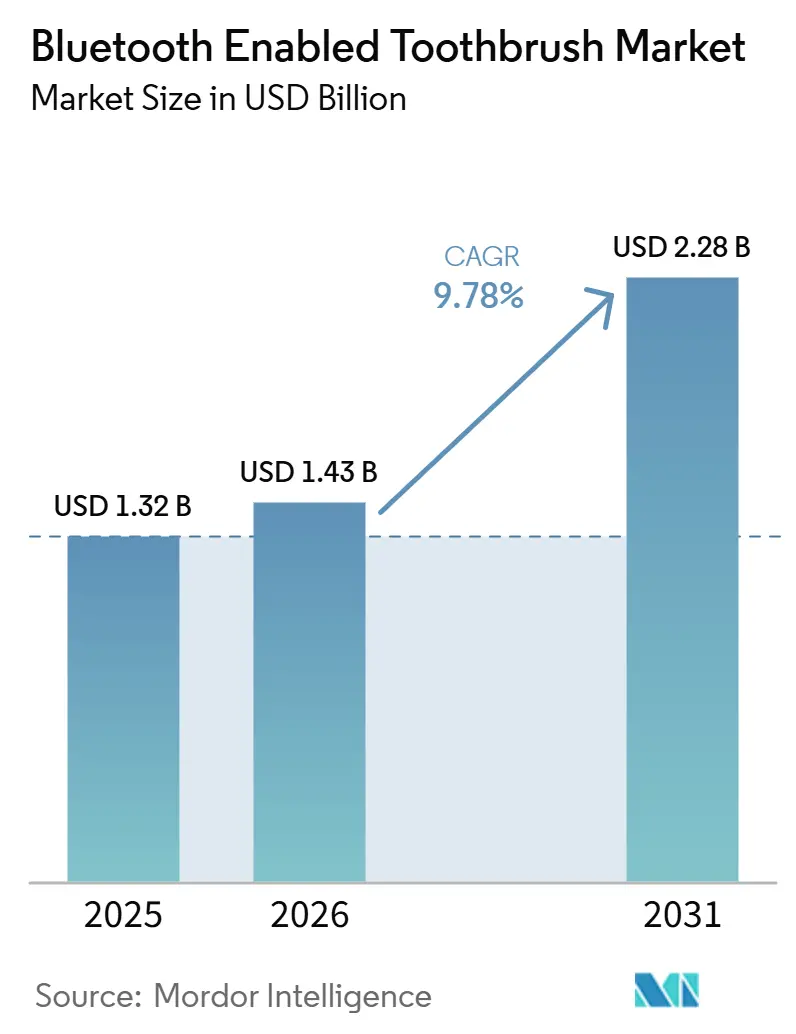
The bluetooth enabled toothbrush market size was valued at USD 1.32 billion in 2025 and estimated to grow from USD 1.43 billion in 2026, and is forecast to reach USD 2.28 billion by 2031 at a 9.78% CAGR over 2026-2031. The Bluetooth-enabled toothbrush market is supported by the high global burden of dental caries and periodontal disease, which keeps preventive oral care relevant for consumers and dental professionals. The category is moving beyond basic connectivity, as brands place greater emphasis on app guidance, brushing records, sensors, and AI-supported feedback. This shift allows manufacturers to compete on sustained post-purchase use rather than device specifications alone. Premium products continue to play a clear role in North America and Europe, while lower-priced connected products can expand access in emerging markets. The Bluetooth-enabled toothbrush market also benefits when brands integrate product design, clinical support, and online customer relationships into a single offering.
Key Report Takeaways
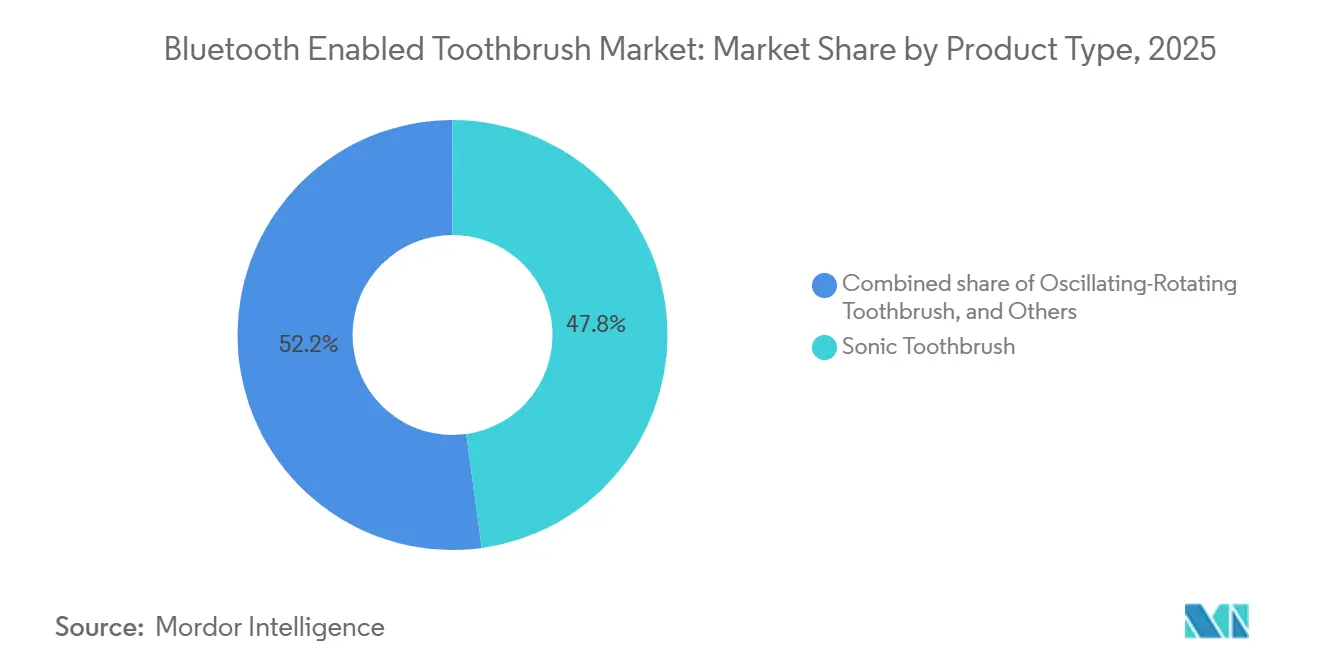
- By product type, sonic toothbrush led the bluetooth enabled toothbrush market with a share of 47.82% in 2025, while hybrid toothbrush is anticipated to register the fastest CAGR of 11.81% during 2026-2031.
- By power source, rechargeable toothbrush retained 91.45% share in 2025 and is forecast to expand at a 9.98% CAGR through 2031.
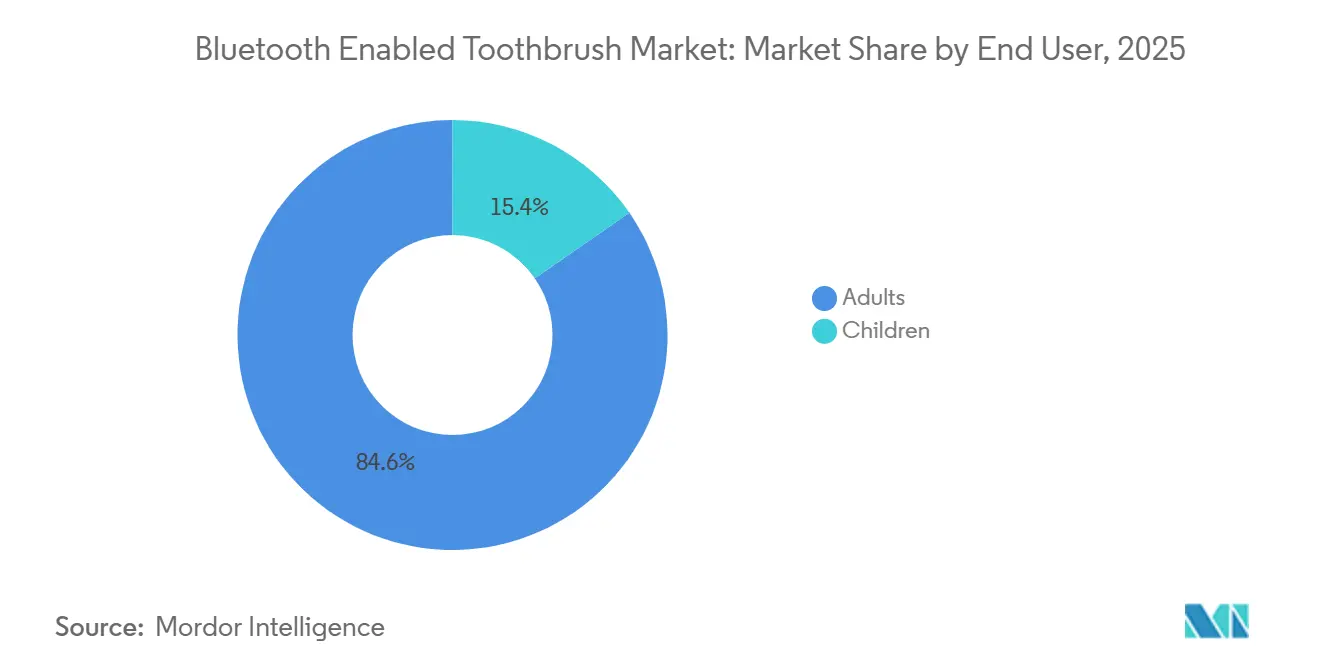
- By end user, adults led the market with an 84.62% share in 2025, while children is anticipated to register the fastest CAGR of 11.22% during 2026-2031.
- By distribution channel, the online retail channel led the bluetooth enabled market with a share of 38.99% in 2025, and anticipated to register the fastest CAGR of 11.91% during 2026-2031.
- By geography, North America accounted for the largest share of the global bluetooth enabled toothbrush market at 35.41% in 2025, while Asia-Pacific is projected to grow at the fastest CAGR 11.57% CAGR through 2031.
Note: Market size and forecast figures in this report are generated using Mordor Intelligence’s proprietary estimation framework, updated with the latest available data and insights as of January 2026.
Global Bluetooth Enabled Toothbrush Market Trends and Insights
Drivers Impact Analysis*
| Drivers | (~) % Impact on CAGR Forecast | Geographic Relevance | Impact Timeline |
|---|---|---|---|
| Growing consumer focus on preventive oral healthcare | +2.1% | Global | Medium term (2-4 years) |
| Expanding AI and bluetooth integration in oral care ecosystems | +2.3% | North America and Europe, with early gains in China and South Korea | Medium term (2-4 years) |
| Rising prevalence of periodontal diseases and dental caries | +1.5% | Global, with a high burden in Asia-Pacific and Sub-Saharan Africa | Long term (≥ 4 years) |
| Continuous innovation in smart sensors and motion tracking | +1.0% | North America, Europe, and China | Short term (≤ 2 years) |
| Increasing dentist recommendations for smart brushing compliance | +0.9% | North America and Europe | Medium term (2-4 years) |
| Growing consumer adoption of connected oral care devices | +0.8% | Global, with Asia-Pacific as an emerging adoption region | Short term (≤ 2 years) |
| Source: Mordor Intelligence | |||
Growing consumer focus on preventive oral healthcare
The Bluetooth-enabled toothbrush market addresses a significant preventive care need, as 3.69 billion people globally had major oral conditions, according to the 2021 Global Burden of Disease assessment. This assessment also reported a combined prevalence of 45,900 cases per 100,000 people. These conditions increase the relevance of tools that encourage regular and complete brushing among consumers and dental professionals. Therefore, brands can position Bluetooth-enabled toothbrushes around preventive routines rather than as premium electronic devices. Brands that link brushing records with clinical outcomes may be better positioned to collaborate with insurers and dental benefit administrators in the United States and Germany.
Expanding integration of AI and bluetooth in oral care ecosystems
Bluetooth connectivity is becoming a core feature in connected oral care platforms, while guidance and feedback quality is gaining importance. Philips Sonicare announced the DiamondClean 9900 Prestige in July 2026 as its first electric toothbrush with on-device AI and real-time, spatially aware guidance. On-device processing reduces reliance on active smartphone use during brushing and can deliver more immediate guidance. The company is also planning to introduce the 1000-7000 Series ranges in 2026, featuring adaptive magnetic sensor technology and up to 62,000 optimal bristle movements per minute. Quip launched its Ultra Smart Sonic Toothbrush in February 2025 with app-integrated tracking and rewards, indicating that connected features are expanding beyond flagship price tiers. As Bluetooth adoption becomes more common, the Bluetooth-enabled toothbrush market will depend more heavily on accurate AI guidance, useful app experiences, gamification, and health-platform integration.
Rising prevalence of periodontal diseases and dental caries
According to the World Health Organization 2025 update, severe periodontal disease affects more than 1 billion people globally due to poor oral hygiene and tobacco use. Poor brushing practices remain a primary clinical risk factor, making real-time feedback from connected devices relevant to prevention. A 2026 network meta-analysis found that oscillating-rotating electric toothbrushes had the highest probability of achieving superior plaque and gingivitis reduction across the technologies examined. The same analysis reported particularly strong benefits for children and orthodontic patients. This clinical evidence supports the use of powered brushing over manual alternatives and gives dental professionals a basis to recommend motion-tracked connected products. The Bluetooth-enabled toothbrush market has room to expand in South and Southeast Asia as more accessible connected products enter Indonesia, Vietnam, and India.
Increasing dentist recommendations for smart brushing compliance
Dentist recommendations remain an important purchase trigger for premium oral care devices, as they give consumers a trusted basis for product selection. In March 2025, Laifen’s Wave Electric Toothbrush received the American Dental Association Seal of Acceptance for its dual oscillation-vibration mechanism. This recognition shows that challenger brands can build professional credibility without relying on the long-established dental networks of large incumbents. In 2025, a systematic review by Journal of Medical Internet Research Publications found that digital gamified tools, when combined with real-time feedback, improved children’s oral health knowledge and behavior compared to traditional education [1]Source: JMIR Publications, " The Application of Gamification in Children’s Oral Health Management," jmir.org. This evidence gives dentists a practical reason to recommend connected brushes for pediatric patients. Companies in the Bluetooth-enabled toothbrush market can strengthen this channel by offering dentist education, clinical summaries, practice dashboards, and guidance on reimbursement pathways.
Restraints Impact Analysis*
| Restraint | (~) % Impact on CAGR Forecast | Geographic Relevance | Impact Timeline |
|---|---|---|---|
| Limited perceived incremental value over conventional electric toothbrushes | -0.9% | Global, especially among consumers with low digital health engagement | Medium term (2-4 years) |
| Premium pricing limits adoption across price-sensitive consumer segments | -1.2% | Asia-Pacific, South America, Middle East, and Africa | Long term (≥ 4 years) |
| Short product replacement cycles increase consumer purchase hesitation | -0.7% | North America and Europe | Short term (≤ 2 years) |
| Dependence on smartphone compatibility and companion application usage | -0.5% | Middle East and Africa, South America, and Southeast Asia | Medium term (2-4 years) |
| Source: Mordor Intelligence | |||
Premium pricing limits adoption across price-sensitive consumer segments
Entry-level connected toothbrushes typically retail for US Dollar 80 to US Dollar 150, while non-connected electric toothbrushes with comparable plaque-removal performance often cost US Dollar 25 to US Dollar 60. This price gap limits adoption in Asia-Pacific, South America, the Middle East, and Africa, where dental spending and discretionary income differ from those in North America and Western Europe. Total ownership costs also include replacement brush heads, optional subscriptions, and extended warranties. Quip introduced the Ultra Smart Sonic Toothbrush in February 2025, starting at US Dollar 100, positioning it at the accessible end of the premium connected category. The product was named a TIME Best Invention in December 2025, supporting its design and value proposition. The Bluetooth-enabled toothbrush market will need modular devices, longer product lifespans, or lower-feature entry products to reach more price-sensitive consumers.
Limited perceived incremental value over conventional electric toothbrushes
Some consumers consider a rechargeable electric toothbrush sufficient for oral hygiene and do not want to manage app pairing, charging, or a new digital routine. This preference is particularly relevant among adults aged over 50 and in regions where oscillating-rotating brushes remain the clinical default. A 2025 randomized controlled trial found that an oscillating-rotating toothbrush delivered greater plaque reduction and gingivitis improvement than a sonic toothbrush after four weeks of twice-daily use. Short replacement cycles of 2-3 years may also create hesitation when manufacturers discontinue product software or companion applications. The Bluetooth-enabled toothbrush market must demonstrate measurable benefits, including longer brushing duration, broader zone coverage, fewer bleeding sites, and dentist-shared compliance reports. These outcomes can make the value of a connected brush clearer than unsupported claims of convenience.
*Our forecasts treat driver/restraint impacts as directional, not additive. The impact forecasts reflect baseline growth, mix effects, and variable interactions.
Segment Analysis
By Product Type: Sonic Leadership Is Challenged by Hybrid Toothbrushes
Sonic toothbrushes account for 47.82% of the Bluetooth enabled toothbrush market share in 2025, supported by broad retail visibility, multiple price points, and the brand recognition of Philips Sonicare. Philips Sonicare describes itself as the number-one sonic toothbrush brand recommended by dental professionals, reinforcing its position across professional and retail channels. Oscillating-rotating Bluetooth models, including Oral-B’s iO Series, combine AI-supported brushing recognition with app-guided pressure feedback. This evidence provides oscillating-rotating products with a strong clinical basis for dentist-led purchasing. Ultrasonic toothbrushes remain a smaller specialist category for consumers with gum sensitivity or post-procedure care needs. Their narrow use case is unlikely to materially alter the overall product mix before 2031.
Hybrid toothbrushes are the fastest-growing product type, and the Bluetooth enabled toothbrush market size for this segment is forecast to grow at a CAGR of 11.81% from 2026 to 2031. These products combine mechanisms that would otherwise be available separately in sonic and oscillating-rotating brushes. Laifen’s Wave combines up to 60° ultra-wide oscillation with up to 66,000 vibrations per minute through its servo system. It received the American Dental Association Seal of Acceptance in 2025 and recognition from TIME in 2024. FOREO’s ISSA 4 uses a silicone-PBT polymer hybrid brush head and offers app connectivity for personalized modes. Product development across these types supports a broader premium portfolio rather than a shift toward a single technology standard.



By Power Source: Rechargeable Models Set the Category Standard
Rechargeable products are expected to account for 91.45% of the Bluetooth-enabled toothbrush market share in 2025 and are projected to grow at a CAGR of 9.98% through 2031. Stable rechargeable power supports Bluetooth radios, motion sensors, and communication with companion applications. It also provides the capacity required for more advanced AI-guidance functions. Battery-operated designs offer less space and power flexibility for these features. The European Union Battery Regulation in 2025, sets requirements for battery performance, labeling, and end-of-life handling, favoring devices designed for a longer useful life [3]Source: European Union Regulation, " concerning batteries and waste batteries," who.int. The regulation increases manufacturers’ responsibilities and makes durable rechargeable designs more important in European markets. As a result, rechargeable models define both the technical standard and the growth path of the Bluetooth-enabled toothbrush market.
FOREO’s ISSA 4 platform is designed to support 365 days of daily use on a single USB charge. This feature reduces the need for frequent charging and demonstrates how battery performance can differentiate connected products. Its modular handle-and-head approach allows users to replace brush heads without replacing the full handle. This approach addresses concerns about electronic waste and product life cycles. Battery-operated connected brushes continue to serve travel use cases and areas with limited USB charging access. However, their technical limitations make them unlikely to regain material share during the forecast period.
By End User: Adults Support Revenue While Children Grow Faster
Adults are projected to account for 84.62% of Bluetooth-enabled toothbrush market revenue in 2025, making them the primary revenue base for premium connected devices. They represent the core audience for AI-guided products, dentist-led purchases, and oral care messaging linked to broader health concerns. In March 2025, the World Health Organization is expected to identify oral diseases as common and largely preventable, supporting a stronger focus on regular oral hygiene [2]Source: World Health Organization, " Oral health," who.int. For adult consumers, the value proposition has shifted beyond appearance to routine management and increased oral health awareness. This shift supports demand for devices that track brushing behavior and provide feedback. Adult purchasing patterns also allow brands to sustain premium pricing when professional recommendations and product performance remain clear. The Bluetooth-enabled toothbrush market continues to depend on this group for its largest absolute revenue contribution.
The children segment has a smaller revenue base but is projected to grow at a CAGR of 11.22% from 2026 to 2031. Gamified applications make brushing an interactive task and help parents manage brushing frequency and duration. A 2025 JMIR systematic review covering 41 studies found that gamified digital interventions improved brushing behavior, plaque control, and oral health knowledge among children. Philips Sonicare reported that 98% of parents using its For Kids app found it easier to help children brush longer and better. Kolibree offers an AR-enabled system that identifies missed brushing zones and allows parental monitoring. A 2025 randomized controlled trial of the Happy Teeth app also reported improved oral health knowledge and dietary awareness among schoolchildren. These systems can help brands retain families over time as children later become adult buyers.
By Distribution Channel: Online Retail Leads Revenue and Growth
Online retail holds 38.99% of category revenue in 2025 and is projected to grow at a CAGR of 11.91% through 2031. Consumers often compare sensors, application features, subscriptions, and clinical credentials before purchasing a connected brush. Online stores provide this information at the point of purchase. They also support direct-to-consumer brands that use subscriptions for replacement brush heads and app engagement after the initial sale. quip, SURI, Oclean, and usmile have used direct digital distribution to establish their brands. The channel also provides first-party data on product use and application engagement, supporting faster product changes and more personalized customer communication in the Bluetooth-enabled toothbrush market.
Hypermarkets and supermarkets remain the second-largest distribution route and provide broad visibility for mid-tier devices. Philips Sonicare launched the Sonicare 6000 and 6400 Series exclusively at Walmart in the United States in September 2025. This strategy reaches consumers who may not visit specialty retailers or dental offices. Pharmacies and drug stores remain important where purchasers rely on dentist or pharmacist recommendations. This trend is particularly relevant in the United Kingdom, Germany, and the United States, where oral care products have a significant in-store presence. Convenience stores and other channels play a limited role in premium connected-device sales. Post-purchase digital engagement, rather than shelf presence, is likely to have the strongest effect on repeat sales across future device cycles.
Geography Analysis
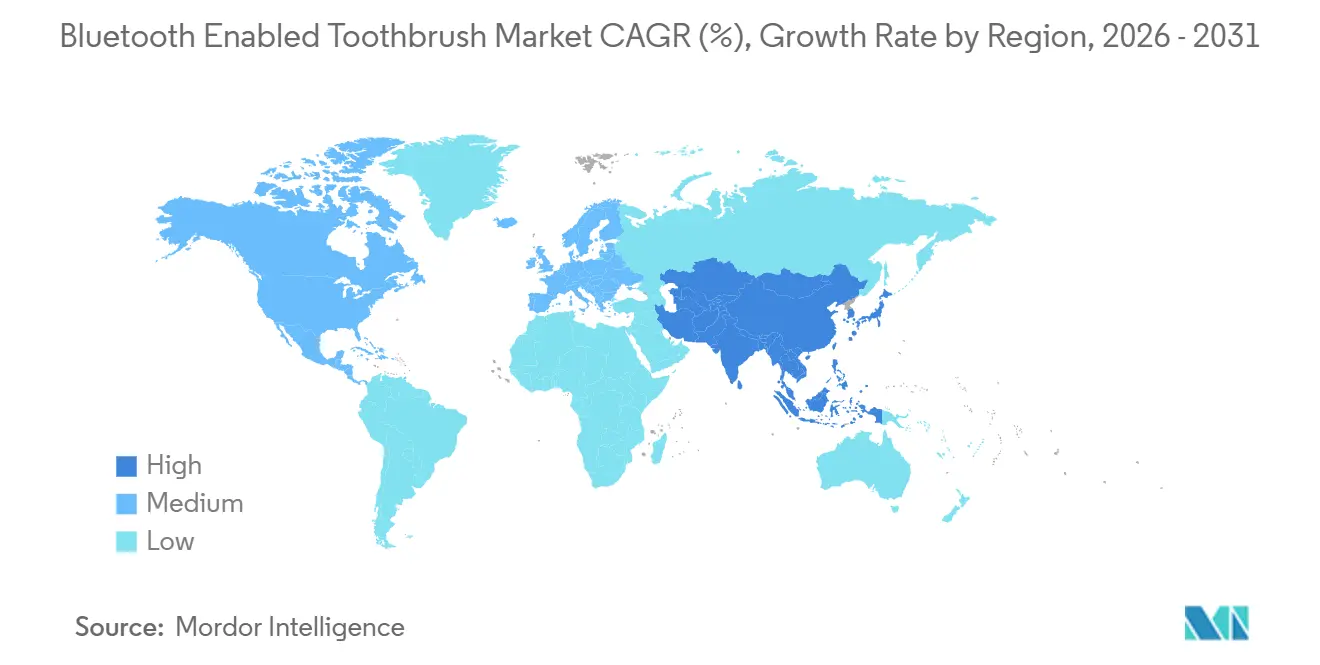
North America accounts for 35.41% of category revenue in 2025. High dental insurance coverage, dentist recommendations, and established e-commerce infrastructure support premium oral care purchases. The United States leads regional demand through hypermarkets, pharmacies, and direct online channels, giving incumbents broad market access. In May 2026, Oral-B announced The Big Rethink 2026 with the International Association for Disability and Oral Health. The research will use the Oral-B iO2 with an adaptive accessory and examine oral care experiences among people with disabilities.
Europe is the second-largest region by revenue, with Germany, the United Kingdom, France, and Scandinavia forming its higher-value core. SURI generated GBP 23.4 million, equivalent to USD 29.7 million, in revenue by 2024 and raised GBP 6 million, equivalent to USD 7.6 million, in March 2024 to support expansion. Its progress reflects demand for direct-to-consumer sustainable oral care products. South America, the Middle East, and Africa remain earlier-stage regions, as premium prices and variable smartphone access constrain adoption.
Asia-Pacific is expected to record the fastest growth in the regional Bluetooth-enabled toothbrush market size, with a CAGR of 11.57% through 2031. China’s manufacturing capability, India’s expanding consumer base, and Southeast Asia’s younger digital population support this growth. Domestic Chinese brands have strengthened their motor design, sensors, software, and price competitiveness. Japan is the region’s most technically mature smart toothbrush market, while South Korea and Indonesia offer strong secondary growth opportunities.

Competitive Landscape
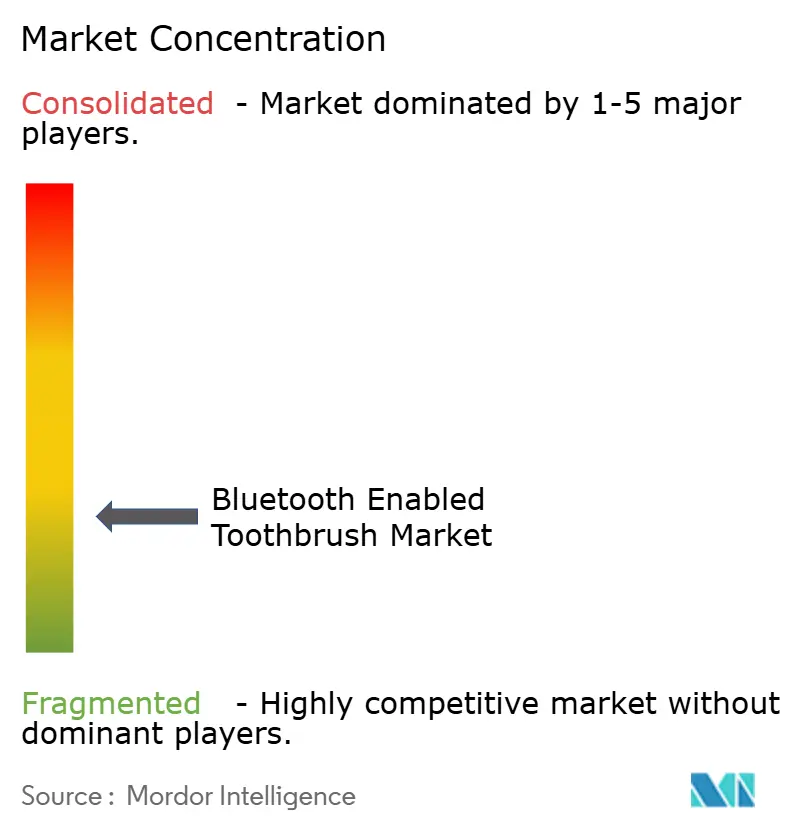
The bluetooth enabled toothbrush market remains fragmented, due to companies like Philips Sonicare and Procter & Gamble’s Oral-B maintaining leading positions through clinical evidence, strong relationships with dental professionals, and broad distribution networks. Their portfolios support high-trust purchases across pharmacies, dental settings, retail stores, and online channels. The Bluetooth-enabled toothbrush market remains fragmented, as challengers have narrowed the gap in performance, connected features, and pricing. Laifen’s American Dental Association Seal of Acceptance in 2025 would provide a credible professional-channel reference for its hybrid Wave toothbrush. Philips Sonicare’s DiamondClean 9900 Prestige, announced in July 2026, would move competition toward on-device AI and integrated guidance.
Several opportunities remain open for companies in the Bluetooth-enabled toothbrush market. No company has commercially scaled a reimbursement-linked device that provides dental insurers with usable brushing records. Firms investing in clinical tracking and dentist-facing dashboards may be better positioned to address this opportunity. Post-orthodontic care also remains underserved, despite documented benefits of electric toothbrushes for orthodontic patients. Geriatric and disability-adapted designs require accessible products, professional support, and improved user experiences, not specification changes alone.
Sustainability is becoming a more visible competitive consideration in the Bluetooth-enabled toothbrush market. SURI’s modular design allows users to replace brush heads without discarding the full handle. FOREO promotes extended battery life, while Philips Sonicare’s 2026 ranges include brush heads with 100% bio-based plastic handles. Application retention, clinical support, and evidence of improved brushing behavior are expected to favor brands with connected data systems over brands focused only on hardware specifications.
Bluetooth Enabled Toothbrush Industry Leaders
-
Procter & Gamble
-
Koninklijke Philips N.V.,
-
Xiaomi
-
Colgate-Palmolive
-
Quip
- *Disclaimer: Major Players sorted in no particular order

Recent Industry Developments
- July 2026: Philips Sonicare launched the DiamondClean 9900 Prestige, the brand’s first electric toothbrush with on-device AI and real-time spatially aware guidance. The product enables zone-by-zone coverage tracking without requiring active smartphone use during brushing. Available on Amazon from September 2026, the launch will mark a shift from app-driven intelligence to hardware-native intelligence in the premium Bluetooth segment.
- May 2026: Oral-B announced The Big Rethink 2026 in partnership with the International Association for Disability and Oral Health. The initiative launched Project Steady, one of Europe’s largest real-world studies on oral care experiences among people with disabilities, using the Oral-B iO2 toothbrush with an adaptive brushing accessory. The initiative expands the addressable Bluetooth toothbrush user base among underserved disability care demographics.
- March 2026: Philips Sonicare unveiled two new electric toothbrush ranges, the 1000-7000 Series, under its refreshed “Feel the Care” brand direction. The ranges integrate adaptive magnetic sensor technology that delivers up to 62,000 optimal bristle movements per minute. They also feature brush head sustainability enhancements, including 100% bio-based plastic handles. The range launched simultaneously across North American retail channels.
- September 2025: Philips Sonicare launched the Sonicare 6000 and 6400 Series in the United States exclusively through Walmart, positioning its next-generation sonic technology for mass retail distribution and targeting price-conscious consumers outside the specialty channel.


Global Bluetooth Enabled Toothbrush Market Report Scope
A Bluetooth-enabled toothbrush is a smart electric toothbrush equipped with Bluetooth technology that connects wirelessly to a smartphone or tablet through a companion application. It allows users to monitor brushing habits, receive real-time guidance, track oral hygiene performance, and access personalized recommendations to improve overall dental care.
The bluetooth enabled toothbrush market is segmented by product type, power source, end user, distribution channel, and geography. By product type, the market is segmented into sonic toothbrush, oscillating-rotating toothbrush, ultrasonic toothbrush, and hybrid toothbrush. By power source, the market is segmented into rechargeable toothbrush and battery-operated toothbrush. By end user, the market is segmented into adults and children. By distribution channel, the market is segmented into hypermarkets/supermarkets, pharmacies and drug stores, convenience/grocery stores, online retail channel, and other distribution channels. Based on geography, the market is classified into North America, Europe, South America, Asia-Pacific, and the Middle East and Africa. The Market Forecasts are Provided in Terms of Value (USD).
| Sonic Toothbrush |
| Oscillating-Rotating Toothbrush |
| Ultrasonic Toothbrush |
| Hybrid Toothbrush |
| Rechargeable Toothbrush |
| Battery-Operated Toothbrush |
| Adults |
| Children |
| Hypermarkets/Supermarkets |
| Pharmacies and Drug Stores |
| Convenience/Grocery Stores |
| Online Retail Channel |
| Other Distribution Channels |
| North America | United States |
| Canada | |
| Mexico | |
| Rest of North America | |
| Europe | Germany |
| United Kingdom | |
| Italy | |
| France | |
| Spain | |
| Netherlands | |
| Poland | |
| Belgium | |
| Sweden | |
| Rest of Europe | |
| Asia-Pacific | China |
| India | |
| Japan | |
| Australia | |
| Indonesia | |
| South Korea | |
| Thailand | |
| Singapore | |
| Rest of Asia-Pacific | |
| South America | Brazil |
| Argentina | |
| Colombia | |
| Chile | |
| Peru | |
| Rest of South America | |
| Middle East and Africa | South Africa |
| Saudi Arabia | |
| United Arab Emirates | |
| Nigeria | |
| Egypt | |
| Morocco | |
| Turkey | |
| Rest of Middle East and Africa |
| By Product Type | Sonic Toothbrush | |
| Oscillating-Rotating Toothbrush | ||
| Ultrasonic Toothbrush | ||
| Hybrid Toothbrush | ||
| By Power Source | Rechargeable Toothbrush | |
| Battery-Operated Toothbrush | ||
| By End User | Adults | |
| Children | ||
| By Distribution Channel | Hypermarkets/Supermarkets | |
| Pharmacies and Drug Stores | ||
| Convenience/Grocery Stores | ||
| Online Retail Channel | ||
| Other Distribution Channels | ||
| By Geography | North America | United States |
| Canada | ||
| Mexico | ||
| Rest of North America | ||
| Europe | Germany | |
| United Kingdom | ||
| Italy | ||
| France | ||
| Spain | ||
| Netherlands | ||
| Poland | ||
| Belgium | ||
| Sweden | ||
| Rest of Europe | ||
| Asia-Pacific | China | |
| India | ||
| Japan | ||
| Australia | ||
| Indonesia | ||
| South Korea | ||
| Thailand | ||
| Singapore | ||
| Rest of Asia-Pacific | ||
| South America | Brazil | |
| Argentina | ||
| Colombia | ||
| Chile | ||
| Peru | ||
| Rest of South America | ||
| Middle East and Africa | South Africa | |
| Saudi Arabia | ||
| United Arab Emirates | ||
| Nigeria | ||
| Egypt | ||
| Morocco | ||
| Turkey | ||
| Rest of Middle East and Africa | ||


Key Questions Answered in the Report
What is the current size of the Global Bluetooth Enabled Toothbrush Market?
The Global Bluetooth Enabled Toothbrush Market was valued at USD 1.32 billion in 2025 and is projected to grow to USD 2.28 billion by 2031, registering a CAGR of 9.78% during 2026–2031.
Which product type accounted for the largest market share in 2025?
The Sonic Toothbrush segment held the largest share of the market in 2025, accounting for 47.82% of total revenue.
Which power source segment dominated the market in 2025?
The Rechargeable Toothbrush segment dominated the market in 2025, capturing 91.45% of global revenue.
Which power source segment is projected to grow the fastest during the forecast period?
The Rechargeable Toothbrush segment is also expected to be the fastest-growing power source category, registering a CAGR of 9.98% during 2026–2031, driven by continuous product innovation and increasing adoption of premium oral care devices.
Which end-user segment held the largest share of the market in 2025?
The Adults segment accounted for the largest share of the Global Bluetooth Enabled Toothbrush Market in 2025, representing 84.62% of total market revenue.
Which distribution channel led the market in 2025?
The Online Retail Channel emerged as the leading distribution channel in 2025, accounting for 38.99% of the global market.
Which region held the largest share of the Global Bluetooth Enabled Toothbrush Market in 2025?
North America was the largest regional market in 2025, accounting for 35.41% of global revenue. High adoption of smart healthcare products, strong consumer purchasing power, and widespread awareness of oral hygiene support the region's leadership.
Page last updated on:





