
Blood Flow Restriction Bands Market Size and Share
Market Overview
| Study Period | 2020 - 2031 |
|---|---|
| Market Size (2026) | USD 302.41 Million |
| Market Size (2031) | USD 406.99 Million |
| Growth Rate (2026 - 2031) | 6.12 % |
| Fastest Growing Market | Asia-Pacific |
| Largest Market | North America |
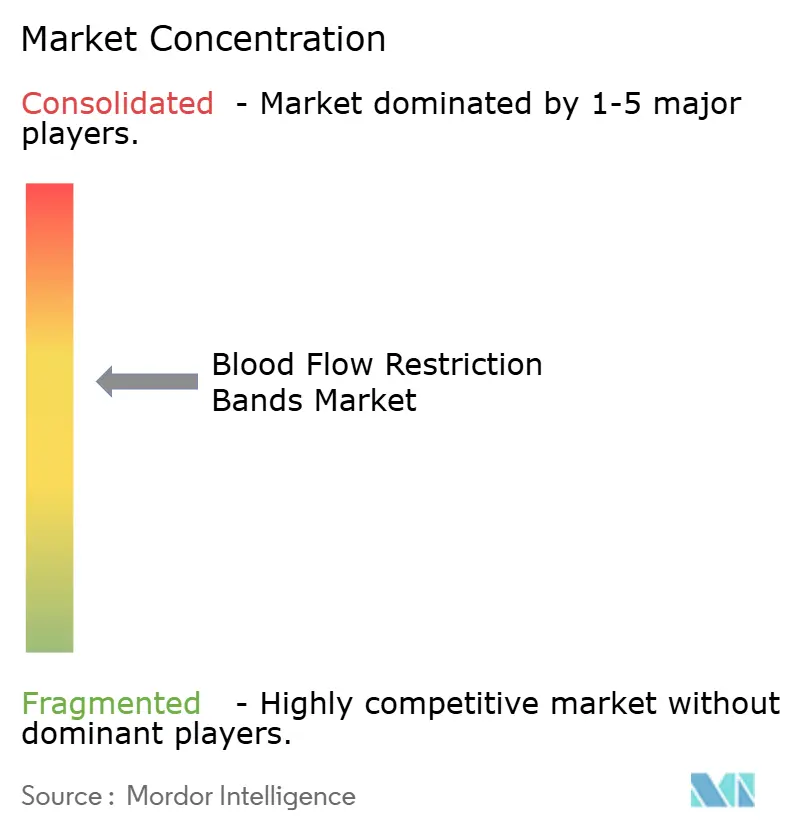
| Market Concentration | Medium |
Major Players *Disclaimer: Major Players sorted in no particular order Image © Mordor Intelligence. Reuse requires attribution under CC BY 4.0. | |
Blood Flow Restriction Bands Market Analysis by Mordor Intelligence
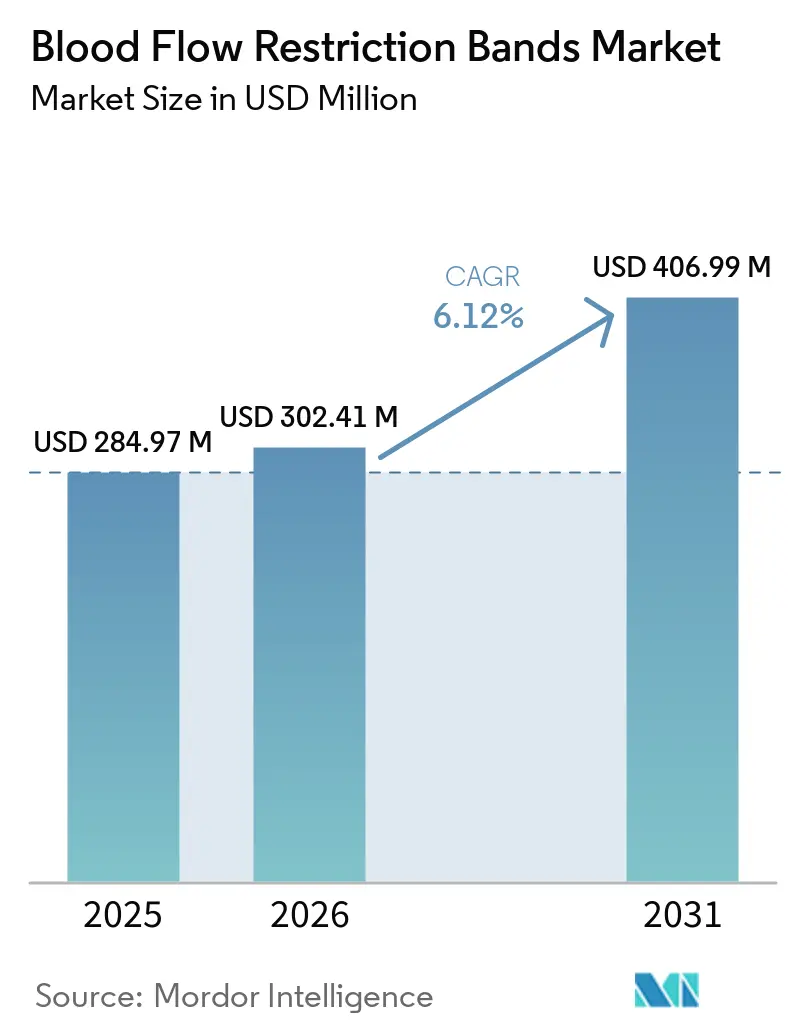
The Blood Flow Restriction Bands Market size is expected to increase from USD 284.97 million in 2025 to USD 302.41 million in 2026 and reach USD 406.99 million by 2031, growing at a CAGR of 6.12% over 2026-2031.
The blood flow restriction bands market is benefiting from the wider clinical use of low-load exercise after surgery, when conventional resistance training can place too much stress on a joint or graft. Evidence from rehabilitation studies is making hospital and therapy teams more willing to standardize blood flow restriction protocols. Connected systems are also changing the purchase decision because they can record pressure settings and treatment sessions. This supports recurring revenue from software, accessories, and follow-up treatment programs. The opportunity is strongest for suppliers that can combine reliable pressure control, clinical documentation, and accessible products for supervised home use.
Key Report Takeaways
- By product type, pneumatic BFR cuffs held 36.46% of the blood flow restriction bands market share in 2025, while elastic BFR bands are forecast to grow at a 6.83% CAGR through 2031.
- By application, rehabilitation and physical therapy accounted for 37.51% of the blood flow restriction bands market size in 2025, while sports performance and athletic training is forecast to grow at a 7.26% CAGR through 2031.
- By technology, manual pressure control held 43.79% of the blood flow restriction bands market share in 2025, while preset pressure control is forecast to grow at a 7.91% CAGR through 2031.
- By end user, rehabilitation centers held 29.53% of the market in 2025, while hospitals and clinics are forecast to grow at an 8.42% CAGR through 2031.
- By geography, North America held 36.72% of the market in 2025, while Asia-Pacific is forecast to grow at a 10.17% CAGR through 2031.
Note: Market size and forecast figures in this report are generated using Mordor Intelligence’s proprietary estimation framework, updated with the latest available data and insights as of January 2026.
Market Trends and Insights
Drivers Impact Analysis of Blood Flow Restriction Bands Market*
| Driver | (~) % Impact on CAGR Forecast | Geographic Relevance | Impact Timeline |
|---|---|---|---|
| Low-Load Strengthening for Rehabilitation | +1.8% | Global, with highest adoption in North America and Europe | Medium term (2-4 years) |
| Rising Sports Injury and Return-to-Play Demand | +1.2% | Global, concentrated in North America, APAC, and Europe | Short term (≤ 2 years) |
| Geriatric and Sarcopenia-Focused Training | +1% | APAC core, especially Japan, South Korea, and China, with spillover to Europe | Long term (≥ 4 years) |
| Connected Pressure-Controlled Systems | +0.9% | North America and EU, with early gains in APAC | Medium term (2-4 years) |
| Military and Tactical Conditioning Adoption | +0.4% | North America, especially the United States and Canada, and Europe, especially the United Kingdom and Germany | Medium term (2-4 years) |
| Clinic-to-Home Rehabilitation Continuity | +0.6% | North America and EU, with early expansion in APAC | Short term (≤ 2 years) |
| Source: Mordor Intelligence | |||
Low-Load Strengthening for Rehabilitation
The blood flow restriction bands market is supported by the ability of low-load training to develop strength when heavy resistance is unsuitable. Blood flow restriction can produce muscle adaptation at 20% to 30% of 1-repetition maximum, which is useful after surgery when graft protection, pain, or joint stress limits exercise intensity. A 2026 meta-analysis found that BFR-assisted low-load training improved pain, function, and grip strength more than low-load training alone in upper-extremity musculoskeletal disorders.[1] A 2026 systematic review also found better balance and walking endurance after more than 4 weeks of BFR training for people recovering from stroke.[2] These findings extend demand from orthopedic care into neurology and physical medicine departments. Certification programs used by hospital systems and military programs can make the protocol part of standard care and favor established clinical suppliers.
Rising Sports Injury and Return-to-Play Demand
Sports injury treatment continues to create demand for tools that help maintain muscle function during restricted activity. The National Safety Council reported 564,845 sports and recreational injuries in the United States during 2024, up 17% from the prior year.[3] Maintaining quadriceps volume during immobilization can be important for athletes who need to return to training after a knee injury. A 2025 randomized trial in amateur soccer players found that low-load BFR improved hypertrophy and hamstring-to-quadriceps ratios compared with standard training.[4] This evidence supports use in prevention programs as well as rehabilitation. Team programs can create repeat demand for cuffs, accessories, and digitally managed protocols instead of relying only on episodic injury-related purchases.
Geriatric and Sarcopenia-Focused Training
Older adults form a long-term demand base because many cannot safely complete conventional high-load resistance programs. A 2026 systematic review found that BFR resistance exercise improved lower-limb strength and muscle mass in healthy adults aged 60 and above. A 2025 review also identified BFR as a potential approach for sarcopenia because it allows resistance exercise at lower mechanical loads. The blood flow restriction bands market can therefore reach rehabilitation providers, senior-care services, and programs that manage functional decline. Japan, South Korea, and China are central to this opportunity because aging populations are increasing the need for muscle-preservation services. Medical-grade products are likely to have an advantage as hospitals and larger care networks expect ISO 13485 quality documentation and EU MDR compliance where applicable.
Connected Pressure-Controlled Systems
Connected systems are raising the value of the blood flow restriction bands market by improving pressure measurement and documenting treatment sessions. SmartCuffs 4.0, Delfi BFR Pro, and AirBands 2.0 illustrate the move toward automated calibration, app control, and sensor-enabled monitoring. A 2025 comparison of popular devices found that none consistently measured limb occlusion pressure accurately in both supine and standing positions. This result supports repeated, position-specific measurement rather than reliance on a fixed pressure setting. Session records can help clinics track limb occlusion pressure, treatment duration, and patient progress. Suppliers with established clinical accounts can use those capabilities to upgrade manual-system customers to connected equipment.
Restraints Impact Analysis of Blood Flow Restriction Bands Market*
| Restraint | (~) % Impact on CAGR Forecast | Geographic Relevance | Impact Timeline |
|---|---|---|---|
| Improper Pressure Application and User-Safety Risk | -1.2% | Global | Short term (≤ 2 years) |
| Inconsistent Clinical Protocols and Practitioner Training | -0.8% | Global, most acute in APAC and South America | Medium term (2-4 years) |
| Premium Pricing of Personalized Pneumatic Systems | -0.6% | Emerging markets, including APAC, MEA, and South America | Long term (≥ 4 years) |
| Limited Reimbursement and Unclear Medical-Use Positioning | -0.9% | Global, most severe in North America and Europe | Long term (≥ 4 years) |
| Source: Mordor Intelligence | |||
Improper Pressure Application and User-Safety Risk
Uneven pressure application remains the most immediate constraint on the blood flow restriction bands market. The 2025 device study found that AirBands had the greatest variation from reference limb occlusion pressure values, while no consumer device was consistent in both tested body positions. Excessive pressure can create risks such as venous thromboembolism, peripheral nerve injury, and rhabdomyolysis. Pneumatic systems that follow FDA 510(k) pathways and EU MDR requirements provide a different level of assurance from many elastic and Velcro bands sold without a regulatory filing. Inconsistent protocols and uneven practitioner training add to the risk, particularly where formal BFR guidance is limited. Suppliers that define product-specific thresholds, support training, and pursue medical-device certification are better placed to pass institutional procurement reviews.
Limited Reimbursement and Unclear Medical-Use Positioning
Reimbursement uncertainty can limit purchases of premium systems even where clinical evidence is strong. Many U.S. payers treat BFR as part of physical therapy and do not provide a dedicated CPT billing code. Providers may therefore use existing manual-therapy or therapeutic-exercise codes that do not fully reflect the equipment and clinical time involved. Coverage also varies across Europe, with selective orthopedic coverage in Germany and restricted use in the United Kingdom. Clinical pneumatic systems priced above USD 5,000 can face a 12- to 24-month internal budget review when no clear reimbursement route exists. This environment can favor low-cost bands in price-sensitive systems and constrain revenue from personalized pneumatic devices.
*Our forecasts treat driver/restraint impacts as directional, not additive. The impact forecasts reflect baseline growth, mix effects, and variable interactions.
Blood Flow Restriction Bands Market Segment Analysis
By Product Type:
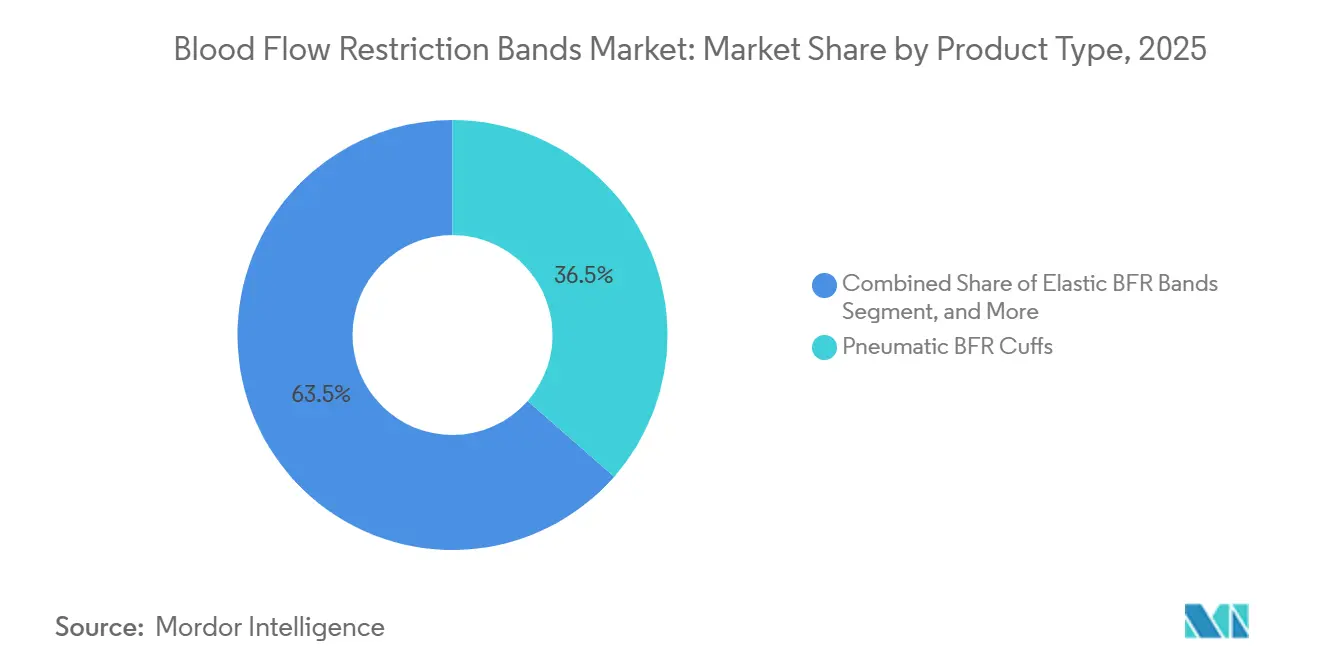
Pneumatic Cuffs Support Clinical Use While Elastic Bands Expand AccessIn the blood flow restriction bands market, pneumatic BFR cuffs held 36.46% of the market in 2025 because clinical and institutional users need repeatable limb occlusion pressure. The blood flow restriction bands market size for pneumatic cuffs is supported by use in rehabilitation facilities, hospital programs, and professional sports settings. Delfi Medical Innovations positions its BFR Pro system for professional leagues, the U.S. Department of Defense, and space research programs. FDA 510(k) clearance and EU MDR requirements can protect established pneumatic suppliers because they raise the evidence and documentation burden for competitors. These systems are also suited to protocols where clinicians must record pressure settings and patient responses. Their higher price can be justified when equipment is used across a large patient base and integrated into formal clinical workflows.
Elastic BFR bands are forecast to grow at a 6.83% CAGR through 2031, making them the fastest-growing product type in the blood flow restriction bands market. Their lower price and portability make them suitable for home rehabilitation, gyms, and consumer fitness channels. A 2025 review described semi-elastic pneumatic cuffs as a practical middle option between rigid tourniquet systems and basic bands. Smart and wireless systems add automatic calibration and app-based control, while adjustable Velcro bands serve price-sensitive gyms and clinics. Wearable garments are an early-stage format that can reduce setup time by placing BFR capability in training apparel. Accessories such as replacement cuffs, pressure gauges, and app subscriptions can add recurring revenue to the blood flow restriction bands industry.

By Application:
Rehabilitation Leads While Sports Performance Builds Faster DemandRehabilitation and physical therapy retained the largest application share at 37.51% in 2025 in the blood flow restriction bands market. The blood flow restriction bands market share in this application reflects early adoption by orthopedic and therapy practitioners. A 2026 randomized controlled trial found that BFR added to routine rehabilitation improved lower-limb motor function, balance, and 6-minute walk-test results in people with stroke. This evidence broadens the clinical use case beyond postsurgical orthopedic recovery. Rehabilitation providers can use low-load protocols for patients who cannot tolerate conventional resistance exercise. The application remains important because clinics can introduce the therapy under professional supervision before extending treatment into home programs.
Sports performance and athletic training are forecast to grow at a 7.26% CAGR through 2031 in the blood flow restriction bands market. Teams use BFR to maintain strength during rehabilitation and may also apply it in preseason conditioning or recovery programs. The amateur soccer trial provides evidence for improved muscle development and hamstring-to-quadriceps balance. Muscle recovery and strength training are also growing as professional teams and trained practitioners increase consumer awareness. Geriatric strength and sarcopenia management remain underdeveloped despite their relevance to aging populations. Other applications include neurological rehabilitation, cardiology, and space medicine, with Delfi BFR Pro used aboard the SpaceX Fram2 mission in April 2025.
By Technology:
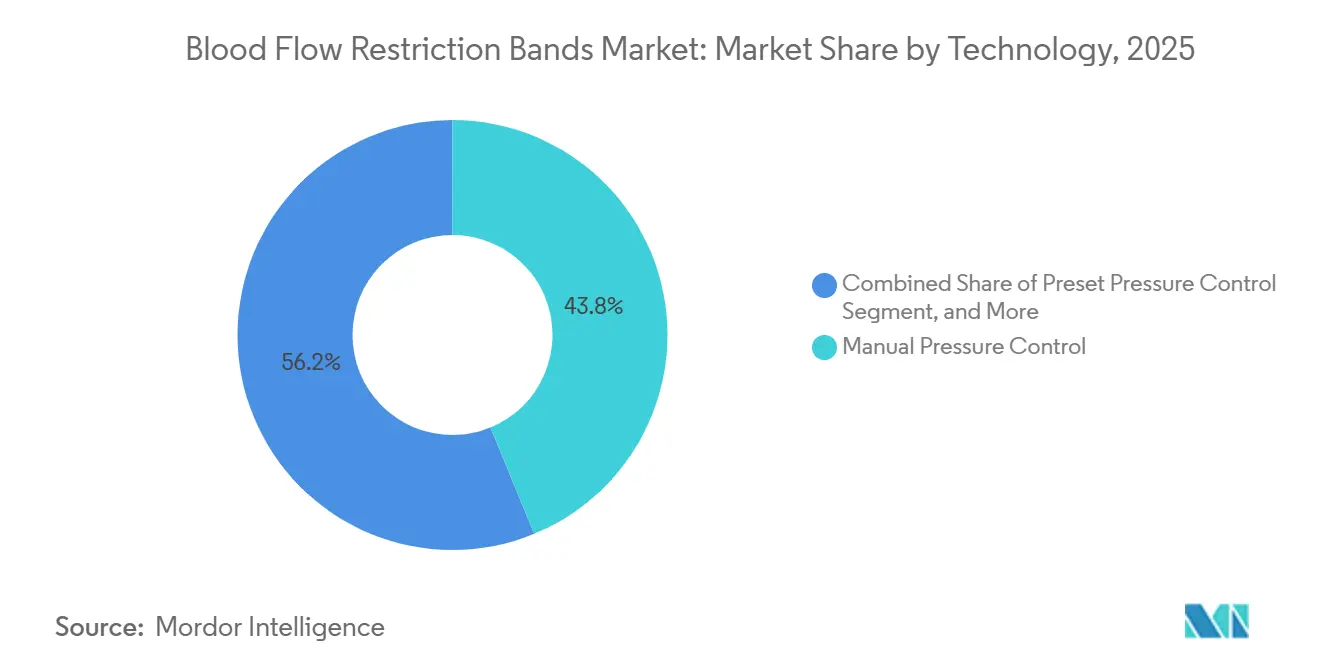
Manual Systems Remain Common While Preset Control Gains GroundManual pressure control held 43.79% of the blood flow restriction bands market in 2025. The installed base is large because hand-pump and dial-based systems are affordable and familiar to trained practitioners in rehabilitation centers and gyms. Manual systems allow clinicians to set pressure directly, but their output can differ with user practice and patient position. The blood flow restriction bands market benefits from their lower entry cost, particularly in facilities that already have staff trained in BFR protocols. Their role is likely to remain significant in cost-sensitive settings. However, the need for consistent pressure records is creating a reason for clinical users to consider calibrated alternatives.
Preset pressure control is forecast to grow at a 7.91% CAGR through 2031 in the blood flow restriction bands market. The 2025 device-comparison study documented meaningful variation in limb occlusion pressure across devices, which strengthens the case for calibrated presets and automated control. Personalized limb occlusion pressure control is used by clinical suppliers such as Delfi and Owens Recovery Science. This approach is moving from high-cost clinical equipment toward mid-range automated devices. Other technologies include Doppler-based occlusion assessment tools and research-grade tourniquet systems. AI pressure estimation, biometric sensors, and Bluetooth connectivity could help suppliers bring individualized pressure control to a wider set of users.
By End User:
Rehabilitation Centers Lead While Hospitals and Clinics Grow FastestRehabilitation centers held 29.53% of the blood flow restriction bands market in 2025. These facilities are primary locations for postoperative orthopedic recovery, outpatient therapy, and professional sports rehabilitation. Their role as prescribers gives them influence over the equipment patients use during supervised sessions. The blood flow restriction bands market is strengthened when rehabilitation centers can continue treatment after discharge through compatible home devices. Certification, protocol design, and device support are important in this setting because staff may manage multiple patient types. Large networks also increasingly expect ISO 13485 quality documentation from suppliers that serve clinical channels.
Hospitals and clinics are forecast to grow at an 8.42% CAGR through 2031 in the blood flow restriction bands market. Evidence on stroke recovery, postsurgical care, and geriatric conditioning supports wider interest across neurology, rehabilitation, and physical medicine departments. A 2026 systematic review recommended that BFR be considered in routine clinical practice for post-stroke rehabilitation. Sports medicine centers are also adding BFR as it moves from experimental use to a more established part of return-to-play care. Fitness centers and gyms offer unit-volume potential but tend to choose lower-priced elastic and preset-pressure products. Home use is growing through programs that transfer a clinic-designed protocol to a consumer-compatible device.
Geography Analysis
North America Blood Flow Restriction Bands Market
North America held 36.72% of the market in 2025, supported by sports medicine facilities, military rehabilitation programs, and established practitioner training networks. The blood flow restriction bands market size in the region is also supported by early FDA device clearances under 21 CFR Part 870. Owens Recovery Science serves professional sports teams, hospital systems, NASA, and military programs as the exclusive U.S. distributor for Delfi BFR Pro. This clinical infrastructure creates a clearer route to institutional adoption than in regions where consumer bands dominate. Canada adds demand through sports medicine and elder-care services, particularly in hospital-based rehabilitation. Mexico remains an emerging location where private sports medicine clinics are beginning to adopt BFR protocols, although awareness and equipment budgets remain limited.
Europe Blood Flow Restriction Bands Market
Europe is the second-largest regional market, with Germany, the United Kingdom, France, Italy, and Scandinavia representing important demand centers. EU MDR 2017/745 requires CE marking for clinical-grade BFR cuffs and favors vendors that can meet the required documentation standards. The United Kingdom has influence through its clinical research base and a Ministry of Defense-affiliated trial examining BFR for military personnel with lower-limb injuries. Germany provides a useful reimbursement example because some statutory insurers cover BFR under selective orthopedic rehabilitation prescriptions. France has commercial interest in wearable and wireless systems through its elite football and cycling environment. These factors support higher clinical standards but can make entry more difficult for suppliers without regulatory and training resources.
APAC, MEA and South America Blood Flow Restriction Bands Market
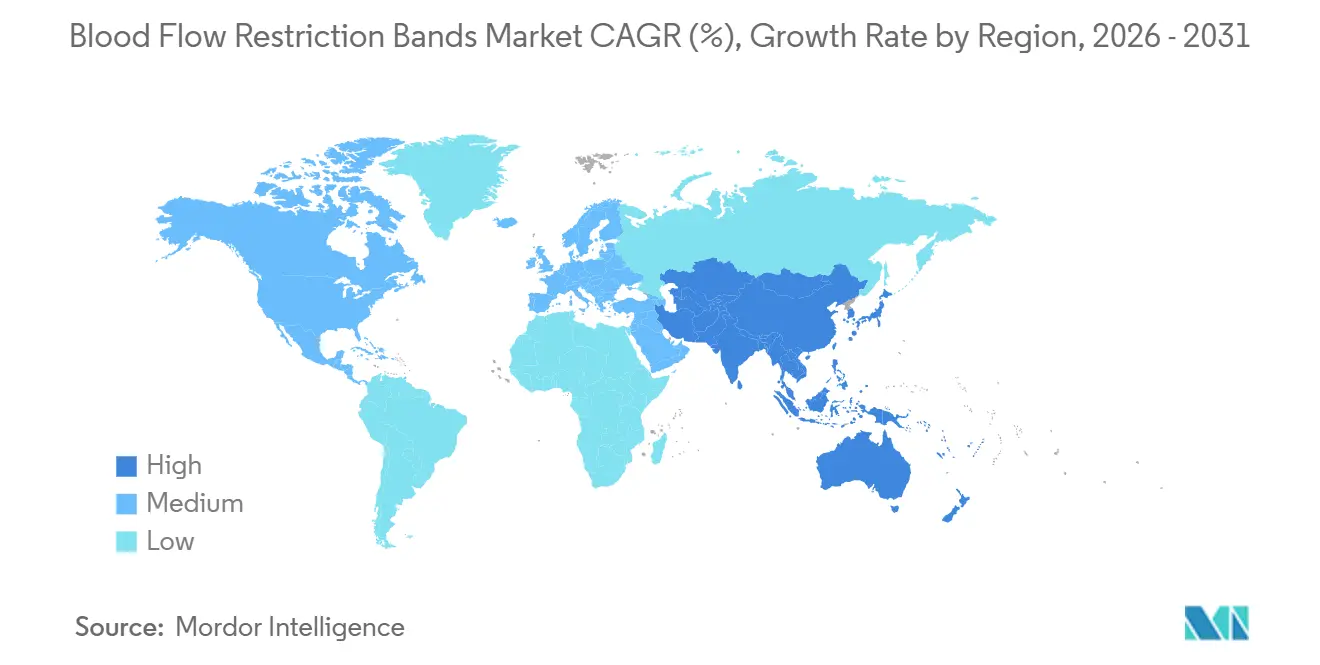
Asia-Pacific is forecast to grow at a 10.17% CAGR through 2031, the fastest rate among regions. Japan remains important because KAATSU training originated there, even though domestic clinical uptake has not fully matched its historical role in BFR research. China is adding rehabilitation capacity as its population ages, while South Korea has a strong sports injury research community and India has an expanding private sports medicine sector. South Korea and Australia are emerging innovation centers, with Australian sports institutes contributing clinical work in rugby and Australian football rehabilitation. Middle East and Africa are early-stage markets, with Saudi Arabia and the UAE building institutional demand through investment in elite sports facilities. South America, led by Brazil and Argentina, is gaining access through e-commerce distribution and continued investment in professional football medicine.
Competitive Landscape
The blood flow restriction bands market has 2 broad competitive groups. Delfi Medical Innovations and Owens Recovery Science operate in the clinical-grade tier, which serves professional sports, military rehabilitation, hospital programs, and space research. A second tier includes Hytro, KAATSU Global, Smart Tools Plus, SAGA Fitness International, B Strong Training Systems, and B3 Sciences. FDA 510(k) clearance and ISO 13485 requirements create meaningful barriers in the clinical tier. In contrast, elastic and Velcro bands have a lower production threshold, which enables new suppliers to enter and puts pressure on pricing. This split means clinical suppliers compete through evidence, training, and reliability, while consumer suppliers compete through price, product design, and distribution reach.
Patent activity is shaping competition around wearable and semi-elastic formats. Hytro secured U.S. Patent No. 12,317,940 in July 2025 for wearable BFR technology that integrates adjustable restriction into performance apparel. Its protection runs through 2040 and may affect design choices for new wearable products. KAATSU Global also holds foundational intellectual property related to semi-elastic pneumatic BFR methods. Delfi’s exclusive U.S. distribution relationship with Owens Recovery Science consolidates clinical sales and support for the Delfi BFR Pro system. This partnership reaches professional leagues, military programs, hospital systems, and NASA-linked work. Such relationships are valuable because they connect hardware sales with practitioner education and ongoing protocol support.
Channel partnerships are becoming important as vendors seek long-term institutional accounts. SimpliFaster added AirBands 2.0 to its professional coach and rehabilitation network in May 2026, widening access to app-controlled cuffs among performance specialists. Hytro formed a partnership with the Serbian Handball Federation in January 2026 and expanded its relationship within the Soudal cycling program. The central product gap remains a device that offers individualized limb occlusion pressure, a price below USD 200, and medical-use clearance at the same time. Suppliers that narrow this gap could reach smaller rehabilitation centers and self-managing athletes that currently buy unvalidated bands. The blood flow restriction bands industry is therefore likely to reward suppliers that balance clinical credibility with simpler and more affordable product use.
Blood Flow Restriction Bands Industry Leaders
-
AirBands BFR
-
B3 Sciences Inc.
-
HawkGrips
-
Hytro Limited
-
B Strong Training Systems
- *Disclaimer: Major Players sorted in no particular order
Blood Flow Restriction Bands Market Companies Covered in this Report
- AirBands BFR
- B Strong Training Systems
- B3 Sciences Inc.
- BFR Bands
- BFR Solutions Limited
- Delfi Medical Innovations Inc.
- EDGE Mobility System
- Exerscribe Inc.
- Gymreapers
- HawkGrips
- Hytro Limited
- Iron Bull Strength
- KAATSU Global, LLC
- LiveBand BFR
- Owens Recovery Science, Inc.
- RockCuff, Inc.
- Saga Fitness International
- Smart Tools Plus, LLC
- The Occlusion Cuff
- TheBFR
- Vikingstrength AS
Recent Industry Developments in Blood Flow Restriction Bands Market
- May 2026: SimpliFaster, a leading distributor to sports performance coaches and rehabilitation practitioners across North America, officially added AirBands Wireless BFR Cuffs (AirBands 2.0) to its product line, significantly expanding the wireless, app-controlled BFR system's institutional distribution reach among professional team coaches and performance specialists.
- January 2026: Hytro announced a formal partnership with the Serbian Handball Federation, becoming its Official Blood Flow Restriction Partner. The collaboration integrates Hytro's patented wearable BFR technology across Serbia's elite handball programs for both training and recovery; Hytro now serves more than 300 professional teams globally across football, rugby, NFL, NBA, athletics, cycling, and motorsport.
- January 2026: BFR.SI launched BFR Cuffs 2.0, a next-generation pneumatic single-chamber cuff designed for professional athletes and fitness users, featuring an upgraded connection-head protection layer, improved waterproof materials, and full backward compatibility with existing manual pump systems.
Global Blood Flow Restriction Bands Market Report Scope
As per the scope of the report, blood flow restriction (BFR) bands are specialized elastic bands or cuffs placed around the upper arms or legs to partially restrict blood flow during exercise. They reduce venous blood return while allowing arterial blood to enter the muscles, creating a training effect similar to high-intensity exercise. BFR bands are commonly used in strength training, rehabilitation, and physical therapy to improve muscle strength and growth with lighter loads.
The blood flow restriction (BFR) bands market is segmented by product type, application, technology, end user, and geography. By product type, the market is segmented into pneumatic BFR cuffs, elastic BFR bands, velcro and adjustable BFR bands, smart and wireless BFR systems, wearable BFR garments, and accessories. By application, the market is segmented into rehabilitation and physical therapy, sports performance and athletic training, muscle recovery, strength training and hypertrophy, geriatric strength and sarcopenia management, and others. By technology, the market is segmented into manual pressure control, preset pressure control, personalized limb occlusion, pressure control, and others. By end user, the market is segmented into rehabilitation centers, hospitals & clinics, sports medicine centers, fitness centers & gyms, and others. The geography segment is further divided into North America, Europe, Asia-Pacific, the Middle East and Africa, and South America. The report also covers the estimated market sizes and trends for 17 countries across major regions globally. The report offers the market size and forecasts in value (USD) for the above segments.
Segmentation Overview
| Pneumatic BFR Cuffs |
| Elastic BFR Bands |
| Velcro and Adjustable BFR Bands |
| Smart and Wireless BFR Systems |
| Wearable BFR Garments |
| Accessories |
| Rehabilitation and Physical Therapy |
| Sports Performance and Athletic Training |
| Muscle Recovery |
| Strength Training and Hypertrophy |
| Geriatric Strength and Sarcopenia Management |
| Others |
| Manual Pressure Control |
| Preset Pressure Control |
| Personalized Limb Occlusion Pressure Control |
| Others |
| Rehabilitation Centers |
| Hospitals & Clinics |
| Sports Medicine Centers |
| Fitness Centers & Gyms |
| Others |
| North America | United States |
| Canada | |
| Mexico | |
| Europe | Germany |
| United Kingdom | |
| France | |
| Italy | |
| Spain | |
| Rest of Europe | |
| Asia-Pacific | China |
| India | |
| Japan | |
| Australia | |
| South Korea | |
| Rest of Asia-Pacific | |
| Middle East and Africa | GCC |
| South Africa | |
| Rest of Middle East and Africa | |
| South America | Brazil |
| Argentina | |
| Rest of South America |
| By Product Type | Pneumatic BFR Cuffs | |
| Elastic BFR Bands | ||
| Velcro and Adjustable BFR Bands | ||
| Smart and Wireless BFR Systems | ||
| Wearable BFR Garments | ||
| Accessories | ||
| By Application | Rehabilitation and Physical Therapy | |
| Sports Performance and Athletic Training | ||
| Muscle Recovery | ||
| Strength Training and Hypertrophy | ||
| Geriatric Strength and Sarcopenia Management | ||
| Others | ||
| By Technology | Manual Pressure Control | |
| Preset Pressure Control | ||
| Personalized Limb Occlusion Pressure Control | ||
| Others | ||
| By End User | Rehabilitation Centers | |
| Hospitals & Clinics | ||
| Sports Medicine Centers | ||
| Fitness Centers & Gyms | ||
| Others | ||
| By Geography | North America | United States |
| Canada | ||
| Mexico | ||
| Europe | Germany | |
| United Kingdom | ||
| France | ||
| Italy | ||
| Spain | ||
| Rest of Europe | ||
| Asia-Pacific | China | |
| India | ||
| Japan | ||
| Australia | ||
| South Korea | ||
| Rest of Asia-Pacific | ||
| Middle East and Africa | GCC | |
| South Africa | ||
| Rest of Middle East and Africa | ||
| South America | Brazil | |
| Argentina | ||
| Rest of South America | ||
Key Questions Answered in the Report
What is forecast rate for blood flow restriction bands?
The blood flow restriction bands market is forecast to grow at a 6.12% CAGR from 2026 to 2031, reaching USD 406.99 million by 2031.
Which product type is most widely used for blood flow restriction training?
Pneumatic BFR cuffs led with 36.46% share in 2025 because clinical settings value repeatable pressure control. Elastic bands are expected to grow faster at a 6.83% CAGR through 2031.
Why are rehabilitation providers adopting BFR equipment?
BFR can support muscle and strength training at low loads. Clinical studies cited in this report found benefits in musculoskeletal and post-stroke rehabilitation.
Which application is growing fastest for blood flow restriction bands?
Sports performance and athletic training is forecast to grow at a 7.26% CAGR through 2031, supported by return-to-play and conditioning use.
What are the main safety concerns with blood flow restriction training?
Inaccurate pressure application can increase safety risk. Clinical providers therefore value individualized limb occlusion pressure, training, and regulated pneumatic systems.
Which region is expected to grow fastest?
Asia-Pacific is forecast to grow at a 10.17% CAGR through 2031, supported by rehabilitation investment, aging populations, and sports medicine activity.