
Blister Pack Vision Inspection Systems Market Size and Share
Market Overview
| Study Period | 2020 - 2031 |
|---|---|
| Market Size (2026) | USD 528.61 Million |
| Market Size (2031) | USD 724.92 Million |
| Growth Rate (2026 - 2031) | 6.52 % |
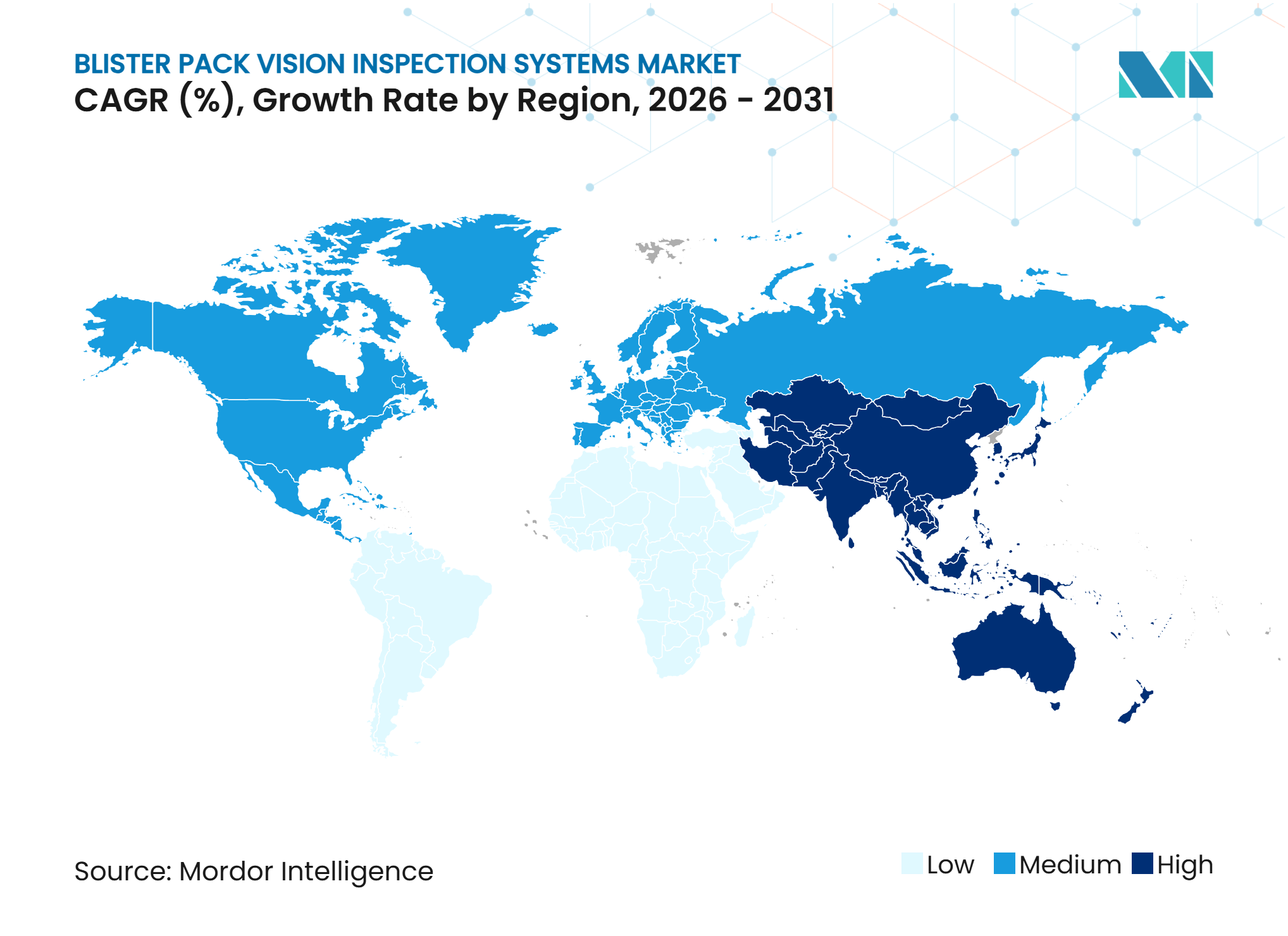
| Fastest Growing Market | Asia-Pacific |
| Largest Market | North America |
| Market Concentration | Medium |
Major Players *Disclaimer: Major Players sorted in no particular order Image © Mordor Intelligence. Reuse requires attribution under CC BY 4.0. | |
Blister Pack Vision Inspection Systems Market Analysis by Mordor Intelligence
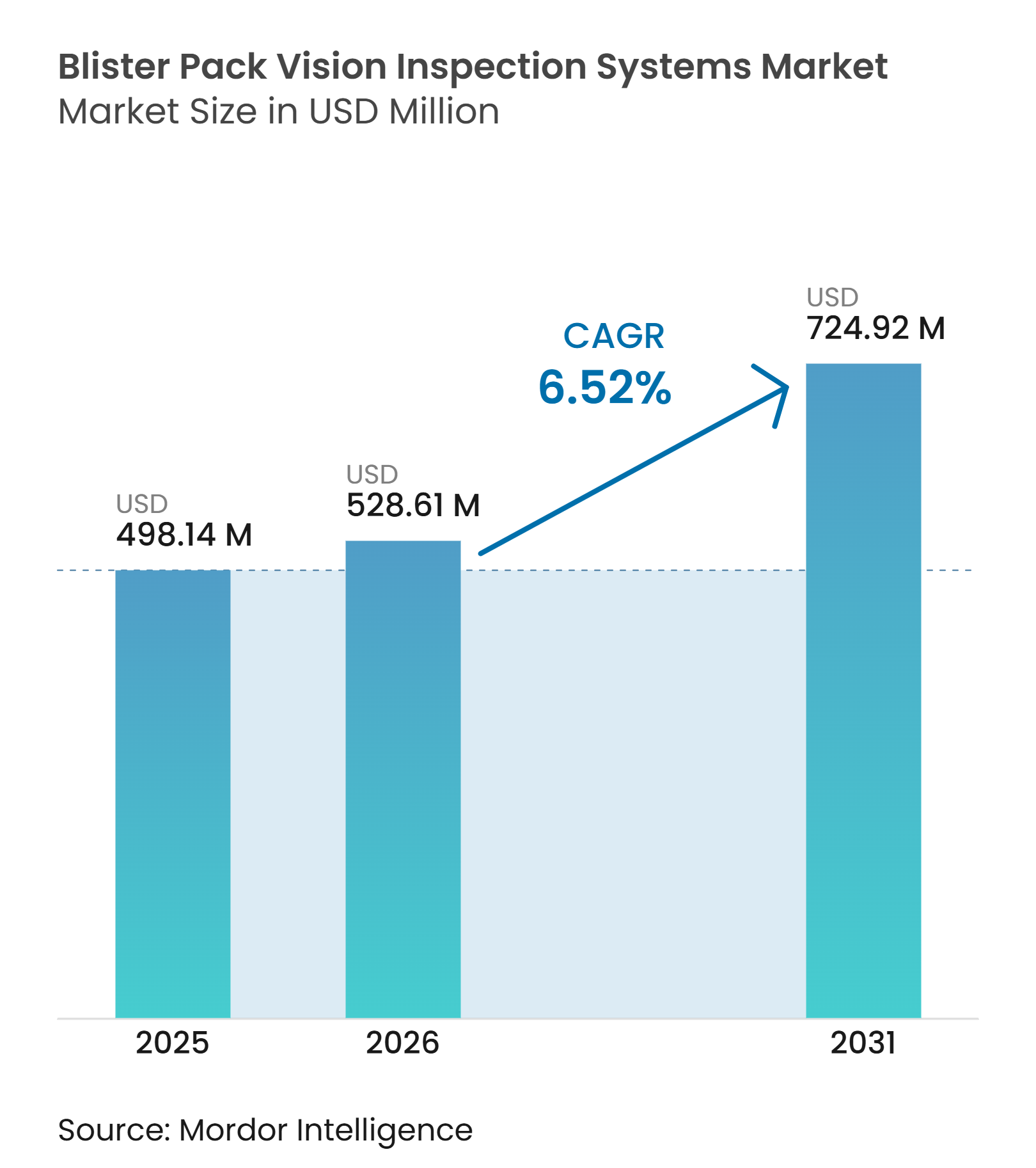
The blister pack vision inspection systems market size is expected to grow from USD 498.14 million in 2025 to USD 528.61 million in 2026 and is forecast to reach USD 724.92 million by 2031 at 6.52% CAGR over 2026-2031. Regulatory expectations are making documented inspection records a basic requirement for pharmaceutical packaging operations. Higher production speeds also make manual inspection less practical on commercial lines. Investment decisions increasingly favor systems that combine visual checks, traceability, and electronic records. Retrofit projects create an option for manufacturers that need better inspection without replacing complete blister lines. The blister pack vision inspection systems market, therefore, benefits from compliance requirements, line modernization, and outsourced pharmaceutical packaging.
Key Report Takeaways
- By inspection type, tablet and capsule inspection held 29.94% of the blister pack vision inspection systems market share in 2025, while print and code inspection is projected to expand at a 6.88% CAGR through 2031.
- By deployment, inline and integrated systems held 72.33% of revenue in 2025, while retrofit systems are projected to expand at a 7.48% CAGR through 2031.
- By inspection stage, post-sealing inspection held 29.89% of revenue in 2025, while product filling inspection is projected to expand at a 6.94% CAGR through 2031.
- By automation level, fully automatic systems held 67.82% of revenue in 2025, while semi-automatic systems are projected to expand at a 7.11% CAGR through 2031.
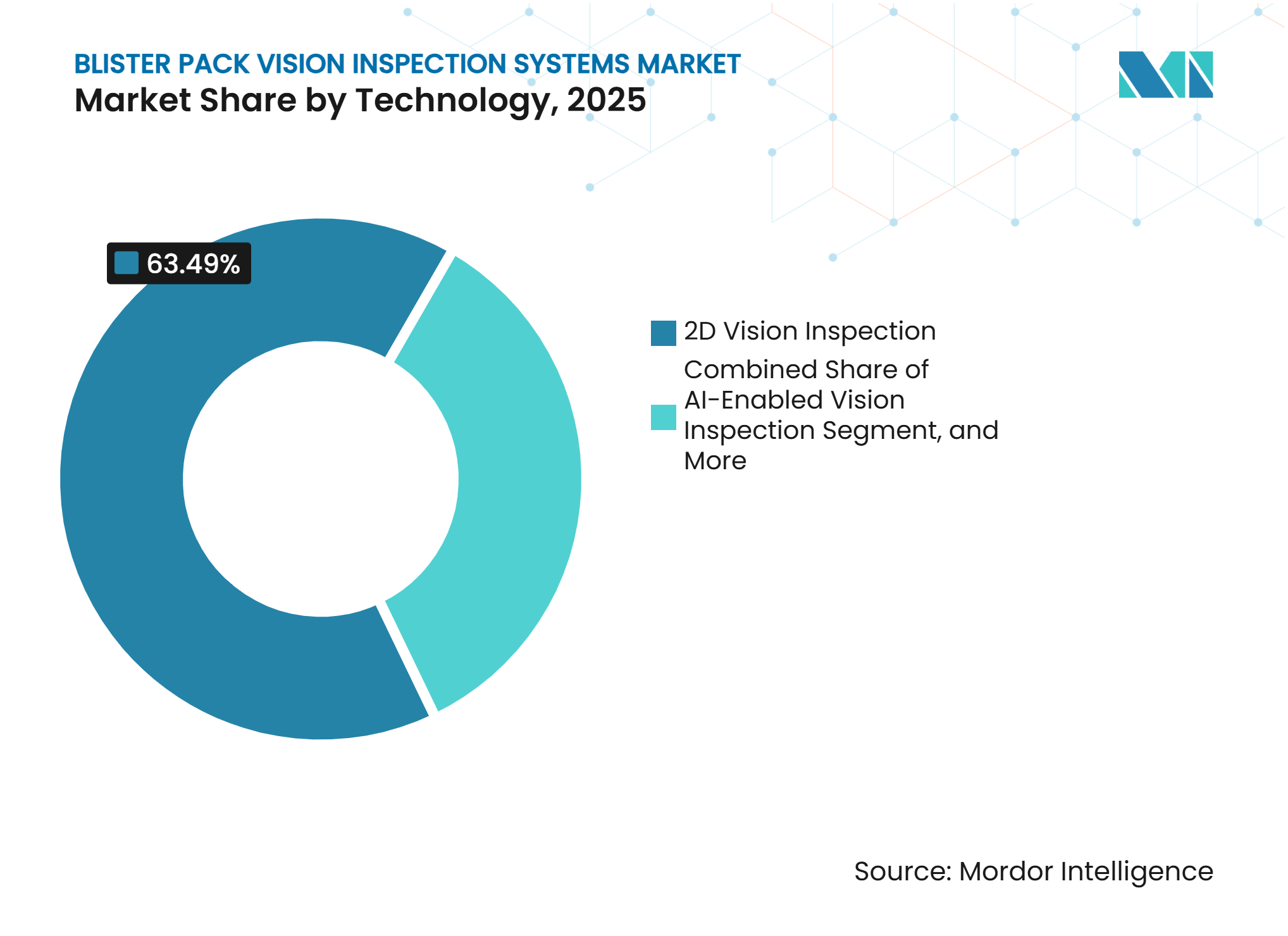
- By technology, 2D vision inspection held 63.49% of revenue in 2025, while AI-enabled vision inspection is projected to expand at a 7.22% CAGR through 2031.
- By end user, pharmaceutical manufacturers held 66.51% of revenue in 2025, while CMOs and CDMOs are projected to expand at a 7.31% CAGR through 2031.
- By geography, North America held 30.41% of revenue in 2025, while Asia-Pacific is projected to expand at a 7.44% CAGR through 2031.
Note: Market size and forecast figures in this report are generated using Mordor Intelligence’s proprietary estimation framework, updated with the latest available data and insights as of January 2026.
Market Trends and Insights
Drivers Impact Analysis of Blister Pack Vision Inspection Systems Market*
| Driver | (~) % Impact on CAGR Forecast | Geographic Relevance | Impact Timeline |
|---|---|---|---|
| Stricter Pharmaceutical Packaging Validation | +1.5% | Global, strongest in North America and Europe | Short term (≤ 2 years) |
| Expansion of High-Speed Solid-Dose Production | +1.2% | Global, strongest in Asia-Pacific and Europe, with expansion into the Middle East and Africa | Medium term (2-4 years) |
| Shift From Manual Sampling to Documented Inline Inspection | +1% | Global, strongest in North America and Europe | Short term (≤ 2 years) |
| AI-Based Defect Classification With Small Training Sets | +0.8% | Global, with early adoption in North America and Europe, followed by Asia-Pacific | Medium term (2-4 years) |
| Serialization and Traceability Integration | +0.7% | North America and Europe, with expanding relevance in Asia-Pacific | Short term (≤ 2 years) |
| Retrofit Demand From Legacy Blister Lines | +0.5% | Global, particularly Europe and Asia-Pacific | Medium term (2-4 years) |
| Source: Mordor Intelligence | |||
Stricter Pharmaceutical Packaging Validation Is Redefining Inspection as a Regulatory Necessity
Regulatory expectations have shifted blister inspection from an operating choice to a compliance requirement. The FDA published draft guidance on container closure systems on August 14, 2026. The guidance uses a risk-based framework for packaging components, including blister films and lidding foils. It calls for evidence on seal integrity, barrier performance, and material compatibility in drug applications and supplements.[1] Under 21 CFR Part 211, packaging and labeling controls require written procedures and examination of packaging materials.[2] These obligations support demand in the blister pack vision inspection systems market for validated equipment and electronic inspection records.
High-Speed Solid-Dose Production Expansion Outpaces Manual Inspection Capacity
Higher solid-dose output is increasing the need for automated inspection at commercial packaging sites. Aenova made a substantial investment at its Bad Aibling blister packaging center, adding an additional high-speed blister line and significantly increasing the site’s annual blister production capacity. Adare completed its Milan packaging expansion in October 2025 with a Marchesini Integra 220S MA260 blister line. The line includes SEA Vision serialization capabilities and supports annual blister output above 50 million units.[3] These projects show why high-speed output is supporting investment across the blister pack vision inspection systems market.
The Shift From Manual Sampling to Documented Inline Inspection Changes Quality-System Logic
Inline inspection is replacing manual sampling on lines where every pack must be checked and documented. An AI vision system at a Japanese pharmaceutical site significantly increased inspection speed for blister sheets. The deployment also added surface wrinkle and pocket foreign-matter detection. Per-pack image archives can support batch release, investigations, and regulatory audits. Sampling plans cannot offer the same pack-level evidence across a full production run. Export-focused sites in India and China also face customer requirements for documented inspection evidence. This trend increases demand for connected systems in the blister pack vision inspection systems market.
AI-Based Defect Classification With Small Training Sets Unlocks Coverage Beyond Rule-Based Platforms
AI adoption is becoming more practical in line with many products and frequent format changes. Antares Vision Group states that its AI-GO platform builds classification, segmentation, and OCR models from limited reference examples. Cognex made OneVision generally available following a beta program. The company reported broad customer adoption and stated that the platform can substantially reduce AI scaling costs compared with site-by-site development. A peer-reviewed study reported a high mean average precision for a blister defect classification model. Faster model preparation can improve inspection coverage for high-mix pharmaceutical packaging.
Restraints Impact Analysis of Blister Pack Vision Inspection Systems Market*
| Restraint | (~) % Impact on CAGR Forecast | Geographic Relevance | Impact Timeline |
|---|---|---|---|
| High Validation and Integration Costs | -1.2% | Global, most acute at smaller sites in Asia-Pacific and the Middle East and Africa | Short term (≤ 2 years) |
| Capital Sensitivity in Generic-Drug Plants | -0.8% | Global, strongest in South Asia and South America | Medium term (2-4 years) |
| Revalidation Burden After Format or Material Changes | -0.6% | Global | Medium term (2-4 years) |
| False Rejects From Foil Glare and Transparent Cavities | -0.4% | Global, acute at sites using transparent PVC blisters | Short term (≤ 2 years) |
| Source: Mordor Intelligence | |||
High Validation and Integration Costs Cap Adoption Velocity Across All Market Tiers
The cost of deploying a vision system extends beyond the equipment purchase. Pharmaceutical facilities must manage installation qualification, operational qualification, performance qualification, software documentation, and training. Existing PLC infrastructure may also require modernization before new inspection software can be validated. A case study by E Tech Group describes a blister-line upgrade that required PLC communication improvements, machine vision integration, and SCADA audit trails for 21 CFR Part 11 compliance. These activities can delay the commercial return from a new line. They are a material constraint for smaller manufacturers and regional CMOs.
Capital Sensitivity in Generic-Drug Plants Creates Prolonged Replacement Cycles
Generic drug manufacturers often face tight budgets for validated inspection equipment. Price pressure can lead these companies to extend replacement cycles or outsource blister packaging to contract packagers. South Asia and South America face added pressure from domestic price controls, import duties, and currency movement against the USD. Material changes can also require a documented requalification of camera settings and defect thresholds. That work becomes burdensome for facilities with large portfolios and several blister formats. These conditions can delay orders in the blister pack vision inspection systems market.
*Our forecasts treat driver/restraint impacts as directional, not additive. The impact forecasts reflect baseline growth, mix effects, and variable interactions.
Blister Pack Vision Inspection Systems Market Segment Analysis
By Inspection Type:
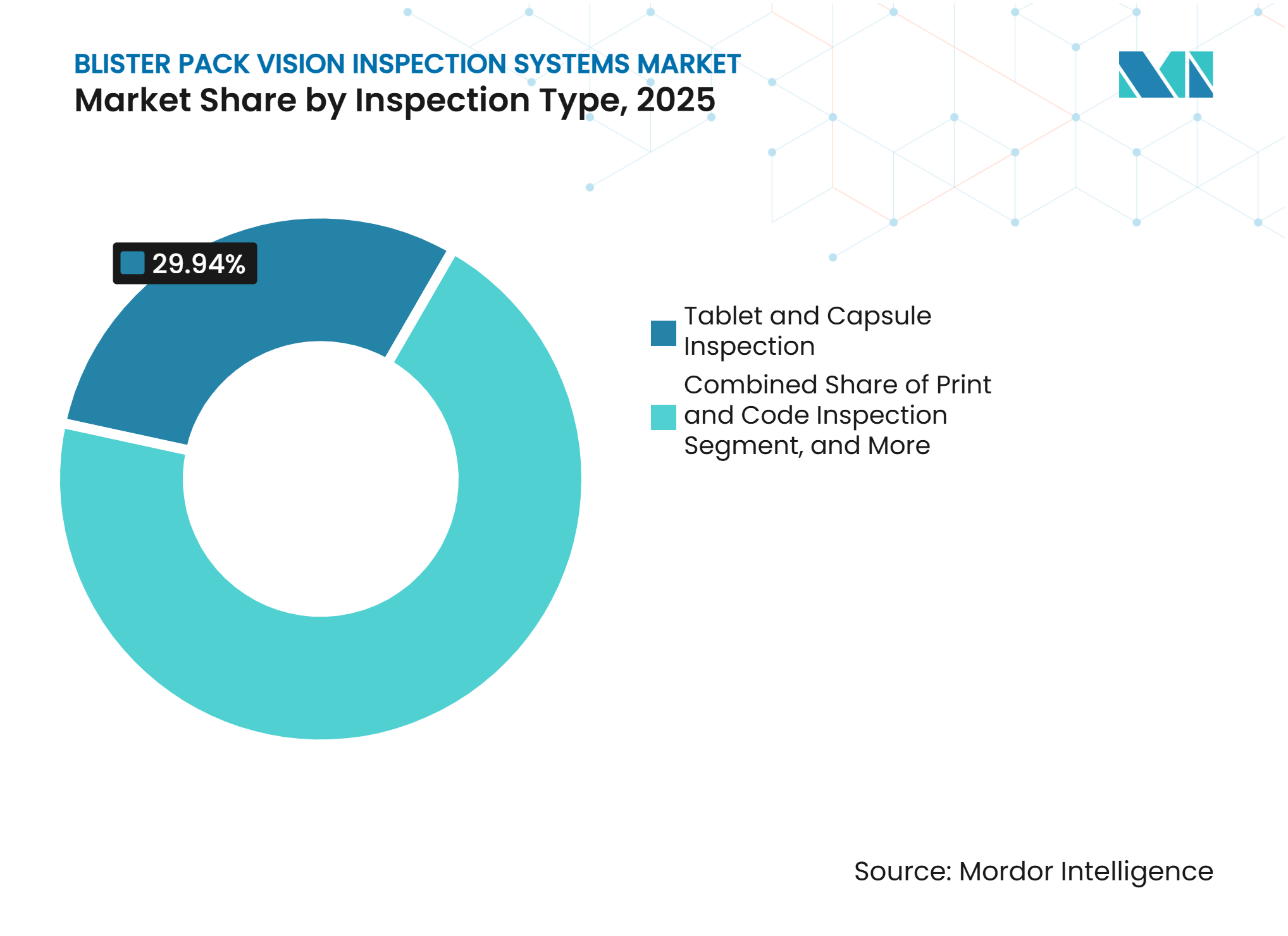
Serialization Requirements Support Print Verification DemandTablet and capsule inspection held 29.94% of the blister pack vision inspection systems market share in 2025. Oral solid dosage forms continue to generate the largest base of unit-level blister inspection demand. Print and code inspection is projected to expand at a 6.88% CAGR through 2031. The category benefits from serialized code verification on pharmaceutical packs. The U.S. DSCSA requires interoperable tracing and verification of certain prescription drug products at the package level. The European delegated regulation requires safety features and verification arrangements for medicinal products. These rules reinforce the case for print quality and code-readability checks on blister lines. The blister pack vision inspection systems market supports this need through vision, OCR, and verification functions. Manufacturers also use these systems to maintain reliable records when products move across regulated supply chains.
Blister cavity and forming inspection focus on defects in the forming film before product packing is complete. Seal and foil inspection identifies incomplete seals and lidding anomalies that can affect package protection. These functions address physical integrity instead of identification data alone. Foreign-particle and contamination inspection has greater relevance on multi-product lines with elevated cross-contamination exposure. Tamper-evident seal checks and label verification provide additional controls where local documentation requirements are increasing. ISO 11607 describes packaging requirements for terminally sterilized medical devices, though its direct scope differs from pharmaceutical blister packaging. Inspection suppliers can apply related packaging-control practices where they suit the product and facility. The broader mix of checks allows a single platform to support both product protection and traceability. This creates opportunities for integrated inspection configurations rather than single-purpose cameras.



By Deployment:
Retrofit Systems Offer a Lower-Disruption Upgrade PathInline and integrated systems accounted for 72.33% of the blister pack vision inspection systems market size in 2025. Their leading position reflects the long-standing use of real-time inspection on validated commercial blister lines. Retrofit systems are projected to expand at a 7.48% CAGR through 2031. They offer an alternative for asset owners that require stronger records but cannot justify replacing the entire packaging line. A retrofit can combine camera stations, controlled lighting, OCR modules, and optical character verification functions. It can also connect to existing reject mechanisms and line controls. This approach limits changes to the production architecture. It can reduce downtime during the upgrade process. It also supports sites that need to improve compliance while preserving existing equipment.
Standalone and offline systems remain useful for quality laboratories and short production campaigns. These systems suit specialty products where continuous inline integration would not be cost-effective. Their role remains narrower than inline inspection at a commercial scale. CDMOs are increasingly standardizing processes across several customer products and packaging formats. This supports greater use of inline systems for recurring commercial work. Retrofit demand remains important because producers are also funding capacity for GLP-1 medicines and biologics. Capital constraints can make a validated upgrade more attractive than a new equipment authorization. The blister pack vision inspection systems market therefore includes both embedded line systems and lower-disruption upgrade options. The choice depends on installed assets, qualification requirements, and expected production volumes.
By Inspection Stage:
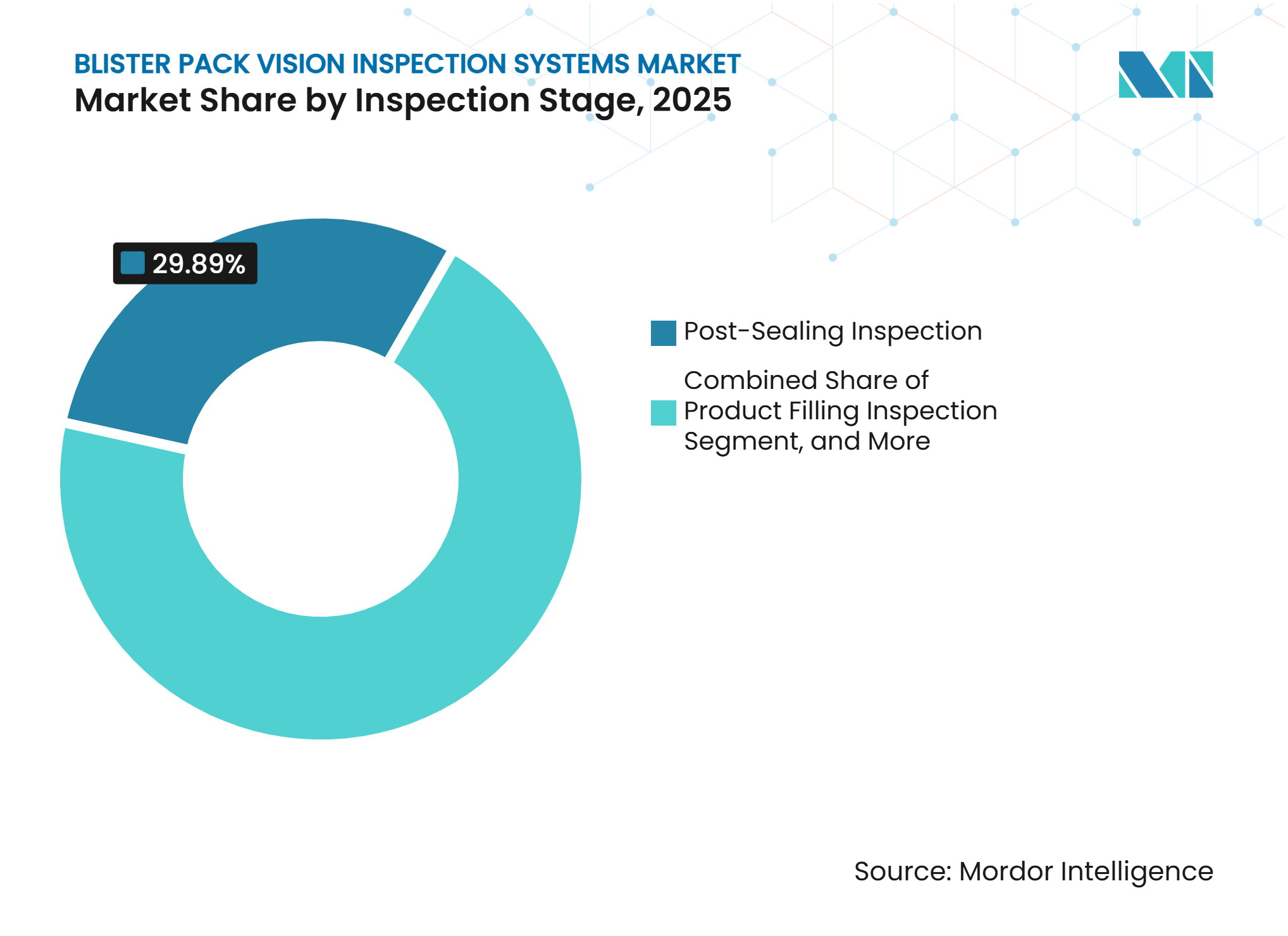
Filling-Stage Detection Reduces Material LossesPost-sealing inspection held 29.89% of revenue in 2025. It acts as the final quality check before blister packs move into cartoning. The system can reject a sealed unit after creating a complete pack image. Product filling inspection is projected to expand at a 6.94% CAGR through 2031. It identifies missing tablets, double-filled pockets, and broken dosage forms before the blister is sealed. Early detection can allow product recovery and reuse of PVC or foil materials when procedures permit. This reduces the cost of defects compared with later rejection. The blister pack vision inspection systems market is therefore moving toward more controls at earlier production points. Such placement can improve material use as well as quality assurance.
Forming and pre-filling inspection addresses film quality before tablets enter the cavity. It can identify holes, thickness variations, and contamination in the forming material. This function provides a more complete upstream check than periodic material testing. Sealing and lidding inspection confirms whether the foil joins correctly with the forming film. Seal performance matters because package failures can affect barrier protection during storage. Final pack and outfeed inspection provides a last in-line check before distribution. It can confirm barcode readability and secondary packaging completeness. Serialization requirements give this final verification role added importance. Together, the stages create a sequence of checks from film preparation through distribution release.

By Automation Level:
Semi-Automatic Systems Serve Flexible ProductionFully automatic systems accounted for 67.82% of the automation segment in 2025. Their position reflects the installed base of high-speed lines that run large volumes with limited operator intervention. Semi-automatic systems are projected to expand at a 7.11% CAGR through 2031. They suit clinical trials, personalized therapies, and advanced therapy medicinal product packaging. These applications often involve batches from several hundred to several thousand units. Frequent changeovers can make fully automated equipment less economical for those runs. Körber introduced the ALVA inspection machine at Interpack in May 2026 for high-mix, low-volume pharmaceutical production. The system covers syringes, vials, and cartridges with automated changeovers. This shows the equipment's response to more variable pharmaceutical production.
CMOs and CDMOs can benefit from semi-automatic flexibility when they handle changing customer portfolios. Recipe management supports repeated use across different products and packaging formats. Electronic format-change records can also support qualification activities. Fully automatic systems remain well-suited to long, stable production runs. Manual inspection systems are losing share in commercial applications. They remain most relevant for early development work and very low-volume operations. The capital cost of automation may not be recoverable over a short production campaign. The blister pack vision inspection systems market serves both high-output sites and facilities that prioritize operational flexibility. This balance explains why semi-automatic systems can expand faster even as fully automatic systems retain the largest installed base.
By Technology:
AI-Enabled Systems Extend Inspection Coverage2D vision inspection held 63.49% of technology revenue in 2025. This installed base remains important because qualified systems offer stable and predictable performance. Replacing a validated 2D system can require a full change-control process. AI-enabled vision inspection is projected to expand at a 7.22% CAGR through 2031. The technology targets defects on reflective, transparent, and low-contrast materials. These materials can create changing illumination conditions across production shifts. Cognex launched the In-Sight 3900 Vision System in May 2026. The company stated that the system combines embedded edge AI, AI tools, and rule-based vision for real-time inspection. The blister pack vision inspection systems market has room for both established 2D systems and newer AI-enabled tools.
3D vision inspection can help when 2D images cannot verify tablet height or cavity deformation. It has relevance for opaque foil formats and complex physical features. Syntegon introduced OpaqView in August 2026 for particle inspection in opaque injectable products. The system uses cameras, multi-angle illumination, and proprietary software. Multimodal platforms combine 2D, near-infrared, and X-ray approaches. These configurations generally serve the highest-capability and highest-cost end of the range. They are more relevant when an undetected defect carries a high product or patient risk. The technology mix is expanding as packaging materials and defect types become more varied. Suppliers must also show that new systems can fit established validation practices.
By End User:
CMOs and CDMOs Are Expanding Their Inspection InvestmentPharmaceutical manufacturers held 66.51% of end-user revenue in 2025. Their share reflects large commercial volumes and a long-established installed base across captive production sites. CMOs and CDMOs are projected to expand at a 7.31% CAGR through 2031. Outsourcing moves the inspection investment decision from the brand owner to the packaging service provider. Contract facilities must accommodate changing products, blister formats, and foil combinations for several customers. This increases the value of fast format learning and recipe management. It also raises the need for documented changeover and inspection records. The blister pack vision inspection systems market serves these facilities with configurations that can handle varied production requirements. The change supports a broader base of inspection buyers across the pharmaceutical value chain.
A 2026 installation at Jubilant HollisterStier CMO included a Körber Seidenader MS-60 automated visual inspection system for a 600-vials-per-minute line. The investment formed part of a larger site expansion. OTC and nutraceutical manufacturers are also adopting more rigorous inspection practices to meet retail quality expectations. Veterinary pharmaceutical packagers and diagnostic kit manufacturers are additional users of blister-related inspection methods. These groups generally operate at lower volumes than large pharmaceutical manufacturers. Their requirements can still align with pharmaceutical GMP-based quality practices. Different end users place different weight on throughput, flexibility, and traceability. This allows equipment suppliers to offer modular systems for specific operating conditions. It also strengthens demand beyond captive pharmaceutical manufacturing sites.
Geography Analysis
North America held 30.41% of the blister pack vision inspection systems market share in 2025. The region benefits from FDA oversight and a significant base of commercial pharmaceutical packaging capacity. The DSCSA requires interoperable electronic tracing and verification for covered prescription drug products. This requirement supports spending on print and code inspection for serialized packs. Canada and Mexico also contribute through export-oriented generic manufacturing that must meet U.S. regulatory requirements. The regional opportunity, therefore, extends across manufacturing supply chains linked to the United States.
Asia-Pacific is projected to expand at a 7.44% CAGR through 2031. Export-quality requirements, local regulatory changes, and capacity additions support this position. Anritsu launched the Ariphas transmission near-infrared tablet inspection device in Japan in February 2026. The system provides non-destructive inspection of tablet interiors, including ingredient uniformity deviations and mixed-tablet contamination. India and China face quality requirements from Western customers and regulators. South Korea and ASEAN countries are also adoption centers for producers seeking European GMP-compliant documentation. Japan also faces a material-transition cycle that could require inspection-system requalification on blister lines.
Europe has a material presence in the blister pack vision inspection systems market because of its established pharmaceutical manufacturing and compliance systems. The EU FMD framework requires safety features and verification processes for medicinal products. Germany, Italy, and France remain important national markets for production equipment and inspection systems. Syntegon launched the AIM9 high-speed inspection platform in February 2026 for visual inspection and container closure integrity testing. South America and the Middle East and Africa remain earlier-stage areas, but domestic pharmaceutical investment can create greenfield demand.
Competitive Landscape
Market Concentration
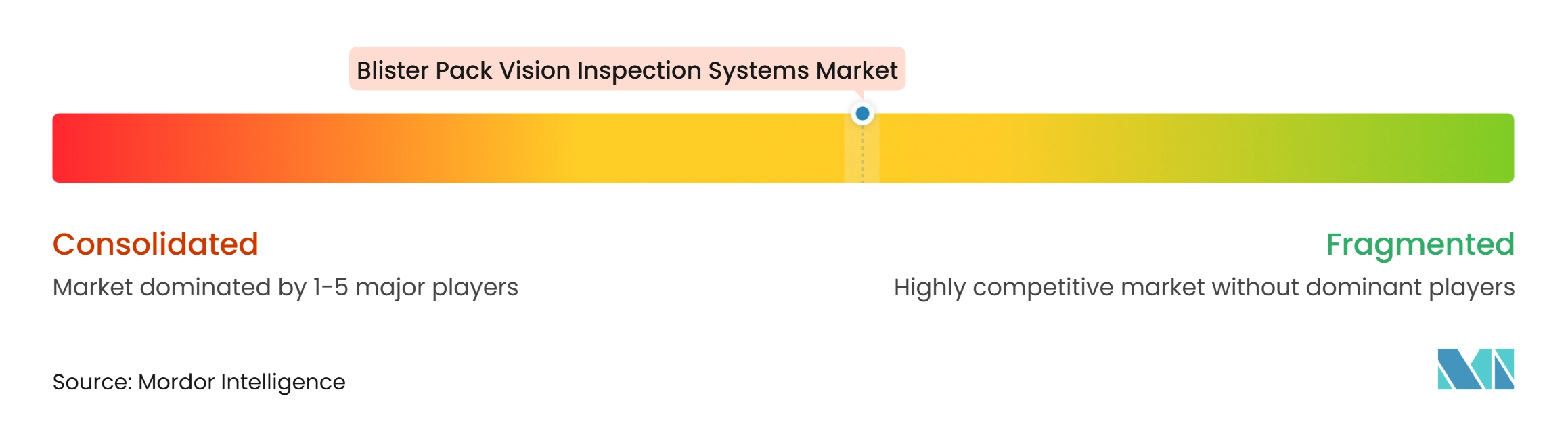
The blister pack vision inspection systems market is moderately fragmented across the full supplier base. The upper tier has meaningful concentration among established pharmaceutical inspection specialists and broader automation providers. Antares Vision Group, SEA Vision, Jekson Vision, Viswill, and Scanware focus on pharmaceutical quality control. Their experience includes validation documentation and customer references from regulated manufacturing sites. Cognex, KEYENCE, and Mettler-Toledo compete through broad machine-vision platforms, processing capabilities, and software tools. Integrated equipment suppliers such as Körber and Syntegon combine inspection with packaging equipment. This supports a single-vendor qualification path for pharmaceutical producers and CDMOs.
Cognex introduced the In-Sight 3900 Vision System in May 2026, combining edge AI with rule-based vision functions. Syntegon launched the AIM9 platform in February 2026 with visual inspection and container closure integrity testing. Körber launched ALVA in May 2026 for high-mix, low-volume pharmaceutical applications. These launches show how suppliers are targeting flexible production, combined inspection methods, and faster deployment. Antares Vision also presented AI-enabled blister filling control and traceability solutions at Interpack 2026. Product development remains focused on detection accuracy, electronic traceability, and line integration.
AI-based false-reject reduction, serialization integration, and modular retrofit capability are key points of differentiation. Mettler-Toledo introduced the X56 DXD+ dual-energy photon-counting X-ray inspection system with AI capabilities in May 2026. Optel Group and Laetus provide serialization connectivity within broader traceability architectures. Semi-automated inspection for high-mix clinical and specialty production remains an open product area. Asian specialists, including Kevision Systems, ACG Group, and ENCLONY, are seeking opportunities at lower price points. This positioning can matter in South and Southeast Asia where premium equipment costs limit adoption. The blister pack vision inspection systems market therefore combines specialist capability with broader automation platforms. No combined share for the leading suppliers is available in the supplied data.
Blister Pack Vision Inspection Systems Industry Leaders
-
Antares Vision Group
-
SEA Vision S.r.l.
-
Cognex Corporation
-
KEYENCE CORPORATION
-
Mettler-Toledo International Inc
- *Disclaimer: Major Players sorted in no particular order
Blister Pack Vision Inspection Systems Market Companies Covered in this Report
- Antares Vision Group
- SEA Vision S.r.l.
- Cognex Corporation
- KEYENCE CORPORATION
- Mettler-Toledo International Inc.
- Omron Corporation
- Syntegon Technology GmbH
- Korber AG
- Jekson Vision
- Viswill Co., Ltd.
- Heuft Systemtechnik GmbH
- Packaging Technologies and Inspection
- ACG Group
- Optel Group
- Laetus GmbH
- Scanware Electronic GmbH
- Kevision Systems Pvt. Ltd.
- SICK AG
- Basler AG
- Teledyne Technologies Incorporated
- Zebra Technologies Corporation
- Ishida Co., Ltd.
- MinebeaMitsumi Inc.
- Pharmaworks, Inc.
- Optimal Industrial Automation and Technologies
Recent Industry Developments in Blister Pack Vision Inspection Systems Market
- August 2026: Syntegon Technology GmbH launched OpaqView at the PDA Visual Inspection Forum in Dublin, a breakthrough inspection technology for opaque injectables that uses advanced cameras, multi-angle illumination, and proprietary software to detect particles in products where conventional automated visual inspection is unreliable. OpaqView is now available across all Syntegon automated inspection platforms following product-specific feasibility confirmation.
- May 2026: Cognex Corporation made OneVision generally available on May 13, 2026, a cloud-to-edge AI vision development environment enabling centralized model training and fleet-wide deployment across global manufacturing sites. Since its June 2025 beta, more than 100 customers adopted the platform, with reported AI scaling cost reductions of up to 50% compared to per-site development workflows.
- May 2026: Cognex Corporation launched the In-Sight 3900 Vision System on May 5, 2026, powered by Qualcomm Dragonwing processors, combining embedded edge AI, advanced AI tools, and rule-based vision in a unified edge-compute platform designed for deterministic, full-line-speed inspection in packaging, pharmaceutical, and electronics manufacturing.
- May 2026: Körber AG launched the ALVA adaptive, fully automatic inspection machine for High Mix Low Volume pharmaceutical production at Interpack 2026 in Düsseldorf on May 7, targeting clinical trials, personalized therapies, ATMPs, and CDMOs. ALVA inspects syringes, vials, and cartridges with automated changeovers and a compact design for frequent format switching.
Global Blister Pack Vision Inspection Systems Market Report Scope
The Blister Pack Vision Inspection Systems Market comprises machine vision hardware and software solutions that automatically inspect pharmaceutical blister packs for defects such as missing or broken tablets/capsules, incorrect product placement, cavity deformities, foil or seal damage, print/OCR errors, and contamination.
The Blister Pack Vision Inspection Systems Market Report is Segmented by Inspection Type (Tablet and Capsule Inspection, Blister Cavity and Forming Inspection, Seal and Foil Inspection, Print and Code Inspection, Foreign Particle and Contamination Inspection, and Other Inspection Types), Deployment (Inline / Integrated, Standalone / Offline, and Retrofit Systems), Inspection Stage (Forming / Pre-Filling Inspection, Product Filling Inspection, Sealing / Lidding Inspection, Post-Sealing Inspection, and Final Pack / Outfeed Inspection), Technology (2D Vision Inspection, 3D Vision Inspection, Multimodal Vision Inspection, and AI-Enabled Vision Inspection) Automation Level (Fully Automatic Systems, Semi-Automatic Systems, and Manual Inspection Systems), End-User (Pharmaceutical Manufacturers, Contract Manufacturing Organizations (CMOs/CDMOs), OTC and Nutraceutical Manufacturers, and Other End-Users), End-User, and Geography (North America, South America, Europe, Asia-Pacific, Middle East and Africa). The Market Forecasts are in Terms of Value (USD).
Segmentation Overview
| Tablet and Capsule Inspection |
| Blister Cavity and Forming Inspection |
| Seal and Foil Inspection |
| Print and Code Inspection |
| Foreign Particle and Contamination Inspection |
| Other Inspection Types |
| Inline / Integrated |
| Standalone / Offline |
| Retrofit Systems |
| Forming / Pre-Filling Inspection |
| Product Filling Inspection |
| Sealing / Lidding Inspection |
| Post-Sealing Inspection |
| Final Pack / Outfeed Inspection |
| 2D Vision Inspection |
| 3D Vision Inspection |
| Multimodal Vision Inspection |
| AI-Enabled Vision Inspection |
| Fully Automatic Systems |
| Semi-Automatic Systems |
| Manual Inspection Systems |
| Pharmaceutical Manufacturers |
| Contract Manufacturing Organizations (CMOs/CDMOs) |
| OTC and Nutraceutical Manufacturers |
| Other End-Users |
| North America | United States | |
| Canada | ||
| Mexico | ||
| South America | Brazil | |
| Argentina | ||
| Rest of South America | ||
| Europe | Germany | |
| United Kingdom | ||
| France | ||
| Italy | ||
| Spain | ||
| Rest of Europe | ||
| Asia-Pacific | China | |
| Japan | ||
| India | ||
| South Korea | ||
| ASEAN | ||
| Rest of Asia-Pacific | ||
| Middle East and Africa | Middle East | Saudi Arabia |
| Turkey | ||
| United Arab Emirates | ||
| Rest of the Middle East | ||
| Africa | South Africa | |
| Nigeria | ||
| Rest of Africa | ||
| By Inspection Type | Tablet and Capsule Inspection | ||
| Blister Cavity and Forming Inspection | |||
| Seal and Foil Inspection | |||
| Print and Code Inspection | |||
| Foreign Particle and Contamination Inspection | |||
| Other Inspection Types | |||
| By Deployment | Inline / Integrated | ||
| Standalone / Offline | |||
| Retrofit Systems | |||
| By Inspection Stage | Forming / Pre-Filling Inspection | ||
| Product Filling Inspection | |||
| Sealing / Lidding Inspection | |||
| Post-Sealing Inspection | |||
| Final Pack / Outfeed Inspection | |||
| By Technology | 2D Vision Inspection | ||
| 3D Vision Inspection | |||
| Multimodal Vision Inspection | |||
| AI-Enabled Vision Inspection | |||
| By Automation Level | Fully Automatic Systems | ||
| Semi-Automatic Systems | |||
| Manual Inspection Systems | |||
| By End-User | Pharmaceutical Manufacturers | ||
| Contract Manufacturing Organizations (CMOs/CDMOs) | |||
| OTC and Nutraceutical Manufacturers | |||
| Other End-Users | |||
| By Geography | North America | United States | |
| Canada | |||
| Mexico | |||
| South America | Brazil | ||
| Argentina | |||
| Rest of South America | |||
| Europe | Germany | ||
| United Kingdom | |||
| France | |||
| Italy | |||
| Spain | |||
| Rest of Europe | |||
| Asia-Pacific | China | ||
| Japan | |||
| India | |||
| South Korea | |||
| ASEAN | |||
| Rest of Asia-Pacific | |||
| Middle East and Africa | Middle East | Saudi Arabia | |
| Turkey | |||
| United Arab Emirates | |||
| Rest of the Middle East | |||
| Africa | South Africa | ||
| Nigeria | |||
| Rest of Africa | |||
Key Questions Answered in the Report
What is the blister pack vision inspection systems market size?
The blister pack vision inspection systems market was valued at USD 528.61 million in 2026 and is forecast to reach USD 724.92 million by 2031 at a 6.52% CAGR. This outlook reflects demand for documented quality records, faster line inspection, and traceability capabilities at pharmaceutical packaging facilities. The blister pack vision inspection systems market also serves both new capacity projects and validated line upgrades.
What is driving demand for blister pack vision inspection systems?
Packaging validation, higher line speeds, serialization requirements, and the need for documented inspection records are supporting adoption. These needs apply to new lines and existing installations that require updated electronic quality evidence. They also place greater value on systems that preserve image records for review, release decisions, investigations, and inspection audits.
Which inspection type leads revenue?
Tablet and capsule inspection led with a 29.94% revenue share in 2025, while print and code inspection is projected to expand fastest at a 6.88% CAGR. The first category serves the large oral solid-dose base, while the second supports serialized data verification on regulated product packs. Forming, sealing, and contamination functions remain important for package protection and product-quality control.
Why are retrofit inspection systems gaining adoption?
Retrofit systems can add vision, OCR, and verification functions while avoiding the full disruption and capital commitment of a new blister line. They offer a practical route for sites that need validated upgrades while preserving existing line assets. These installations may also support improved controls without requiring a complete redesign of line controls, reject systems, or packaging equipment.
Which region is expanding fastest?
Asia-Pacific is projected to expand at a 7.44% CAGR through 2031, supported by pharmaceutical capacity growth and export-quality requirements. Japans equipment upgrade activity, Indian exports, Chinese manufacturing investment, and expanding adoption in South Korea and ASEAN countries underpin this regional position. Manufacturers across the region must address domestic requirements as well as quality specifications imposed by international pharmaceutical customers.
How are AI-enabled systems changing pharmaceutical packaging inspection?
AI-enabled systems can improve detection on reflective and transparent materials and can support faster preparation for varied product formats. The systems can be especially relevant for operators managing several recipes and frequent packaging changeovers. The blister pack vision inspection systems market can use these capabilities to complement, rather than immediately replace, qualified 2D vision systems.