
Bitumen Emulsifiers Market Size and Share
Market Overview
| Study Period | 2021 - 2031 |
|---|---|
| Market Size (2026) | USD 66.24 Million |
| Market Size (2031) | USD 88.27 Million |
| Growth Rate (2026 - 2031) | 5.91 % |
| Fastest Growing Market | Asia-Pacific |
| Largest Market | Asia-Pacific |
| Market Concentration | Low |
Major Players *Disclaimer: Major Players sorted in no particular order Image © Mordor Intelligence. Reuse requires attribution under CC BY 4.0. | |
Bitumen Emulsifiers Market Analysis by Mordor Intelligence
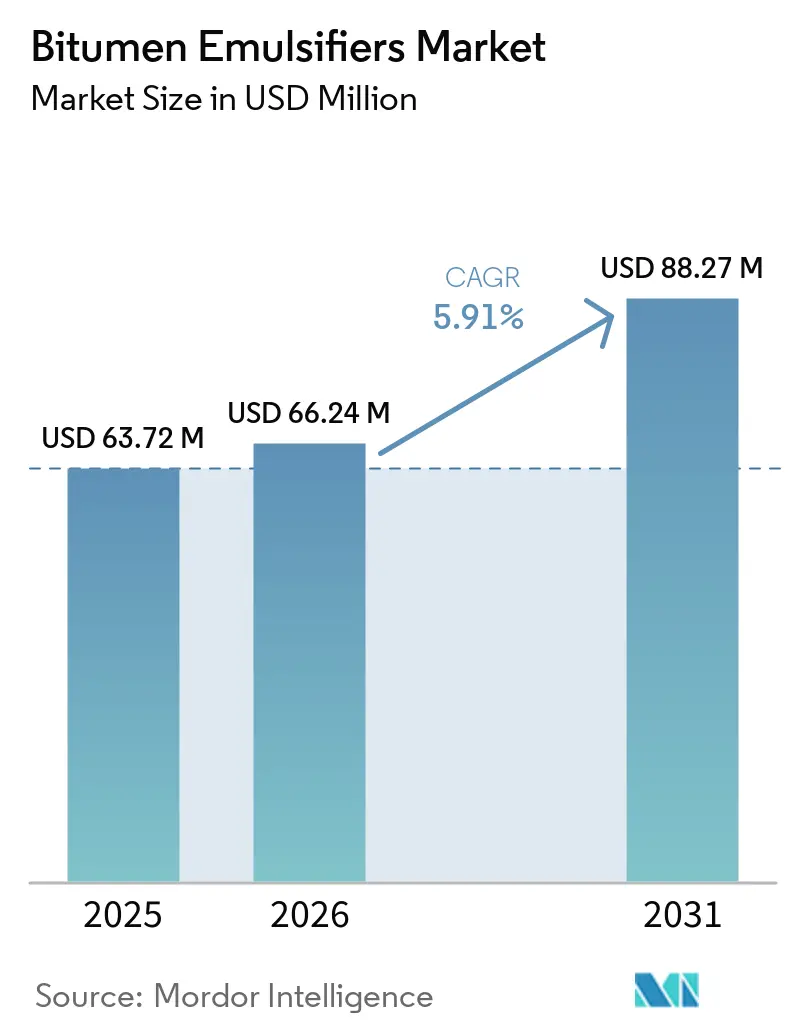
The Bitumen emulsifiers market size was estimated at USD 63.72 million in 2025 and is estimated to grow from USD 66.24 million in 2026 to USD 88.27 million by 2031, at a CAGR of 5.91% during the forecast period (2026-2031). Road agencies are placing greater emphasis on maintenance methods that reduce energy use and emissions associated with hot-mix asphalt, particularly where aging pavements require repeated interventions rather than full reconstruction and where work must be completed without lengthy road closures. This shift supports wider use of cold-mix, slurry seal, microsurfacing, and surface-preservation techniques, as these approaches require less heating, extend pavement service life, and can be applied where permanent asphalt-plant access is not practical. Suppliers are responding with polymer-compatible grades, bio-based formulations, verified environmental declarations, regional distribution arrangements, and technical services that help contractors select products suited to local aggregates, weather conditions, pavement conditions, equipment availability, traffic-management constraints, quality-control practices, and expected maintenance closure durations. Feedstock volatility, fixed-price public tenders, limited contractor familiarity in developing markets, storage and distribution requirements, and continued use of hot-mix asphalt in structural layers are limiting the pace of change in the bitumen emulsifiers market. Public agencies also remain cautious about revising specifications for high-traffic structural corridors, where performance expectations, established construction processes, and concerns over long-term performance continue to favor conventional paving systems, particularly in heavily loaded roadway sections where agencies have limited tolerance for schedule changes or premature pavement distress.
Key Report Takeaways
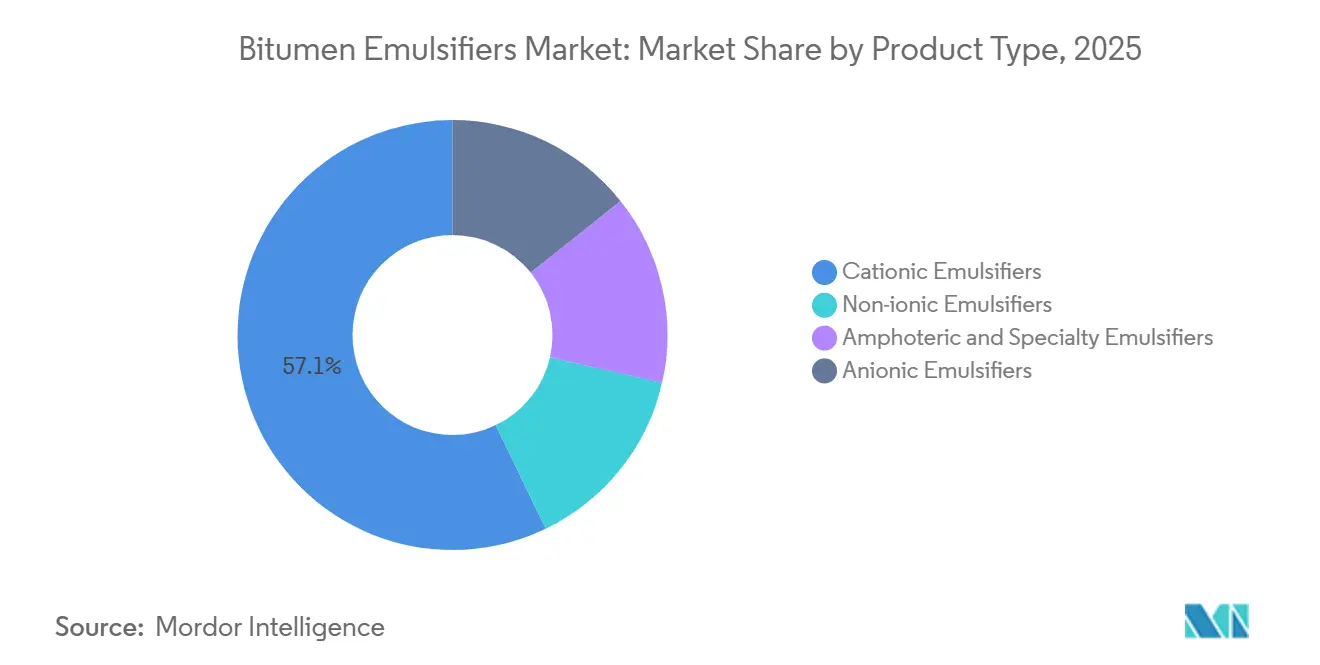
- By product type, cationic emulsifiers held 57.14% of the Bitumen emulsifiers market share in 2025, while amphoteric and specialty emulsifiers are forecast to grow at a 7.34% CAGR through 2031.
- By setting type, rapid-setting emulsifiers held a 37.82% share in 2025, while quick-setting emulsifiers are forecast to grow at a 6.81% CAGR through 2031.
- By application, surface treatment held a 44.27% share in 2025, while the mixing sub-segment is forecast to grow at a 6.59% CAGR through 2031.
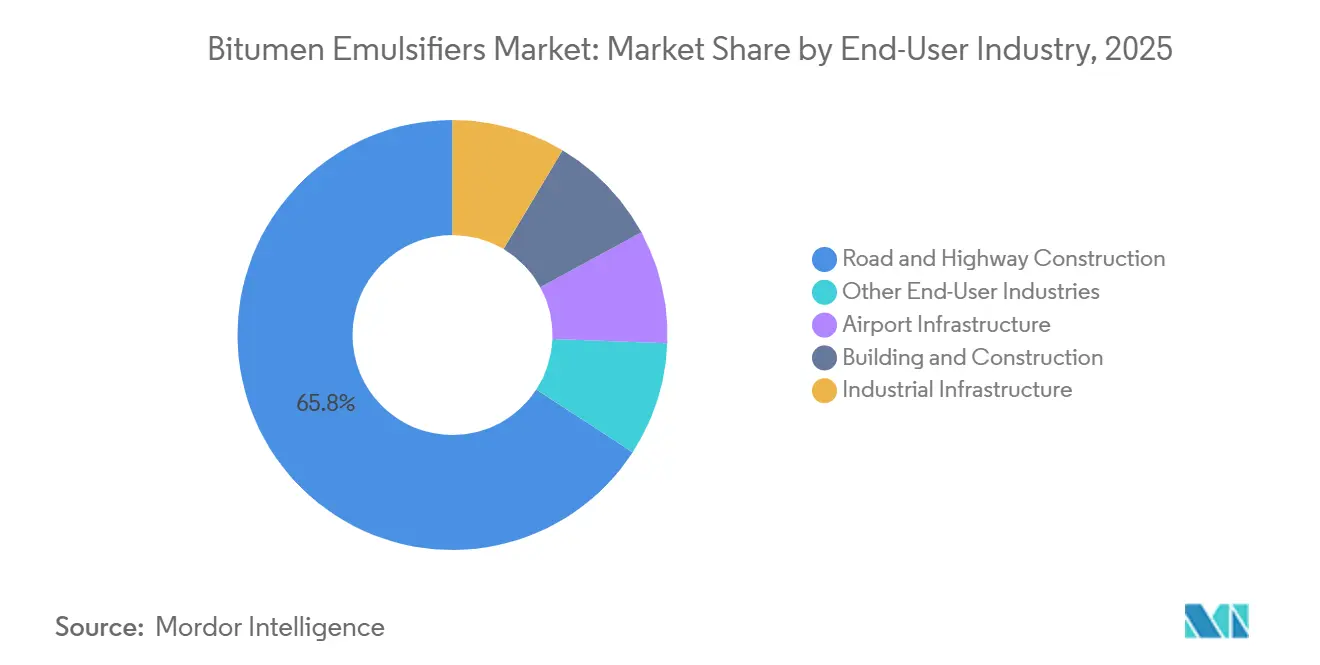
- By end-user industry, road and highway construction held a 65.83% share in 2025, while airport infrastructure is forecast to grow at a 6.74% CAGR through 2031.
- By geography, Asia-Pacific accounted for 48.53% of the bitumen emulsifiers market share in 2025 and is expected to advance at a 6.68% CAGR through 2031.
Note: Market size and forecast figures in this report are generated using Mordor Intelligence’s proprietary estimation framework, updated with the latest available data and insights as of January 2026.
Market Trends and Insights
Drivers Impact Analysis of Bitumen Emulsifiers Market*
| Drivers | (~) % Impact on CAGR Forecast | Geographic Relevance | Impact Timeline |
|---|---|---|---|
| Increasing Road Infrastructure Development and Highway Maintenance Investments | +2.0% | Global, concentrated in APAC and North America | Short term (≤ 2 years) |
| Growing Adoption of Cold-Mix Asphalt, Slurry Seal, and Micro Surfacing Technologies | +1.3% | North America, Europe, and APAC core | Medium term (2-4 years) |
| Rising Demand for Polymer-Modified and High-Performance Bitumen Emulsions | +0.9% | APAC, including India and South Korea, and North America | Medium term (2-4 years) |
| Stringent Environmental Regulations Promoting Low-Emission Road Construction Materials | +0.7% | Europe and North America, with spillover to the Middle-East and Africa | Long term (≥ 4 years) |
| Growing Use of Bio-based and Renewable Feedstock Emulsifier Technologies | +0.4% | Europe and North America, with early adoption in APAC | Long term (≥ 4 years) |
| Source: Mordor Intelligence | |||
Increasing Road Infrastructure Development and Highway Maintenance Investments
Government-backed road programs across Asia-Pacific and North America are supporting near-term demand for bitumen emulsifiers. Maintenance work uses emulsifiers across surface treatments, tack coats, fog seals, and microsurfacing applications. India's National Highways Authority of India (NHAI) completed 5,313 km of national highways in 2025-26 and reported capital expenditure of INR 244,362 crore (USD 29 billion). China's transport fixed-asset investment reached CNY 3.67 trillion (USD 550.5 billion) in 2025. The scale of these programs supports both new road construction and the maintenance of existing assets. The bitumen emulsifiers market benefits when public agencies prioritize pavement preservation.
China added 67,500 km of rural roads in 2025, bringing its rural road network to 4.71 million km. Rural roads are difficult to serve with hot-mix plants because transport distances raise costs and reduce flexibility. Cold-applied emulsion systems are therefore suitable for routine maintenance in remote locations. Mature road networks are also directing more spending toward preservation rather than full reconstruction. This pattern favors specialty grades used in chip seals, fog seals, and microsurfacing. The bitumen emulsifiers market stands to benefit where maintenance budgets grow faster than greenfield construction spending.
Growing Adoption of Cold-Mix Asphalt, Slurry Seal, and Micro Surfacing Technologies
Cold-mix asphalt systems consume less energy than hot-mix asphalt systems. A 2025 peer-reviewed study reported energy use of 80 MJ/t for cold-mix asphalt and 279 MJ/t for hot-mix asphalt. The same study reported a 42.7% reduction in life-cycle greenhouse gas emissions for cold-mix asphalt. It also benchmarked cold-mix asphalt construction cost at USD 12,193 per km, with material costs 57% lower than comparable hot-mix alternatives. These cost and environmental differences are encouraging municipal agencies to reconsider specifications. The bitumen emulsifiers market benefits when these systems are adopted for budget-constrained maintenance programs.
Pennsylvania's District 3 preserved more than 229 miles of roadway through microsurfacing from 2020 to 2024. The program received the International Slurry Surfacing Association's Excellence in Pavement Preservation Award in March 2025[1]. Predictive modeling for cold-mix curing is expected to reduce uncertainty around field performance. The cited study identifies further development of AI-based modeling for curing kinetics during 2026-27. Better curing control can support use on higher-traffic routes that have historically retained hot-mix specifications. This creates demand for slow-setting and medium-setting formulations in the bitumen emulsifiers market.
Rising Demand for Polymer-Modified and High-Performance Bitumen Emulsions
Polymer-modified emulsions require chemistries that can stabilize binders with higher viscosity and elastic behavior. This requirement favors amphoteric and specialty formulations over standard cationic surfactants. High-traffic road surfaces require binders with greater resistance to traffic loading and temperature stress. These needs drive demand toward formulations that can accommodate higher polymer loadings without compromising storage stability. They also raise the value of application support and product qualification. The bitumen emulsifiers market presents an opportunity for suppliers to meet performance requirements rather than only basic binder specifications.
Eurobitume published a life-cycle assessment for polymer-modified bitumen in May 2026. The assessment covered Styrene-Butadiene-Styrene (SBS)-based polymer-modified binders containing 3.5% and 6% polymer. This work supports the development of environmental product declarations for polymer-modified materials. Bio-based chemistry is also relevant because it can help suppliers meet both material performance and environmental requirements. Research published in 2026 found that aminated lignin at 2.25 wt.% served as a cationic emulsifier and a biopolymeric modifier in stable 60 wt.% binder emulsions. The bitumen emulsifiers market rewards suppliers that can combine polymer compatibility, verified performance, and lower-impact feedstock options.
Stringent Environmental Regulations Promoting Low-Emission Road Construction Materials
Environmental requirements are becoming a factor in public road procurement, particularly in Europe. Eurobitume published its Decarbonization Roadmap in June 2026, targeting a 73% reduction in European bitumen production emissions by 2050. CEN/TR 18114:2025 establishes an environmental product declaration framework for bitumens and bituminous binders, including emulsions. The framework aligns with the EU Construction Products Regulation and the requirements of EN 15804. These standards make life-cycle documentation more important for suppliers. The bitumen emulsifiers market favors producers that can provide verified environmental information.
Product-specific environmental declarations for biogenic binder components support supplier selection in procurement markets that use environmental criteria. Requirements are spreading across Scandinavia, France, the Netherlands, and Germany through public tender practices. Suppliers without verified life-cycle data face higher barriers to participation in these tenders. Compliance obligations also increase the technical and administrative burden of specialty chemical manufacturing and transport. Larger specialty chemical companies have more resources to absorb that burden. The bitumen emulsifiers market is therefore shifting from a purely functional product category toward one where documentation and certification influence market access.
Restraints Impact Analysis of Bitumen Emulsifiers Market*
| Restraints | (~) % Impact on CAGR Forecast | Geographic Relevance | Impact Timeline |
|---|---|---|---|
| Limited Adoption of Bitumen Emulsion Technologies in Developing Road Markets | -1.1% | APAC outside India and China, Sub-Saharan Africa, and South America | Medium term (2-4 years) |
| Competition from Conventional Hot Mix Asphalt in Large-Scale Infrastructure Projects | -0.9% | Global, most pronounced in APAC and MEA | Short term (≤ 2 years) |
| Regulatory Compliance Challenges for Specialty Chemical Manufacturing and Transportation | -0.5% | Europe and North America, with spillover to APAC and MEA | Long term (≥ 4 years) |
| Source: Mordor Intelligence | |||
Limited Adoption of Bitumen Emulsion Technologies in Developing Road Markets
Developing road markets often lack the technical capacity to consistently specify, produce, and apply bitumen emulsions. This limits the conversion of infrastructure spending into demand for emulsifiers. Contractor familiarity, plant availability, and specification inertia can suppress adoption even as road networks expand. Emulsions also require suitable storage and distribution because they are temperature-sensitive and have shorter shelf lives than cutback bitumen. These requirements slow adoption across parts of Southeast Asia and Africa. The operational challenge is significant where local supply chains cannot provide regular delivery and reliable field support.
The constraint is not limited to the choice of emulsifier chemistry. Contractors also need reliable logistics, trained crews, and specifications that recognize emulsion-based maintenance methods. These capabilities can take several years to establish. The bitumen emulsifiers market cannot fully capture the potential implied by road investment until this supporting infrastructure is in place. Rural road expansion still creates a practical use case because remote projects can face high hot-mix transport costs. Market development will depend on technical service, contractor training, and local supply networks. Regulatory requirements pose an additional compliance challenge as transport and manufacturing rules become more demanding.
Competition for Conventional Hot Mix Asphalt in Large-Scale Infrastructure Projects
Hot-mix asphalt retains an advantage on long road corridors where centralized plants can operate at high utilization rates. It also provides the initial stiffness and compressive strength required in structural pavement layers. Expressway base and binder courses in India, China, and Southeast Asia, therefore, continue to use hot-mix asphalt. This keeps the largest new infrastructure contracts focused on a competing pavement system. Emulsifier demand is consequently concentrated in maintenance and preservation work, which can have fragmented procurement and lower volume intensity than large expressway projects.
Cold-mix technology is improving, but broad use in primary structural layers remains unlikely during 2026-2031. A peer-reviewed study reported that a geopolymer-based cold asphalt emulsion mix achieved an indirect tensile stiffness modulus of 2,465 MPa after 3 days, which was 110% above the 28-day stiffness of hot-mix asphalt in that comparison. Field adoption will still require confidence in durability, construction practice, and specification approval. Hot-mix asphalt is therefore expected to remain dominant in structural layers. The bitumen emulsifiers market will continue to rely on preservation, recycling, and specialized cold-applied uses for much of its growth.
*Our forecasts treat driver/restraint impacts as directional, not additive. The impact forecasts reflect baseline growth, mix effects, and variable interactions.
Bitumen Emulsifiers Market Segment Analysis
By Product Type:
Cationic Chemistry and Specialty Grades Command Higher MarginsCationic emulsifiers held 57.14% of product-type share in 2025, making them the largest product class in the bitumen emulsifiers market. Their position reflects the compatibility between positively charged surfactants and the predominantly negatively charged aggregates used in road construction, which gives contractors a broadly applicable formulation route. Cationic systems serve standard road applications, while anionic emulsifiers based on carboxylic-acid or resin-acid chemistry are used in European limestone-aggregate markets and are receiving attention in formulations based on pine rosin and tall oil. Non-ionic emulsifiers offer flexibility in cold-climate, waterproofing, and roofing applications where substrate surface charge varies. Product selection depends on aggregate behavior, climate, application method, and the required workability of the finished emulsion.
Amphoteric and specialty emulsifiers are forecast to grow at a 7.34% CAGR through 2031. Demand for these grades is driven by their ability to stabilize polymer-modified emulsions with high styrene-butadiene-styrene (SBS) content, where standard cationic surfactants become unreliable at elevated polymer concentrations. Research from 2026 on lignin indicates that bio-based modifiers can provide stable cationic emulsification and combine a functional emulsifier role with a biopolymeric modifier role. Overall demand remains strongest for cationic chemistry, while margin potential is concentrated in amphoteric and bio-based specialty grades that address demanding pavement conditions. This creates distinct premium opportunities within the bitumen emulsifiers market.

By Setting Type:
Rapid Setting Dominates, Quick Setting Gains Ground in Urban MarketsRapid-setting emulsifiers accounted for 37.82% of the setting-type share in 2025. They are widely used in spray surface treatments, including chip seals, tack coats, prime coats, and fog seals, because these applications require a fast break after application before aggregate trafficking. Medium-setting and slow-setting products support cold-mix asphalt, slurry seal, and microsurfacing, where longer workability helps achieve appropriate aggregate coverage and interparticle packing during mixing and laying. Each setting class serves a distinct operating window, allowing contractors to match formulation behavior with weather, aggregate properties, equipment, and traffic-control requirements. This range of setting behavior gives the bitumen emulsifiers market a role across both rapid preservation work and longer-duration cold-mix applications.
Quick-setting emulsifiers are forecast to grow at a 6.81% CAGR through 2031. They are designed for projects where a surface must open to traffic within minutes, a requirement that is increasingly relevant for urban maintenance during overnight lane closures lasting 4-6 hours. These programs require predictable mixing, rapid breaking, and curing before morning traffic returns, particularly when closures cannot be extended without disrupting commercial activity. Rapid-setting products address some of these needs, but quick-setting chemistry more closely matches strict return-to-traffic requirements. Growth will be supported as cities expand their preventive maintenance and overnight work programs.
By Application:
Surface Treatment Anchors Market, Mixing Segment Accelerates on SustainabilitySurface treatment held 44.27% of the application-type share in 2025. Chip seals, tack coats, prime coats, and fog seals form the core of this category, serving aging pavement stock that requires periodic surface sealing to reduce water ingress, aggregate loss, and progressive surface deterioration. Waterproofing and roofing, industrial coatings and adhesives, and dust suppression and soil stabilization provide additional non-road demand and offer some resilience when public road construction budgets weaken. These uses broaden the product base by relying on protective, bonding, and moisture-control characteristics rather than road maintenance activity alone. Surface treatment remains the primary application base for the bitumen emulsifiers market.
The mixing sub-segment is forecast to grow at a 6.59% CAGR through 2031. It includes cold-mix asphalt, slurry seal, microsurfacing, cold in-place recycling, and full-depth reclamation, which allow agencies to extend pavement life while making greater use of existing materials. A cited cold-mix review reported life-cycle cost savings of up to 40% compared with full reconstruction. Cold in-place recycling and full-depth reclamation can consume large volumes of emulsifier per treated lane-kilometer, creating sustained demand where agencies prefer rehabilitation over replacement. The bitumen emulsifiers market share of mixing applications is expected to benefit from fiscal constraints, lower-emission construction requirements, and circularity goals for reclaimed asphalt pavement.
By End-User Industry:
Road and Highway Dominates, Airport Infrastructure Offers Fastest GrowthRoad and highway construction retained 65.83% of the end-user share in 2025. This position reflects its use of emulsifiers for surface preservation, tack coats, base-course preparation, and recycling work across local roads, highways, and other paved transport links. Road agencies are the primary purchasers of these products through direct contracts or contractor procurement, and the timing of their programs strongly affects annual consumption. Building and construction, industrial infrastructure, and other end uses, including waterproofing, foundation treatment, and dust suppression, provide supplementary demand that is less directly tied to public road budgets. This diversification can reduce seasonal exposure for suppliers in the bitumen emulsifiers market.
Airport infrastructure is forecast to grow at a 6.74% CAGR through 2031. Runway and taxiway rehabilitation creates demand for tack coats and prime coats in maintenance programs, while cold-applied emulsions can be appropriate near aviation fuel systems where fire-safety requirements limit hot-applied alternatives. Airfield work, therefore, has a technical basis beyond cost optimization and requires dependable application performance under operational constraints. Airport rehabilitation investment can broaden the customer base for the bitumen emulsifiers market and reduce dependence on conventional road contracts, while also giving suppliers an opportunity to serve applications with demanding performance and safety requirements.
Geography Analysis
APAC Bitumen Emulsifiers Market
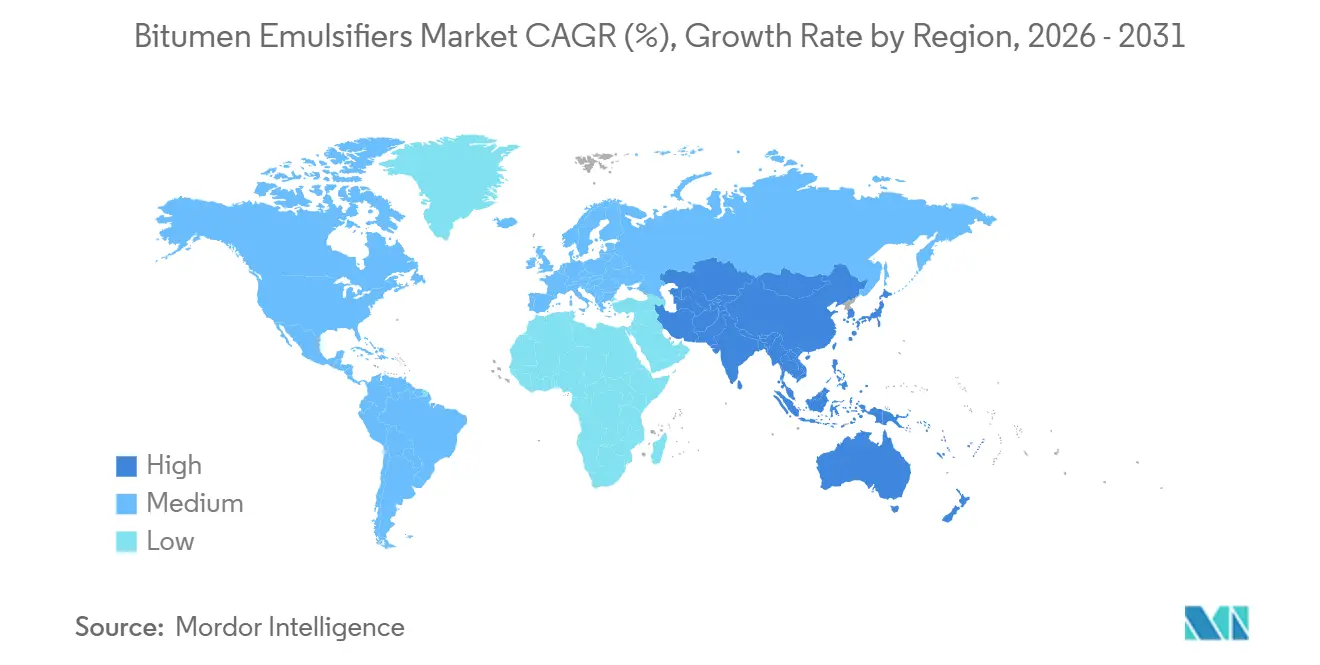
Asia-Pacific accounted for 48.53% of global market value in 2025 and is forecast to grow at a CAGR of 6.68% through 2031. China's CNY 3.67 trillion (USD 0.54 trillion) in transport investment in 2025 supported a total road network exceeding 5.5 million km. India imported 35-36% of its bitumen requirement in FY25, increasing exposure to supply disruptions affecting refinery-linked intermediates. Japan and South Korea are mature, maintenance-led markets that support demand for quick-setting and polymer-modified grades. Remote road maintenance needs further support for the bitumen emulsifiers market across the Asia-Pacific region.
North America Bitumen Emulsifiers Market
North America is supported by pavement preservation programs and road maintenance contracting. In July 2024, Nouryon entered a distribution agreement with Brenntag Specialties for asphalt additives in the United States. Through The Miller Group, Colas secured a seven-year road maintenance contract in the Durham region of Canada, which began in August 2026[2]. Multi-year contracts of this nature improve demand visibility for suppliers serving integrated road contractors, supporting continued demand for preservation materials.
EMEA and South America Bitumen Emulsifiers Market
Europe's market is shaped by aging road assets, environmental product declaration requirements, and decarbonization commitments. South America has growth potential for road programs, as tropical-climate conditions favor fast return-to-traffic maintenance methods. The Middle-East and Africa are emerging demand areas as road modernization expands beyond traditional Gulf infrastructure projects. In these regions, the bitumen emulsifiers market follows a different adoption path, as logistics, specifications, and contractor training remain decisive factors.
Competitive Landscape
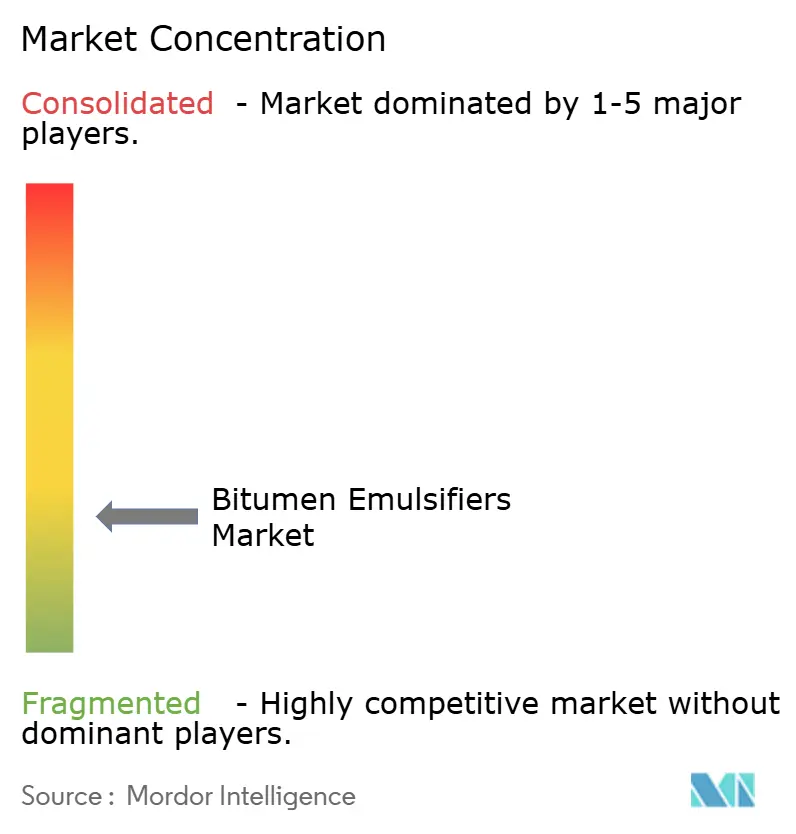
The bitumen emulsifiers market is fragmented. Arkema, BASF, Evonik, Nouryon, Croda, and Ingevity supply high-value surfactant formulations. Integrated road contractors, including Colas through McAsphalt and Continental Bitumen, also control downstream emulsion production capacity. Competition operates between chemistry suppliers seeking specification acceptance and emulsion producers competing for contractor supply contracts. Suppliers are focusing on bio-based feedstocks, environmental certification, and regional expansion.
Arkema is advancing its ArrMuls and Polyram portfolio toward bio-sourced formulations through its Ambition 2028 roadmap. BASF launched Butonal MB 5126 through a biomass-balance approach in June 2024, stating that the product achieved a 100% cradle-to-gate CO2 reduction under that approach. Product development and verified environmental claims are becoming clear ways to differentiate supplier offerings, particularly in public tenders that assess environmental performance alongside technical suitability.
Amphoteric emulsifiers for high-polymer applications remain a specialized category without a dominant supplier. Bio-based formulations can widen the feedstock options available to producers while maintaining application performance. Smaller suppliers such as Zydex Group, T-Pave International, and Petrochem Specialities are gaining traction in South and Southeast Asia through locally tailored formulations and responsive application support, a service model that global suppliers with centralized technical infrastructure find difficult to replicate.
Bitumen Emulsifiers Industry Leaders
-
Arkema
-
Nouryon
-
Ingevity
-
Evonik Industries AG
-
Kao Corporation
- *Disclaimer: Major Players sorted in no particular order
Bitumen Emulsifiers Market Companies Covered in this Report
- Arkema
- BASF
- Colas
- Croda International Plc
- Evonik Industries AG
- Ingevity
- Kao Corporation
- Macismo International Ltd
- Marathon Petroleum LP
- McAsphalt Industries Limited
- Nouryon
- Opal Paints Products Pvt. Ltd.
- Petrochem Specialities
- T-Pave International Pte Ltd
- Zydex Group
Recent Industry Developments in Bitumen Emulsifiers Market
- July 2026: Ingevity Corporation announced that its Evotherm P35 warm-mix additive received formal approval from Germany's Federal Highway Research Institute, making it eligible for use in federal road construction projects. The approval followed years of performance testing under real-world traffic and environmental conditions.
- April 2025: Colas, through its Canadian subsidiary The Miller Group, secured a seven-year road maintenance contract worth EUR 100 million (USD 108 million) with the Ontario Ministry of Transportation for the Durham region. The contract, effective August 2026, covers pavement repairs, shoulder maintenance, drainage, structures, and winter operations, and is expected to support sustained demand for emulsion-based pavement maintenance products.
Global Bitumen Emulsifiers Market Report Scope
Bitumen emulsifier is a chemical additive that enables oil-based bitumen to mix with water, forming a stable liquid mixture. It reduces surface tension, allowing fine bitumen particles to remain suspended in water without agglomeration.
The bitumen emulsifiers market is segmented by product type, setting type, application, end-user industry, and geography. By product type, the market is segmented into cationic emulsifiers, anionic emulsifiers, non-ionic emulsifiers, and amphoteric and specialty emulsifiers. By setting type, the market is segmented into rapid setting, medium setting, slow setting, and quick setting. By application, the market is segmented into surface treatment, mixing, waterproofing and roofing, industrial coatings and adhesives, and dust suppression and soil stabilization. By end-user industry, the market is segmented into road and highway construction, airport infrastructure, building and construction, industrial infrastructure, and other end-user industries. The report also covers market size and forecasts for bitumen emulsifiers across 16 countries in major regions. The market sizes and forecasts are provided in terms of value (USD).
Segmentation Overview
| Cationic Emulsifiers |
| Anionic Emulsifiers |
| Non-ionic Emulsifiers |
| Amphoteric and Specialty Emulsifiers |
| Rapid Setting |
| Medium Setting |
| Slow Setting |
| Quick Setting |
| Surface Treatment | Chip Seal |
| Tack Coat | |
| Prime Coat | |
| Fog Seal | |
| Mixing | Cold Mix Asphalt |
| Slurry Seal | |
| Micro-surfacing | |
| Cold In-place Recycling | |
| Full-depth Reclamation | |
| Waterproofing and Roofing | |
| Industrial Coatings and Adhesives | |
| Dust Suppression and Soil Stabilization |
| Road and Highway Construction |
| Airport Infrastructure |
| Building and Construction |
| Industrial Infrastructure |
| Other End-User Industries |
| Asia-Pacific | China |
| India | |
| Japan | |
| South Korea | |
| Rest of Asia-Pacific | |
| North America | United States |
| Canada | |
| Mexico | |
| Europe | Germany |
| United Kingdom | |
| France | |
| Italy | |
| Russia | |
| Rest of Europe | |
| South America | Brazil |
| Argentina | |
| Rest of South America | |
| Middle-East and Africa | Saudi Arabia |
| South Africa | |
| Rest of Middle-East and Africa |
| By Product Type | Cationic Emulsifiers | |
| Anionic Emulsifiers | ||
| Non-ionic Emulsifiers | ||
| Amphoteric and Specialty Emulsifiers | ||
| By Setting Type | Rapid Setting | |
| Medium Setting | ||
| Slow Setting | ||
| Quick Setting | ||
| By Application | Surface Treatment | Chip Seal |
| Tack Coat | ||
| Prime Coat | ||
| Fog Seal | ||
| Mixing | Cold Mix Asphalt | |
| Slurry Seal | ||
| Micro-surfacing | ||
| Cold In-place Recycling | ||
| Full-depth Reclamation | ||
| Waterproofing and Roofing | ||
| Industrial Coatings and Adhesives | ||
| Dust Suppression and Soil Stabilization | ||
| By End-User Industry | Road and Highway Construction | |
| Airport Infrastructure | ||
| Building and Construction | ||
| Industrial Infrastructure | ||
| Other End-User Industries | ||
| By Geography | Asia-Pacific | China |
| India | ||
| Japan | ||
| South Korea | ||
| Rest of Asia-Pacific | ||
| North America | United States | |
| Canada | ||
| Mexico | ||
| Europe | Germany | |
| United Kingdom | ||
| France | ||
| Italy | ||
| Russia | ||
| Rest of Europe | ||
| South America | Brazil | |
| Argentina | ||
| Rest of South America | ||
| Middle-East and Africa | Saudi Arabia | |
| South Africa | ||
| Rest of Middle-East and Africa | ||
Key Questions Answered in the Report
What is current market size of Bitumen Emulsifiers Market?
The Bitumen emulsifiers market size was estimated at USD 63.72 million in 2025 and is estimated to grow from USD 66.24 million in 2026 to USD 88.27 million by 2031, at a CAGR of 5.91% during the forecast period (2026-2031).
Which bitumen emulsifier product type led demand in 2025?
Cationic emulsifiers led with a 57.14% product-type share in 2025 due to their compatibility with common road aggregates.
Which setting type is growing fastest through 2031?
Quick-setting emulsifiers are projected to grow at a 6.81% CAGR, supported by overnight urban maintenance requirements.
Which region leads in global demand?
Asia-Pacific led with 48.53% of global value in 2025 and is forecast to grow at a 6.68% CAGR through 2031.