
Bioactive Peptides Market Size and Share
Market Overview
| Study Period | 2020 - 2031 |
|---|---|
| Market Size (2026) | USD 3.71 Billion |
| Market Size (2031) | USD 5.28 Billion |
| Growth Rate (2026 - 2031) | 7.31 % |
| Fastest Growing Market | Asia-Pacific |
| Largest Market | North America |
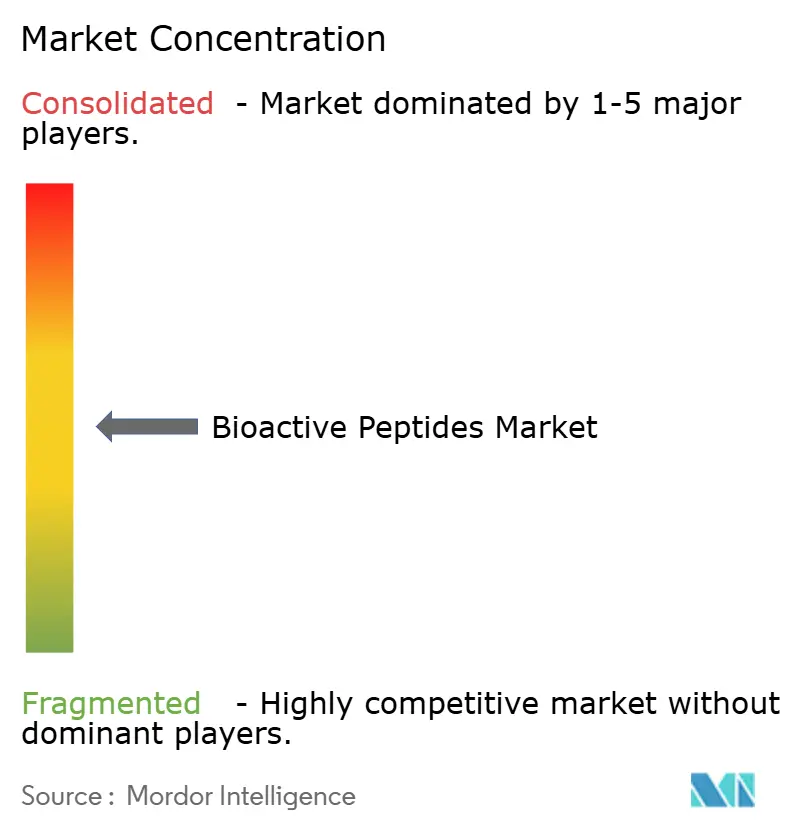
| Market Concentration | Medium |
Major Players *Disclaimer: Major Players sorted in no particular order Image © Mordor Intelligence. Reuse requires attribution under CC BY 4.0. | |
Bioactive Peptides Market Analysis by Mordor Intelligence
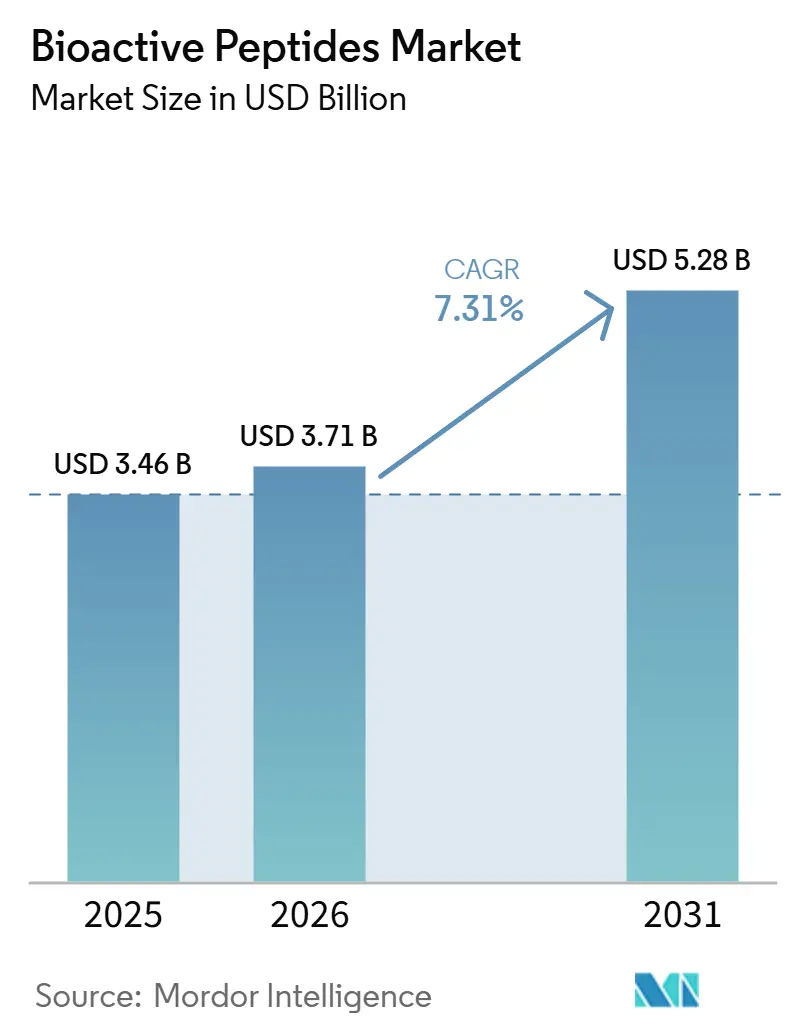
The Bioactive Peptides Market size is projected to be USD 3.46 billion in 2025, USD 3.71 billion in 2026, and reach USD 5.28 billion by 2031, growing at a CAGR of 7.31% from 2026 to 2031.
The bioactive peptides market is supported by demand for functional ingredients in food, nutraceutical, and pharmaceutical channels. Clinical work on cardiometabolic and metabolic outcomes gives manufacturers a stronger basis for product positioning. Aging populations also sustain interest in preventive nutrition rather than reactive treatment. Investment in therapeutic peptide manufacturing can lower production costs for food-grade products that use related synthesis and purification capabilities. The Bioactive Peptides Market nevertheless faces a difficult balance between proving bioactivity, preserving it through digestion, and meeting different regulatory requirements across regions, because each of these requirements can affect formulation choices, the type of evidence a supplier needs, the cost of production, and the timing of a regional launch.
Key Report Takeaways
- By source, animal-derived peptides held 42.31% share of global revenue in 2025, while synthetic and recombinant peptides are projected to grow at an 11.58% CAGR through 2031.
- By bioactivity and function, antihypertensive peptides held 34.24% of the bioactive peptides market share in 2025, while antidiabetic and DPP-IV-inhibitory peptides are projected to grow at a 9.22% CAGR through 2031.
- By form, powder held 38.14% share of global revenue in 2025, while liquid formulations are projected to grow at an 8.82% CAGR through 2031.
- By end user, food and beverage manufacturers held 35.65% share of end-user revenue in 2025, while CDMOs are projected to grow at a 10.95% CAGR through 2031.
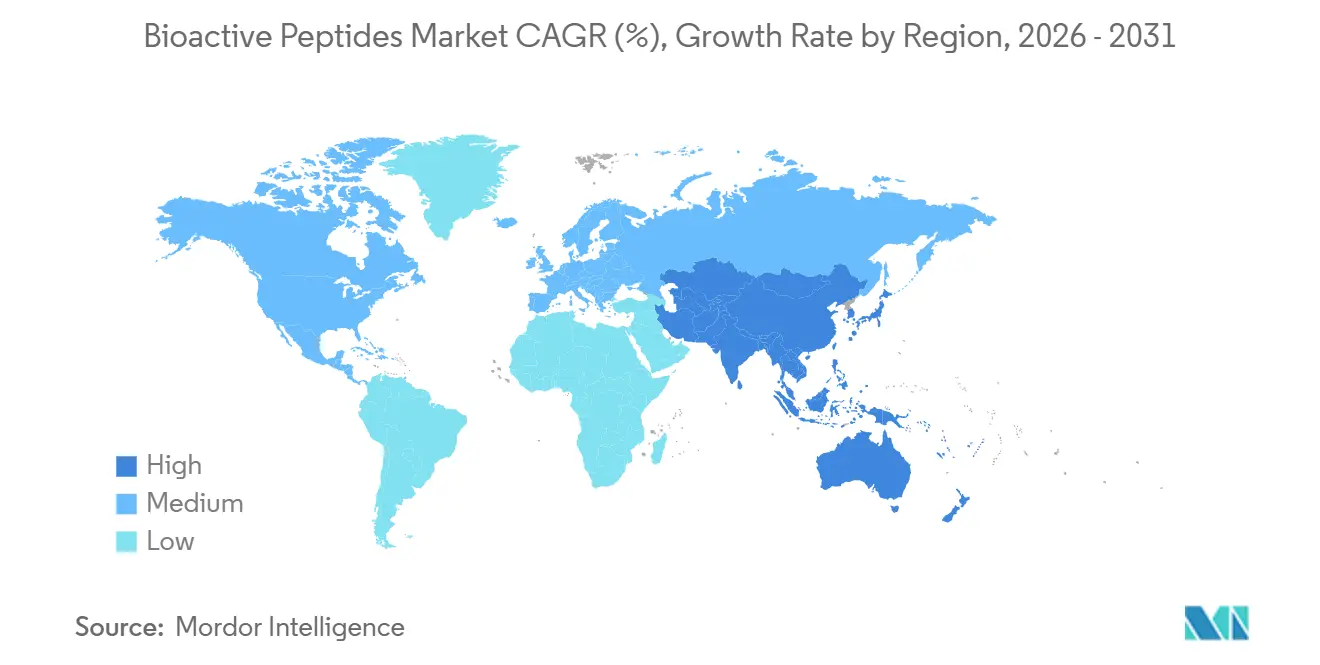
- By geography, North America held 37.61% of global revenue in 2025, while Asia-Pacific is projected to grow at an 8.25% CAGR through 2031.
Note: Market size and forecast figures in this report are generated using Mordor Intelligence’s proprietary estimation framework, updated with the latest available data and insights as of January 2026.
Market Trends and Insights
Drivers Impact Analysis of Bioactive Peptides Market*
| Driver | (~) % Impact on CAGR Forecast | Geographic Relevance | Impact Timeline |
|---|---|---|---|
| Expansion of Functional Foods and Nutraceuticals | +2.3% | Global, concentrated in North America, EU, and urban APAC | Medium term (2-4 years) |
| Rising Demand for Preventive Healthcare and Healthy Aging Solutions | +1.7% | North America, EU, Japan, South Korea | Long term (≥ 4 years) |
| Growth in Sports Nutrition and Medical Nutrition | +1.1% | North America, APAC urban centers, Europe | Medium term (2-4 years) |
| Advances in Enzymatic Hydrolysis, Purification and Peptide Synthesis | +0.9% | EU, North America, APAC, including India and China | Short term (≤ 2 years) |
| AI-Assisted Peptide Discovery and Bioactivity Prediction | +0.7% | North America, EU, APAC | Medium term (2-4 years) |
| Upcycling of Dairy, Marine and Agro-Industrial Protein Side Streams | +0.6% | EU, APAC, South America | Medium term (2-4 years) |
| Source: Mordor Intelligence | |||
Expansion of Functional Foods and Nutraceuticals
The Bioactive Peptides Market benefits as food companies seek sequence-specific ingredients with clinical support. Consumer demand is moving beyond generic protein supplements toward products associated with cardiometabolic, immune, and gut health. A 2025 review reported that food-derived peptides can influence glycemic control through IRS-1/PI3K/Akt activation and AMPK-mediated GLUT4 translocation[1]. The review also described effects involving adipokines, HMG-CoA reductase, and NF-κB/MAPK signaling. These multiple mechanisms allow fortified dairy, beverages, and bars to support more specific health positions. Suppliers that document the mechanism as well as the outcome can support higher-value contracts and longer supply relationships, particularly when branded food companies need evidence that can be used consistently in product development, technical discussions, and consumer-facing health positions.
Rising Demand for Preventive Healthcare and Healthy Aging Solutions
Aging populations in North America, Japan, and Western Europe support demand for peptides used in nutrition for sarcopenia, hypertension, and metabolic decline. A 2025 randomized, double-masked, placebo-controlled study of 114 prehypertensive and hypertensive participants found that HCP-C7C12 reduced systolic blood pressure by 9.41% and diastolic blood pressure by 9.53% over 8 weeks. The study also reported prebiotic-like microbiota effects and activation of pathways associated with butyrate production. This evidence links antihypertensive ingredients to metabolic benefits beyond blood pressure management. The bioactive peptides market, therefore, has a durable health-focused demand base in regions with older populations. ACE inhibition, microbiome effects, and endothelial function give the category relevance across several consumer health needs, allowing a single well-supported ingredient to be considered in products aimed at blood pressure, digestive health, healthy aging, and broader metabolic support.
Advances in Enzymatic Hydrolysis, Purification and Peptide Synthesis
Production advances are improving precision and reducing recurring costs in the Bioactive Peptides Market. A 2025 study reported an immobilized Alcalase that retained 50% catalytic activity after 7 reuse cycles and operated at temperatures up to 70°C and pH up to 12. A 2026 paper described Aqualigase, an engineered protease that enabled one-step peptide bond condensation in an aqueous phase without organic solvents and was applied to teriparatide synthesis. These methods address enzyme replacement and solvent disposal costs. Early adopters can use a lower cost per gram either to protect margins or offer more competitive ingredient pricing. Better production control also supports the consistent specifications required by food and clinical nutrition customers, where changes in peptide profile, taste, solubility, or stability can determine whether an ingredient can move from laboratory testing into a repeatable commercial formulation.
AI-Assisted Peptide Discovery and Bioactivity Prediction
AI-assisted discovery can shorten the path from a protein sequence database to a preclinical candidate. A 2024 review explained that machine-learning models trained on bioactivity data can predict peptide potency, selectivity, and toxicity before laboratory synthesis. This helps research teams prioritize candidates and use laboratory capacity more selectively. The bioactive peptides market can benefit when discovery programs identify compounds with clearer functional differentiation. The approach is relevant to food and pharmaceutical peptide research because each program begins with a broad set of possible sequences. It does not remove the need for clinical validation, regulatory work, or manufacturing scale-up. It can instead make those later investments more focused on the most promising candidates, helping research teams decide which sequences warrant synthesis, screening, formulation work, and the more demanding clinical and regulatory programs that are required before commercial use.
Restraints Impact Analysis of Bioactive Peptides Market*
| Restraint | (~) % Impact on CAGR Forecast | Geographic Relevance | Impact Timeline |
|---|---|---|---|
| High Production, Purification and Clinical-Validation Costs | -1.5% | Global | Short term (≤ 2 years) |
| Stringent Health-Claim, Novel-Food and Ingredient-Approval Requirements | -1.1% | EU, North America, and APAC | Medium term (2-4 years) |
| Bioactivity Loss Across Processing, Digestion and Storage Conditions | -0.8% | Global | Long term (≥ 4 years) |
| Fragmented Evidence Standards Across Food, Supplement and Pharmaceutical Channels | -0.6% | Global | Long term (≥ 4 years) |
| Source: Mordor Intelligence | |||
High Production, Purification and Clinical-Validation Costs
High-purity peptide production remains expensive across the separation, purification, and validation stages. A 2025 review found that high-performance liquid chromatography can achieve the required separation for pharmaceutical-grade purity but has capital and throughput constraints for large food-grade volumes. The review also noted that membrane fouling in ultrafiltration lowers processing efficiency and creates replacement costs. Clinical validation creates another investment requirement for a supplier seeking a supported health claim. These costs favor established ingredient companies that can fund clinical programs and maintain regulatory relationships. The Bioactive Peptides Market can therefore concentrate value among companies with broad portfolios that can support research across product cycles, absorb the cost of unsuccessful programs, and use established commercial relationships to place successful ingredients into multiple food, supplement, and clinical channels.
Stringent Health-Claim, Novel-Food and Ingredient-Approval Requirements
Regulatory pathways create substantial time-to-market pressure for novel peptide ingredients. Commission Implementing Regulation (EU) 2026/1427 authorized enzymatically produced egg membrane hydrolysate as a novel food in July 2026. EFSA's 2025 scientific opinion considered egg membrane collagen peptides under Regulation (EU) 2015/2283. The process illustrates the investment period that can separate discovery from approved claim language. Requirements vary among food, supplement, and pharmaceutical channels. A claim supported in one framework does not necessarily transfer to another framework. The bioactive peptides market must therefore manage approval planning as closely as formulation and production planning, since a technically sound ingredient can still face delayed revenue if its evidence package, intended use level, target consumer group, or claim wording does not match the relevant authority’s requirements.
*Our forecasts treat driver/restraint impacts as directional, not additive. The impact forecasts reflect baseline growth, mix effects, and variable interactions.
Bioactive Peptides Market Segment Analysis
By Source:
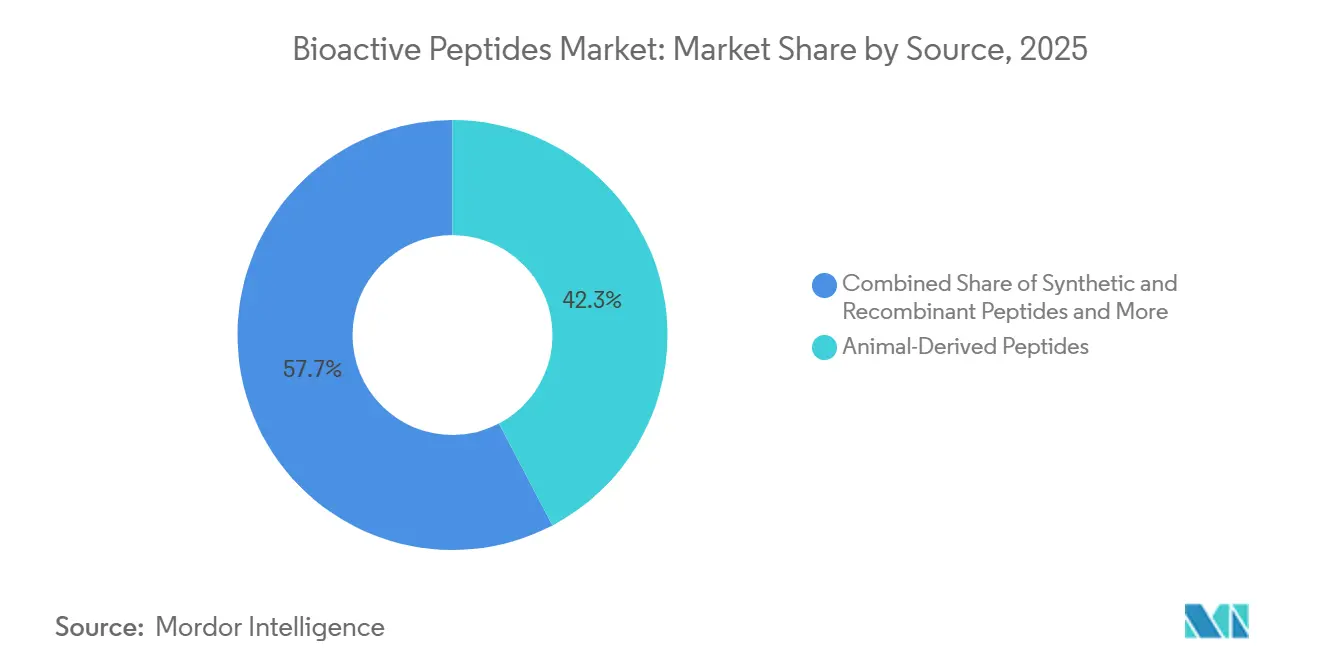
Animal-Derived Peptides Lead, but Synthetic Routes AccelerateAnimal-Derived Peptides held 42.31% share of global revenue in 2025, supported by established whey, casein, collagen, and gelatin supply chains. Dairy-derived IPP and VPP sequences from fermented milk have clinical evidence base for blood pressure outcomes. The evidence described systolic reductions of 5.0 mm Hg and diastolic reductions of 2.3 mm Hg in clinical meta-analyses. Plant-Derived Peptides are gaining attention from legumes, cereals, and seeds. Chickpea, rapeseed, and hemp proteins have been screened for ACE-inhibitory, DPP-IV-inhibitory, and antioxidant candidate sequences. Animal supply chains remain important because they offer mature raw material availability and established hydrolysis processes. At the same time, dairy and collagen producers can draw on familiar procurement systems, known protein fractions, and existing relationships with food and supplement formulators.
Marine-Derived Peptides use fish skin, bones, viscera, and crustacean shells that would otherwise have lower-value uses. Fish protein hydrolysates can contain 60-90% protein and essential amino acids associated with cardiovascular relevance. Microbial and Fermentation-Derived Peptides offer a separate route using food-grade substrates. Precision fermentation using Lactobacillus and Pediococcus can yield antioxidant, anti-inflammatory, and antidiabetic peptides. Synthetic and Recombinant Peptides represent the fastest-growing source category, with Bioactive Peptides Market size for this segment projected to expand at an 11.58% CAGR through 2031. Pharmaceutical CDMO capacity for solid-phase peptide synthesis supports this growth because investments in equipment, skilled personnel, purification capability, and quality systems can increase the availability of manufacturing resources that are relevant to specialized peptide production. A 2026 review described photocatalysis and electrochemistry as emerging routes that address earlier cost and sustainability limits.

By Bioactivity and Function:
Hypertension Dominates, Antidiabetic Sequences AccelerateAntihypertensive Peptides led this segment with 34.24% share in 2025. Dairy, marine, and plant sequences are supported by evidence around ACE inhibition and blood pressure outcomes. The Bioactive Peptides Market maintains demand for these products because hypertension has a large preventive-nutrition audience. Fractions below 3 kDa and fractions rich in phenylalanine, tryptophan, and tyrosine showed stronger radical-scavenging activity. Antimicrobial Peptides are also attracting pharmaceutical interest, because the search for new antimicrobial sequences extends beyond conventional bacterial sources and supports investigation of candidates with differentiated biological properties.
A 2025 study identified more than 12,000 putative archaeal antimicrobial peptides through deep-learning prediction[2]. Antidiabetic and DPP-IV-Inhibitory Peptides are the fastest-growing bioactivity category, with the Bioactive Peptides Market size for this segment projected to increase at a 9.22% CAGR through 2031. These peptides can support blood glucose control through CaSR-dependent GLP-1 secretion, DPP-4 inhibition, and inhibition of α-amylase and α-glucosidase. A 2025 review discussed enzymatic hydrolysis, fermentation, and encapsulation methods for placing DPP-IV-inhibitory peptides in functional foods without compromising bioactivity. Immunomodulatory and anti-inflammatory peptides serve the immunity-focused nutrition demand. At the same time, anticancer and neuroprotective sequences remain earlier-stage commercial opportunities that could become more relevant as clinical evidence, delivery systems, and regulatory pathways develop further.
By Form:
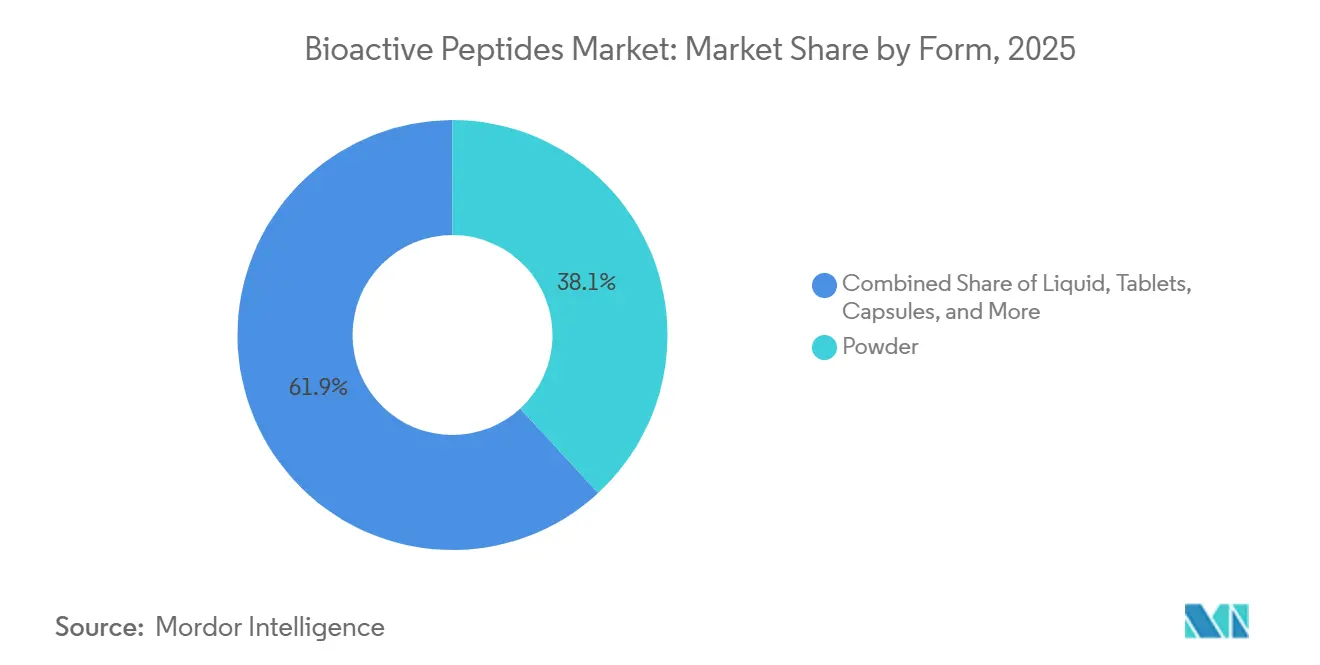
Powder Leads on Cost and Scale, Liquid Gains on Consumer ConveniencePowder accounted for 38.14% of global revenue in 2025. It is the preferred bulk format for many food and supplement manufacturers. Compatibility with spray drying and microencapsulation supports commercial use. Extended shelf stability and high protein concentration also suit ingredient trade. Tablets and capsules serve applications where dosage precision and defined serving sizes are important. Gels, oral films, and semi-solids have a premium role in cosmetic and bioactive applications, including collagen products for skin barrier and wound healing.
Liquid formulations are forecast to grow at an 8.82% CAGR through 2031, the highest rate among forms. Ready-to-drink sports nutrition and clinical nutrition demand formats that combine taste with adherence. Arla Foods Ingredients launched Lacprodan DI-3092 in December 2024, a whey protein hydrolysate with reduced bitterness, 10 g protein per 100 mL, and low viscosity. The product addressed a formulation barrier that had limited peptide use in medical nutrition. Improved taste masking and stability systems are widening the application range for liquid products. The Bioactive Peptides Market is thus gaining a route into premium consumer and clinical formats where powder is not the preferred delivery form, especially when a ready-to-drink product needs a smooth texture, acceptable viscosity, stable appearance, and a flavor profile that supports regular use.
By End User:
Food Manufacturers Lead, CDMOs Accelerate on Pharma TailwindsFood and Beverage Manufacturers held 35.65% share of end-user revenue in 2025. Their position reflects the role of functional food fortification and dairy ingredient innovation in creating demand. Dietary Supplement Companies are the second-largest customer group. Their demand is associated with branded products supported by clinical substantiation. Pharmaceutical and Biotechnology Companies increasingly seek custom and patent-eligible sequences rather than commodity hydrolysates. Cosmetic and Personal Care Manufacturers form another channel for collagen-derived functional peptides.
CDMOs are projected to grow at a 10.95% CAGR through 2031, making them the fastest-growing end-user group. Their demand is tied to outsourced manufacturing of therapeutic peptide active pharmaceutical ingredients. PolyPeptide Group stated 20-25% revenue growth guidance for 2026 at constant currency in its 2025 annual report. The company reported EUR 110 million (USD 126.9 million) in capital expenditure in 2025 for capacity development. Shared purification, lyophilization, and GMP infrastructure can potentially be used by nutraceutical-grade producers at incremental cost. This connection gives the Bioactive Peptides Market an indirect supply-side benefit from therapeutic peptide investment. However, food-grade producers still need to meet their own specifications, volume requirements, cost targets, and regulatory obligations for their intended applications.
Geography Analysis
North America Bioactive Peptides Market
North America held 37.61% of the global Bioactive Peptides Market revenue in 2025. High willingness to pay for clinically supported ingredients, mature supplement retail, and established regulatory pathways support this position. A 2024 FDA confirmation allowed Arla Foods Ingredients’ whey protein hydrolysates to be used in infant formula for allergy management. This action reflects active regulatory engagement with ingredient innovation. Canada and Mexico are relevant distribution corridors for manufacturers with United States-centered supply chains, since regional production, warehousing, regulatory coordination, and established customer relationships can influence how quickly ingredient suppliers can serve adjacent North American markets.
Europe Bioactive Peptides Market
Europe is a major region where regulation shapes ingredient strategy as strongly as consumer demand. The EU Novel Food pathway under Regulation (EU) 2015/2283 functions as a quality screen and a barrier to entry. The July 2026 authorization of egg membrane hydrolysate gave Eggnovo SL a 5-year exclusivity under the Commission regulation[3]. Collagen peptides are important in the European supplement channel, where GELITA, Weishardt, and Rousselot are major suppliers. Italy and Spain offer growth opportunities for marine-derived peptides due to proximity to fishery by-product streams and European circular-bioeconomy incentives, which can encourage processors to move material from lower-value disposal pathways toward protein recovery, hydrolysis, and specialized functional ingredient uses.
APAC, MEA and South America Bioactive Peptides Market
Asia-Pacific has the fastest forecast growth, with the Bioactive Peptides Market size projected to rise at an 8.25% CAGR through 2031. China’s functional food sector, India’s sports and clinical nutrition demand, and Japan’s collagen demand under the FOSHU framework support regional growth. India specializes in cost-efficient solid-phase peptide synthesis, while China is expanding custom synthesis and precision fermentation. GCC demand for halal-certified ingredients supports the Middle East and Africa, while Brazil and Argentina provide soy, marine, and bovine protein inputs in South America. A 2026 review described fermentation and green extraction routes that convert South American agro-industrial coproducts into functional ingredients, indicating that agricultural and processing residues can support ingredient development when producers combine reliable feedstock access with suitable extraction, quality-control, and commercialization systems.
Competitive Landscape
The bioactive peptides market is moderately fragmented across dairy cooperatives, collagen specialists, agri-processing companies, pharmaceutical CDMOs, and peptide-discovery businesses. Fonterra, Arla Foods Ingredients, and FrieslandCampina operate in dairy-based inputs. GELITA, Rousselot, Nitta Gelatin, and Weishardt specialize in collagen ingredients. DSM-Firmenich, Kerry Group, ADM, and Roquette have broader food ingredient capabilities. PolyPeptide Group and CordenPharma operate in pharmaceutical peptide manufacturing. Nuritas reported a USD 42 million Series C funding round in December 2024 to expand its AI Magnifier platform and partnerships.
Darling Ingredients and Tessenderlo Group agreed in May 2025 to combine Rousselot and PB Leiner into Nextida. The proposed company was expected to have annual revenue of USD 1.5 billion and a capacity of 200,000 metric tons across 23 facilities. The transaction is anticipated to close in 2026, subject to regulatory approval. Its scale could influence supply terms for collagen peptides across food and pharmaceutical uses. This consolidation is most material in the collagen layer rather than across the whole bioactive peptides market due to a wide set of dairy, marine, plant, fermentation, pharmaceutical, and discovery participants with different technology bases and end-customer relationships. Large suppliers can use global procurement, formulation capabilities, and regulatory resources to defend established positions.
Marine-derived and microbial fermentation peptides remain areas where supply-chain development trails the available scientific and commercial interest. Integrated biorefinery models for fish-processing by-products can achieve more than 70% resource recovery and reduce emissions by 50-75% compared with conventional disposal. These models can support entrants that build sourcing and processing capabilities before larger firms standardize the category. PolyPeptide reported expansions in Malmö, Strasbourg, and Braine-l'Alleud, providing precision peptide manufacturing capacity for CDMO clients. Seagarden AS and Ingredia SA compete through specialized marine and dairy sourcing. Their focus can be defensible in specialty nutrition. Still, it may be exposed if larger CDMO-scale producers move further into food-grade ingredients, where scale, integrated manufacturing, broad customer access, and the ability to finance validation work may reshape pricing and the range of available product formats.
Bioactive Peptides Industry Leaders
-
Kerry Group plc
-
Arla Foods Ingredients Group P/S
-
dsm-firmenich AG
-
Fonterra Co-operative Group Limited
-
FrieslandCampina Ingredients
- *Disclaimer: Major Players sorted in no particular order
Bioactive Peptides Market Companies Covered in this Report
- Angel Yeast Co., Ltd.
- Archer Daniels Midland Company
- Arla Foods Ingredients Group P/S
- Corden Pharma International
- Darling Ingredients Inc.
- dsm-firmenich AG
- Fonterra Co-operative Group Limited
- FrieslandCampina Ingredients
- GELITA AG
- Genscript
- Glanbia plc
- Hilmar Ingredients
- Ingredia SA
- Kerry Group plc
- Nitta Gelatin Inc.
- Nuritas Limited
- PolyPeptide Group AG
- Roquette Freres
- Rousselot S.A.S.
- Seagarden AS
- Weishardt International
Recent Industry Developments in Bioactive Peptides Market
- July 2026: The European Commission issued Implementing Regulation (EU) 2026/1427, approving enzymatically produced egg membrane hydrolysate as a novel food for food supplements at up to 500 mg/day for adults. Eggnovo SL received exclusive EU marketing rights through July 2031.
- May 2026: GELITA AG launched CURADERM, a Bioactive Collagen Peptide for skin barrier function, wound healing, atopic-prone skin, and gum health, at Vitafoods Europe 2026 in Barcelona. The launch expands GELITA's BCP portfolio into wound care and dermatology-adjacent supplement claims.
Global Bioactive Peptides Market Report Scope
As per the scope of the report, bioactive peptides are specific protein fragments that, when released during digestion or food processing, exert beneficial effects on body functions and health. They can influence various physiological processes, such as lowering blood pressure, enhancing immune function, or acting as antioxidants.
The bioactive peptides market is segmented by source into animal-derived peptides, plant-derived peptides, marine-derived peptides, microbial and fermentation-derived peptides, and synthetic and recombinant peptides; by bioactivity and function into antihypertensive peptides, antioxidant peptides, antimicrobial peptides, anti-inflammatory peptides, antidiabetic and DPP-IV-inhibitory peptides, immunomodulatory peptides, and others; by form into powder, liquid, tablets, capsules, gels, oral films, and semi-solids, and other forms; by end user into food and beverage manufacturers, dietary supplement companies, pharmaceutical and biotechnology companies, cosmetic and personal care manufacturers, contract development and manufacturing organizations, and other end users; and by geography into North America, Europe, Asia-Pacific, Middle East and Africa, and South America. The market report also covers the estimated market sizes and trends for 17 countries across major regions globally. For each segment, the market size and forecast are provided in terms of value (USD).
Segmentation Overview
| Animal-Derived Peptides |
| Plant-Derived Peptides |
| Marine-Derived Peptides |
| Microbial and Fermentation-Derived Peptides |
| Synthetic and Recombinant Peptides |
| Antihypertensive Peptides |
| Antioxidant Peptides |
| Antimicrobial Peptides |
| Anti-Inflammatory Peptides |
| Antidiabetic and DPP-IV-Inhibitory Peptides |
| Immunomodulatory Peptides |
| Others |
| Powder |
| Liquid |
| Tablets |
| Capsules |
| Gels, Oral Films and Semi-Solids |
| Other Forms |
| Food and Beverage Manufacturers |
| Dietary Supplement Companies |
| Pharmaceutical and Biotechnology Companies |
| Cosmetic and Personal Care Manufacturers |
| Contract Development and Manufacturing Organizations |
| Other End users |
| North America | United States |
| Canada | |
| Mexico | |
| Europe | Germany |
| United Kingdom | |
| France | |
| Italy | |
| Spain | |
| Rest of Europe | |
| Asia-Pacific | China |
| Japan | |
| India | |
| Australia | |
| South Korea | |
| Rest of Asia-Pacific | |
| Middle East and Africa | GCC |
| South Africa | |
| Rest of Middle East and Africa | |
| South America | Brazil |
| Argentina | |
| Rest of South America |
| By Source | Animal-Derived Peptides | |
| Plant-Derived Peptides | ||
| Marine-Derived Peptides | ||
| Microbial and Fermentation-Derived Peptides | ||
| Synthetic and Recombinant Peptides | ||
| By Bioactivity and Function | Antihypertensive Peptides | |
| Antioxidant Peptides | ||
| Antimicrobial Peptides | ||
| Anti-Inflammatory Peptides | ||
| Antidiabetic and DPP-IV-Inhibitory Peptides | ||
| Immunomodulatory Peptides | ||
| Others | ||
| By Form | Powder | |
| Liquid | ||
| Tablets | ||
| Capsules | ||
| Gels, Oral Films and Semi-Solids | ||
| Other Forms | ||
| By End User | Food and Beverage Manufacturers | |
| Dietary Supplement Companies | ||
| Pharmaceutical and Biotechnology Companies | ||
| Cosmetic and Personal Care Manufacturers | ||
| Contract Development and Manufacturing Organizations | ||
| Other End users | ||
| By Geography | North America | United States |
| Canada | ||
| Mexico | ||
| Europe | Germany | |
| United Kingdom | ||
| France | ||
| Italy | ||
| Spain | ||
| Rest of Europe | ||
| Asia-Pacific | China | |
| Japan | ||
| India | ||
| Australia | ||
| South Korea | ||
| Rest of Asia-Pacific | ||
| Middle East and Africa | GCC | |
| South Africa | ||
| Rest of Middle East and Africa | ||
| South America | Brazil | |
| Argentina | ||
| Rest of South America | ||
Key Questions Answered in the Report
What is the projected size of the Bioactive Peptides Market by 2031?
The Bioactive Peptides Market is projected to reach USD 5.28 billion by 2031, from USD 3.71 billion in 2026, at a 7.31% CAGR. Demand is supported by functional food, nutraceutical, and pharmaceutical applications that seek clinically supported peptide ingredients.
Which source category leads bioactive peptide demand?
Animal-Derived Peptides led with 42.31% share in 2025, supported by established whey, casein, collagen, and gelatin supply chains. These sources have mature hydrolysis systems and familiar raw material availability for food and supplement manufacturers.
Which bioactive peptide application is growing fastest?
Antidiabetic and DPP-IV-Inhibitory Peptides are projected to grow at a 9.22% CAGR through 2031. Their appeal is linked to dietary mechanisms involving GLP-1 secretion, DPP-4 inhibition, and carbohydrate-digesting enzymes.
Why are liquid peptide formulations gaining traction?
Liquid formulations are projected to grow at an 8.82% CAGR through 2031 because ready-to-drink sports and clinical nutrition products require acceptable taste and stable performance. Better taste masking, low viscosity, and stability systems are expanding their use beyond conventional powder formats.
Which region is expected to grow fastest for bioactive peptides?
Asia-Pacific is projected to grow at an 8.25% CAGR through 2031, supported by demand in China, India, and Japan. China is expanding custom synthesis and precision fermentation, India has cost-efficient solid-phase peptide synthesis, and Japan has established collagen demand.