
Beryllium Hydroxide Market Size and Share
Market Overview
| Study Period | 2021 - 2031 |
|---|---|
| Market Size (2026) | USD 142.12 Million |
| Market Size (2031) | USD 179.23 Million |
| Growth Rate (2026 - 2031) | 4.75 % |
| Fastest Growing Market | Asia-Pacific |
| Largest Market | North America |
| Market Concentration | High |
Major Players *Disclaimer: Major Players sorted in no particular order Image © Mordor Intelligence. Reuse requires attribution under CC BY 4.0. | |
Beryllium Hydroxide Market Analysis by Mordor Intelligence
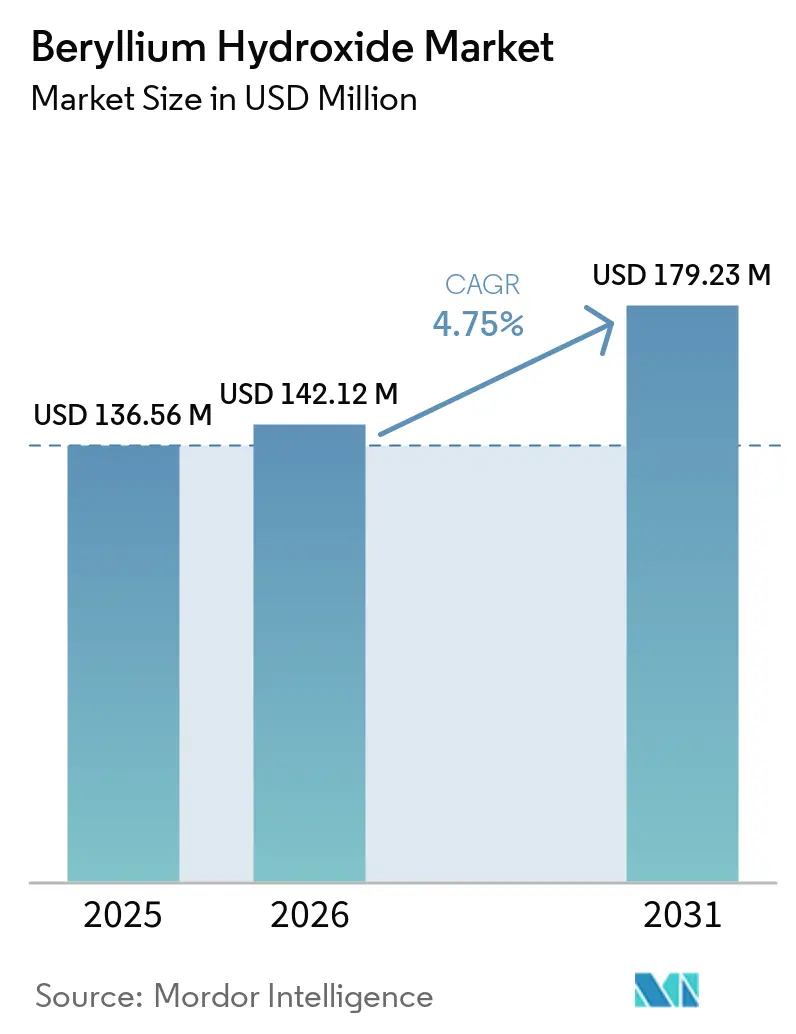
The Beryllium hydroxide market size was valued at USD 136.56 million in 2025 and is estimated to grow from USD 142.12 million in 2026 to USD 179.23 million by 2031, at a CAGR of 4.75% during the forecast period (2026-2031). Beryllium hydroxide sits at the start of the beryllium value chain, as it is converted into metal, oxide ceramics, and copper alloys. This position ties its demand to broader applications of beryllium in defense, electronics, space systems, and precision industrial uses. Supply remains concentrated, with estimated refined beryllium production of 360 metric tons in 2024, including 180 metric tons in the United States and 77 metric tons in China. Customer-funded capacity investment and increased scrap recovery could support supply continuity, while exposure controls and limited refining capacity continue to restrict new market entrants. The beryllium hydroxide market also benefits when design requirements make thermal conductivity, stiffness, electrical insulation, or fatigue resistance difficult to replace with lower-cost materials.
Key Report Takeaways
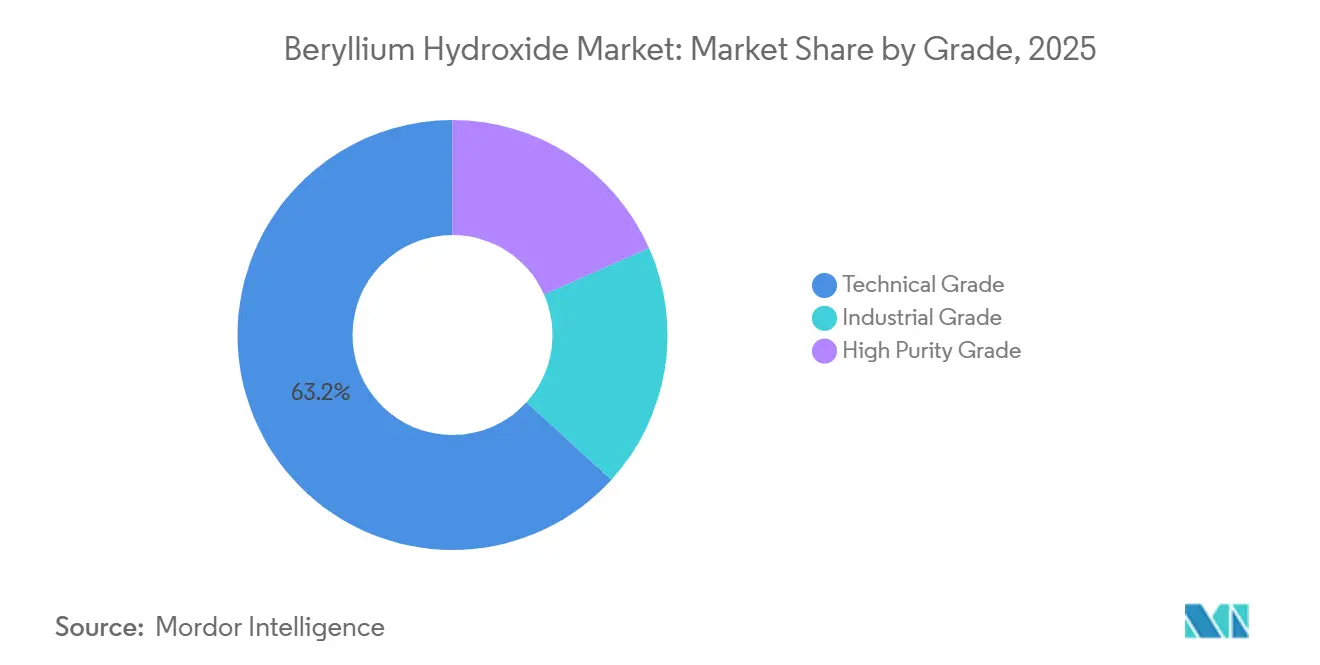
- By grade, Technical Grade held 63.25% of the Beryllium hydroxide market share in 2025 and is forecast to grow at a CAGR of 5.22% through 2031.
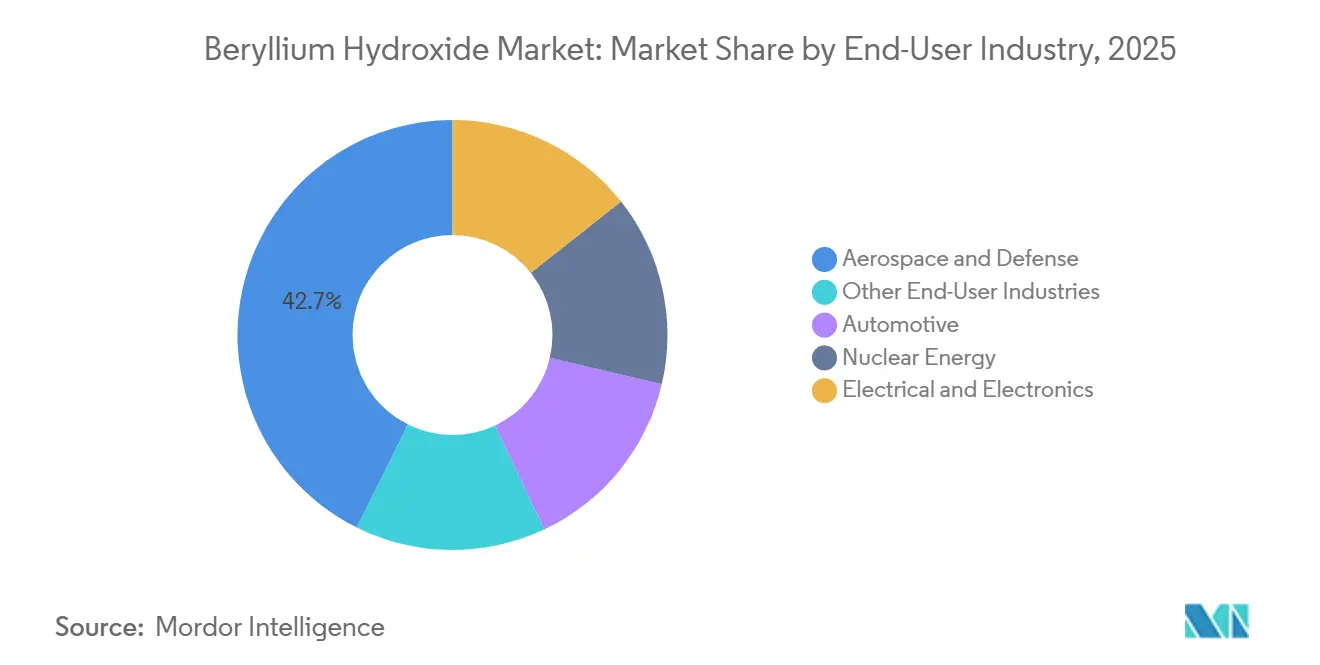
- By end-user industry, Aerospace and Defense accounted for 42.67% of the Beryllium hydroxide market share in 2025, while Electrical and Electronics is forecast to grow at a CAGR of 5.67% through 2031.
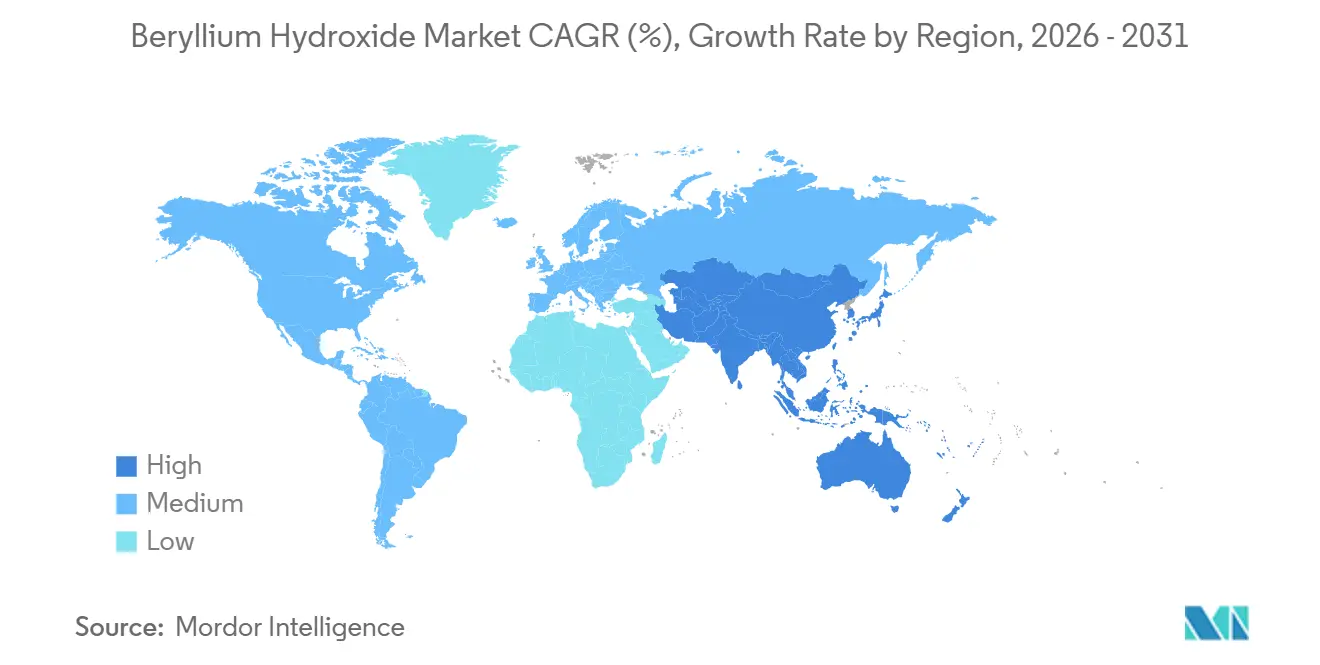
- By geography, North America held 41.46% of the Beryllium hydroxide market share in 2025, while Asia-Pacific is forecast to grow at a CAGR at 5.43% through 2031.
Note: Market size and forecast figures in this report are generated using Mordor Intelligence’s proprietary estimation framework, updated with the latest available data and insights as of January 2026.
Market Trends and Insights
Drivers Impact Analysis of Beryllium Hydroxide Market*
| Drivers | (~) % Impact on CAGR Forecast | Geographic Relevance | Impact Timeline |
|---|---|---|---|
| Electronics Miniaturization and High-Power Thermal Management | +1.1% | Global, with the highest intensity in Asia-Pacific and North America | Medium term (2-4 years) |
| Aerospace and Defense Lightweight Precision Systems | +1.3% | North America, Europe | Long term (≥ 4 years) |
| Electric Vehicle and Charging-Connector Demand | +0.8% | Asia-Pacific, Europe | Medium term (2-4 years) |
| 5G, radar, and High-Frequency Communications Build-Out | +0.7% | Asia-Pacific core, with spillover to North America, the Middle East, and Africa | Short term (≤ 2 years) |
| Closed-Loop Recovery from Beryllium-Bearing Scrap | +0.4% | North America, Europe, Japan | Long term (≥ 4 years) |
| Source: Mordor Intelligence | |||
Electronics Miniaturization and High-Power Thermal Management
The beryllium hydroxide market serves thermal management applications that use beryllium oxide ceramics. Smaller transistor nodes and higher server rack power densities increase heat management requirements in constrained spaces. Beryllium oxide offers thermal conductivity of 260 W/(m·K) and electrical insulation, compared with 25-35 W/(m·K) for alumina alternatives. These properties support its use where conventional heat spreaders cannot meet thermal and space requirements. Electronics and communications represented Chinese beryllium demand in 2024, supported by new energy vehicle power electronics, graphics processing unit (GPU) thermal modules, and high-power semiconductor substrates. Research published in 2025 demonstrated beryllium extraction from processing sludge, which provides a secondary feedstock route as ceramic fabrication expands.
Aerospace and Defense Lightweight Precision Systems
The beryllium hydroxide market supports applications that require high stiffness at low weight and stable performance under heat. Beryllium is 40% stiffer than steel at one-third of its density, supporting structural, optical, and thermal applications. SAE International revised AMS7906E, AMS7902H, and AMS4511B specifications in May 2025, with tighter requirements for purity, homogeneity, and mechanical reliability. These changes align with requirements for hypersonic vehicles, spacecraft structures, and precision optical systems. Materion stated that its AlBeMet aluminum-beryllium composites have been used in more than 150 satellites in orbit. Its aerospace and defense business reported record quarterly sales in Q2 2026, while new defense orders totaled USD 140 million.
Electric Vehicle and Charging-Connector Demand
The beryllium hydroxide market supplies the feedstock used in beryllium copper for charging connectors and vehicle electronics. Beryllium copper retains spring performance and electrical conductivity after more than 50,000 plug-unplug cycles. NGK Berylco identifies conductivity, fatigue resistance, formability, and miniaturization potential as relevant properties for charging terminals and connectors[1]. Battery management systems also use spring contacts for cell sensing, balancing, and protection. Higher charging power increases heat at contact interfaces, raising the importance of thermal management. This application remains relevant even as battery chemistries and vehicle platforms change.
5G, radar, and High-Frequency Communications Build-Out
The beryllium hydroxide market supports the production of beryllium copper components used in high-frequency connectors and spring contacts. Beryllium copper combines 70% International Annealed Copper Standard (IACS) electrical conductivity with fatigue resistance and fine surface quality. These characteristics are important above 6 GHz, where conductor surface quality and dimensional stability affect insertion loss. Millimeter-wave 5G systems operating above 24 GHz use smaller connector geometries and tighter tolerances than sub-6 GHz systems. Military radar modernization draws on the same high-purity feedstock base used for high-frequency communications components. This overlap increases demand for high-purity and industrial-grade material rather than allowing a shift to lower grades.
Restraints Impact Analysis of Beryllium Hydroxide Market*
| Restraints | (~) % Impact on CAGR Forecast | Geographic Relevance | Impact Timeline |
|---|---|---|---|
| Chronic Beryllium Disease and Exposure-Control Cost | -0.9% | Global, with the highest compliance burden in North America and Europe | Long term (≥ 4 years) |
| Highly Concentrated Ore and Refining Capacity | -0.8% | Global | Long term (≥ 4 years) |
| Qualification Delays for Safety-Critical Components | -0.6% | North America, Europe | Medium term (2-4 years) |
| Source: Mordor Intelligence | |||
Chronic Beryllium Disease and Exposure-Control Cost
The beryllium hydroxide market faces high compliance costs due to occupational exposure risks associated with beryllium processing. OSHA sets a permissible exposure limit of 0.2 µg/m³ over an 8-hour time-weighted average and a short-term limit of 2.0 µg/m³ over 15 minutes. New facilities require enclosed processing systems, high-efficiency particulate air filtration, exposure monitoring, medical surveillance, and recordkeeping. These requirements increase the initial capital investment for hydroxide refining and alloy processing. OSHA estimated that 62,000 U.S. workers across 7,300 establishments are at risk of beryllium exposure. The International Agency for Research on Cancer (IARC) Group 1 classification, along with associated legal and insurance liabilities, further discourages the development of new Western refining capacity.
Highly Concentrated Ore and Refining Capacity
The beryllium hydroxide market depends on a small number of refining centers, making supply disruption a material risk. The principal processing base includes Materion's Elmore, Ohio operation, the Ulba Metallurgical Plant in Kazakhstan, and Chinese producers. Kazakhstan supplied 39% of the United States beryllium imports during 2020-2023, while Latvia and Japan processed imported feedstocks rather than operating as independent ore suppliers. U.S. apparent consumption rose from 144 metric tons in 2023 to 170 metric tons in 2024, reflecting procurement cycles within a small buyer base. Beryllium oxide and hydroxide face a 3.7% U.S. import tariff, while unwrought beryllium metal faces an 8.5% tariff. Safety-critical applications also require long qualification cycles, which slow the adoption of new suppliers even when material is available in the beryllium hydroxide market.
*Our forecasts treat driver/restraint impacts as directional, not additive. The impact forecasts reflect baseline growth, mix effects, and variable interactions.
Beryllium Hydroxide Market Segment Analysis
By Grade:
Technical Grade Leads in Quantity While High Purity Grade Holds Strategic ValueTechnical Grade accounted for 63.25% of the beryllium hydroxide market share in 2025 and is projected to record a 5.22% CAGR through 2031. This combination of scale and growth reflects its role in copper-beryllium alloy fabrication, which accounted for 80% of total beryllium consumption. Technical Grade provides a cost-efficient feedstock with manageable impurity tolerances. Its demand extends to electronics, automotive, and defense connector applications, and the beryllium hydroxide industry depends on this broad alloy cycle for commercial output.
Industrial Grade supports ceramic substrates, moderately demanding electronic packaging, and some nuclear applications within the beryllium hydroxide market. High Purity Grade is in smaller quantities but commands the highest unit price. Beryllium metal is required for defense optics, inertial guidance systems, and nuclear reflector components, and its demand varies with the number of active government programs. SAE International's (SAE) 2025 revision of AMS4511B introduced tighter compositional controls for aerospace alloy castings. The average value of beryllium-copper master alloy increased from USD 660 per kilogram of contained beryllium in 2022 to USD 1,400 in 2023 and USD 1,500 in 2024.

By End-User Industry:
Aerospace and Defense Leads by Value, While Electrical and Electronics Defines the Growth CurveAerospace and Defense accounted for 42.67% of the beryllium hydroxide market size in 2025. Applications include inertial guidance systems, satellite structures, military optical platforms, and missile defense interceptors. Materion lists AlBeMet qualifications to AMS 7911, 7912, and 7913, with identified use in the F-35 Lightning II, F-16, and Boeing AH-64 Apache. SAE's 2025 specification updates align with tighter requirements for hypersonic vehicles and precision systems. Nuclear energy also uses high-purity grade for moderator and reflector components. A 2025 study described a chlorination-based pathway for decontaminating irradiated beryllium reflectors, which could support material reclamation during refurbishment.
Electrical and Electronics is projected to expand at a 5.67% CAGR through 2031, the fastest end-user growth rate in the beryllium hydroxide market. Demand comes from beryllium oxide substrates, spring contacts, and thermal management ceramics used in power conversion systems. Beryllium oxide offers a thermal conductivity of 260 W/(m·K) for applications that also require electrical insulation. IBC Advanced Alloys reported a 5.7% revenue increase in its copper alloys division for Q1 2026, supported by defense and adjacent electronics demand. Automotive demand is increasingly tied to new energy vehicle powertrain components rather than internal-combustion applications. Other end-use industries contribute demand through specialized industrial products.
Geography Analysis
North America Beryllium Hydroxide Market
North America accounted for 41.46% of the beryllium hydroxide market share in 2025. The United States is central to the region, as Materion operates an integrated supply chain from the Spor Mountain mine in Utah to alloy and ceramics production in Ohio. A major U.S. defense contractor committed USD 65 million to capacity expansion at two Materion facilities, with additional capacity expected to come online starting in 2028. U.S. imports declined from 39 metric tons in 2022 to 20 metric tons in 2024, indicating greater domestic self-sufficiency[2]. Materion also entered into a multiyear agreement with Commonwealth Fusion Systems in 2025 for advanced materials to support fusion energy research.
APAC Beryllium Hydroxide Market
Asia-Pacific is forecast to grow at a 5.43% CAGR through 2031, the fastest regional growth rate in the beryllium hydroxide market. China, Japan, and South Korea have interconnected demand across electronic materials and downstream fabrication. China produced 77 metric tons of beryllium in 2024 but remained short of its downstream processing and fabrication needs. Japan refines imported feedstocks and produces beryllium copper strip for charging terminals and telecommunications connectors. Materion expanded its semiconductor manufacturing presence in South Korea through a 2025 acquisition. This regional network supports demand for electronic materials and higher-specification feedstock.
EMEA and South America Beryllium Hydroxide Market
Europe, South America, the Middle East, and Africa account for the remaining demand in the beryllium hydroxide market, each serving specialized regional needs. European consumption centers on precision aerospace components, beryllium copper electronics, and specialized industrial tooling, with Germany, France, and the Nordic countries representing the main demand centers. European copper-beryllium scrap has a 30-40% closed-loop recovery rate, processed through facilities in Japan and the United States. South American demand is primarily driven by mineral processing and defense procurement in Brazil. Demand in the Middle East and Africa is tied to energy infrastructure in Saudi Arabia and defense modernization in South Africa.
Competitive Landscape
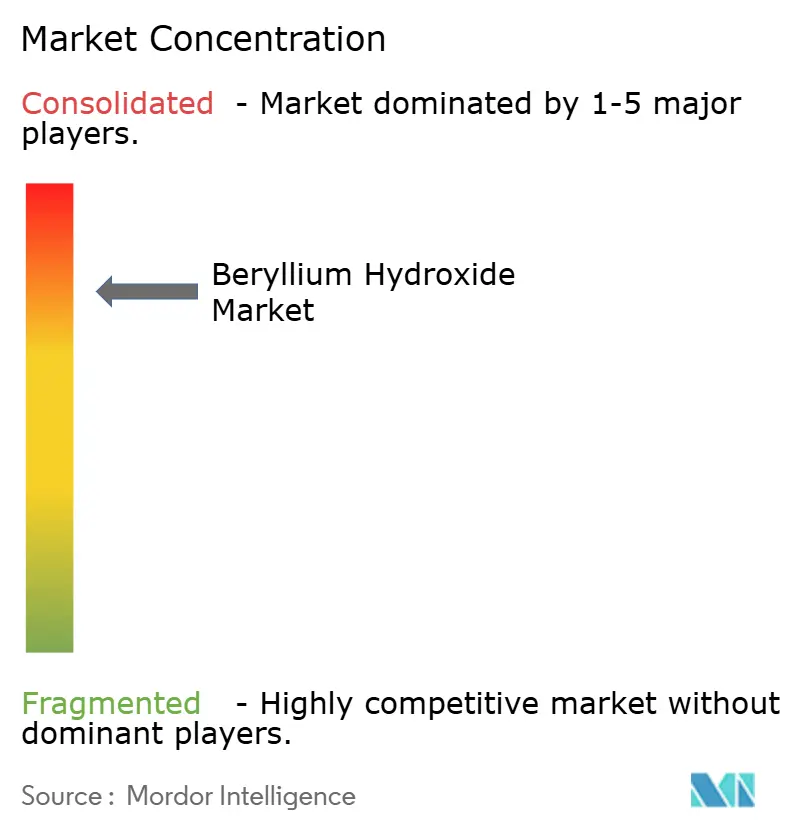
The beryllium hydroxide market is consolidated. Materion operates the only fully integrated Western supply chain, from ore to finished beryllium products. The company held 65% of global primary production capacity as of the annual report reference date for 2025. Ulba Metallurgical Plant and Chinese producers form the main non-Western refining base. Materion's adjusted EBITDA reached USD 71.8 million in Q2 2026, equal to 23.3% of value-added sales.
Primary producers compete on supply security and product specifications. IBC Advanced Alloys and NGK Metals compete through alloy conversion and customer-specific product capabilities. Chinese producers focus on technical-grade material for domestic fabrication. Materion's USD 65 million customer-funded capacity project ties future production to defense demand. Its multi-year fusion-materials agreement extends the company's presence into an emerging energy application. The acquisition in South Korea further positions the company closer to Asian semiconductor customers.
Secondary hydroxide recovery, fusion-energy applications, and specialty oxide ceramics remain areas for development in the beryllium hydroxide market, particularly where supply assurance is important. The end-of-life recycling rate was 19%, compared with 40% for the leading producer's production scrap. Electrochemical refining research offers a possible route for secondary processors. Aerospace suppliers require Nadcap accreditation and certification to ISO 9001:2015 and AS 9100D. These requirements protect established suppliers and lengthen qualification timelines. The beryllium hydroxide market, therefore, combines high upstream concentration with differentiated downstream capabilities.
Beryllium Hydroxide Industry Leaders
-
MATERION CORPORATION
-
Ulba Metallurgical Plant JSC
-
Hunan Pirna Industry Co.,Ltd
-
China Minmetals Corporation
-
Emeishan Zhongshan New Material Co., Ltd.
- *Disclaimer: Major Players sorted in no particular order
Beryllium Hydroxide Market Companies Covered in this Report
- Advanced Industries International
- American Beryllia Inc.
- American Elements
- Belmont Metals
- Brush Wellman Inc.
- China Minmetals Corporation
- Emeishan Zhongshan New Material Co., Ltd.
- Hunan Pirna Industry Co.,Ltd
- IBC Advanced Alloys
- MATERION CORPORATION
- NGK Metals
- Shanghai Xinglu Chemical Technology Co., Ltd.
- Stanford Advanced Materials
- Ulba Metallurgical Plant JSC
- Xinjiang Nonferrous Metal Industry Group
Recent Industry Developments in Beryllium Hydroxide Market
- February 2026: Materion received a USD 65 million customer-funded capital expenditure from a major U.S. defense prime to expand beryllium capacity at two facilities, supporting defense inventory replenishment and capability enhancement. Additional capacity is expected online from 2028, marking a shift from transactional procurement to supply-security co-investment.
- May 2025: SAE International released revised aerospace material specifications AMS7906E (beryllium bars, rods, tubing, and shapes) and AMS7902H (beryllium sheet and plate, 98Be), with stricter purity, homogeneity, and mechanical property requirements for hypersonic vehicle programs, spacecraft structural components, and precision optical systems. These revisions reflect five-year periodic reviews accelerated by new program requirements. The specifications rely on beryllium hydroxide as the primary intermediate in downstream beryllium material production.
Global Beryllium Hydroxide Market Report Scope
Beryllium hydroxide is a white, crystalline chemical compound. It exhibits amphoteric properties, meaning it reacts with both acids and bases. The compound is primarily used as an intermediate in the production of beryllium metal and beryllium oxide, which find applications across industries such as aerospace, defense, and electronics.
The beryllium hydroxide market is segmented by grade, end-user industry, and geography. By grade, the market is segmented into technical grade, industrial grade, and high purity grade. By end-user industry, the market is segmented into aerospace and defense, automotive, nuclear energy, electrical and electronics, and other end-user industries. The report also covers market size and forecasts for beryllium hydroxide across 15 countries in major regions. The market sizes and forecasts are provided in terms of value (USD).
Segmentation Overview
| Technical Grade |
| Industrial Grade |
| High Purity Grade |
| Aerospace and Defense |
| Automotive |
| Nuclear Energy |
| Electrical and Electronics |
| Other End-User Industries |
| Asia-Pacific | China |
| India | |
| Japan | |
| South Korea | |
| ASEAN Countries | |
| Rest of Asia-Pacific | |
| North America | United States |
| Canada | |
| Mexico | |
| Europe | Germany |
| United Kingdom | |
| France | |
| Italy | |
| NORDIC Countries | |
| Rest of Europe | |
| South America | Brazil |
| Argentina | |
| Rest of South America | |
| Middle East and Africa | Saudi Arabia |
| South Africa | |
| Rest of Middle East and Africa |
| By Grade | Technical Grade | |
| Industrial Grade | ||
| High Purity Grade | ||
| By End-User Industry | Aerospace and Defense | |
| Automotive | ||
| Nuclear Energy | ||
| Electrical and Electronics | ||
| Other End-User Industries | ||
| By Geography | Asia-Pacific | China |
| India | ||
| Japan | ||
| South Korea | ||
| ASEAN Countries | ||
| Rest of Asia-Pacific | ||
| North America | United States | |
| Canada | ||
| Mexico | ||
| Europe | Germany | |
| United Kingdom | ||
| France | ||
| Italy | ||
| NORDIC Countries | ||
| Rest of Europe | ||
| South America | Brazil | |
| Argentina | ||
| Rest of South America | ||
| Middle East and Africa | Saudi Arabia | |
| South Africa | ||
| Rest of Middle East and Africa | ||
Key Questions Answered in the Report
What is current market size of Beryllium Hydroxide Market?
The Beryllium hydroxide market size was valued at USD 136.56 million in 2025 and is estimated to grow from USD 142.12 million in 2026 to USD 179.23 million by 2031, at a CAGR of 4.75% during the forecast period (2026-2031).
Which grade leads in beryllium hydroxide demand?
Technical Grade led with a 63.25% share in 2025 and is projected to grow at a 5.22% CAGR through 2031.
Which end-user application is growing fastest?
Electrical and Electronics is the fastest-growing end-user category, with a projected 5.67% CAGR through 2031.
Why is beryllium hydroxide used in electronics?
It is converted into beryllium oxide and beryllium copper for thermal management substrates, connectors, and spring contacts.