
Benzoates Market Size and Share
Market Overview
| Study Period | 2022 - 2032 |
|---|---|
| Market Size (2027) | USD 766.04 Billion |
| Market Size (2032) | USD 994.56 Billion |
| Growth Rate (2027 - 2032) | 5.36 % |
| Fastest Growing Market | North America |
| Largest Market | Asia-Pacific |
| Market Concentration | High |
Major Players *Disclaimer: Major Players sorted in no particular order Image © Mordor Intelligence. Reuse requires attribution under CC BY 4.0. | |
Benzoates Market Analysis by Mordor Intelligence
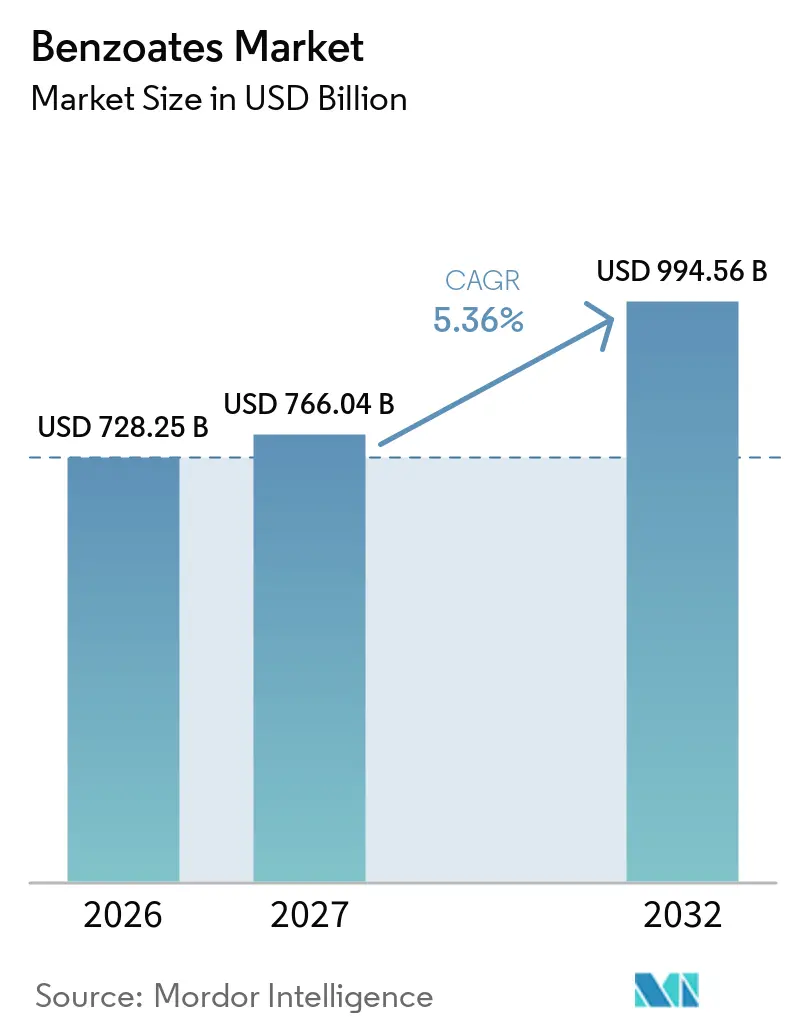
The Benzoates market size was valued at USD 728.25 million in 2026 and is estimated to grow from USD 766.04 million in 2027 to USD 994.56 million by 2032, at a CAGR of 5.36% during the forecast period (2027-2032). The benzoates market relies on the cost-effective preservation performance of sodium benzoate and potassium benzoate, particularly in acidic products. Food and beverage applications remain a significant driver of demand, but pharmaceutical oral liquids and water-rich personal care products are expanding the demand base. This broadens the benzoates market beyond packaged food categories, where demand is maturing in developed economies. Producers with reliable quality records, regulatory documentation, and diversified supply are better positioned to serve customers managing formulation and supplier requirements. Regulatory differences and trade measures are also increasing the value of regional production assets and compliant supply chains in the benzoates market.
Key Report Takeaways
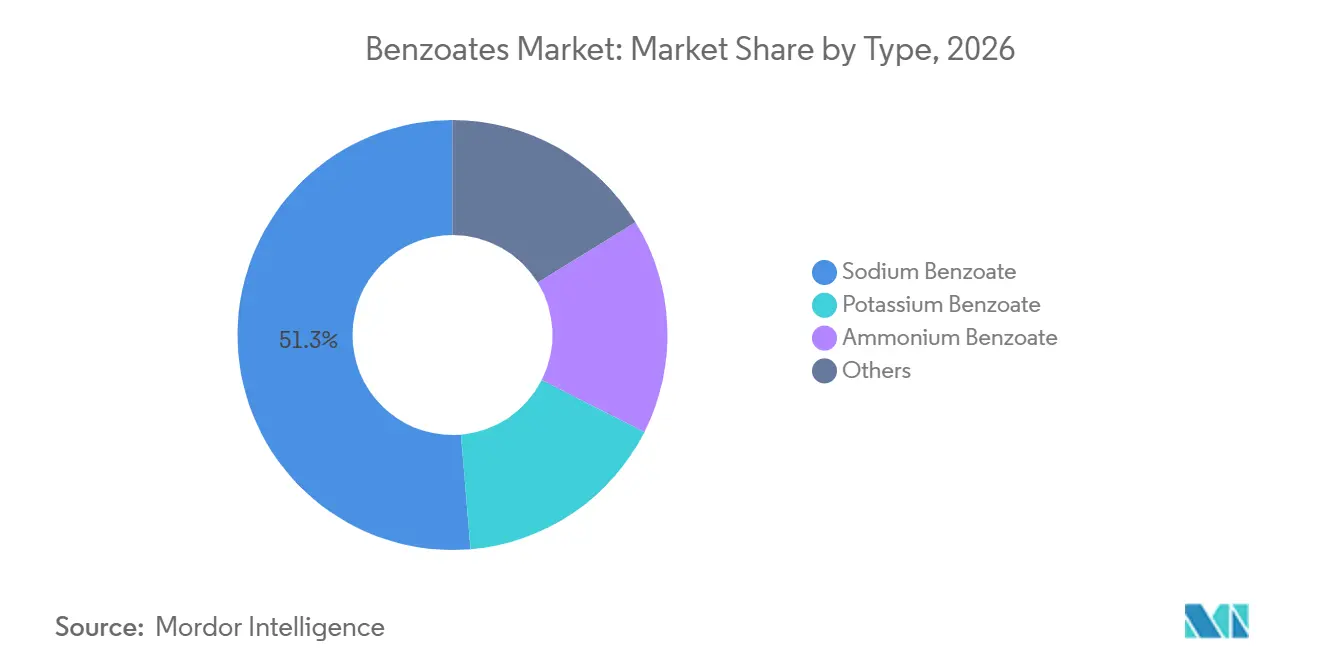
- By type, sodium benzoate held 51.34% of the Benzoates market share in 2026, while potassium benzoate is forecast to grow at a 5.94% CAGR through 2032.
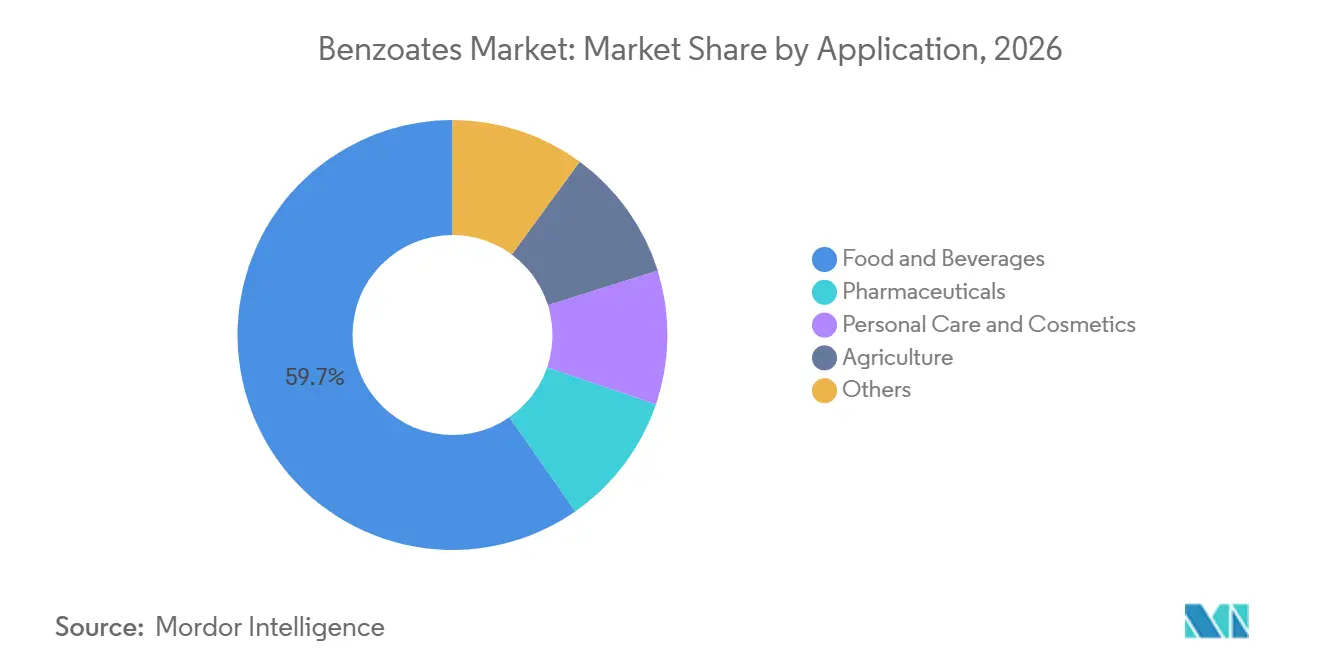
- By application, food and beverages accounted for 59.67% of the Benzoates market share in 2026, while personal care and cosmetics are forecast to expand at a 6.45% CAGR through 2032.
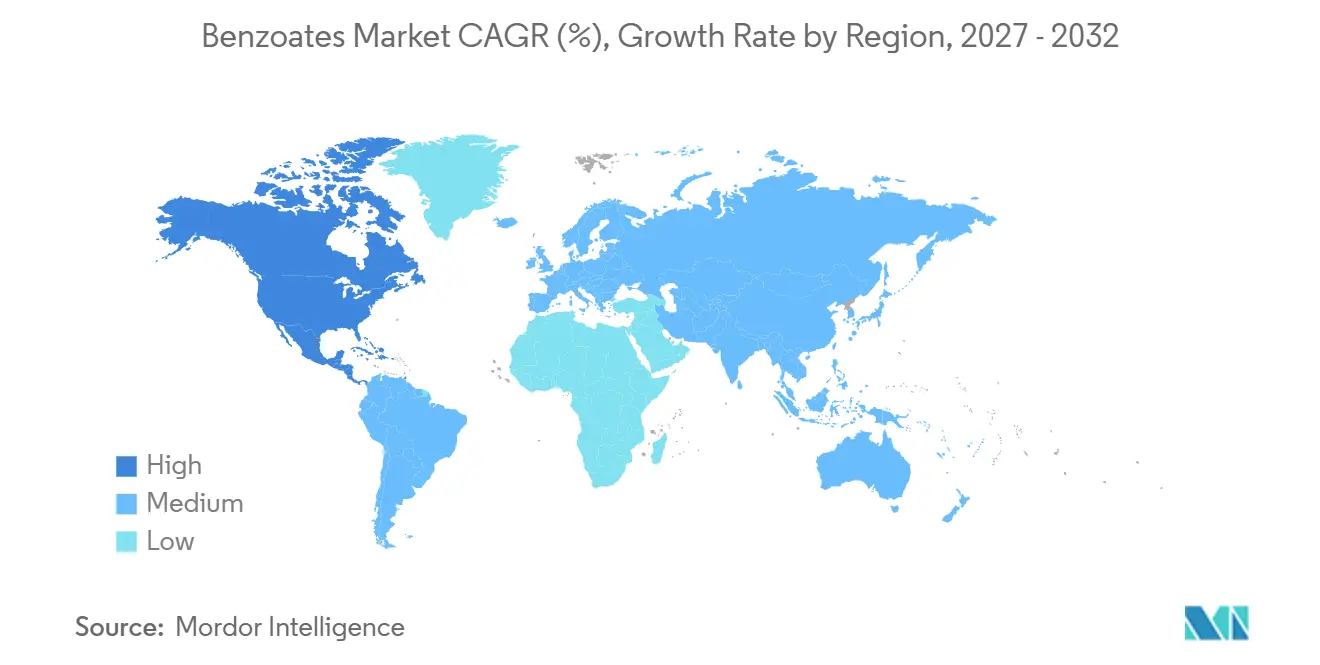
- By geography, Asia-Pacific accounted for 40.81% of the Benzoates market share in 2026, while North America is forecast to grow at a 6.12% CAGR through 2032.
Note: Market numbers in this report are based on Mordor Intelligence's proprietary estimation framework, which combines nine months of actuals with Q4 projections for base year 2026.
Market Trends and Insights
Drivers Impact Analysis of Benzoates Market*
| Drivers | (~) % Impact on CAGR Forecast | Geographic Relevance | Impact Timeline |
|---|---|---|---|
| Packaged and Shelf-stable Food and Beverage Expansion | +1.8% | Global, concentrated in Asia-Pacific and Latin America | Short term (≤ 2 years) |
| Low-pH Preservation Efficiency and Cost Advantage | +0.9% | Global, core for price-sensitive emerging markets | Short term (≤ 2 years) |
| Growth of Pharmaceutical Oral Liquids and Topical Formulations | +0.7% | Global, strongest in North America, EU, and South Asia | Medium term (2-4 years) |
| Rising Personal Care and Water-rich Cosmetic Formulations | +0.6% | APAC core, spillover to North America and EU | Medium term (2-4 years) |
| Emerging-market Processing and Distribution Formalization | +0.5% | Sub-Saharan Africa, South and Southeast Asia, Middle East and Africa (MEA) | Long term (≥ 4 years) |
| Source: Mordor Intelligence | |||
Packaged and Shelf-stable Food and Beverage Expansion
Centralized food production supports demand for preservatives that can protect products through long distribution periods, particularly where ingredients and finished products move through several distribution steps before retail sale. Acidic beverages and shelf-stable foods remain important outlets in the benzoate market because benzoates are effective under low-pH conditions and offer a familiar option for high-volume formulations. Lower-sugar product reformulation can reduce the microbial protection that sugar provides, increasing the need for other preservation measures in suitable beverage formulations and altering the preservation balance within the recipe. An estimated 237 million metric tons of unmet retail packaged food potential exists in Asia-Pacific, with India and Indonesia identified as major contributors for 2025 through 2029. This points to sustained use of shelf-life solutions as processors extend the distribution of packaged products, introduce new beverage variants, and seek consistent protection during ambient storage. Codex Alimentarius standards also support more consistent preservative controls for multinational food manufacturers operating across emerging-market facilities, simplifying internal ingredient specifications across plants.
Low-pH Preservation Efficiency and Cost Advantage
Sodium benzoate becomes biologically active as benzoic acid in acidic media, which supports its use in beverages and sauces where low pH allows the preservative system to function efficiently. Antimicrobial activity can be achieved at concentrations as low as 0.05% in appropriate formulations. Natural alternatives may require materially higher dosage levels and be less stable under processing conditions[1]. That performance profile keeps the benzoates market relevant where formulation cost, line efficiency, and consistent microbial control are central purchasing criteria. Higher procurement costs can still pressure buyers that lack scale or long-term supply agreements, particularly when they purchase merchant-grade inputs rather than integrated supply. Integrated producers are better positioned to manage this pressure due to a stronger link between upstream sourcing and finished-product supply, helping customers plan around supply availability and documented grade consistency.
Growth of Pharmaceutical Oral Liquids and Topical Formulations
Pharmaceutical oral liquids require preservatives that can be qualified for multi-dose applications and supported by established documentation throughout product development and commercial supply. Sodium benzoate is listed in the United States Pharmacopeia and European Pharmacopeia excipient frameworks, which can simplify supplier qualification for established products. U.S. patents filed on oral formulations use sodium benzoate at 1-2 mg/mL. Pediatric suspensions are a relevant route of administration because aqueous dosage forms require microbial control without materially affecting palatability or altering a medicine's intended administration characteristics. Established supply chains can support the analytical documentation required for multi-preservative systems under the International Council for Harmonization of Technical Requirements for Pharmaceuticals for Human Use (ICH) Q2(R2), including records that customers need for quality review. This gives the benzoates market a stable pharmaceutical outlet for suppliers that can provide traceability, consistent product specifications, and repeatable documentation across manufacturing sites.
Rising Personal Care and Water-rich Cosmetic Formulations
Water-rich emulsions, shampoos, conditioners, and cleansers require preservation systems that remain effective throughout the finished product's lifecycle, from manufacturing and packaging through normal consumer use. Potassium benzoate offers higher aqueous solubility, which supports its use in formulations where the preservative must disperse reliably in a water-based system. Rinse-off products can provide additional formulation scope under relevant EU and US requirements, which is relevant for shampoo, conditioner, and cleanser producers. Ashland markets Optiphen BSB-W as a blend containing sodium benzoate, potassium sorbate, and benzyl alcohol for personal care applications. Such multi-preservative approaches allow the benzoates market to participate in product lines that seek certification-compatible ingredient choices while still addressing microbial control in water-rich formats.
Restraints Impact Analysis of Benzoates Market*
| Restraints | (~) % Impact on CAGR Forecast | Geographic Relevance | Impact Timeline |
|---|---|---|---|
| Clean-label Reformulation and Natural-preservative Substitution | -0.8% | North America and EU, spillover to premium APAC segments | Medium term (2-4 years) |
| Benzoate-to-benzene Risk in Acidic, Ascorbate-containing Beverages | -0.4% | Global, acute in EU and North America beverage segments | Short term (≤ 2 years) |
| Region-specific Maximum-use Limits and Labeling Complexity | -0.3% | EU, APAC, China, Japan, and South Korea | Long term (≥ 4 years) |
| Source: Mordor Intelligence | |||
Clean-label Reformulation and Natural-preservative Substitution
Demand for familiar ingredient lists is encouraging reformulation in premium food categories, especially in North America and Western Europe. Encapsulated plant extracts are being explored as clean-label alternatives in carbohydrate-based foods, with reported encapsulation efficiency of 70% to 95% and a 2- to 3-day extension in mold-free shelf life for cited bakery applications. However, these alternatives are not equally viable across all product categories. Acidic beverages with high water activity continue to require reliable preservation performance under specific pH conditions. As a result, substitution is shifting the application mix within the benzoates market rather than reducing the overall need for benzoates across food, pharmaceutical, and personal care uses.
Benzoate-to-Benzene Risk in Acidic, Ascorbate-containing Beverages
Benzoate salts, when combined with ascorbic acid, can form benzene under conditions such as heat or ultraviolet exposure. The U.S. Food and Drug Administration (FDA) cites the 5 parts per billion drinking-water standard as a benchmark for benzene in soft drinks and other beverages[2]. This issue can prompt beverage manufacturers to review formulations and storage controls. The concern is more significant for heat-exposed, non-carbonated, vitamin C-fortified beverages than for chilled carbonated products. Tropical distribution conditions can increase the relevance of this risk where heat exposure is harder to control. This remains a category-specific formulation issue for the benzoates market rather than a restriction on all benzoate uses.
*Our forecasts treat driver/restraint impacts as directional, not additive. The impact forecasts reflect baseline growth, mix effects, and variable interactions.
Benzoates Market Segment Analysis
By Type:
Sodium Benzoate Retains the Largest Base, While Potassium Benzoate Gains in Specialized FormulationsSodium benzoate accounted for 51.34% of global benzoate demand in 2026. It is widely used in beverages, sauces, and pharmaceutical oral liquids due to its preservative efficacy and competitive cost profile. Its solubility and thermal stability support processing across a range of acidic products. The FDA lists sodium benzoate as a direct food substance generally recognized as safe under 21 CFR 184.1733. LANXESS offers Purox S and Kalaguard SB among its food ingredient products and has documented renewable feedstock certification at its Botlek operations. These product and sourcing attributes help ensure sodium benzoate remains relevant to customers who need both established preservation chemistry and documented supply practices.
Potassium benzoate is forecast to grow at a 5.94% CAGR through 2032, making it the fastest-growing segment within the type segmentation. Its water solubility supports applications in sodium-reduced foods and water-based cosmetic products, particularly where sodium content, pH range, and label positioning are evaluated together. Ammonium benzoate and other derivatives serve narrower industrial and agricultural uses, including animal feed preservation. Trade measures affecting Chinese sodium benzoate supply could shift relative purchasing decisions in Europe over time. Potassium benzoate demand is therefore driven by specialized formulation needs rather than broad commodity substitution.

By Application:
Food and Beverages Remain the Largest Outlet, While Personal Care and Cosmetics Expand FasterFood and beverages accounted for 59.67% of the benzoates market in 2026. Carbonated drinks, fruit juices, ready-to-drink teas, flavored waters, sauces, and other acidic products form the core of this demand. Benzoates are most effective in low-pH environments, making the chemistry well suited to these applications. Low-sugar and sugar-free beverages may require additional microbial control, as reduced sugar lowers osmotic inhibition. Ambient-distributed beverages in Southeast Asia, Sub-Saharan Africa, and the Middle East also require stable preservation across extended distribution periods. The scale of these product categories gives food and beverages a durable role in the benzoates market.
Personal care and cosmetics are forecast to grow at a 6.45% CAGR through 2032. Water-rich skincare, haircare, and body care formulations support demand for preservative systems effective in emulsions and aqueous bases. South Korea's ingredient dictionary identifies potassium benzoate as component code 7441 and records a combined benzoate limit of 0.5% as acid for leave-on products. This regulatory alignment can reduce formula complexity for brands selling across Asian and European markets. Pharmaceuticals provide stable demand through pediatric liquid medicines and generic suspension formulations. Agriculture remains the smallest and most price-sensitive application, as its use in feed preservatives and fungicide compositions is subject to tighter controls on chemical inputs.
Geography Analysis
Asia-Pacific
Asia-Pacific accounted for 40.81% of regional demand in 2026. China and India are central to regional production and consumption, together supplying more than 70% of global sodium benzoate output. Growth in food processing, demand for packaged beverages, and pharmaceutical manufacturing supports regional consumption. Japan and South Korea contribute to demand for cosmetic- and pharmaceutical-grade materials. The Korean Cosmetic Ingredient Association maintains an ingredient record for potassium benzoate, supporting compliance in cosmetic formulations. The benzoates market benefits from the region's large base of export-oriented processors. Regulatory alignment with EU cosmetic requirements makes potassium benzoate systems more practical for products targeting multiple markets.
North America
North America is forecast to grow at a 6.12% CAGR through 2032. Food Safety Modernization Act (FSMA) supplier verification requirements, FDA food compliance requirements, and pharmaceutical specifications increase the value of documented quality systems. Low-sugar and functional beverages continue to drive demand, as reformulation can increase the need for preservative support in appropriately acidic formulations. Natural personal care products represent another outlet for blend-based preservative systems. LANXESS presented its sustainable aroma chemicals portfolio at the 2025 Fragrance and Flavour Association of India (FAFAI) convention and discussed its Scopeblue approach to allocating renewable raw materials. Canada and Mexico contribute to demand through food processing and pharmaceutical manufacturing activity. The benzoates market in North America is driven more by compliance, supplier qualification, and higher-value grades than by low-cost commodity supply.
Europe, South America, and Middle East and Africa
Europe is managing supply changes related to the 2026 provisional anti-dumping duties on Chinese sodium benzoate. Germany remains a notable regional consumer due to its established food, beverage, and pharmaceutical manufacturing industries. EU REACH and European Food Safety Authority (EFSA) requirements are key compliance factors for suppliers serving European customers. South America is expected to benefit from further formalization of food processing, particularly in Brazil. Middle East and Africa represent a developing demand base as food logistics and shelf-stable production expand. Saudi Arabia is a Gulf demand center, with food and beverage production operating under Codex Alimentarius-aligned regulations. These regions illustrate how the benzoates market responds differently to trade regulations, processing investment, and local compliance frameworks.
Competitive Landscape
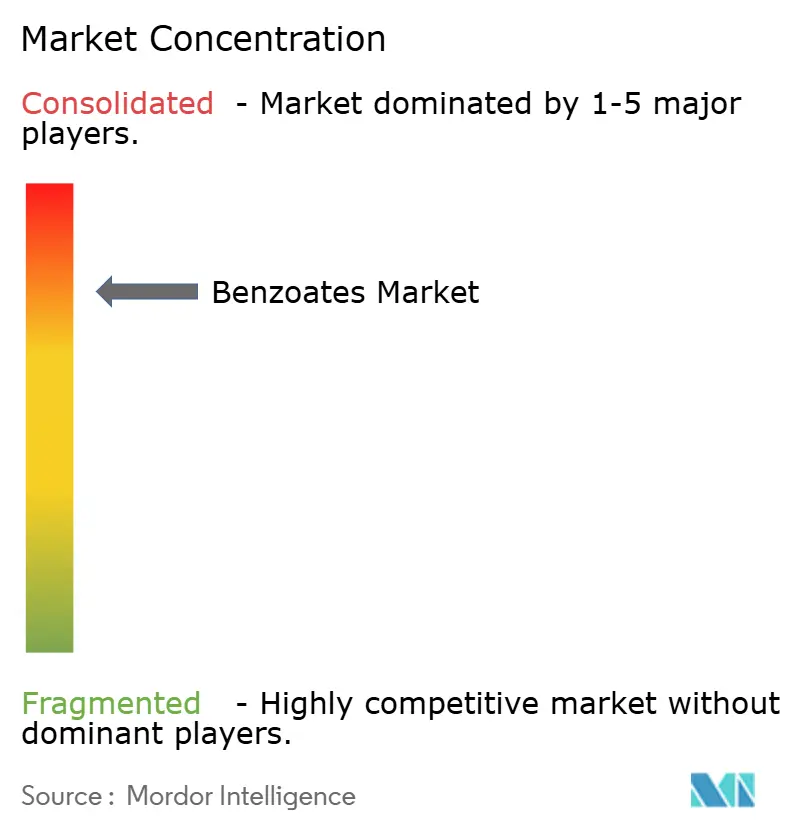
The benzoates market is consolidated. LANXESS, Wuhan Youji, Eastman Chemical, Tianjin Dongda, and Tengzhou Tenglong collectively account for 80% to 85% of global sodium benzoate production capacity. LANXESS has strengthened its position through the acquisition of Emerald Kalama Chemical and a broader integrated supply model. Its production bases in the Netherlands, the United States, and India support a range of grades and supply continuity across food, personal care, and other end-use requirements. The company also uses the Scopeblue mass-balance framework for selected products, which supports a renewable-content positioning. These capabilities are relevant when customers require certification, supply assurance, documented sourcing, and a supplier capable of serving multiple regions.
Pharmaceutical-grade and cosmetic-grade materials offer room for competition beyond standard commodity supply. These grades require analytical records, reliable purity, and regulatory traceability that smaller suppliers may find difficult to maintain across customer audits. Eastman Chemical operates a broad portfolio of specialty chemicals that supports sales to personal care and pharmaceutical channels. Ganesh Benzoplast stated during its October 2026 investor call that it had secured REACH certification for benzoic acid and sodium benzoate in the United Kingdom and across Europe, and had booked more than 600 tons of export orders. The company also described a capacity expansion that it expects to commission by July 2027. These developments indicate that compliance credentials, export capacity, and product documentation can provide India-based producers with a path into Western markets without relying solely on local commodity demand.
ISO 22000, Food Safety Modernization Act (FSMA) supplier verification, and EU REACH registration remain important barriers for suppliers seeking premium customers. Commodity suppliers continue to compete mainly on price in markets with less demanding requirements. Trade actions can strengthen the position of producers with manufacturing assets outside the affected export route, while compliance requirements can favor established suppliers with detailed documentation. Customers are also likely to favor suppliers that can consistently document materials for food, cosmetic, and pharmaceutical uses and respond to qualification requests. The benzoates market is therefore divided between large-scale commodity supply and higher-value, compliance-led grades. This structure makes the benzoate market less open to rapid entry into regulated grades than into standard merchant supply.
Benzoates Industry Leaders
-
LANXESS
-
WUHAN YOUJI
-
Eastman Chemical Company
-
Tengzhou Tenglong Chemical Co., Ltd.
-
Tianjin Dongda Chemical Group Co., Ltd.
- *Disclaimer: Major Players sorted in no particular order
Benzoates Market Companies Covered in this Report
- A.M FOOD CHEMICAL CO., LIMITED
- Avantor, Inc.
- Eastman Chemical Company
- Emerald Kalama Chemical, LLC
- FBC Industries
- Foodchem International Corporation
- Ganesh Benzoplast Limited
- LANXESS
- Merck KGaA
- Spectrum Chemical Mfg. Corp.
- Tengzhou Tenglong Chemical Co., Ltd.
- Tianjin Dongda Chemical Group Co., Ltd.
- Tokyo Chemical Industry Co., Ltd.
- Vertellus Holdings LLC
- WUHAN YOUJI
Recent Industry Developments in Benzoates Market
- October 2026: Ganesh Benzoplast Limited announced REACH certification for benzoic acid and sodium benzoate in the United Kingdom and Europe, with over 600 tons in benzoate export orders booked and a target of 2,000 tons annually. The company confirmed capacity expansion at one of its two benzoate plants, each rated at 1,000 tons per month, targeting commissioning by July 2027 and expected to contribute 20%-25% revenue growth in the following year.
- July 2026: The European Commission imposed provisional anti-dumping duties on Chinese sodium benzoate, effective July 29, 2026, following an investigation launched in December 2025 at LANXESS Chemical B.V.'s request. Duties range from 57.6% for Wuhan Youji to 116.4% for all other Chinese exporters, disrupting Chinese producers' access to the EU sodium benzoate market and increasing European producers' pricing power.
Global Benzoates Market Report Scope
A benzoate is any salt or ester of benzoic acid. Benzoates, most notably sodium benzoate, are widely used as chemical preservatives in food, beverages, cosmetics, and pharmaceuticals to inhibit the growth of mold, yeast, and bacteria. Sodium benzoate functions by lowering the pH of a product, creating an acidic environment that disrupts microbial cell activity and prevents spoilage.
The benzoates market is segmented by type, application, and geography. By type, the market is segmented into sodium benzoate, potassium benzoate, ammonium benzoate, and others. By application, the market is segmented into food and beverages, pharmaceuticals, personal care and cosmetics, agriculture, and others. The report also covers market sizes and forecasts for benzoates across 15 countries in major regions. The market sizes and forecasts are provided in terms of value (USD).
Segmentation Overview
| Sodium Benzoate |
| Potassium Benzoate |
| Ammonium Benzoate |
| Others |
| Food and Beverages |
| Pharmaceuticals |
| Personal Care and Cosmetics |
| Agriculture |
| Others |
| Asia-Pacific | China |
| India | |
| Japan | |
| South Korea | |
| Rest of Asia-Pacific | |
| North America | United States |
| Canada | |
| Mexico | |
| Europe | Germany |
| United Kingdom | |
| France | |
| Italy | |
| Rest of Europe | |
| South America | Brazil |
| Argentina | |
| Rest of South America | |
| Middle East and Africa | Saudi Arabia |
| South Africa | |
| Rest of Middle East and Africa |
| By Type | Sodium Benzoate | |
| Potassium Benzoate | ||
| Ammonium Benzoate | ||
| Others | ||
| By Application | Food and Beverages | |
| Pharmaceuticals | ||
| Personal Care and Cosmetics | ||
| Agriculture | ||
| Others | ||
| By Geography | Asia-Pacific | China |
| India | ||
| Japan | ||
| South Korea | ||
| Rest of Asia-Pacific | ||
| North America | United States | |
| Canada | ||
| Mexico | ||
| Europe | Germany | |
| United Kingdom | ||
| France | ||
| Italy | ||
| Rest of Europe | ||
| South America | Brazil | |
| Argentina | ||
| Rest of South America | ||
| Middle East and Africa | Saudi Arabia | |
| South Africa | ||
| Rest of Middle East and Africa | ||
Key Questions Answered in the Report
What is current market size of Benzoates Market?
The Benzoates market size was valued at USD 728.25 million in 2026 and is estimated to grow from USD 766.04 million in 2027 to USD 994.56 million by 2032, at a CAGR of 5.36% during the forecast period (2027-2032).
Which type of benzoate has the largest share?
Sodium benzoate held a 51.34% share in 2026 due to its established use in acidic beverages, sauces, and oral pharmaceutical liquids. Its cost profile, thermal stability, and recognized regulatory position support this broad application base in high-volume formulations.
Which application is growing fastest for benzoates?
Personal care and cosmetics are forecast to grow at a 6.45% CAGR through 2032, supported by water-rich formulations in skincare, haircare, and body care. Potassium benzoate is useful where aqueous solubility and preservative performance must be considered together in product development.
Why are benzoates used in low-sugar beverages?
Reduced sugar can lower osmotic microbial inhibition, increasing the need for suitable preservative support in acidic beverage formulas. Manufacturers must also manage formula compatibility, intended pH, packaging, and storage conditions.